ULA reveals Chinese-owned company attempted to steal rocket data

In an interview yesterday ULA’s CEO Tory Bruno revealed that a Chinese-owned software company tried to infiltrate the supply chain being set up to build their next generation Vulcan rocket.

Bruno said the Chinese-owned vendor identified in ULA’s supply chain was a provider of software for tools used to manufacture the company’s next-generation rocket Vulcan Centaur. Because the issue was detected quickly, no sensitive information was extracted by that supplier, Bruno said.

The company flagged as a risk was a tool supplier working with KUKA Robotics. According to ULA, KUKA had no access to ULA’s intellectual property. “ULA envisions no further future work involving KUKA or KUKA products,” the spokesperson said. “There was no evidence they attempted to obtain data, however, we have an obligation to our customers as well as our company to ensure we have taken all necessary steps to protect our IP as well as information the government has entrusted us with.”

The Pentagon has shown growing concern about Chinese ownership of U.S. suppliers and continues to impose cybersecurity requirements on contractors. “But I have to tell you this is just shocking in terms of the scale and ubiquity of this threat and this effort on the part of China to not only gain access to intellectual property through traditional means — hacking or espionage — but through infiltration of the supply chain,” Bruno said.

The article also notes that while the top tier subcontractors ULA might hire are almost all American owned, foreign companies own 70% of the smaller subvendors, and the number of Chinese-owned subvendors has grown 420% since 2010.

China’s effort to steal American technology has been a serious problem that has been ignored for too long.

5 comments

California wildfire threatens Wilson Observatory

One of the many wildfires raging across California has now come with 500 feet of the Mt. Wilson Observatory.

Officials at the observatory said all personnel had been evacuated as the fire was “knocking on our door.”

Firefighters battling the blaze had made slight headway in recent days in trying to control the flames that erupted September 6, but containment shrank from 6 percent to 3 percent Tuesday, according to the Angeles National Forest. “They are in a firefight right now, because it is so close,” LA County Fire Captain David Dantic told the Los Angeles Times, referring to crews positioned at Mt. Wilson.

He said the fire, located about 16 miles (25 kilometers) northeast of downtown Los Angeles, had grown to 40,000 acres (16,200 hectares). “It’s a bigger area now,” Dantic said. “Before, we had 6 percent containment when it was about 30,000 acres, but now the fire has gotten bigger. It’s a bigger footprint. That’s why the containment is down.”

KNX radio said the fire was also threatening broadcast towers in the area worth more than a billion dollars.

If destroyed I doubt seriously there would be money to rebuild Wilson, especially because its location near the bright lights of Los Angeles limits its astronomical value. Astronomers have shifted its use to other purposes that are not as badly affected by the light pollution, but once gone it will be hard to raise the cash to bring it back.

8 comments

Martian crater filled with lava

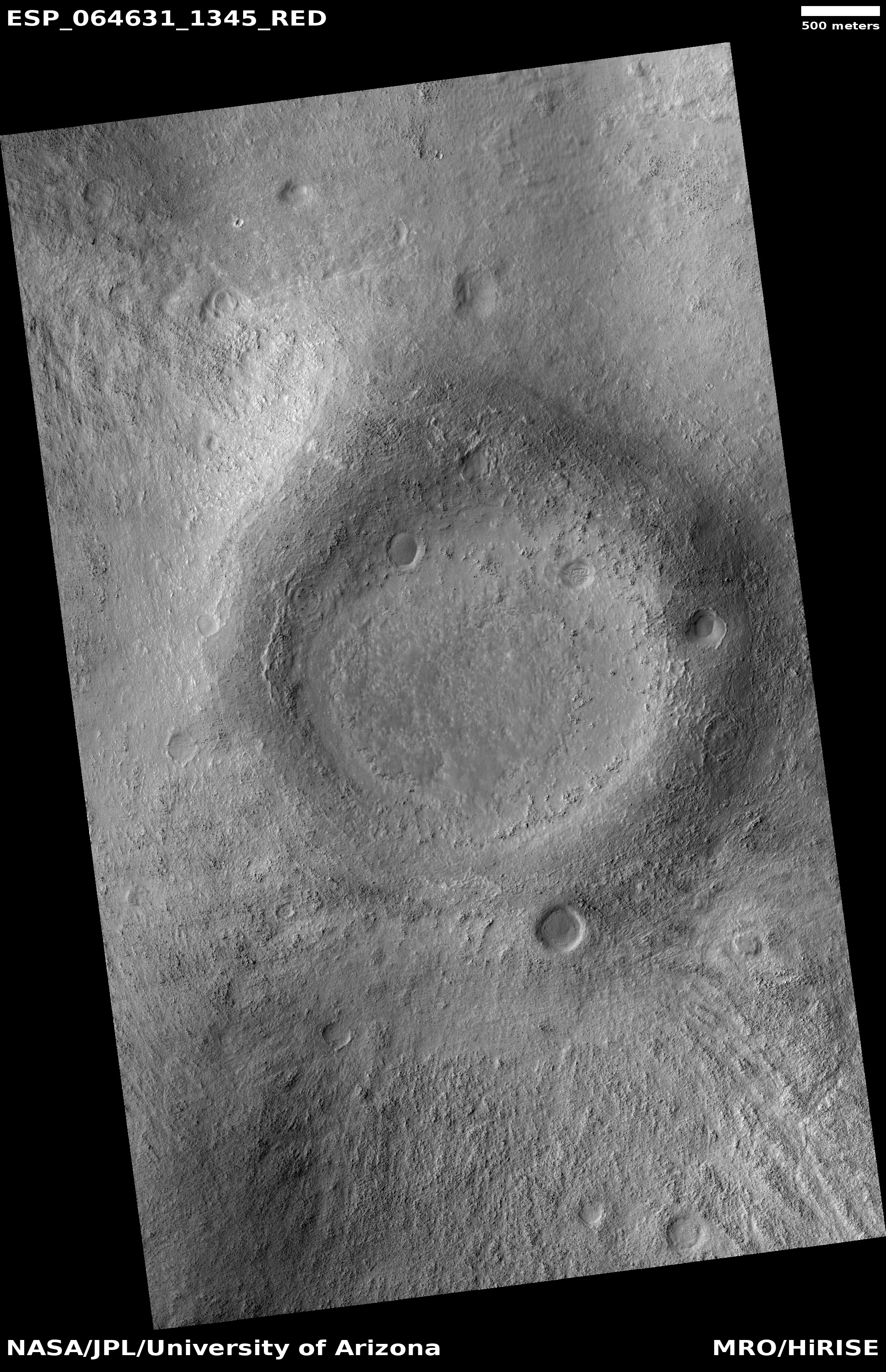
Lava filled Martian crater
Click for full image.

Cool image time! Unlike most of the recent images I’ve posted from Mars, today’s has nothing glacial about it. Instead, the photo to the right, cropped to post here, shows us a crater where lava broke through the southern rim to fill its interior.

The picture was taken on July 15, 2020 by the high resolution camera on Mars Reconnaissance Orbiter (MRO). The crater is located within what I call volcano country on Mars, just inside the Athabasca Valles lava field, what some scientists believe [pdf] is the youngest lava field on Mars, estimated have occurred less than 600 million years ago.

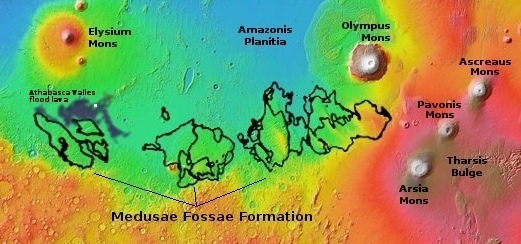
The overview map below provides context.

Overview map

The tiny white box south of Elysium Mons indicates the location of this crater. The dark blue areas indicate the extent of the Athabasca lava field. The Medusae Fossae Formation is the largest volcanic ash deposit on Mars.

The Athabasca lava field is about the size of Great Britain, and is thought to have been laid down in only a matter of a few weeks. When it spread it clearly reached this crater, the lava pushing through to fill it. If you look at the full image you can see that the north-trending lava flow even continued past the crater a considerable distance on both sides, the crater acting like a big rock in a stream, blocking the flow.

Since this happened more than half a billion years ago, a lot of erosion has occurred, mostly between the crater’s rim and the edge of the ponded but now solidified lava.

0 comments

Robots playing soccer

An evening pause: This is a clip from a robot competition in 2019 of what are called “kidsized” robots. Short but entertaining, especially because it demonstrates the relative stupidity and slow incompetence of state-of-the-art robots. Future versions might someday get to the level of Terminator, but these robots show that we are fortunately nowhere that close today.

Hat tip Roland.

4 comments

Unexplored Mars

Strange crater on the edge of Argyre Basin
Click for full image.

The constant stream of images and data that our orbiters and landers are feeding down to us from Mars can sometimes give the impression that the red planet is being thoroughly explored. Today’s cool image illustrates how this impression is false, and instead shows a hint of what remains untouched on the fourth planet from the Sun, a planet with the same land area as on Earth.

The photo to the right, cropped and reduced to post here, was taken by the high resolution camera of Mars Reconnaissance Orbiter (MRO) on May 10, 2020, and shows a strange crater on the north interior edge of Argyre Basin, one of Mars’ largest basins located in the southern hemisphere. Not as deep or as large as Hellas Basin, what I call the basement of Mars, Argyre is still the second largest such basin on Mars, about 1,100 miles in diameter with its lowest elevation 17,000 feet below the surrounding southern cratered highlands. Like Hellas, it is thought to be the remains of major impact.

The point of this post is not to try to explain the geology of this crater. Located at 45 degrees south latitude, it might or might not be showing us glacial evidence. The nature of the terrain is inconclusive. To figure out the geology here would require a lot more data, and a focused interest in studying it.

Instead, this image shows us how little we know of Mars. For example, this photo was not requested by any scientist doing specific research. It was requested instead by the science team for MRO’s high resolution camera because they need to take images at regular intervals to maintain the camera’s temperature, and if no one has requested an image for a specific time period, they make their own choice, picking a spot that might be interesting without knowing sometimes what they might find. Often such “terrain sample” images are somewhat boring. Other times they reveal some surprisingly interesting geology.

The map below gives a sense of how little of the Argyre Basin has been explored by MRO’s high resolution camera.
» Read more

3 comments

Scientists declare solar minimum over, with next sunspot maximum coming

Scientists from the government agencies of NOAA and NASA today announced that the solar minimum of the past sunspot cycle occurred in December 2019, and that the ramp up to the next solar maximum has begun, which they predict will be as active as the last weak maximum.

The announcement and prediction was put forth by “the Solar Cycle 25 Prediction Panel, an international group of experts co-sponsored by NASA and NOAA.” While this group is made up of legitimate scientists studying the Sun, its press releases tend to be lobbying efforts for government programs, which nicely describes today’s release as well. The release not only touts the importance of their work, it links this work to the Trump administration’s Artemis program to get back to the Moon.

Note also that this announcement only makes official what has been obvious for months, as I have noted in my monthly sunspot updates. See for example this quote from my September 7th update:

What is clear is that the activity does herald the next maximum. As in the past few months, the sunspots in August all had polarities that assigned them to the new maximum. While it is not impossible for there to be a handful of sunspots in the next few months that belong to the last maximum, it now appears that the last cycle is pretty much over. We are entering the ramp up to the next maximum, presently predicted by a portion of the solar science community aligned with NOAA to be a weak one.

The only change is that it appears they are upping their prediction for the next maximum slightly. Before the prediction panel had said that the next maximum would be weaker than the past maximum. Now they it appears they are saying it will be the same.

0 comments

Empty Chinese apartment complex overrun with plants and mosquitoes

The coming dark age: A Chinese apartment complex, designed to be an “eco-paradise,” has instead become an empty jungle overrun with plants and mosquitoes.

An experimental green housing project in a Chinese megacity promised prospective residents life in a “vertical forest,” with manicured gardens on every balcony. All 826 apartments were sold out by April this year, according to the project’s estate agent, but instead of a modern eco-paradise, the towers look like the set of a desolate, post-apocalyptic film.

The problem? The mosquitoes love the plants too. Only a handful of families have moved into Chengdu’s Qiyi City Forest Garden because of an infestation, state media reported.

The pictures at the link are quite incredible. Imagine being surrounded by neighbors who allow their property to fall apart and you have a sense of what these buildings look like.

4 comments

Japan chooses Hayabusa-2’s next asteroid target

The new colonial movement: It appears that Japan has chosen the next asteroid that its probe Hayabusa-2 will visit in 2031, after it releases its samples to Earth in December from Ryugu.

Japan’s Hayabusa2 space explorer will aim to probe the asteroid “1998KY26” located between the orbits of Earth and Mars in 2031 after completing its current mission of collecting samples from another asteroid, the country’s science minister said Tuesday.

It is hoped Hayabusa2 will approach the ball-shaped asteroid, which has a diameter of around 30 meters and rotates about every 10 minutes, in July 2031, Education, Culture, Sports, Science and Technology Minister Koichi Hagiuda said.

It will not obtain samples from this second asteroid, only observe it close up by camera.

1 comment

China launches rocket from ocean launch platform

The new colonial movement: China today successfully put nine Earth observation smallsats into orbit using its Long March 11 rocket, and it did it by launching from a floating launch platform.

I have embedded video of the launch below the fold. Notice that the rocket appears to ignite its first stage engines after it is flung upward from the platform, similar to the launch of an ICBM from a submarine. This is not surprising, as the Long March 11 solid fueled rocket is based on ICBM technology.

The leaders in the 2020 launch race:

23 China
15 SpaceX
9 Russia
4 ULA
4 Europe (Arianespace)

The U.S. still leads China 24 to 23 in the national rankings.

» Read more

1 comment

The frozen and changing mid-latitudes of Mars

Glacial erosion on Mars
Click for full image.

Using “frozen” and “changing” to describe any single location might seem contradictory, but when it comes to the mid-latitudes of Mars, high resolution images keep telling us that both often apply, at the same time and at the same place.

The photo to the right, rotated, cropped, and reduced to post here, is a typical example. Taken on May 8, 2020 by the high resolution camera on Mars Reconnaissance Orbiter (MRO), it shows what the scientists label as “mesas and ridges.” Drainage is to the south, and it sure looks like some sort of glacial flow is working its way downward within the canyons between those mesas.

Overall the terrain has the appearance of a frozen ice sheet, or at least terrain that has a shallow ice table close to the surface. It also looks like chaos terrain in its infancy, the erosion process not yet cutting down enough to make the mesas stand out fully.

The location of these mesas and ridges is shown in the context map below, which also shows that this location is at the same latitude as SpaceX’s Starship prime Martian landing site, and only about 400 to 500 miles to the east.
» Read more

0 comments

Next Starship test flight to go to 60,000 feet

Capitalism in space: SpaceX has decided, after two successful 500 foot hops using its fifth and sixth Starship prototypes, to forego further hops with those prototypes and instead test fly prototype number eight to a height of 60,000 feet, about 11 miles.

Starship SN5 and SN6 were set to become a tag-team, flying 150-meter hops to refine the launch and landing techniques that SpaceX has pioneered with its Falcon 9 rocket. However, with SN5’s hop proving to be a success, followed by a notable improvement with SN6’s leap to 150 meters a few weeks later, it’s likely SpaceX is now confident of advancing to the next milestone.

The company has applied for an FCC license to do the flight anytime from Oct ’20 to April ’21, with October 11th being the first available date.

In the meantime the company plans a pressure tank test to failure of prototype #7, probably later this week.

In other related news at the second link, Boeing and Firefly have also applied for FCC licenses, the former for a Starliner demo mission from November ’20 to May ’21, the latter for its first launch of its smallsat Alpha rocket, also from November ’20 to May ’21.

13 comments

China’s Kuaizhou-1A rocket fails at launch

China’s Kuaizhou-1A rocket yesterday failed during launch, though no details have been released.

Kuaizhou 1A and Kuauzhou 11 are rapid response rockets derived from intercontinental ballistic missiles that are capable of placing satellites into orbit on short notice. Launches are managed by ExPace, a commercial subsidiary of the state-owned China Aerospace Science and Industry Corporation.

The Kuaizhou-1A is the smaller of the two rockets. This was its first failure after ten successful launches.

4 comments

Astra’s first orbital launch test fails

Capitalism in space: The first orbital launch test of the smallsat rocket company Astra failed last night shortly have liftoff.

In a more detailed update published on Astra’s website several hours after the launch, officials wrote that the rocket’s guidance system “appears to have introduced some slight oscillation into the flight, causing the vehicle to drift from its planned trajectory leading to a commanded shutdown of the engines by the flight safety system.”

“We didn’t meet all of our objectives, but we did gain valuable experience, plus even more valuable flight data,” Astra said. “This launch sets us well on our way to reaching orbit within two additional flights, so we’re happy with the result.”

This failure was not unexpected. The company has made it clear that it was the first of a three flight program aimed at reaching orbit with the third launch.

2 comments

The alien Red Planet and the scientific method

Spiders, dunes, and strange terrain in high latitude southern Martian crater
Click for full image.

As a child growing up in the 1950s and 1960s and an avid reader of science fiction, I was constantly presented with stories about Mars and what people imagined it was like. At the time no spacecraft had as yet gotten a close look at the planet, so the theories of a desert planet, with many canals built by an alien race attempting to stave off death as the planet’s water disappeared, were still considered possible. So were theories that the changing colors across its surface seen seasonally in ground-based telescopes suggested the possibility of some form of lichen-like life that came and went with the seasons.

None of those fantasies have turned out to be true. All attempted to create an alien planet in the model of Earth, and thus were guaranteed to get it wrong. After a half century of increasingly sophisticated research, we now know a bit more about what Mars is like, and have learned that it is much stranger than we had imagined, an icy world quite possibly shaped by slowly shifting glaciers and ice sheets, creating surface features in ways so alien from what we are familiar with on Earth that even now scientists struggle to figure those processes out.

The photo above and to the right, taken on May 25, 2020 by the high resolution camera on Mars Reconnaissance Orbiter (MRO), is a perfect example. At first glance it fits what I call a “what the heck?” image. Without knowing more, it is impossible to figure out what we see here.

The wider image below, taken by context camera on MRO, provides our first clue.
» Read more

4 comments

Japan delays launch of new rocket one year

Capitalism in space: Because of a problem discovered in the development of its new first stage engine, Japan has now delayed the first launch of its new H3 rocket one year, to ’21.

Mitsubishi is building the rocket for Japan’s space agency JAXA, Since you design and build your rocket around your rocket engines, having a problem with that rocket engine puts a serious crimp on construction. Thus, identifying and dealing with such engine issues early in development is wise.

Still, Japan continues to lag behind the other space-faring nations in the development of its space industry.

0 comments

Astra scrubs launch attempt

Capitalism in space: The smallsat rocket company Astra yesterday scrubbed another attempt to achieve its first orbital launch.

They were forced to stand down at T-25 minutes because of a sensor issue. No further details were released, nor have they as yet announced a new launch date.

This launch will be the third for Astra, following two flights from the Pacific Spaceport Complex Alaska in July and November 2018, respectively. These flights were originally believed to be failures. However, Astra stated that the first (designated Rocket 1.0) was successful and that the second (Rocket 2.0) was “shorter than planned.” Neither rocket was designed to reach orbit, as they did not have functioning upper stages.

This scrubbed flight has been dubbed Rocket 3.0, and was part of what the company calls a three launch program aimed at reaching orbit by the third launch. All three launches are orbital, but the company has made it clear that it would not be surprised if the first or even the second failed.

2 comments

NASA to buy lunar mined material from private companies

Capitalism in space: NASA yesterday announced that, rather than develop its own lunar sample missions, it wants to buy such lunar mined material obtained from private companies.

NASA on Thursday launched an effort to pay companies to mine resources on the moon, announcing it would buy from them rocks, dirt and other lunar materials as the U.S. space agency seeks to spur private extraction of coveted off-world resources for its use.

NASA Administrator Jim Bridenstine wrote in a blog post accompanying the announcement that the plans would not violate a 1967 treaty that holds that celestial bodies and space are exempt from national claims of ownership.

The initiative, targeting companies that plan to send robots to mine lunar resources, is part of NASA’s goal of setting what Bridenstine called “norms of behavior” in space and allowing private mining on the moon in ways that could help sustain future astronaut missions. NASA said it views the mined resources as the property of the company, and the materials would become “the sole property of NASA” after purchase.

This announcement continues NASA’s transition under the Trump administration from trying to run everything to simply being a customer buying what it needs and wants from the private sector. The idea is smart, as it will guarantee that these samples will be obtained in the cheapest and fastest way possible, while simultaneously sparking the development of a competitive and thriving private industry capable of flying all kinds of planetary missions. The lower costs of these private planetary probes will in turn will spark the creation of a new private sector of customers buying those probes for their own profit-centered needs.

4 comments

Boeing strikes deal to avoid harsher ethics probe in NASA’s lunar lander scandal

Boeing has struck a deal with both NASA and the Air Force in order to avoid a harsher and more extensive ethics probe into its part in the NASA lunar lander contract bidding scandal.

The agreement, signed in August, comes as federal prosecutors continue a criminal investigation into whether NASA’s former human exploration chief, Doug Loverro, improperly guided Boeing space executive Jim Chilton during the contract bidding process.

By agreeing to the “Compliance Program Enhancements”, the aerospace heavyweight staves off harsher consequences from NASA and the Air Force – its space division’s top customers – such as being suspended or debarred from bidding on future space contracts. The agreement calls for Boeing to pay a “third party expert” to assess its ethics and compliance programs and review training procedures for executives who liaise with government officials, citing “concerns related to procurement integrity” during NASA’s Human Landing System competition.

Since Loverro resigned in May, Boeing has fired one company attorney and a group of mid-level employees, three people familiar with the actions told Reuters.

The deal seems like a bureaucratic whitewash, designed to take the heat off the company. And since Boeing as a company has many problems, I remain skeptical that any of this will make a difference in getting things fixed.

4 comments

ULA pinpoints cause of Delta launch abort, reschedules launch

ULA has identified the cause of the launch abort of its Delta 4 Heavy rocket on August 29th, and has now aiming for a launch no earlier than September 18th.

A torn diaphragm in one of three pressure regulators at Cape Canaveral Air Force Station’s Launch Complex 37 caused the computer-controlled scrub just three seconds before liftoff on Aug. 29, ULA CEO Tory Bruno said via Twitter on Wednesday. The engines briefly lit on fire, but the rocket remained firmly on the pad.

“Torn diaphragm (in the regulator), which can occur over time,” Bruno said. “Verifying the condition of the other two regulators. We will replace or rebuild as needed, re-test, and then resume towards launch.” [emphasis mine]

The highlighted words illustrate the less than stellar old space rocket design that the Delta 4 Heavy represents, and that ULA is perpetuating as long as it uses this rocket. Rather than redesign so that these torn diaphragms will no longer be a problem, it appears they will simply make sure this design is tested and works, for this launch. Thus, this issue has the possibility of reappearing in a future launch.

Wouldn’t it be better to upgrade and eliminate such a problem, for good, once it is identified? That appears to be SpaceX’s strategy, and the consequence is that their rockets and spacecraft get increasingly more reliable with time.

Anyway, if ULA’s schedule holds, it means there will be two launches at Cape Canaveral in less than 24 hours, as SpaceX is aiming for another Starlink launch the day earlier.

8 comments

Northrop Grumman shuts down Omega rocket program

Having lost any chance of getting launch contracts or development money from the military for the next five-plus years, Northrop Grumman has chosen to shut down its Omega rocket program.

“We have chosen not to continue development of the OmegA launch system at this time,” Northrop Grumman spokeswoman Jennifer Bowman said in a statement. “We look forward to continuing to play a key role in National Security Space Launch missions and leveraging our OmegA investments in other activities across our business.”

Bowman said the company will not be protesting the U.S. Space Force’s decision to select United Launch Alliance and SpaceX for the NSSL contracts.

This was a typical big space Washington project, aimed solely at getting government contracts, as well as government cash to develop it. The company had no interest in trying to develop it with its own R&D funds in order to garner market share in the general launch market, or even to make it cheaper and more useful to the military than SpaceX’s rocket.

In this sense this is no great loss. What we need is real competition, aimed at coming up with better ideas that will lower cost and increase capabilities. What Northrop Grumman was offering was none of those things. It was fake competition, and of no real value.

2 comments
1 381 382 383 384 385 821