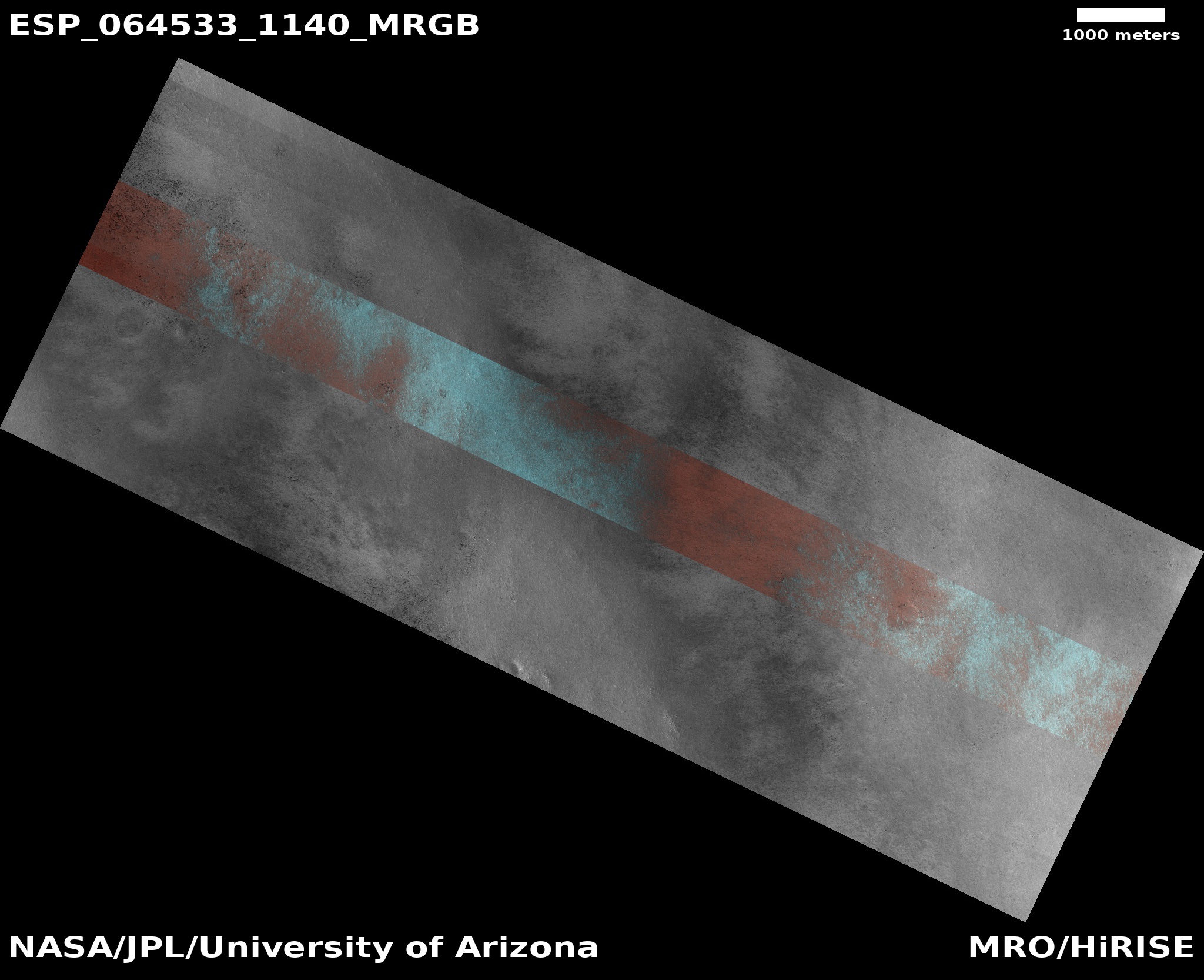
The dry barren plains of Tyrrhena Terra

Tyrrhena Terra badlands
Click for full image.

In a sense today’s cool image is a replay of one I posted in March, showing the dry barren terrain in the vast rough cratered highlands of Tyrrhena Terra, located along the equator of Mars between the giant basins of Isidis and Hellas.

Today’s image on the right, cropped to post here, was taken by the high resolution camera on Mars Reconnaissance Orbiter on March 26, 2020, and shows well the barrenness of this region. The surface appears quite solid, like bedrock, rather than the squishy soft surface of the northern lowland plains. Moreover, there is a lot of dust trapped in the low areas between the ridges, forming ripples that new data suggest move slowly across the surface. If you click on the full image, you will see that this terrain is far from local, and goes on in this manner for quite a distance in all directions.

This is a dry and forbidding place, about the size of the American southwest, from Texas to California.

The overview map below provides some context of Tyrrhena Terra’s location on Mars.
» Read more

0 comments

Virgin Galactic again delays first commercial flight

Capitalism in space: Virgin Galactic, which has been repeatedly delaying its first commercial flight for more than a decade, has done so again, stating that it will not occur until 2021.

The company, in its fiscal second quarter financial results released Aug. 3, said it expected to perform two more test flights of SpaceShipTwo from Spaceport America in New Mexico, both of which will be powered flights. The vehicle has made two glide flights since moving to the spaceport early this year.

The first of those powered flights, scheduled for the fall, will have two pilots on board. It will also carry payloads for NASA’s Flight Opportunities program that arranges flights of experiments on suborbital vehicles, said George Whitesides, chief space officer and former chief executive of Virgin Galactic, in a company earnings call.

If that flight goes as expected, Virgin Galactic will then perform a second flight, this time with four mission specialists on board along with the two pilots. Those mission specialists “will evaluate the performance of our full customer cabin and associated hardware,” he said. The company unveiled the design of the cabin July 28, although Whitesides said they were still completing the installation of the cabin on the company’s current SpaceShipTwo vehicle, VSS Unity.

“Presuming things go as expected on this fully-crewed flight, we would then plan to fly Sir Richard Branson on the third powered flight from New Mexico,” he said. That flight would take place in the first quarter of 2021 and mark the beginning of commercial service, although Whitesides said it will also be a test flight of sorts. “Sir Richard is in a unique position to provide the ultimate cabin and spaceflight experience evaluation, as a visionary of the Virgin customer experience.”

The company also announced that it intends to sell stock shares to raise more capital. Right now the stock is selling for about $20.

I am no expert on the stock market, but to my mind this company’s chances of making big profits from suborbital flights is slim to none. They might make some money, but hardly enough ever to repay their investors. Virgin Galactic’s window for making big money in suborbital tourism closed forever with the success of SpaceX’s manned Dragon flight to ISS. The space tourism market is shifting to orbital space, something Virgin Galactic cannot provide. Worse, the cost for getting to orbit continues to drop, while this company can’t reduce its prices much.

Virgin Galactic provides a weak product in the present market, one that can only become weaker when compared to its competitors.

3 comments

Starship hop today?

UPDATE: They are close to trying again. If you refresh your screen, you will now have two iterations of the live stream. This will allow you to have two cameras visible at the same time, You can show the main “nerdie” camera on one, with their commentary, and show the wider “sapphire” camera on the second. You pick cameras by clicking on the camera icon in the menu bar at the bottom of the screen.

UPDATE: First attempt apparently aborted. No word yet if they will attempt again today.

UPDATE: Scrubbed on August 3rd, attempting again on August 4th.

Capitalism in space: SpaceX’s Starship team has scheduled the first 500 foot hop of the fifth Starship prototype today, after canceling yesterday’s attempt.

The window for Starship SN5’s 150m hop debut now stretches from 8am to 8pm CDT (13:00-01:00 UTC) on Monday, August 3rd. It’s currently unknown if SpaceX will offer its own live coverage of the test flight but several unofficial streams will likely be available from NASASpaceflight.com, LabPadre, SPadre, and more. Stay tuned for updates!

I have embedded LabPadre’s live stream below the fold, if you wish to run it in the background. They will have commentary when they note a “pad clear” signal.
» Read more

8 comments

Study: Mars’ meandering canyons formed under ice

A new study comparing Mars’ meandering canyons with those found in the Arctic regions on Earth suggests that the Martian valleys were formed by water melting under large ice sheets, not flowing water on the surface.

A large number of the valley networks scarring the surface of Mars were carved by water melting beneath glacial ice, not by free-flowing rivers as previously thought, according to new research published in Nature Geoscience. The findings effectively throw cold water on the dominant “warm and wet ancient Mars” hypothesis, which postulates that rivers, rainfall and oceans once existed on the red planet.

To reach this conclusion, lead author and postdoctoral research scholar Anna Grau Galofre of Arizona State University’s School of Earth and Space Exploration developed and used new techniques to examine thousands of Martian valleys. She and her co-authors also compared the Martian valleys to the subglacial channels in the Canadian Arctic Archipelago and uncovered striking similarities. The western edge of the Devon ice cap on the Canadian Arctic Archipelago.

I have noted previously on Behind the Black my sense that the planetary science community was beginning to shift away from the hypothesis of flowing liquid surface water on Mars as an explanation for the planet’s riverlike and oceanlike features to some form or ice/glacial activity. For a half century the scientists have tried and failed to come up with some scenario that could allow water to flow on the surface in Mars’ cold climate and thin atmosphere.

Ice or glacial activity rather than flowing liquid water might solve this problem, and today’s paper is a push in this direction.

3 comments

Private Japanese lunar lander redesigned, flight delayed one year

Capitalism in space: The privately financed Japanese lunar landing company Ispace has redesigned its lander and delayed the first flight by one year, to 2022.

Since a preliminary design review in 2018, ispace has reduced the size of Hakuto-R. Previously 3.5 meters high and 4.4 meters wide with its landing legs deployed, the lander is now 2.3 meters high and 2.6 meters wide. The spacecraft’s mass has decreased from 1,400 to 1,050 kilograms, primarily by reducing the amount of propellant on board.

A smaller lander is less expensive to develop, said Ryo Ujiie, manager of the lander system engineering group at ispace, during a call with reporters July 30. It also reduces the size and complexity of the landing legs. The spacecraft will use a different trajectory to go to the moon, employing a low-energy transfer orbit that requires less propellant but takes roughly twice as long as previously planned. “We had to pick a more propellant-efficient orbit” given the reduction in propellant, said Chit Hong Yam, manager of the mission design and operations group. “We’re confident that, with enough checking, we should be able to execute this orbit.”

While the overall lander is smaller, it still maintains a payload capacity of 30 kilograms. Once on the surface, likely at one of several mid-latitude sites on the moon under consideration by ispace, it will operate for 12 days.

That first flight will launch on a Falcon 9. The company raised $95 million in private capital in 2017, and still plans a second lander launch in 2023.

1 comment

Endeavour safely splashes down

Splashdown of Endeavour

Capitalism in space: SpaceX’s Endeavour Dragon capsule has successfully splashed down in the Gulf of Mexico, returning two humans back to Earth safely after completing the first two month long manned commercial space mission.

If you go to the live stream to watch recovery operations, note that the boats and ships and persons involved are all property and employees of SpaceX. This is entirely an operation of the private company. The government is not involved, other than NASA’s justified monitoring as SpaceX’s customer.

One cool tidbit for the future. Endeavour is scheduled to fly again, in the spring of 2021. On that flight will be Megan McArthur, the wife of astronaut Bob Behnken, and she will likely sit in the same place he did on his flight.

31 comments

Russians sign deal to fly two tourists to ISS

Capitalism in space: Now that their Soyuz capsule is no longer required to fly NASA astronauts to ISS, the Russians have spare seats, and have now signed a deal with Space Adventures to fly two tourists to ISS in late 2021.

They will announce the tourist’s names later this year.

Space Adventures also has a deal with SpaceX to fly two tourists on a Dragon capsule on a week-plus long orbital mission (not docking with ISS). SpaceX also has a deal with the space station company Axiom to fly tourists to ISS. Next year could thus see two or three tourist flights to space.

Isn’t competition wonderful?

9 comments

Electrical disconnect caused Rocket Lab’s July 4th launch failure

Capitalism in space: According to Rocket Lab’s investigation into the July 4th launch failure, an electric connection detached and cut off power to the upper stage, causing it to cease firing prematurely.

Once the electrical system disconnected in flight, it cut power from the rocket’s battery to the electric turbopumps on the Electron’s second stage Rutherford engine. That caused the engine to switch off prematurely around five-and-a-half minutes after the rocket took off from Rocket Lab’s launch base in New Zealand.

The early engine shutdown prevented the rocket from reaching the velocity necessary to enter a stable orbit around Earth, according to Peter Beck, founder and CEO of Rocket Lab, a small satellite launch company headquartered in Long Beach, California.

But telemetry continued streaming from the launch vehicle back to Rocket Lab’s control center in Auckland, New Zealand, allowing engineers to analyze data and determine the cause of the failure. The kerosene-fueled second stage engine shut down in a controlled manner, and the rocket coasted to an altitude of around 121 miles (195 kilometers) before re-entering the atmosphere and burning up.

Now that the company understands what caused the detachment, it will institute testing to make sure it doesn’t happen again. The fix however will not require any redesign of the rocket, and so they are targeting late August for their next launch, followed in September with the first launch from Wallops Island, Virginia. They also still expect to complete one launch per month through the end of the year.

0 comments

Jupiter’s south pole

The storms at the south pole of Jupiter
Click for full image.

Cool image time! The photo to the right, rotated and reduced to post here, was taken by Juno during its 28th close orbital fly-by of Jupiter, and then processed by citizen scientist Hemant Dara.

While not the first Juno image of the poles of Jupiter, this photo illustrates very well the evolution of the gas giant’s deep atmosphere as you move from the equator to the pole. From the equator to the high mid-latitudes the planet’s rotation, producing a day only 10 hours long, organizes that atmosphere into jet streams that form the bands that astronomers have spied from Earth since the first telescopes.

At the pole the influence of that rotation seems to wane, or at least influence the atmosphere differently, so that the storms seem to form randomly and incoherently.

The image also shows that there appear to be several types of storms at the south pole. Some appear as tight spirals, similar to hurricanes. Others appear chaotic, with no consistent shape, almost like clouds on Earth.

The processes that would explain all this are not yet understood, in the slightest, and won’t be until we get orbiters at Jupiter able to watch the atmosphere continuously, as we do here on Earth. Then it will be possible to assemble movies of the formation and dissipation of these storms, and begin (only begin) to decipher what causes them.

5 comments

Starship fifth prototype set for first 500 foot hop

Capitalism in space: SpaceX fifth Starship prototype has passed all of its static fire tests and is now ready for its first flight, a 500 foot vertical hop.

That hop should occur within days.

I have embedded a nice video that summarizes well all of the work being done right now at SpaceX’s Boca Chica facility in Texas, including the construction of large assembly buildings for both Starship and Super Heavy.
» Read more

7 comments

Yutu-2 completes 20th lunar day on Moon

The new colonial movement: The Chinese lunar rover Yutu-2 has completed its 20th lunar day on the farside of the Moon, and has now been put in sleep mode for the long lunar night.

Yutu 2 continued on its planned journey to the northwest of the lander, according to the China Lunar Exploration Program (CLEP). The rover covered 90 feet (27.64 meters) during the lunar day to make a total of 1,610 feet (490.9 m) of roving since setting down on the far side of the moon in January 2019.

The article at the link includes some images, including visual data from the ground-piercing radar that suggests at least four layers in the lunar subsurface.

0 comments

Manned Dragon return on August 2nd threatened by weather

Capitalism in space: The splashdown of SpaceX’s first manned Dragon capsule Endeavour on August 2nd is now threatened by weather.

Isaias officially became a named tropical storm on Wednesday night, when its wind speeds exceeded 39 mph. The storm could affect several landing areas just as Endeavour is supposed to reenter Earth’s atmosphere, deploy its parachutes, and splash into the Atlantic Ocean or Gulf of Mexico.

Three of the seven landing zones that SpaceX and NASA prescribed for the test mission, called Demo-2, lie within the “cone of probability” for the storm’s path. Those splashdown sites are located off the coasts of Cape Canaveral, Daytona, and Jacksonville, according to NASA. A July 30 map shows NASA and SpaceX’s landing zones for the Crew Dragon Demo-2 mission amid the estimated path and conditions of Tropical Storm Isaias. The outer-edge green shows a 5-10% chance of sustained tropical storm-force winds. Google Earth; NOAA; NASA; Business Insider

Depending on how large the storm grows and how nasty weather conditions become, mission managers may scrub the undocking and landing attempt. Steep waves, rain, lightning, low clouds, poor visibility (for helicopters to fly the astronauts from a SpaceX recovery boat back to land), or even winds stronger than about 10 mph can trigger a “no-go” decision.

At the moment they are go for undocking on August 1st and splashdown the next day, but that could change depending on how the weather changes.

1 comment

Russia’s Proton rocket launches two communication satellites

Russia today successfully launched two communications satellites into orbit using its Proton rocket.

This was the first Proton launch in 2020, after Roscosmos discovered in April problems with three rockets that required them to be sent back to their manufacturer.

The leaders in the 2020 launch race:

18 China
11 SpaceX
9 Russia
4 ULA
3 Japan

The U.S. still leads China 19-18 in the national rankings.

0 comments

Perseverance’s planned journey in Jezero Crater

Jezero Crater delta
Jezero Crater delta

If all goes right, on February 18, 2021 the rover Perseverance will gently settle down onto the floor of Jezero Crater on Mars. The image to the right is probably the most reproduced of this site, as it shows the spectacular delta that some scientists believe might be hardened mud that had once flowed like liquid or lava from the break in the rim to the west.

They hope to put Perseverance down to the southeast of that delta, as shown in the overview map below.
» Read more

0 comments

Astronomers find freshly fallen meteorites based on tracking their fall

Australian astronomers have found two meteorites on the ground after spotting them in the sky before they fell, with one found only

The first had been spotted in the sky only a few weeks earlier, while the second had been spotted back in November 2019. They had had to postpone the search for the second until the restrictions for the Wuhan flu were lifted.

The discovery of the first was amusing:

Astronomer Dr Hadrien Devillepoix and planetary geologist Dr Anthony Lagain originally went on a reconnaissance mission to assess the latest fall site near Madura, taking drone imagery of the area. Dr Devillepoix said that as they were walking back to their car along the old telegraph track near Madura Cave, they spotted what appeared to be a real meteorite on the ground just in front of them.

“I thought Anthony was playing a prank on me, that he planted one of the fake meteorites we were using for the drone training session. But after a closer inspection, it was evident that the fist-sized, 1.1 kilogram rock we just found was indeed the meteorite we were after,” Dr Devillepoix said. Dr Devillepoix explained that although the rock was very close to the predicted fall position, the team was not expecting to find it that quickly in this bushy terrain.

Based on its track as it fell, the astronomers think it might be from the Aten family of asteroids, which orbit the Sun between Venus and Earth. Such asteroids are hard to find because of the glare of the Sun, and are thus not as well studied. This makes this find even more significant.

Finds like this, which are beginning to happen more and more, are important because, first, the meteorite doesn’t spend much time in the Earth environment, and second, they can precisely identify where the asteroid came from. Both facts allow scientists a much better understanding of the asteroids themselves.

1 comment

Academia proves it can fake presidential speeches

MIT last week released a seven-minute-long fake documentary that made believe the Apollo 11 landing on the Moon was a failure and that Armstrong and Aldrin had died. The big moment in the film was the faked but very real-looking broadcast of President Richard Nixon giving the speech to the nation, announcing their death. (The speech was actually written by Nixon just in case the mission had failed, so those are his words, though never actually spoken in public.)

In this disturbingly real deepfake video, President Nixon breaks the news that NASA failed and astronauts died on the moon. Deepfakes are video forgeries that make people appear to be doing or saying things they aren’t. Deepfake software has made manipulated videos accessible and increasingly harder to detect as fake.

…It took a half a year for Massachusetts Institute of Technology AI experts to create the very convincing 7-minute deepfake video that mixes actual NASA footage with Nixon delivering a tragic speech as though Apollo 11 had not succeeded in its mission to the moon.

Artificial intelligence “deep-learning” technology was used to make Nixon’s voice and facial movements convincing. The contingency speech (which can be found in National Archives) was read aloud by an actor.

The makers of this fake film claim it was done “to show people the dangerous influence deepfake videos can have on an unsuspecting public.” I say it was done to demonstrate that it could be done, and thus lay the groundwork for discrediting politicians who don’t toe the party line. Politicians now know that they can be destroyed either with faked videos having them do something ugly, or by convincing the public that something they really did say was instead fake.

The level of immorality required to spend the time to create such fakery boggles my mind. It used to be that people questioned the morality of everything they did. For example, in the 1930s physicists and nuclear scientists wrestled with the idea of working on nuclear weapons, and most only ended up doing it during World War II because of the threat that the Nazis would get it first. Otherwise most would not have refused.

It is for this exact same moral reason that I always let my readers know every change I make to any NASA image, in order to gain their trust about what I present.

It appears to me that makers of this video at MIT had no such moral qualms. Instead, their effort has acted to further erode the public’s faith in any information they get about anything. Soon no one will be able to trust anything they read or see, especially because most mainstream news organizations today are decidedly lax about revealing such photo-shopping. Instead, such photo-manipulation is becoming increasingly common, without any notice to the public that it is being done.

This fake video demonstrates that now, anything goes. And yes, we all should expect this technology to be used quite soon in politics. There is no ethics there any longer, at all. Politicians were always a profession that attracted a low class of individuals, but that class is now lower because the entire society has declined.

Hat tip Mike Nelson.

16 comments

Live stream of Perseverance launch tomorrow

I have embedded below the fold NASA’s live stream channel for tomorrow’s 7:50 am (Eastern) launch of the Perseverance rover to Mars on a ULA Atlas-5 rocket.

At present the channel is carrying NASA’s programming leading up to the launch. The actual live stream for the launch begins at 7 am (Eastern).

The weather looks good, and there appear to be no issues, as of 11 pm (Eastern).

» Read more

5 comments

Glacier country on Mars

Glacial flow in Protonilus Mensae
Click for full image.

Cool image time! The photo to the right, rotated, cropped, and reduced to post here, was taken on May 24, 2020 by the high resolution camera on Mars Reconnaissance Orbiter (MRO), and provides a wonderful example of the kind of evidence of buried glaciers found extensively in the mid-latitudes of Mars.

This particular region, called Protonilus Mensae, is a region of chaos terrain at the transition zone between the southern cratered highlands and the northern lowland plains. I have featured a number of cool images in Protonilus, all of which show some form of buried glacial flow, now inactive.

The last cool image above was one that the MRO science team had picked to illustrate how to spot a glacier on Mars.

In this particular image are several obvious glacier features. First, we can see a series of moraines at the foot of each glacier in the photo, each moraine indicating the farthest extent of the glacier when it was active and growing. It also appears that there are two major layers of buried ice, the younger-smaller layer near the image’s bottom and sitting on top of a larger more extensive glacier flow sheet. This suggests that there was more ice in the past here, and with each succeeding ice age the glaciers grew less extensive.

Second, at the edges of the flows can be seen parallel ridges, suggestive also of repeated flows, each pushing to the side a new layer of debris.

Third, the interior of the glacier has parallel fractures in many places, similar to what is seen on Earth glaciers.

Protonilus Mensae, as well as the neighboring chaos regions Deuteronilus to the west and Nilosyrtis to the east, could very well be called Mars’ glacier country. Do a search on Behind the Black for all three regions and you will come up with numerous images showing glacial features.

Below is an overview of Protonilus, the red box showing the location of this image. Also highlighted by number are the locations of the three features previously posted and listed above.
» Read more

0 comments
1 384 385 386 387 388 816