Inspector General: NASA’s lunar rover VIPER mission on schedule, with some cost increases

VIPER's planned route on the Moon

According to a report [pdf] issued today by NASA’s inspector general, the agency’s VIPER lunar rover mission is generally on schedule for its ’23 launch, though it has experienced some cost increases and still carries some scheduling risks, mostly related to the development of Astrobotic’s commercial Griffin lunar lander, and its precursor Peregrine mission that ULA hopes to launch on its first Vulcan rocket test.

Although Astrobotic personnel explained that Griffin’s development schedule is largely independent of its Peregrine mission, the Peregrine Lander—planned to launch in 2022—has multiple systems and subsystems that will also be used on Griffin. Therefore, any technical problems with these systems may adversely affect development of the Griffin Lander because Astrobotic would only have about a year, depending on the Peregrine launch date and start of lunar operations, to resolve the issues prior to NASA delivering VIPER for integration and launch. Furthermore, any failures during the Peregrine mission may lead to Griffin delays as NASA and Astrobotic investigate the failures and develop corrective actions.

In addition, VIPER long-lead acquisitions—such as the rover solar power array and avionics unit—have been affected by aerospace industry supply chain delays caused by COVID-19 as have delivery of computer boards and motor parts. Both of these issues have impacted design verification testing needed for the mission’s Critical Design Review, while COVID-19 also delayed some component development schedules.

Peregrine’s launch has been delayed by a year because Vulcan has been delayed because of Blue Origin’s problems with the BE-4 rocket engine. Though ULA hopes the Vulcan/Peregrine launch can occur late this year, that date remains very much in doubt. Further launch delays would thus threaten the launch of Griffin and VIPER.

As for the cost increases, the IG found that NASA had been forced to increase the budget for VIPER by 18.1%, a relatively minor increase compared to many of NASA’s other big projects. The IG noted however that further cost overruns are very possible, especially if the Peregrine mission experiences problems.

The photo above shows the rover’s presently planned route in the relatively flat area about 85 miles from the Moon’s south pole and near the western edge of Nobile Crater (pronounced No-BEEL-e).

1 comment

Ingenuity completes its 24th flight on Mars

Overview map
Click for interactive map.

Ingenuity today completed its 24th flight on Mars, traveling a short 33 feet for 69.5 seconds in order to place it in a good position for an upcoming record-setting 25th flight.

With Flight 24 in our log book, it is now time to look forward to our upcoming effort that charts a course out of Séítah. Flight 25 – which was uplinked yesterday – will send Ingenuity 704 meters to the northwest (almost 80 meters longer than the current record – Flight 9). The helicopter’s ground speed will be about 5.5 meters per second (another record) and we expect to be in the rarefied Martian air for about 161.5 seconds.

The red dot on the map to the right indicates Perseverance’s present position. The green dot shows where Ingenuity landed today. The tan dashed lines indicate the planned routes for both. Ingenuity’s next flight will take it out of the rough terrain of Seitah and much closer to Three Forks.

0 comments

The most valuable real estate on the Moon

The most valuable real estate on the Moon
Click for full image.

Cool image time! The photo to the right, reduced and annotated to post here, is an oblique view of the terrain near Shackelton Crater and the Moon’s south pole, taken by Lunar Reconnaissance Orbiter (LRO) and released today.

Shackleton-de Gerlache ridge, about 9 miles long, is considered one of the prime landing sites for both a manned Artemis mission as well as the unmanned Nova-C lander from the commercial company Intuitive Machines. To facilitate planning, scientists have created a very detailed geomorphic map [pdf] of this region. As explained at the first link above,

Going back to time-proven traditions of the Apollo missions, geomorphic maps at a very large scale are needed to effectively guide and inform landing site selection, traverse planning, and in-situ landscape interpretation by rovers and astronauts. We assembled a geomorphic map covering a candidate landing site on the Shackleton-de Gerlache-ridge and the adjacent rim of Shackleton crater. The map was derived from one meter per pixel NAC image mosaics and five meters per pixel digital elevation models (DEM) from Lunar Orbiter Laser Altimeter (LOLA) ranging measurements.

Such geology maps guide planning and exploration, but actual images tell us what the first explorers will see. Below is a close-up overhead view of small area at the intersection of the ridge and the rim of Shackleton.
» Read more

5 comments

Strange terrain at the Martian equator

Strange terrain at the Martian equator
Click for full image.

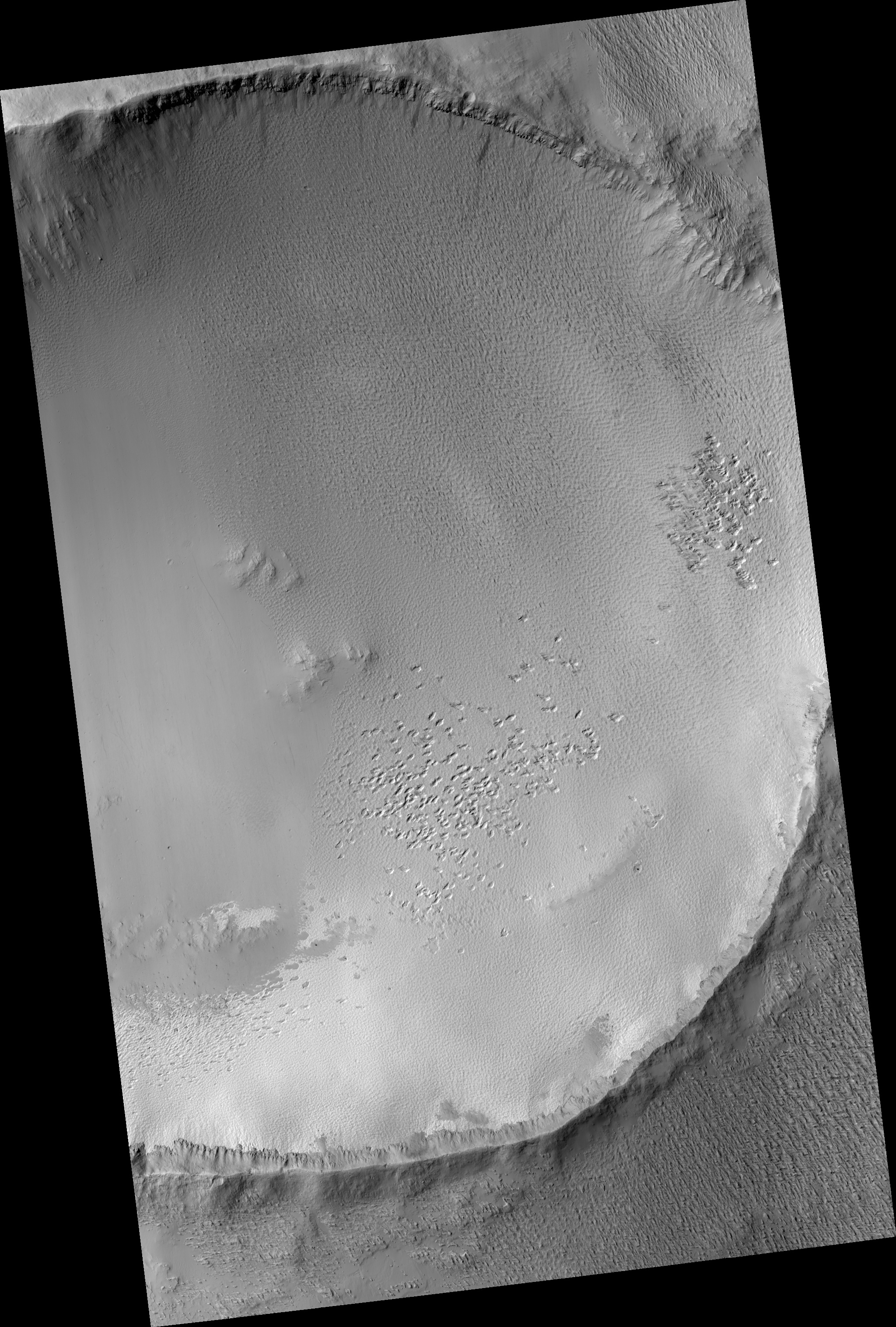
Cool image time! The photo to the right, cropped to post here, was taken on January 29, 2022 by the high resolution camera of Mars Reconnaissance Orbiter (MRO). It shows a small portion of the floor of 41-mile-wide Tuskegee Crater, sitting at the Martian equator on the rim of the outlet to the giant canyon Valles Marineris.

I have purposely focused on a section of the color strip, because of its strange green color. Most MRO images are reddish (indicating dust) or blue (indicating coarse rocks or ice). Green seems to me to be rare, and in fact is not even mentioned in the MRO science’s team explanation [pdf] of the colors the instrument produces. Since green is neither dust nor ice, this suggests some form of hard bedrock, with a mineralogy that produces that color.

The overview map below gives some context.
» Read more

4 comments

A large Martian river basin with delta

Map of Hypanis Valles river basin on Mars
Click for full image.

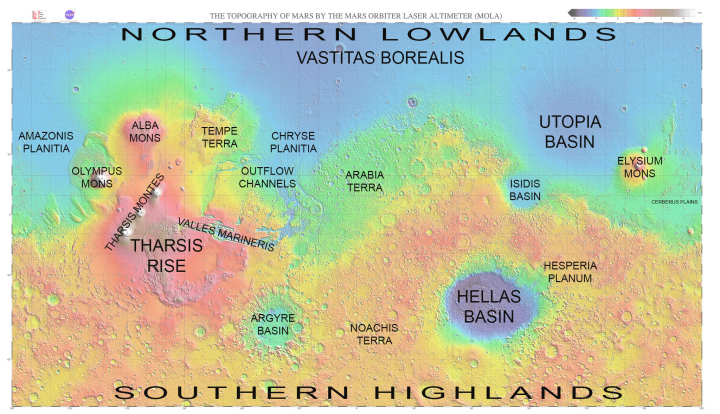
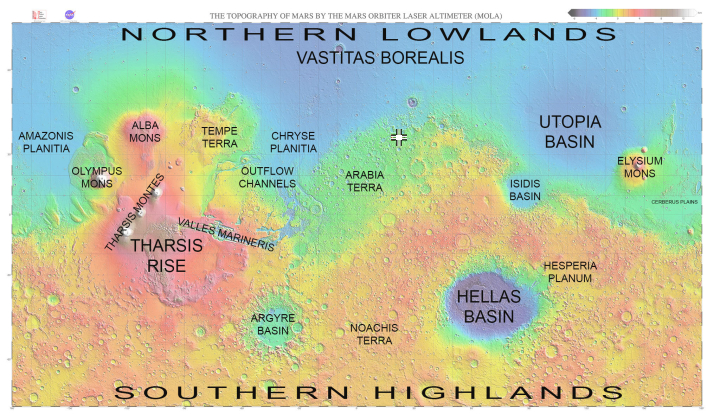
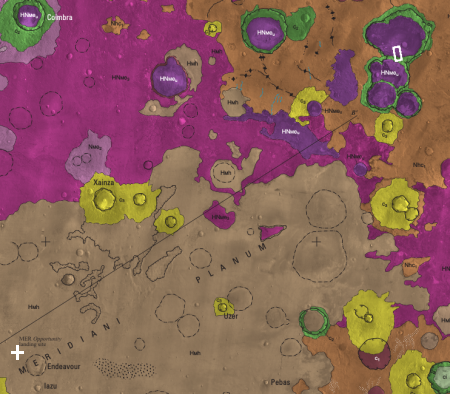
Cool map time! The map to the right, reduced to post here, is figure 1 in a new paper outlining the known geology of what appears to be a large ancient and now dry river basin with delta on Mars, found north of Valles Marineris and draining into the northern lowland plain dubbed Chryse Planitia where both Viking-1 and Mars Pathfinder landed, in 1976 and 1997 respectively.

The river basin itself is called Hypanis Valles. The white splotch at the river basin’s outlet is dubbed the Hypanis Deposit, and is thought by some scientists to be a delta of material that was placed there when the river was active 3.6 billion years ago and poured into what some scientists believe was an intermittent ocean in Chryse Planitia. From the paper’s conclusion:

As proposed in prior works, Hypanis may have formed subaqueously as a delta, and may record a water level drop of about 500 m[eters, or about 1,600 feet] as a shoreline retreated to the northeast. We identified kilometer-sized cones and mounds which appear to have erupted onto the surface. Characteristics of these features more closely resemble those of outgassing, sedimentary diapirism, and mud volcanism rather than of igneous volcanism.

The intermittent ocean theory has problems however. For this delta to have formed underwater that ocean would have to have been much much larger than estimated based on the present known data, extending out to cover almost all of Chryse Planitia, in some places to a very great depth.

Some scientists have hypothesized that the ocean need not have been that large because a land dam would have confined it to a smaller region at the river’s outlet. This research however found no evidence of such a dam. However, the paper also noted that “Further work could examine the role of ice or glaciers in the formation of Hypanis and determine if an ice dam would be plausible.”

And of course there remains the more fundamental mystery of liquid water on the Martian surface, which makes the river basin itself a puzzle. No generally accepted model allowing for surface liquid water on Mars presently exists. The possibility that ice and glaciers could have done the job comes to mind again. Though the geology in this region reveals what looks like to our Earth eyes to be a very large river system, now dry, this is not Earth but an alien planet. Tributary systems like this might form from different and as yet not understood processes on Mars, some of which might involve glaciers.

0 comments

Active volcanoes on Pluto?

Elevation map of Wright Mons on Pluto

The uncertainty of science: According to new research published yesterday, scientists now posit that there might be recent volcanic activity on Pluto, based on data and images sent back by New Horizons during its fly-by of the planet in 2015.

You can read the paper here. From its abstract:

The New Horizons spacecraft returned images and compositional data showing that terrains on Pluto span a variety of ages, ranging from relatively ancient, heavily cratered areas to very young surfaces with few-to-no impact craters. One of the regions with very few impact craters is dominated by enormous rises with hummocky flanks. Similar features do not exist anywhere else in the imaged solar system. Here we analyze the geomorphology and composition of the features and conclude this region was resurfaced by cryovolcanic processes, of a type and scale so far unique to Pluto. Creation of this terrain requires multiple eruption sites and a large volume of material (>104 km3) to form what we propose are multiple, several-km-high domes, some of which merge to form more complex planforms. The existence of these massive features suggests Pluto’s interior structure and evolution allows for either enhanced retention of heat or more heat overall than was anticipated before New Horizons, which permitted mobilization of water-ice-rich materials late in Pluto’s history. [emphasis mine]

The image to above is Figure 10 in the paper’s supplementary material [pdf]. It shows the volcano-like appearance of Wright Mons on Pluto, a mound approximately 3,000 feet high with a central depression equally deep, with a volume “similar in magnitude to that of the Hawaiian volcano Mauna Loa.”

These conclusions are quite tantalizing, but the amount of data is sparse, and thus it is wise not to take them too seriously. For example, the scientists have no idea how Pluto could presently have any form of liquid or active volcanism. Another mission to Pluto — studying it over a long time from orbit — will be required to determine how active the planet really is, or if it is active at all.

2 comments

Scientists: Ice layers in Burroughs Crater confirm Martian orbital climate cycles

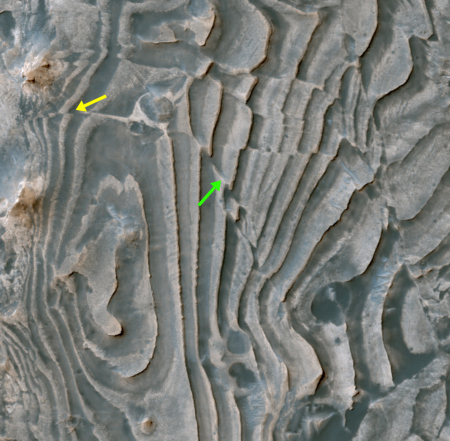
Layering in the west side of Burroughs Crater
Click for full image.

According to a new paper published today, scientists have used the ice layers inside Burroughs Crater on Mars to confirm the theory that the Red Planet has undergone numerous climate cycles during the past four million years, caused by the swings in the planet’s rotational tilt and eccentric orbit. From the press release:

Previously, Martian climate scientists have focused on polar ice caps, which span hundreds of kilometers. But these deposits are old and may have lost ice over time, losing fine details that are necessary to confidently establish connections between the planet’s orientation and motion and its climate.

Sori and his colleagues turned to ice mounds in craters, just tens of kilometers wide but much fresher and potentially less complicated. After scouring much of the southern hemisphere, they pinpointed Burroughs crater, 74 kilometers wide, that has “exceptionally well-preserved” layers visible from NASA HiRISE [Mars Reconnaissance Orbiter’s high resolution camera] imagery, Sori said.

The researchers analyzed the layers’ thicknesses and shapes and found they had strikingly similar patterns to two important Martian orbital dynamics, the tilt of Mars’ axis and orbital precession, over the last 4 to 5 million years.

The photo above of those layers was taken by Europe’s Trace Gas Orbiter on March 13, 2019, cropped and reduced to post here.

This research greatly strengthens the theory that the ice on Mars gets distributed to different latitudes in cycles, depending on the cyclical fluctuations in the planet’s orbit and tilt. However, it does not yet confirm these cycles apply to the glaciers found in craters in lower latitudes. Burroughs Crater is at 72 degrees south latitude, near the southern polar ice cap, well south of the band of glaciers scientists have discovered in the mid-latitudes down to 30 degrees latitude. Nonetheless, this research strongly suggest the same cycles apply in those lower latitudes.

5 comments

Ice sheets on Mars below 30 degrees latitude?

Cracks in Ice on Mars?
Click for full image.

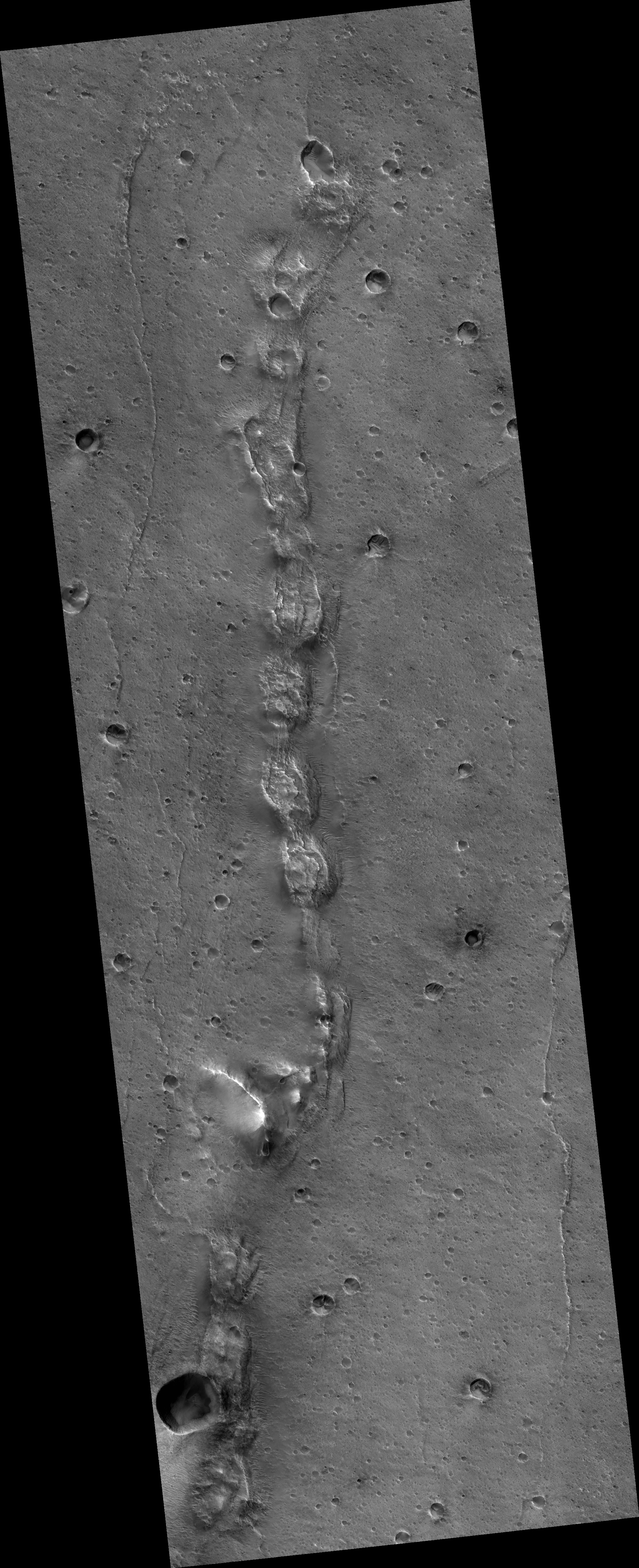
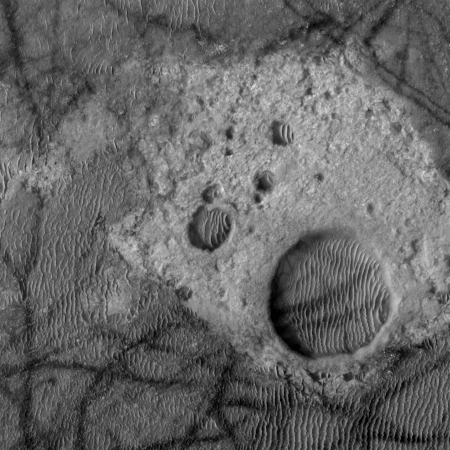
Cool image time! The photo to the right, cropped and reduced to post here, was taken on November 29, 2021 by the high resolution camera on Mars Reconnaissance Orbiter (MRO). It shows a collection of scattered thin surface fractures, grouped in clusters of parallel lines with the orientation of the clusters all somewhat random to other clusters.

The fractures, as well as the material inside the craters, appears to resemble glacial features, suggesting that these fractures are the result of either the past motion of the glacial sheet, or the sublimation of the buried ice, which causes it to crack and shrink as it slowly dissipates away.

The problem with that hypothesis is the location, as shown by the overview map below.
» Read more

0 comments

Curiosity presently traveling over broken sandstone from an ancient dune field

Gator-back terrain on Mars
Click for full image.

According to a new paper, scientists now think that the rough and broken cap layer of the Greenheugh pediment that Curiosity is presently traveling across was originally a dune field periodically washed by water runoff, which with time eventually hardened into sandstone.

That broken terrain, dubbed “gator-back terrain” by the Curiosity science team, is shown clearly in the image to the right, taken on March 20, 2022. From the paper’s abstract:

The Greenheugh pediment is capped by a unit of broadly uniform thickness which represents the remains of the Stimson dune field that existed <2.5 Ga (mid- to late-Hesperian). ChemCam geochemical data shows that the sands deposited at the Greenheugh capping unit were sourced from a nearby olivine-rich unit. Surface waters then cemented the windblown sand deposits, ponding at the unconformity with the underlying mudstone unit, creating concretions towards the base. Episodes of groundwater circulation did not affect the rocks at Greenheugh as much as they did at other Stimson localities with the exception of acid-sulfate alteration that occurred along the unconformity. These results suggest that the ancient Stimson dune field was a dynamic environment, incorporating grains from the surrounding geological units on Mt Sharp. Furthermore, liquid water was stable at the surface in the Hesperian and was available for multiple diagenetic events along bedrock weaknesses.

In other words, material from Mount Sharp formed the dune fields, all of which were reshaped by groundwater circulation, with the dunes higher on the mountain seeing less groundwater.

The biggest uncertainty of these findings is explaining how surface liquid water could exist on Mars. Scientists have yet to develop an accepted model that would allow it. Another possibility would be the recent data that suggests Gale Crater was filled with glaciers. If so, scientists would need to figure out how the interaction of a Martian glacier might have geologically changed those dunes in a manner similar to groundwater.

2 comments

Ingenuity completes 23rd flight on Mars

Overview map
Click for interactive map.

JPL announced tonight in a tweet that Ingenuity today completed its 23rd successful flight on Mars.

23 flights and counting! #MarsHelicopter successfully completed its 23rd excursion. It flew for 129.1 seconds over 358 meters [1,175 feet].

The overview map to the right was taken from the “Where is Perseverance?” webpage and annotated by me to show the planned future routes of both Perseverance and Ingenuity. The white dotted line shows Perseverance’s path, now having almost circled the rough ground on its way to the delta and Three Forks. The tan dotted line indicates Perseverance’s future route. The dashed pink and green lines indicate two possible future flight paths for Ingenuity.

The green dot marks the position the science team marked on the map for where Ingenuity landed after today’s flight. They have not yet calculated the actual flight path, which is why it is shown by the tan dashed line. This also means there is as yet some uncertainty about this landing spot.

Originally, the plan had been to get to this spot in one flight. For reasons not yet explained, when the helicopter took off on its 22nd flight during the March 19-20th weekend, it stopped after only about 100 feet. Today’s flight apparently completed the plan, putting the helicopter where it was supposed to be.

3 comments

Ingenuity completes 22nd flight; Perseverance on a roll

Overview map
Click for interactive map.

According to a tweet from JPL on March 21, 2021, Ingenuity successfully completed its 22nd flight on Mars during the March 19-20th weekend, flying for 101 seconds at a height of about 30 feet.

The tweet provided no other information, other than another flight might occur as early as later this week.

However, the most recent map update from the rover/helicopter science teams, shown to the right and annotated to post here, tells us what happened. The white dotted line indicates Perseverance’s travels. The tan dotted line indicated the flight path and landing spots for Ingenuity. The dashed tan lines indicate the planned routes for both. The red dot marks Perseverance’s present location. The green dot marks Ingenuity’s location, after its 22nd flight.

The announced flight plan for Ingenuity’s 22nd flight is shown by the two blue dots, heading north and then making a sharp left before landing. Apparently, the helicopter either did not complete that plan, landing earlier for some reason, or the flight team had decided before takeoff to shorten the flight plan significantly.

What we do know is that the helicopter landed safely, from images downloaded on March 20th [sol 384] and from the JPL tweet. The next flight, targeting later this week, could attempt to complete the previous flight plan, or instead continue to break it up into small sections.

Meanwhile, Perseverance has been racing across the Martian surface, traveling almost as much in the past week as it had for the past year. (See the map from March 16th to compare.) Moreover, the Perseverance team shortened its planned route, cutting to the west of that large crater rather than skirting it to the east. The route taken was probably slightly rougher, but nothing the rover couldn’t handle, and it saved travel time. Apparently, the scientists running the rover are now very eager to finally get to the delta, the mission’s primary geological target.

0 comments

The unbelievably rough and wind-swept surface of Mars’ Greenheugh pediment

Gator-back terrain on Mars
Click for full image.

Since my last update on the travels of the Mars rover Curiosity on February 22, 2022, the rover has been been creeping ever so slowly westward across a plateau that scientists have dubbed the Greenheugh pediment.

Scientists have known for years that the surface of the pediment was going to be rough going. This panorama taken by Curiosity when it first climbed up to the pediment in March 2020 to take a peek before retreating revealed that roughness starkly.

In truth, since beginning its traverse of that pediment in February, the Curiosity team has found the ground not only as rough as expected, but beautiful in a strange sort of way, as illustrated by the March 20, 2022 photo to the right, reduced to post here. As Lauren Edgar, Planetary Geologist at USGS Astrogeology Science Center, noted yesterday in a Curiosity update that featured this image:
» Read more

4 comments
1 77 78 79 80 81 157