The icy Reull Valley of Mars

Eroded ice in crater near Reull Valles
Click for full image.

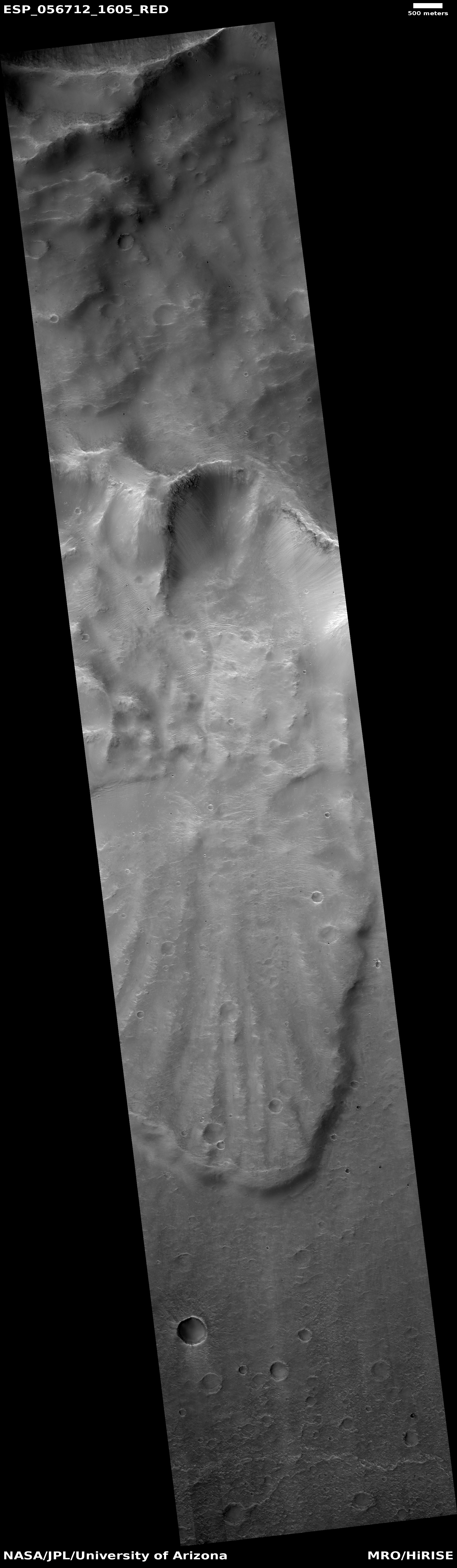
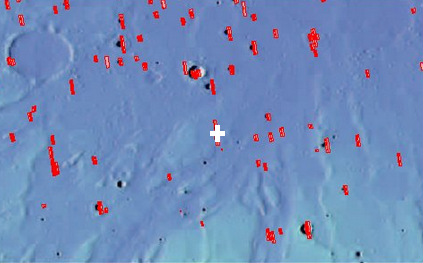
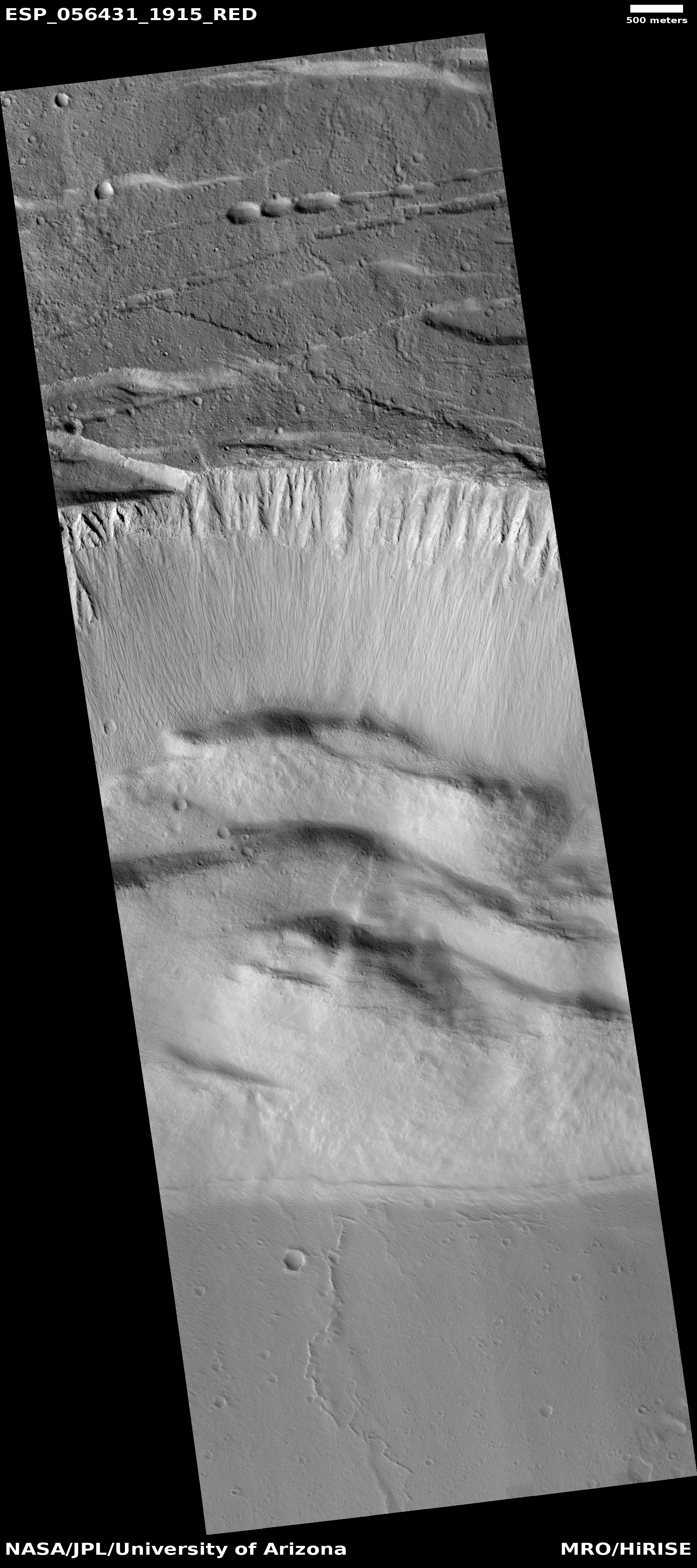
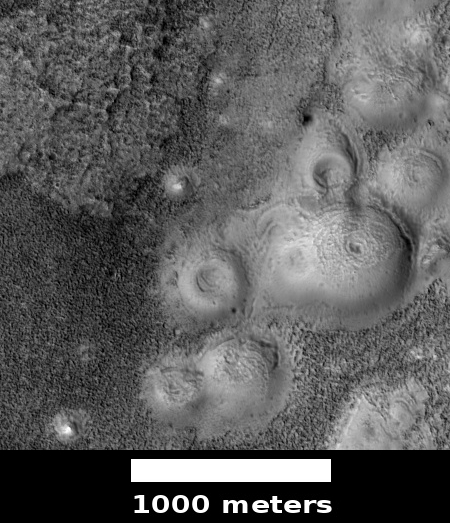
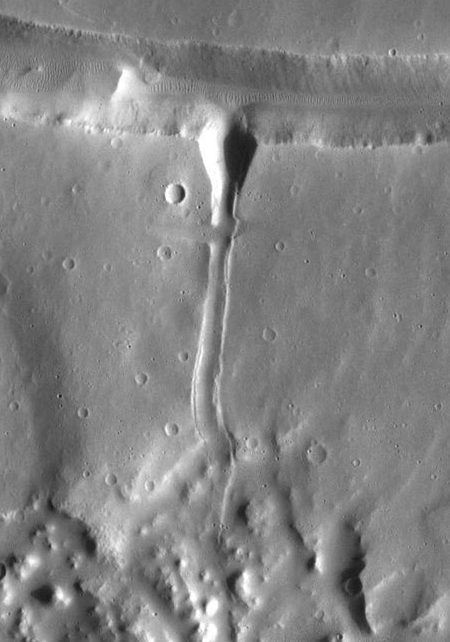
Cool image time! The photo to the right, cropped and reduced to post here, was taken on February 20, 2022 by the high resolution camera on Mars Reconnaissance Orbiter (MRO). It shows the eroded floor of a 10-mile-wide very obscured unnamed crater that sits above the northern wall of a canyon dubbed Reull Valles.

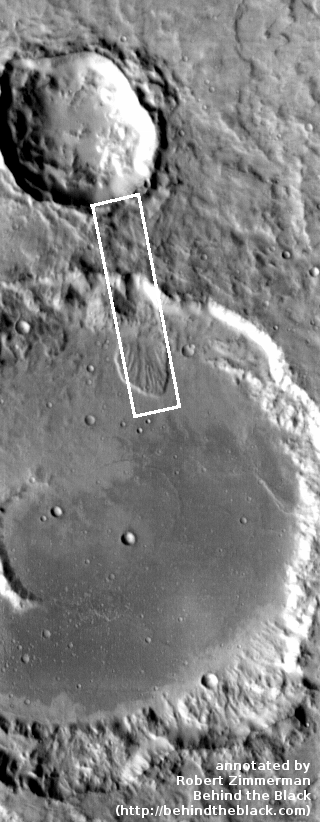
For reference the interior slope of the crater’s southern rim is labelled. The crater sits at 40 degrees south latitude. Thus, this crater is inside the 30 to 60 degree mid-latitude bands where scientists have found many glaciers on Mars. The eroded floor of this crater appears to confirm this conclusion. In the full photo the erosion is even more pronounced, as well as more chaotic, farther from that rim to the north.

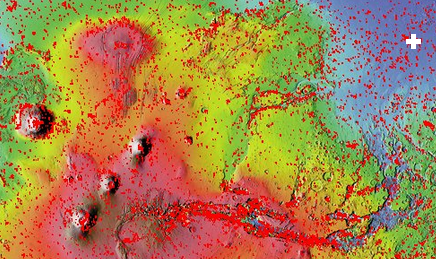
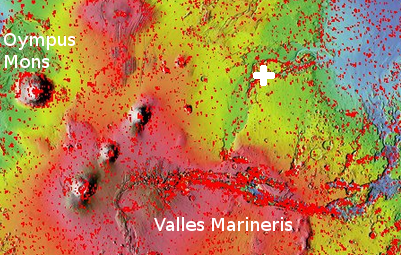
Because Reull Valles sits inside that southern glacial band, it is home to much evidence of ice. The overview map below provides the context.
» Read more

1 comment

The gigantic lava flows off of the solar system’s biggest known volcano

Olympus Mons' gigantic lava flow
Click for full image.

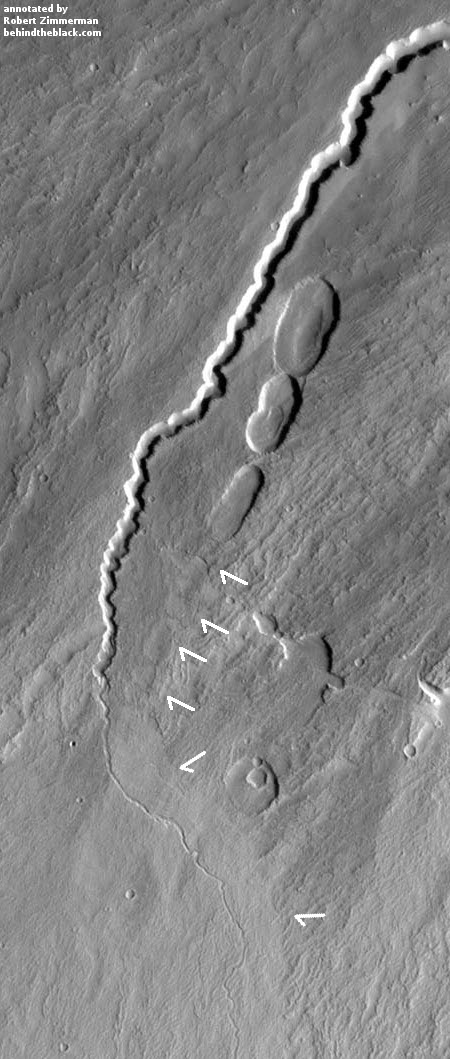
Cool image time! The photo to the right, cropped, reduced, and annotated to post here, was taken on October 30, 2021 by the high resolution camera on Mars Reconnaissance Orbiter (MRO). The picture covers a very tiny section of the southeast flank of Olympus Mons, the largest known volcano in the solar system. The arrow indicates the direction of the downward slope.

Olympus Mons itself is about 400 miles wide with an actual height relative to Mars’ “sea level” of just under 70,000 feet, more than twice as high as Mount Everest on Earth. The mountain’s flanks, almost 200 miles long from caldera edge to base, drop about 54,000 feet. That average drop of about 270 feet every mile is not particular steep, but its continuous nature over such a very very long distance makes its quite daunting.

You can see evidence of that slope in the photo. The downward pointing lobes each indicate the volcano’s last separate lava flows that ceased moving when each froze in place, probably several tens of millions of years ago. These lobes were also placed on top of many earlier flows from the volcano’s past eruptions that probably continued for several billion years, beginning 3.5 billion years ago.

The overview map helps provide a sense of scale by placing this image on that mountain flank.
» Read more

2 comments

Perseverance spots its parachute

Perseverance spots its parachute
Click for full resolution. Original images found here and here.

Overview map
Click for interactive map.

Cool image time! Today the Perseverance science team released two photos taken on April 6th that captured the parachute that the rover had used to land on Mars on February 18, 2021. The enhanced panorama above is from those images. The white feature near the center is the parachute. The mountains in the distance are the southern rim of Jezero Crater, about 40 miles away.

The overview map to the right gives the context. The red dot is Perserverance’s location as of yesterday, on sol 413. The black dot marks its location on April 6th, when it took the pictures. The green dot marks Ingenuity’s present position. The yellow lines indicate the approximate area covered by the panorama.

Ingenuity had not completed its 25th flight until April 8th, two days after these photos were taken, so it isn’t actually just off the edge of these photos, it is beyond the near ridgeline out of sight.

1 comment

Dawn on the Moon

Dawn on the Moon's far side
Click for full image.

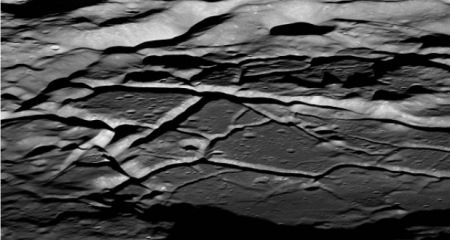
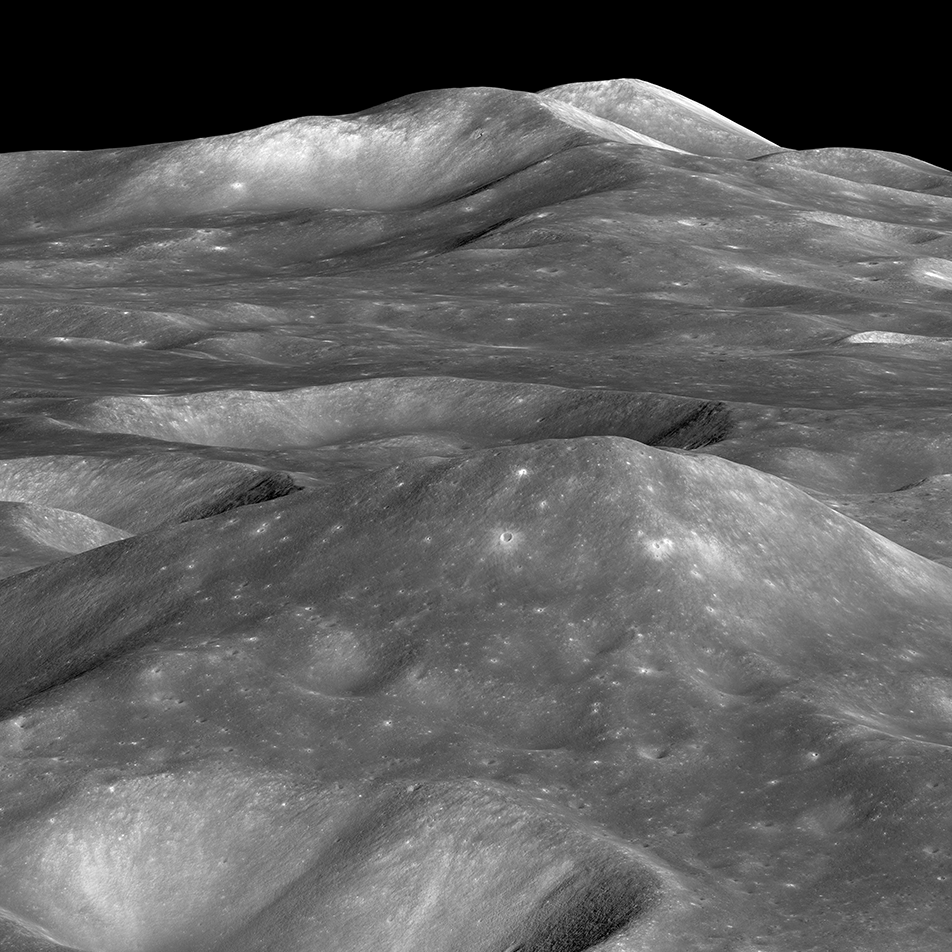
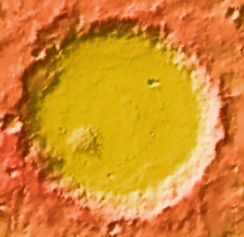
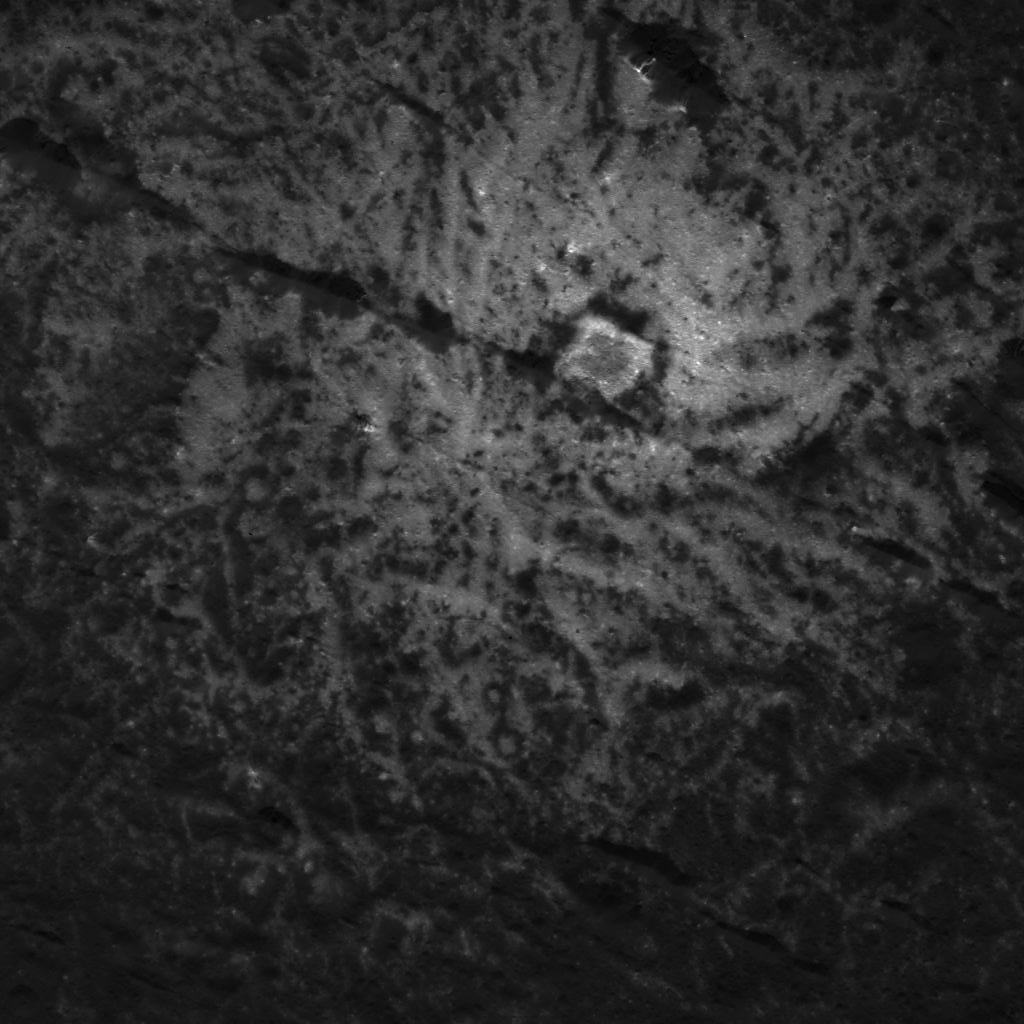
Cool image time! The photo to the right, reduced to post here, was taken on August 25, 2019 by Lunar Reconnaissance Orbiter (LRO). It shows an oblique view looking west just after lunar dawn of an unnamed 13-mile-wide crater in Mare Moscoviense on the far side of the Moon. From the caption:

Mare Moscoviense is one of the few volcanic plains on the farside, which is largely comprised of ancient cratered highland terrain. The fact that the farside was strikingly different from the familiar nearside was a surprise when the Soviet Luna 3 spacecraft returned the first farside images in 1959. The highland crust is thicker on the farside than on the nearside, which is thought to have inhibited magmas from reaching the surface as frequently as they once did on the nearside.

As seen in the image above, Mare Moscoviense lies within a large impact basin, the formation of which thinned the local crust, perhaps making it easier for lavas to erupt that would have otherwise stalled below the surface. But why does this global asymmetry in crustal thickness exist? This is still a mystery, like the origins of the large-scale asymmetries observed on Mars and Mercury, though ideas like a giant impact event that stripped off a portion of the crust or asymmetric overturn of the mantle have been proposed.

Note the dark shadow obscuring the foreground on the left. It appears from the topography in the overhead map at the link that the ridgeline that marks the eastern border of Mare Moscoviense is just high enough at dawn to keep the mare in shadow while allowing the sun’s dawn light to peek over and illuminate the crater’s rim. That ridgeline however only extends so far to the north, thus allowing sunlight to hit the plains on the right sooner.

3 comments

White sediment in Martian slot canyon

White sediment in Martian slot canyon
Click for full image.

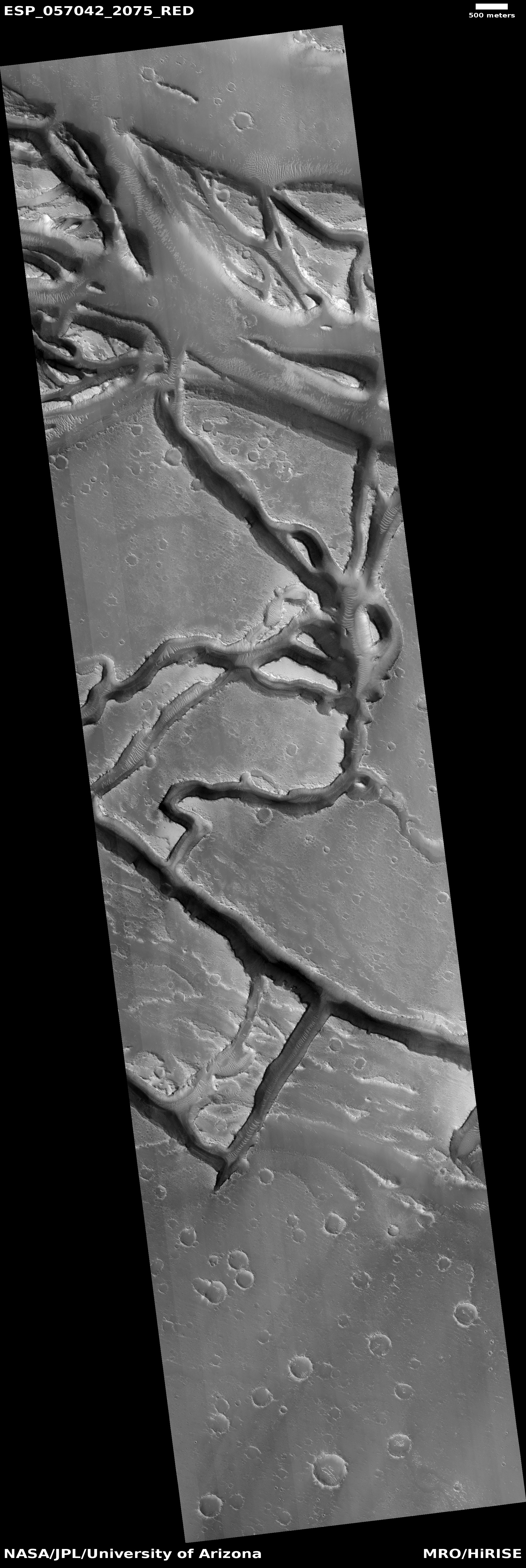
Yesterday’s Picture of the Day from the high resolution camera on Mars Reconnaissance Orbiter (MRO) revisited a captioned image first posted in February 2014 by the science team. That picture, cropped and enhanced, is to the right. From the 2014 caption:

There is a large channel system that flows into the basin, called Ladon Valles, and scientists think that the basin may have once filled with water before another channel to the north formed and drained it. These exposures of light-toned layered sediments provide clues about the environment that existed within Ladon Basin when water may have ponded and deposited these sediments.

Later research has generally concluded that these white sediments are iron and magnesium smectites, often appearing as white tuff material whose deposition is generally associated with precipitation of water or snow and its subsequent evaporation or sublimation.
» Read more

0 comments

Ingenuity completes 25th flight, the longest yet

Overview map
Click for interactive map.

On April 8th the Mars helicopter Ingenuity successfully completed its 25th flight on Mars, traveling 2,310 feet at 18 feet per second while flying for 161.3 seconds.

The long distance was designed to take it out from the rough region dubbed Seitah and near the delta that is the prime geological target of the rover Perseverance.

The overview map shows the location of both rover and helicopter as of today. The red dot is Perseverance, the green dot is Ingenuity. The rover has now completed its entire planned travels, as announced in June 2021. Where it goes next has not as yet not been announced. According to the team, they plan to use Ingenuity to scout out possibly routes up onto the delta. This likely means the rover will likely spend some time at the base of the delta, getting as much data as it can, while Ingenuity does this scouting work.

1 comment

The spread of the oceans’ sea floors appears to be slowing

The uncertainty of science: Based on data covering the last 19 million years, scientists now believe that the rate in which the Earth’s ocean sea floors are spreading has been slowing steadily.

Today, spreading rates top out around 140 millimeters per year, but peaked around 200 millimeters per year just 15 million years ago in some places, according to the new study. The study was published in the AGU journal Geophysical Research Letters, which publishes high-impact, short-format reports with immediate implications spanning all Earth and space sciences.

The slowdown is a global average, the result of varying spreading rates from ridge to ridge. The study examined 18 ridges, but took a particularly close look at the eastern Pacific, home to some of the globe’s fastest spreading ridges. Because these slowed greatly, some by nearly 100 millimeters per year slower compared to 19 million years ago, they dragged down the world’s average spreading rates.

You can read the actual paper here.

To put it mildly, the conclusion here is uncertain. The difference between 140 and 200 millimeters is less than two and a half inches. A hundred millimeters is less than four inches. Such small differences over millions of years could simple be caused by random fluctuations over time. Furthermore, the scientists did not actually detect the spreading rates from millions of years ago. They instead inferred it based on the data we do have of the changes in the Earth’s magnetic field over time.

Still, this result is very intriguing indeed. More than anything, it should help geologists develop better theories to explain plate tectonics, and what drives it. At the moment no theory adequate explains it.

7 comments

Frozen lava in Mars’ volcano country

The frozen lava of the Athabasca flood plain
Click for full image.

Cool image time! The photo to the right, cropped and reduced to post here, was taken on January 28, 2022 by the high resolution camera on Mars Reconnaissance Orbiter (MRO). It shows what appears to be at first glance a relatively featureless plain with a lighter material covered by a patchwork of darker material.

Note however the lack of craters. Except for several faint depressions near the image’s center, there are none. And those depressions look like the expression of craters that have been covered by material. Is the two-toned surface here an expression of past lava flows? Or are we seeing an ice-sheeted plain, with the patches representing higher terrain above that plain?

The overview map below answers the question somewhat clearly.
» Read more

0 comments

Curiosity retreating from Greenheugh Pediment

Overview map
Click for interactive map.

Because of the incredible roughness of the ground on the Greenheugh Pediment, the science team for the rover Curiosity has decided to make a major change in their route. Rather than continue their traverse across this terrain, as planned for years, they have decided to back off in order to protect Curiosity’s dinged wheels, and find a more friendly route up Mount Sharp.

“It was obvious from Curiosity’s photos that this would not be good for our wheels,” said Curiosity Project Manager Megan Lin of NASA’s Jet Propulsion Laboratory in Southern California, which leads the mission. “It would be slow going, and we wouldn’t have been able to implement rover-driving best practices.”

The gator-back rocks aren’t impassable – they just wouldn’t have been worth crossing, considering how difficult the path would be and how much they would age the rover’s wheels.

So the mission is mapping out a new course for the rover as it continues to explore Mount Sharp, a 3.4-mile-tall (5.5-kilometer-tall) mountain that Curiosity has been ascending since 2014. As it climbs, Curiosity is able to study different sedimentary layers that were shaped by water billions of years ago. These layers help scientists understand whether microscopic life could have survived in the ancient Martian environment.

The plan is to retrace the rover’s path back through Gordon Notch and then head uphill though another gap that will take it directly onto the next sedimentary layer, dubbed the sulfate unit. On the overview map above, the red dotted line shows the long-planned route. The yellow lines indicate the area seen in the panorama I posted on April 6th, when Curiosity was at its farthest into the pediment. The blue dot marks Curiosity’s position two days ago. You can see that it has retreated backwards.

This change means the scientists will likely not get a close look at Gediz Vallis Ridge. However, it also means the rover will likely reach Gediz Vallis much sooner that previously planned.

0 comments

Perseverance arrives at Three Forks at the base of Jezero Crater’s delta

Panorama of delta in Jezero Crater
Original images found here, here, here, and here. Click for full resolution.

Overview map
Click for interactive map.

Cool image time! The panorama above was created from four navigation camera images taken by the Mars rover Perseverance on April 10th. Because the lens on Perseverance’s navigation cameras produce slightly curved images which are taken in pairs, the panorama is made of two parts, each a pair perfectly matched images looking from a different angle. I have overlapped the pairs but as you can see, the match at the center is imperfect. While this does not produce a single smooth image, the two paired panoramas show the foot of the entire delta that had flowed into Jezero crater in the past and is the prime geological target of the rover. What is it made of? What caused it to flow into the crater? When did it do it? How was Mars different when it did so? Was the crater wet? Was the delta mud when it flowed, or was it sediment under water, pushed out by that flowing water?

The location map to the right is taken from the “Where is Perseverance?” webpage but annotated to show the planned routes of both Perseverance and Ingenuity, as shown by the tan dashed lines. The red dot marks Perseverance present location, the green dot Ingenuty’s. The yellow lines the approximate area covered by the panorama.

What next? Expect Perseverance to move as close to the base of the delta’s cliff as possible and spend at least several months studying it. Ingenuity meanwhile will be flown to the west to scout the various hollows that are potential routes for Perseverance to climb up onto the delta.

0 comments

Splonk went the crater!

Splonk went the crater!
Click for full image.

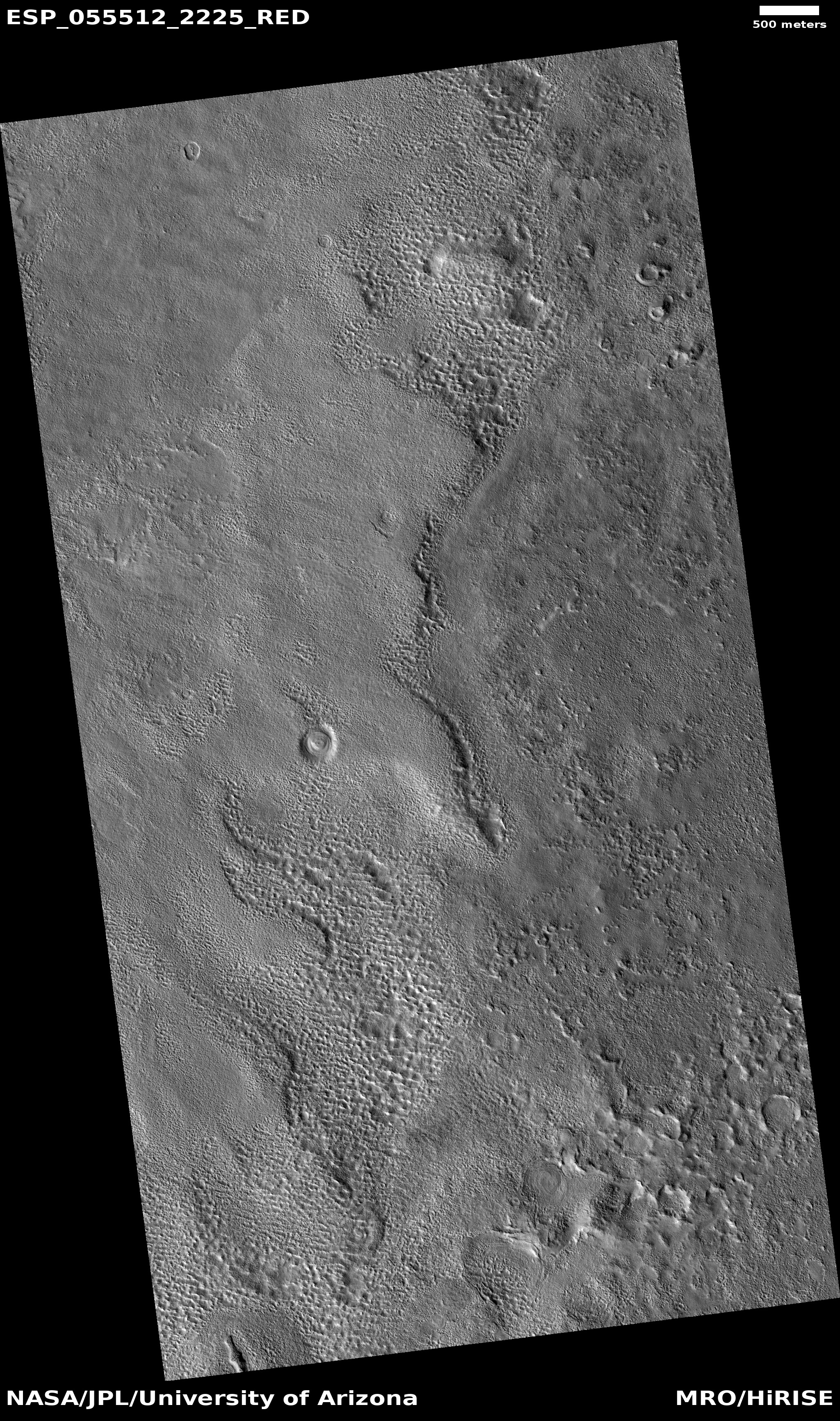
Cool image time! The photo to the right, cropped and reduced to post here, was taken on February 18, 2022 by the high resolution camera on Mars Reconnaissance Orbiter (MRO). It shows what the scientists label as a “degraded crater in Utopia Planitia.”

There is a lot of intriguing geology in this one image. First of course is the crater itself. We have to ask, is it from an impact or from some volcanic process? The location, at 44 degrees north latitude, argues that some form of ice or mud process was involved. Maybe we are looking at a frozen eruption from an underground ice layer. If this was instead caused by an impact, the crater’s ringlike structure could have been created by the ripples of melted ice and mud emanating away but then quickly refreezing.

Surrounding the crater are many small fissures, the largest ones all oriented in a north-south direction. If there is an ice layer near the surface, these cracks might be caused by that ice sublimating away. Why the largest cracks orient in the same direction however is a mystery.

The color variations suggest [pdf] dust (red-orange) as well as a variety of minerals (green). Since no blue appears visible in this version of the photo, if this crater was shaped by melting or erupting ice, that ice is well covered by that layer of dust and debris.

The location map below as always provides context.
» Read more

2 comments

Curiosity’s upcoming rough terrain

Curiosity's view looking west on April 5, 2022 (Sol 3435)Click for high resolution. For original images go here, here, here, and here.

Overview map
Click for interactive map.

Cool image time! The panorama above, created by me from four photos taken by Curiosity’s right navigation camera on April 5, 2022, reveal much about the alien world of Mars that the rover is exploring. The red dotted line indicates approximately the rover’s upcoming route.

First there is the rough surface of the Greenheugh Pediment, the sloping plateau that Curiosity is presently traversing. Called “gater-back terrain” by the science team, this broken surface apparently is sandstone that was originally a dune field that in the past was periodically washed by water runoff and later hardened into this structurally weak rock.

Second, I have orientated the images so that the rim of Gale Crater, approximately 25 miles away, is horizontal. By doing so, we can see the upward slope of the Greenheugh Pediment. Curiosity is on a tilted surface, and while it will be traversing along a contour line as it heads west towards Gediz Vallis Ridge about 1,000 feet away, when it turns left and heads uphill, the climb will be steady and steep, as it has now been for the past year since the rover entered the mountains at the foot of Mount Sharp.

Taken together, these details indicate why Curiosity has moved very slowly in recent weeks, as shown by the white dots in the overview map to the right. The blue dot marks Curiosity’s present location, with the yellow lines indicate the approximate view in the panorama above.

Traversing the pediment carries real risk to the rover. Though its somewhat dinged wheels have held up well during this last year of traveling in these rough mountains, at any point the severe roughness here could damage one or more wheels significantly, even putting one or more out of commission. The rover team is traveling carefully to avoid this, but these factors illustrate a possible end for the rover, though hopefully still years away.

0 comments
1 76 77 78 79 80 157