A volcanic extrusion on the floor of Valles Marineris?

A volcanic extrusion on the floor of Valles Marineris?
Click for full image.

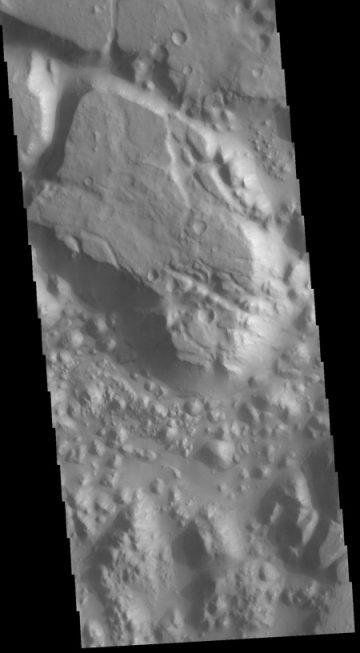
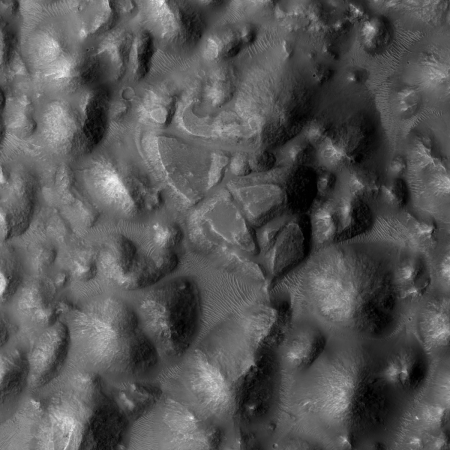
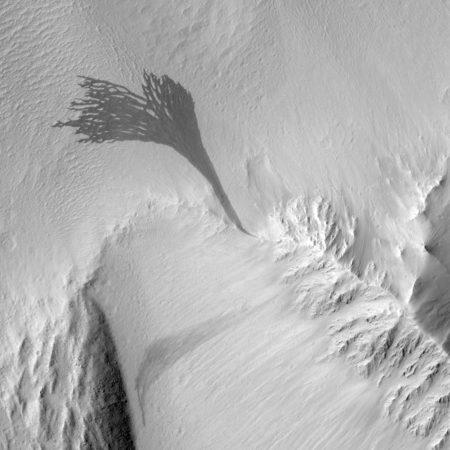
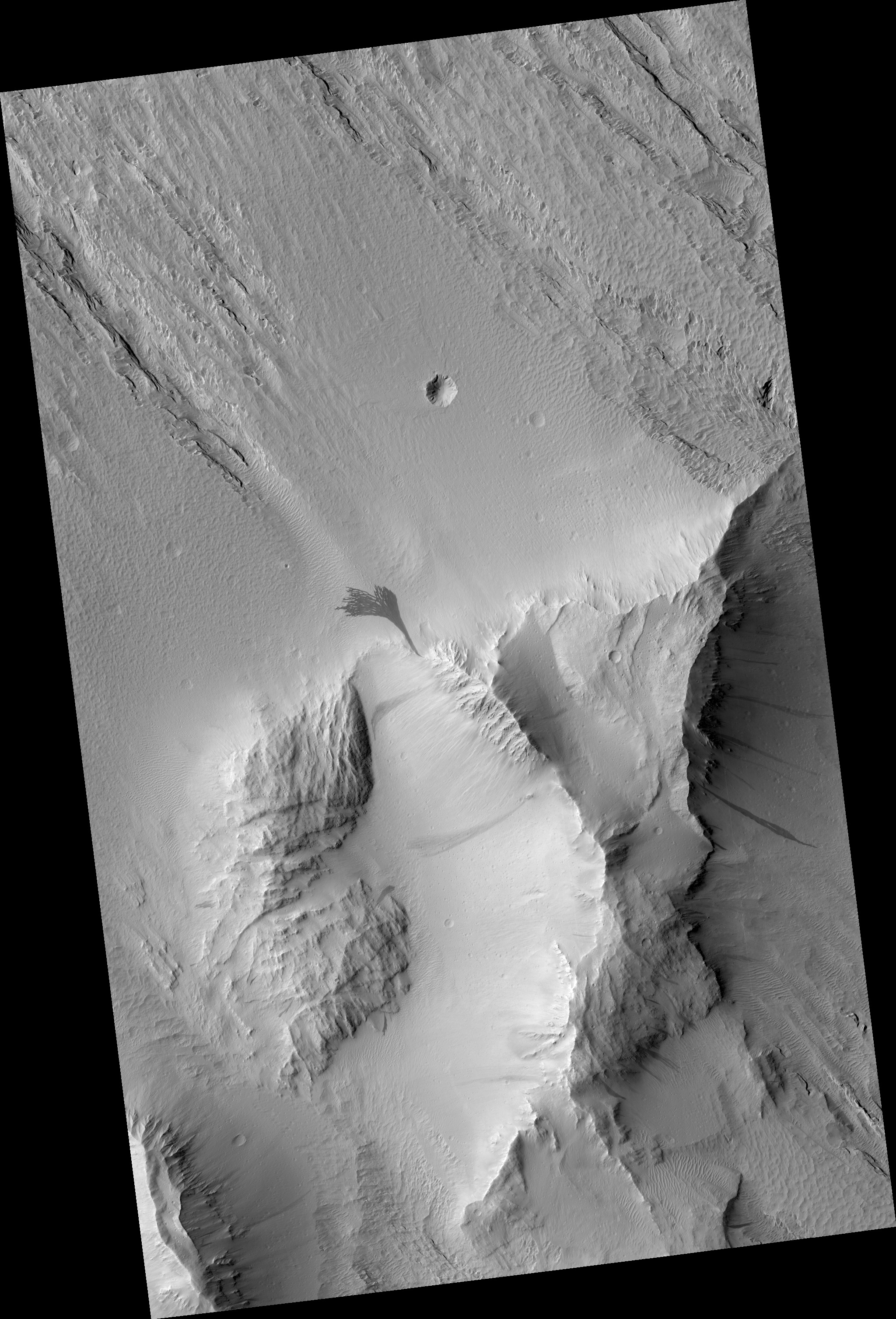
Cool image time! The photo to the right, rotated, cropped, and reduced to post here, was taken on August 31, 2021 by the high resolution camera on Mars Reconnaissance Orbiter (MRO). It shows what the science team labels a “possible contact between two units.”

I think that contact is the point where that eroded mountain touches the surrounding smooth canyon floor. The mountain itself looks to me to be a very eroded extrusion of lava that was placed there from below a very very long time ago, covered later by material, and now exposed for a long enough period that its surface appears to have been carved by wind and even possibly flowing water or ice.

Because it is lava it is more resistant to erosion, which is why it sits higher than the smooth terrain around it. Even though both experienced the same processes of wear over time, the mountain’s surface was only carved away partly, while the material that had been in the floor was washed away entirely.

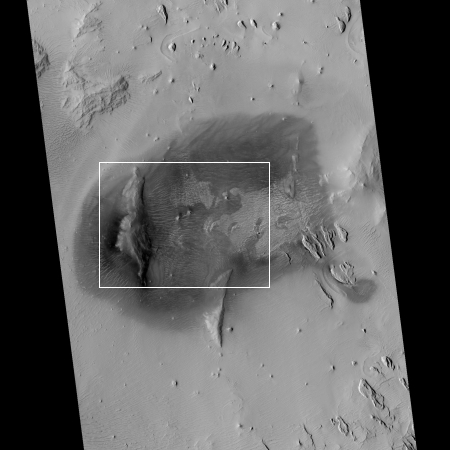
This is all a guess. However, a look below at the overview map, showing this mountain’s location on Mars, as well as MRO’s wider view from its context camera, I think strengthens my hypothesis.
» Read more

0 comments

Frozen lake bed in the Martian high latitudes?

Frozen lakebed in the Martian high latitudes?
Click for full image.

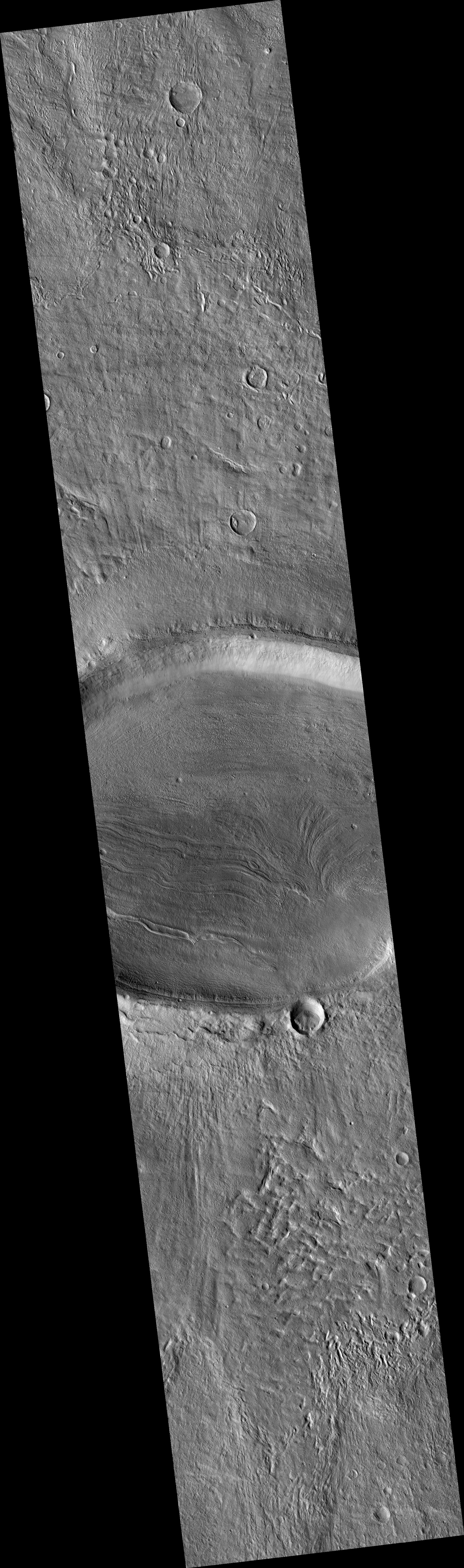
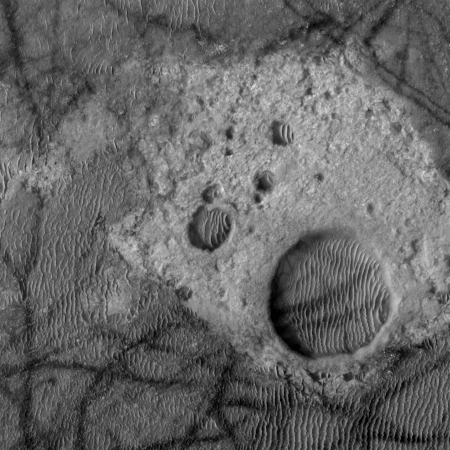
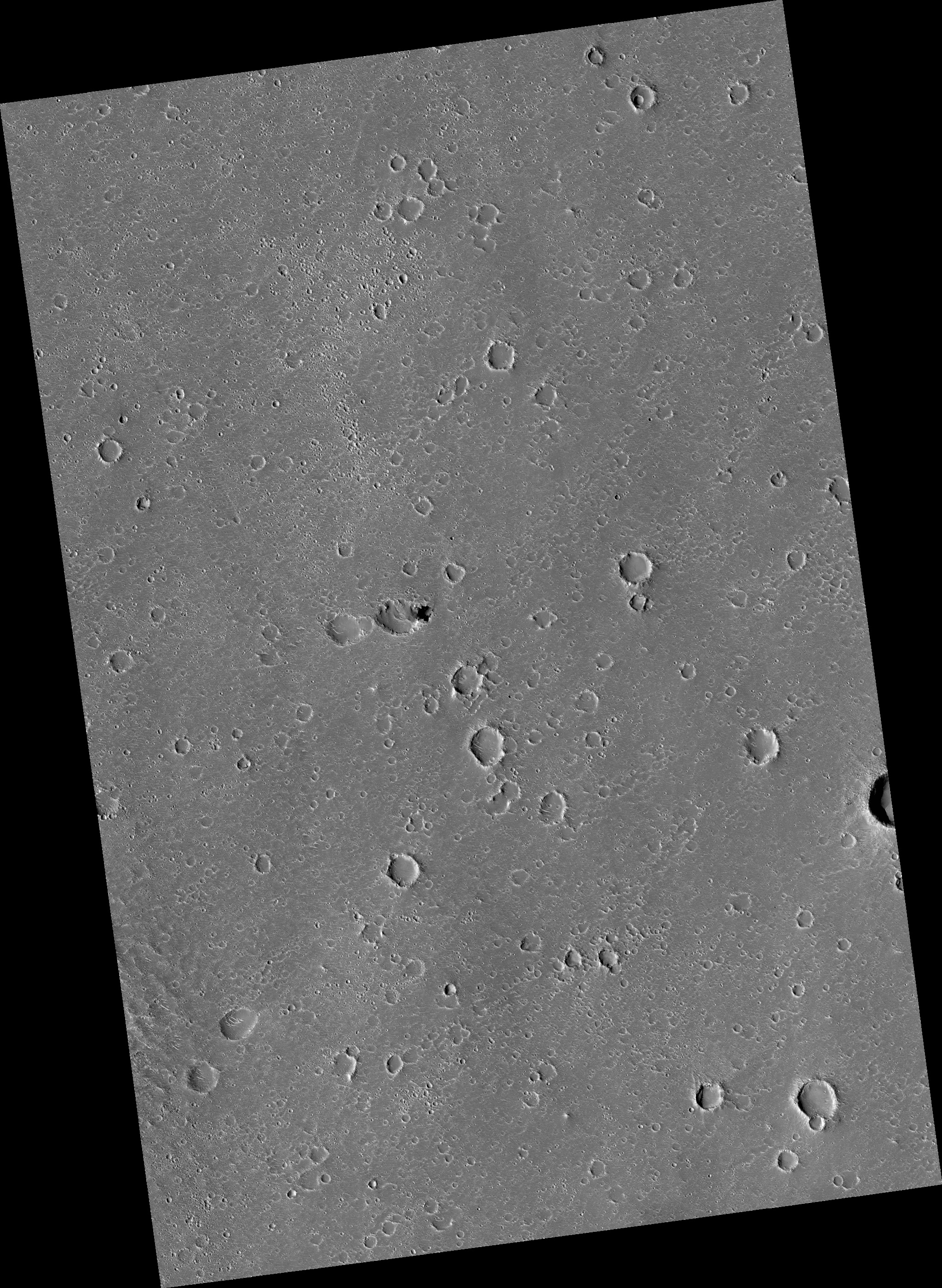
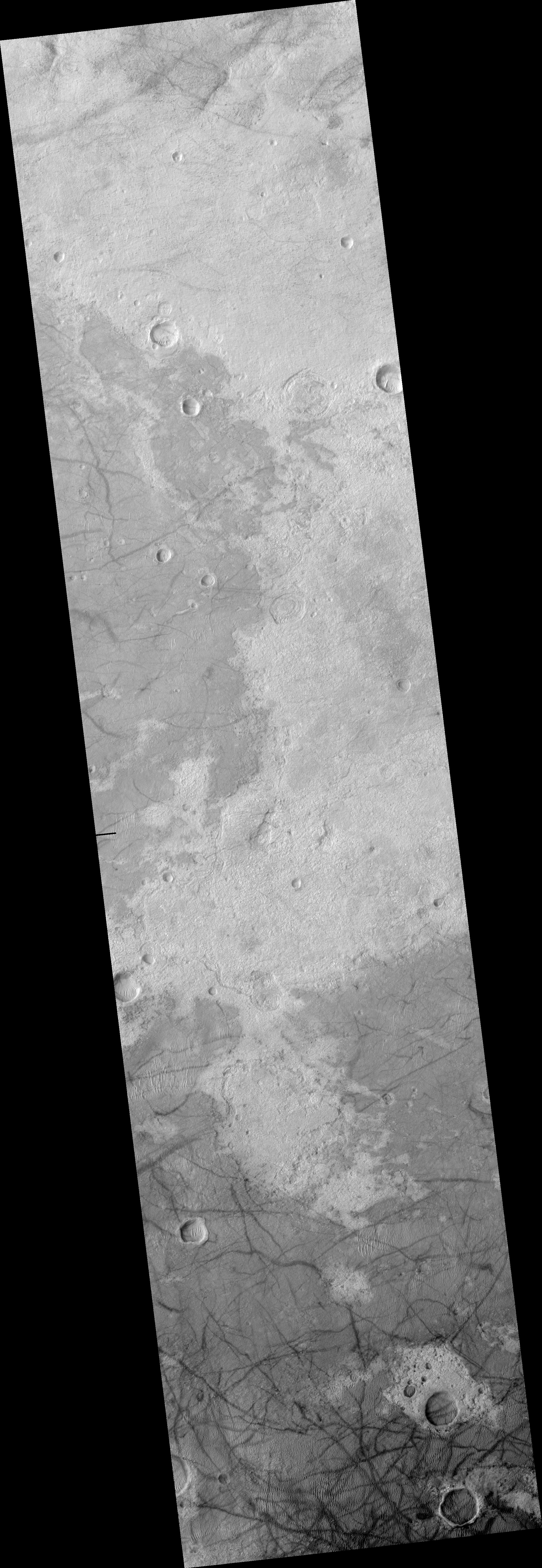
Today’s cool image comes from today’s Mars Reconnaissance Orbiter’s (MRO) high resolution picture of the day, rotated and cropped to post here. The original was taken back on March 28, 2017.

What formed those strange circular ridges and the many small cracks and hollows? The caption provided is somewhat vague and I think confusing:

This formation looks like a crater from a meteor impact rather than an ancient caldera of a volcano. Connected to the crater is a carved-out area that resembles a lake bed. At high resolution, we might be able to determine the likelihood of a water lake bed or lava bed. This observation will give insight into some of the interesting geology of this area.

The crater this caption is referring to is not visible in the image provided. It can be seen to the west of this location, in the MRO context camera picture below.
» Read more

0 comments

The strange surface of Mars’ north pole icecap

Mars' north pole icecap
Click for full image.

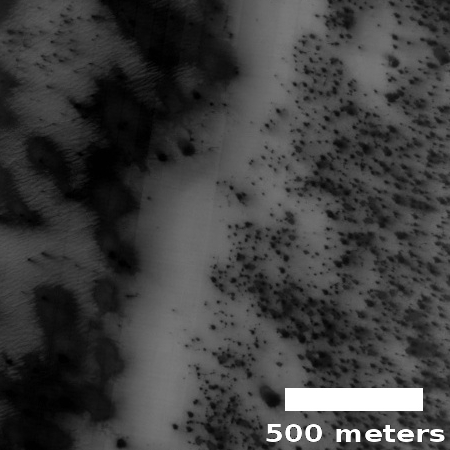
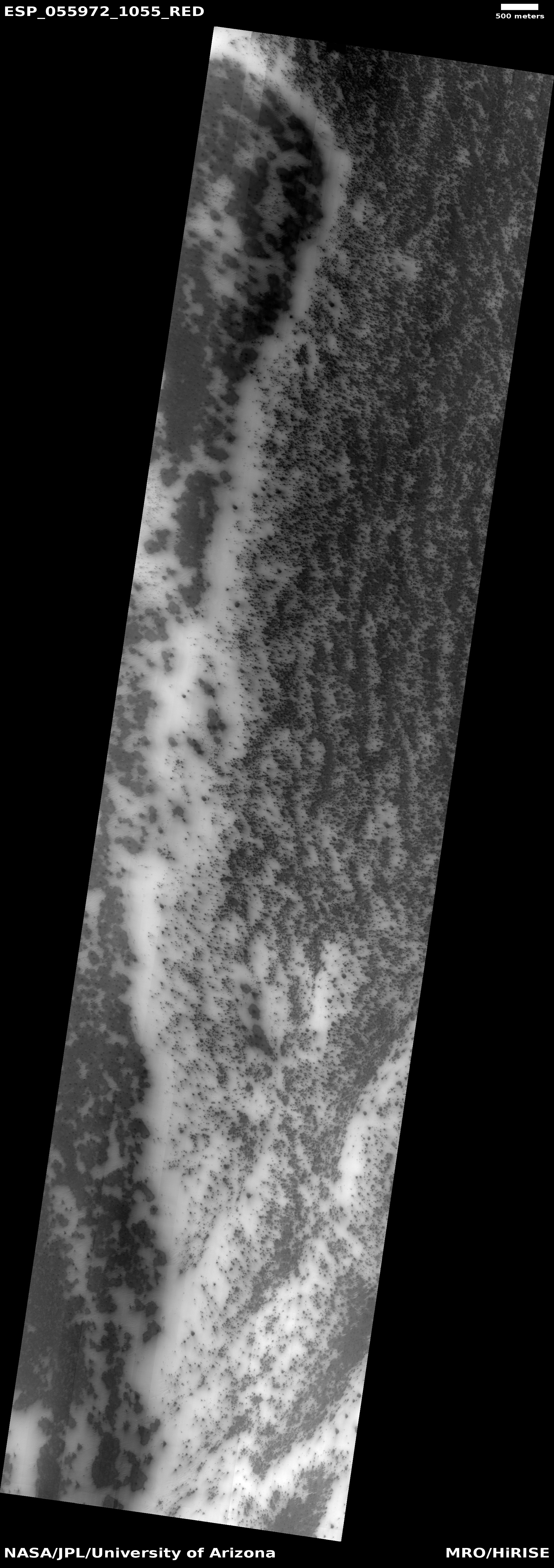
Cool image time! The photo to the right, rotated, cropped, and annotated to post here, was taken on September 17, 2021 by the high resolution camera on Mars Reconnaissance Orbiter (MRO). It shows us a very small section of Mars’ north pole icecap.

What are we looking at? The picture was taken in summer, so by this point the thin mantle of dry ice that falls as snow in the winter and covers the north pole down to about 60 degrees latitude has sublimated away. This surface thus is water ice interspersed with Martian dust.

Yet, unlike the Antarctic icecap on Earth, the ice surface is not smooth and flat. Instead, this Martian ice has a surface that is a complex arrangement of hollows and ridges, all about the same size. Why?

And what are the two larger white spots? What caused them and why are they the only differently-sized objects in the picture?

The full resolution close-up, found at the image website, provides some answers to these questions.
» Read more

0 comments

Two skylights into connected Martian lava tube?

Two skylights into a connected Martian lava tube?
Click for full image.

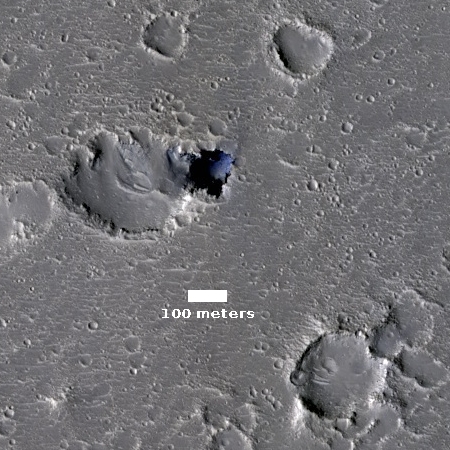
Cool image time! The photo to the right, cropped and annotated to post here, was taken on September 1, 2021 by the high resolution camera on Mars Reconnaissance Orbiter (MRO). I have annotated it to note the two apparent skylights that appear aligned along a north-south depression.

The grade is downhill to the north. If you look at the full image you will see that this north-south depression extends for a considerable distance beyond the edges of the cropped image above, with that depression appearing to dissipate to the north into a series of parallel very shallow depressions, almost like the lava had flowed out of the tube and formed branching surface rivulets heading south.

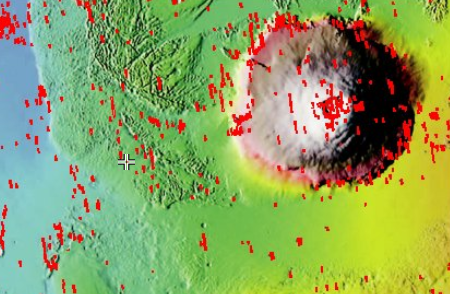
The overview map shows that this tube is on the northern flanks of the volcano Arsia Mons.
» Read more

2 comments

Holes in snowy ice on Mars?

Holes in snowy ice on Mars?
Click for full image.

Cool image time! Today we return to the regions surrounding Milankovic Crater in the high northern latitudes of Mars. The photo to the right, cropped and reduced to post here, was taken on June 1, 2021 by the high resolution camera on Mars Reconnaissance Orbiter (MRO). It shows a spray of impact craters where the bolides apparently landed in relatively soft material. The location itself is about 10 miles to the southeast of the 74-mile-wide crater, and sits within its rim ejecta blanket.

The label for the image says this is showing “crater modification,” which suggests that the rimless nature of these craters became so after their creation. This location, at 54 north latitude, is in a region of Mars where scientists have found a lot of evidence of near surface ice. For example, within Mikankovic Crater itself they have identified numerous scarps with clearly seen pure ice layers.

If ice is close to the surface here, then the ground could be like soft snow on Earth, especially because Mars’ lighter gravity would not compress that ice as much. Think about what happens when you toss pebbles into soft snow. They fall through, and leave behind holes not unlike the ones we see in this picture. Later, sunlight would begin to modify the holes so that their edges grow outward, once again exactly as we see here.

The overview map below as always gives some context, which in this case has less to do with Mars but with Elon Musk and Starship.
» Read more

0 comments

Layered glaciers in Mars’ glacier country

Layered glacier in Mars' glacier country
Click for full image.

Cool image time. The photo to the right, cropped and reduced to post here, was taken on August 30, 2021 by the high resolution camera on Mars Reconnaissance Orbiter (MRO). It shows two different impact craters in a glacial region dubbed Nilosyrtis Mensae, located in the northern mid-latitudes in the 2,000 mile long strip chaos terrain that I have labeled glacier country because practically every image finds them there.

The splash apron surrounding the larger crater is typical of craters in Martian regions where ice is thought to be near the surface.

What makes this picture interesting is that the glaciers appear layered. You can see evidence of this in the mounds inside both craters. Those mounds appear to represent earlier periods when there was more ice here. Since then the mounds have partly sublimated away.

You can also see evidence of layers in the material surrounding the nearby larger mounds.

The map below shows us where this image is, relative to all of glacier country as well as the rover Perseverance in Jezero Crater.
» Read more

0 comments

A collapsing north wall in Valles Marineris

Mass wasting in Valles Marineris
Click for full image.

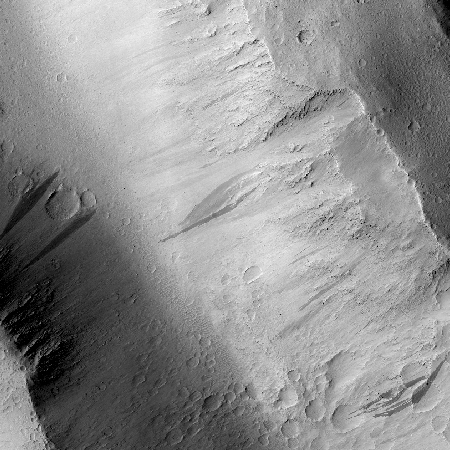
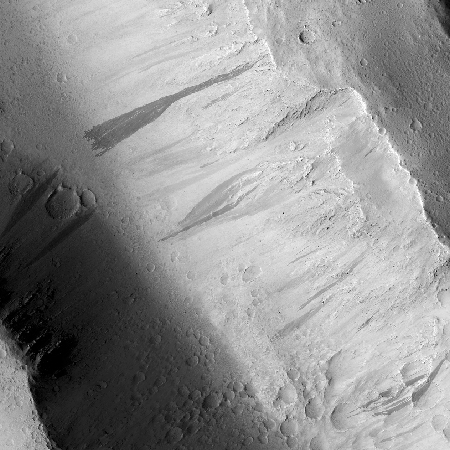
Cool image time! The photo to the right, rotated, cropped, and reduced to post here, was taken on July 17, 2021 by the high resolution camera on Mars Reconnaissance Orbiter (MRO). It shows what the scientists label as an alluvial fan.

I have also seen them label this kind of avalanche as mass wasting, where the material moves down slope suddenly in a single mass.

The image shows the aftermath of such an event, after a large blob of material broke free from the mountainside and slid almost as a unit downhill to settle more than two miles away on the floor of the canyon. The distance traveled and the blobby nature of the flow both reveal how the lower Martian gravity changes the nature of such events, compared to what you might see on Earth. The flows can travel farther, and can hold together as a unit easier.

The overview map below not only provides the context, but it tells us that such events are remarkably common in this place.
» Read more

2 comments

The icy Phlegra Mountains on Mars

Overview map

Cool image time! The Phlegra Mountains on Mars are probably the iciest mountains on the red planet, something I noted previously in an April 2020 essay, highlighting a half dozen images from the high resolution camera on Mars Reconnaissance Orbiter (MRO) that showed that iciness. As I stated:

Here practically every photograph taken by any orbiter appears to show immense glacial flows of some kind, with some glaciers coming down canyons and hollows [#1], some filling craters [#2], some forming wide aprons [#3] at the base of mountains and even at the mountains’ highest peaks [#4], and some filling the flats [#5] beyond the mountain foothills.

And then there are the images that show almost all these types of glaciers, plus others [#6].

The overview map above not only shows the locations of these six images in black, it also shows in red two of SpaceX’s four prime candidate landing sites for its Starship spacecraft. Note that #3 above is one of those sites.

The white rectangle in the Phlegra Mountains marks the location of today’s cool image below, taken on June 11, 2021 by MRO’S high resolution camera.
» Read more

0 comments

Dry Martian chaos

Dry chaos on Mars
Click for full image.

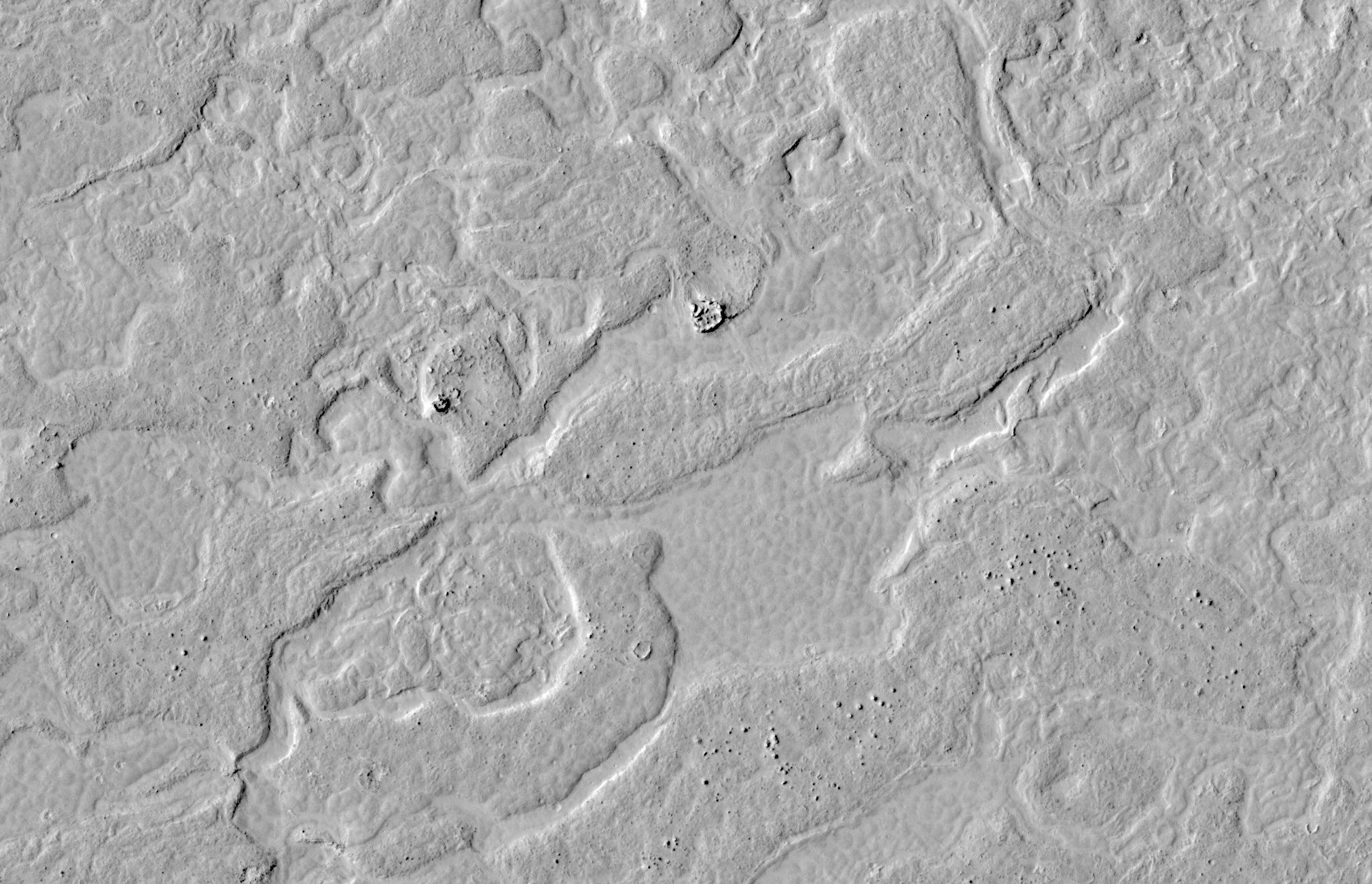
On Mars, one of the most common kinds of landscape is called chaos terrain. Made up of mesas, buttes, and cross-cutting random canyons, this geology is not seen on Earth, and when first identified by scientists in early orbital pictures in the 1970s, it baffled them. While it is clear that some form of erosion process caused it, the scientists did not have enough data then to figure out what that process was.

Today scientists have a rough theory, based on what they now know about Mars’ overall geology and its climate and orbital history. The canyons of chaos terrain were originally fault lines where either water or ice could seep through and widen. See this January 2020 post for a more detailed explanation.

Most of the cool images I have posted of chaos terrain have been in places in the mid-latitudes that are covered with glaciers. See for example this December 2019 post of one particular mesa in glacier country, with numerous glaciers flowing down its slopes on all sides. That mesa is quite typical of all such mesas in the mid-latitudes.

Today’s cool image above, cropped to post here, takes us instead to the Martian very dry equatorial regions. The photo was taken on May 17, 2021 by the high resolution camera on Mars Reconnaissance Orbiter (MRO), and like mid-latitude chaos, it shows a collection of random mesas with canyons cut almost randomly between.

Unlike the mid-latitudes, however, there is no evidence of glaciers here. Instead, the canyons and mesa slopes are covered with dust, shaped into wind-blown dunes.

As always, the overview map below gives us some context.
» Read more

0 comments

A gecko on Mars

Gecko on Mars
Click for full image.

Today’s cool image is also today’s picture of the day from the science team of the high resolution camera on Mars Reconnaissance Orbiter (MRO. That picture, rotated, cropped, and reduced to post here, can be seen to the right. As the caption authors Sharon Wilson and Sarah Sutton write:

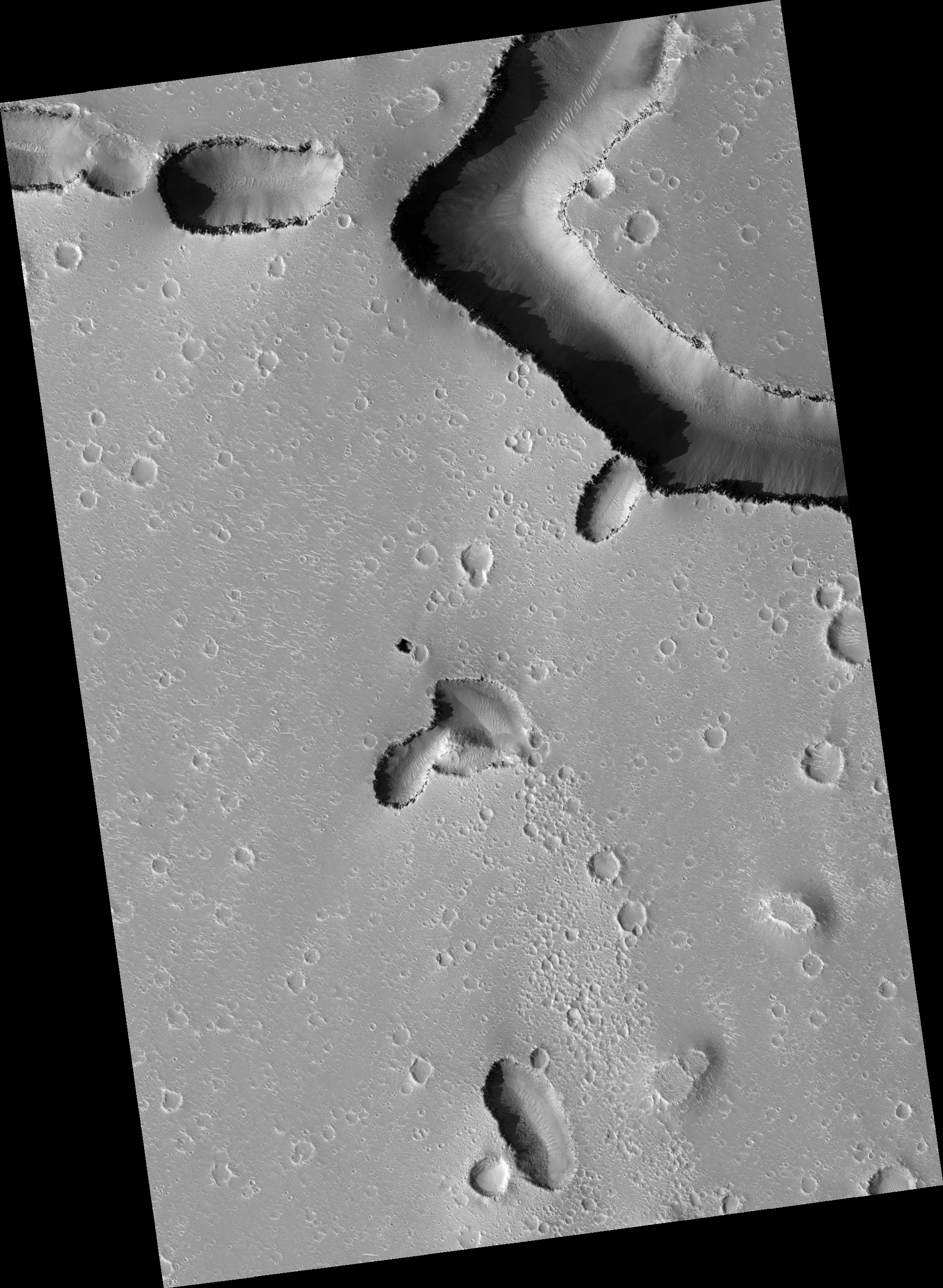
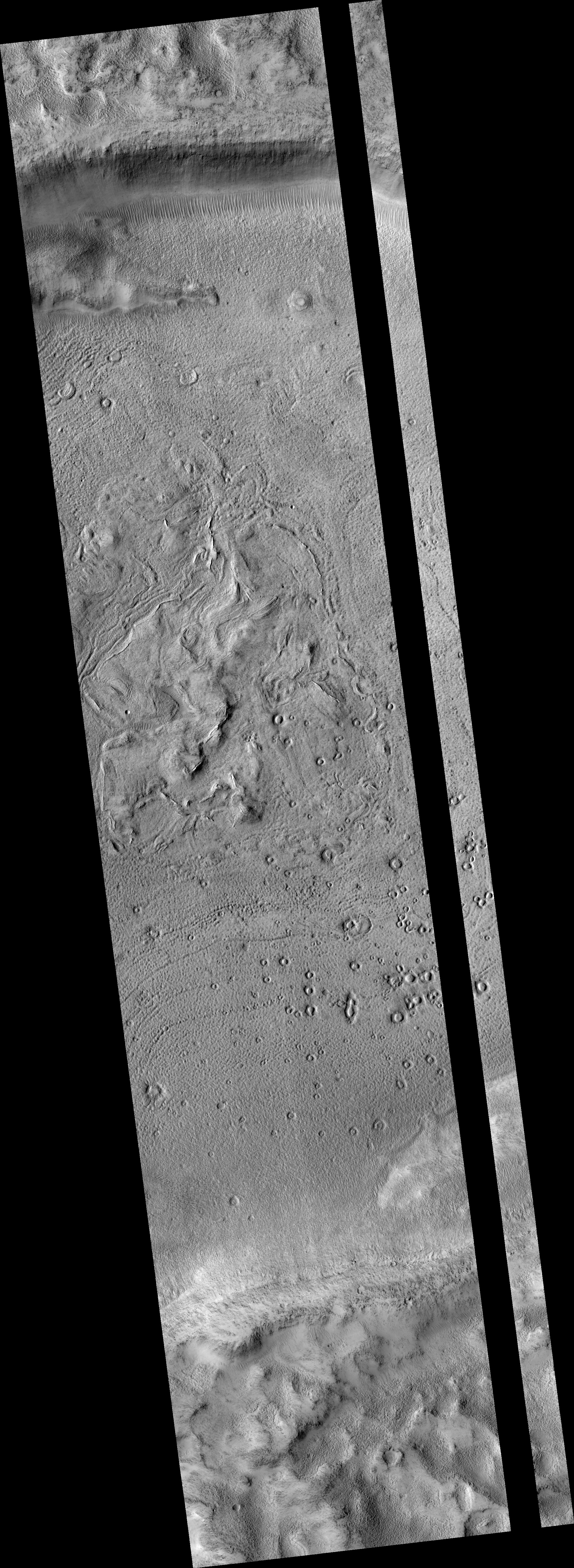
The smooth volcanic surfaces in the Gordii Fossae region are sometimes interrupted by long, narrow troughs, or fissures. These fissures form when underground faults, possibly involving magma movement, reach the near-surface, allowing material to collapse into pits or an elongated trough. This fissure appears to have erupted material that flowed onto the surface.

If you use your imagination, this trough resembles a gecko with its long tail and web-shaped feet!

This impression is even more evident in the wider image taken by MRO’s context camera below.
» Read more

3 comments

Dusty chaos in Martian canyons

Outcrops in dusty chaos on Mars
Click for full image.

Cool image time! The photo to the right, cropped and reduced to post here, was taken on May 30, 2021 by the high resolution camera on Mars Reconnaissance Orbiter (MRO). It shows the dusty dry floor of the chaos region of rough terrain in a side canyon of Valles Marineris, near its outlet. The color strip and the bright outcrops suggest that this terrain contains interesting minerals and resources. To determine exactly what those materials are however requires more information not available in this photo.

This ancient chaos terrain is the leftover eroded sea floor of a intermittent inland sea, leftover water from the catastrophic floods that are theorized to have flowed out of Valles Marineris and carved its gigantic canyons.

The overview map below shows this hypothesized sea.
» Read more

1 comment

Ancient fossil river in the very dry equatorial regions of Mars

Inverted Channel on Mars
Click for full image.

Cool image time! The photo to the right, rotated, cropped, and reduced to post here, was taken on August 29, 2021 by the high resolution camera on Mars Reconnaissance Orbiter (MRO). It shows what the scientists label an “inverted channel in Arabia Terra,” a small example of the more than 10,000 miles of fossilized rivers in this region on Mars that scientists have identified using MRO.

They are made of sand and gravel deposited by a river and when the river becomes dry, the channels are left upstanding as the surrounding material erodes. On Earth, inverted channels often occur in dry, desert environments like Oman, Egypt, or Utah, where erosion rates are low – in most other environments, the channels are worn away before they can become inverted. β€œThe networks of inverted channels in Arabia Terra are about 30m high and up to 1–2km wide, so we think they are probably the remains of giant rivers that flowed billions of years ago. [emphasis mine]

Since this fossilized river is located at 11 degrees north latitude, smack in the middle of the dry equatorial regions of Mars, it has certainly been a dry desert for a very long time. You can see how barren the terrain appears by looking at the wider view afforded by MRO’s context camera below.
» Read more

4 comments
1 50 51 52 53 54 90