A Martian cliff

A strange Martian cliff
Click for full image.

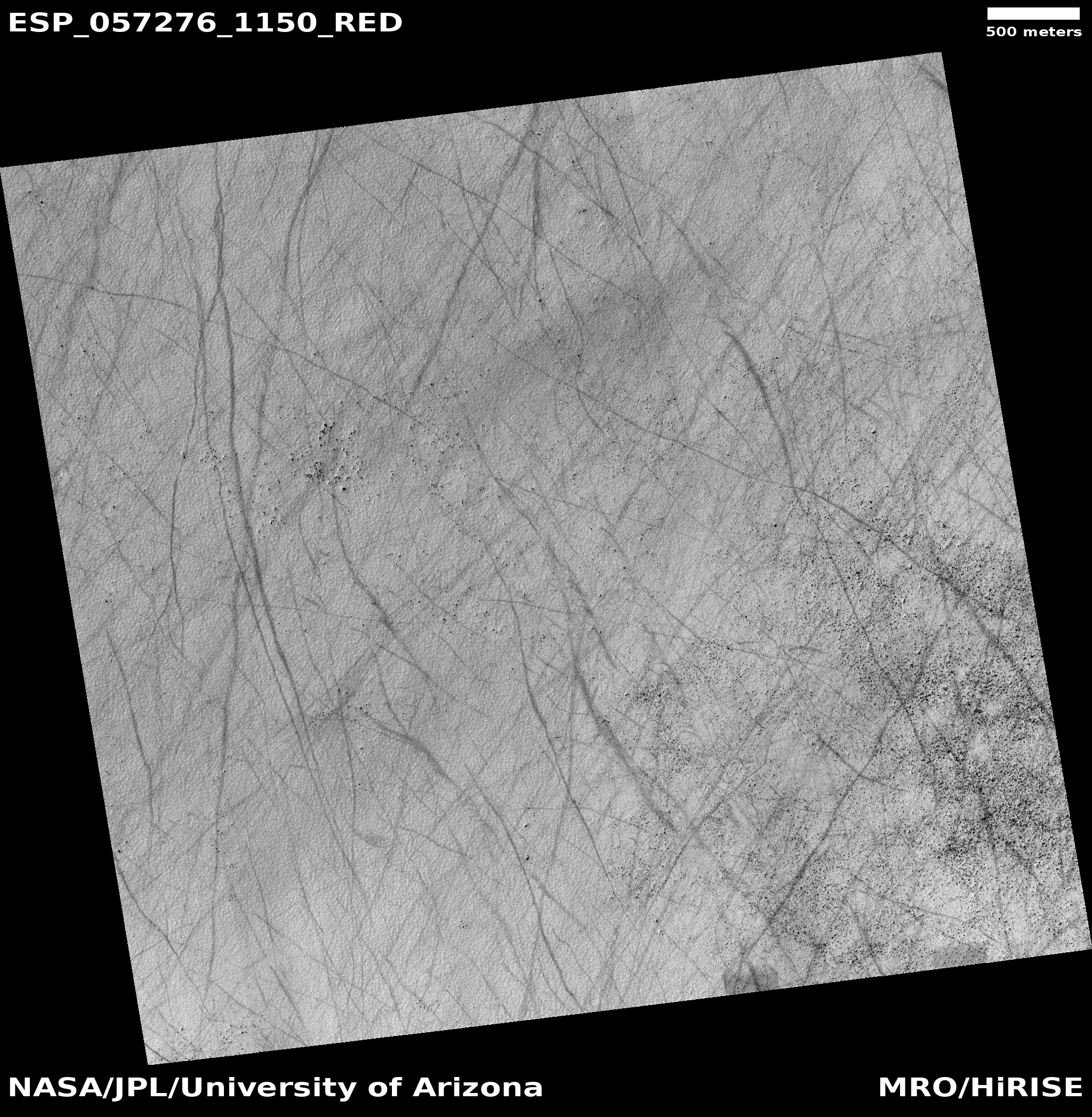
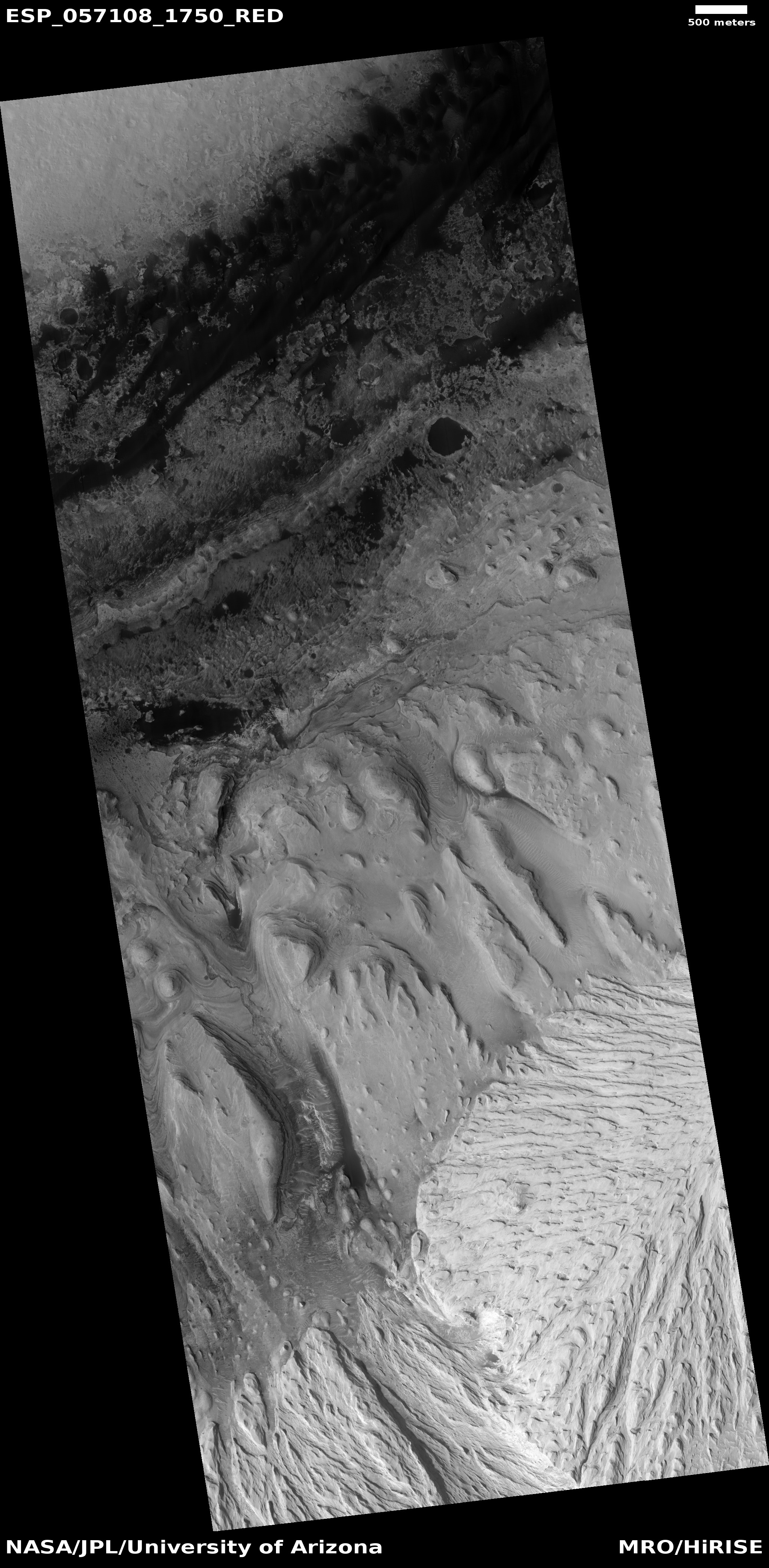
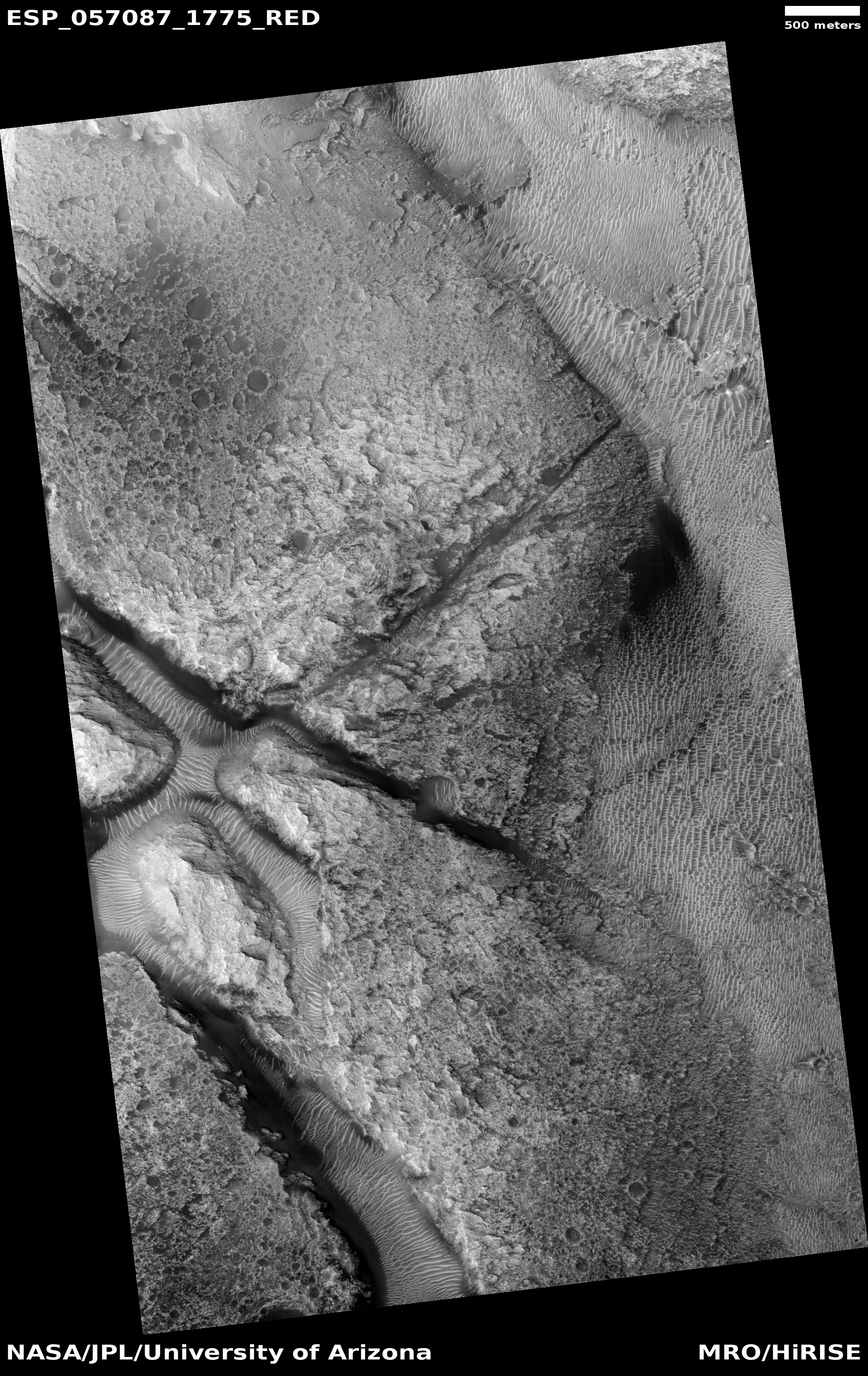
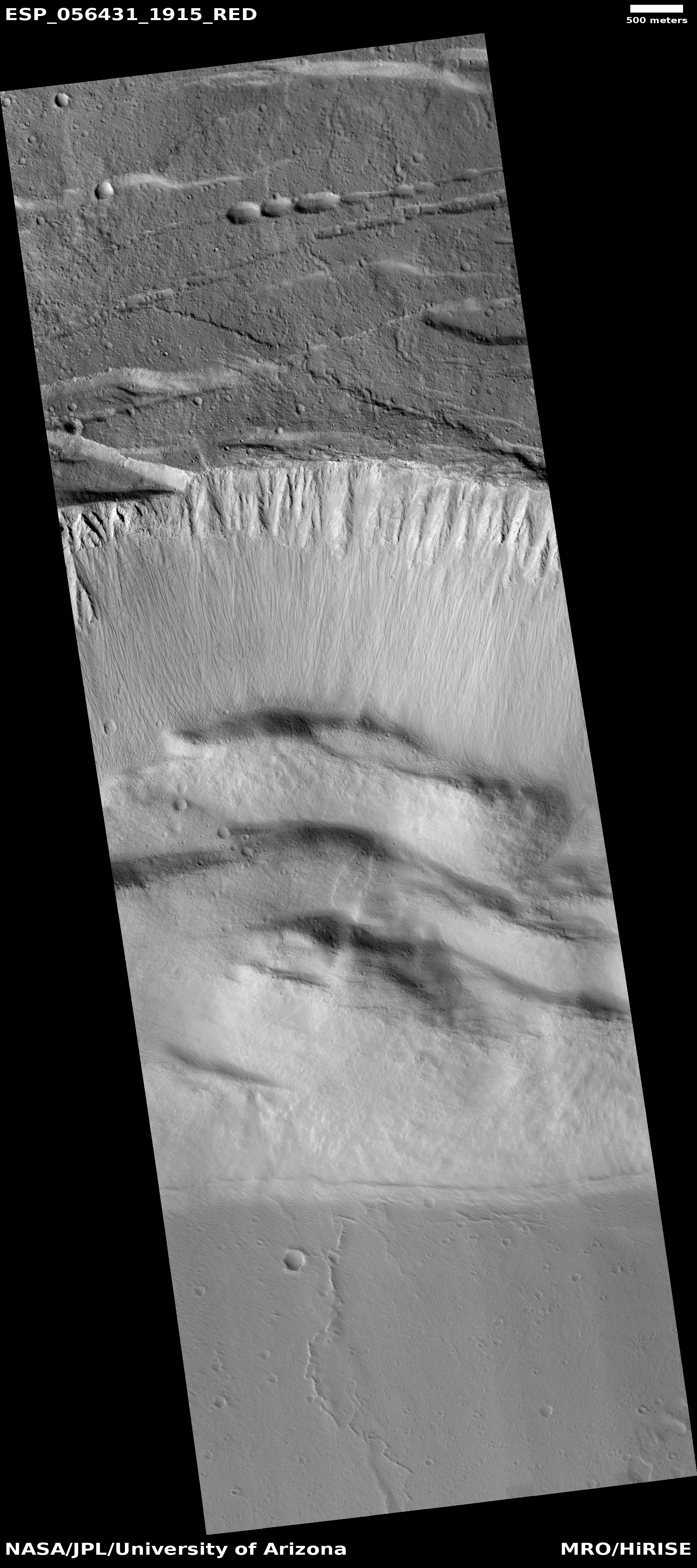
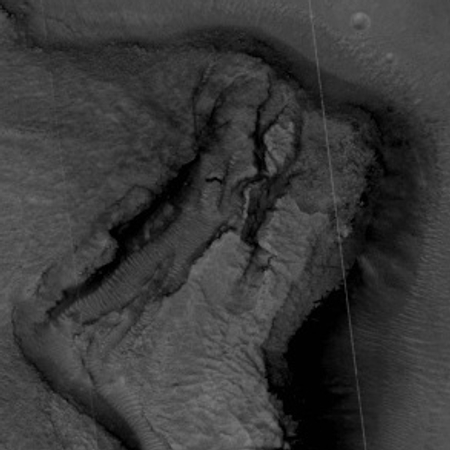
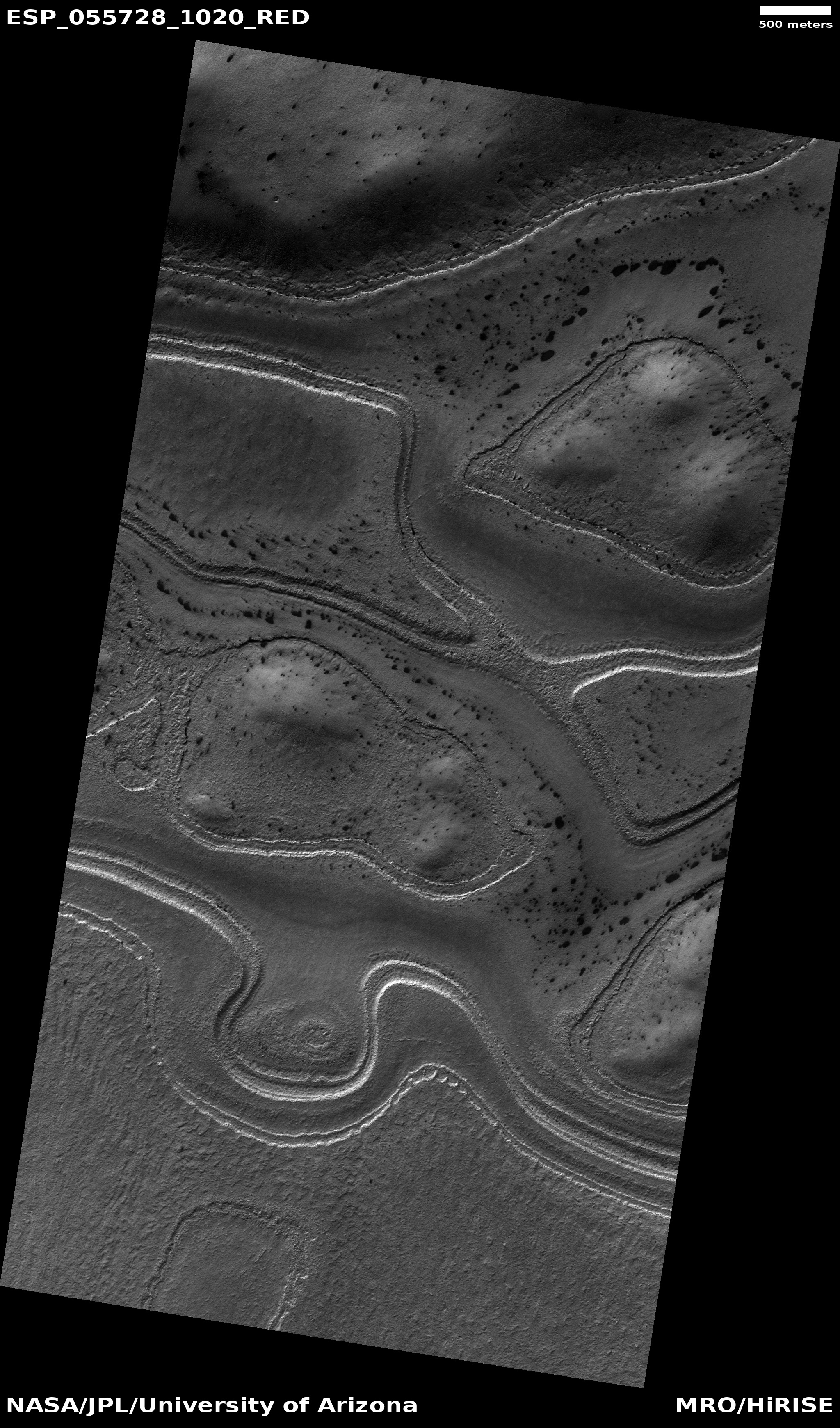
Many features on Mars immediately make one think of the Grand Canyon and the stark dramatic geology of the American southwest. Today’s cool image on the right, cropped and reduced to post here, is a typical example. Photographed on September 7, 2021 by the high resolution camera on Mars Reconnaissance Orbiter (MRO), it shows a dramatic cliff face that I estimate is about 3,000 feet high.

A closer look, however, almost always shows that this Martian terrain is not like the American southwest at all, but alien in its own way.

At the base of this abrupt cliff the terrain suddenly changes to a series of smooth downward fan-shaped flows. The cliff evokes rough boulders, avalanches, and chaotic erosion. The fans evoke a gentle and organized erosion of small particles like dust or sand. The two processes are completely different, and yet here the former is butted right up against the latter.

The fans also appear to flow out of hollows in the rough cliff, suggesting that somehow as the cliff erodes in chunks those chunks break into sand or dust, find the lowest points, and then flow downward like liquid.

How strange. How Martian. And how truly beautiful.

5 comments

Ice-filled crater on the Martian north polar ice cap

Ice-filled crater on the Martian north pole ice cap
Click for full image.

Cool image time! The photo to the right, cropped to post here, was taken on September 18, 2021 by the high resolution camera on Mars Reconnaissance Orbiter (MRO) and shows a very distinct impact crater on top of the layered deposits of ice mixed with dirt that form the bottom layers as well as surround the visible north pole ice cap on Mars.

I purposely cropped the high resolution image so that the crater is off center to show the dark streaks that appear to blow away from the crater to the northwest, west, and southwest. This asymmetric pattern suggests the wind direction at this location generally flows to the west, but the pattern might also be caused by lighting effects. The location is at 82 degrees north latitude, and the Sun was only 31 degrees high when the picture was taken, causing long shadows. Also, in the full image, you can see a whole strip of similarly oriented streaks, suggesting that these are slope streaks descending a slope going downhill to the northwest.

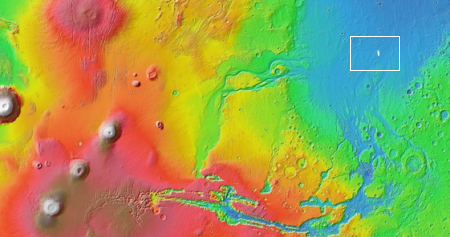
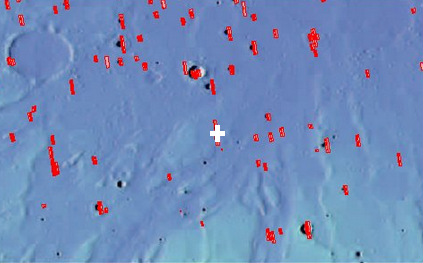
The overview map below also provides important information about this location.
» Read more

1 comment

Ice canyons at the Martian north pole

Ice canyons at the Martian north pole
Click for full image.

Cool image time! The photo to the right, cropped and reduced to post here, was taken on July 24, 2021 by the high resolution camera of Mars Reconnaissance Orbiter (MRO) and shows one small portion of the edge of Mars’ north pole ice cap.

The many layers in that ice cap are clearly evident, with some darker because they were probably laid down at a time when the Martian atmosphere was more filled with volcanic ash. According to the presently accepted theory, the layers show the cyclical climate patterns of Mars, caused by the large shifts in its obliquity, or the tilt of the planet along its rotational axis, ranging from 11 to 60 degrees. Presently Mars is tilted 25 degrees, similar to Earth’s 23 degrees. The two extremes cause the planet’s water ice to shift back and forth from the mid-latitudes to the poles, causing the layers.

The height of this layered cliff face is probably about 1,500 feet, though that is a very rough estimate. Notice also that this image shows an ice canyon running from the left to the right and flowing into a much larger ice canyon to the right. The top cliff is probably about a third the height of the bottom cliff.

The overview map below shows gives the context, not only in place but also in time.
» Read more

1 comment

The badlands on the floor of Valles Marineris

The badlands on the floor of Valles Marineris
Click for full image.

Cool image time! The recent discovery that there might be a near surface reservoir of ice on the floor the canyon Valles Marineris, near the Martian equator, immediately brought this location to the forefront as a possible site for establishing colonies. The weather will be less harsh than higher latitudes, the low elevation means a thicker atmosphere, and the terrain will be more appealing than the boring flat northern lowlands.

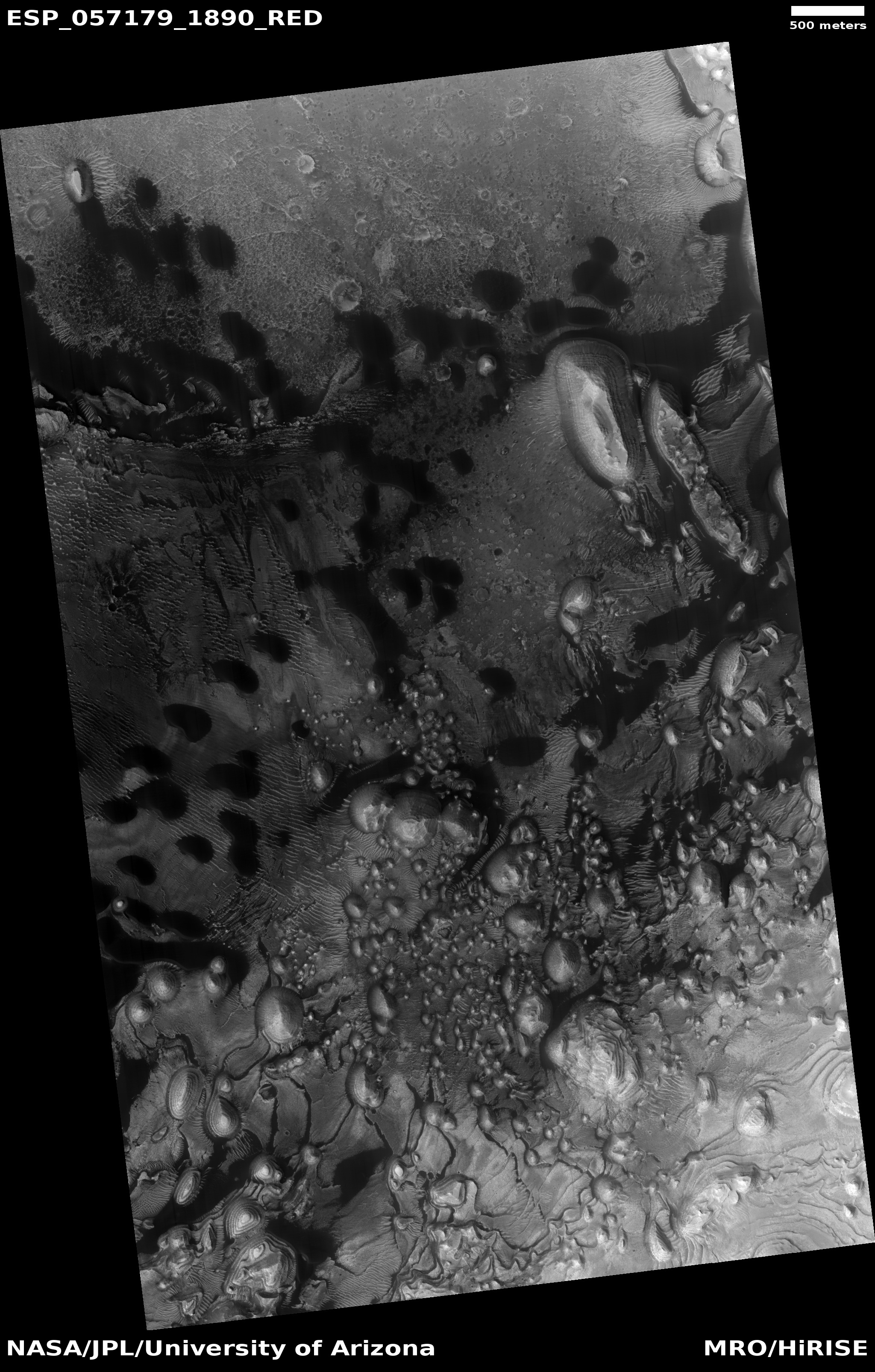
The picture to the right, cropped and reduced to post here, illustrates however the likely difficulties of landing and living on the floor of Valles Marineris. Taken on July 26, 2021 by the high resolution camera on Mars Reconnaissance Orbiter (MRO), the photo shows just one small area of the floor of Ius Chasm, the western part of Valles Marineris and about 300 miles to the east of that water reserve.

In this one picture we can see trapped sand dunes in hollows, eroded depressions, mottled terrain resembling stucco, and innumerable cliffs and sinks and plateaus. For the first manned spacecraft to land on Mars, this is not a good first choice. Even later, when the first bases have been built, this terrain would still be forbidding for the early colonists to land in and traverse.

The overview map below shows exactly where this picture is relative to the rest of the Valles Marineris.
» Read more

16 comments

Slope streaks in frozen lava flows on Mars

Slope streaks on frozen lava
Click for full image.

Cool image time! The photo to the right, cropped and reduced to post here, was taken on June 5, 2021 by the high resolution camera on Mars Reconnaissance Orbiter (MRO). It shows a ridgeline at the base of the giant volcano Pavonis Mons, with slope streaks on ridge’s north and south sides.

Slope streaks are a mysterious phenomenon unique to Mars. While they resemble an avalanche, they do not change the topography of the surface at all. They appear to occur randomly year round, fading slowly with time. Also, while most are dark, scientists have also spotted bright slope streaks as well.

Slope streaks also only appear on surfaces covered with a layer of fine dust, something that is obviously the case in the cool image to the right. There is so much dust on the surface here that bedrock only appears at the top of the ridge, peeking out in only a few places.

The location of this image, as shown in the overview map below, adds some additional details.
» Read more

1 comment

Cracking glaciers on Mars

Cracking glaciers on Mars
Click for full image.

Cool image time! The photo to the right, cropped and reduced to post here, was released today as the picture of the day for the high resolution camera on Mars Reconnaissance Orbiter (MRO). Located in the 2,000 long northern mid-latitude strip that I dub Mars’ glacier country, it shows many of the numerous glacial features that are routinely found in images taken in this region. According to Dan Berman, senior scientist at the Planetary Science Institute in Arizona, who wrote the caption,

This observation shows a lobe-shaped debris apron emanating from a massif (shown in the upper left of the image) in the Protonilus Mensae region in the Northern Hemisphere of Mars. These aprons are composed of nearly pure water ice with a layer of debris on the surface protecting the ice from sublimation (going directly from a solid to gaseous state). This image shows different terrain types on the apron that indicate the presence and flow of ice, from smoother polygonal terrain closer to the massif, to rougher, patterned ground commonly called โ€œbrain terrain.โ€ Also visible on the apron are a series of linear pits.

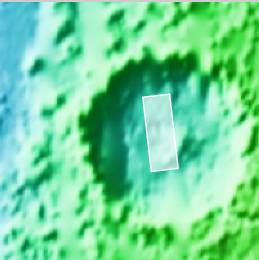
Protonilus Mensae is the central mensae region in that mid-latitude strip of glaciers.The overview map below shows the location of this photo in that region. Also below is a close-up of the linear pits and cracked terrain surrounding that oblong mound, as indicated by the white rectangle.
» Read more

0 comments

Visible clean water ice on Mars

Crater with ice scarp
Click for full image.

Cool image time! The photo to the right, cropped and reduced to post here, is today’s picture of the day for the high resolution camera on Mars Reconnaissance Orbiter (MRO). Taken on September 13, 2021, it shows an exposed scarp on the southern inner wall of a small 800-foot-wide crater.

What makes that scarp intriguing is its blue color. As noted by Shane Byrne of the Lunar and Planetary Lab University of Arizona, who wrote the caption:

This north-facing cliff appears to expose icy material thatโ€™s similar to other pole-facing scarps showing buried ice elsewhere on the planet. These cliffs give us a cut-away view of the buried ice in that location and can help answer questions about what the Martian climate was like when this ice formed.

The crater itself sits inside a much larger crater, as shown in the wider picture below.
» Read more

7 comments

Strange eroded glacial flows in unnamed crater on Mars

Eroded glacial flows in unnamed crater on Mars
Click for full resolution image.

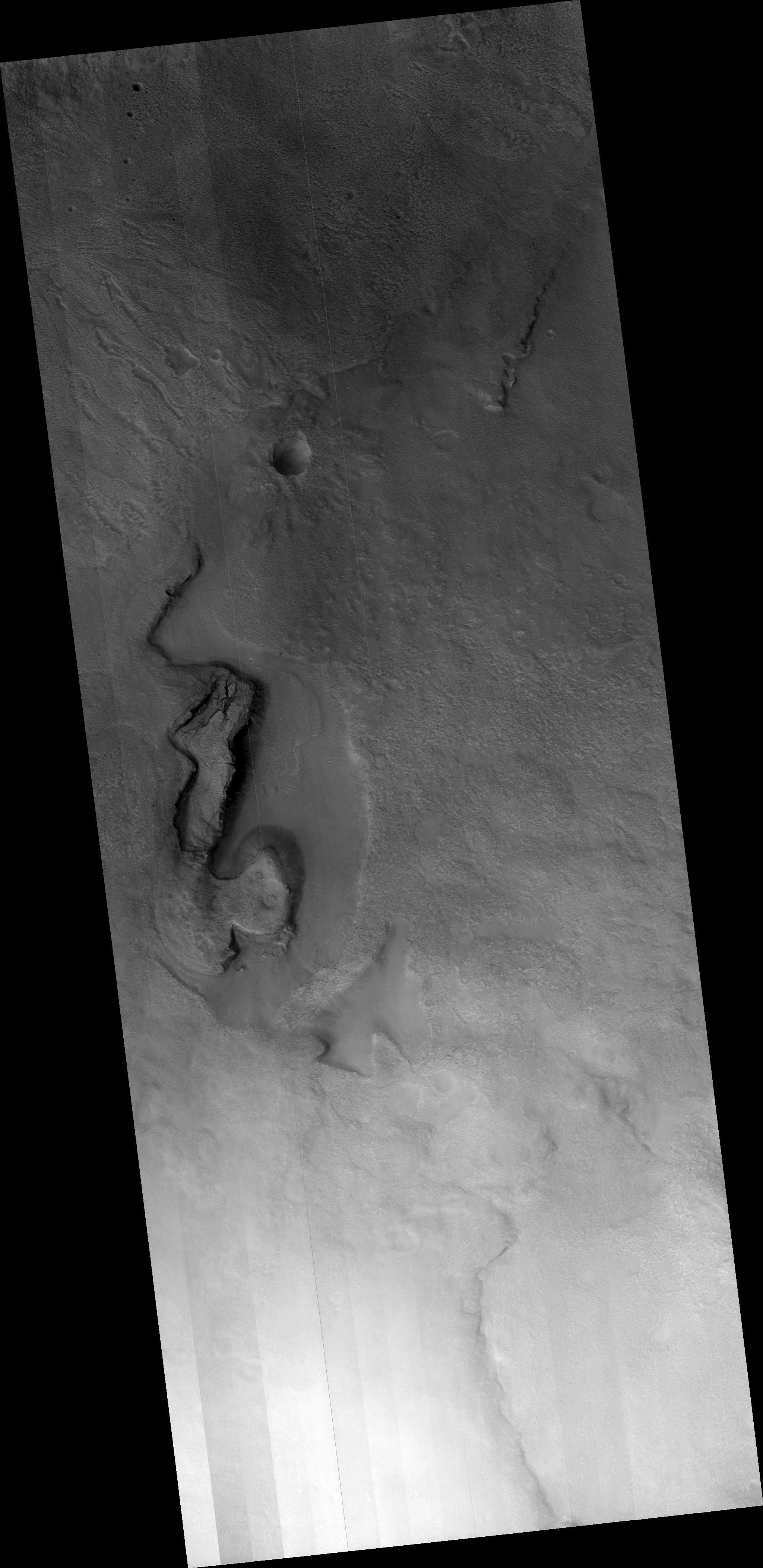
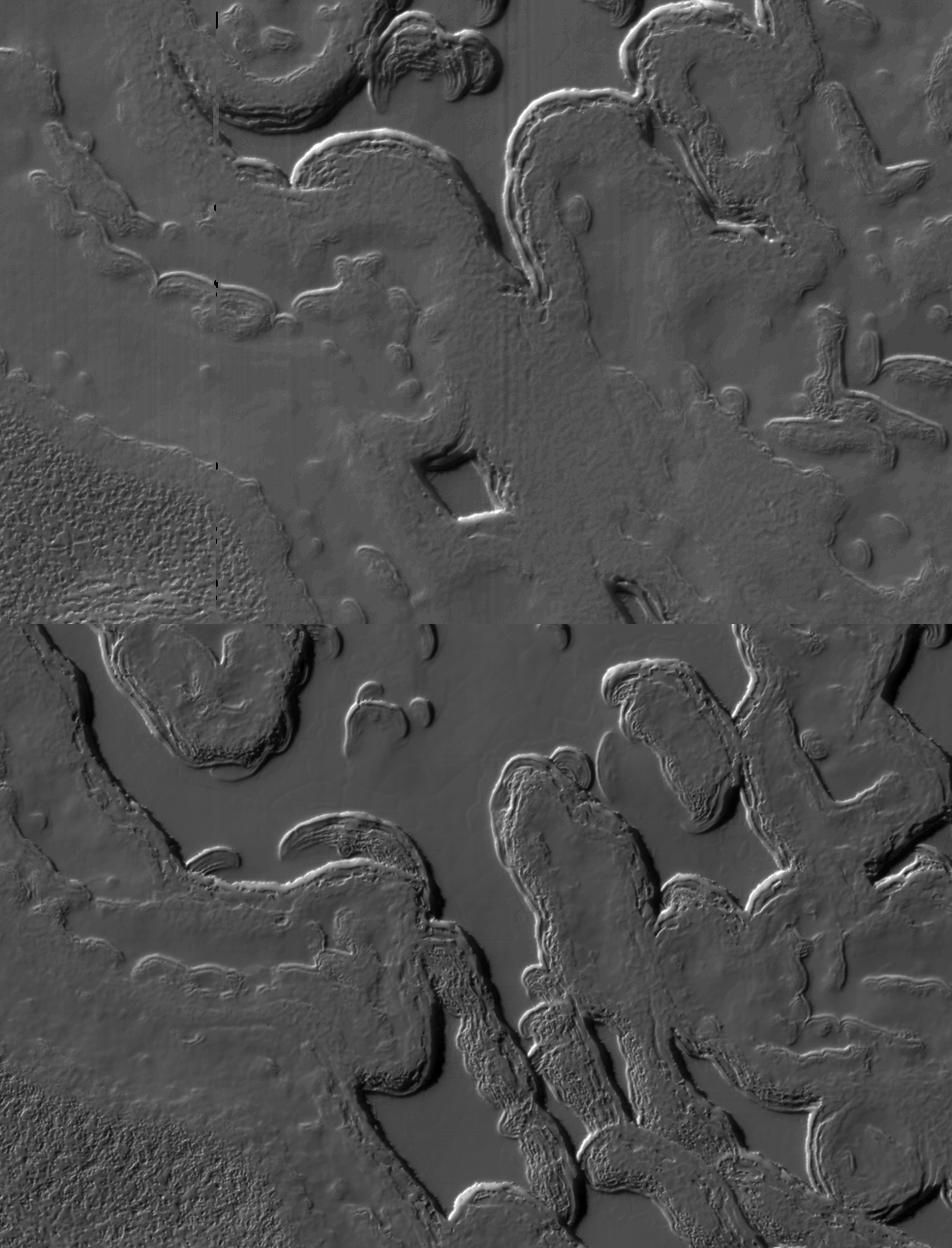
Cool image time! The photo to the right, rotated, cropped, and reduced to post here, was taken on November 1, 2021 by the high resolution camera on Mars Reconnaissance Orbiter (MRO). It shows a series of strange glacial-like flows coming off the western slopes of the central peak of a 40-mile-wide unnamed crater, located smack dab in what I call Mars’ glacier country, that 2,000 long mid-latitude strip where almost every image shows evidence of glaciers.

The cropped section to the right doesn’t really do these strange flows justice. Make sure you click on the image to see the full resolution version. There are numerous separate flows coming off that central peak. Each appears to show that as time passed, each flow traveled a shorter distance down the mountain, leaving a moraine behind at higher and higher points.

The overview map below provides the context.
» Read more

0 comments

Sculptured lava south of Olympus Mons?

Sculptured lava?
Click for full image.

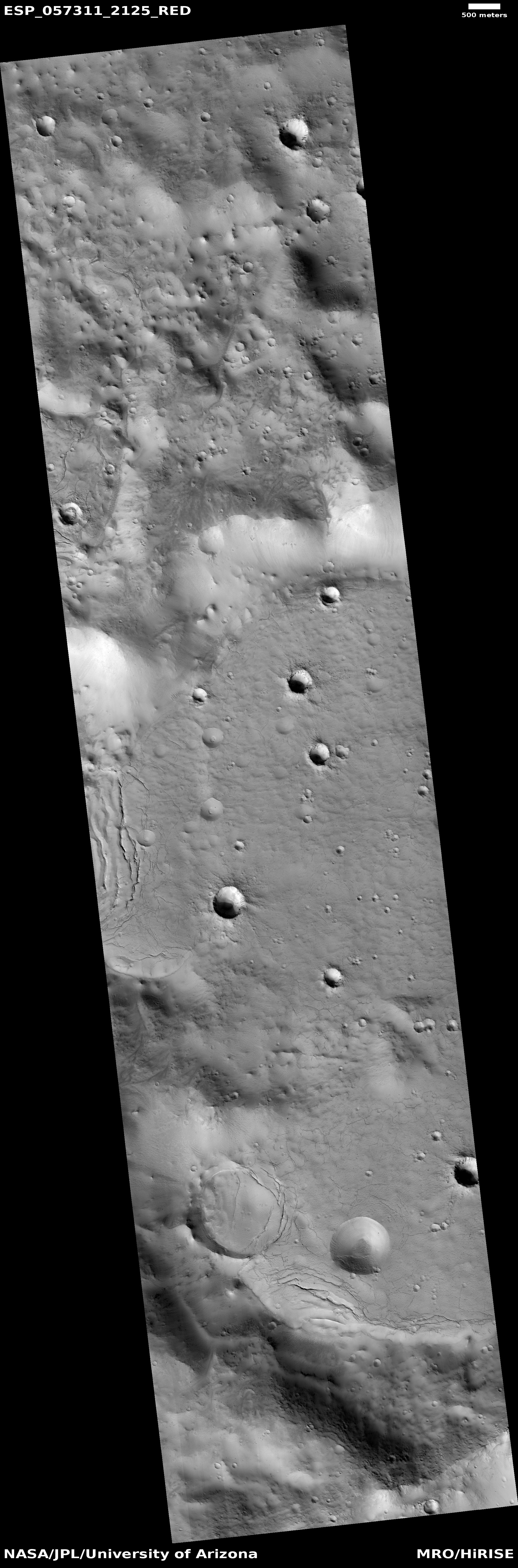
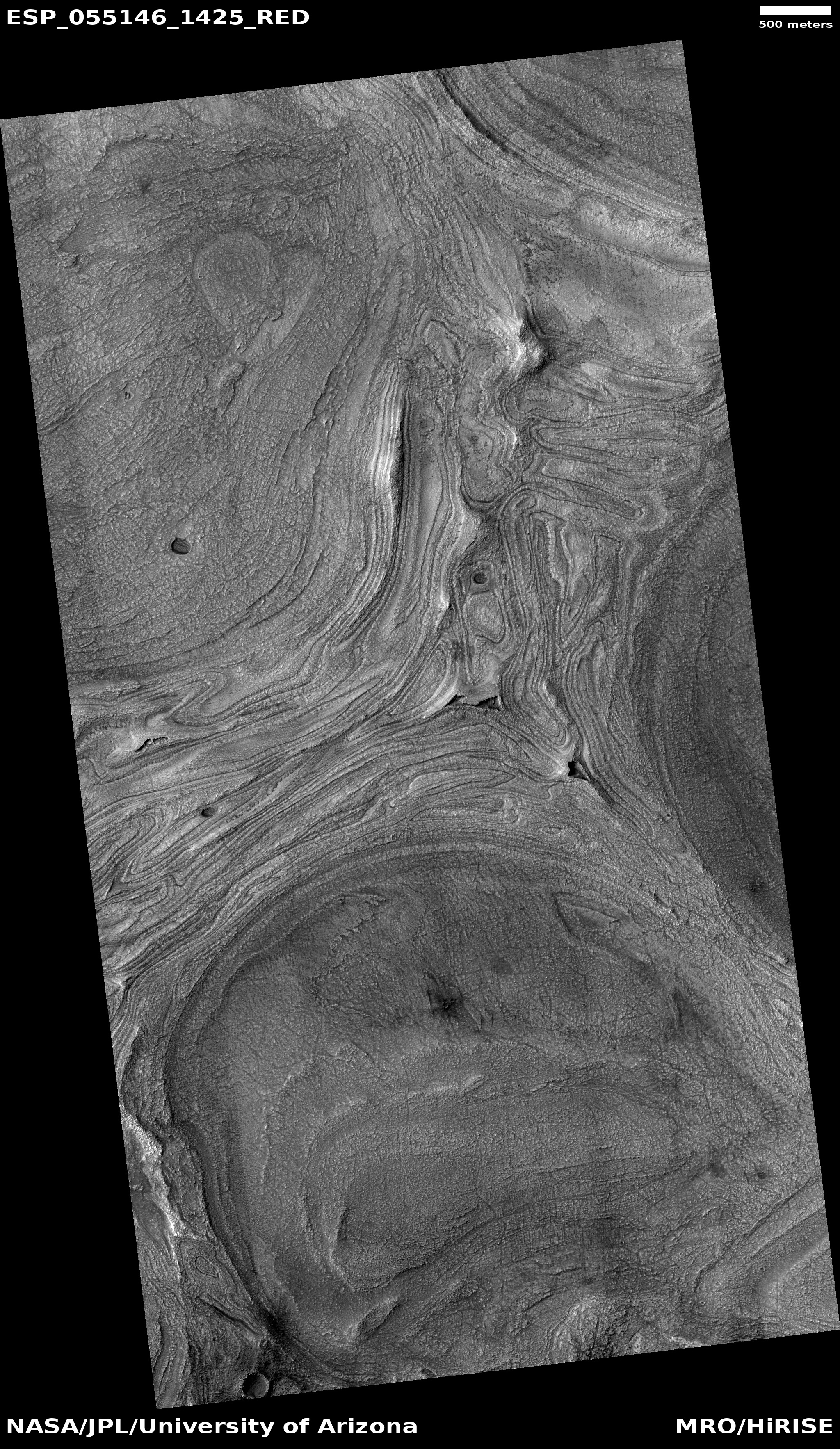
Time for a cool image! The photo to the right, rotated, cropped, and reduced to post here, was taken on September 8, 2021 by the high resolution camera on Mars Reconnaissance Orbiter (MRO). It shows a region of strangely sculptured terrain located several hundred miles south of Olympus Mons.

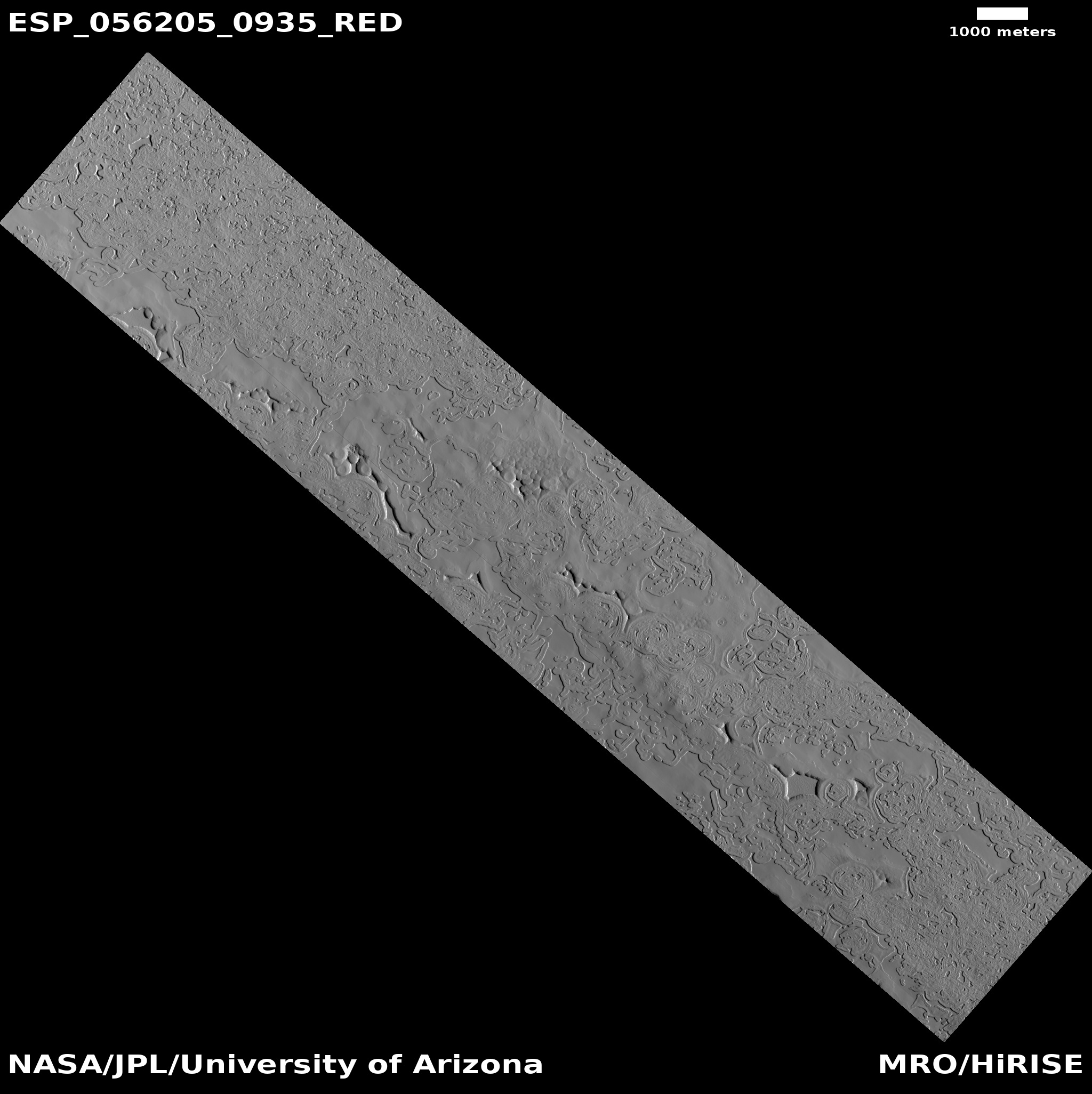
It appears the prevailing winds are to the west. The question is whether the wind is shaping a hard lava surface, over eons, or is shaping instead layers of dust or volcanic ash quickly and seasonally. At this location either is possible. In fact, we might even be seeing evidence of both at the same time.

The overview map below shows that the location is just outside the Medusae Fossae Formation, the largest volcanic ash deposit on Mars.
» Read more

6 comments

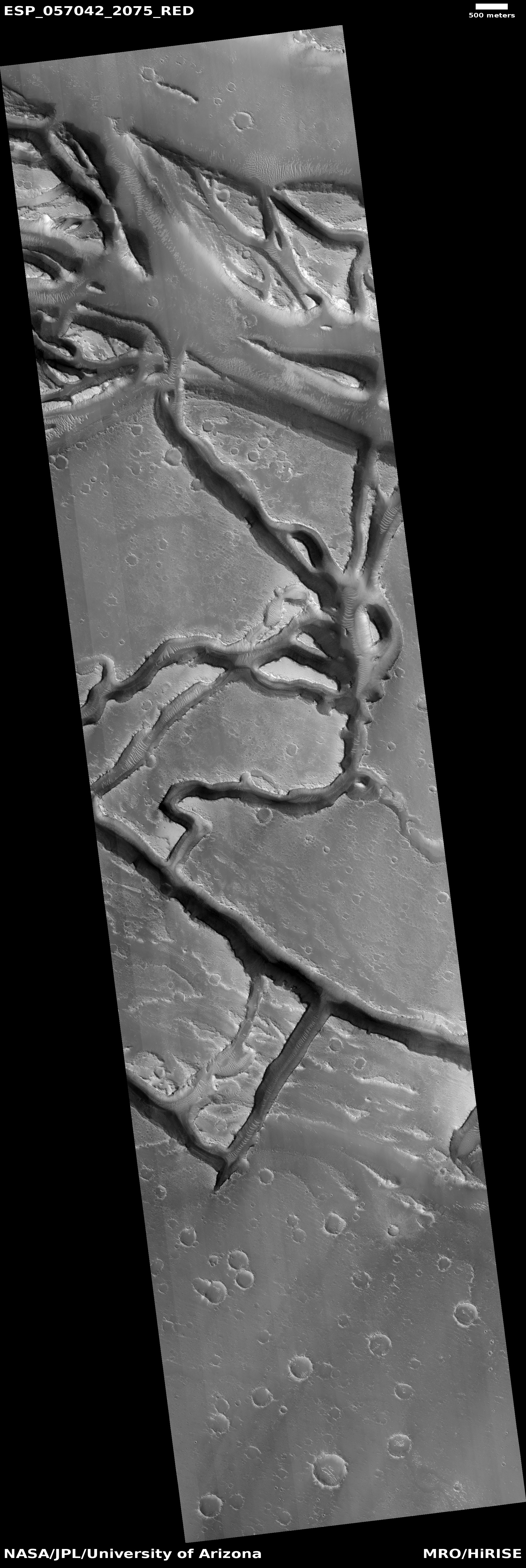
Volcanic vent on Mars

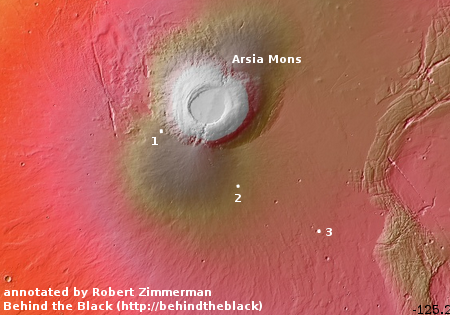
Overview of Arsia Mons pits

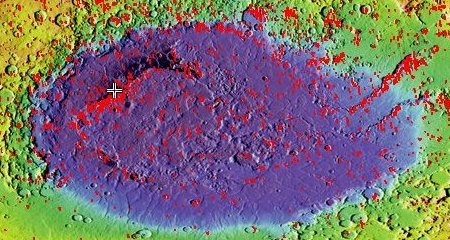
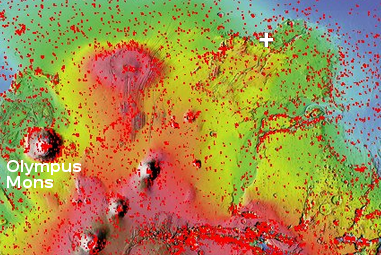
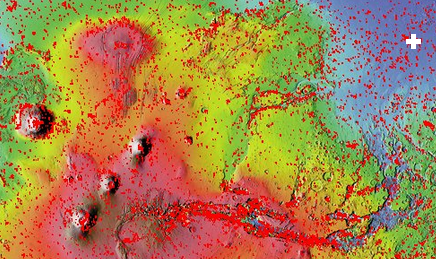
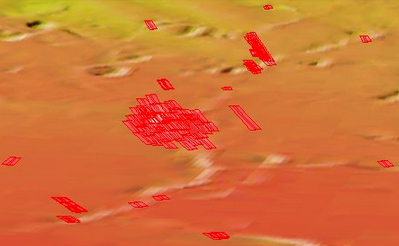
To understand today’s cool image we really should start from a distance and zoom in. The overview map to the right focuses in on the two southernmost giant volcanoes in the string of three that sit to the east of Mars’ biggest volcano, Olympus Mons, and to the west of the planet’s biggest canyon, Valles Marineris.

The black dots mark the locations of the many high resolution photos taken by Mars Reconnaissance Orbiter that I have featured previously on Behind the Black. Many are isolated openings with no related geological features. Others appear to be skylights into a more extensive lava tube, hinted at by either a continuing surface depression or a series of similar skylights.

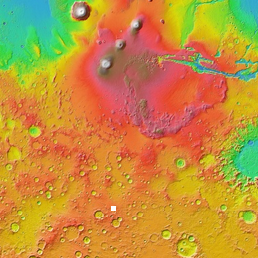
The white dot marks the location of today’s cool image, about 350 miles south of Arsia Mons’ caldera.
» Read more

2 comments

Craters in the soft Martian northern lowland plains

Craters in the soft Martian northern lowland plains
Click for full image.

Cool image time! The photo to the right, cropped and reduced to post here, was a featured image today from the high resolution camera on Mars Reconnaissance Orbiter (MRO).

The caption, written by Carol Weitz of the Planetary Science Institute in Arizona, focused on the wind patterns created within these craters.

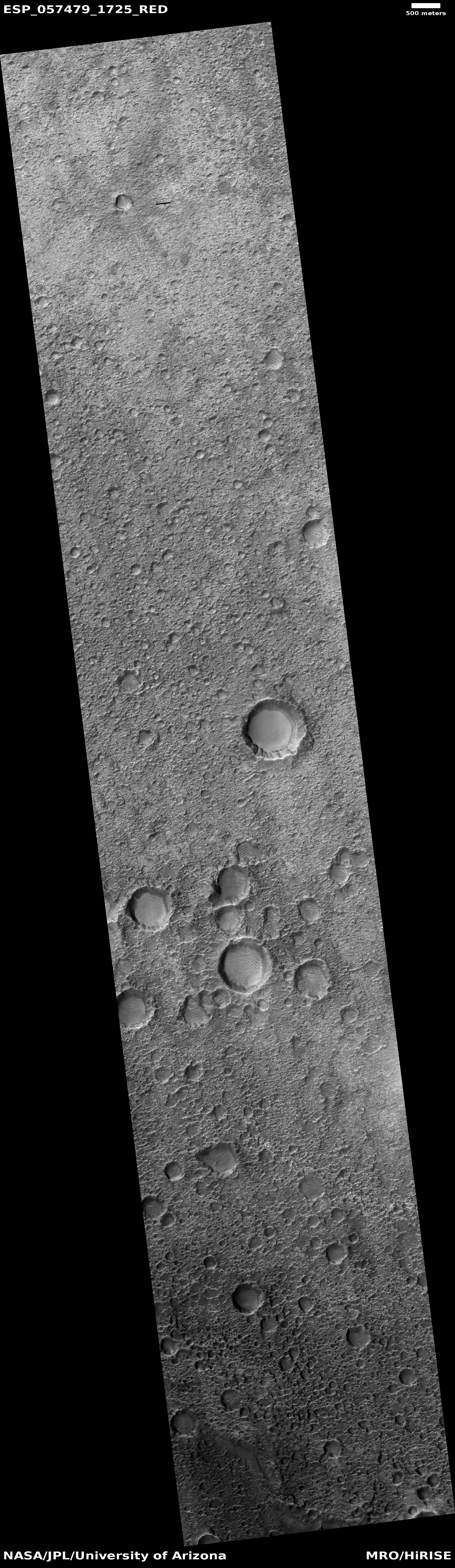
These impact craters in the northern middle latitudes have interesting interiors: all of them have wind-blown (aeolian) ripples.

Outside of the craters and along the crater floors, the ripples are all oriented in the same direction. However, along the walls of some of the larger craters, the ripples are situated radially away from the center, indicating the winds moving inside the larger craters can be influenced by the topography of the crater wall.

Additionally, many of the larger craters have layered mesas along their floors that are likely sedimentary deposits laid down after the craters formed but prior to the development of the aeolian ripples.

I am further intrigued by the rimless nature of these craters, as well as the lack of significant rocky debris at their edges. They all look like the bolides that created them impacted into a relatively soft surface that, rather than break up into rocks and boulders, melted, flowed, and then quickly refroze into these depressions.

The location, as always, provides us a possible explanation.
» Read more

2 comments

Snow on Martian dunes

Snowy dunes near the Martian north pole
Click for full image.

Close-up of snowy dunes
Click for full image.

Cool image time! The first photo to the right, rotated, cropped, and reduced to post here, was taken on September 19, 2021 by the high resolution camera on Mars Reconnaissance Orbiter (MRO), and shows what appears to be snow nestled in the hollows of many dunes.

The second photo, cropped to post here, shows in high resolution the area in the white box.

Is that snow water, or dry ice? The location is very far north, 76 degrees latitude, so it could be either. Since the photo was requested by Candice Hansen of the Planetary Science Institute in Arizona, I emailed her to ask. Her answer:

Early in the spring all the bright stuff is dry ice. As it gets later in the spring it is probably still mostly dry ice but with HiRISE images alone we cannot really distinguish the composition of the ice. In-between the dunes it is almost certainly bare ground late in the spring, but since the dunes are dark the surface just looks bright in contrast

This picture was taken in summer, which suggests the snow is probably water, not dry ice. Yet, all the snow is found in the north-facing hollows, places that will remain mostly in shadow at this high latitude, 76 degrees north. Thus, it is possible that the snow is the last remaining traces of the thin dry ice mantle that covers the Martian poles down to about 60 degrees latitude during the winter, and sublimates away in summer.

Hansen had requested a whole bunch of similar images of such snowy dunes. As she explained,
» Read more

2 comments
1 49 50 51 52 53 90