Ground-based telescope actually photographs an exoplanet

exoplanet imaged directly
Click for original movie.

Using a new instrument on the Subaru Telescope in Hawaii astronomers have not only discovered a massive exoplanet orbiting a star, they have been able to actually photograph the planet itself.

The arrow in the picture to the right shows that planet. That picture is a screen capture from a short movie complied from five observations taken over several months earlier this year, showing the planet as it orbited the star, the light of which is blocked out so as to not blind the camera. From the press release:

The newly discovered planet, HIP 54515 b, orbits a star 271 light-years away in the constellation Leo. With nearly 18 times Jupiter’s mass, it circles its star at about Neptune’s distance from our Sun. But the star and planet appear very close when seen from Earth; roughly the size that a baseball seen 100 km away would appear. The SCExAO system produced extremely sharp images allowing us to see the planet.

The astronomers also used this new instrument to image a brown dwarf star with a mass equivalent to sixty Jupiters about 169 light years away.

Weird mottled terrain in the dry tropics of Mars

Mottled ridges
Click for full image.

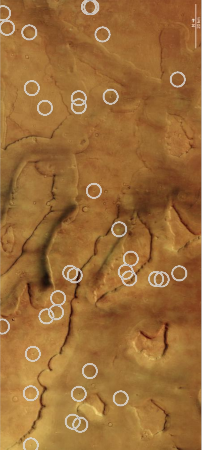
Cool image time! The picture to the right, cropped, reduced, and enhanced to post here, was taken on October 28, 2025 by the high resolution camera on Mars Reconnaissance Orbiter (MRO). Labeled by the science team as “mottled ridged terrain,” it shows a relatively flat area of scattered broken-up flat-topped ridges and knobs, following no clear pattern of formation.

In trying to research this, I could only find one paper [pdf] discussing this kind of mottled ridges that did a survey of similar features across a large region to the northwest. That paper could not determine what caused such features, but came up with hypothesis. From the abstract:

While it is not possible to determine the precise formation mechanism of these polygonal ridge networks from our new data, their formation can be assessed in terms of three possibly separate processes: (1) polygonal fracture formation, (2) fracture filling and (3) exhumation. We find that polygonal
fracture formation by impact cratering and/or desiccation of sedimentary host deposits is consistent with our results and previous spectral studies. Once the polygonal fractures have formed, fracture filling by clastic dikes and/or mineral precipitation from aqueous circulation is most consistent with our results. Exhumation, probably by aeolian processes that eroded much of these ancient Noachian terrains where the ridges are present caused the filled fractures to lie in relief as ridges today.

To put this in plain terms, the initial polygon-patterned cracks were formed by either an impact or the drying out of the surface (similar to the cracks seen on dried mud here on Earth). Both could have contributed. Then material welled up from below, either lava or mud, that hardened to fill the cracks. Later erosion by wind stripped away the surface, leaving behind these broken ridges.

As always, the location adds some very interesting context.
» Read more

Sunspot update: Sunspot activity again crashes far below predictions

It is the start of another month, so it is time again to post my monthly update of the never-ending sunspot cycle on the Sun, using NOAA’s own monthly update of its graph of sunspot activity and annotating it with extra information to illustrate the larger scientific context.

The green dot on the graph below indicates the level of sunspot activity on the Sun’s Earth-facing hemisphere during the month of November. And once again, the Sun surprised us, producing far less sunspots than expected, based on the April 2025 prediction by NOAA’s panel of solar scientists (as indicated by the purple/magenta line).
» Read more

New data from VLT uncovers numerous debris disks around stars

A sampling of debris disks
Click for original

Using a new instrument on the Very Large Telescope (VLT) in Chile, astronomers have compiled a catalog of 51 potential exoplanet solar systems, all with intriguing debris disks surround the stars with features suggesting the existence of asteroids and comets.

The image to the right shows a sampling of those systems. From the press release:

“To obtain this collection, we processed data from observations of 161 nearby young stars whose infrared emission strongly indicates the presence of a debris disk,” says Natalia Engler (ETH Zurich), the lead author of the study. “The resulting images show 51 debris disks with a variety of properties — some smaller, some larger, some seen from the side and some nearly face-on – and a considerable diversity of disk structures. Four of the disks had never been imaged before.”

Comparisons within a larger sample are crucial for discovering the systematics behind object properties. In this case, an analysis of the 51 debris disks and their stars confirmed several systematic trends: When a young star is more massive, its debris disk tends to have more mass as well. The same is true for debris disks where the majority of the material is located at a greater distance from the central star.

Arguably the most interesting feature of the SPHERE debris disks are the structures within the disks themselves. In many of the images, disks have a concentric ring- or band-like structure, with disk material predominantly found at specific distances from the central star. The distribution of small bodies in our own solar system has a similar structure, with small bodies concentrated in the asteroid belt (asteroids) and the Kuiper belt (comets).

The data from various telescopes both on the ground and in space is increasingly telling us that our solar system is not unique, and that the galaxy is filled with millions of similar systems, all in different states of formation. This hypothesis is further strengthened by the appearance of interstellar comet 3I/Atlas, which despite coming from outside our solar system is remarkably similar to the comets formed here.

Astronomers detect another galaxy that shouldn’t be there, so soon after the Big Bang

A spiral galaxy too early in the universe
Click for original.

Using the Webb Space Telescopes astronomers have detected another galaxy that shouldn’t be there, so soon after the Big Bang.

The image to the right comes from figure 1 of the peer-reviewed paper. The galaxy’s two spiral arms form a backward “S” emanating out from the galaxy’s nucleus. From the press release:

Using JWST, researchers Rashi Jain and Yogesh Wadadekar spotted a galaxy remarkably similar to our own Milky Way. Yet this system formed when the cosmos was barely 1.5 billion years old—roughly a tenth of its present age. They named it Alaknanda, after the Himalayan river that is a twin headstream of the Ganga alongside the Mandakini—fittingly, the Hindi name for the Milky Way.

…It already has two sweeping spiral arms wrapped around a bright, rounded central region (the galaxy’s ‘bulge’), spanning about 30,000 light-years across. Even more impressively, it is annually churning out new stars, their combined mass roughly equivalent to 60 times the mass of our Sun. This rate is about 20 times that of the present-day Milky Way! About half of Alaknanda’s stars appear to have formed in only 200 million years—a blink in cosmic time.

This galaxy underlines the difficulty for cosmologists by much of Webb’s data of the early universe. Present theories of galaxy formation say it should take billions of years to form such a spiral galaxy, meaning it shouldn’t exist as yet so soon, only 1.5 billion years after the Big Bang.

Either the theories have to be revised substantially, or they are simply wrong entirely. Or we are missing or lacking in some fundamental information about the early universe that skews all our theories.

Three new papers find sugars, “gum,” and lots of stardust in the samples brought back from the asteroid Bennu

Bennu
The asteroid Bennu

Three new papers published this week have found that the samples brought back by OSIRIS-REx from the asteroid Bennu contained some unexpected or unusual materials, including sugars that are important for biology, a gumlike material never seen before, and a much higher amount of stardust than expected.

The papers can be read here, here, and here.

As the press release notes, describing the sugar discovery:

The five-carbon sugar ribose and, for the first time in an extraterrestrial sample, six-carbon glucose were found. Although these sugars are not evidence of life, their detection, along with previous detections of amino acids, nucleobases, and carboxylic acids in Bennu samples, show building blocks of biological molecules were widespread throughout the solar system.

The stardust results found six-times the abundance previously found in other samples.

As for the “gum”, this was possibly the strangest discovery of all, coming from the solar system’s earliest time period.
» Read more

More glaciers on Mars

Overview map

More glaciers on Mars
Click for original image.

Cool image time! The picture to the right, rotated, cropped, reduced, and sharpened to post here, was taken on September 26, 2025 by the high resolution camera on Mars Reconnaissance Orbiter (MRO).

The scientists label this image “Moraine-like assemblage exposed by ice retreat.” I say: If anyone still doubts the extensive presence of near-surface ice on Mars, this picture should put that doubt to rest.

The white dot on the overview map above marks the location, deep within the 2,000-mile-long strip in the Martian northern mid-latitudes that I label “glacier country,” because practically every picture taken there shows glacial features. This picture is just one more example. As the inset in the overview above shows, this flow is coming down from the exterior rim of an unnamed, partly obscured ancient 17-mile-wide crater, dropping about 7,000 feet from the rim’s peak. This particular section shows the last 3,000 feet of that descent, as the glacier worked its way through a gap in a ridge paralleling that rim.

The image label refers to the flow features that appear to be corroding away. It appears the full data set suggests that corrosion is exposing the material pushed downward by that glacier, what on Earth we call a moraine.

Predicting dust storms in the Starship candidate landing zone on Mars

View of dust storm one
Click for original figure.

Scientists using the UAE’s Al-Amal Mars orbiter were able to track two near-identical dust storms that occurred in the northern lowland plains of Mars and near the candidate landing zone for SpaceX’s Starship spacecraft.

The image to the right comes from figure 2 of the paper, and was taken by Al-Amal approximately 25,000 miles above the red planet’s surface. By comparing the growth and evolution of both storms, the scientists now think they have a method for predicting when such storms occur in this region. From their abstract:

Our observational case study constrains scenarios presented by Ogohara (2025). We show the first scenario, summarized in Section 5 of Ogohara (2025), [explains] dust storms 1 and 2. This scenario is as follows. Dust storms form in the later morning hours through combined effects of the warm sector of a low-pressure system and daytime phenomena. The low-pressure system is associated with wavenumber 3 baroclinic waves.

There is no doubt that dust storms 1 and 2 start to form and develop in the late morning hours, in or near the warm sector of a low-pressure system. Also, combined effects of this low-pressure system and daytime convection are possible. This is supported by evidence for daytime convection, such as the dust devil number in MY 28 and planetary boundary layer height estimates from the Mars Climate Database.

In other words, future SpaceX colonists should be prepared for late morning dust storms when a low-pressure system moves in.

The smooth and extremely calm methane lakes of Titan

The Cassini radar track on Titan
Click for full image.

Using archival radar data obtained by the Saturn orbiter Cassini from one of its many fly-bys of the moon Titan, scientists now believe that most of the high northern latitude lakes on Titan are mostly made of pure methane, not ethane, and that their surface is remarkably calm and smooth. From the abstract:

During its 119th flyby of the moon, the Cassini spacecraft conducted a bistatic radar experiment observing a group of seven lakes in Titan’s Northern Lake District located between (72°N, 143°W) and (77°N, 131°W). The orbiter transmitted a continuous-wave signal at a wavelength of 3.56 cm (X-band) toward Titan’s surface, targeting the moving specular reflection point between the spacecraft and Earth. As the antenna footprint intercepted the liquid surfaces of the lakes, distinct specular reflections were detected on Earth by the 70-m antenna at NASA’s Canberra Deep Space Network complex. Analysis of these reflections shows that all seven lakes exhibit similar dielectric properties—linked to their composition—and surface roughness, suggesting they are methane-dominated and may have a few millimeters of surface roughness. [emphasis mine]

The highlighted phrase underscores what previous data had shown, that the methane lakes of Titan are remarkably calm, almost to the point of absurdity.

The image to the right, figure 1 of the paper, shows the track of this radar observation. Based on this data as well as data obtained during a later fly-by of another nearby lake, the scientists posit that all the lakes in this region are likely similar, mostly filled with methane having a surface with barely no ripples at all.

This information is crucial for the planned Dragonfly mission, that will fly over and onto Titan’s methane lakes, though not in the high latitudes but in its equatorial regions. Knowing the conditions as best as possible will increase the odds that this very risky mission will succeed.

New radar data shows no evidence of liquid water under Mars’ south pole ice cap

New data using the Sharad radar instrument on Mars Reconnaissance Orbiter (MRO) appears to disprove the 2018 observations that suggested a lake of liquid water might exist under the Martian south pole ice cap.

From the abstract:

Due to a novel spacecraft maneuver, SHARAD has now obtained a basal return associated with the putative body of water. Modeling of the radar response is not consistent with the liquid water explanation, instead suggesting a localized, low roughness region of dry rock/dust beneath the ice could explain the SHARAD response. Reconciling the divergent responses of SHARAD and MARSIS remains essential to determine the nature of this anomalous south polar region.

In other words, this reflectively bright area is caused not by liquid water, but by a very smooth patch in the south pole’s many underlying layers. What remains unknown is the cause of that smoothness. The scientists posit that “a crater floor with sediment or impact melt fill” could be the cause. Another study in 2022 suggested it could be volcanic rock, while a 2021 study claimed clay could be the cause.

At the moment no one has the ability to find out. The only certain way would be to drill deep cores, but that won’t happen until there is a thriving colony on Mars.

What might be the weirdest crater on Mars

What might be Mars' weirdest crater
Click for original.

Cool image time! The picture to the right is taken from a global mosaic created from images taken by the wide-view context camera on Mars Reconnaissance Orbiter (MRO). The original source image was probably a photograph taken on February 15, 2020.

I normally begin with an image from MRO’s high resolution camera, but the only images that camera took of this crater did not show it entirely. This context camera shows it in all its glory, what to my eye appears to be one of the weirdest craters I’ve seen on Mars.

First, note its oblong shape — 5.5 miles long and 3.7 miles wide — which appears to narrow to the southeast. It certainly appears that if this crater was caused by an impact, the bolide came in at a very low angle from the northwest, plowing this 700-foot-deep divot as it drove itself into the ground. Research has shown that an impact has to come in almost sideways to do this. Even at slightly higher angles the resulting craters will still appear round.

But wait, there’s more!
» Read more

Cracks on Mars

A cracking Martian surface

Cool image time! The picture to the right, cropped, reduced, and sharpened to post here, was taken on September 20, 2025 by the high resolution camera on Mars Reconnaissance Orbiter (MRO).

The camera team describes these features as “ridges,” which in one sense is entirely true. The features are ridges that rise above the surrounding plain. The problem is that they are also cracks, with most showing a distinct central fissure in their middle.

Such double ridged cracks are reminiscent of the surface of dried mud or paint, when it begins to crack and shrink. The surface on each side of a crack pulls away, rising upward slightly as it does so. Is that what we are seeing here, the drying of this surface?

As always, location is critical to understanding the Martian geology.
» Read more

NASA releases numerous images of interstellar Comet 3I/Atlas

Comet 3I/Atlas as seen by Mars Reconnaissance Orbiter

NASA yesterday released a slew of images of interstellar Comet 3I/Atlas, taken by numerous in-space probes at Mars and elsewhere.

The picture to the right, cropped to post here, is probably the one with the most detail, taken by Mars Reconnaissance Orbiter (MRO) from Mars orbit on October 2, 2025. In addition, images were captured by:

None of these pictures show the comet in any great detail. All however confirm once again that it is a comet, not an interstellar alien spacecraft as some idiots in academia have been proposing wildly. The Maven observations in ultra-violet wavelengths for example identified hydrogen and other isotopes coming off the comet as it is heated by the Sun. MRO’s image to the right once again showed the comet’s coma and tail.

Above all, these observations were great engineering experiments for all the science teams, demonstrating that they could point their instruments in an unplanned direction and capture a very faint object quite far away.

Looking for avalanches on Mars

Avalanche scarp on Mars

Cool image time! The picture to the right, rotated, cropped, reduced, and enhanced to post here, was taken on September 24, 2025 by the high resolution camera on Mars Reconnaissance Orbiter (MRO).

The science team labels this as an “avalanche scarp”. At first glance it appears we are looking at a major mass wasting event flowing downward to cover the lighter banded terrain near the bottom of the picture.

The problem is that the overlying material didn’t move as an avalanche down onto that lighter material. Note that it has within it its own layers. To have flowed over that lower terrain it would have had to do that coherently, its many layers moving in unison. This doesn’t seem probable, though who knows considering the alien nature of Mars.

So what is going on? And why was this picture taken?
» Read more

Cracking scallops in the Mars

Cracking scallops on Mars
Click for original image.

Cool image time! The picture to the right, cropped to post here, was taken on September 27, 2025 by the high resolution camera on Mars Reconnaissance Orbiter (MRO).

The science team labels this “scallop-hosting mantle”. In other words, the surface here has a mantle of material that is for a variety of reason cracking and producing these north-facing scallops. That mantle also appears layered, since it descends downward in terraced steps as you travel north. This particular terrace drops about 40 feet.

Scientists believe [pdf] these scallops are formed in connection with the sublimation of underground ice.

According to [one hypothesis] scallop formation should be ongoing at the present time. Sublimation of interstitial ice could induce a collapse of material, initially as a small pit, then growing southward because of greater solar heating on the southern side. Nearby scallops would coalesce together as can be seen to have occurred.

In the case of the image to the right, this sublimation is also accompanied by a drying process similar to cracks one sees in dried mud. As the ice sublimates away the remain material shrinks and cracks.
» Read more

Perseverance moves on

Perseverance panorama, November 16, 2025
Click for high resolution version. For original images, go here, here, and here.

Overview map
Click for interactive map.

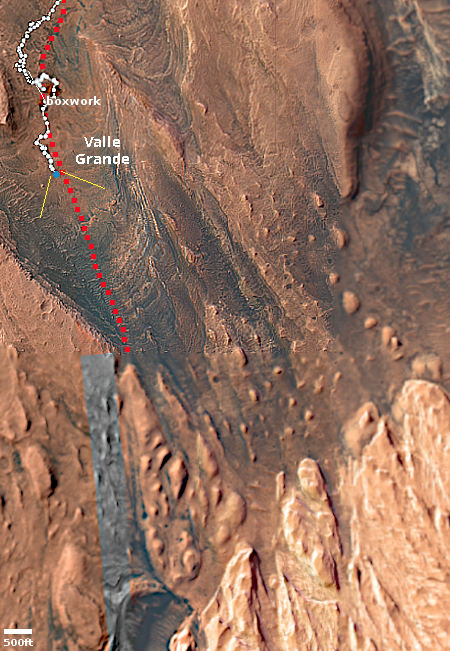
Cool image time! It appears that during the government shutdown the science team for the Perseverance rover on Mars made the decision to leave an area they had been exploring for the past two months, driving the rover aggressively to the southwest and in a direction that had been unplanned.

The overview map to the right illustrates that move, with the blue dot marking the rover’s present position. The white dotted line indicates its actual travels, while the red dotted line shows the planned route. According to that planned route, the plan had been to move south and back up onto the top of the rim of Jezero Crater. For reasons that the science team has not explained, they decided instead to head to the southwest, away from the crater rim.

The panorama above was created by stitching together three images released today by Perseverance’s left navigation camera (see here, here, and here). The yellow lines on the overview map indicate my guess as to the area covered by this panorama. Note Perseverance’s tracks on the left. I think this panorama shows us the area the rover traveled in this recent move.

Note also the barrenness of the terrain. This is truly an alien world. It has an atmosphere that produces a very faint wind, that over eons can erode things. This is why this exterior wall of the rim of Jezero crater is so relatively smooth. Crater rims are usually places of jagged broken rock, thrown out by the impact. That very thin Martian atmosphere over time has smoothed that terrain.

This landscape also has no life. Except for some spots in the polar regions, it is literally impossible to find any place on Earth so devoid of life.

The orbital propulsion module for India’s Chandrayaan-3 lunar lander drifts back into lunar orbit

When India’s Chandrayaan-3 spacecraft arrived in lunar orbit in August 2023, it separated into three units, the lander, a lunar orbiter, and a propulsion unit used to get everything to the Moon.

While the Vikram lander successfully touched down several hundred miles from the Moon’s south pole and the Chandrayaan-3 orbiter continues to make observations of the Moon, in October 2023 engineers had the propulsion module do a burn that sent it out of lunar orbit and into an Earth orbit that was close to one of the Lagrange points where the gravity of the Earth and Moon are balanced.

Now, three years later, that module has drifted back into lunar orbit, where it has since done two close fly-bys of the surface.

This intricate orbital dance culminated when the module once again entered the Moon’s SOI [sphere of influence] on November 4, 2025, an event marking the transition where lunar gravity dominates its motion.

The first recorded lunar flyby occurred on November 6, 2025, at a distance of 3,740 km from the lunar surface, though it was outside the Indian Deep Space Network’s (IDSN) visibility range. A second, closely monitored flyby took place on November 11, 2025, bringing the module within 4,537 km of the Moon and well within observation capabilities.

These events noticeably altered the satellite’s orbital parameters, expanding its orbit size from 100,000 x 300,000 km to a massive 409,000 x 727,000 km and shifting its inclination from 34° to 22°.

It is not clear what happens next. Having this module in lunar orbit could be an issue for present and later orbiters, as no orbit around the Moon can ever be stable. At some point India’s space agency ISRO needs to properly dispose of this unit, either by sending into the Moon or out of the Moon-Earth system entirely. I am of course assuming it has the fuel to do so.

Comet C/2025 K1 — NOT interstellar 3I/Atlas — breaks up as it passes closest to the Sun

The broken apart nucleus of Comet 3I/Atlas
Click for original image.

CORRECTION: I originally posted this story thinking the comet imaged was the interstellar Comet 3I/Atlas. It is not. It is a different one. I have changed to post below to correct my error.

——————
Sometime on November 11, 2025, the nucleus of interstellar C/2025 K1 broke into three pieces as it passed through its closest and hottest point to the Sun.

The image to the right, cropped and reduced to post here, comes from images of the break-up taken by the Virtual Telescope project, which gathers data from many small telescopes remotely.

From the first link, translated by Google from the Italian:

Its trajectory led it, in early October, to pass through a point of minimum distance from the Sun (perihelion) quite close to our star, about 0.33 astronomical units, just outside the orbit of Mercury. Because of this “short” distance from the Sun, it experienced high solar irradiation, which caused a significant increase in the temperature of the surface and internal layers of the nucleus.

These are precisely the conditions under which a “breakup” event is expected: depending on the internal properties of the nucleus—namely, its porosity, its state of cohesion, its composition, and the percentage of ice—it is possible that the increase in temperature could cause significant “outgassing,” a sudden and violent outflow of gaseous and dusty material, and the consequent fragmentation of the nucleus, sometimes into a few pieces of roughly similar size, sometimes into a cloud of fragments and debris that spread along the trajectory of the original comet.

…”From an initial quick analysis of the images, we can confirm that there are certainly two fairly similar pieces, whose brightness maxima are separated by approximately 2,000 km (distance projected on the star field); “Furthermore, we can intuit the presence of a third, smaller and fainter fragment to the left of the pair,” observes Mazzotta Epifani.

It will be interesting to see if the same thing happens to interstellar Comet 3I/Atlas as it makes its own pass close to the Sun.

Saturn’s rings, warped by one of Saturn’s moons

Daphne inside Saturn's rings
Click for original image.

Cool image time! Rather than post another Mars image, I decided today to dig into the archive left from the Cassini orbiter that circled Saturn from July 1, 2004 until September 15, 2017. The picture to the right, cropped to post here, was taken on September 13, 2017, only two days before the orbiter burned up in Saturn’s atmosphere. From the caption:

This image of Saturn’s outer A ring features the small moon Daphnis and the waves it raises in the edges of the Keeler Gap. The image was taken by NASA’s Cassini spacecraft on Sept. 13, 2017. It is among the last images Cassini sent back to Earth. The view was taken in visible light using the Cassini spacecraft wide-angle camera at a distance of 486,000 miles from Saturn. Image scale is 2.7 miles [per pixel].

The moon is traveling downward in this image. As it moves past the outer ring, its gravity causes that edge to ripple, producing the waves.

The scale will give you an idea of how big the rings of Saturn are. The Keeler Gap is at the outer edge of the A ring of Saturn, which is the outermost ring that is clearly visible using ordinary amateur telescopes. That edge however is more than 90,000 miles from Saturn. And grayish bands to the right of Daphne and the Keeler Gap are only the outer half of the A ring, which is by itself about 9,000 miles wide.

The edge of Mars’ north polar ice cap

The fringe of Mars' perennial ice cap
Click for original image.

Cool image time! The picture to the right, cropped, reduced, and sharpened to post here, was taken on September 29, 2025 by the high resolution camera on Mars Reconnaissance Orbiter (MRO).

The picture shows what the science team labels as a “fringe of perennial ice.” For this picture, north is down. The white stuff on the top half of the image is that perennial ice, while the dark material at the bottom is likely a mixture of dust and debris that is still impregnated with ice.

Mars is a very icy world. Orbital data now suggests that above 30 degrees latitude there is a lot of near surface ice, though it is often mixed in with the red planet’s ample dust, blown there for eons. This location however shows us a place where that ice is on the surface, and is generally pure.

That does not mean however this will be a good location to establish a colony.
» Read more

Curiosity looks downhill at past travels

Curiosity looks downhill
Click for original image.

Cool image time! The picture to the right, cropped, reduced, and sharpened to post here, was taken on November 6, 2025 by the left navigation camera on the Mars rover Curiosity.

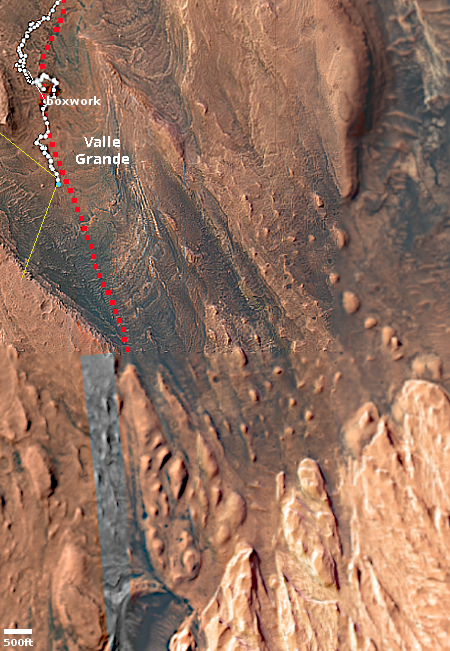
The picture looks north across Gale Crater, its distant rim about 20-30 miles away barely visible in the dusty atmosphere. In the foreground can be seen Curiosity’s recent tracks, showing how the science team had it travel back and forth several times, probably to check out several different interesting nearby ground features, as well as see how the ground changed by that travel. The rover has been traveling in an area called boxwork, a series of small intercutting ridges and hollows. Several of those ridges can be seen just beyond the tracks.

The red dotted line indicates my rough estimate as to the rover’s route uphill to get to this point, traveling up and to the left and following ridges just out of view.
» Read more

Crazy layers inside a Martian crater

Crazy layers in a Martian Crater
Click for original image.

Cool image time! The picture to the right, cropped, reduced, and sharpened to post here, was taken on September 30, 2025 by the high resolution camera on Mars Reconnaissance Orbiter (MRO).

The scientists label this image with the term “layers”, but to my eye this is kind of an understatement. The geology in the top half of this picture is more than simply layers, it is an example of that unique Martian geological feature dubbed “brain terrain”, but on steroids.

No one yet knows what causes brain terrain, though scientists think it is related to the sublimation of near surface ice. Normally the tubelike formations are much smaller, only ten to thirty feet long, not hundreds of feet as we see here.

In this case the location of these features makes their formation even more puzzling, as there is no near surface ice found here.
» Read more

Webb tracks volcanic eruptions on Io

Different Webb infrared detections of Io over time
Click for original image.

Using the Webb Space Telescope, scientists have tracked two different volcanic eruptions on Io that too place from 2022 to 2023, detecting sulfur monoxide both from those eruptions as well as sulfur from the magnetic plasma torus produced as the planet travels through Jupiter’s strong magnetic field. From the paper’s abstract:

Volcanic thermal emission was detected from Loki Patera and Kanehekili Fluctus [two volcanic vents]. The main changes in the shape of the thermal emission spectra since [Webb] observed Io in November 2022 were consistent with the continued cooling of emplaced lava flows in the Kanehekili Fluctus region, and the crust that had formed on the surface of the lava lake in Loki Patera. Images of Io in the SO 1.707 μm emission band [sulfur monoxide] show a concentration above Kanehekili Fluctus and in two regions in the northern hemisphere. The emissions are sourced from SO molecules ejected from volcanic vents. We further detected, for the first time, sulfur line emissions at 1.08 and 1.13 μm. These emissions are distributed homogeneously across a band in Io’s northern hemisphere. They are mainly produced through excitation by electrons from the plasma torus, penetrating Io’s atmosphere.

The top image to the right shows the heat signature above the two volcanoes, one to the southwest and the second to the northeast. The middle image shows the sulfur monoxide emissions detected by Webb above those volcanoes from their on-going eruptions. The bottom image shows the more diffuse sulfur emissions, mostly in the northern hemisphere, believed produce by interactions with the plasma torus.

This research also relied on data obtained by both the Keck telescopes in Hawaii and the Hubble Space Telescope.

There are of course uncertainties with these results. For example, the conclusion that the more diffuse sulfur is produced by interactions with the plasma torus is not as certain. First, those sulfur emissions still appear closely linked to the volcanoes, which suggests this still could be a source.

Second, the observations also cover only two data points in time, in 2022 and 2023. To get a more precise map of the activity on Io we really need an orbiter there observing the planet on a continuous basis, something that is at this time impossible, not only because no mission is planned but because the hostile radiation environment this close to Jupiter makes the engineering quite challenging. It is this reason why Europa Clipper is not going into orbit around Europa when it arrives there in 2031. Better to orbit Jupiter and only periodically dip into that harsh radiation environment.

This typical cliff on Mars just happens to match the walls of the Grand Canyon

A typical Martian cliff, comparable to the Grand Canyon
Click for original image.

Cool image time! The picture to the right, cropped, reduced, and sharpened to post here, was taken on August 23, 2025 by the high resolution camera on Mars Reconnaissance Orbiter (MRO).

The label the science team gave this image, “remnant fan”, suggests the focus of research here is the fingerlike ridges on the floor of the canyon, emanating out from the cliff. These appear to be the remains of an ancient mass-wasting event, similar to an avalanche but different in that instead of it being a pile of surface material falling down the cliff, the cliff itself breaks free and slumps downward. In this case the event was so long ago that most of the slumped material has eroded away, leaving only those ridges, likely resistant to erosion because of the impact of the material from above.

If you look at the top of cliff, you can see evidence that another mass wasting event is pending. Note how the plateau floor near the cliff has dropped about 100 feet. This drop suggests that this part of the cliff has started to slump and break away from the plateau.
» Read more

Someone is apparently considering putting a helicopter on Starship when it goes to Mars

Potential Starship helicopter location

In my regular trolling through the images sent down from Mars Reconnaissance Orbiter (MRO), I sometimes come across things that imply truly exciting future missions. That happened when in 2019 I found a bunch of photos each labeled as a “candidate landing site for SpaceX Starship”. Without fanfare SpaceX had begun researching locations for where it intended to land Starship on Mars, in the northern lowland plains, research that it later solidified considerably.

Similarly, I have found MRO images in 2022 suggesting scientists were thinking of running a helicopter mission inside Valles Marineris, the largest canyon in the solar system. Another image in 2024 suggested that a helicopter mission might go to another region in Mars’s southern cratered highlands.

The image to the right, cropped, reduced, and sharpened to post here, is another new example of a potential Martian helicopter mission. It was taken on August 19, 2025 and is labeled provocatively “Characterize Possible Rotorcraft Landing Site.” Unlike the previous two proposed helicopter locations, however — which appeared to be aimed at uncertain NASA funding — this image’s location suggests it is far more certain, and might launch far sooner than you can imagine.
» Read more

ISS study suggests that weightlessness impacts the eyes of men more than women

Eye flattening while in space
Astronauts who experienced changes in their
eyes (SANS) while on long missions in space

The uncertainty of science: A recent study of 30 astronauts during long term stays on ISS suggests that weightlessness impacts the shape of the eyes more in men than in women.

You can read the paper here.

In addition to changes in fluid around the brain, the team also found that a form of eye compression, a hallmark of Spaceflight Associated Neuro-ocular Syndrome known as globe flattening, was the most consistent eye change among crew members. “By far the most prevalent sign of eye changes that we observed was globe flattening, suggesting that this should be the primary monitoring target for ocular health,” Seidler said. “Interestingly, eye changes were more prevalent in males than females.”

Globe flattening, when the back of the eyeball becomes slightly indented or pushed inward, might sound minor, but it can have significant effects on vision and raise concerns for long-duration space missions.

Surprisingly, there was no strong link between brain structural changes and eye changes, suggesting that the effects on the eyes and brain may arise from distinct mechanisms rather than shared physiological cause

For the eye research, the sample was so small, 28 individuals of which only 9 were females, the researchers readily admit in their abstract that and “interpretation of these findings should be tempered by the fact that our sample included a relatively small number of females.” Nonetheless, the research did suggest that, regardless of sex, about half of all humans will experience these eye issues during long missions in weightlessness.

The results underscore the need to do artificial gravity experiments in orbit, to find out the minimum amount of gravity needed to mitigate or even eliminate these health issues. Otherwise, interplanetary travel is going to be seriously hampered, if not impossible.

New orbital radar data confirms large ice deposits in Phelgra Mountains near Starship landing zone

Overview map

A new paper published this week used the SHARAD radar instrument on Mars Reconnaissance Orbiter (MRO) to confirm that the glacial features found everywhere within the Phlegra Mountains where one of Starship’s four prime landing sites is located contains significant quantities of very accessible pure water ice.

The red dots on the map to the right mark two of those prime landing sites, with one inside the Phelgra Mountains in a region directly studied by this paper. The numbered black dots were other images taken by MRO for SpaceX, reported here in 2020. From the paper’s abstract:

We examined mid-latitude landforms on Mars that resemble Earth’s debris-covered glaciers in a region called Phlegra Montes. Our study site is a 1,400-km-long mountain range in the northern hemisphere of Mars that houses numerous debris-covered glaciers also called Viscous Flow Features (VFFs). Using data from the SHallow Radar (SHARAD) instrument, we detected eight new glaciers and estimated the thickness and volume of ice within them as well as the thickness of the debris on top insulating the ice. Our findings suggest that the region holds around 1.2 trillion cubic meters of ice below the surface. We detected two notable types of glaciers for the first time on Mars using SHARAD: (a) a glacier system with terrace-like steps and (b) a perched “hanging” glacier on the eastern side of the mountains

The study also found that the layer of dust and debris that covers these glaciers and protects them from sublimating away ranges from 6 to 25 feet in thickness, well within reach of any future colonists.

This study only confirms what all the orbital data for the past two decades has suggested, that Mars is an icy world like Antarctica, not a dry desert like the Sahara. As the researchers themselves note in the very first line of their paper, “Mars is a frozen world where water ice is abundant above, at, and under the surface.”

Their research also confirms that SpaceX has made a good choice for its Starship prime landing sites. Though it will likely not make its first landing at site #3, because it is inside the mountains and thus more risky, expect a landing there not long thereafter.

The alien landscape of Mars’ north polar ice cap

The strange terrain of Mars' north polar ice cap
Click for original image.

Cool image time! The picture to the right, cropped to post here, was taken on August 24, 2025 by the high resolution camera on Mars Reconnaissance Orbiter (MRO).

The camera team labels this simply as a “terrain sample,” which usually means it was not taken as part of any specific research request, but to fill a gap in the camera’s schedule in order to maintain its proper temperature. When they need to do this, they try to find interesting things to photograph, and mostly succeed.

At first glance the picture to the right does not appear that interesting. If anything it shows an endless expanse of mottled terrain, with no features of any interest at all. This sameness however is what makes this picture and landscape intriguing. What caused it to look this way?
» Read more

Ispace signs deals with companies in India and Japan

The Japanese lunar lander startup Ispace today announced it has signed partnership deals with two different companies, OrbitAid in India and Toyota in Japan.

The startup OrbitAid is India’s first “on-orbit refueling company”. It will provide Ispace’s landers with standardized docking ports as well as refueling capabilities.

The two companies aim to demonstrate the critical capabilities required for mission extension in the cislunar environment, enabling long-duration lunar operations and paving the way for a sustainable lunar economy. The integration of OrbitAID’s SIDRP interface is expected to not only optimize refueling, recharging, and data transmission capabilities but also support ispace’s efforts to enhance the performance and reliability of its landers. By enabling lunar refueling, both companies plan to facilitate deep-space exploration beyond Earth’s orbit.

Toyota meanwhile will provide technical support to Ispace as it develops its own second generation lunar rover, dubbed Lunar Cruiser. Ispace is already prepping a smaller rover that will fly on its next lunar landing mission.

Ispace has been signing on a range of customers and commercial partners in recent months, even though its only two attempts to land on the Moon both failed just before touch down. It has contracts with NASA, ESA, and JAXA for future missions. These new deals appear designed to strengthen and extend its capabilities beyond simply landing on the Moon, but also to provide interplanetary spacecraft as well.

Astrobotic’s Griffin lunar lander delayed again

Moon's south pole, with landers indicated

According to an update on the status of Astrobotic’s Griffin lunar lander posted on October 24, 2025, the company has now delayed the launch from the fall of 2025 to July 2026, apparently because the spacecraft is not yet assembled and its many components are still undergoing testing.

For example, none of Griffin’s four propellant tanks have yet been installed. Nor apparently has its core structure been fully integrated, with “tanks, ramps, attitude control thrusters, and solar panels” only now having completed “fit checks.”

The map to the right indicates the location where Griffin is supposed to land, about 100 miles from the Moon’s south pole. Nova-C, Intuitive Machines first attempt to soft land on the Moon, landed at the green dot, but failed when it fell over at landing. Intuitive Machines second lunar lander, Athena, also fell over when it landed in the same region that is now Griffin’s target landing zone.

Griffin has experienced repeated delays since the contract was issued to Astrobotic in 2020. The mission was originally supposed to launch in November 2023, carrying NASA’s Viper rover. In July 2022 however it was delayed one year to November 2024 because Astrobotic said it needed more time.

Sometime after the failure of Astrobotic’s first lunar lander, Peregrine, in January 2024, NASA once again delayed the Griffin mission, pushing it back another year to November 2025.

In July 2024 NASA canceled Viper, removing it as a payload from Griffin, because Viper was significantly overbudget and would not be ready for that fall 2025 launch. NASA however did not cancel Griffin. It appears however that Astrobotic wasn’t ready either for a launch in November, and thus this further delay.

Whether it will be ready by July remains unknown. Based on Astrobotic’s own update I have serious doubts. For a spacecraft that was supposed to originally launch in 2023, Griffin seems woefully unready now, two years past that date.

1 2 3 4 32