Three Dog Night – Mama told me not to come

An evening pause: Performed live in 1970. Nice piece of music and performance, but it epitomizes well the sixties generation and its carefree decadence. Freedom is a wonderful thing, but it also requires responsibility or everything will fall apart. In the end, unfortunately, the sixties generation did not put much stock in responsibility. We are now reaping the harvest they sowed. (And I speak as a member of that generation.)

Hat tip Roland.

2 comments

New Florida company to offer stratospheric tourist balloon flights

Capitalism in space: A new Florida company dubbed Spac Perspective plans to offer six-hour-long tourist balloon flights to altitudes of 100,000 feet for $125,000 per ticket.

“Spaceship Neptune,” operated by a company called Space Perspective from leased facilities at NASA’s Kennedy Space Center, will carry eight passengers at a time on six-hour flights. The passenger cabin, lifted by a huge hydrogen-filled balloon, will climb at a sedate 12 mph to an altitude of about 30 miles high. That will be followed by a slow descent to splashdown in the Atlantic Ocean where a recovery ship will be standing by to secure the cabin and crew.

Test flights carrying scientific research payloads are expected to begin in 2021. The first flights carrying passengers are expected within the next three-and-a-half years or so, with piloted test flights before that.

While the company initially will operate out of the Florida spaceport, the system could be launched from multiple sites around the world, with Hawaii and Alaska near-term possibilities.

The co-CEO of this company, Jane Poynter, had been the head of WorldView here in Tucson when that company was first planning to do tourist flights like this. She got pushed out a little over a year ago as the company shifted away from tourist flights to military surveillance, only to reappear now in Florida with a new company proposing the same thing.

All power to her. I hope this new company succeeds. It is offering a product at half the price of Virgin Galactic that is actually far superior (30 miles altitude for six hours vs 50 miles for five minutes).

NOTE: 100,000 feet elevation equals 30 kilometers, not 30 miles. I think the “30 mile” number in the quote is probably a mistake.

7 comments

Two new multi-wavelength Hubble images of planetary nebulae

Hubble images of the Butterfly and Jewel Bug planetary nebulae
Click for full image.

Cool images from Hubble! Astronomers have used the Hubble Space Telescope’s entire suite of instruments to produce spectacular new multi-wavelength images of two planetary nebulae, stars that for some reasons not yet entirely understood are surrounded by breath-taking jets and cloud-formations of all shapes and sizes.

The two images are to the right, cropped and reduced to post here.

Planetary nebulas, whose stars shed their layers over thousands of years, can turn into crazy whirligigs while puffing off shells and jets of hot gas. New images from the Hubble Space Telescope have helped researchers identify rapid changes in material blasting off stars at the centers of two nebulas β€” causing them to reconsider what is happening at their cores.

In the case of NGC 6302, dubbed the Butterfly Nebula, two S-shaped streams indicate its most recent ejections and may be the result of two stars interacting at the nebula’s core. In NGC 7027, a new cloverleaf pattern β€” with bullets of material shooting out in specific directions β€” may also point to the interactions of two central stars. Both nebulas are splitting themselves apart on extremely short timescales, allowing researchers to measure changes in their structures over only a few decades.

This is the first time both nebulas have been studied from near-ultraviolet to near-infrared light, a complex, multi-wavelength view only possible with Hubble.

The press release suggests that the most likely and popular explanation for the formation of planetary nebula is the interaction of two closely orbiting stars. While this might be true, it remains only one theory among many, all of which explain some of what we see and none of which explain everything. As I noted in my November 2014 cover story about planetary nebulae for Sky & Telescope:
» Read more

2 comments

Three Starship prototypes in line for testing

Capitalism in space: SpaceX’s assembly line for building Starship prototypes is heating up, with three such ships completed or under construction in Boca Chica, Texas.

Initially numbered 5 through 7, the goal of the first two will be to do the first full scale vertical hops, flying as high as 7.5 miles.. #7 however has a different purpose:

While stouter than an actual Starship-class methane or oxygen tank, this particular test tank is maybe only 25% shorter than the methane tanks installed on Starship prototypes. According to Musk and effectively confirmed by writing all over the prototype, this particular test tank – formerly Starship SN7 – was built to determine if a different kind of steel could be preferable for future ships.

Shortly after the June 15th test began to wind down, Musk announced that the new material (304L stainless steel) had performed quite well, reaching 7.6 bar (110 psi) before it sprung a leak. The fact alone that it sprung a leak instead of violently depressurizing is already a major sign that 304L is preferable to 301L, as it means that Starships built out of it could fail much more gracefully in the event of a leak instead of collapsing or violently exploding. A step further, SpaceX has already managed to repair the leak on SN7 and will likely test the tank again in the next few days.

SpaceX is once again demonstrating how to properly do this kind of cutting edge development. You test, you fix or, you change, based on what your tests tell you. You don’t lock down design in the early stages, because at that point you really don’t know enough to do so.

2 comments

Astra schedules next launch attempt

Capitalism in space: The smallsat rocket company Astra has scheduled its next launch attempt for July 20.

The company tried twice to launch in March, with the second attempt destroying the rocket and launchpad. They have now rebuilt, though they also admit that this first launch might also fail, and that it is part of a three launch program. By the third launch they expect to reach orbit for sure.

If Astra succeeds, they will leap ahead of Virgin Orbit as the second smallsat rocket company, following Rocket Lab, to become operational.

0 comments

Enigmatic layering and chasms on Mars

Enigmatic layering and chasms
Click for full image.

Overview map

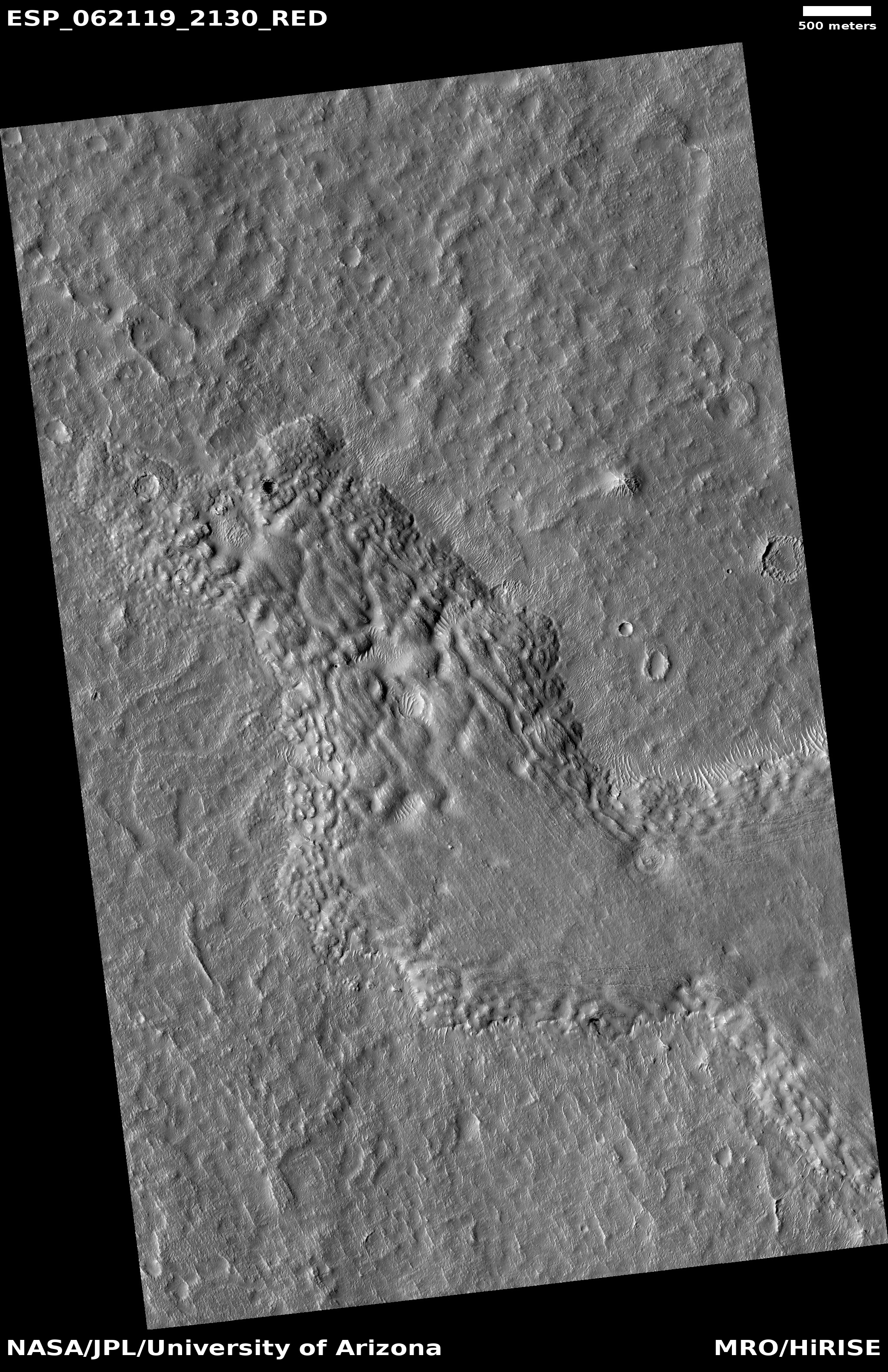
Cool image time! The photo to the right, rotated, cropped, and reduced to post here, was taken on April 28, 2020 by the high resolution camera on Mars Reconnaissance Orbiter. (MRO). The science team entitled it “Enigmatic Uplifts in Echus Montes,” indicating a sense of bafflement on their part about this geology.

The features here are certainly somewhat puzzling. At first glance the terrain is reminiscent of Martian chaos terrain, mesas cut by canyons in an almost random pattern. As I explained at the link,

Chaos terrain is typically a collection of mesas separated by straight-lined canyons. It is found in many places on Mars, most often in the transition zone between the southern highlands and the northern lowlands where an intermittent ocean might once have existed. It is believed to form by erosion, possibly caused by either flowing water or ice, moving along fault lines. As the erosion widened the faults, they turned into canyons separating closely packed mesas. With time, the canyons widened and the mesas turned into a collection of hills.

What makes this particular image puzzling however is that there seem to be multiple layers of mesas and canyons. Look at the top of the rectangular mesa in the upper middle of the image. It appears to have its own miniature chaos terrain on its plateau. Somehow that first layer of chaos was abandoned when the more prominent larger canyons started to form around it.

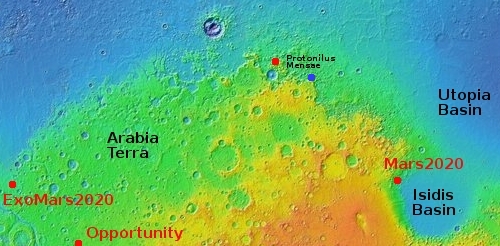
The location of this feature is indicated by the black cross on the overview map to the right. It is in the middle of the large and wide northward trending part of the giant valley dubbed Kasei Valles. And as usual, knowing the location helps explain what we are seeing.
» Read more

2 comments

A fast radio burst that beats every sixteen days

Astronomers have now added to the mystery of fast radio bursts (FRBs), of which about a hundred are known, by discovering one in a nearby galaxy that has a regular outburst every 16.35 days.

Earlier this year CHIME worked with astronomers in Europe to pinpoint the origin of a particular FRB emission β€” called FRB 180916.J0158+65 β€” to a galaxy located 500 million light years from Earth.

Now CHIME has determined that FRB 180916 pulses at predictable intervals more than two weeks apart. β€œIt tells us that the origin of at least some FRBs is astrophysically regular in nature, but on long enough time scales that they may be tied to something different than a rotating, compact object β€” perhaps something like an orbiting system,” said Newburgh, whose lab builds instrumentation for collecting data about the history of the cosmos

Or to put it another way, they really haven’t any idea yet what exactly causes these bursts. The new data however will help formulate better theories, that I guarantee will be contradicted by subsequent new data. At the moment there is so little known about FRBs that any theory must be looked at with great skepticism.

0 comments

U.S. & U.K. sign space agreement

Anticipating the exit of the United Kingdom from the European Union, the Trump administration has signed an new space agreement with the U.K. in order to facilitate the ability of U.S. companies export British technology as well as launch from its spaceports.

I cannot find the actual text of the agreement so my description, based on news reports and the press release (linked above) might be wrong. It does appear however that the agreement is designed to smooth out the regulatory environment that might block commercial space development involving both countries.

It also seems required because of the UK’s exit from the EU. They need to sign bilateral agreements with other nations to replace the EU framework.

0 comments

SpaceX hiring engineers for building floating Starship spaceport

Capitalism in space: SpaceX has issued advertisements looking for two engineers to help build an offshore floating spaceport for launching its Starship/Super Heavy reusable rocket.

This plan is not really a surprise, as Musk from his first description of Starship said that it would likely launch and land on floating platforms. The rocket is big, so putting its launch and landing in the ocean reduces the risk to populated areas, while giving the company some flexibility about where it will land. The latter point reinforces the company’s stated goal of using this rocket not only to make interplanetary travel affordable but to also provide point-to-point transportation on Earth.

8 comments
1 92 93 94 95 96 169