Chinese astronauts complete first spacewalk using new Wentian module

The new colonial movement: Chinese astronauts yesterday completed their first spacewalk using the airlock on the new Wentian module that was recently launched to that nation’s Tiangong-3 space station.

The spacewalk lasted six hours, and was mostly designed to test the airlock itself as well as do the first tests of Wentian’s own robot arm. It appears they also installed an “extended pump set”, whatever that is, and did other work near the hatch. More here.

4 comments

NASA is paying Boeing twice as much as SpaceX for its manned flights

Capitalism in space: in an excellent analysis of the total amount NASA will pay both SpaceX and Boeing for all their manned flights to ISS before the station retires, Eric Berger at Ars Technica has determined that the agency will essentially pay Boeing twice as much per flight.

In 2014, NASA narrowed the crew competition to just two companies, Boeing and SpaceX. At that time, the space agency awarded Boeing $4.2 billion in funding for development of the Starliner spacecraft and six operational crew flights. Later, in an award that NASA’s own inspector general described as “unnecessary,” NASA paid Boeing an additional $287.2 million. This brings Boeing’s total to $4.49 billion, although Finch told Ars that Boeing’s contract value as of August 1, 2022, is $4.39 billion.

For the same services, development of Crew Dragon and six operational missions, NASA paid SpaceX $2.6 billion. After its initial award, NASA has agreed to buy an additional eight flights from SpaceX—Crew-7, -8, -9, -10, -11, -12, -13, and -14—through the year 2030. This brings the total contract awarded to SpaceX to $4.93 billion.

Since we now know how many flights each company will be providing NASA through the lifetime of the International Space Station, and the full cost of those contracts, we can break down the price NASA is paying each company per seat by amortizing the development costs.

Boeing, in flying 24 astronauts, has a per-seat price of $183 million. SpaceX, in flying 56 astronauts during the same time frame, has a seat price of $88 million. Thus, NASA is paying Boeing 2.1 times the price per seat that it is paying SpaceX, inclusive of development costs incurred by NASA.

Despite the larger payments to Boeing, the company could very well lose money on Starliner. The higher cost to NASA from Boeing is due almost entirely because the agency was absorbing more of its initial development cost. SpaceX’s Dragon capsule had already been flying cargo missions to ISS when these manned contracts were awarded. SpaceX merely had to upgrade its manned capsule. Boeing had to design and build it from scratch. Moreover, the contracts were fixed price, which means Boeing had to absorb more than a half billion in additional costs when it had to refly the unmanned demo flight of Starliner.

Finally, because of the delays, Boeing won less NASA business. It also has gotten none of the private commercial manned flights that are going on right now. Those contracts went to SpaceX, including all the profits. Whether Boeing can eventually win some private contracts down the road is unknown. It will certainly have to lower its price to compete with SpaceX.

13 comments

Rocket Lab completes first static fire test of previously flown rocket engine

Capitalism in space: Rocket Lab has successfully completed for the first time a full duration static fire test using one of its Rutherford rocket engines that had been flown on a launch earlier this year, recovered, and refurbished.

The engine was previously successfully launched to space and returned to Earth during Rocket Lab’s recent recovery mission, ‘There And Back Again’, launched on May 2, 2022. The mission was the first time Rocket Lab attempted a mid-air capture of Electron’s first stage, using parachutes on the rocket to slow its descent from space before a helicopter plucked the rocket from the sky as it approached Earth’s surface. The Electron stage was ultimately released for a soft ocean splashdown, before it was collected by vessel and returned to Rocket Lab’s production complex.

The refurbished Rutherford engine passed all of the same rigorous acceptance tests Rocket Lab performs for every engine, including 200 seconds of engine fire and multiple restarts. Data from the test fire shows the engine produced full thrust of 21kNs within 1000 milliseconds of ignition and performed to the same standard of a newly-built Rutherford engine. This Rutherford engine will now continue as an engine life-leader for future Rutherford development.

I have embedded a video of the full test below. This achievement makes Rocket Lab only the third company to successfully refire a previously flown engine, after SpaceX and NASA’s space shuttle engines. It might also be the first time an engine recovered from the ocean has been successfully refurbished. SpaceX had tried to do the same with early Falcon 9 first stages, before they could land vertically, but all accounts suggested the salt water made the engines unusable.

Based on the the quote above, however, this engine will not be used on a future flight, but for testing only. The company still intends to catch the stages as they descend by parachute with a helicopter, which will then transport them safely to land. Further attempts to do so will take place in later launches this year.

» Read more

5 comments

On Mars you can find glaciers everywhere in the mid-latitudes

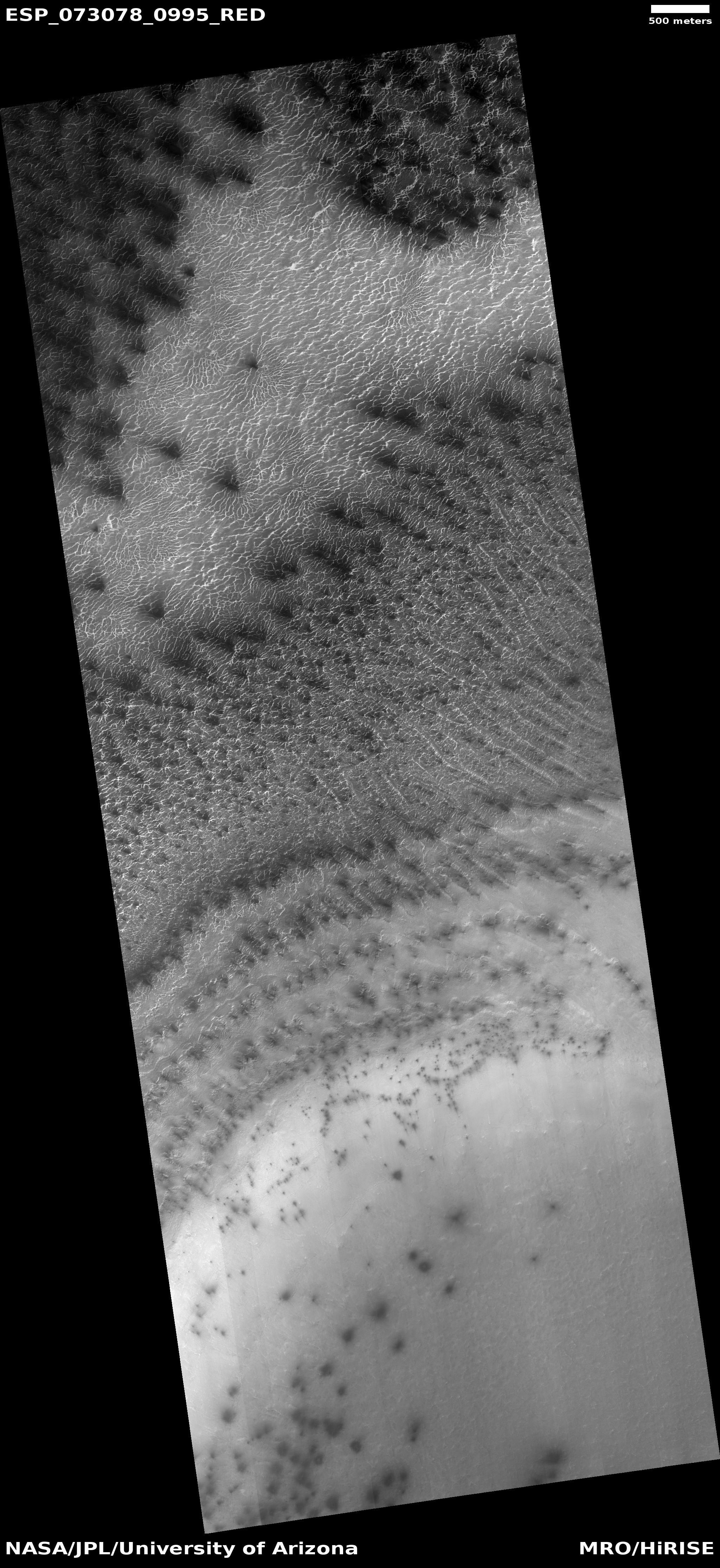
Glacial material in Mars' rift zone
Click for full image.

Cool image time! If you ever decide to have some fun exploring the archive of images being sent back to Earth by the high resolution camera on Mars Reconnaissance Orbiter (MRO), always remember that the latitude of the image will almost immediately help to explain the strange features that you see in each picture.

The hi-res photo to the right, rotated, cropped, and reduced to post here, was taken on May 22, 2022 and provides us a great example. The jumbled features in the depression on the image’s right half surely look like the glacial features seen routinely in the 2,000-mile-long strip found in the 30 to 60 degree band in the chaos terrain of the northern lowland plains. In fact, it is likely that cycles of ebb and flow of those glaciers helped shape this chaos of buttes and mesas and cross-cutting canyons.

This picture however is nowhere near any chaos terrain, or that 2,000 long strip. In fact, it is instead in an area that appears mostly formed by tectonic and volcanic activity, as the overview map below shows.
» Read more

0 comments

Today’s blacklisted American: Google scholarship sets racist quotas favoring minorities

Google: dedicated to segregation!
Google: dedicated to the new segregation!

“Segregation today, segregation tomorrow, segregation forever!” Tech giant Google has established a discriminatory fellowship program that major universities can participate in that specifically favors some races while barring others.

The Google Ph.D. Fellowship, which gives promising computer scientists nearly $100,000, allows each participating university—a group that includes most elite schools—to nominate four Ph.D. students annually. “If a university chooses to nominate more than two students,” Google says, “the third and fourth nominees must self-identify as a woman, Black / African descent, Hispanic / Latino / Latinx, Indigenous, and/or a person with a disability.”

So no one misunderstands Google’s very specific discriminatory intent, here is the exact quote from its FAQ about the fellowship program:
» Read more

14 comments

Musk tweets that SpaceX wants to complete 100 launches in 2023

Capitalism in space: Elon Musk yesterday tweeted that SpaceX’ is now planning to attempt about 100 launches next year, which will almost double its expected output this year.

To get some perspective of this goal, 100 launches in a single year would be more launches than the entire world completed each year from 1991 (after the fall of the Soviet Union) through 2017 (before the recent resurgence of American commercial rocketry).

This decision probably relates to getting SpaceX’s Starlink constellation operational. Musk had hoped to begin Starship launches of Starlink soon, and now likely recognizes that such launches are probably more than a year away. Moreover, this year SpaceX engineers have demonstrated that the Falcon 9 can launch a lot of these satellites. So far in 2022 it has launched about 50 Starlink satellites per launch, and done so about 25 times. That’s 1,250 satellites in a little more than half a year. With a 100 launches, Falcon 9 could launch about 5,000 satellites alone next year, a pace that will certainly be sufficient in the short run to get Starlink operational.

8 comments

SpaceX completes static fire test of three engines on Superheavy prototype #7

Capitalism in space: SpaceX yesterday successfully completed the first static fire test of more than one engine on its Superheavy prototype #7, firing three engines for five seconds.

NASASpaceflight livestreamed the test, and its footage suggests that only two engines may have fully lit up, with the third perhaps aborting. Whether or not the third Raptor joined the party, however, it was still the first multi-engine Super Heavy static fire that SpaceX has performed.

I have embedded that footage below. Expect more such tests in the coming days. If all works as planned (something we should not expect as this remains a development program), the tests will culminate in an orbital test flight sending Starship on a one orbit mission around the Earth. At present SpaceX wants that flight to occur before the end of this year.

» Read more

3 comments

Webb obtains first direct infrared images of exoplanet

Webb's first infrared images of an exoplanet
Click for original image.

Using four different infrared instruments on the James Webb Space Telescope, astronomers have obtained the first infrared images of a gas giant with a mass about six to twelve times larger than Jupiter and circling about 100 times farther from its sun.

The montage to the right shows these four images. The white star marks the location of this star, the light of which was blocked out to make the planet’s dim light visible. The bar shapes on either side of the planet in the NIRCam images are artifacts from the instrument’s optics, not objects surrounding the planet.

This is not the first direct image of an exoplanet, as the Hubble Space Telescope has already done so, and done it in the visible spectrum that humans use to see. However, Webb’s infrared images provide a great deal of additional detail about this planet and its immediate surroundings that optical images would not. For example, the MIRI images appear to show us the outer atmosphere of this gas giant.

1 comment

Experiment on Perseverance has successfully produced oxygen repeatedly

An engineering experiment on the Mars rover Perseverance, dubbed MOXIE, has now successfully produced oxygen from the carbon dioxide in the Martian atmosphere, and has done so seven different times. After filtering an air sample…

…the air is then pressurized, and sent through the Solid OXide Electrolyzer (SOXE), an instrument developed and built by OxEon Energy, that electrochemically splits the carbon dioxide-rich air into oxygen ions and carbon monoxide. The oxygen ions are then isolated and recombined to form breathable, molecular oxygen, or O2, which MOXIE then measures for quantity and purity before releasing it harmlessly back into the air, along with carbon monoxide and other atmospheric gases.

Since the rover’s landing in February 2021, MOXIE engineers have started up the instrument seven times throughout the Martian year, each time taking a few hours to warm up, then another hour to make oxygen before powering back down. Each run was scheduled for a different time of day or night, and in different seasons, to see whether MOXIE could accommodate shifts in the planet’s atmospheric conditions.

During each run, the instrument produced about six grams of oxygen per hour, though a recent run produced more than 10 grams per hour, about half what a human needs to survive.

MOXIE runs only for short times, because it uses so much power the rover can’t do other work during runs. It is also only a technology test, so its operation is given a lower priority. Nonetheless, it appears that this test has successfully demonstrated that future astronauts on Mars will have a system for producing an unlimited supply of breathable oxygen. The next step would be to scale this up to produce enough oxygen to also fuel the astronaut’s return rocket.

2 comments

NASA thinks engine issue on SLS launch caused by misreading sensor

NASA engineers have now concluded that the improper temperatures in one engine in SLS’s core stage that forced the August 29, 2022 launch to be scrubbed were caused by a faulty sensor, and that the actual temperatures in the engine were correct.

During a news conference on Tuesday evening, NASA’s program manager for the SLS rocket, John Honeycutt, said his engineering team believed the engine had actually cooled down from ambient temperature to near the required level but that it was not properly measured by a faulty temperature sensor. “The way the sensor is behaving does not line up with the physics of the situation,” Honeycutt said.

The problem for NASA is that the sensor cannot be easily replaced and would likely necessitate a rollback to the Vehicle Assembly Building at Kennedy Space Center in Florida, a few kilometers from the launch pad. This would delay the launch of the rocket at least into October, and the space agency is starting to get concerned about wear and tear on a rocket that has now been stacked for nearly a full year.

With this SLS rocket, NASA management is now trapped between a rock and a hard place. The rocket’s solid rocket boosters has been stacked for just short of two years, almost a full year beyond their use-by date. Moreover, there are batteries on the rocket that only function for about a month before they must be replaced. Their replacement date is September 6th, which means if NASA cannot get the rocket launched by that date it will have to return it to the assembly building, delaying the launch to at least October. If it has to replace the solid rocket boosters the launch will likely then be delayed until next year, which will seriously impact the second SLS launch, set to send astronauts around the Moon and back.

At the moment the launch is scheduled for a two hour launch window beginning at 2:17 pm (Eastern) on Saturday, September 3, 2022. The countdown will be live streamed here. At the moment the weather for Saturday has improved, with s 60% chance the launch can proceed.

10 comments
1 68 69 70 71 72 192