Musk’s Mars plan

Musk's Mars plan

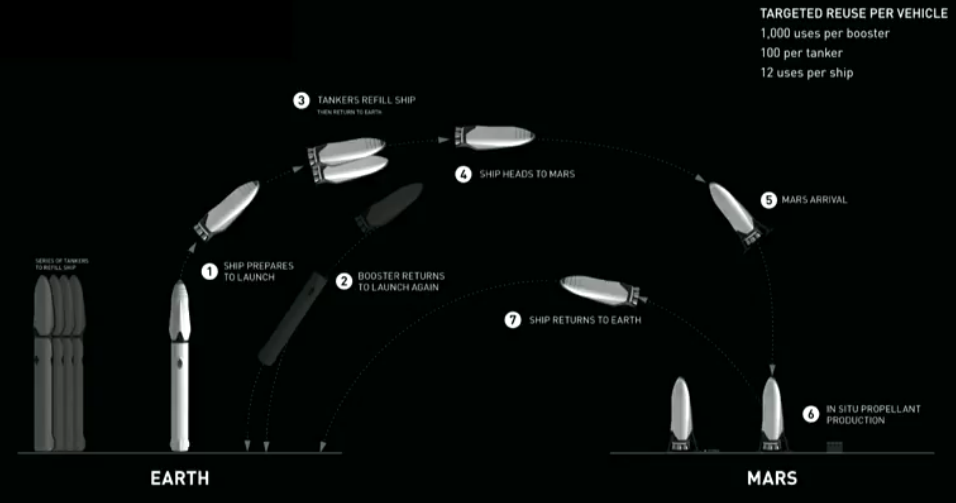
Today Elon Musk gave a speech at the International Astronautical Congress in Guadalajara, Mexico. The speech laid out SpaceX’s proposed architecture for building what he presently calls his interplanetary transport system. The image on the right is one of his talk slides, showing the basic concept, which is built around using the company’s new Raptor engine — still under development — which only got its first test firing this past week.

The plan is ambitious and visionary, which from Musk is not surprising. It is also aimed to be as practical and as cost effective as possible, which also is not surprising coming from Musk. The rocket itself will be larger than both the Saturn 5 and SLS, but not significantly more. Compared to those government rockets however it will be far cheaper and faster to build, though Musk’s hope that they will be launching their first test flights in four years is almost certainly too optimistic. The concept is to use what they have learned with the Falcon 9 to build a bigger rocket with a reusable first stage that launches a large second stage that is either the spaceship taking people to Mars or a giant tanker for refueling that spaceship.

In one of Musk’s early slides he noted something that I have been arguing for decades. “Speading the required lift capacity across multiple launches substantially reduces development costs and compresses schedule.” Though he is still proposing a heavy-lift rocket, he is also following in the footsteps of Wernher Von Braun by proposing that any Mars mission will require some assembly in orbit.

The plan is also aimed at making space travel as affordable as possible. Musk structured the design in as many ways as possible to make it as efficient and as inexpensive as possible. It still won’t be cheap, at about $140K per ton, but at that price it will be affordable to a lot of people. He also mentioned that it include free passage back to Earth.

I doubt we will see this system built as outlined today in the time span predicted by Musk. At the same time, I would not be surprised if we do see some variation of it, and see it built within the near future. In 2011 Musk proposed recovering his Falcon 9 first stages by landing them vertically. The idea seems radical. He got it done in four years. There is every reason to believe he will make this Mars proposal happen as well.
14 comments

Mars rover update: September 20, 2016

Opportunity comes first this time because it actually is more interesting.

Opportunity

For the overall context of Opportunity’s travels at Endeavour Crater, see this post, Opportunityโ€™s future travels on Mars.

Having several choices on where to head, the Opportunity science team this week chose took what looks like the most daring route, heading almost due east towards the floor of Endeavour Crater. In fact, a review of their route and the images that the rover continues to take suggests that the panorama I created last week looked almost due east, not to the southeast as I had guessed. I have amended the most recent overhead traverse image, cropped and reduced below, to show what I now think that panorama was showing.
» Read more

1 comment

Suspicious climate data manipulation at NASA

The uncertainty of modern climate science isn’t merely because of the overall complexity of the data and the climate. Though there are numerous factors that contribute to the long term fluctuations of the climate that we do not yet completely understand or can quantify with any precision (the sun, dust, soot, volcanoes, carbon dioxide increase, to name just a few), there is a more tragic uncertainty that global warming scientists at NASA and NOAA have added to the mix, one that is entirely unjustified and harmful to the field of science and the questions that it is trying to answer.

In the case of this post, that tragic uncertainty has to do with sea level rise and the “adjustments,” without explanation, that NASA is making to its sea level data. Below is a graph taken from the link, showing the changes that have been made to published data from 1982 in order to eliminate a long period of almost no sea level rise from the mid 1950s through 1980.
» Read more

28 comments

A Mars Rover Update

I have decided to continue my Mars rover updates, and make them a regular mid-week feature here on Behind the Black. This is the first.

Curiosity

For the overall context of Curiosity’s travels, see this post, Pinpointing Curiosityโ€™s location in Gale Crater.

Since my last updates here and here, Curiosity has moved south through the gap between buttes to exit the Murray Butte area. The initial slopes of Mount Sharp lie ahead, an open road with no apparent rough terrain to slow travel.

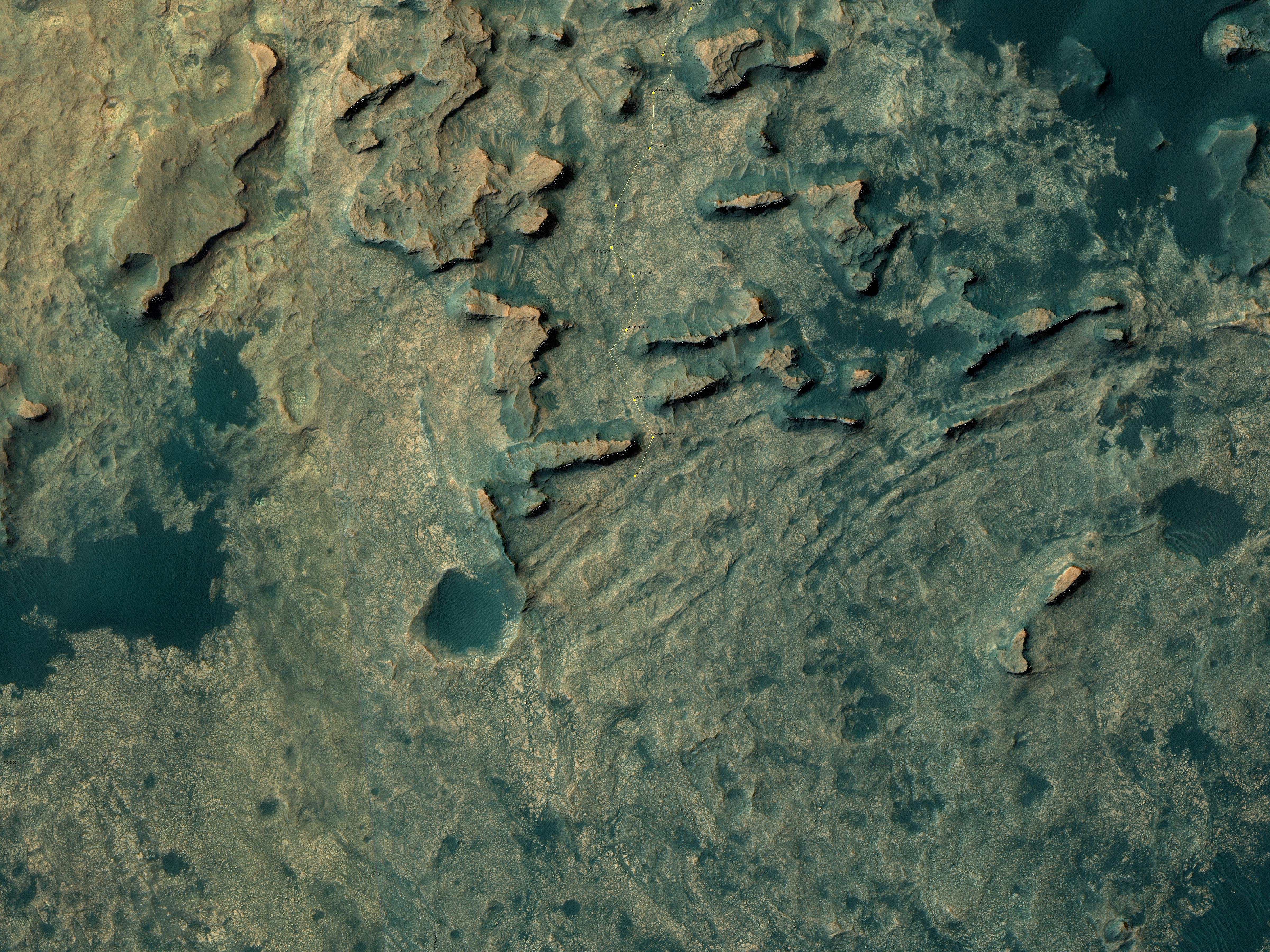
Doing science however does slow travel, and for good reason. Once through the gap the science team decided to swung the rover west and up against the base of the gap’s western butte, rather than immediately head south to climb the mountain. The Mars Reconnaissance Orbiter image below, cropped and reduced, illustrates this path.
» Read more

3 comments

Sunspots: A recovery in August

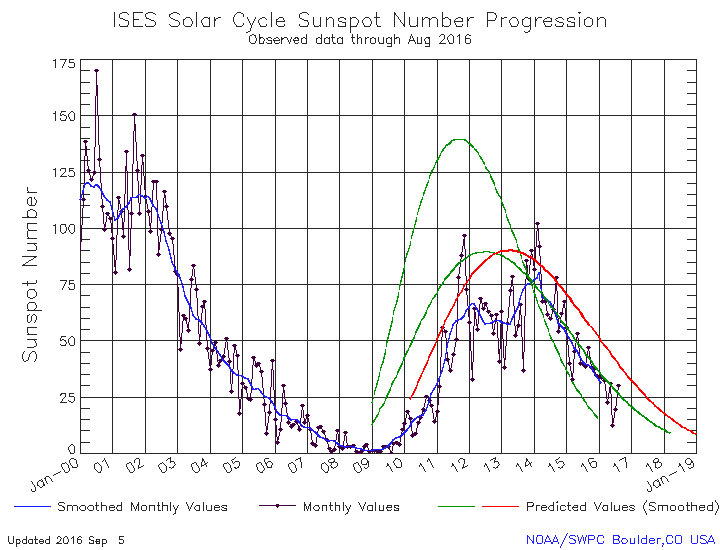
NOAA’s monthly update of the solar cycle was posted today. As I do every month, I am posting it here, with annotations to give it context.

August 2016 Solar Cycle graph

The graph above has been modified to show the predictions of the solar science community. The green curves show the community’s two original predictions from April 2007, with half the scientists predicting a very strong maximum and half predicting a weak one. The red curve is their revised May 2009 prediction.

The recovery in sunspot activity that began in July continued in August. The number of sunspots increased enough to once again raise the overall curve up to match the green curve of the 2007 weak prediction. Even so, this solar maximum remains far weaker than the weakest prediction. Also, this solar maximum, which started later than all the predictions, looks like it will be far shorter than all the predictions. As I have noted previously, this is counter to all previous solar cycles, where it is the more active cycles that are shorter and the weaker cycles are longer. Here, we are getting a weak cycle that is also short, which once again suggests that we are seeing solar behavior previously unobserved. The solar cycle is doing things it hasn’t done since scientists began studying it closely after Galileo.

2 comments

Opportunity’s future travels on Mars

Opportunity's future path

Approaching the gap

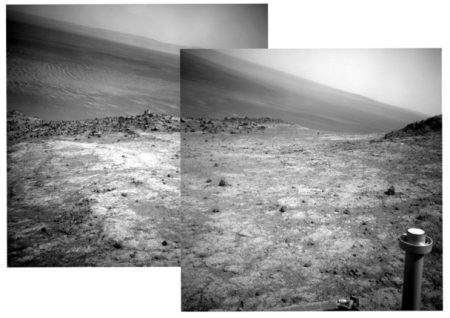
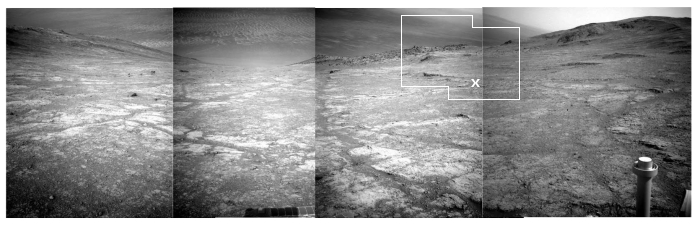
Having spent a lot of time recently analyzing the travels of Curiosity in Gale Crater and in the foothills to Mount Sharp, I decided this week that I also needed to do the same with Opportunity at Endeavour Crater.

The image above is a panorama that I have assembled from images taken by Opportunity’s navigation camera on Sol 4477 (sometime last week). To the right is a panorama assembled from images taken by the navigation camera several days later, on Sol 4481, after Opportunity had moved closer to the gap shown in the first picture above. The inset in the image above shows the location of the image on the right. The X shows Opportunity’s approximate position.

Below the fold is the most recent orbital mosiac showing Opportunity’s recent travels near Endearvour Crater and in Marathon Valley, cropped and annotated by me to indicate the areas seen by the two panoramas above. The red dot shows Opportunity’s present position.
» Read more

2 comments

Falcon 9 explodes on launchpad

During a standard prelaunch static test firing today a Falcon 9 rocket exploded on the launchpad.

Obviously, this will put a hold on all of SpaceX’s upcoming efforts.

  • Falcon Heavy: Since the explosion was almost certainly caused by a failure in the first stage, they will have to hold off that first Falcon Heavy demo launch scheduled for this fall, since it uses three first stages strapped together.
  • Reused Falcon 9: Similarly, the first launch of a recovered Falcon 9 first stage, also set for the fall, will likely have to be delayed until they determine what went wrong today.
  • Reused Dragon: NASA had indicated that one of the cargo missions to ISS next year would reuse a previously flown Dragon. Though this explosion has nothing to do specifically with Dragon, the capsule is launched with a Falcon 9, and thus cannot fly until this investigation is over.
  • Falcon 9: SpaceX had been attempting this year to up its launch rate to more than one per month. That will now not happen.
  • Red Dragon: SpaceX has said it plans to fly a test Dragon to Mars in 2018, the next launch window. While this explosion will delay the company’s plans over the next year, I expect SpaceX will not cancel that 2018 launch. They have enough time to investigate this failure and fix the cause without missing that window.
  • Elon Musk’s Mars speech: Finally, Musk is scheduled to make a major speech on September 26 at the International Aeronautical Congress (IAC) in Guadalajara, Mexico, outlining his company’s future plans to fly to Mars. He almost certainly will have to rewrite that speech.

This launchpad explosion is bad news for SpaceX but it is also very puzzling. I cannot remember the last time a rocket exploded on the launchpad during a static fire test. Failures have in recent years always occurred during the actual launch, when the rocket is flying and is thus exposed to large dynamic forces which can cause the engineering to go screwy. For a rocket to explode at the moment it ignites its engines suggests a very fundamental design fault, which seems unlikely considering the number of launches and static fires SpaceX has completed with the Falcon 9, including numerous prelaunch tests of the rocket’s first stage, both on the launchpad and at the company’s test facility in Texas prior to shipment to the launchpad.

Update: SpaceX has now said that the problem occurred near the rocket’s upper stage during fueling, prior to the actual ignition of the engines.

This news is both good and bad. The good news: It means that the failure had nothing to do with the much tested Merlin engines, which would have suggested a fundamental design flaw previously unseen. That is now clearly not the case. The bad news: The update suggests that the problem might be related to SpaceX’s high density, high pressure fueling, which by lowering the temperature of the tanks allows them to load more fuel and oxidizer. This novel approach, only introduced last year in order to give the rocket greater fuel capacity, might have a design problem that they had not anticipated.

14 comments

Changes on Comet 67P/C-G

Cool image time! Below the fold are two images taken by Rosetta of the smooth boulder-strewn area on Comet 67P/C-G called Imhotep, which has been featured many times by the Rosetta science team. The image on the left was taken October 26, 2014 soon after the spacecraft’s arrival at the comet. The image on the right was taken August 17, 2016, almost two years later after it had completed its close approach to the Sun. With both images I have cropped them and reduced their resolution to fit here. With the more recent image I have also stretched it horizontally to better match it to the older image.

The point? The giant boulders on this smooth region act as markers so that we can more easily compare the region and see how it has changed with time. The newer image clearly shows a loss of material from the surface, with the depressions in the smooth areas having grown much larger and in some areas much deeper. At the same time, there has been a softening in some of the edges between the lower and higher areas, especially in the middle of the smooth region.

What will happen here in the future? It appears that the smooth area is actually pond of dust that is slowly evaporating away with each close approach to the Sun, leaving behind the solid bedrock pinnacles within it that only appear as boulders because they are mostly buried. Eventually, when the dust is gone, some of those pinnacles will break away as well.
» Read more

2 comments

Beyond Murray Buttes

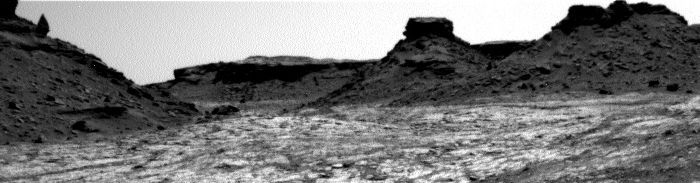
Panorama ahead for Curiosity, Sol 1438

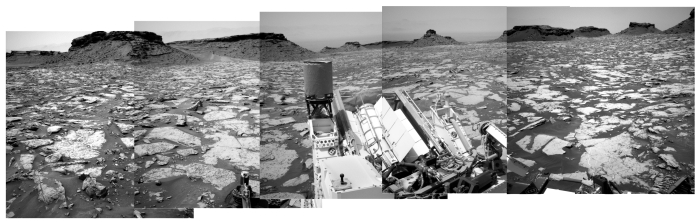
Time for a Curiosity update. Above is a panorama I’ve created from raw images released today from the rover’s left navigation camera of the mesa filled terrain within which Curiosity now sits. Since my last update they have traveled about 200 feet south, moving away from the mesa with the balanced rock

Below the fold is a Mars Reconnaissance Orbiter image with Curiosity’s path indicated. I have marked the balanced rock with an X, and have indicated with the yellow lines the area covered by the panorama above.

They appear to be aiming due south for the narrow gap between the long ridge-like mesas. This will bring Curiosity out into the open and sloping terrain that can be seen in the distance in the last image of my last update. I suspect they want to get a closer look at those parallel grooves, even if it means the journey will be a little rougher.
» Read more

6 comments

The Grand Canyon

Park Service warning sign

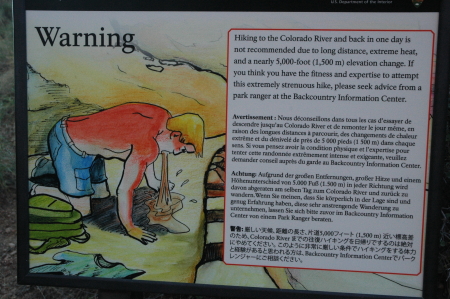
When I posted here on Behind the Black that Diane and I were on our way to the Grand Canyon for our annual hike to the bottom, one of my readers, Keith Douglas, commented that he and his family would be there about the same time. In trying unsuccessfully to meet up, at one point Keith mentioned that his two kids, aged 24 and 23, were proposing they hike into the canyon. Keith emailed me to ask, “From what I read, hiking into the canyon and out is not recommended for a one day activity. What about halfway and back up? Can that be done in an afternoon? It seems pretty hot.” I responded,

Though one can hike down and up in one day, this is not recommended for most. Usually you need to be in very good condition and young. It also helps if you are a long distance runner. Hiking down to Indian Gardens [about two thirds of the way down] can be done as a day trip, but if you don’t hike a lot it will be an intense and long experience. Also, having the right pack and gear is essential! People who go carrying a one liter bottle of water and no hat are guaranteed to suffer.

I didn’t tell them they couldn’t do it, or that they shouldn’t, or that it wasn’t possible. I simply outlined some of the basics for doing it, and let them decide what to do.

Keith answered, with humor, “Thanks for helping me talk my kids out of a hike down.” He later added, “I read a hiking guide on the nps website. It seems to be designed to discourage canyon hiking rather than prepare novice hikers.”

In one sentence Keith encapsulated the problem with almost all of the advice the Park Service gives about the Grand Canyon.
» Read more

9 comments

Balanced Rock at last

Balanced rock close-up

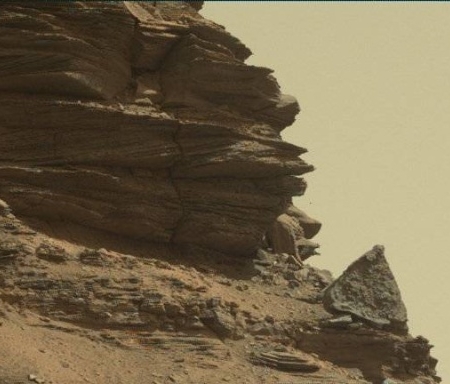
My pessimistic prediction that Curiosity’s science team would take the least risky route and thus not pass close to the butte with the balanced rock has fortunately turned out to be very wrong! They have moved Curiosity into the closest gap to get the best views of both the balanced rock as well as the butte behind it. The image on the right, cropped, was taken by the rover’s mast camera as Curiosity entered the gap between the buttes. It shows clearly that balanced rock broke off from the layers above and landed on its side.

The image below the fold shows the same butte after Curiosity had passed the balanced rock (inside red box).
» Read more

1 comment

Curiosity prepares to move on

Route through Murray Buttes

After several days of drilling, the Curiosity science team is preparing to move forward. As one member of the team notes,

After a short drive weโ€™ll acquire images for context and targeting. Overnight, Curiosity will complete a SAM electrical baseline test to monitor instrument health. Based on some of the recent Mastcam images that weโ€™ve acquired…, the view ahead should be quite scenic as we drive through the Murray Buttes!

The image above is a close-up of those Buttes, showing Balanced Rock on the left, taken from one of three raw left navigation images. The image below is a panorama I have created from those navigation images, with an inset box to show the location of the above picture.
» Read more

5 comments

Rivers of liquid carved deep gorges on Titan

Cassini radar data of Via Flumina

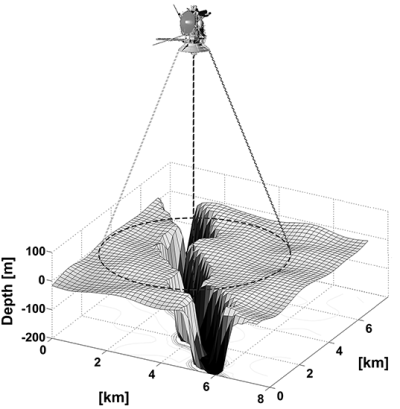
Cool image time! New data from Cassini has now both confirmed that there is liquid inside some of the river-like formations on Titan, and that this liquid has carved these formations into very deep gorges.

The Cassini observations reveal that the channels — in particular, a network of them named Vid Flumina — are narrow canyons, generally less than half a mile (a bit less than a kilometer) wide, with slopes steeper than 40 degrees. The canyons also are quite deep — those measured are 790 to 1,870 feet (240 to 570 meters) from top to bottom.

The branching channels appear dark in radar images, much like Titan’s methane-rich seas. This suggested to scientists that the channels might also be filled with liquid, but a direct detection had not been made until now. Previously it wasn’t clear if the dark material was liquid or merely saturated sediment — which at Titan’s frigid temperatures would be made of ice, not rock.

The diagram on the above right is from the paper itself, and shows some of the radar data obtained by Cassini. It also illustrates the deep and narrow nature of Via Flumina. This is almost the equivalent of what we call slot canyons on Earth, formed by periodic flash floods that cut their way down as the surface is slowly uplifted by other processes.

The new radar data showed that the surface at the base of the gorge was smooth and flat, just as you’d find if that base was filled with liquid.The altimeter data showed that gorge’s elevation matched that of Titan’s lakes at its insurgence, but as you traveled upstream the elevation rose, just as it does on any river on Earth. Moreover, this data was reasonably trustworthy as they had already used Cassini to successfully do exactly the same thing — identify a known river — when it flew past Earth on its way to Saturn.

Be prepared for one piece of misinformation when the press reports on this story, almost certainly caused by the American Geological Union’s press release about this paper. That press release incorrectly claims that the paper confirmed that these are methane rivers. It does no such thing. It only shows that the gorges have a liquid in them, and that the liquid almost certainly formed the gorges. Though methane is a very likely candidate for this liquid based on what we know of Titan, the actual make-up of the river remains uncertain.

I therefore predict our incompetent modern mainstream press will only read this press release and not the paper itself, and thus they will tout these incorrectly as methane rivers.

Below is a cropped Cassini radar image of Via Flumina, showing its river-like appearance. Scientists always suspected these were formed by flowing liquid. Now they have strong evidence from within the gorge to justify that suspicion.

Via Flumina on Titan

2 comments

Getting and Installing Linux – Part 6

Installing Windows using VirtualBox

by James Stephens

Today I will be installing Windows on VirtualBox. VirtualBox allows me to easily install and run Windows on my Linux computer without having to partition, format or otherwise disturb my hard drive. Once installed booting into the Windows guest is easy, just open VirtualBox and select Windows and hit start. Given the fact a virtual machine shares hardware resources with it’s host, generally a 64 bit host operating system can only host a 32bit guest operating system. Windows in most cases is still a 32 bit operating system.

First of all I will download VirtualBox via the my distribution’s Software Manager. Once it’s installed you will usually find its shortcut under Applications/System/Oracle VM VirtualBox in your application launcher. Click on it and VirtualBox will open to its Welcome massage. To create a virtual machine, in this case Windows, choose “new” in the VirtualBox tool bar.

Create Virtual Machine dialogue

The create virtual machine dialogue will appear where you will give the guest operating system a descriptive name and select its type and version, such as Windows XP.
» Read more

6 comments

More Junk Science and Journalism

I can’t stand it. I just can’t stand it. It keeps happening and I just can’t stand it.

Yesterday there was this absurd short news piece posted on the website of the so-called journal Science, “Apollo astronauts much more likely to die from heart disease”. describing a research paper published by one of Nature’s side journals, Scientific Reports. Before I even looked at the story I said to myself, “How can they possibly come to that conclusion considering the tiny number of humans who have ever traveled beyond Earth orbit? The sample will simply be too small to allow for any such finding.”

Then I looked at the article and found my instincts confirmed. As Steve Milloy noted on his very aptly named website, Junk Science,

Yes, the result is based on a total of three (3) cases of heart disease deaths of out seven (7) Apollo astronauts. Past the vanishingly small sample size and even smaller number of cases, heart disease is a natural disease of aging and the Apollo lunar astronauts were 10 years older than the other comparison groups.

To put it more bluntly, this was a garbage piece of very bad science. While it was somewhat embarrassing for a Nature journal to publish it, it was far more disgraceful for the journal Science to highlight it. I, however, don’t have to join these two peer-review journals and participate in their stupidity, and thus I made no mention of the story on Behind the Black, because it is my policy to not waste much time on bad science, unless I think that bad science is going to have bad repercussions.

Well the bad repercussions have arrived. Since yesterday, the following so-called news organizations have run with this story, without the slightest indication that they have faintest understanding of science, statistics, or plain common sense:
» Read more

10 comments

The Lie that is Orion

Several weeks ago NASA put out one of its periodic press releases touting the wonders of the engineering the agency is doing to prepare for its future missions to Mars. In this case the press release described a new exercise device, dubbed ROCKY (for Resistive Overload Combined with Kinetic Yo-Yo), for use in the Orion capsule.

โ€œROCKY is an ultra-compact, lightweight exercise device that meets the exercise and medical requirements that we have for Orion missions,โ€ said Gail Perusek, deputy project manager for NASAโ€™s Human Research Programโ€™s Exploration Exercise Equipment project. โ€œThe International Space Stationโ€™s exercise devices are effective but are too big for Orion, so we had to find a way to make exercising in Orion feasible.

As is their habit these days in their effort to drum up support for funding for SLS and Orion, the press release was filled with phrases and statements that implied or claimed that Orion was going to be the spacecraft that Americans will use to explore the solar system.

…engineers across NASA and industry are working to build the Orion spacecraft and Space Launch System rocket that will venture to deep space for the first time together…

…Over the next several years, NASAโ€™s Human Research Program will be refining the device to optimize it not only for near-term Orion missions with crew, but for potential uses on future long-duration missions in Orion…

These are only two examples. I have clipped them because both were very carefully phrased to allow NASA deniablity should anyone question these claims. For example, in the first quote they qualify “deep space” as specifically the 2018 unmanned lunar test flight. And the second quote is qualified as referring to missions to lunar space. Nonetheless, the implied intent of this wording is to sell Orion as America’s interplanetary spaceship, destined to take us to the stars!

Don’t believe me? Then take a look at NASA’s own Orion webpages, starting with the very first words on their Orion Overivew page.
» Read more

11 comments

Curiosity’s way forward

Panorama with balanced rock

As Curiosity moves up into the foothills of Mount Sharp the terrain is getting increasingly interesting. The image above is a panorama I have created from three Left Navigation Camera images posted here on Sunday evening. It shows what I think will be the general direction mission scientists wish to send Curiosity. (Note that the top of the leftmost mesa is not as flat as shown, as its top was cut off in the original image.)

Below is a Mars Reconnaissance Orbiter image showing Curiosity’s present position from above. I have annotated it to show the general view as shown in the above image. I have also marked on both the location of the balanced rock first photographed on July 7.
» Read more

1 comment

Getting and Installing Linux – Part 5

Running Windows programs on Linux:

An overview of WINE and Virtual Machine

by James Stephens

In addition to all the software available for Linux, Linux also possesses the ability to run Windows software using either WINE or in a virtual machine. This can be valuable in many ways, from running legacy software to running Windows and Linux on the same machine at the same time.

WINE is the open source implementation of CrossOver, which Apple users may already be familiar. It is essentially a translator: WINE sits between a Windows application and the Linux system, presenting what appears to be a Windows system to an application and generating Linux instructions for processing. It’s not a perfect solution, but it’s pretty good. It’s fast and efficient, requiring little more resources then the application itself, making it suitable for older machines. When properly configured, Windows applications install as if in Windows and run on Linux like any other application. The backward compatibility of WINE is actually better then that of Windows itself. So if you have beloved but outdated software you can run it again with WINE. In my case that is a Windows 3.1 controlled audio mixing console. A lot of people like to play the old Windows 95 games. For more information including a list of compatible Windows software and performance assessments go to www.winehq.org
» Read more

3 comments

Getting and Installing Linux – Part 4

The Software Manager

by James Stephens

๏ปฟA computer is nothing more than a toy unless it has the tools you need to get your work done, and Linux has a great set of tools. Most distributions come loaded with the tools most people use every day, a full office suite, graphics and media packages and so on. If you want more, a world of software awaits at your fingertips via the Software Manager. Think of it as the app store for your distribution, with tens of thousands of official titles vetted and available for download, most free of charge. No longer are you left to the wilds of the Internet to find what you need.

Most Linux Software is functionally equivalent to that of Apple or Windows. Most open source titles are ported to all platforms including Linux. So if you use an open source title such as Audacity or VLC media player, just type its name into the Linux Software Manager search bar and you will find it. For propitiatory titles such as Photoshop just define what it does, image manipulation for example, and the Software Manager will suggest Linux equivalents like GIMP or KRITA. In addition Photoshop and some other Windows software run great on Linux using WINE – the Windows compatibility layer. More about that later.
» Read more

0 comments

Angara’s status

The competition heats up: Work on the factories that will build and assembly Russia’s new Angara rocket appear to be nearing completion.

The article is an excellent overview of the entire Angara program. It also includes a number of interesting nuggets of information that might explain events of the past as well as Russia’s future success or failure of Angara.

For example, the repeated problems with Proton’s Briz-M upper station in 2012 could have been caused by the shift of much of its production from the Khrunichev factories near Moscow to a newly absorbed company located in Siberia. The move was made to take advantage of lower costs in Siberia while letting the company sell off land in Moscow.

Beginning in 2009, PO Polyot was to take responsibility for the production of the Briz-KM upper stage for the Rockot booster, as well as Rockot’s adapter rings and the payload fairings. Also, the manufacturing of all key elements for the Angara-1.2 version of the rocket would end up in Omsk as well. Additionally, the Ust-Katav Wagon-building Plant, UKVZ, would produce components for Angara and its KVTK upper stage, along with sections of the Proton rocket and the Briz-M upper stage.

As for Angara, the article suggests that Russia is struggling to make it as inexpensive to launch as Proton:
» Read more

2 comments
1 48 49 50 51 52 84