China releases data sets from Chang’e-4 lander

China today released another set of data from the instruments on the Chang’e-4 lander, which landed on the far side of the Moon on January 3, 2019, bringing with it China’s Yutu-2 rover.

The datasets include 3,991.1 MB of 803 data files obtained by the four scientific payloads on the Chang’e-4 lander and rover between December 26, 2021 and January 10, 2022.

The data was posted on the official website of the Lunar and Planetary Data Release System, though none of the press reports from multiple China’s state-run press sources include it. All are simply the same three paragraph story, word for word. That site however is here, though it is entirely in Chinese and the English pages fail to load.

0 comments

For only 7th time, searchers find meteorite immediately after fall

For only 7th time, searchers on February 15th found a fragment of a meteorite that had only fallen to Earth three days before, and was furthermore only discovered mere hours before it entered the Earth’s atmosphere.

From the tweet of the discoverers:

FRIPON/Vigie-Ciel finds a fragment of asteroid 2023CX1 in Seine Maritime!!! The discovery was made by Loïs Leblanc, an 18-year-old student, part of the field research team.

Vigie-Ciel (“Sky Watchers”) and FRIPON are a volunteer project that searches for meteorites. The asteroid itself was discovered by Hungarian astronomer Krisztián Sárneczky while doing routine survey scan for near Earth asteroids.

The find was the second time Sárneczky has spotted an asteroid just hours before it broke apart in Earth’s atmosphere as a fireball, following an incredible find in March 2022.

By finding meteorites this quickly after arrival scientists get a more pristine sample, since the asteroid has not been exposed to the Earth’s environment for any extended length of time.

3 comments

First launch of Japan’s H3 rocket aborts at T-0

In its first attempt to launch its new H3 rocket today the rocket’s main liquid-fueled engines ignited, but then the two strap-on solid rockets failed to ignite at T-0, causing that main engine to shut down to protect the rocket and payload.

I have embedded the live stream below, cued to about T-39. At the end of the broadcast the rocket appeared in good condition, though it was still unclear what the caused the problem.

At the moment there is no word when JAXA, Japan’s space agency, will attempt another launch. The H3 is years behind schedule, and was developed in the hope it would be more efficient and cost less to launch than the H2A rocket Japan presently uses.
» Read more

5 comments

Ingenuity completes 43rd flight on Mars, the longest in almost a year

Overview map
Click for interactive map.

The Mars helicopter Ingenuity today successfully completed its 43rd flight on Mars, traveling 1,280 feet for 2 minutes and 26 seconds.

The green dot on the map to the right marks Ingenuity’s position before the flight, with the green lines marking the approximate direction and distance flown. The Perseverance/Ingenuity team has not yet updated its interactive map, so the precise landing spot is not yet available.

This flight was the helicopter’s longest since April 2021, just before the onset of the long six-month-long Martian winter. At that time Ingenuity completed its 28th flight, traveling 1,371 feet. Since then engineers struggled to keep Ingenuity alive during the dark winter, a task made more difficult due to an unexpected higher winter dust storm season.

Winter however is over, the helicopter is now fully charging with no problem, and has new flight software that allows it to go higher and over rougher terrain. In fact, like the last flight, Ingenuity flew farther and longer than planned, as it had been programmed to go 1,235 feet for 2 minutes and 17 seconds. That extra 45 feet and 9 seconds were likely used by the helicopter to locate a safe landing spot.

For perspective, Ingenuity’s total mission was originally planned to last only 30 days, and complete about a half dozen test flights merely to prove the concept of flight on Mars was possible. It has now lasted two years, completed 43 flights, and traveled almost five and a half miles. An amazing engineering achievement by JPL’s engineering team.

4 comments

The endless volcanic ash of Mars’ Medusae Fossae Formation

The endless volcanic ash of Mars' Medusae Fossae Formation
Click for original image.

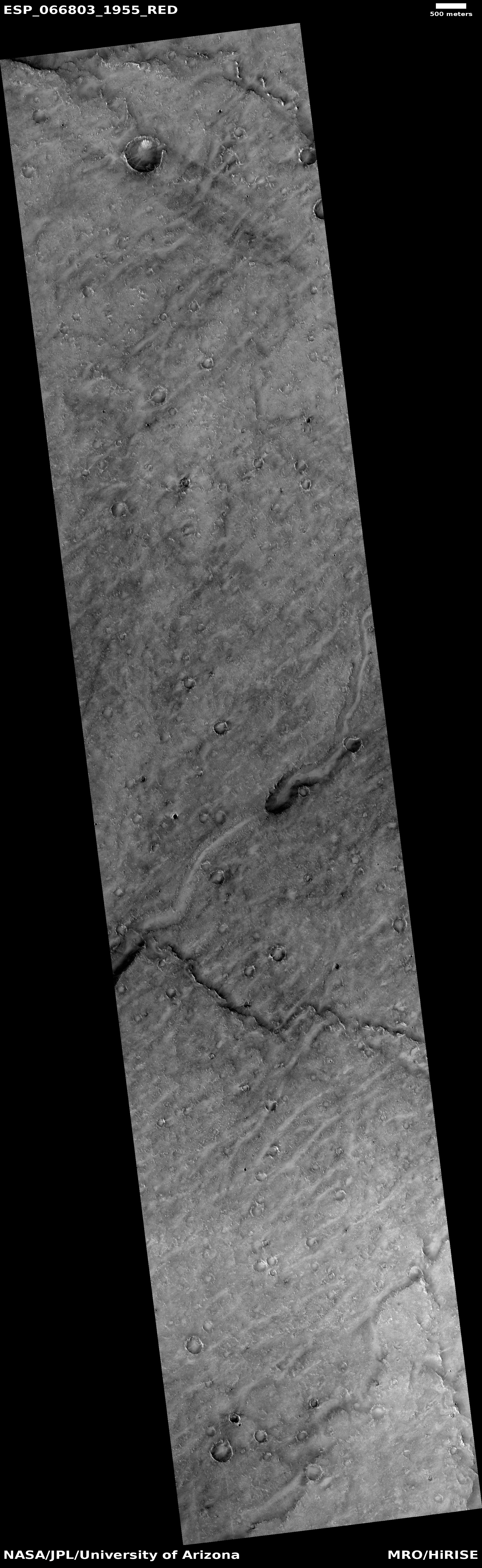
Cool image time! The picture to the right, cropped, reduced, and enhanced to post here, was taken on January 6, 2023 by the high resolution camera on Mars Reconnaissance Orbiter (MRO), and shows a small but typical area of the Medusae Fossae Formation, what is thought to be the largest volcanic ash deposit on Mars.

The picture itself was a “terrain sample,” taken by the MRO science team not as part of any specific research but to fill a gap in the camera’s schedule so as to maintain its temperature. The terrain itself looks like a field of sand that someone had run a fine comb across. In this case, the comb was the winds of Mars, prevailing from the southeast to the northwest. The crescent-like divots in the picture’s lower right are probably caused by some hard underground feature that the winds cannot blow away. Instead, it blows around, like water in rapids flowing around a rock, and takes the ash with it as it does so.
» Read more

1 comment

NASA outlines its expected needs as a space station customer

NASA has now published an updated detailed specification of what it will want to do on the four private space stations being built to replace ISS.

NASA published two white papers Feb. 13 as part of a request for information (RFI) for its Commercial Low Earth Orbit Destinations effort to support development of commercial stations. The documents provide new details about how NASA expects to work with companies operating those stations and the agency’s needs to conduct research there.

One white paper lists NASA’s anticipated resource needs for those stations, including crew time, power and volume, broken out for each of the major agency programs anticipated to use commercial stations. Companies had been seeking more details about NASA requirements to assist in the planning of their stations.

,,,The second white paper outlines the concept of operations NASA envisions for its use of commercial space stations. The 40-page document described in detail what it expects from such stations in terms of capabilities, resources and operations, as well as what oversight the agency anticipates having.

At the moment NASA has contracts with four different space station companies or partnerships, Axiom, Blue Origin, Nanoracks and Northrop Grumman, each of which is building its own station. Because NASA will initially be the biggest customer for these stations its requirements will help shape those stations significantly, which is why this information is of critical importance for the private companies.

At the same time, NASA is not dictating specific designs. The agency remains the customer, buying time on private facilities that will be owned privately and be free to sell their product to others. Thus, the designs of these stations might not match exactly what NASA desires, since even now there are other customers interested in buying space station time and space.

2 comments

Roscosmos will launch unmanned Soyuz to ISS on February 21

Roscosmos today announced that it will launch the unmanned Soyuz to ISS on February 21st, only a two-day delay after doing a quick inspection of its outer surface for possible damage following the coolant leak of a Progress freighter on February 11th.

BtB’s stringer Jay provided me this translation of the announcement at the link:

The Soyuz MS-23 spacecraft has been checked and is beginning to be prepared for launch. The preparations suspended the day before at Baikonur will resume tomorrow or the day after tomorrow.
The launch is scheduled for the 20th of February.

The ship was inspected. No maliciously drilled holes were found. We decided not to wait any longer. In any case, a refueled ship must either be launched or sent to a museum.

Update: removal of the launch vehicle to the launch pad on February 18, launch on February 21″ [emphasis mine]

The highlighted words are truly intriguing. It appears Roscosmos is desperately trying to convince the world that the repeated recent leaks to Soyuz and Progress spacecraft are not related to sabotage on the ground. At the same, Roscosmos has never told us the results of its investigation into the 2018 hole in a Soyuz capsule that someone drilled and then patched before launch. It seems incredibly unlikely that the two recent leaks in the exterior coolant systems of two different spacecrafts were both caused by impact from a micrometeorite or tiny piece of space junk. Two such impacts could of course occur this frequently, but for both to happen to such similar locations on only Russian spacecraft seems beyond improbable.

Either way, the decision makes some sense. The available lifeboats on ISS right now are really insufficient. Better to get this launched. More important, they had already begun fueling it, and once that is done the clock was running. They have to launch by a certain time.

Meanwhile it would be wise for NASA to begin arranging new emergency lifeboat arrangements with SpaceX as well as Boeing (once it finally gets Starliner operational). Depending on the Russians for even part of this responsibility seems ill advised. If preplanned properly, SpaceX could certainly launch one of its Dragon manned capsules quickly in an emergency.

13 comments

“What the heck?!” swirls on Mars


Click for original image.

Time for another “What the heck?!” image on Mars. The picture to the right, cropped to post here, was taken on January 6, 2023 by the high resolution camera on Mars Reconnaissance Orbiter (MRO). It is what the science team calls a “terrain sample,” which means it wasn’t taken as part of any specific scientific investigation and requested by a scientist. Instead, it was taken to fill a gap in MRO’s schedule. In order to maintain the camera’s proper temperature it is necessary for it to take regular pictures, and sometimes if there is a gap between requested images the science team picks something almost at random to fill the gap.

Sometimes the picture results in something relatively uninteresting. More often they try to pick something intriguing but not yet of interest to any particular researcher. With today’s cool image they certainly found something intriguing, so much so that I haven’t the faintest idea what is going on here.

Clearly, the tan swirls lie on the higher topology, and could be dust covered. The darker hollows in between could be darker because they are so, or because they are in shadow.
» Read more

0 comments

India’s government plans to sell tourist tickets on its future manned flights

The new colonial movement: It appears that once it completes its first manned mission in space, dubbed Gaganyaan, India’s government space agency ISRO intends to sell tourist tickets on future manned flights.

[Union Minister Jitendra] Singh, who also holds the portfolios of Personnel, Public Grievances and Pensions, informed the House that the objective of India’s maiden human spaceflight programme, ‘Gaganyaan’, is demonstration of human spaceflight capability to low earth orbit (LEO), which is a precursor to the future space tourism programme. “The ISRO has carried out a few feasibility studies for a sub-orbital space tourism mission,” the Union Minister revealed while announcing that after the accomplishment of the ‘Gaganyaan’ mission, activities towards space tourism would be firmed up.

Selling commercial tickets on its spacecraft would be completely in line with ISRO’s decades-long policy of trying to make money from its space capabilities. Whether this action however will help or hinder India’s independent space industry remains unclear. Like NASA a decade ago, there is a turf war in ISRO over whether to cede power to private enterprise, or hold it entirely in ISRO’s grip. If ISRO sells manned spaceflight tickets it will make it harder for private tourism companies to gain investment capital.

0 comments

Perseverance’s depot of core samples, ready for pickup

Mosaic of Perseverance's core sample depot
Click for original image.


Overview map
Click for interactive map.

The Perseverance science team yesterday released the annotated mosaic above, cropped to post here, showing the scattered depot of core samples the rover deposited on the floor of Jezero Crater for later pickup some time next decade for return to Earth.

The overview map to the right shows the context. The blue dot marks Perseverance’s position when it took the picture, on January 31, 2023. The green dot marks Ingenuity’s location at that time. The yellow lines indicate the approximate area covered by the mosaic. The green outline indicates the area of the depot.

Eight of those tubes are filled with rock and regolith (broken rock and dust), while one is an atmospheric sample and one is a “witness” tube. The rover photographed the depot using the Mastcam-Z camera on the top of its mast, or “head,” on Jan. 31, 2023. The color has been adjusted to show the Martian surface approximately as it would look to the human eye.

The location of each tube was carefully mapped because it is possible wind will cover them with dust in the decade-plus before pickup. This mosaic will also act as a guide for the future Mars helicopters that will arrive to grab the core samples and bring them to an ascent spacecraft that will bring them back to Earth.

2 comments

Imaging satellite builder Maxar signs contract with Umbra to use its radar satellites

Maxar, which operates a constellation of high resolution optical imaging satellites for commercial and military use, has now signed a contract with Umbra, which operates a constellation of high resolution radar satellites for commercial and military use.

The partnership will allow Maxar to directly task Umbra’s satellites and integrate synthetic aperture radar (SAR) data into its portfolio of Earth intelligence products and services, Tony Frazier, head of Maxar’s public sector Earth intelligence, told SpaceNews.

SAR is a specialized form of remote sensing that has been in growing demand since Russia’s invasion of Ukraine. SAR satellites can capture images at night, through cloud cover, smoke and rain — conditions that impair traditional optical satellites like those operated by Maxar.

The contract will give Maxar “assured access” to the soon-to-be launched six and seven satellites in Umbra’s constellation.

Essentially, this deal enhances Maxar’s value. Its main customer is the U.S. military, and it can now offer that military a more enhanced observation capability. Umbra meanwhile gets a major customer quickly, rather than having to pitch its product to multiple potential buyers. Its radar product is also enhanced, because it will now come automatically partnered with optical imagery.

0 comments

Dislodged fuel filter identified as cause of Virgin Orbit launch failure

Virgin Orbit yesterday revealed that a dislodged fuel filter in LauncherOne’s upper stage caused the failure of the rocket to reach orbit during its January 9, 2023 launch from Cornwall, UK.

The data is indicating that from the beginning of the second stage first burn, a fuel filter within the fuel feedline had been dislodged from its normal position. Additional data shows that the fuel pump that is downstream of the filter operated at a degraded efficiency level, resulting in the Newton 4 engine being starved for fuel. Performing in this anomalous manner resulted in the engine operating at a significantly higher than rated engine temperature.

Components downstream and in the vicinity of the abnormally hot engine eventually malfunctioned, causing the second stage thrust to terminate prematurely.

The rocket thus did not have enough velocity to reach orbit, and fell in the ocean.

No word yet on when the company will next launch, though it has said that launch will be from Mojave, California.

5 comments
1 355 356 357 358 359 1,353