Soft Martian buttes

Soft Martian buttes
Click for original image.

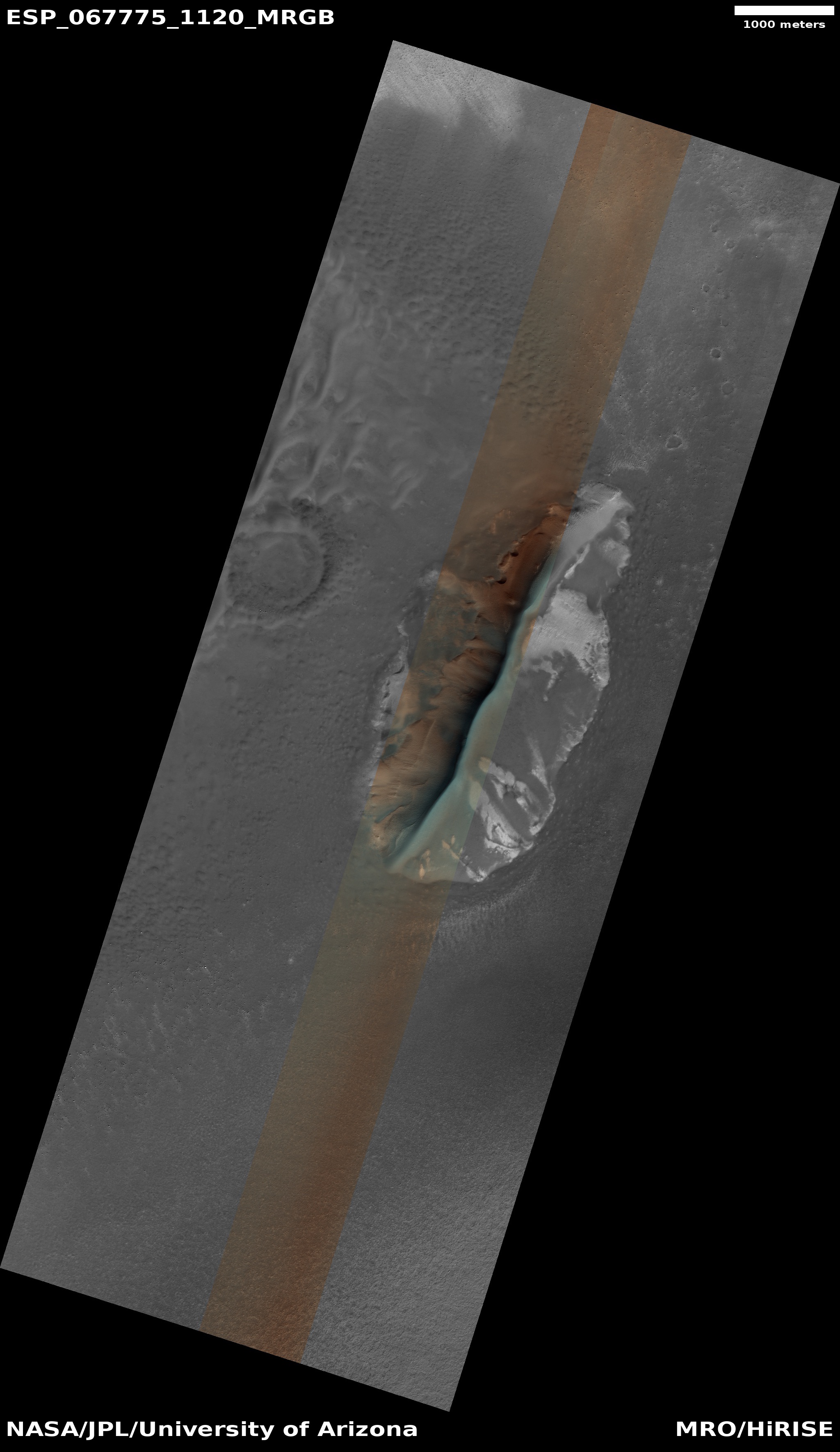
Cool image time! The picture to the right, rotated, cropped, reduced, and sharpened to post here, was taken on January 1, 2023 by the high resolution camera on Mars Reconnaissance Orbiter to fill a gap in its shooting schedule so that the scientists could maintain the camera at its proper temperature.

In other words, the picture was not taken as part of any particular research project. Its target was in a sense chosen almost at random, though the science team always tries to find something of interest in such situations. In this case I think they succeeded, as these soft terraced buttes illustrate well the alien nature of Mars. The ground is barren, with absolutely no evidence of any life, and it appears that the buttes have been softened and eroded by eons of wind action. You can see evidence of this by the handful of dust devil tracks that cross the buttes.

There is more.
» Read more

0 comments

Astronomers discover dwarf binary star system invisible to the human eye

Using the infrared instrument on the Keck telescope in Hawaii, astronomers have discovered a dwarf binary star system invisible to the human eye, with the tightest orbit ever seen.

The two stars are so close that it takes them less than one Earth day to revolve around each other; each star’s “year” lasts just 17 hours.

The newly discovered system, named LP 413-53AB, is composed of a pair of ultracool dwarfs, a class of very low-mass stars that are so cool that they emit their light primarily in the infrared, making them completely invisible to the human eye. They are nonetheless one of the most common types of stars in the universe.

Previously, astronomers had only detected three short-period ultracool dwarf binary systems, all of which are relatively young — up to 40 million years old. LP 413-53AB is estimated to be billions of years old — similar in age to our Sun — but has an orbital period that is about four times shorter than all the ultracool dwarf binaries discovered so far.

The two stars’ mutual orbit generally places them only about 600,000 miles apart. For comparison, the Moon orbits the Earth at a distance of 240,000 miles.

3 comments

What to expect when SpaceX launches Starship on its first orbital flight

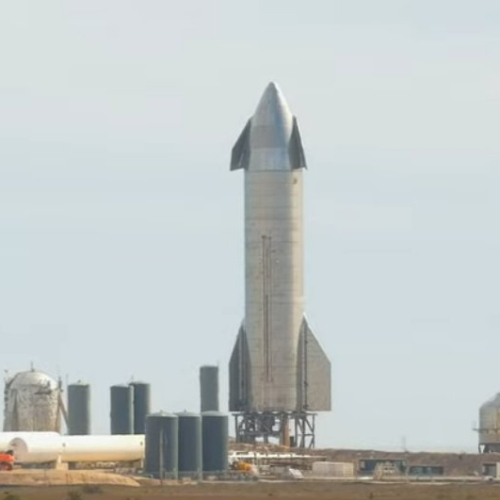
Link here. The article does a careful review of the previous dress rehearsal countdowns and static fire tests, especially the last which successfully fired 31 of Superheavy’s 33 Raptor-2 engines for 7 seconds, in order to understand what will happen during the countdown on the day the rocket does its first orbital launch, now expected within weeks.

It appears right now that SpaceX is preparing to replace one or both of those failed engines, and do it with Superheavy prototype #7 still mounted to the launchpad. Starship prototype #24 has not yet been stacked on top, but work is presently being done to it nearby to prepare it for launch. For example, workers recently have removed the attachment points used by cranes before the chopsticks existed and put thermal tiles there instead.

Based on the pace of work, SpaceX should be ready to launch by mid-March. All that will prevent this will be the FAA, which still has not approved the launch license.

0 comments

Webb spots massive galaxies in the early universe that should not exist at that time

The uncertainty of science: Astronomers using the Webb Space Telescope have identified six galaxies that are far too massive and evolved to have formed so quickly after the Big Bang.

The research, published today in Nature, could upend our model of the Universe and force a drastic rethink of how the first galaxies formed after the Big Bang. “We’ve never observed galaxies of this colossal size, this early on after the Big Bang,” says lead researcher Associate Professor Ivo Labbé from Swinburne University of Technology.

“The six galaxies we found are more than 12 billion years old, only 500 to 700 million years after the Big Bang, reaching sizes up to 100 billion times the mass of our sun. This is too big to even exist within current models.

You can read the paper here [pdf]. The “current models” Labbé is referring to are all the present theories and data that say the Big Bang occurred 13.7 billion years ago. These galaxies, however, found less than a billion years after that event, would have needed 12 billion years to have accumulated their mass.

If confirmed, these galaxies essentially tell us that the Big Bang is wrong, or very very VERY incomplete, and that all the data found that dates its occurrence 13.7 billion years ago, based on the Hubble constant, must be reanalyzed.

It is also possible these galaxies are actually not galaxies, but a new kind of supermassive black hole able to form very quickly. Expect many scientists who are heavily invested in the Big Bang to push for this explanation. It might be true, but their biases are true also, which means that Webb is presenting us with new data that calls for strong skepticism of all conclusions, across the board.

16 comments

MAVEN experiences problem with attitude control system

The Mars orbiter MAVEN has had to shut down its inertial measurement unit (IMU), used to tell the spacecraft its orientation in space and pointing direction, after it experienced a problem and caused the spacecraft to enter safe mode temporarily.

The IMU had been powered up in preparation for a minor maneuver targeted to reduce eclipse durations in 2027. On Feb.17, MAVEN exited safe mode and is currently operating in all stellar mode, a mode that does not rely on IMU measurements such that the IMU can be powered off to conserve its lifetime. The maneuver will be waived as the team evaluates the path forward. Relay activities and nominal science operations are scheduled to resume on Feb. 23.

“Relay activities” is NASA’s vague way of describing MAVEN’s job as a communications satellite for the rovers on the surface of Mars. Losing this satellite would hamper those operations somewhat, though there are several other orbiters available to pick up the task, with Mars Odyssey presently tasked to able to handle most communications relays.

0 comments

China’s Long March 3B rocket launches communications satellite

China today successfully used its Long March 3B rocket, launching from an interior spaceport, to place a satellite into orbit to provide “high-speed broadband access services for fixed terminals, vehicle/ship/airborne terminals.”

Little other information has been released, but that description sounds remarkably similar to what OneWeb’s satellite constellation does.

No word on whether the rocket’s lower stages crashed near habitable areas.

The 2023 launch race:

12 SpaceX
6 China
2 Russia
1 Rocket Lab
1 Japan
1 India

American private enterprise still leads China 13 to 6, and the entire world combined 13 to 10. SpaceX alone leads the entire world combined 12 to 10.

0 comments

Cliffs inside 285-mile-wide Schiaparelli Crater on Mars

Cliffs inside Schiaparelli Crater
Click for original image.

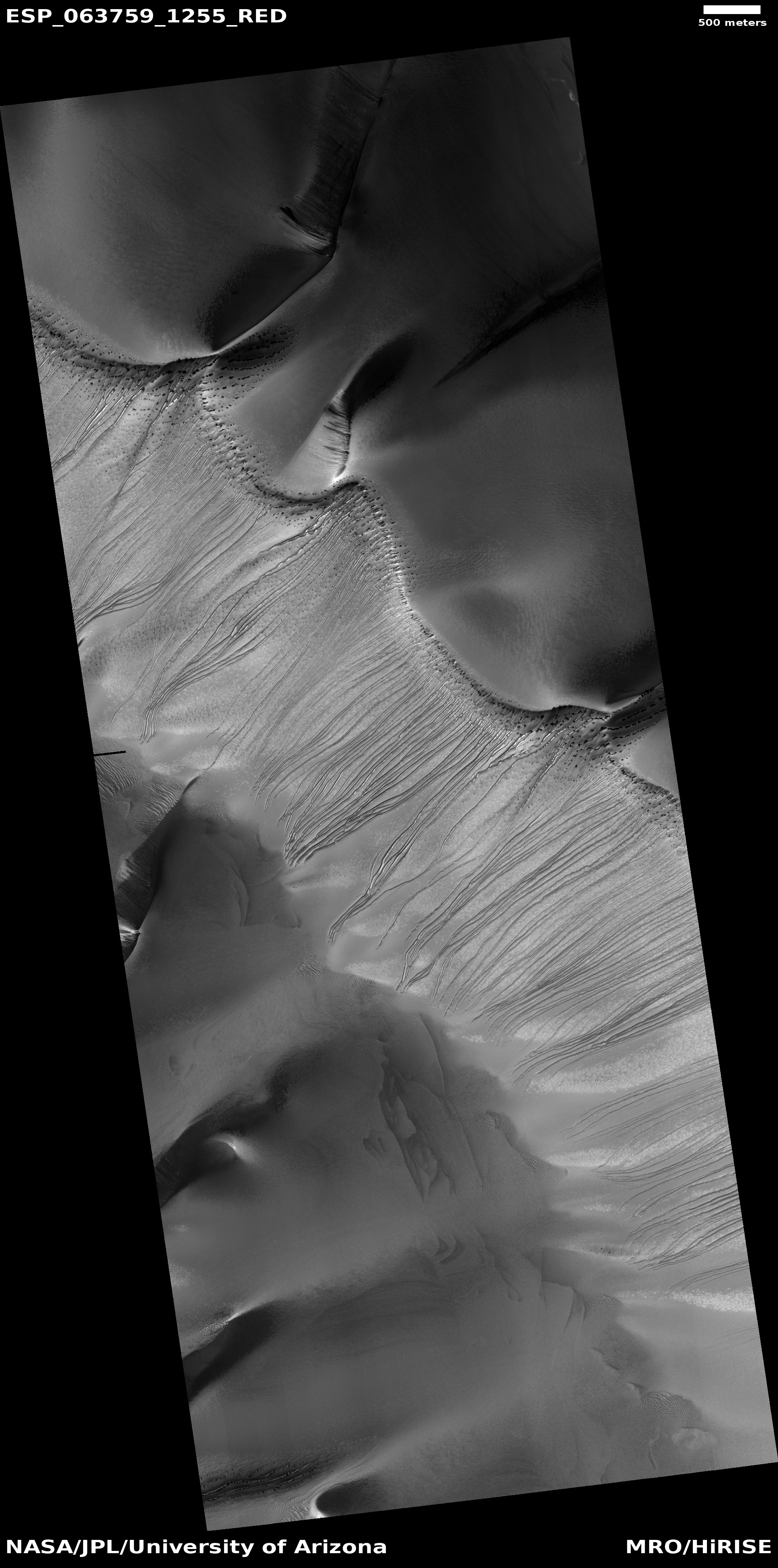
Cool image time! The picture to the right, rotated, cropped, reduced, and sharpened to post here, was taken on December 2, 2022 by the high resolution camera on Mars Reconnaissance Orbiter (MRO), and was labeled by the science team as showing “dramatic cliffs and swirls in mound-skirting unit.”

I estimate the tallest point of this cliff butte to be somewhere between 500 and 800 feet high. And while the cliff is what first attracts the eye, one mustn’t ignore the vast amounts of dust and sand that cover everything here. The small teardrop-shaped buttes on the upper plateau suggest the prevailing wind direction there is from the north to the south. However, the north-south orientation of the ripple dunes on the floor below suggests that the prevailing wind direction below the cliff is east-west. Explaining how the topography could so quickly change the prevailing wind direction is beyond my skill.

The swirls mentioned by the scientists can be seen at the top of the cliff (on the left) and just below its base, in areas where there appears to be less dust. Those swirls reveal the many geological layers here.
» Read more

1 comment

SpaceX ready to launch Starship prototype #24 into orbit

According to a statement yesterday by one SpaceX official, the company is now ready to launch its Superheavy #7 booster, stacked with its Starship prototype #24, on an orbital test flight, with the only remaining obstacle to launch the launch license, not yet approved by the FAA.

Speaking on a panel at the Space Mobility conference here about “rocket cargo” delivery, Gary Henry, senior advisor for national security space solutions at SpaceX, said both the Super Heavy booster and its launch pad were in good shape after the Feb. 9 test, clearing the way for an orbital launch that is still pending a Federal Aviation Administration launch license. “We had a successful hot fire, and that was really the last box to check,” he said. “The vehicle is in good shape. The pad is in good shape.”

…“Pretty much all of the prerequisites to supporting an orbital demonstration attempt here in the next month or so look good,” he said.

Henry also outlined SpaceX’s overall plans for Starship in the next year or two, beginning with a series of test/operational launches that will iron out the kinks of the rocket while simultaneously placing Starlink satellites into orbit. At the same time, development will shift to creating a Moon lander version of Starship for NASA’S Artemis program, including doing refueling tests of Starship in orbit. These test flights will also lead quickly to the three private manned flights that SpaceX already has contracts for, including two around the Moon and one in Earth orbit.

8 comments

NASA signs deal to launch Israel’s first space telescope mission

NASA today announced that it has agreed to provide the launch opportunity for Israel’s first space telescope, dubbed the Ultraviolet Transient Astronomy Satellite (ULTRASAT), designed to make wide-field ultraviolet observations from geosynchronous orbit.

Led by the Israel Space Agency and Weizmann Institute of Science, ULTRASAT is planned for launch into geostationary orbit around Earth in early 2026. In addition to providing the launch service, NASA will also participate in the mission’s science program.

The press release, both from NASA and from Weizmann, was remarkably vague about how NASA will provide that launch capability. The only orbital rocket NASA has is SLS. Will ULTRASAT launch as a secondary payload on a future Artemis launch? Or will NASA buy launch services from another rocket company? The press releases did not say.

Regardless, this deal means that American taxpayers have agreed to foot the launch cost of this Israeli space telescope, in exchange for obtaining telescope time for American astronomers. Interestingly, the press releases also provided no information about how much that launch cost would be.

There has long been a need for a dedicated new ultraviolet space telescope, so this deal could be a good one for American astronomers and a worthwhile use of some of NASA’s budget. It just seems inappropriate for NASA to keep the details so secret.

0 comments

Japanese startup enters the high altitude balloon space tourism business

A Japanese startup, Iwaya Giken, announced yesterday that it is building a two-person capsule that will carry two persons, a pilot and passenger, on high-altitude stratospheric tourist balloon flights for about $180K per ticket.

The company, Iwaya Giken, based in Sapporo in northern Japan, has been working on the project since 2012 and says it has developed an airtight two-seat cabin and a balloon capable of rising up to an altitude of 25 kilometers (15 miles), where the curve of the Earth can be clearly viewed. While passengers won’t be in outer space — the balloon only goes up to roughly the middle of the stratosphere — they’ll be higher than a jet plane flies and have an unobstructed view of outer space.

The company teamed up with major Japanese travel agency JTB Corp., which announced plans to collaborate on the project when the company is ready for a commercial trip. Initially, a flight would cost about 24 million yen ($180,000), but Iwaya said he aims to eventually bring it down to several million yen (tens of thousands of dollars).

No date for the first launch was mentioned. This company now joins two American balloon companies as well as a Spanish balloon company, all planning to offer rides to the edge of space.

4 comments

Despite a complete lack of any customers, Spaceport America in New Mexico now plans to build a “reception center.”

The New Mexico Spaceport Authority has decided it needs to build another building at Spaceport America, even though that spaceport has seen no significant business in its almost two decades of operation, and has little indication of any future business to come.

The Spaceport Technology and Reception Center’s mission “will be to become the welcoming face to staff, visitors, and prospective customers visiting or working at Spaceport America. The proposed 30,000 square foot STARC building will be a multi-use facility; it will house the Spaceport’s core IT server center, staff offices and conference rooms, an Auditorium, food preparation and dining area, virtual experience center, and 2nd and 3rd floor lounge and viewing areas,” according to a request for proposals (RFP) issued by the New Mexico Spaceport Authority (NMSA). “The new building will provide modern, comfortable work and meeting spaces for NMSA staff and a means to receive, entertain and educate groups of visitors and/or potential customers,” the document added.

The article goes on to detail how NMSA has spent millions of tax dollars for years, with the promise of billions of revenue from space launches and thousands of local jobs, all of which have turned out to be pie in the sky. Other than Virgin Galactic, which remains a very questionable customer, no major rocket companies have shown any interest in launching from this spaceport.

To propose spending more on another building that will likely sit empty most of the time is absurd. As the article notes, New Mexico has many much more compelling issues to spend its taxpayer money. This boondoggle should be shut down.

1 comment

A lunar lava avalanche three miles wide and one mile long

A lunar lava avalanche three miles wide and one mile long

Cool image time! The picture to the right, cropped, reduced, and sharpened to post here, was taken October 16, 2016 and released today by the Lunar Reconnaissance Orbiter (LRO) science team. It shows a three-mile-wide unnamed crater that impacted on the rims of two other lunar impacts, one larger but the other monumental.

The trio of impact events that resulted in this spectacular corner of the Moon occurred over nearly four billion years of lunar history; first, the Orientale basin (>3.7 billion years), Lowell W (one to three billion years), and finally, this unnamed crater (likely <100 million years).

The Orientale Basin is about 500 miles wide, and is one of the most distinct large features on the lunar surface, a gigantic bowl with three concentric rings surrounding it. Because it is near the eastern limb of the near side, it wasn’t until the space age before a good overhead view of this major lunar geological impact basin was seen. Lowell W is about 11 miles wide.

The overview map below shows the context between Lowell W and this small crater, with the yellow lines indicating the area covered by the picture above.
» Read more

0 comments
1 353 354 355 356 357 1,353