More delays for New Shepard

Capitalism in space: Bob Smith, the CEO of Blue Origin, revealed this week that the first manned flights of its reusable suborbital New Shepard spacecraft will likely not happen in 2019, as previously announced.

Blue Origin, which is headquartered in Kent, Wash., has filed plans with the Federal Communications Commission for at least two more New Shepard test flights from its test and launch facility in West Texas. These would be the 12th and 13th flights of the New Shepard test program.

On Tuesday, Blue Origin sought reauthorization of the next test flight for a six-month period running from Nov. 1 to next May. The existing authorization is set to expire on Dec. 1, which suggests that the company wants to reserve more time to prepare for the test.

Whether those next two test flights will use the capsule they have flown previously, or a new capsule, dubbed “RSS First Step”, that they intend to put the first people on, could determine how much of a delay to expect. That new capsule is built but it has never flown. If the next two flights use the previous test capsule, this would guarantee even more delays before Blue Origin flies people.

8 comments

Soyuz launches military surveillance satellite

Russia today completed its second Soyuz launch in twenty-four hours, launching the third in a constellation of military satellites designed to detect incoming missiles.

With this launch Russia has topped its total from 2018, and looks very likely finish the year with the most launches since 2016.

The leaders in the 2019 launch race:

18 China
16 Russia
10 SpaceX
6 Europe (Arianespace)

The U.S. continues to lead China 19 to 18 in the national rankings.

0 comments

UK company buys space on Astrobotic’s first lunar lander

Capitalism in space: Spacebit, a United Kingdom company, has signed a deal to put an instrument on Astrobotic’s first lunar lander, Peregrine-1, set for launch by 2021.

Astrobotic was one of the three private companies awarded NASA contracts to build unmanned lunar landers to carry NASA instruments to the Moon. In addition, these companies could sell additional space to other private companies. According to the press release, Astrobotic already has a manifest of sixteen such contracts.

0 comments

Proton commercial launch delayed

One of the last few commercial launches for Russia’s Proton rocket has been delayed because the satellite “was not attached correctly to the upper stage.”

This is likely not as serious a blunder as the story makes it sounds. They had detected some “electromagnetic interference” in the upper stage’s control system during prechecks, which suggests a wire got crossed somewhere.

2 comments

Three launches today, including launch of three astronauts and UAE’s first spaceman

Three launches today, by China, Japan, and Russia. China launched a Yunhai-1 weather satellite using its Long March 2D rocket. Japan in turn successfully launched, on its second attempt, its HTV cargo freighter to ISS. This was Japan’s second launch this year.

Finally, Russia has just successfully put three astronauts into orbit using its Soyuz rocket, including the first astronaut of the United Arab Emirates.

The leaders in the 2019 launch race:

18 China
15 Russia
10 SpaceX
6 Europe (Arianespace)

The U.S. lead over China in the national rankings is now 19 to 18.

0 comments

LauncherOne shipped to Mohave for launch prep

Capitalism in space: Virgin Orbit has shipped its first LauncherOne rocket to Mohave for final tests prior to its first launch, planned for sometime this year.

Virgin Orbit didn’t give a schedule for completing those tests and performing that orbital flight. Dan Hart, president and chief executive of Virgin Orbit, said at the World Satellite Business Week conference in Paris Sept. 11 that he expected those final tests be completed in a matter of weeks. “It will take a handful of weeks to get through a number of wet dress rehearsals, crew training, and verification of the system,” he said. “We’ll do one flight test with that rocket and then we’ll get to orbit.” He estimated the company would be ready for launch “in the middle of this fall.”

If that first orbital test flight is successful, they hope to do their first operational commercial launch before the end of the year.

My 2016 prediction that a LauncherOne will complete its first commercial launch before SpaceShipOne, continues to look likely, even though SpaceShipOne began development more than a decade before LauncherOne..

1 comment

Astronomer: Look for monolith on co-orbiting asteriods

According to one astronomer in a paper published this week, the most likely place to find alien artifacts would be on the co-orbital asteroids, objects whose orbit is very similar to the Earth and thus always nearby but mostly unseen.

In this context, a co-orbital is an asteroid that goes around the Sun on the same, or similar, orbital path to Earth. Co-orbital objects approach Earth very closely every year at distance is much shorter than anything except the moon.

Consequently, co-orbitals could be a great place to watch Earth from. Not only would any alien probes on co-orbital objects be concealed, but they would also be anchored and able to access solar energy. They could possibly sustain themselves for many thousands of years.

According to this paper, if aliens have visited the solar system in the past they would place their long-term alien probes on such an asteroid, or even give it a comparable co-orbit. And if we look and don’t find anything, that would strongly imply that we are alone in the universe.

Fun stuff, but need I say that not finding alien artifacts at these locations proves nothing.

Hat tip Jeff Bliss.

2 comments

Musk shows off Starship

Capitalism in space: In a tweet on September 22 Elon Musk gave an update on the status of its Starship rocket.

His tweet provided a picture of crews attaching “rear moving fins” the what they are now calling Starship Mk1.

The photo showed the stainless steel hull of the rocket as SpaceX attached two large fins to the base. Starship is a massive, next-generation vehicle that Musk’s company is building to send cargo and as many as 100 people to the moon and Mars.

Musk is expected to make a major speech on September 28 on Starship’s status.

0 comments

NASA awards Lockheed Martin long term Orion contract

The never-ending boondoggle: NASA today awarded Lockheed Martin a long term contract to build as many as twelve future Orion capsules.

OPOC is an indefinite-delivery/indefinite-quantity contract that includes a commitment to order a minimum of six and a maximum of 12 Orion spacecraft, with an ordering period through Sept. 30, 2030. Production and operations of the spacecraft for six to 12 missions will establish a core set of capabilities, stabilize the production process, and demonstrate reusability of spacecraft components.

“This contract secures Orion production through the next decade, demonstrating NASA’s commitment to establishing a sustainable presence at the Moon to bring back new knowledge and prepare for sending astronauts to Mars,” said NASA Administrator Jim Bridenstine. “Orion is a highly-capable, state-of-the-art spacecraft, designed specifically for deep space missions with astronauts, and an integral part of NASA’s infrastructure for Artemis missions and future exploration of the solar system.” [emphasis mine]

I honestly don’t know how NASA can commit to building these Orion capsules, when Congress has yet to fund them. I guess NASA has decided that Congress and elections are irrelevant, that they — as our anointed rulers in Washington — can make these decisions unilaterally, at their own whim.

One quote in the press release really stood out to me:

“As the only vehicle capable of deep space exploration, the Orion spacecraft is critical to America’s continued leadership,” said Rep. Brian Babin [R-Texas].

What a crock. Orion is pork, period. It is simple too small for any deep space mission, no matter what lies NASA tries to tell us. It will get us nowhere.

All this contract does is justify the existence of the Johnson Space Center, which really has no purpose since the retirement of the shuttle and the decision to fly future astronauts on privately built spacecraft. Having Orion to “manage” will convince people that the workers at Johnson are doing something, when really almost everything of importance will be done by Lockheed Martin.

This contract is also another component in NASA’s political strategy to get as many players in the space business committed to both Artemis and Gateway. Pretty soon they will have everyone on board, with big tax dollar bribes.

Meanwhile, what they are building won’t accomplish anything, and will strand us in lunar orbit for decades, while other countries land and learn how to build bases on other worlds.

10 comments

Tongue-shaped glaciers on Mars

Tongue-shaped glacier on Mars
Click for full image.

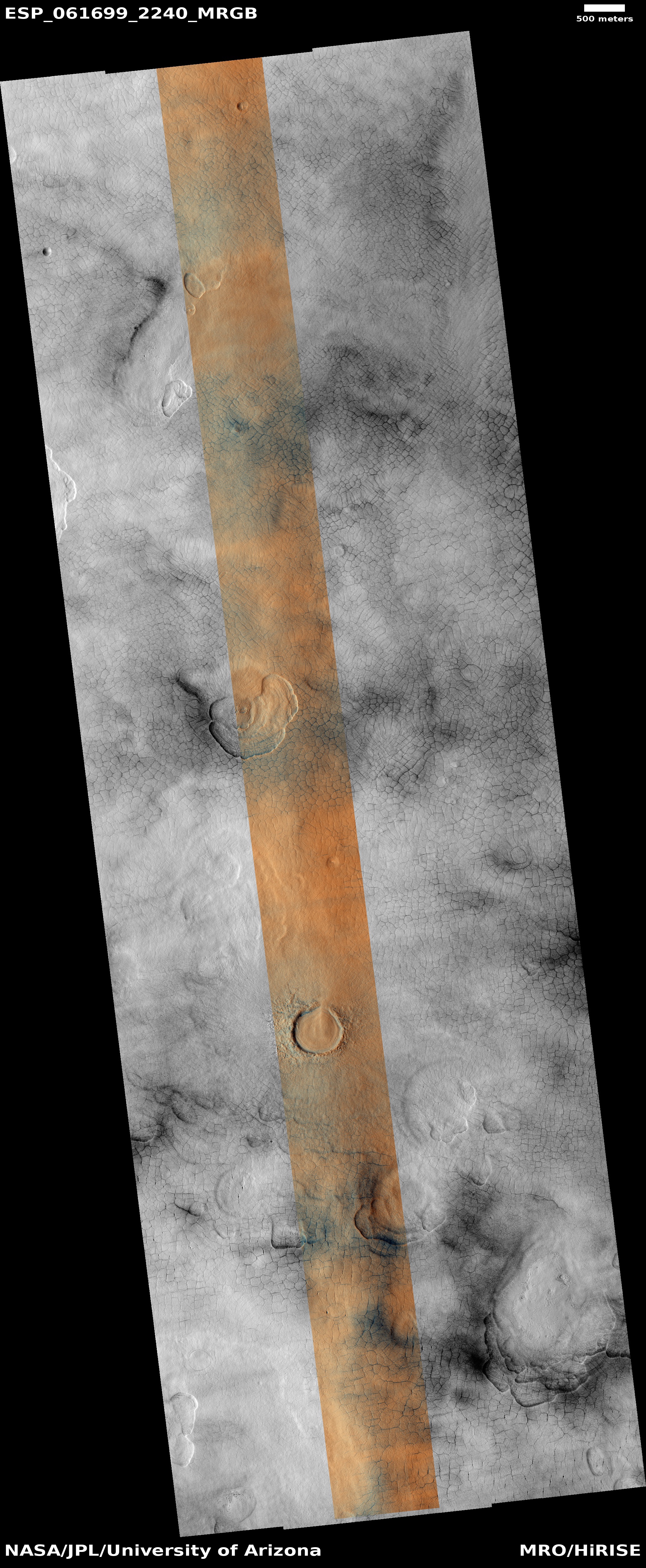
Cool image time! I could also call this another example of mass wasting, which it appears to be according to my understanding of Martian geological processes. However, the Mars Reconnaissance Orbiter science team dubbed this image “Tongue-Shaped Glaciers in Centauri Montes,” and I have no right to disagree with them.

The image to the right, rotated, cropped, reduced, and brightened to post here, shows the most prominent tongue-shaped glacier in the full image. The two curved ridges to the south of the glacier’s tip are almost certainly old moraines of debris pushed there during earlier events, when the glacier material extended farther out. In fact, if you look close you can see that this tongue lies on top of a larger older tongue that lines up with the closer of these two ridges.

This feature is located at 37 degrees south latitude, which puts it inside Mars’s southern glacial band that extends from 30 to 60 degrees latitude. According to the present defined types of Martian glaciers, this tongue is what scientists have dubbed a lobate debris apron, a glacier that in many ways resembles glaciers we see on Earth.

The location of this feature is especially interesting, especially because other images have found that it is not unique to this region.
» Read more

0 comments

Australia signs on to NASA’s Artemis project

Australia has committed $150 million to help its private sector contribute to NASA’s Artemis project and Trump’s goal to land a manned mission on the Moon by 2024, signing a joint agreement with NASA on September 21.

The government is investing $150 million over five years for Australian businesses and researchers to join NASA’s endeavour, and deliver key capabilities for the mission. “We’re backing Australian businesses to the moon, and even Mars, and back,” Prime Minister Scott Morrison said. “We’re getting behind Australian businesses so they can take advantage of the pipeline of work NASA has committed to.”

The specifics, as quoted from the agreement, are somewhat vague.

This agreement is part of NASA’s effort to accumulate allies for both Artemis and its lunar space station Gateway. Australia has now joined Russia, Europe, Japan, and Canada. All of these nations and their space agencies desperately want the U.S. project to take place, most especially Gateway, as it will firm up funding for them all for decades.

NASA already has the big space contractors behind Artemis, though Boeing has expressed some opposition to Gateway. It has also awarded a lot of small contracts to a number of companies in the new commercial space industry to support Artemis. On top of this, it has distributed the project’s management within NASA so as to solidify support in Congress.

By accumulating these allies whose interests are in line with NASA’s goals, the agency hopes to convince Congress to fund the project. Unfortunately, the House, controlled by the Democrats whose only policy goal these days is to oppose Trump, have so far refused to fund the Trump 2024 manned mission.

Whether Artemis and Gateway will happen remains an open question. Congress wants the pork both projects will bring them. I predict that if both houses of Congress return to Republican control in 2020 they will fund this boondoggle.

Unfortunately, this won’t get us anywhere near the Moon, as the project as designed actually makes lunar landings more difficult and expensive. Getting from Gateway to the lunar surface requires more equipment and fuel than going directly there. If built as NASA has proposed, our astronauts will watch from Gateway as China and India land and begin settling the Moon.

But it will justify the spending of a lot of taxpayer money in congressional districts for decades to come. Hooray!

0 comments

Storms on Jupiter

Storms on Jupiter
Click for full resolution image.

The image on the right, reduced to post here, was created by Citizen scientist Kevin Gill from recent Juno images taken of Jupiter, and shows in detail some of the many storms that fill Jupiter’s many bands of color.

We do not have a scale, but my guess is that these storms are probably about the size of the Earth, which means these storms are bigger than any hurricane you can imagine. If you click on the image to look at the full resolution photograph, you can see there are tiny white clouds clumped in the middle of the picture’s three biggest storms. Those clumps are probably also bigger than any single clouds you could find anywhere on Earth.

As I wrote in a post in April 2017 about a similar Juno image:

What should fill us with even more awe is that this only covers a very thin slice of the top of Jupiter’s deep atmosphere. The planet itself is about 89,000 miles in diameter, more than ten times larger than Earth. The depth of its atmosphere is not really known, but it must be deeper than several Earths, piled on top of each other. In that depth there must be many atmospheric layers, each thicker and denser than the one above, and each with its own weather systems and complexities.

It will take centuries of research, including the development of new engineering capable of accessing this place, to even begin to map out its meteorology. And this is only one gas giant, of what we now know must be millions and millions throughout the galaxy.

If we have the nerve and daring, the human race has the opportunity to go out there and never be bored. There will always be something unknown to discover.

All that still applies. We have only just begun our journey exploring the universe.

1 comment

Mitsubishi IDs cause of launchpad fire, reschedules launch

Mitsubishi, the Japanese company that builds the H-2B rocket for Japan’s space agency JAXA, has identified the cause of the dramatic launchpad fire that broke out only about three hours before the launch of their HTV unmanned ISS cargo freighter.

MHI announced Friday that officials believe the fire started near an “exit hole” on the mobile launch platform. Investigators believe the blaze was most likely caused by static electricity, and exacerbated by a flammable oxygen-rich environment inside the mobile launch platform.

Low winds at Tanegashima during the Sept. 10 countdown allowed oxygen vapors to build up at the launch pad in higher concentrations than previous countdowns, officials said. Super-cold oxygen is used as an oxidizer in both stages of the H-2B rocket, and also flows through the first stage’s twin LE-7A main engines during pre-launch “chilldown” conditioning procedures.

“As a result of the investigation, it was confirmed that there was a high possibility that the fire spread due to the static electricity generated by the oxygen dripping from the engine exhaust port during the propellant filling operation, which continued to blow on the heat-resistant material in the exit hole at the movable launch pad,” MHI said in a statement. “We have taken corrective measures and have confirmed normal functioning of the rocket and facility,” MHI said.

They have rescheduled the launch for September 26. Initially they were aiming for September 24, but rescheduled because there might be an orbital conflict between their rocket’s second stage and the launch of a Soyuz to ISS that same day.

5 comments

Cave pits in the Martian northern lowlands

New pits in Hephaestus Planitia

I could call this my monthly Martian Pit update. Since November 2018 I have each month found from two to five new and interesting cave pits in the monthly download of new images from the high resolution camera on Mars Reconnaissance Orbiter (MRO). My previous posts:

All except the last August 12 post were for pits on the flanks of Arsia Mons, the southernmost in the line of three giant volcanoes to the southeast of Olympus Mons, and were thus almost certainly resulting from lava flows.

The August 12 post instead showed pits found in Utopia Planitia, one of the large plains that comprise the Martian northern lowlands where scientists think an intermittent ocean might have once existed. All of these pits are found in a region of meandering canyons dubbed Hephaestus Fossae.

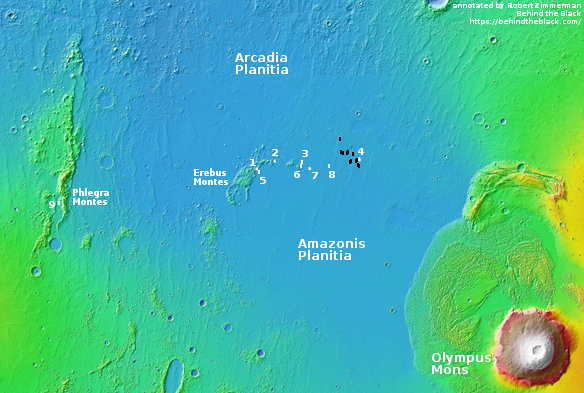
In the most recent MRO release scientists once again focused on the pits in or near Hephaetus, imaging four pits, two of which have been imaged previously, as shown in my August post and labeled #2 and #4 in this article, and two (here and here) that appear new. The image on the right, cropped to post here, shows the two new pits, dubbed #1 and #3. In the full image of #1, it is clear that this pit lines up nicely with some other less prominent depressions, suggesting an underground cave. Pit #3 however is more puzzling. In the full image, this pit actually runs perpendicular to a long depression to the west. There are also no other related features around it.

What makes all four of these pits intriguing is their relationship to Hephaestus Fossae and a neighboring rill-like canyon dubbed Hebrus Valles, as shown in the overview map below.
» Read more

6 comments

Russia and China to team up on lunar lander/orbiter missions

Russia and China have signed an agreement to cooperate on several future lunar lander and orbiter unmanned missions.

The agreements will see cooperation in Russia’s Luna-26 orbiter spacecraft and Chang’e-7 polar landing mission, according to Roscosmos, which could involve contributions of science payloads to the respective spacecraft. Both missions are currently scheduled for the early-to-mid 2020s.

The two sides also committed to previously announced plans to create a joint lunar and deep space data center, which will consist of hubs in both Russia and China.

How they will specifically cooperate on those specific space missions was not made clear. From what I can gather, the real heart of this agreement are those joint data centers for both missions.

0 comments

Bridenstine will ask Russia for explanation about drill hole

NASA’s administrator Jim Bridenstine, when asked by journalists about the decision by Russia to keep secret the origins of the drill hole in a Soyuz capsule that caused a leak on ISS, said he will politely beg Russia for some answers.

NASA Administrator Jim Bridenstine vowed Thursday to speak to the head of the Russian space agency after reports that the cause of a hole found on the International Space Station last year would be kept secret.

But he was careful to point out that he doesn’t want this situation to destroy the country’s relationship with Russia, a partner in space since 1975. “They have not told me anything,” Bridenstine told the Houston Chronicle during a question and answer session at a Houston energy conference. “I don’t want to let one item set (the relationship) back, but it is clearly not acceptable that there are holes in the International Space Station.”

Sure, let’s not offend those Russians so we can keep flying Americans on their capsules, even though they won’t tell us who drilled a hole in a Soyuz capsule prior to launch, then patched it badly so that it began leaking after a few months in space.

This kind of logic could only make sense in Washington government circles.

1 comment

ESA asks NASA’s help on ExoMars rover parachute problems

The European Space Agency (ESA) has asked for help from NASA in trying to figure out the cause of the failures during testing of the parachutes they want to use to safely land their ExoMars 2020 rover, Rosalind Franklin.

So far the parachutes have been damaged on all previous tests. They plan two more tests in December and February.

Both tests, to be held at high altitude to simulate the Martian atmosphere, need to succeed in order for the parachutes to pass qualification. TheExoMars mission faces a final review scheduled April 2020, Francois Spoto, ExoMars program manager, told SpaceNews. “Now the situation is critical, of course, because we have limited time and no margin,” Spoto says.

If one of the tests fails, the ExoMars mission will miss the narrow July 25 to Aug. 13 launch window next year and slip to the next window, in late 2022. The lander and rover segments are meanwhile progressing well and ready for environmental testing.

They held a workshop on the previous failures, and obtained new analysis of the causes from JPL engineers.

2 comments

Progress on Dragon parachute tests

It appears that SpaceX’s parachute testing for its Dragon manned capsule is finally satisfying the concerns of NASA and its safety panel, based on a Sept 17 NASA blog post.

In fact, SpaceX’s success has even forced NASA “to reevaluate its own [parachute] standards and certification processes.”

The article at the link also notes quite correctly NASA’s tendency to miss the forest for the trees, which is why it has forced SpaceX to do so much additional parachute testing, even though the company apparently had a solid understanding of its parachutes a long time ago.

[T]he space agency has been focused on parachutes and COPVs [the tank issues that caused the 2016 launchpad explosion] for years. This is primarily a result of NASA’s notoriously reactive approach to safety: SpaceX suffered two COPV-related Falcon 9 failures in 2015 and 2016 and has experienced an unknown number (likely 1-3) of anomalies during Crew Dragon parachute testing.

As a result, NASA has focused extensively on these two stand-out concerns. To an extent, this is reasonable – if you know things have a tendency to fail, you’re going to want to make sure that they don’t. However, prioritizing reactive safety measures at the cost of proactive safety would be a major risk, akin to getting in a car crash because you didn’t use a turn signal and then prioritizing turn signal use so much that you forget to look both ways before making turns. Sure, you will probably never get in the same crash, but you are raising the risk of new kinds of accidents if you overcorrect your attention distribution.

Either way, it increasingly appears that a manned Dragon mission might finally be getting close to launch.

0 comments

Yutu-2’s first close look at mysterious “gel-like” material

gel-like?
Click for full image.

Chinese scientists have released images showing their approach and first look at the mysterious “gel-like material they spotted inside a small crater using their lunar rover Yutu-2, presently exploring an area on the far side of the Moon.

The image to the right, cropped and expanded to post here, focuses on that location. As much as we might wish it, the rectangle is not the monolith from 2001, a Space Odyssey. It is merely a section where it appears they increased the exposure to see more details in the shadows. Also, as noted at the webpage:

The compressed, black-and-white shot comes from an obstacle-avoidance camera on the rover. The green, rectangular area and red circle within are suspected to be related to the field of view of the Visible and Near-Infrared Spectrometer (VNIS) instrument, rather than the subject matter itself, according to some lunar scientists.

Apparently they were unsatisfied with the data from this viewpoint, and moved the rover to get a second better view. The results from that second location however have not been released.

3 comments
1 424 425 426 427 428 813