Scientists propose new theory to explain mysterious slope streaks on Mars

Slope streaks on Mars
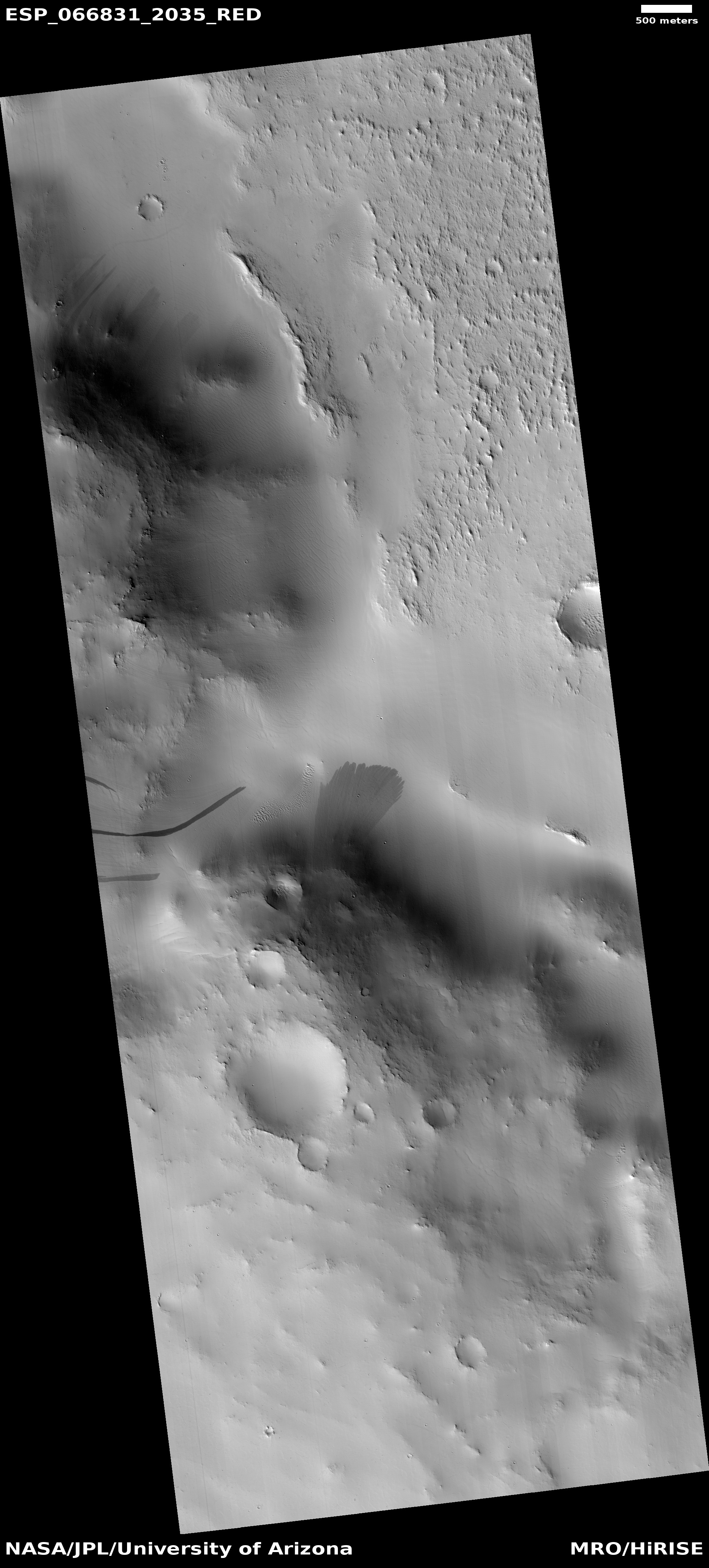
Click for full image.

In a paper published earlier this month, scientists have proposed a new theory to explain the the origin of slope streaks on Mars, a unique Martian geological feature that at first glance look like a stainlike avalanches which also appear to do nothing to change the surface topography. (See earlier posts here and here for a description of this strange Martian phenomenon.)

Essentially, data from the orbiters suggests that carbon dioxide frost develops just under the surface during the night. In equatorial regions this frost mixes with dust (allowing it to exist even in these warmer climates). When the morning light hits the frost it causes it to sublimate away, which in turn causes the appearance of slope streaks as the dust is released from the frost.

From the paper’s abstract:

At sunrise, sublimation-driven winds within the regolith are occasionally strong enough to displace individual dust grains, initiating and sustaining dust avalanches on steep slopes, forming ground features known as slope streaks. This model suggests that the CO2 frost cycle is an active geomorphological agent at all latitudes and not just at high or polar latitudes, and possibly a key factor maintaining mobile dust reservoirs at the surface.

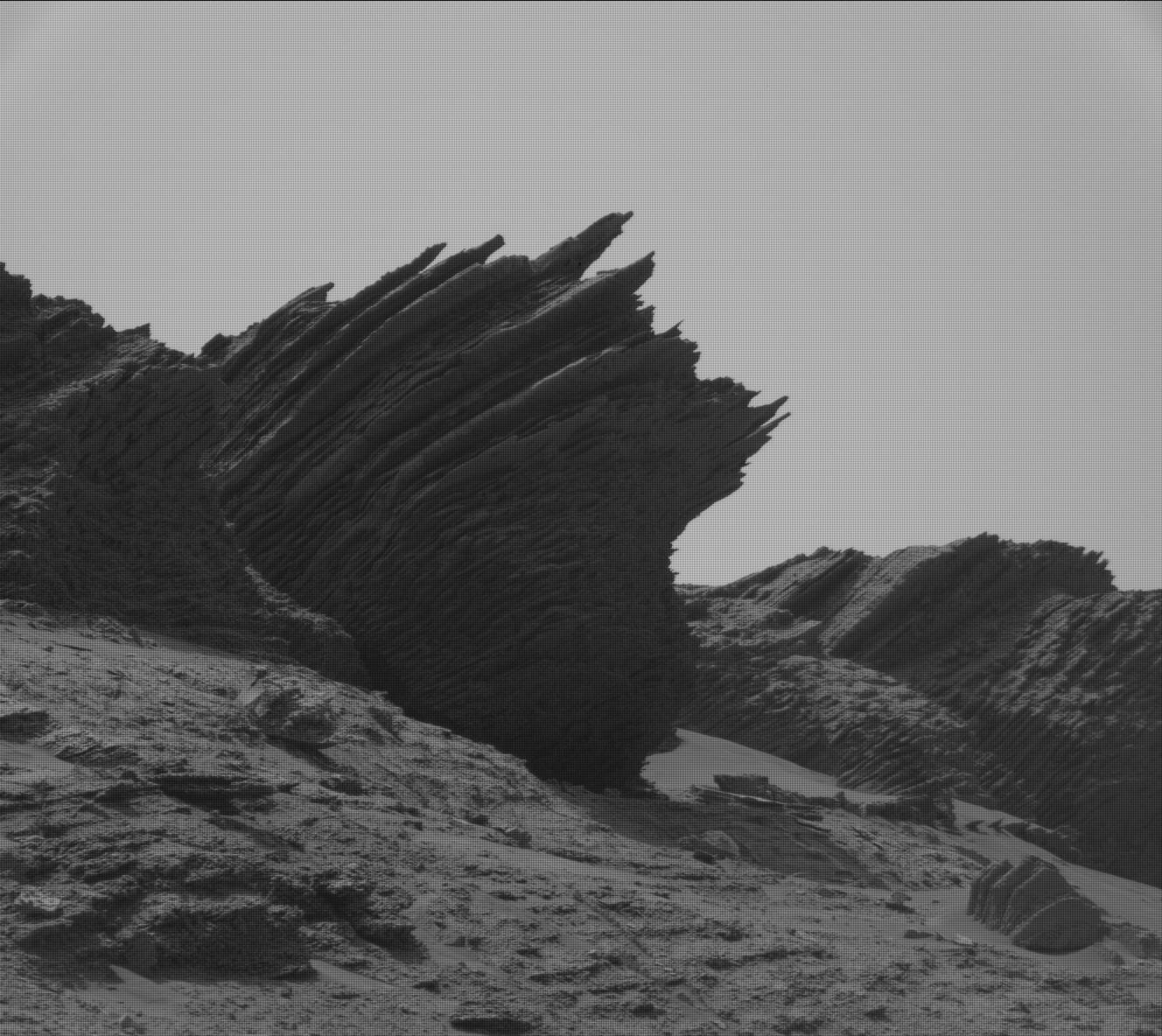
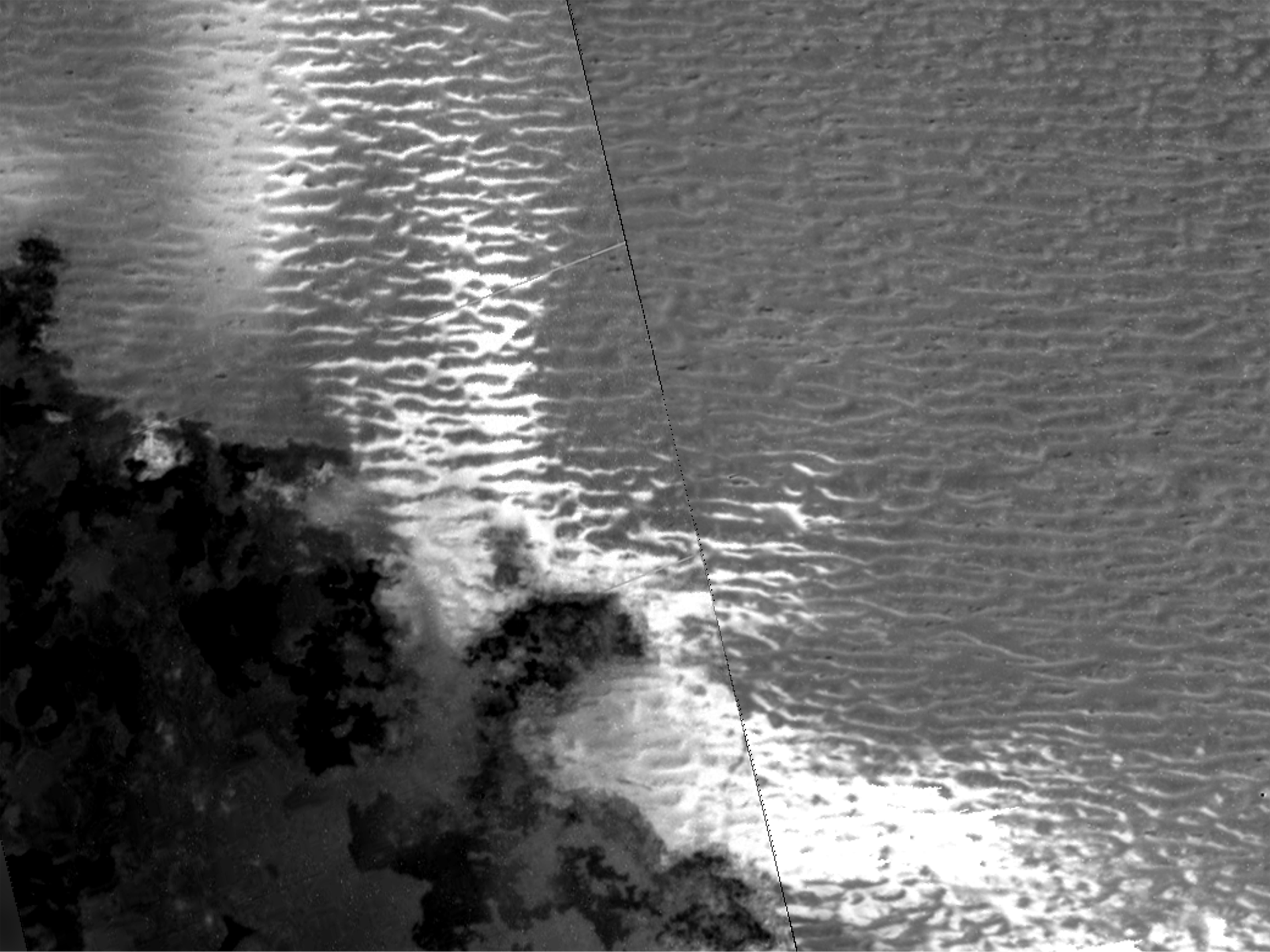
The cool image above, cropped and reduced to post here, was taken on October 28, 2020 by the high resolution camera on Mars Reconnaissance Orbiter (MRO) and shows an excellent example of two very spectacular large slope streaks, one long and narrow and another short and wide. Located at 23 degrees, this is an area where no ice has yet been found near the surface.

This new theory joins two other popular theories attempting to explain slope streaks. The others postulate that the streaks are either dust avalanches of a different type or the percolation of a brine of chloride and/or perchlorate in a thin layer several inches thick close to the surface.

None have been proven. None likely fit all the known data at this point.

2 comments

InSight detects 5 magnitude Martian quake, the largest detected so far

The seismometer deployed by the Martian lander InSight has now detected its largest quake yet on Mars, with an estimated magnitude of 5.

NASA’s InSight Mars lander has detected the largest quake ever observed on another planet: an estimated magnitude 5 temblor that occurred on May 4, 2022, the 1,222nd Martian day, or sol, of the mission. This adds to the catalog of more than 1,313 quakes InSight has detected since landing on Mars in November 2018. The largest previously recorded quake was an estimated magnitude 4.2 detected Aug. 25, 2021.

The timing was very fortunate. Only three days later the power being generated by InSight’s dust-covered solar panels dropped too low, and the lander went into safe mode. Though its mission has been extended through the end of this year, the inability of the solar panels to produce energy because of dust has been predicted to shut down operations sooner. While it might be possible to restart science operations, this most recent safe mode situation could very well be that moment.

Meanwhile, scientists will analyze the data of this most recent large quake to attempt to pinpoint its location. They will also study it to gain a better understanding of the interior structure of Mars.

1 comment

Curiosity climbing out of Gordon Notch hollow

Panorama showing the upcoming steep climb
Click for full image. For original images go here, here, here, here, and here.

Overview map
Click for interactive map.

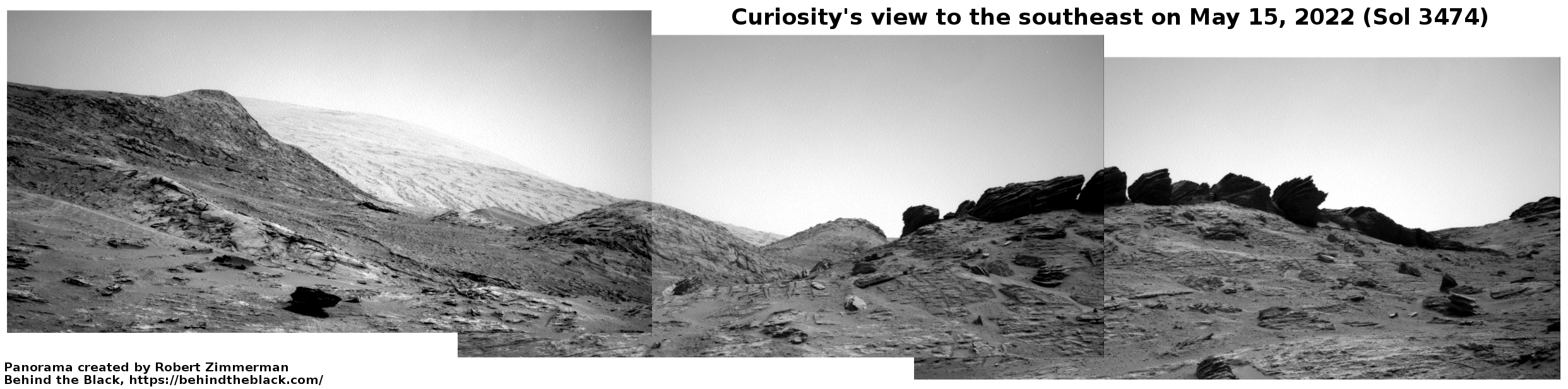
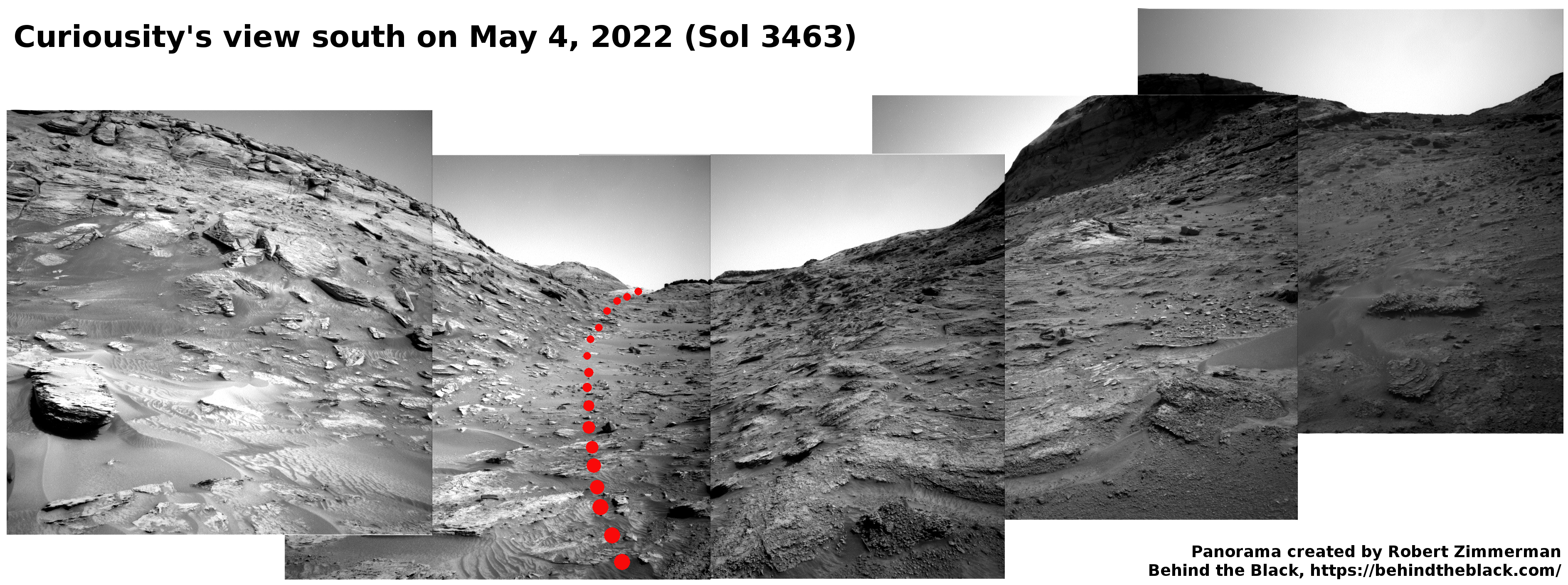
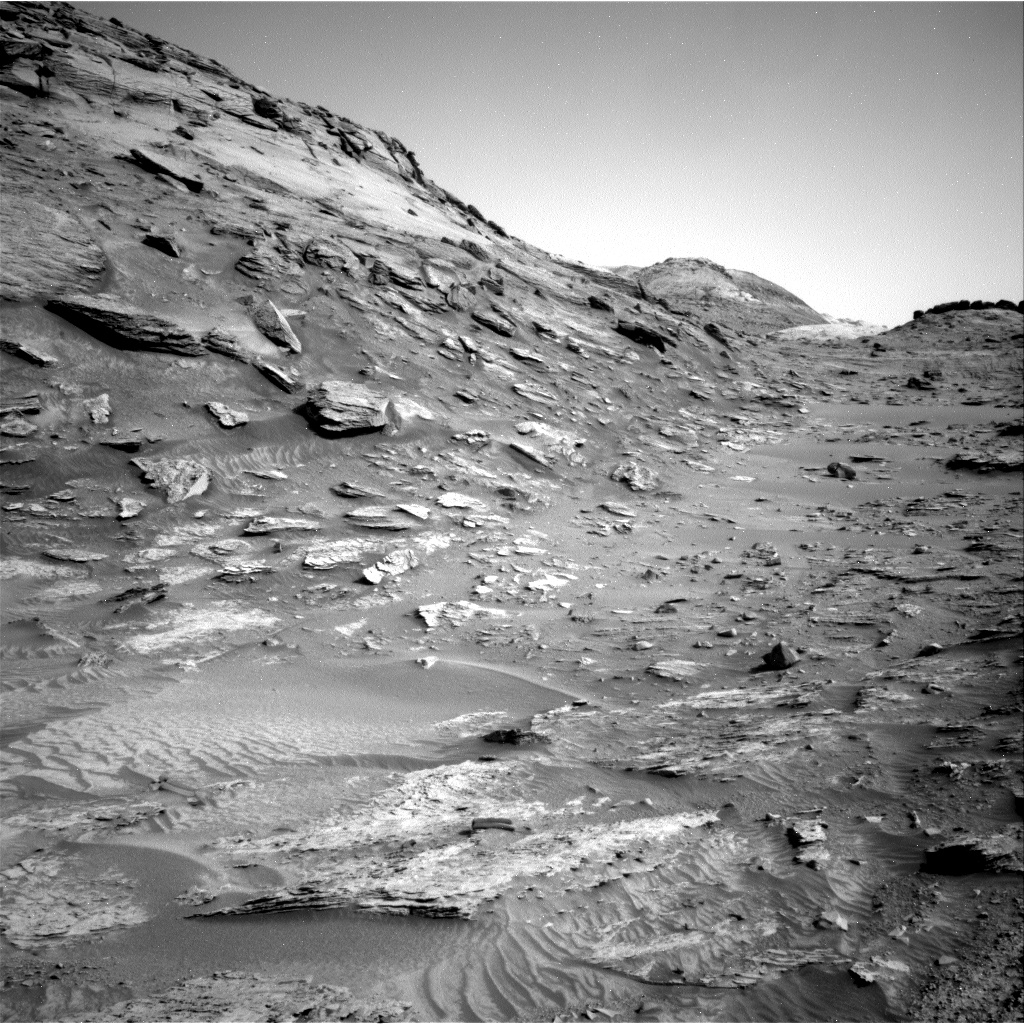
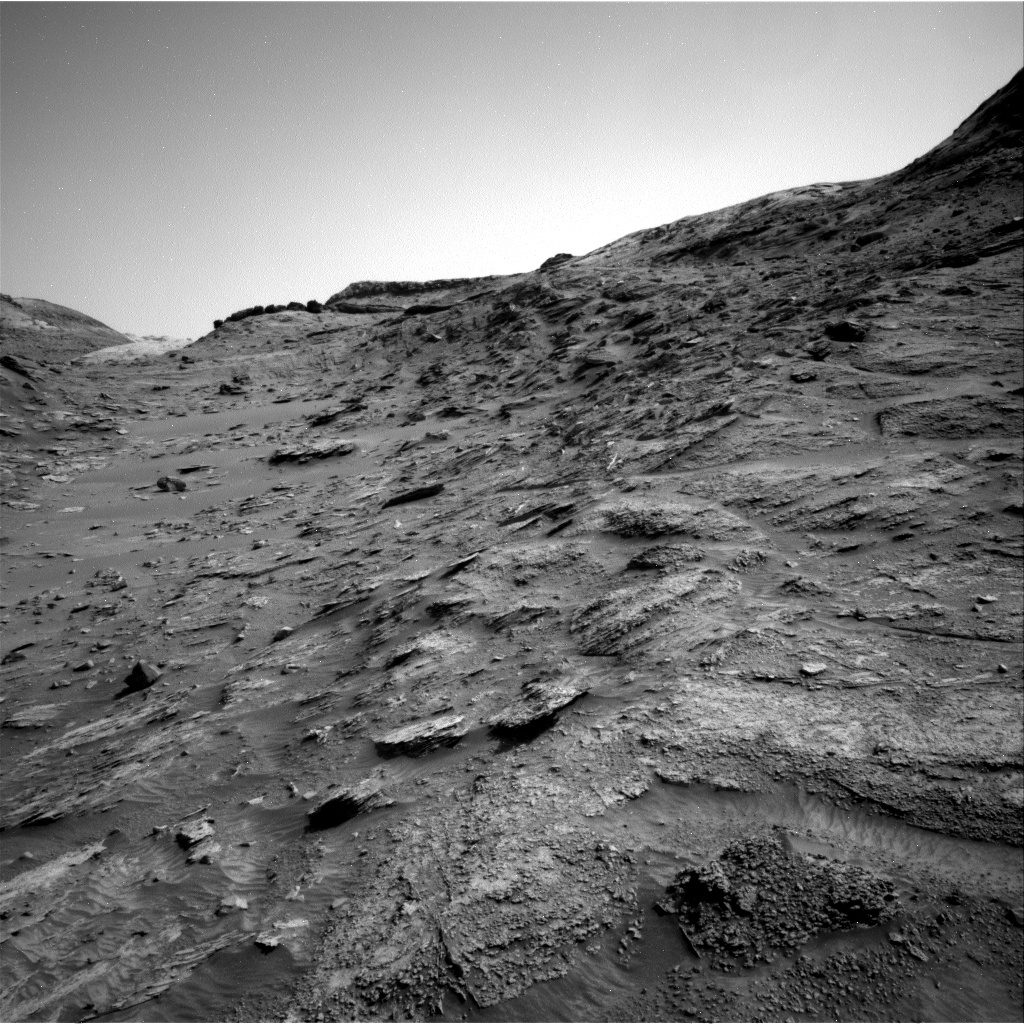
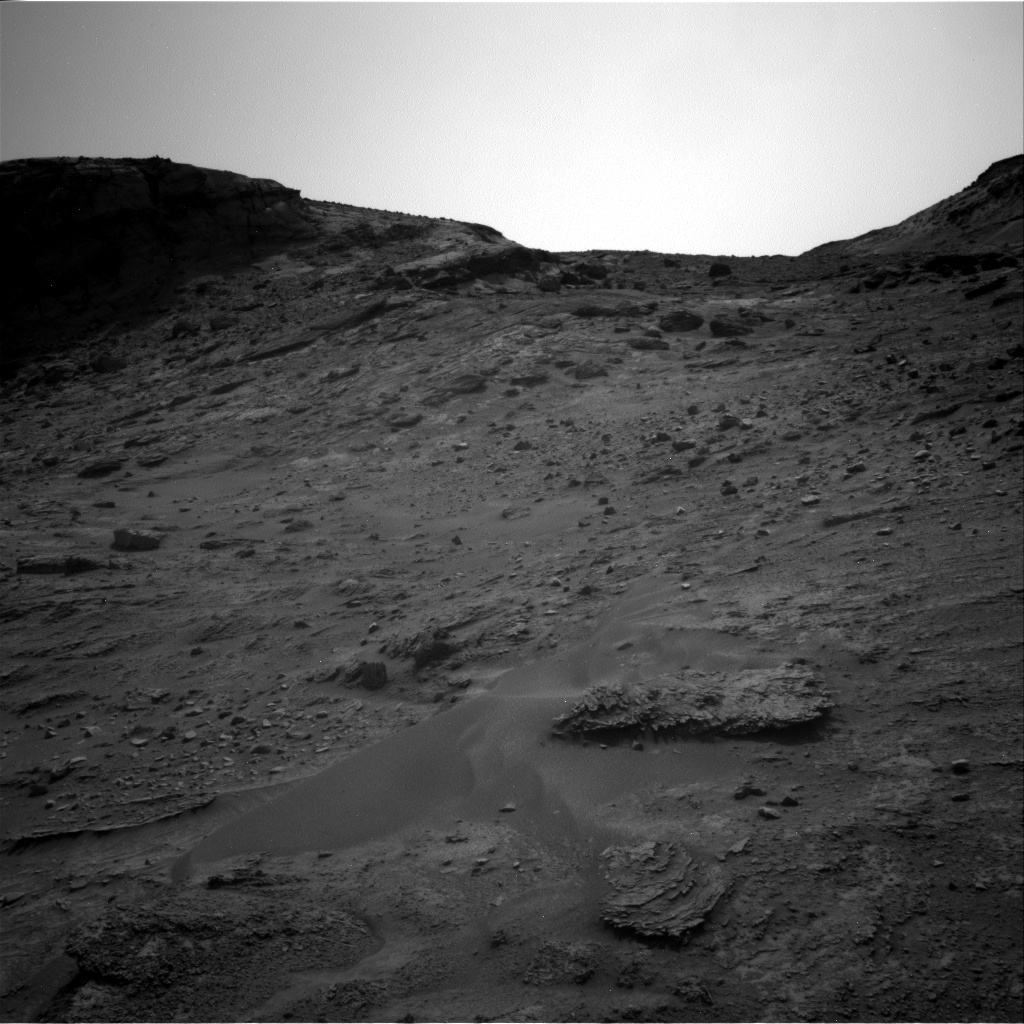
Cool image time! The panorama above was created from five photos taken by Curiosity’s right navigation camera on May 4, 2022 as the rover worked its way upward out of Gordon Notch Hollow, the small valley it had left when it attempted to cross the Greenheugh Pediment to the west and was forced to retreat back into when engineers found the rough terrain on the pediment too much for the rover’s wheels.

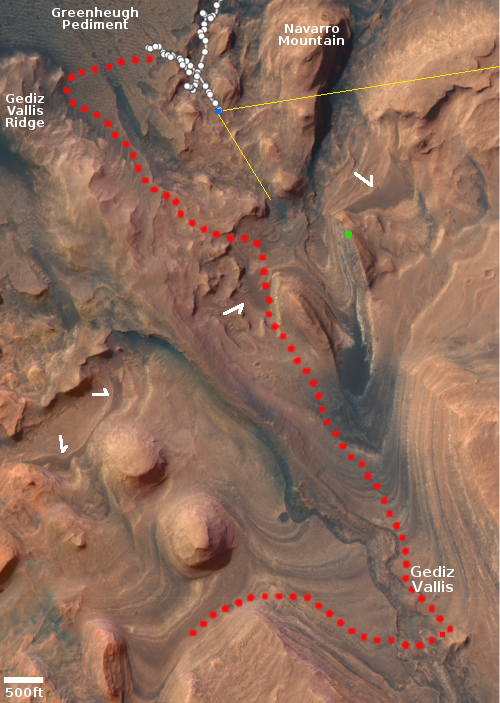
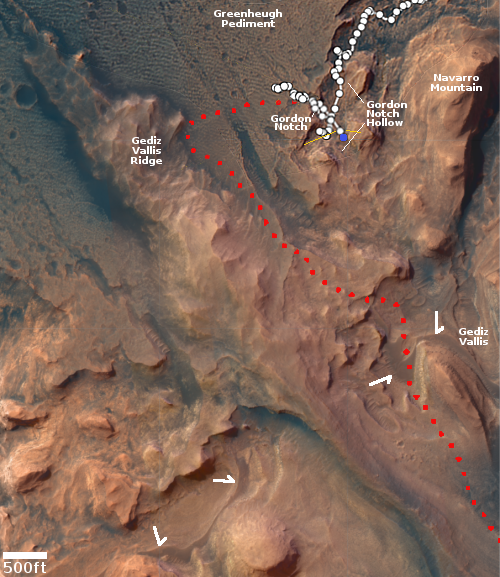
The overview map to the right provides context. The blue dot marks Curiosity’s present position on Mars, on its 3,465 Sol since landing. The yellow lines mark the area viewed in the panorama, taken two Sols earlier. The red dotted line marks the original planned route, now abandoned. The white arrows indicate one of the more interesting upcoming geological features, dubbed by scientists the “marker horizon,” a distinct layer found in many places on the flanks of Mount Sharp.

On the panorama above the red dotted line is my guess as to the planned route out of Gordon Notch Hollow.
According to the science team’s most recent update on May 4th:
» Read more

0 comments

Why a big Earth mountain would hardly be noticed on Mars

A big mountain lost on Mars
Click for full image.

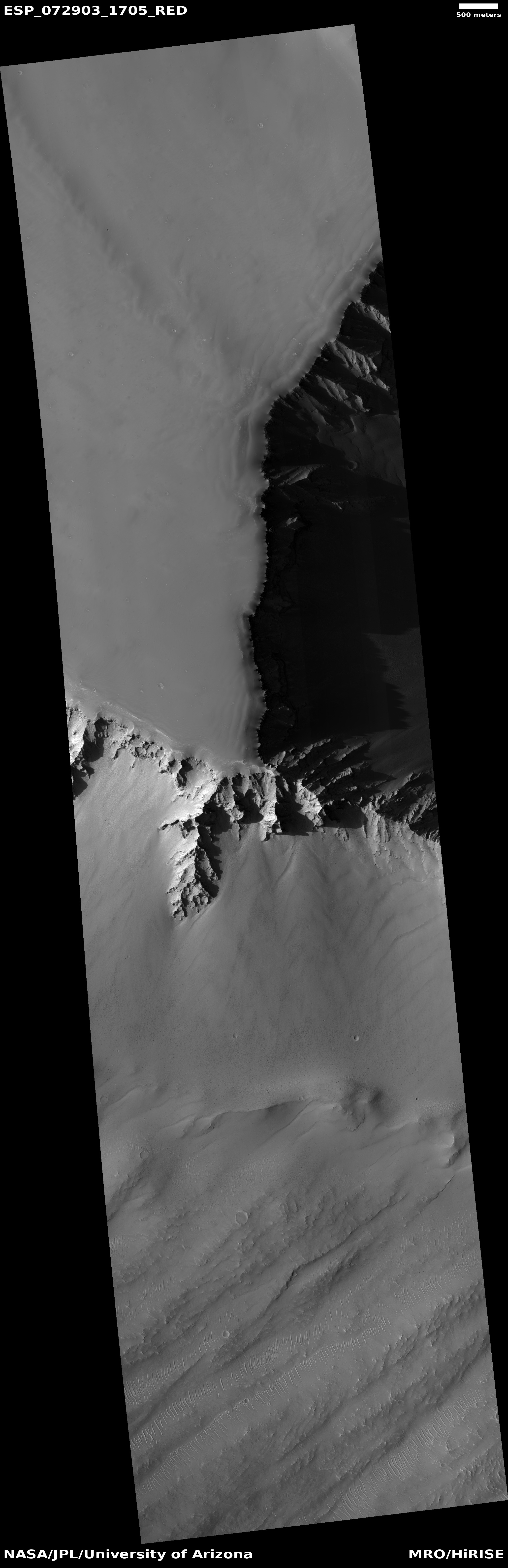
Cool image time! The photo to the right, cropped and reduced to post here, was taken on February 13, 2022 by the high resolution camera on Mars Reconnaissance Orbiter (MRO). It shows a cliff escarpment that, based on a rough estimate of MRO’s elevation data, ranges from 10,000 to 13,000 feet high. Because the sun is only about 32 degrees above the western horizon, the shadows are long and distinct and bring out the features quite dramatically.

On Earth, a mountain 13,000 feet high would generally be named, because there are really not that many of them. If it was a cliff face dropping down into a canyon, which this Martian cliff is, it would be quite unique and probably be one of the most popular tourist spots on the globe. For comparison, the rim of the Grand Canyon in the national park, visited by millions, is only 4,000 to 6000 feet in elevation. This cliff on Mars is more than twice as deep, and yet, it is hardly the most spectacular canyon rim on the red planet.

The overview map below explains this.
» Read more

2 comments

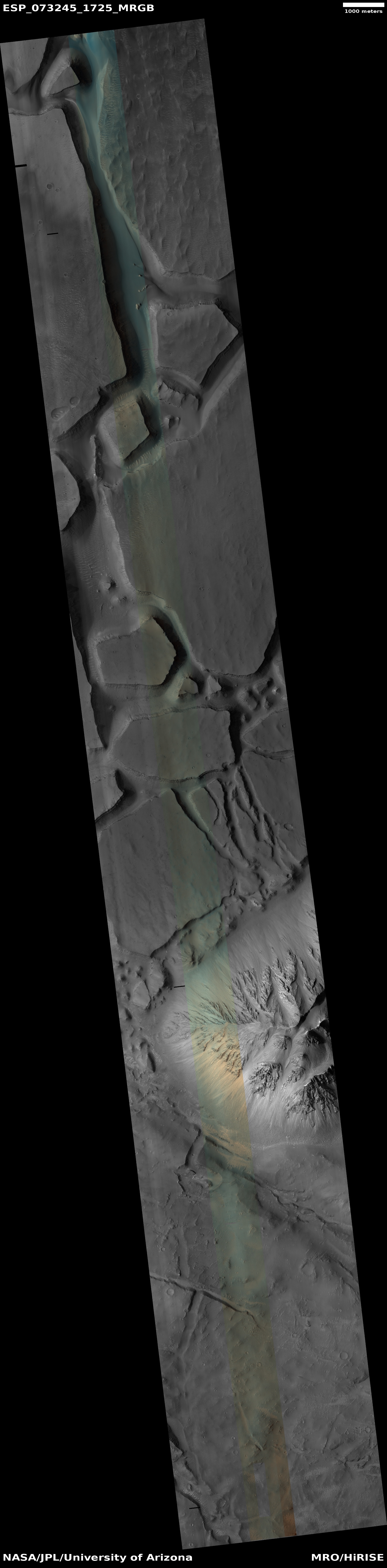
A quake south of Starship’s prime landing sites on Mars

The lowlands south of Starship's prime landing site
Click for full image.

Cool image time! The photo to the right, rotated, cropped, and reduced to post here, was taken on February 23, 2022 by the high resolution camera on Mars Reconnaissance Orbiter (MRO). Though it shows the largely featureless northern lowland plains of Mars, it is particularly interesting for two reasons.

First, according to the photo’s label this scarp/ridge is apparently near a quake detected by the seismometer placed on Mars by the lander InSight, located about a thousand miles to the southwest. Though no information of the strength of this quake is available, it is likely to have been a small and weak one, interesting mostly because it indicates some small underground instability or a recent small impact on the surface. The image favors the former, as it shows no obvious recent features of change. What it does show is one very intriguing flow feature draping the scarp. As the location is at 34 north latitude in a region where scientists have found a lot of evidence of water ice very close to the surface, the flow could very well be glacial in nature, though dismissing a lava origin would be a mistake.

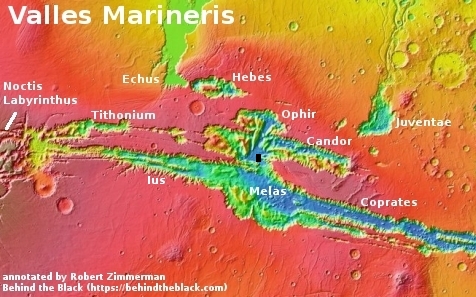
The second reason this location is of interest is what lies relatively nearby, as shown in the overview map below.
» Read more

1 comment

ESA: ExoMars will likely be delayed till ’28 at the soonest

An official of the European Space Agency (ESA) at a May 3rd science meeting announced that the launch of its ExoMars rover will likely be delayed until 2028 at the earliest because of the partnership breakup with Russia due to its invasion of the Ukraine.

Russia had been providing both the launch rocket as well as the lander on Mars.

Speaking at a May 3 meeting of NASA’s Mars Exploration Program Analysis Group (MEPAG), Jorge Vago, ExoMars project scientist at ESA, said he doubted a new lander could be ready by 2026. “It is theoretically possible, but in practice we think it would be very difficult to reconfigure ourselves and produce our own lander for 2026,” he said. “Realistically, we would be looking at a launch in 2028.”

Launching in 2028 could pose technical challenges for ExoMars. One trajectory would get the rover to Mars relatively quickly, but have it arrive just a month before dust storm seasons starts at the preferred landing site. An alternative trajectory would require traveling for more than two years to each Mars, but get the rover there six months before dust storms start.

“We have been trying very hard to convince the engineering team that the dust storm season is not death,” Vago said. “We should concentrate on making the rover more robust and able to weather a dust storm.”

There are other issues. The rover will need new radioisotope heating units, or RHUs, to provide power, since Russia will no longer providing them. If the U.S. provides, the launch for security reasons will have to take place in the U.S., which means the launch provider will have to be American.

The delay to ’28 also could cause the ExoMars rover mission to be completely changed, repurposed to become part of the sample return mission that the ESA and NASA are partnering to bring back the cached samples that Perseverance is gathering. If so, this repurposing might delay its launch to Mars even further.

2 comments

Navigating a rover on Mars

16 photos taken by Perseverance's right navigation camera on May 2, 2022

Overview map
Click for interactive map.

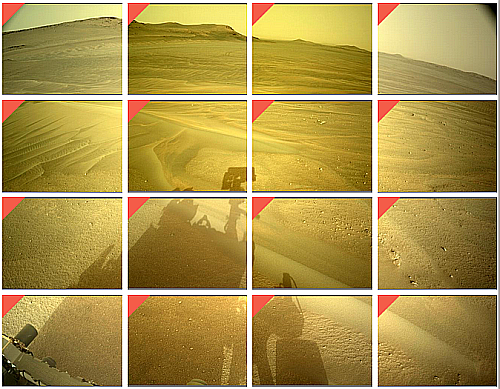
Cool image time! The photo to the right is actually a screen capture of 16 consecutive photos taken on May 2, 2022 by the right navigation camera on the Mars rover Perseverance.

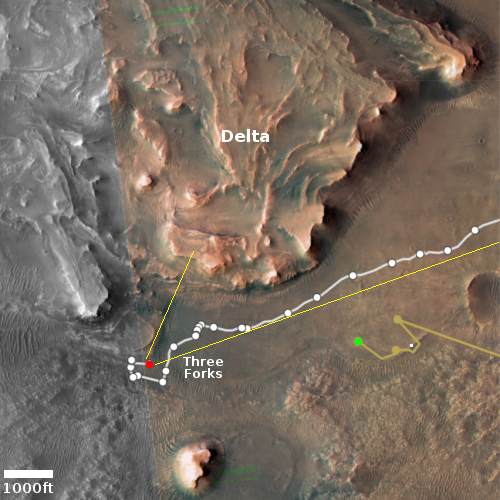
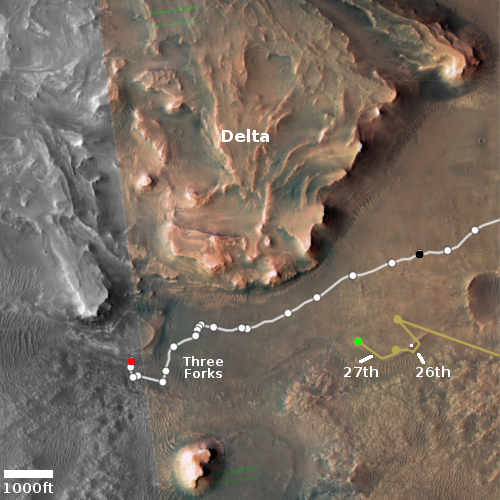
The overview map below gives the context. The red dot marks Perseverance’s position when the photos were taken. The green dot marks Ingenuity’s position. The small white dot marks the spot where the rover’s parachute landed. The yellow lines indicate I think the area covered by the sixteen navigation images.

There is a reason for showing this panorama in this somewhat crude form. The engineers who run Perseverance have programmed its navigation cameras to send back its pictures so that they immediately line up in this coherent pattern. There is no need to rearrange them upon arrival. The engineers thus can instantly see how each picture relates to the others, and thus get an immediate sense of the nearby terrain in which they must plot the rover’s next move.

Perseverance is now in its second science campaign, focused on studying the base of the delta. As the science team studies the delta’s cliff face, they are also studying the best route to continue uphill. To do both, they have begun slowly moving along that face, going from west to east.

The rough panorama above thus shows them the ground ahead as they continue that traverse. I expect the rover’s next move will be to the northeast, once again moving along the base of the nearest cliff. The panorama shows that while the ground in this area has a few ridges, none are so high as to cause Perseverance any problems.

0 comments

Brain terrain in Mars’ glacier country

Brain terrain in glacier country
Click for full image.

Cool image time! The photo to the right, cropped and reduced to post here, was taken on February 10, 2022 by the high resolution camera on Mars Reconnaissance Orbiter (MRO).

It shows what planetary scientists have dubbed “brain terrain”, a truly unique Martian geological feature that is not found on Earth and also remains as yet unexplained. Specifically, the brain terrain is the speckled areas between the larger flow features, all of which are probably ice or glacier related.

What especially drew me to this MRO image however was the particular flow feature in the center left that looks like either a giant squid or something out of Lovecraft horror short story. Talk about a cool image!

The downward grade here is likely to the north, as this spot is inside a north-south canyon, cutting into the southern cratered highlands. The general north-south trend of the depression here reinforce this supposition.

The overview image below provides context.
» Read more

0 comments

As Curiosity retreats from rough country, scientists look at the future geology it will see

Overview map
Click for interactive map.

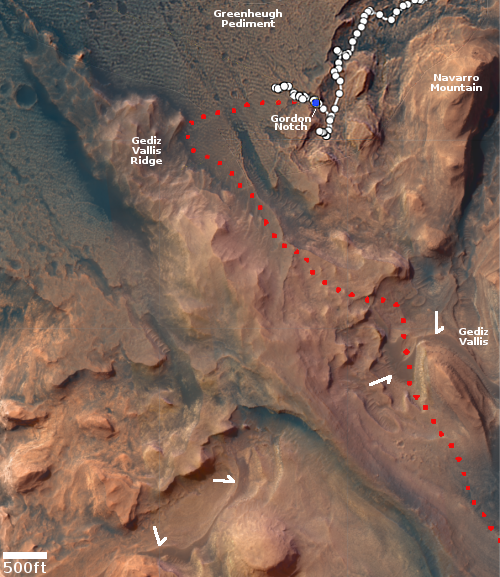
Cool image time! For the past two weeks the Curiosity science team has been gingerly and slowing backing the rover off from the very rough terrain of the Greenheugh pediment, as shown on the overview map to the right. The blue dot indicates Curiosity’s present position, with the red dotted line marking its original planned route, now abandoned.

The main question remains: Where to go next? At this point the science team is still debating their exact path forward. As Catherine Weitz of the Planetary Science Institute explained to me in an email today,

The Curiosity team is still working out the details. Maybe in another month or so the new route will be finalized so stay tuned.

No matter what route they eventually choose, the white arrows mark one of the more interesting upcoming geological features that the scientists very much intend Curiosity to reach. In a paper published at the end of March in which Weitz was the lead author, they describe this “marker horizon” as follows:
» Read more

2 comments

Dunes on Jupiter’s volcano moon Io?

Dunes on Io?
Click for full image.

The uncertainty of science: According to a just published paper, scientists now propose that the dune-like ridges long known to exist on Io, Jupiter’s volcano-covered moon, might actually be dunes, even though Io has no real atmosphere.

The photo to the right, cropped, reduced, and annotated to post here, was taken by the Galileo while it orbited Jupiter from 1995 to 2003. It illustrates what the scientists believe is the proposed process:

McDonald and his colleagues used mathematical equations to simulate the force required to move grains on Io and calculated the path those grains would take. The study simulated the movement of a single grain of basalt or frost, revealing that the interaction between flowing lava and sulfur dioxide beneath the moon’s surface creates venting that is dense and fast moving enough to form large dune-like features on the moon’s surface, according to the statement.

In what might be a monumental understatement about the reality of interplanetary geology, McDonald said this in the press release: “This work tells us that the environments in which dunes are found are considerably more varied than the classical, endless desert landscapes on parts of Earth.”

Damn right. The possibility of unexpected geology of all kinds on the millions of planets, moon, and asteroids not yet studied is endless, and guaranteed.

3 comments

Ingenuity photographs Perseverance’s abandoned parachute on 26th flight

Perseverance's parachute, as photographed by Ingenuity
Click for full image.

Overview map
Click for interactive map.

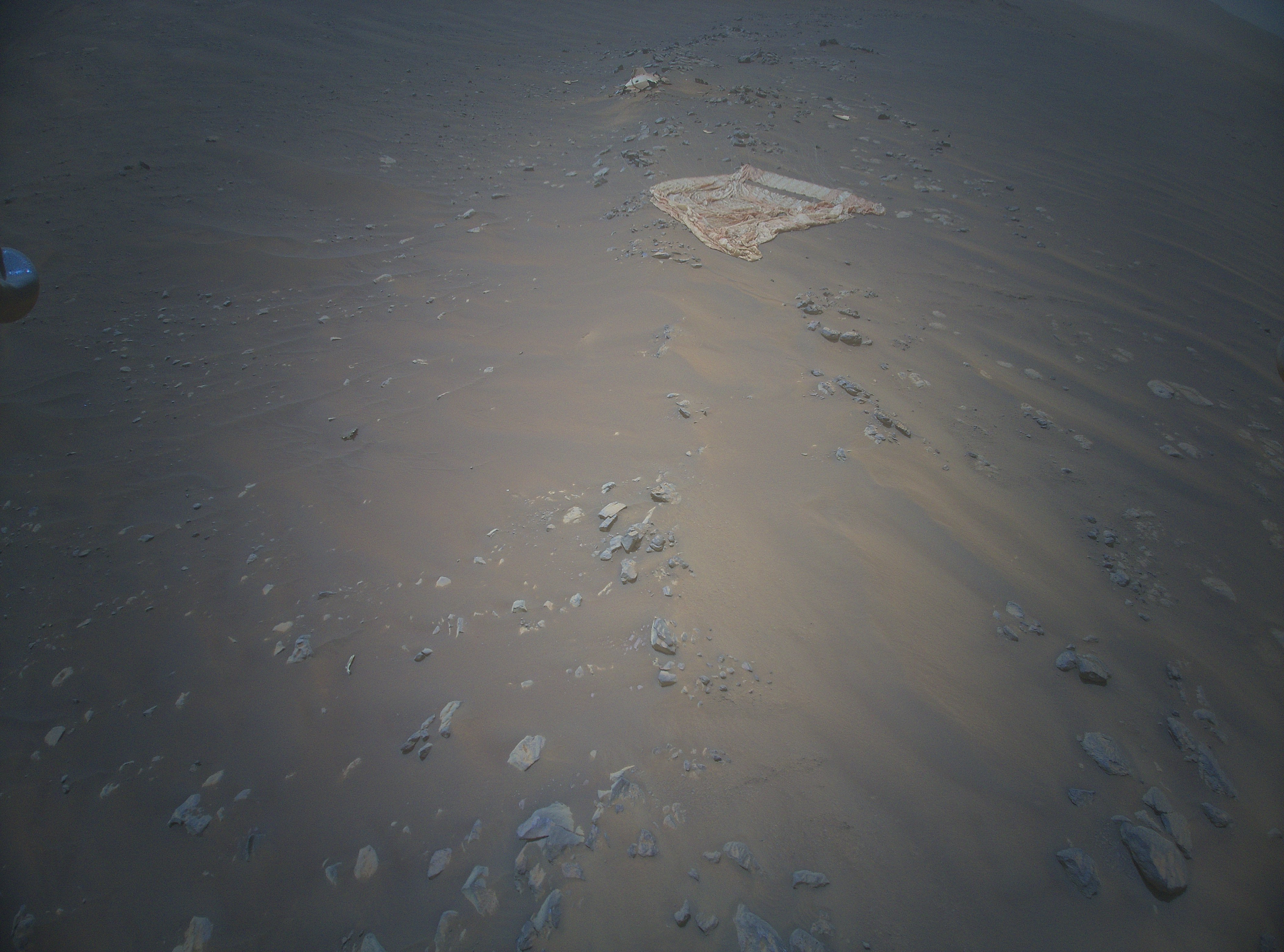
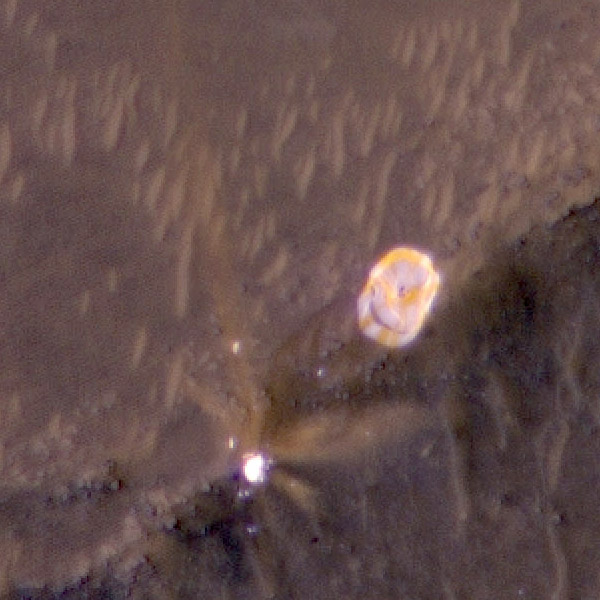
In the past week the Mars helicopter Ingenuity successfully completed its 26th and 27th flights, with the first specifically planned to fly over the parachute that had been used by Perseverance when it landed on Mars on February 18, 2021. The first photo to the right, enhanced, cropped, and reduced to post here, is the color photo of that parachute that Ingenuity took during that flight on April 20th. Near the top of the frame you can also see the equipment used to attach the chute to the rover. The photo looks to the southwest.

The map to the right indicates the flight paths for both hops, both slightly more than 1,000 feet total. The green dot marks Ingenuity’s position yesterday, the red dot Perseverance’s position. The small white dot indicates the parachute’s location.

On April 8th Perseverance had snapped a picture of the parachute, from the position indicated by the black dot. Since that photo was taken from a distance, it could not show much. Ingenuity’s more recent photo from overhead however captures the chute quite clearly, and suggests that in the year since landing the weak Martian wind has shifted its edges slightly while depositing some dust on its surface.

You can see the changes at the edges by comparing Ingenuity’s picture with a photo taken on February 19, 2021 by Mars Reconnaissance Orbiter (MRO). In Ingenuity’s picture the near edge of the parachute especially appears to have become bunched up over time, suggesting the prevailing and strongest winds have come from the south.

4 comments

InSight scientists publish paper describing last year’s big Martian quakes

Figure 5: global map of located Martian quakes

The InSight science team has now published a paper [pdf] describing in detail what they gleaned from the two large earthquakes the lander detected on Mars last year, measuring 4.1 and 4.2 magnitudes.

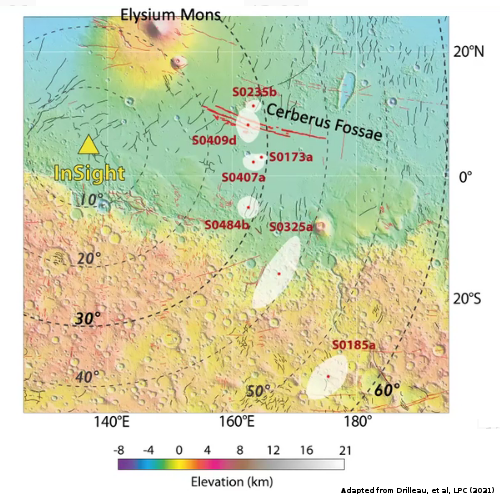
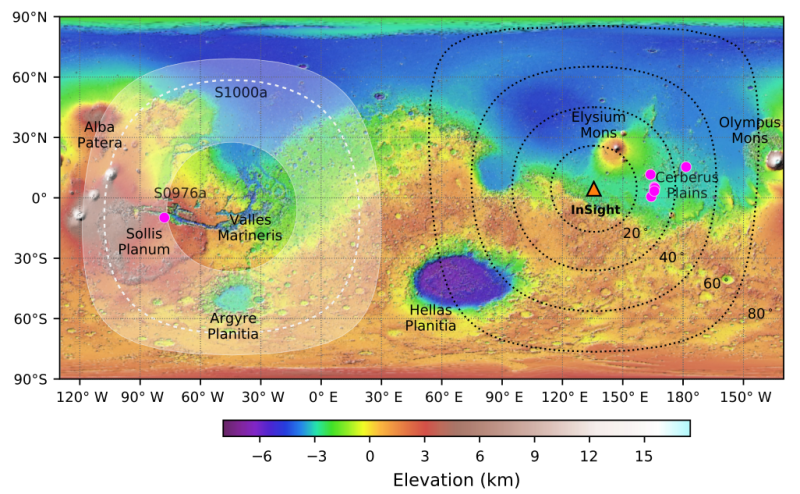
The map above, figure 5 of their paper, marks their best estimate of the quakes’ locations, dubbed S0976a and S1000a. From the caption:

Mars surface relief map showing InSight’s location (orange triangle), the location of other located mars-quakes (magenta dots) that cluster around 30° distance, close to Cerberus Fossae, and S0976a, located within Valles Marineris just north of Sollis Planum. Because no back azimuth can be determined for S1000a, its location is predicted to be somewhere within the shaded region between 107° and 147° from InSight. The event’s preferred distance (116°) is marked with the white dashed line. The black dotted lines mark radii around InSight up to 80°.

A review of Mars Reconnaissance Orbiter (MRO) high resolution images of that part of Valles Marineris where S096a occurred will likely uncover a whole bunch taken since last August, all attempting to detect any actual surface changes produced by quake. I think I’ll do that review, and see if I can spot something.

The paper also notes the uniqueness of S1000a, which lasted 94 minutes, the longest so far detected on Mars. The complexity of its signal also makes locating it difficult, though the most likely possible locations — indicated by the white dashed line in the map above — crosses through the Tharsis Bulge where Mars’ biggest volcanoes are found.

Sadly, InSight will likely shut down before the end of this year due to loss of power, so until another seismometer is sent there no further Martian quakes will be detected.

0 comments

The icy Reull Valley of Mars

Eroded ice in crater near Reull Valles
Click for full image.

Cool image time! The photo to the right, cropped and reduced to post here, was taken on February 20, 2022 by the high resolution camera on Mars Reconnaissance Orbiter (MRO). It shows the eroded floor of a 10-mile-wide very obscured unnamed crater that sits above the northern wall of a canyon dubbed Reull Valles.

For reference the interior slope of the crater’s southern rim is labelled. The crater sits at 40 degrees south latitude. Thus, this crater is inside the 30 to 60 degree mid-latitude bands where scientists have found many glaciers on Mars. The eroded floor of this crater appears to confirm this conclusion. In the full photo the erosion is even more pronounced, as well as more chaotic, farther from that rim to the north.

Because Reull Valles sits inside that southern glacial band, it is home to much evidence of ice. The overview map below provides the context.
» Read more

1 comment

The gigantic lava flows off of the solar system’s biggest known volcano

Olympus Mons' gigantic lava flow
Click for full image.

Cool image time! The photo to the right, cropped, reduced, and annotated to post here, was taken on October 30, 2021 by the high resolution camera on Mars Reconnaissance Orbiter (MRO). The picture covers a very tiny section of the southeast flank of Olympus Mons, the largest known volcano in the solar system. The arrow indicates the direction of the downward slope.

Olympus Mons itself is about 400 miles wide with an actual height relative to Mars’ “sea level” of just under 70,000 feet, more than twice as high as Mount Everest on Earth. The mountain’s flanks, almost 200 miles long from caldera edge to base, drop about 54,000 feet. That average drop of about 270 feet every mile is not particular steep, but its continuous nature over such a very very long distance makes its quite daunting.

You can see evidence of that slope in the photo. The downward pointing lobes each indicate the volcano’s last separate lava flows that ceased moving when each froze in place, probably several tens of millions of years ago. These lobes were also placed on top of many earlier flows from the volcano’s past eruptions that probably continued for several billion years, beginning 3.5 billion years ago.

The overview map helps provide a sense of scale by placing this image on that mountain flank.
» Read more

2 comments

Perseverance spots its parachute

Perseverance spots its parachute
Click for full resolution. Original images found here and here.

Overview map
Click for interactive map.

Cool image time! Today the Perseverance science team released two photos taken on April 6th that captured the parachute that the rover had used to land on Mars on February 18, 2021. The enhanced panorama above is from those images. The white feature near the center is the parachute. The mountains in the distance are the southern rim of Jezero Crater, about 40 miles away.

The overview map to the right gives the context. The red dot is Perserverance’s location as of yesterday, on sol 413. The black dot marks its location on April 6th, when it took the pictures. The green dot marks Ingenuity’s present position. The yellow lines indicate the approximate area covered by the panorama.

Ingenuity had not completed its 25th flight until April 8th, two days after these photos were taken, so it isn’t actually just off the edge of these photos, it is beyond the near ridgeline out of sight.

1 comment

Dawn on the Moon

Dawn on the Moon's far side
Click for full image.

Cool image time! The photo to the right, reduced to post here, was taken on August 25, 2019 by Lunar Reconnaissance Orbiter (LRO). It shows an oblique view looking west just after lunar dawn of an unnamed 13-mile-wide crater in Mare Moscoviense on the far side of the Moon. From the caption:

Mare Moscoviense is one of the few volcanic plains on the farside, which is largely comprised of ancient cratered highland terrain. The fact that the farside was strikingly different from the familiar nearside was a surprise when the Soviet Luna 3 spacecraft returned the first farside images in 1959. The highland crust is thicker on the farside than on the nearside, which is thought to have inhibited magmas from reaching the surface as frequently as they once did on the nearside.

As seen in the image above, Mare Moscoviense lies within a large impact basin, the formation of which thinned the local crust, perhaps making it easier for lavas to erupt that would have otherwise stalled below the surface. But why does this global asymmetry in crustal thickness exist? This is still a mystery, like the origins of the large-scale asymmetries observed on Mars and Mercury, though ideas like a giant impact event that stripped off a portion of the crust or asymmetric overturn of the mantle have been proposed.

Note the dark shadow obscuring the foreground on the left. It appears from the topography in the overhead map at the link that the ridgeline that marks the eastern border of Mare Moscoviense is just high enough at dawn to keep the mare in shadow while allowing the sun’s dawn light to peek over and illuminate the crater’s rim. That ridgeline however only extends so far to the north, thus allowing sunlight to hit the plains on the right sooner.

3 comments

White sediment in Martian slot canyon

White sediment in Martian slot canyon
Click for full image.

Yesterday’s Picture of the Day from the high resolution camera on Mars Reconnaissance Orbiter (MRO) revisited a captioned image first posted in February 2014 by the science team. That picture, cropped and enhanced, is to the right. From the 2014 caption:

There is a large channel system that flows into the basin, called Ladon Valles, and scientists think that the basin may have once filled with water before another channel to the north formed and drained it. These exposures of light-toned layered sediments provide clues about the environment that existed within Ladon Basin when water may have ponded and deposited these sediments.

Later research has generally concluded that these white sediments are iron and magnesium smectites, often appearing as white tuff material whose deposition is generally associated with precipitation of water or snow and its subsequent evaporation or sublimation.
» Read more

0 comments

Ingenuity completes 25th flight, the longest yet

Overview map
Click for interactive map.

On April 8th the Mars helicopter Ingenuity successfully completed its 25th flight on Mars, traveling 2,310 feet at 18 feet per second while flying for 161.3 seconds.

The long distance was designed to take it out from the rough region dubbed Seitah and near the delta that is the prime geological target of the rover Perseverance.

The overview map shows the location of both rover and helicopter as of today. The red dot is Perseverance, the green dot is Ingenuity. The rover has now completed its entire planned travels, as announced in June 2021. Where it goes next has not as yet not been announced. According to the team, they plan to use Ingenuity to scout out possibly routes up onto the delta. This likely means the rover will likely spend some time at the base of the delta, getting as much data as it can, while Ingenuity does this scouting work.

1 comment

The spread of the oceans’ sea floors appears to be slowing

The uncertainty of science: Based on data covering the last 19 million years, scientists now believe that the rate in which the Earth’s ocean sea floors are spreading has been slowing steadily.

Today, spreading rates top out around 140 millimeters per year, but peaked around 200 millimeters per year just 15 million years ago in some places, according to the new study. The study was published in the AGU journal Geophysical Research Letters, which publishes high-impact, short-format reports with immediate implications spanning all Earth and space sciences.

The slowdown is a global average, the result of varying spreading rates from ridge to ridge. The study examined 18 ridges, but took a particularly close look at the eastern Pacific, home to some of the globe’s fastest spreading ridges. Because these slowed greatly, some by nearly 100 millimeters per year slower compared to 19 million years ago, they dragged down the world’s average spreading rates.

You can read the actual paper here.

To put it mildly, the conclusion here is uncertain. The difference between 140 and 200 millimeters is less than two and a half inches. A hundred millimeters is less than four inches. Such small differences over millions of years could simple be caused by random fluctuations over time. Furthermore, the scientists did not actually detect the spreading rates from millions of years ago. They instead inferred it based on the data we do have of the changes in the Earth’s magnetic field over time.

Still, this result is very intriguing indeed. More than anything, it should help geologists develop better theories to explain plate tectonics, and what drives it. At the moment no theory adequate explains it.

7 comments

Frozen lava in Mars’ volcano country

The frozen lava of the Athabasca flood plain
Click for full image.

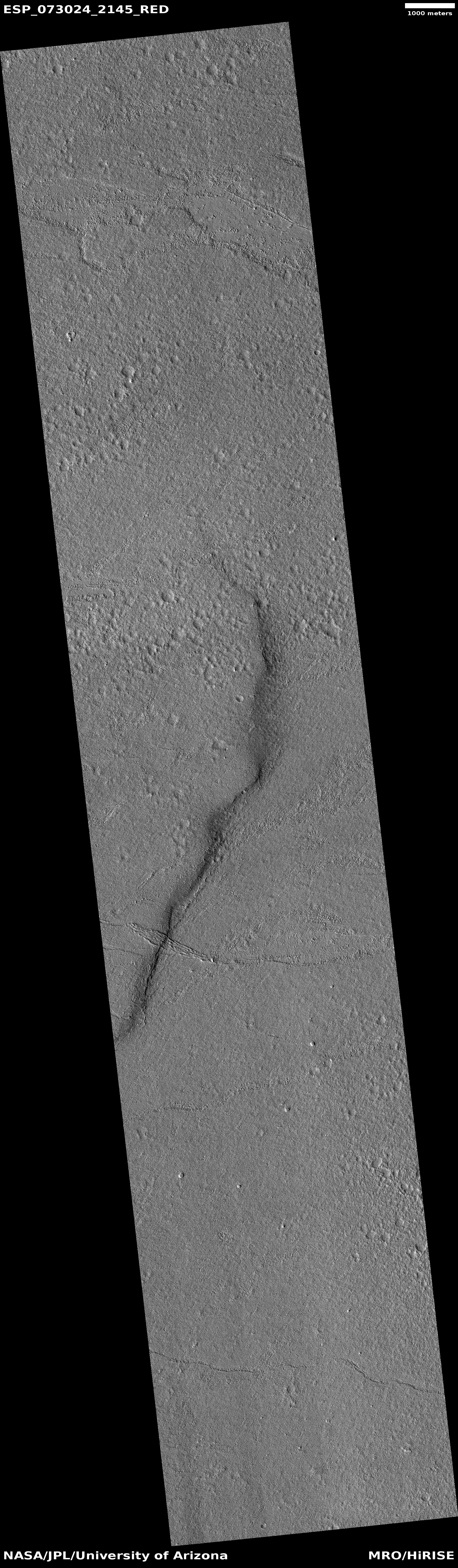
Cool image time! The photo to the right, cropped and reduced to post here, was taken on January 28, 2022 by the high resolution camera on Mars Reconnaissance Orbiter (MRO). It shows what appears to be at first glance a relatively featureless plain with a lighter material covered by a patchwork of darker material.

Note however the lack of craters. Except for several faint depressions near the image’s center, there are none. And those depressions look like the expression of craters that have been covered by material. Is the two-toned surface here an expression of past lava flows? Or are we seeing an ice-sheeted plain, with the patches representing higher terrain above that plain?

The overview map below answers the question somewhat clearly.
» Read more

0 comments
1 45 46 47 48 49 95