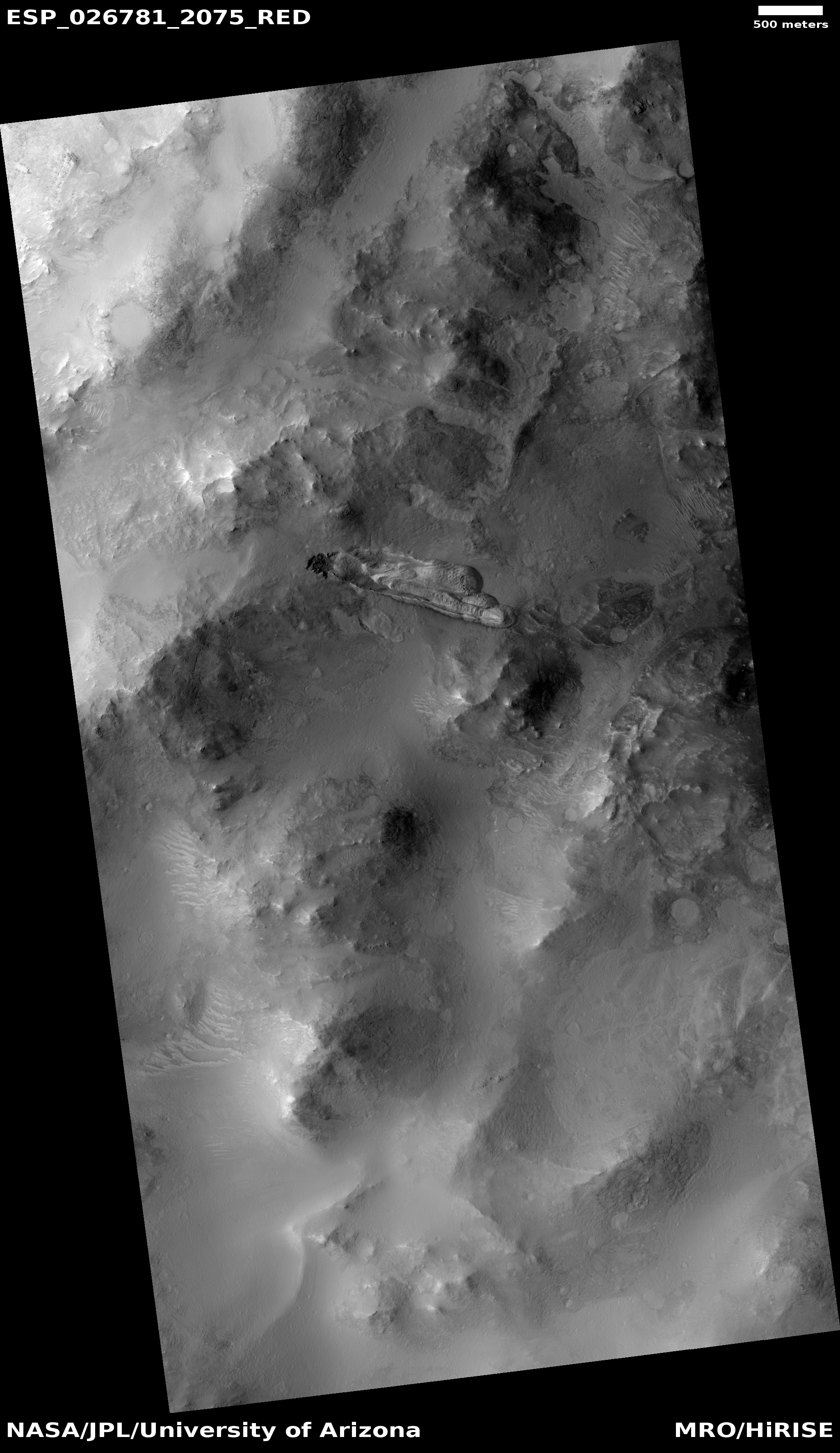
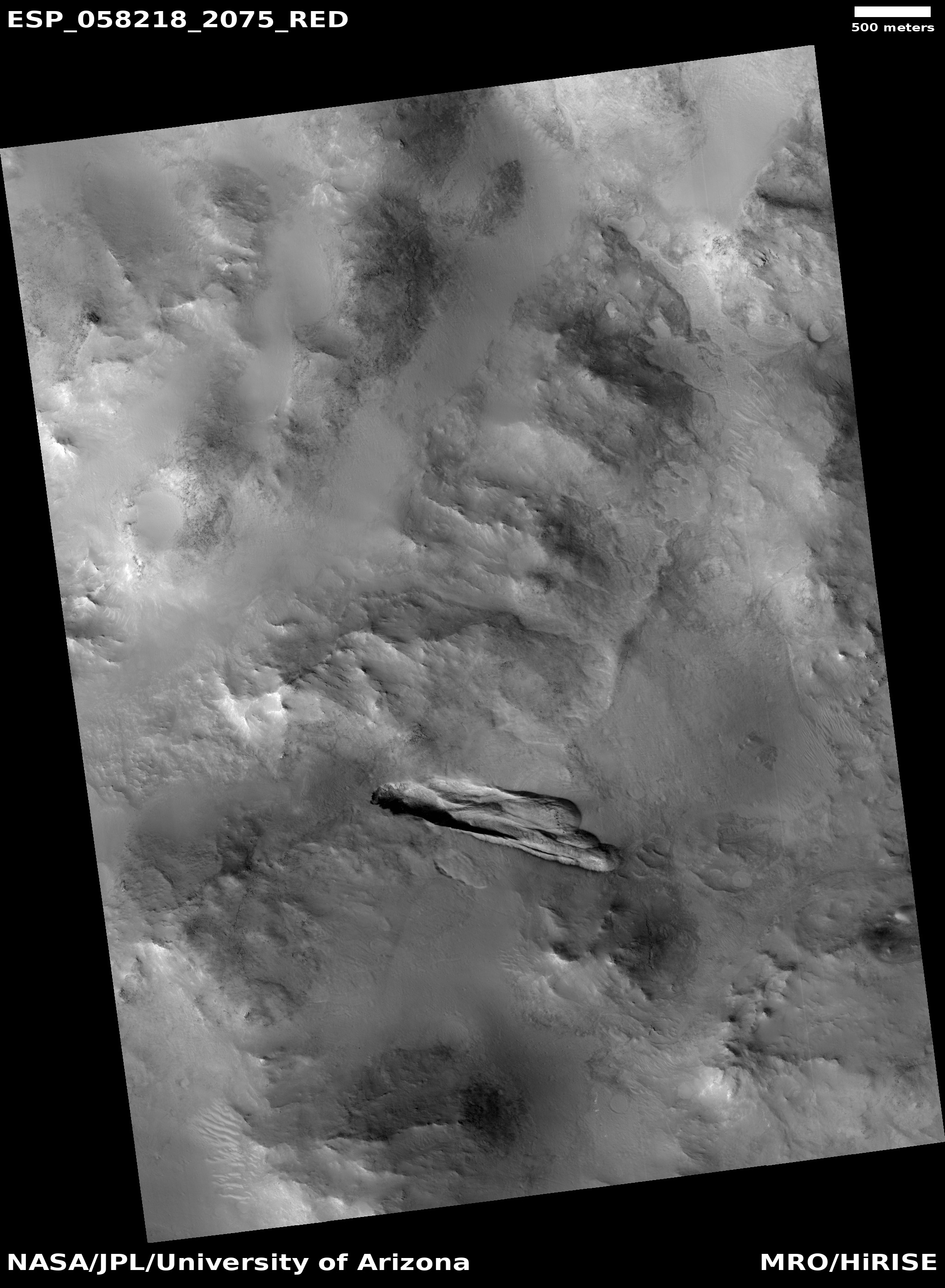
Planet-wide groundwater system on Mars

Old news: The European Space Agency today released a press release announcing the results of a science paper that appears to have found evidence of a planet-wide groundwater system on Mars.

I call this old news because I reported on this paper a month ago here on Behind the Black: Well water likely available across Mars.

We are now near the end of my February birthday-month fund-raising drive. If anything should justify a donation or subscription, this story should provide it. You can either wait for the mainstream press to rewrite press releases, or you can support my effort to get real news to you now, reported with both enthusiasm and honest skepticism.

I really do hate to brag, but I also don’t believe in false modesty.

0 comments

ExoMars prototype test driven from 6,000 miles away

The engineering team that will drive ExoMars 2020 on the surface of Mars in 2021 has completed a test drive using an engineering prototype, controlling it from more than 6,000 miles away.

Experts at the European Space Agencyโ€™s centre in Oxfordshire completed a series of tests across nearly 6,900 miles (11,000 km) in order to see how the Mars rover reacts to commands across large distances.

When on the surface of Mars, the rover will need to be controlled when it is up to 250 million miles from Earth.

The trials team used a new model called โ€˜Charlieโ€™ to test hardware, software and to practice science operations for the future European Space Agency (ESA) ExoMars rover, which will look for life on Mars in 2021. The Atacama desert was chosen because it is the closest we can get to a Martian-like environment.

I must admit that every press release from Europe about ExoMars 2020 gives me worried chills. Each release is often filled too much with empty boasts and little substantive detail. Worse, each seems to repeatedly remind me of some guy working in his garage on a weekend project.

The issue could merely be a case of poor press release writing, but something about each release makes these alarm bells go off in the back of my mind. With the launch only about sixteen months away, I hope I am wrong.

4 comments

Waterlike Martian lava flows

Flowing like water
Click for full image.

Each month the Mars Reconnaissance Orbiter (MRO) science team highlights with captions about four out of the 300-500 new images released that month.

Of the four captioned images in February, the first was entitled “Almost Like Water,” and focused on the waterlike nature of the lava flow. The image on the right is a cropped and annotated section of that featured photograph, with the yellow arrows indicating the flow directions.

The lava appears to have flowed smoothly around obstructions, almost like water, forming streamlined islands. In the southern part of this image, a branch of the flow diverts around a small crater, and eventually rejoins the main part of the flow. [Visible in the full photograph] Irregular-shaped ring structures appear on the northern end and are related to the volcanic activity that formed the flows.

You can see an example of one of those islands near the top of the above image.

This is hardly the only MRO image showing such flows. In fact, the February image release included a bunch, some of the more intriguing of which I highlight below. These lava flows are seen in many different places on Mars, in a wide variety of geological settings, facts that suggest that volcanic activity was once very widespread and ubiquitous on Mars.
» Read more

0 comments

Curiosity recovering from safe mode

Last week Curiosity suddenly went into safe mode, halting science operations for four days while engineers analyzed the issue.

Curiosity encountered a hurdle last Friday, when a hiccup during boot-up interrupted its planned activities and triggered a protective safe mode. The rover was brought out of this mode on Tuesday, Feb. 19, and is otherwise operating normally, having successfully booted up over 30 times without further issues.

Throughout the weekend, Curiosity was sending and receiving technical data, communicating with the team in order to help them pinpoint the cause of the issue. “We’re still not sure of its exact cause and are gathering the relevant data for analysis,” said Steven Lee, Curiosity’s deputy project manager at NASA’s Jet Propulsion Laboratory in Pasadena, California. JPL leads the Curiosity mission. “The rover experienced a one-time computer reset but has operated normally ever since, which is a good sign,” he added. “We’re currently working to take a snapshot of its memory to better understand what might have happened.”

…”In the short term, we are limiting commands to the vehicle to minimize changes to its memory,” Lee said. “We don’t want to destroy any evidence of what might have caused the computer reset. As a result, we expect science operations will be suspended for a short period of time.”

As far as I could tell, images were being uploaded to their public image page through February 20, when I did my last rover update. Since then however no new images have appeared. I fear this might be related to the computer issues Curiosity experienced in September that shut down operations for about six weeks and was never quite resolved. Of Curiosity’s two main computers both have now experienced serious problems.

0 comments

Another batch of caves/pits found on Mars

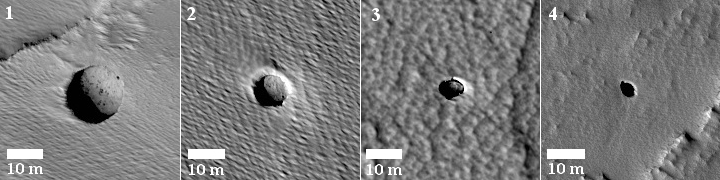
Four new pits on Mars

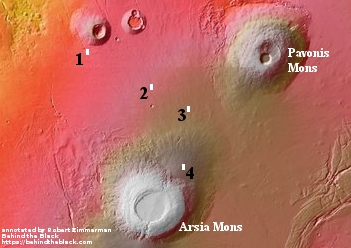
Overview of February 2019 pits

In the past year the monthly image releases from the high resolution camera on Mars Reconnaissance Orbiter (MRO) archive have frequently included newly discovered pit entrances. Each time I have written posts highlighting these new pits, in June, July, November 2018 and January 2019. In fact, this is happening so frequently I could almost label it a monthly update!

The November release imaged three pits found on the southern flanks of Arsia Mons. The January 2019 release found several north of the volcano, two of which are very close to the two middle new pits highlighted above. The February release, which is the focus of this post, included four more pits, shown above, all located north and west of Arsia Mons, as shown in the overview map to the right.

Pits 2 and 3 above appear to belong to a cluster of pits all located in the general area between Arsia and Pavonis Mons. (You can see their uncaptioned releases here and here.) Most sit alone on a flat somewhat featureless plain. Sometimes there are flow features nearby, but each pit usually seems to sit unique and unrelated to these other faint features.

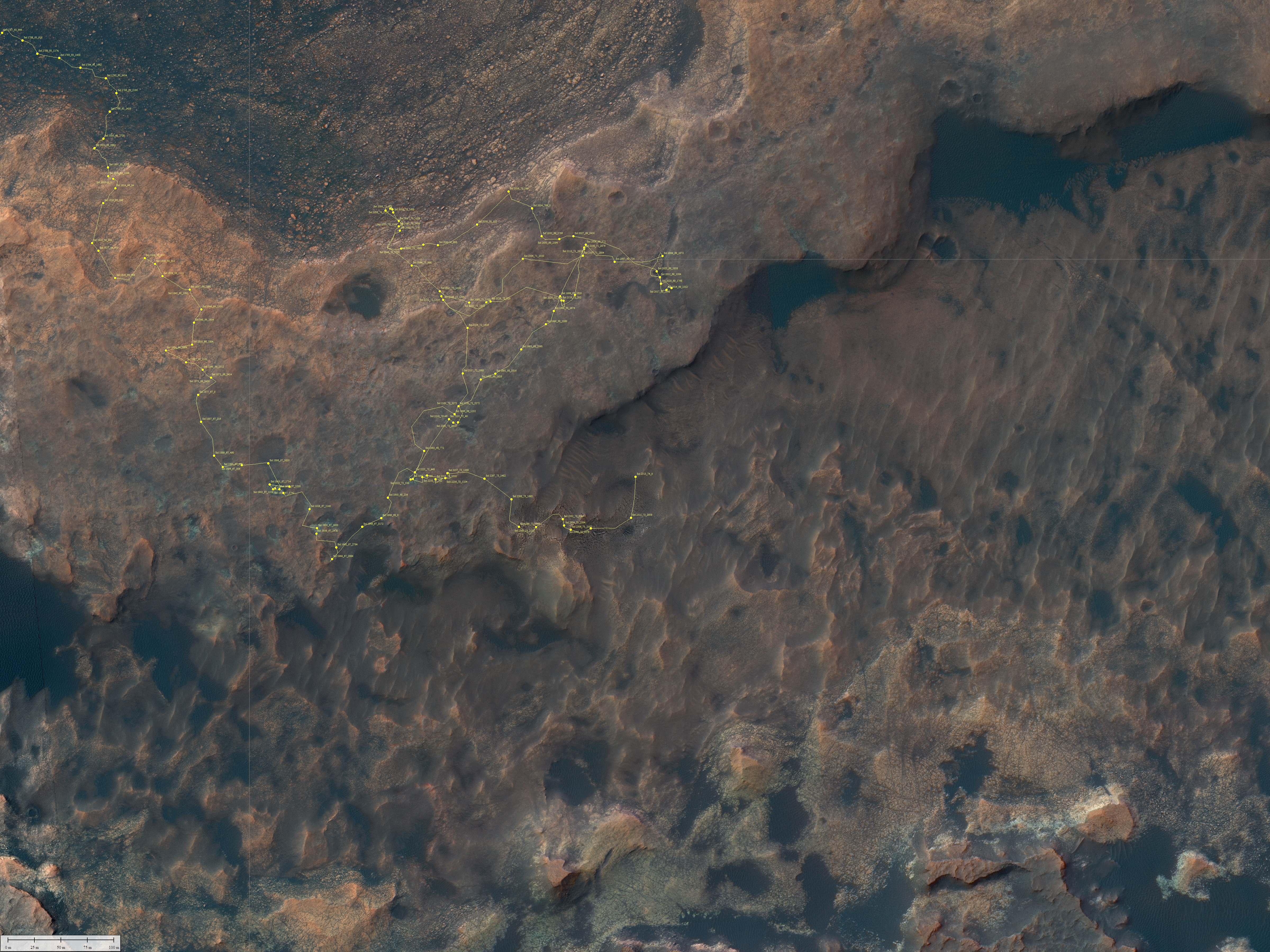
Pit 1 is very intriguing in that it sits amid a very long chain of pits and canyons, all aligned, as shown in the image below and to the right.
» Read more

0 comments

Rover update: February 20, 2019

Summary: Curiosity in the clay unit valley. Opportunity’s long journey is over. Yutu-2 creeps to the northwest on the Moon’s far side.

For the overall context of Curiosity’s travels, see my March 2016 post, Pinpointing Curiosityโ€™s location in Gale Crater.

For the updates in the past year go here. For a full list of updates before February 8, 2018, go here.

Curiosity
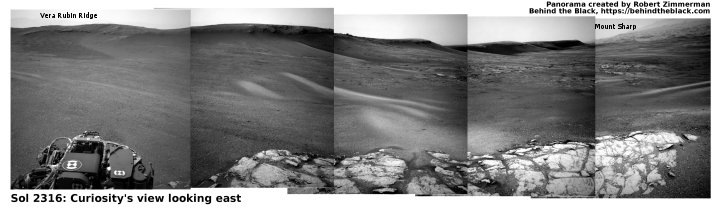
Curiosity's view to the east on Sol 2316
Click image for full resolution version
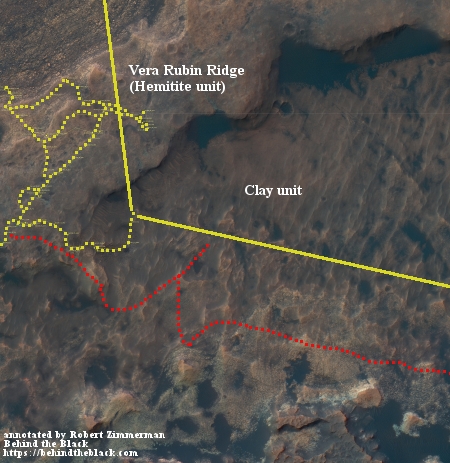
Overview of Curiosity's future travels
Click image for original image

Since my January 22, 2019 update, Curiosity finally drove down off of Vera Rubin Ridge into a valley between the ridge and the lower slopes of Mt Sharp. The Mars Reconnaissance Orbiter (MRO) overview on the right has been annotated by me to show the rover’s travels (shown by the yellow dotted line), with its proposed route indicated by the red dotted line. The yellow lines indicate approximately the terrain seen in the panorama above. The panorama was created from images taken on Sol 2016.

The valley that Curiosity is presently traversing is dubbed “the clay unit” or “the clay-bearing unit” by the geologists, based on its make-up determined from orbital data. So far they have found this terrain to be “some of the best driving terrain we’ve encountered in Gale Crater, with just some occasional sandy patches in the lee of small ridges.” Initially they had problems finding any rocks or pebbles large enough for the instruments to use for gathering geological data. For the past week or so, however, they have stopped at “bright exposure of rock” where some bedrock was visible, giving them much better material to work with.
» Read more

1 comment

The InSight Martian weather station

InSight’s weather station is now providing daily weather updates to the public.

Starting today, the public can get a daily weather report from NASA’s InSight lander.

This public tool includes stats on temperature, wind and air pressure recorded by InSight. Sunday’s weather was typical for the lander’s location during late northern winter: a high of 2 degrees Fahrenheit (-17 degrees Celsius) and low of -138 degrees Fahrenheit (-95 degrees Celsius), with a top wind speed of 37.8 mph (16.9 m/s) in a southwest direction.

This daily weather data can be found here. For the weather from Curiosity, go here. Weekly global weather reports from Mars Reconnaissance Orbiter are found here.

Comparing the weather at the two landers, you will notice that it is generally warmer at InSight. This is not surprising, as Curiosity is climbing a mountain, and is now at a much higher elevation.

1 comment

A river valley floor on Mars

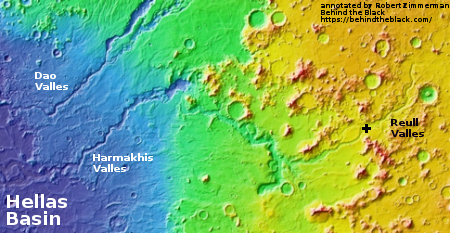
Overview of Reull Valles region

Today’s cool image focuses in on a Mars Reconnaissance Orbiter (MRO) uncaptioned photograph taken of the valley floor of Reull Vallis, a meandering canyon that drains into Hellas Basin, the bottom of Mars.

The image on the right is not that photograph. Instead, it is an overview of the area surrounding it. The image location is indicated by the black cross, dead center within the floor of Reull Vallis itself. This valley, as well as Dao and Niger to the northwest but lower in elevation are all thought to have been formed from flowing water, all of which apparently drained from the east and to the west into Hellas Basin.

This last detail is very important and bears repeating before looking at today’s subject image. The river that formed Reull Vallis flowed from the east to the west. Now for that picture.
» Read more

0 comments

Monitoring a fresh-looking Martian landslide

2012 image of Martian landslide
Click for full image

2018 image of Martian landslide
Click for full image

Time for two cool images! To the right are two images taken by the high resolution camera on Mars Reconnaissance Orbiter (MRO), the top one taken in April 2012, and the bottom taken in December 2018. Both have been cropped and reduced slightly in resolution to post here.

The second image is trying to answer, in only a small way, one of the most fundamental questions of the Martian environment: How fast does it change? The images from orbit have periodically seen evidence of new impacts. MRO images have tracked dust devil tracks. And we know that somehow water, ice, wind and volcanic activity have eroded and reshaped the surface over eons.

What we don’t know truly and with detail is the pace of these changes, with any accuracy. The pace of some things over time seems obvious. For example, Mars’s inactive but gigantic volcanoes suggest that once volcanism was very active, but over time has ceased so that today it is unclear if any is occurring. Similarly, the geological evidence suggests that in the far past water flowed on the surface, producing catastrophic floods. Now that liquid water is all but gone, and this erosion process as ceased.
» Read more

0 comments

NASA officially declares Opportunity dead

NASA today officially announced that the rover Opportunity — built to last 90 days — is dead, only three weeks after celebrating its fifteenth anniversary operating on the Martian surface.

This is what project scientist Steve Squyres had to say about the rover’s finish:

โ€œWhen I saw that the storm had gone global, I thought this could be it,โ€ said Squyres, explaining that Opportunity was a solar-powered vehicle and needed the sun for energy. โ€œTo have Opportunity โ€“ designed for 90 days โ€“ taken out after fourteen and a half years by one of the most ferocious dust storms to hit the planet in decades, you have got to feel pretty good about it.โ€

He said: โ€œIt was an honorable end, and it came a whole lot later than any of us expected.โ€

The article gives some nice background into the personal stories of many of the scientists who worked on Opportunity for all those years. For some overall scientific context, see this article. Or you can read the many rover updates I have written in the past two and a half years, which will give you a detailed sense of Opportunity’s travels along the rim of Endeavour Crater.

8 comments

InSight deploys heat sensor onto Mars surface

InSight has successfully deployed its temperature instrument onto the Martian surface, where it will next begin drilling its heat sensor about sixteen feet down into the ground.

Equipped with a self-hammering spike, mole, the instrument will burrow up to 16 feet (5 meters) below the surface, deeper than any previous mission to the Red Planet. For comparison, NASA’s Viking 1 lander scooped 8.6 inches (22 centimeters) down. The agency’s Phoenix lander, a cousin of InSight, scooped 7 inches (18 centimeters) down.

“We’re looking forward to breaking some records on Mars,” said HP3 Principal Investigator Tilman Spohn of the German Aerospace Center (DLR), which provided the heat probe for the InSight mission. “Within a few days, we’ll finally break ground using a part of our instrument we call the mole.”

Whether the spike will be able to get to 16 feet will depend on many factors, such as whether a rock below the surface happens to be in the way.

0 comments

NASA about to pull plug on Opportunity

Rumors today say that during a press conference tomorrow NASA will announce that it is closing the books on the incredibly successful rover Opportunity.

From the first link:

NASA said Tuesday it will issue a final series of recovery commands, on top of more than 1,000 already sent. If there’s no response by Wednesday โ€” which NASA suspects will be the case โ€” Opportunity will be declared dead, 15 years after arriving at the red planet.

Opportunity was supposed to last 90 days. Instead, it lasted just under fifteen years, drove 28 miles, and saw far more of the Martian surface than anyone ever expected.

It now sits inside the rim of fourteen-mile Endeavour Crater, waiting for those first explorers to come and get it. I wonder when that will be.

1 comment
1 142 143 144 145 146 212