Saturn’s core is a slushy mix of rocks and liquid

Saturn's rings
Click for more information.

Using archival data from the Cassini orbiter that mapped ripples in the rings of Saturn, scientists have produced a model of Saturn’s core that suggests it is a slushy soup that as it sloshes about shifts the gas giant’s gravitational field.

By using the famous rings like a seismograph, scientists studied processes in the planet’s interior and determined that its core must be “fuzzy.” Instead of a solid sphere like Earth’s, the core of Saturn appears to consist of a ‘soup’ of rocks, ice and metallic fluids that slosh around and affect the planet’s gravity.

…Not only does the planet’s core seem sludgy, it also appears to extend across 60% of the planet’s diameter, making it much larger than previously estimated. The analysis showed that Saturn’s core might be about 55 times as massive as the entire planet Earth. Of the total mass of the core, 17 Earth masses are made of ice and rock, with the rest consisting of a hydrogen and helium-based fluid, the study suggests.

The image above was taken in 2017, and shows both a density wave in the rings (the parallel lines in the center) caused by a Saturn moon, and numerous “propellers”, small distortions in the rings caused by slightly larger objects.

4 comments

Ingenuity’s 12th flight successful

Ingenuity's shadow just before landing.

According to the Perseverance science team, the Mars helicopter Ingenuity successfully completed its twelfth flight on Mars early yesterday, making a short scouting round trip over an area called South Seitah to provide images that the team can use to plan the rover’s future route.

All told, Ingenuity flew just under 1,500 feet flying about 30 feet above the ground for just under three minutes. The picture to the right was taken just before landing, and shows the helicopter’s shadow on the ground. It is one of six so far downloaded. The remaining images will follow later.

The announcement was made on Twitter, and included some embarrassingly over-the-top prose:

The #MarsHelicopter’s latest flight took us to the geological wonder that is the “South Séítah” region.

South Seitah is hardly a “geological wonder”. It is a sandy area with some rocks and interesting geology.

I’m not sure why, but the Perseverance rover team seems prone to do this with their press releases and announcements. The claim they make over and over that Perseverance’s prime mission is to look for ancient life is junk Now they call a relatively undistinguished and small area on a crater floor a “wonder.”

Makes one think they somehow feel a need to justify what they are doing, something that is patently absurd. They are controlling a robotic rover and helicopter tens of millions of miles away as both explore a place on another planet no one had ever visited before. That certainly is spectacular enough, and does not need purple prose to justify.

3 comments

Blue Origin files lawsuit against Starship lunar contract award

What a joke: Jeff Bezos’s company Blue Origin on August 13th filed a lawsuit in federal court, attempting to overthrow the contract award NASA gave SpaceX’s Starship in its manned lunar lander Artemis project

In a court filing on Friday, Blue Origin said it continued to believe that two providers were needed to build the landing system, which will carry astronauts down to the Moon’s surface as early as 2024. It also accused Nasa of “unlawful and improper evaluation” of its proposals during the tender process. “We firmly believe that the issues identified in this procurement and its outcomes must be addressed to restore fairness, create competition and ensure a safe return to the Moon for America,” Blue Origin said.

The article then goes on to list the basic facts that make this lawsuit absurd. First, NASA had not been appropriated enough money by Congress to award two contracts, and had it done so, it would have violated the law. Second SpaceX’s bid was the lowest bid, far less than Blue Origin’s expensive price. Third, SpaceX was already test flying early prototypes of its Starship lander, while Blue Origin had built nothing. Fourth, many other technical issues made SpaceX’s bid superior.

Finally, the GAO, as an independent arbitrator, has already ruled against a Blue Origin protest, stating unequivocally that NASA had done nothing wrong in its contract process.

This lawsuit makes Blue Origin appear to be a very unserious company. Rather than putting its energies towards building rockets and spacecraft to demonstrate its capabilities, it focuses its effort on playing legal games in the courts. Such behavior will only make it seem less appealling when next it bids on a NASA or Space Force contract.

15 comments

Arianespace’s Vega rocket successfully launches five satellites

Capitalism in space: Arianespace’s Vega rocket today successfully launched five satellites into orbit, completing the company’s third launch in 2021 and the second Vega launch this year.

With only three launches so far in 2021, Arianespace does not make the leader board, which is presently as follows:

26 China
20 SpaceX
12 Russia
4 Northrop Grumman

The U.S.’s lead over China in the national rankings remains 31 to 26.

0 comments

Regional Martian dust storms help suck water from Mars

Orbital data now shows that both global and regional dust storms on Mars help remove the planet’s water, allowing it to reach higher atmospheric elevations where solar radiation breaks it up and it escapes into space.

Scientists have long suspected that Mars, once warm and wet like Earth, has lost most of its water largely through this process, but they didn’t realize the significant impact of regional dust storms, which happen nearly every summer in the planet’s southern hemisphere. Globe-enveloping dust storms that strike typically every three to four Martian years were thought to be the main culprits, along with the hot summer months in the southern hemisphere when Mars is closer to the Sun.

But the Martian atmosphere also gets heated during smaller, regional dust storms, according to a new paper published August 16 in the journal Nature Astronomy. The researchers, an international team led by Chaffin, found that Mars loses double the amount of water during a regional storm as it does during a southern summer season without regional storms.

This conclusion is based on data gathers from three different orbiters during a regional dust storm in early 2019.

1 comment

A Martian river of ice

Glacial flow on Mars?
Click for full image.

Cool image time! The photo to the right, rotated, cropped and reduced to post here, was taken on May 13, 2021 by the high resolution camea on Mars Reconnaissance Orbiter (MRO). It spans the entire 4.7 mile width of the southern hemisphere canyon dubbed Reull Vallis. The white arrow indicates the direction of the downhill grade

The scientists title this image “Lineated Valley Fill.” The vagueness of this title is because they have not yet confirmed that this lineated valley fill is a glacier flowing downhill to the west.

Nonetheless, the material filling this valley has all the features one expects glaciers to exhibit. Not only is the the lineation aligned with the flow, it varies across the width of the canyon as glaciers normally do. At the edge the parallel grooves are depressed, probably because they are torn apart by the canyon walls as the glacier flows past. In turn, at the center of the flow the grooves are thinner and more tightly packed, and appear less disturbed. Here, the flow is smooth, less bothered by surrounding features.

This pattern also suggests the merging of two flows somewhere upstream.

A glance at the spectacular Concordia glacier in the Himalayas near the world’s second highest mountain, K2, illustrates the similarity of this Martian feature to Earth glaciers.

Reull Vallis itself flows down to Hellas Basin, the deepest basin on Mars. As it meanders downhill along its 650 mile length it steadily gets wider and less distinct as it drops into Hellas. Along its entire length MRO has photographed numerous similar examples of this lineated fill, all suggesting that under a thin layer of debris is a thick glacier, slowerly carving this canyon out.

The overview map below illustrates these facts nicely, while further reinforcing these glacial conclusions.
» Read more

8 comments

Ingenuity’s next flight

Ingenuity's flight plane for 12th flight
Click for full image.

The Ingenuity engineering team today announced their plans for the helicopter’s twelfth flight on Mars, scheduled for early tomorrow.

Ingenuity will climb to an altitude of 10 meters and fly approximately 235 meters east-northeast toward the area of interest in Séítah. Once there, the helicopter will make a 5-meter “sidestep” in order to get side-by-side images of the surface terrain suitable to construct a stereo, or 3D, image. Then, while keeping the camera in the same direction, Ingenuity will backtrack, returning to the same area from where it took off. Over the course of the flight, Ingenuity will capture 10 color images that we hope will help the Perseverance science team determine which of all the boulders, rocky outcrops and other geologic features in South Séítah may be worthy of further scrutiny by the rover.

The map above shows South Seitah in the yellow oval. The yellow line marks Ingenuity’s past flights. The white line marks the path Perseverance has taken south since landing. The dashed lines mark Perseverance’s planned route.

Thus, the helicopter will be obtaining aerial photos of the region in Seitah where the scientists want to send Perseverance, in order to help them pick the best route.

6 comments

Curiosity looks backwards

Curiosity panorama looking southeast
Click for full resolution version. For original images go here and here.

Overview map
Click for interactive map.

Cool image time! The mosaic above was created from two photos taken on August 13, 2021 by Curiosity’s right navigation camera. It looks to the southeast, at the mountainous Martian terrain that the rover had been traveling just below for the past two months.

The overview map to the right shows with the yellow lines the approximate area covered by this mosaic. The white mountain at the top is the highest visible flank of Mount Sharp, and is beyond the right/bottom edge of the overview map. Mt. Sharp’s peak itself is not visible, as it is higher up and to the right. It is presently blocked by these mountainous foothills.

The science team probably took this image partly to provide another view of these mountains for comparison with earlier views. They can use this new data to look for changes as well as obtain better three-dimensional data.

They also took the image for the same reason I post it here. Having now climbed more than 1,500 feet from the floor of Gale Crater, Curiosity’s view is routinely spectactular. Why not enjoy it?

Mt. Sharp’s peak however is still about 13,000 feet above the rover. The climb up the mountain has just begun.

14 comments

Boeing to return Starliner to factory

Capitalism in space: According to a Wall Street Journal story today, Boeing and NASA have decided to remove the Starliner capsule from the Atlas-5 rocket and return it to Boeing’s factory in order to do a more thorough inverstigation into the capsule’s failing valves.

This decision means that the launch of the second unmanned demo test flight of Starliner will not occur in August, and will likely be delayed several more months. NASA and Boeing just held a press conference in which they made this decision official. During that conference they said they think the moist environment at Kennedy might have caused corrosion in the valves, which caused them to stick.

I once again wonder if Boeing has any quality control systems at all. For such a serious problem — the failure of 13 valves out of 24 — to suddenly pop up just hours before launch, when they have been developing this capsule for years, and even had an extra year and a half to check the capsule out after the failures during the first unmanned demo flight in December 2019, is somewhat astonishing, and very disturbing.

Others will argue that problems like this can always appear unexpectedly in space hardware. I say hogwash. Boeing is not inventing something new with Starliner. This is a capsule, using heritage engineering first invented in the late 1950s. It should not be so hard to get this right.

57 comments

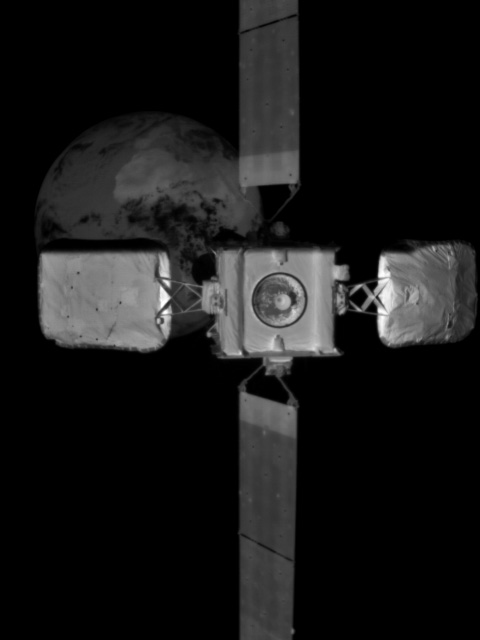
South Korean company invests $300 million in OneWeb

Capitalism in space: Hanwah, a South Korean conglomerate, has now invested $300 million in private capital in the satellite communications company OneWeb.

U.K.-headquartered OneWeb expects regulatory approvals to complete the Hanwha transaction in the first half of 2022, bringing its total investment since emerging from bankruptcy protection in November to $2.7 billion. The startup has said it only needed $2.4 billion to fund its initial constellation of 648 satellites in low Earth orbit.

It reached that in June, after Indian telecom company Bharti Global doubled its investment to $1 billion to secure what would have been a 38.6% stake before Hanwha’s announcement. The U.K. government, French satellite operator Eutelsat and Japanese internet giant Softbank were each in line for just under 20% after making their own investments. U.S.-based Hughes Network Systems, which is supplying parts for OneWeb’s ground segment, also had a small stake.

Hanwha also wishes to build its own 2,000 satellite constellation, targeted for operation by 2030. This investment gives it access to OneWeb’s technology which it can later use.

For OneWeb, this new capital solidifies its full recovery from bankruptcy, and makes it a very viable competitor to SpaceX’s Starlink constellation.

0 comments

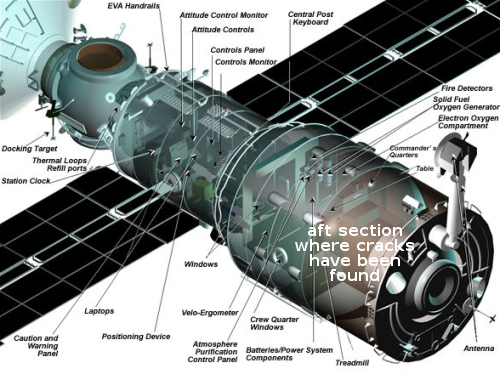
Russians accuse American astronaut of drilling hole in Soyuz

In several articles published today in the state-run Russian press, the Russians made the accusation that the hole and drilling damage that had been found on an in-orbit Soyuz capsule was put there by an American astronaut.

The first link above notes that while the Russians took a lie detector test, showing they didn’t drill the hole, the Americans refused. A second TASS link argues that their investigation proves that all the drill damage had to been done in orbit, for two reasons. First, they always test the capsule’s intergrity in a vacuum chamber before launch, and would have discovered it then. Second, the nature of the drill damage suggests it was done in zero gravity.

A third link provides an English translation of the more detailed Russian report, which made this direct accusation:

Firstly, the illness of the female astronaut, which is the first known incident of deep vein thrombosis in orbit, and the fact that Serena Maria Auñón-Chancellor had suffered the condition was published in a scientific article only after she had returned to Earth. This could have provoked ‘an acute psychological crisis’, which could have led to attempts by various means to speed up her return to the planet, according to my anonymous source. Secondly, for some reason unknown to Roscosmos, the video camera at the junction of the Russian and American segments was not working at that time. Thirdly, the Americans refused to perform a polygraph examination, while the Russian cosmonauts were polygraphed. Fourthly, Russia never had an opportunity to study the tools and the drill which are aboard the ISS to see if there are any signs of metal shavings from the hull of our ship’s orbital module.

This longer article also makes the claim that, because of the location of some of the drill attempts, whoever did drilling had no knowledge of the Soyuz’s construction.

All this may be true, but it conveniently ignores several very important facts: The one successful drillhole that caused the leak had been patched, which would have prevented any leak during the vacuum tests on the ground. The leak occurred because the patch was not designed to survive the hostile environment of space and eventually failed.

Also, the Russians’ own investigation had found that there was plenty of time on the ground for this sabotage to have occurred, so saying it had to have happened in space is incorrect.

Finally, the claim that the drill damage had to have been done in zero gravity is pure opinion, and hardly evidence.

In other words, it sounds as if the Russians are trying to shift blame from themselves (and an unknown ground worker) to an American astronaut. It is certainly possible that their claims are true, but they seem incredibly implausible. Much more likely would be sabotage on the ground by a very disgruntled Russian worker, routinely underpaid and resentful of the corruption that permeates Roscosmos and all of Russian society.

Such a conclusion however would be beyond embarrassing for the Putin government and the head of Roscosmos, Dmitry Rogozin. It is far better to place the blame on an American, especially because the end of the U.S.-Russian partnership on ISS is only a few years away.

11 comments

Branson sells more than ten million shares of Virgin Galactic

Capitalism ?in? space? Continuing his steady off-loading of Virgin Galactic stock since the company went public, Richard Branson has sold another 10.5 million shares, lowering his steadily shrinking ownership share another 4% to 18% total.

The sale garnered him $300 million in cash.

When the company went public in 2019, Branson reserved for himself 51% ownership. Since then he has periodically sold off large chunks, usually well timed to specifically planned events that worked to pump up the stock’s price. This last sale obviously was planned to take advantage of the publicity following Branson’s own suborbital flight in July.

While Virgin Galactic might have a future in suborbital space tourism, I remain very skeptical. It certainly does not have a future in the larger orbital market, as it has no experience building real rockets (Virgin Orbit was spun off this company years ago, taking with it all that experience). Thus, the company has very limited possibilities. As the orbital market grows and becomes dominant, I can’t see there being that much long term interest in short suborbital hops.

I think Branson agrees with me, which is why he is getting out when the getting is good. That he is following the classic and very corrupt method of “pump and dump” only solidifies my belief that he is an outright con-man.

That the mainstream press continues to genuflect before him only tells us how corrupt and incompetent that press has become.

2 comments
1 52 53 54 55 56 126