Two smallsat orbiters to launch in ’24 to study Martian upper atmosphere

NASA has picked a twin orbiter mission being built by a partnership of the University of California-Berkeley and the private rocket company Rocket Lab to place two smallsats in orbit around Mars to study how the harsh environment of space might be causing the red planet to lose its atmosphere.

The entire project is dubbed ESCAPADE (an insanely contrived acronym) but the two smallsats have been dubbed “Blue” and “Gold.”

The mission builds on decades of experience at SSL in building satellite instruments and fleets of spacecraft to explore regions around Earth, the moon and Mars, specializing in magnetic field interactions with the wind of particles from the sun. Each of the two satellites, named after UC Berkeley’s school colors, will carry instruments built at SSL to measure the flow of high energy electrons and ionized oxygen and carbon dioxide molecules escaping from Mars, magnetic field detectors built at UCLA and a probe to measure slower or thermal ions built at Embry-Riddle Aeronautical University in Daytona Beach, Florida.

With twin satellites, it is possible to measure conditions simultaneously at two places around the planet, Lillis said, allowing scientists to connect plasma conditions at one site to the escaping ion flux at another. Over the course of the mission, the two satellites will change positions to map the upper atmosphere and magnetosphere of nearly the entire planet from an altitude of between 150 and 10,000 kilometers.

Maybe the most important aspect of this mission however is not what it will learn at Mars, but how it is being financed and built. NASA is only paying about $80 million, a tiny amount compared to most past unmanned planetary probes. The university in turn is buying Rocket Lab’s Photon satellite structure rather than building the satellites from scratch. It will configure the instruments to fit into that ready made satellite body, thus saving time and money.

By doing it this way NASA and the planetary science community is increasingly relying on private companies to provide them their planetary probes, rather than building such things by hand themselves, at much greater cost. The result is a growing and thriving private commercial sector that owns and builds its own planetary probes, for profit.

0 comments

Curiosity’s coming mountainous target

Curiosity's upcoming mountainous target
Click for full image.

Overview map


Click for interactive map.

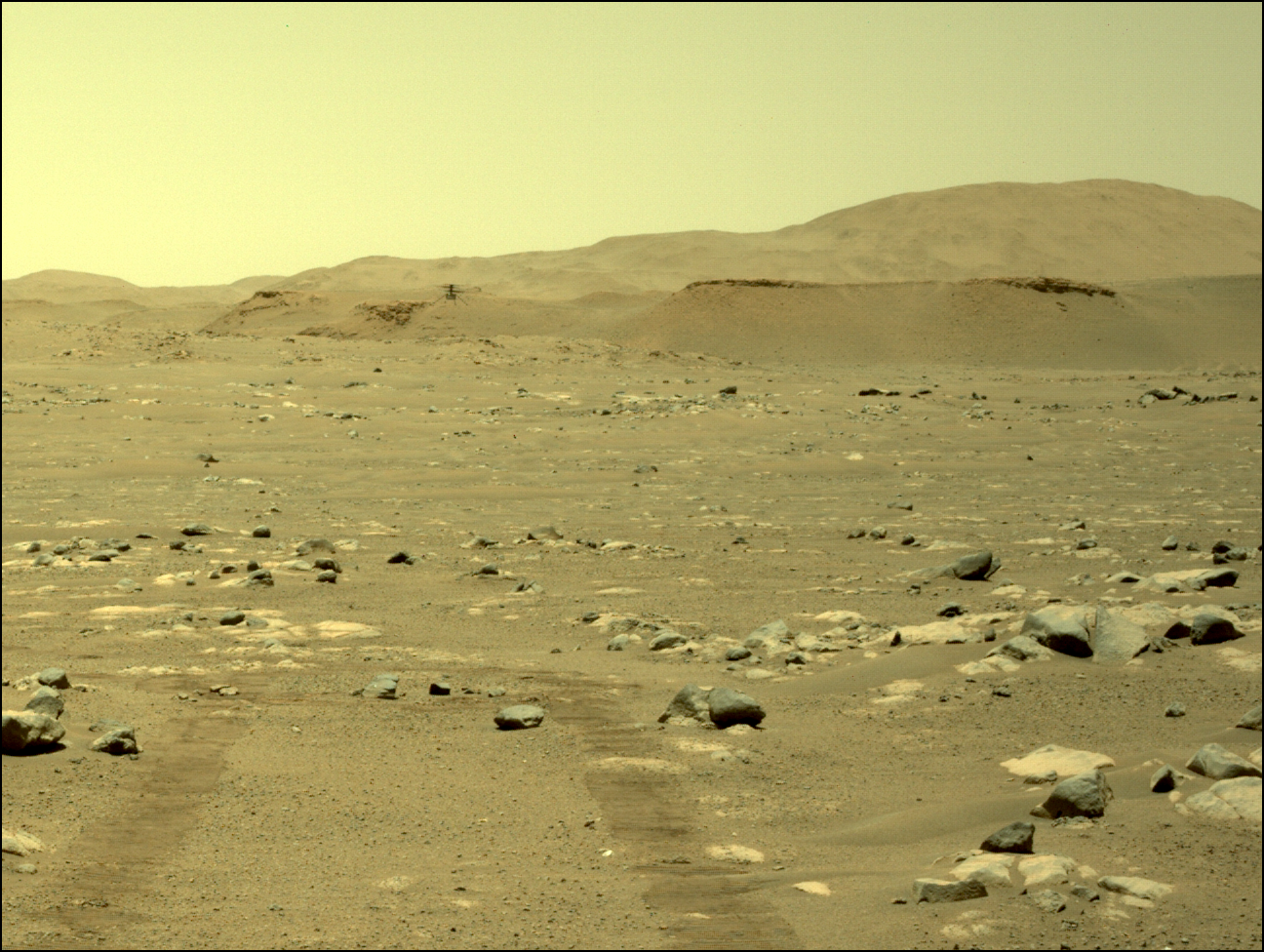
Cool image time! The photo above, taken on August 22, 2021 by Curiosity’s left navigation camera and reduced to post here, looks ahead at the rover’s upcoming mountainous goals. The overview map to the right shows the area covered by this image by the yellow lines. The dotted red line indicates the rover’s original planned route, with the white dotted line its actual path of travel.

The cliff ahead is about 400-500 feet away. The top of this cliff is the Greenheugh Pediment, its blocky top geological layer visible as the dark cap at the top of the cliff face. Back in March 2020 Curiosity had climbed up to view across this pediment, from a point to the northwest and off the overview map to the left. (Go to this link to see what the view was like from there.) Since then the science team has had the rover travel quite a distance, to circle around to now approach the pediment from the east.

The white box marks the area covered by a close-up high resolution mast camera image, shown below.
» Read more

0 comments

Update on Starship/Superheavy preparations for orbital test flight

Starship prototype #20 being prepped
Screen capture from Labpadre live stream, available here.

Link here. In sum it appears that SpaceX is getting very close to launch, with the permit approval of the FAA increasingly becoming the biggest obstacle to progress.

Although the completion of all of this testing could take a long time, in Elon Musk’s mind, the path to returning B4 and S20 to being an integrated stack could be during this month.

A week ago, Musk tweeted that the “first orbital stack of Starship should be ready for flight in a few weeks, pending only regulatory approval.” Ultimately, once the vehicle is in its launch configuration, there will be a lengthy process of passing the aforementioned regulatory approval, with an environmental public comment period triggered ahead of launch. This has to be completed before the launch license can be granted by the Federal Aviation Administration (FAA).

The screen capture above shows Starship prototype #20 sitting on the suborbital flight test pad, as workers on cherry-pickers work on its exterior. The orange, green, and white tiles are likely tile locations still needing some level of installation work.

Based on SpaceX’s normal pace of operations, the engine testing for both Starship and Superheavy will take several weeks, once both are ready for such testing. While Starship appears just about ready, Superheavy apparently needs more work. When SpaceX stacked both together on the orbital launchpad several weeks ago, it suggested both were closer to launch than they were. Their present status suggests engine testing will likely begin in September, with Starship at the beginning of the month and Superheavy at the end of the month. That would make a launch possible sometime in late October, assuming the federal government doesn’t decide to shut this entire operation down by refusing to issue a permit.

7 comments

Asteroid discovered with shortest orbit yet

Astroid's orbit
Click for full image.

Astronomers have discovered an asteroid that circles the Sun with the shortest orbit yet found, flying mostly inside the orbit of Mercury.

The illustration to the right shows the asteroids orbit, which is also tilted 32 degrees from the plane of the solar system.

The orbit of the approximately 1-kilometer-diameter asteroid takes it as close as 20 million kilometers (12 million miles or 0.13 au), from the Sun every 113 days. Asteroid 2021 PH27, revealed in images acquired during twilight, also has the smallest mean distance (semi-major axis) of any known asteroid in our Solar System — only Mercury has a shorter period and smaller semi-major axis. The asteroid is so close to the Sun’s massive gravitational field, it experiences the largest general relativistic effects of any known Solar System object.

Relatively few asteroids have been found with orbits shorter than Earth’s, because to find them astronomers have to turn their telescopes sunward, where viewing is limited to the early evening or early morning. Few space-based telescopes in all wavelengths also don’t look this way much, because of the risk of damage from the intense sunlight.

It is thus unknown exactly how many asteroids exist with similar orbits. There may be many, with many having short eccentric orbits, similar to comets, that extend out to Earth’s orbit and thus pose a risk. Or there may be few, since such orbits so close to the Sun are likely to cause the asteroid’s break-up and destruction over time.

Knowing how many of course is important, in order to obtain a full census of those asteroids in the solar system that might hit the Earth. To get it will likely require placing a probe designed to look for them.

3 comments

Russia launches another 34 OneWeb satellites

Russia today put another 34 OneWeb satellites into orbit, using its Soyuz-2 rocket.

OneWeb now has 288 satellites in orbit, out of the planned 648. At present the constellation is able to provide service to customers in latitudes north of 50 degrees. Though SpaceX’s Starlink constellation is also offering service to customers in the same northern latitudes, the two companies service different customer bases, with OneWeb aimed at big business and government operations and Starlink aimed at individual residential customers.

The leaders in the 2021 launch race:

27 China
20 SpaceX
13 Russia
4 Northrop Grumman.

The U.S. still leads China 31 to 27 in the national rankings.

2 comments

Trump says he “single-handedly” decided to move Space Force command from Colorado to Alabama

On Friday former President Donald Trump stated that it was his decision to put the headquarters of the new Space Force in Alabama, not in Colorado where most military related space operations have been located for decades.

“Space Force — I sent to Alabama,” Trump said. “I hope you know that. (They) said they were looking for a home and I single-handedly said, ‘Let’s go to Alabama.’ They wanted it. I said, ‘Let’s go to Alabama. I love Alabama.’”

U.S. Rep. Doug Lamborn, a Republican who represents Colorado Springs, said Trump’s remarks were “an admission” that the headquarters move “was based solely on politics and personal preference — not the Air Force’s basing criteria or national security.”

When this decision was announced in January, I then believed porkmeister Senator Richard Shelby (R-Alabama) had forced it through, but it appears now that is wrong. It was Trump, but still for reasons of pork.

This was a bad decision, one that from the beginning was going to have both practical and political opposition. For practical reasons Colorado always made better sense as Space Force headquarters because it would require less relocation of assets. For political reasons it was flying in the face of a lot of well-established vested interests in Colorado.

Trump’s admission yesterday will likely provide the final bit of ammunition needed by Colorado politicians to get it overturned.

18 comments

Russia delays launch of next unmanned lunar probe

According to a story in Russia’s state-run press, Roscosmos has decided to delay the launch of its Luna-25 lander from October 2021 to May 2022.

The story gave no reason for the delay.

Luna-25 would be the first Russian lunar probe since the 1970s, and is supposed to be that country’s first probe in a partnership with China to establish a manned lunar base by the 2030s.

Want to bet the Russian contribute to this project will be repeatedly delayed, and will also likely be disappointing? That has been the track record of Roscosmos for the past two decades (like all 21st century government projects). This first delay signals many more to come.

I am not saying Russia will fail to launch anything. What I am saying is that everyone should reserve a large store of skepticism about any promises Russia’s makes.

0 comments

New cracks across old Martian lava flows

New cracks across an old lava flow
Click for full image.

Cool image time! The photo to the right, cropped and reduced to post here, was taken on June 4, 2021 by the high resolution camera on Mars Reconnaissance Orbiter (MRO). It captures one of the many deep straight fissure canyons that make up the feature dubbed Cerberus Fossae in the center of Mars’ volcano country.

The crack is called a graben, and happens when the ground is either stretched from pressure from below, or when two adjacent large blocks of material move sideways relative to each other.

What makes this particular graben interesting are two features. First, the overlapping break suggests something complex took place at this spot when the crack separated. Second, the crack cut across the foot of an older frozen lava flow, meaning it has to be younger than that flow.

The overview map below provides a clue when that lava flow might have occurred, while also suggesting this crack in Cerberus Fossae might be much younger than expected.
» Read more

6 comments

British court dismisses billionaire’s lawsuit against Sutherland spaceport

A British judge today dismissed entirely [pdf] the lawsuit filed by billionaire Anders Povlsen, who had been trying to block the construction of a spaceport in Sutherland, Scotland, a region where he owns thousands of acres and is involved in many environmental issues.

Povlsen instead has been lobbying to have a spaceport instead built in the Shetland Islands, by a company he has invested in.

The ruling on all points went against Povlsen. The judge concluded:

Since I have held that none of the grounds of challenge is well founded it is unnecessary to [do anything], and I do not propose to do so (other than to say what I have already said….)

I shall sustain [the defense’s case and]… repel the petitioner’s pleas-in-law, and refuse the petition. I shall reserve meantime all questions of expenses.

This likely clears the way for construction of the Sutherland spaceport, from which the British smallsat rocket company Obex wants to launch. Lockheed Martin has said it would launch smallsats from Sutherland, but it has also said it would launch from Shetland too.

Povlsen’s opposition based on environmental concerns was of course a smokescreen to get this competing spaceport closed so that the one he has invested in in Shetland would get all the business. For more than three-quarters of a century launches have taken place at both the Kennedy and Vandenberg spaceports in the U.S., with neither doing any harm to the surrounding wildlife. Moreover, at Kennedy that spaceport forced the creation of a wildlife preserve, which prevented development. As long as they are operated with care and properly, spaceports are good for wildlife.

1 comment

China’s astronauts complete 2nd spacewalk at Tianhe space station

The new colonial movement: Two Chinese astronauts yesterday successfully completed a six hour spacewalk, installing components on the outside of the Tianhe space station module necessary for future construction work.

The pair, wearing second generation Feitian (“flying to space”) extravehicular mobility suits, completed installing foot restraints and an extravehicular working platform to the large robotic arm. Chinese media outlets streamed footage of the EVA. … The EVA also included work on a panoramic camera, installing a toolkit, adding a pump set for the Tianhe thermal control system and other apparatus in preparation for the arrival of two further modules in 2022. The EVA was completed at 2:33 a.m. Friday, around an hour ahead of schedule.

The first spacewalk occurred in the first week in July.

These astronauts have been working at the station since mid-June, and are expected to return to Earth in mid-September, completing a three month mission. Shortly thereafter a new cargo freighter will launch to the station to provide supplies for the next crew, due in October.

0 comments

Perseverance’s next drill attempt

Perseverance short term planned route
Click for full image.

The Perseverance science team today announced its near-future plans for where it will send the rover, but also when and how it will attempt its next core sample drilling.

The map to the right, cropped and reduced to post here, shows the rover’s future route. The red dot indicates its present location. The blue dot indicates where next they will attempt to drill. The route shows that they have decided to also make a short side trip south, an target that until now was considered optional.

As for what they plan to do in that next drill attempt:

We will first abrade the selected rock and use the science instruments to confirm (to the best of our ability) that the new target is likely to result in a core after the sampling process.

If we choose to sample the rock, Perseverance will perform a set of activities very close to what was done on the prior coring target. The main difference will be, after coring, we’ve added a “ground in the loop” session to review the images of the tube in the bit and confirm a sample was collected. Then, the tube will be transferred into the rover for processing.

If post-coring imagery shows no sample in the tube, we may elect to try again, using an alternate geometry (e.g. more horizontal) for the coring activity. Another option, if the targeted rock doesn’t allow for a change in geometry, is to look for a different rock in this region that is more easily cored horizontally.

They really want to get a sample of this particular bedrock on the floor of Jezero Crater. Their problem is that the first core sample failed because the bedrock was too structurally weak, crumbled into powder during drilling, and thus poured out of the drillbit once retracted from the ground. It could be that this will be a consistent issue with any sample attempts in this bedrock. This is why they are also considering drilling sideways, in order to hold any material they grab.

I suspect that the short side trip south might be to an outcrop that the rover could drill sideways into. Thus, if they are successful in getting a sample at the blue dot they might still cancel that side trip.

0 comments

NASA freezes work on SpaceX’s lunar lander version of Starship

In response to Blue Origin’s lawsuit that is attempting to cancel the contract award to SpaceX for adapting its Starship upper stage rocket as a manned lunar lander, NASA yesterday officially paused all work by it and SpaceX on this project.

From NASA’s statement:

NASA has voluntarily paused work with SpaceX for the human landing system (HLS) Option A contract effective Aug. 19 through Nov. 1. In exchange for this temporary stay of work, all parties agreed to an expedited litigation schedule that concludes on Nov. 1. NASA officials are continuing to work with the Department of Justice to review the details of the case and look forward to a timely resolution of this matter.

The optics for Blue Origin remain ugly. Not only does the company appear more interested in fighting court battles than building spaceships and rockets, it now is acting to prevent others from doing so.

The timeline of events however is interesting. Blue Origin filed its lawsuit on August 13th. NASA issued the first $300 million payment to SpaceX for this $2.9 billion contract on August 16th. Even with this announcement today, the payment suggests that NASA is doing what it can to make the contract award an accomplished fact that the courts will not find easy to overturn.

1 comment
1 50 51 52 53 54 126