Shetland Spaceport now faces same regulatory hurdles that destroyed Virgin Orbit

The new Shetland spaceport, Saxavord, is right now attempting to get launch approvals from United Kingdom’s Civil Aviation Authority (CAA), the same agency that dithered for six months approving a Virgin Orbit launch, thus causing the bankruptcy of that company.

According to Saxavord’s CEO, the spaceport has two launches aiming to launch before the end of this year, assuming the CAA can get its act together and give its approval. This quote however is worrisom:

The Saxavord spaceport says it is “still on track” to receive its necessary licences from the sector’s regulator before the summer. This relates to applications to the Civil Aviation Authority for range and spaceport licences.

Meanwhile SaxaVord CEO Frank Strang said the company is also on track for two rocket launches this year – “albeit they have moved slightly to the right”. [emphasis mine]

The delays could be coming from the rocket companies themselves. One of those companies is the German startup, Rocket Factory Augsburg, which has leased exclusive use of one launchsite. The other is the American startup ABL, which has had one launch attempt from the U.S. that failed.

Based on the CAA’s track record however the delays are just as likely coming from it. The CAA began this licensing process in November 2022, and is not done yet six months later.

2 comments

Scientists try to model what would happen if Ryugu hit Earth

Ryugu's northen hemisphere
Ryugu’s northen hemisphere. The arrow marks the spot Hayabusa-2
gathered samples

Scientists, using the data and rock samples gathered by the Japanese probe Hayabusa-2, have attempted to predict what what would happen if the rubble-pile asteroid Ryugu hit the Earth.

Without diversion intervention, Tanaka explained, if the Ryugu asteroid was heading to Earth and entered the planet’s atmosphere at an angle of 45 degrees and at a speed of around 38,000 miles per hour (17 kilometers per second), the rubble pile asteroid would break up at an altitude of around 25 to 21 miles (40 to 35 km) over the surface of the planet.

This would result in an “airburst” similar to that seen over Russia in February 2013 when the Chelyabinsk meteor erupted at an altitude of around 19 miles (30 kilometers) over Earth. The result of the Chelyabinsk blast was a bright flash of light and an atmospheric blast equivalent to the detonation of 400–500 kilotons of TNT. This is as much as 33 times the energy released by the atomic bomb that devastated Hiroshima at the end of the Second World War.

The Chelyabinsk meteor caused about 1,500 injuries, mostly from people injured by glass thrown out by breaking windows when it suddenly and unexpectedly exploded during re-entry. With Ryugu this would not be a surprise, so these injuries could be reduced, though not eliminated. The damage and injuries from pieces that survived the breakup and hit the ground remains unknown because scientists don’t know how much of the asteroid would survive the break up.

Ryugu of course poses no threat, because it is not on a collision course with Earth. Whether an asteroid like Ryugu could be diverted however remains unknown, since any such diversion must not cause the asteroid to break apart as well.

7 comments

The outermost edge of Mars’ north polar icecap

The outermost edge of Mars' north polar icecap
Click for original image.

Cool image time! The picture to the right, rotated, cropped, reduced, and sharpened to post here, was taken on February 4, 2023 by the high resolution camera on Mars Reconnaissance Orbiter (MRO). It shows the terminating cliffs of the north pole ice cap of Mars, dubbed Rupes Tenius on this side of the icecap.

At this point the elevation difference of the icecap’s edge from top to bottom is not significant, only about 1,500 feet or so, though this is a very rough estimate. As with all other images of the ice cape’s edge, there are many many layers visible, all indicating a different cycle in the climate history of Mars as its rotational tilt swings from about 11 degrees to 60 degrees over eons.

Moreover, at this point there is likely not that much difference between the terrain on top and the terrain below. Both will be mixed ice and dust and coarse rocks, though the percentages will be shifting towards less ice as we go down.
» Read more

1 comment

FAA issues travel advisory for Boca Chica for April 10, 2023 Starship launch

Though the FAA has not yet issued the launch license to SpaceX, allowing it to do the first orbital launch test of its Superheavy/Starship rocket, the agency today did issue a travel advisory for the Boca Chica area for April 10-11, 2023, in connection with this launch.

The FAA advisory is here. Scroll down to see the space activities section, which includes this information:

SPACEX STARSHIP SUPERHEAVY BOCA CHICA, TX
PRIMARY: 04/10/23 1310-1745Z
BACKUP(S): 04/11-12/23 1310-1745Z

Based on this information, we should expect the FAA launch license to be publicly announced any moment.

Hat tip BtB’s stringer Jay, who trolls Twitter so I don’t have to.

16 comments

English company buys land in Ohio for astronaut training facility

Blue Abyss, an English company focused on establishing “extreme environment research, test, and training centres,” has purchased twelve acres in Ohio where it plans to build an astronaut training facility.

The property, which is near Cleveland’s NASA Glenn Research Center, will include a 164-foot deep pool, microgravity center, astronaut training center, and a hotel. Brook Park Mayor Edward Orcutt described the facility as a “boot camp for astronauts.”

It appears the company is expecting there to be a lot of commercial astronauts in the coming years who will need training, and anticipates that NASA will not be capable of or interested in providing the service.

5 comments

Lockheed Martin picked by Australia to build two military communications satellites

Australia’s military announced yesterday that it has chosen Lockheed Martin as the “preferred bidder” to build two military communications satellites.

According to Australian media reports, the ADF [Australian Defense Force] is interested in buying at least two geostationary communications satellites and wants a sovereign military satcom capability. Currently Australia’s defense forces rely on commercial satellite services and on the U.S. Wideband Global Satcom constellation. Air Vice-Marshal David Scheul, head of Australia’s Air Defence and Space Systems Division, said the project will deliver the country’s “first sovereign-controlled satellite communication system over the Indo-Pacific ocean regions.”

Lockheed Martin edged out competing teams led by Airbus, Boeing, Northrop Grumman and Australia’s largest satellite operator Optus.

To get the contract, Lockheed Martin partnered with almost a dozen Australian companies. The specifics of the deal however still have to be worked out.

2 comments

Virgin Orbit files for bankruptcy

Less than a week after it laid off 85% of its workforce, Virgin Orbit’s management has filed for Chapter 11 bankruptcy.

Under Chapter 11, it appears the company can still be purchased and re-established, much like Firefly Aerospace was when it filed for bankruptcy. Since Richard Branson’s Virgin Group pumped a lot of cash into the company in the past six months, exceeding $70 million, it would get first crack at ownership rights. We should therefore not be surprised if Virgin Orbit comes back to life, owned by Branson and bought for pennies on the dollar, with the little stockholders and investors left in the lurch.

1 comment

A journey into Martian chaos

Overview map of Aram Chaos

With today’s cool image, we shall begin with the overview map, and drill our way down until we get a close look at another example of truly alien Martian terrain, with only a hint of similarity to comparable geology on Earth.

The overview map to the right shows us Aram Chaos, an ancient 170-mile-wide impact crater that has gone through such complex geology that it is difficult, maybe impossible, to unravel it based on data obtained from orbit. As I wrote in a detailed December 2020 post describing the confusing geology of this crater,

The floor of Aram Chaos is a place of great puzzlement to planetary geologists. The geology there is incredibly complex, and includes chaos terrain overlain by several sedimentary layers of sulfate minerals. The chaos terrain is most obvious in the southern part of the crater’s floor. The flat areas near the eastern center are those overlaying sedimentary layers.

When we zoom into the white box we can see a good example of this complexity.
» Read more

0 comments

Ingenuity completes 49th flight on Mars

Overview map
Click for interactive map.

The Ingenuity team today posted the official flight totals for the Mars helicopter’s 49th flight, which took place yesterday.

The helicopter flew 925 feet for 143 seconds, or two minutes and twenty-three seconds. The plan had been to fly 894 feet for 135 seconds, but has been happening consistently for the past dozen or so flights, the helicopter spent a little more time in the air and traveled a little farther.

As for altitude, it apparently did exactly as planned, averaging about 40 feet in height until the end of the mission, when Ingenuity went straight up another twelve feet to get a wider view of its landing area.

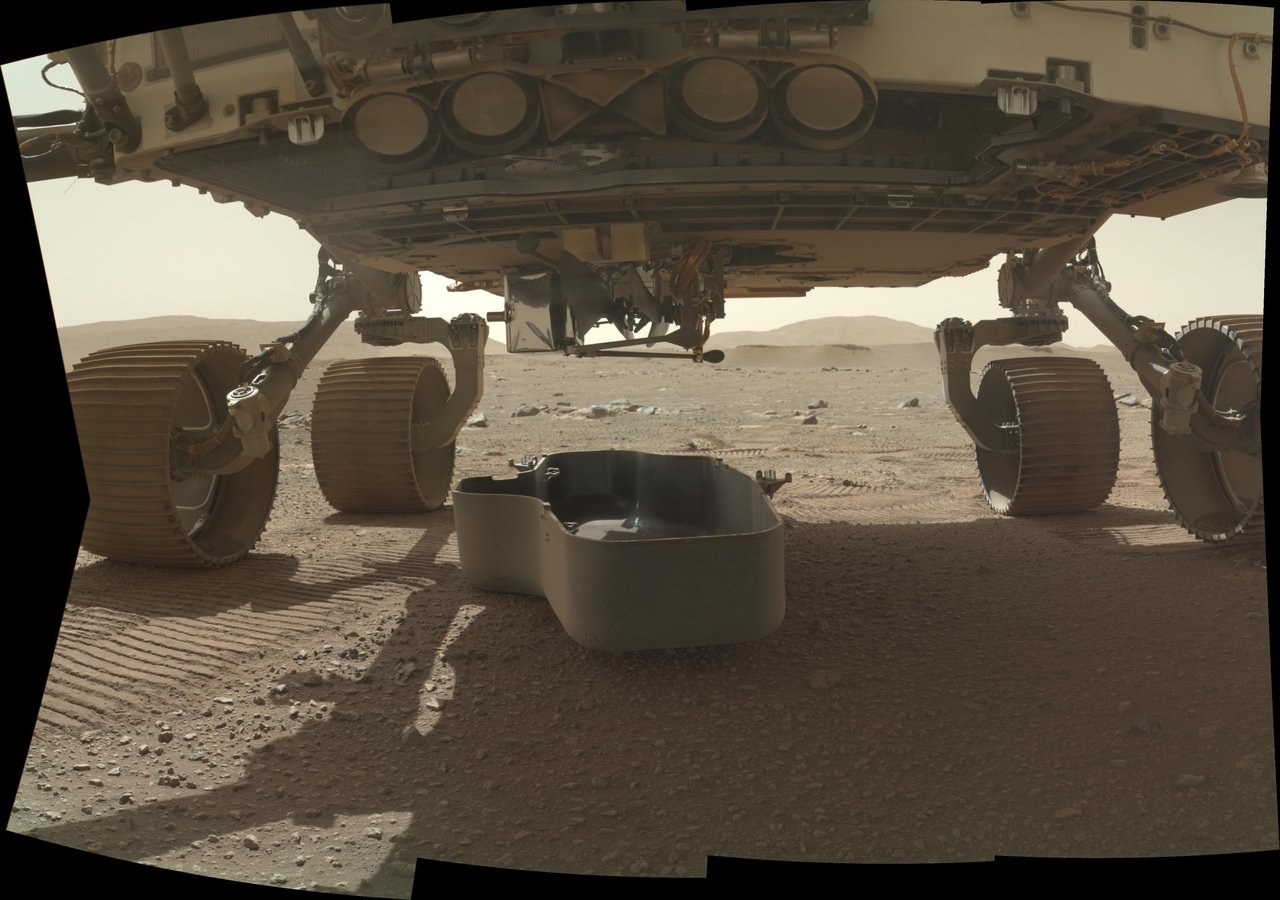
The map to the right shows the context. The green dot marks Ingenuity’s location at the start of the flight. The green line indicates my approximate estimate of its flight path and landing area, which the engineering team has not yet posted. The white dots and line mark Perseverance’s path, with its present location at the area dubbed Tenby where it has obtained its first core sample from the top of the delta.

1 comment

Sunspot update: Activity remained high in March

It is time for my monthly sunspot update. NOAA this week updated its graph that tracks the number of sunspots on the Sun’s Earth-facing hemisphere. This graph is posted below, with some additional details included to provide some context.

Last month the number of sunspots dipped slightly after a gigantic leap of activity in January. This month showed a small rise in activity, but not enough to bring levels back to the January’s levels. Nonetheless, activity remains the highest seen since 2014. when the last solar maximum was approaching its end, and continues to exceed significantly the 2020 prediction by NOAA’s panel of solar scientists.
» Read more

3 comments

NASA names four astronauts to fly on first manned Artemis mission around Moon

NASA today named the four astronauts who will fly on its Artemis-2 in a 10-day mission around the Moon, launched on SLS’s second launch in an Orion capsule and tentatively scheduled for late 2024.

The crew assignments are as follows: Commander Reid Wiseman, Pilot Victor Glover, Mission Specialist 1 Christina Hammock Koch, and Mission Specialist 2 Jeremy Hansen. They will work as a team to execute an ambitious set of demonstrations during the flight test.

The approximately 10-day Artemis II flight test will launch on the agency’s powerful Space Launch System rocket, prove the Orion spacecraft’s life-support systems, and validate the capabilities and techniques needed for humans to live and work in deep space.

The flight, set to build upon the successful uncrewed Artemis I mission completed in December, will set the stage for the first woman and first person of color on the Moon through the Artemis program, paving the way for future for long-term human exploration missions to the Moon, and eventually Mars. This is the agency’s Moon to Mars exploration approach. [emphasis mine]

The highlighted words illustrate some important facts. First, this first manned flight of Orion will also be the first that will use the capsule’s life-support systems, which were not included the first flight around the Moon in December. Thus, these four humans are essentially guinea pigs for this engineering. Seems such a plan should have been questioned by NASA’S corrupt safety panel, but then, it is corrupt, and never seems to have much problem with unsafe practices done by NASA itself. Instead, it spends a lot of time making up problems for SpaceX and missing problems at Boeing and NASA.

Second, note NASA’s emphasis on race and sex for the first landing on the Artemis-3 mission. Note too that Artemis-2 crew also includes a black and a woman. Though the press release wisely and correctly makes no mention of race when describing the four astronauts, it does tout the achievements of Christina Koch as a woman, not as a person.

Don’t get me wrong. It is good that a black and a woman are flying to the Moon. It just appears very clear that NASA now has a firm quota system, requiring one of each for every mission.

Finally, there is something not mentioned in the press release or on the Artemis-2 webpage that is very telling. Neither says anything about a launch date, which NASA had previously announced as November 2024. I have been predicting from the beginning that this date is a fantasy. It now appears NASA realizes it but is not yet ready to admit it publicly.

4 comments

Starship and Superheavy readied for orbital flight

With Superheavy prototype #7 already on the launchpad at Boca Chica, Texas, SpaceX engineers yesterday moved Starship prototype #24 beside it in preparation for stacking the orbital spacecraft on top of Superheavy for a launch now expected no earlier than April 10, 2023.

As the article notes, when Superheavy lifts off, it will set a new record for the most powerful rocket, having twice the thrust of either of NASA’s Saturn-5 or SLS rockets. And this record will be achieved by a privately built and owned rocket whose development has been funded almost entirely by private investment capital. Note too that the development took about six years, from concept to first launch, a few years less than it took NASA to build the Saturn-5 in the 1960s, and about one third the time it NASA to do the same thing with SLS in the 2000s, the 2010s, and the 2020s.

The orbital mission, it successful, will have Superheavy lift off, separate from Starship and then land controlled in the Gulf of Mexico. Starship will continue into orbit, and then attempt a controlled vertical splashdown in the Pacific Ocean northwest of the big Island of Hawaii.

At the moment, it appears the only obstacle to launch remains the FAA, which after many months has still not issued the launch license. This new activity at Boca Chica however suggests SpaceX expects that approval to occur momentarily.

15 comments
1 366 367 368 369 370 1,327