Musk abandons the Democrats, will vote Republican in November

In another example of the leftist Marxist Democratic Party losing long time supporters, Elon Musk revealed in a podcast today that he has switched his voter registration from Democrat to independent, and now plans to vote Republican in the upcoming election.

Elon Musk, admitting he had voted “overwhelmingly” for Democrats in the past, has changed his mind.

Musk is registered as an independent voter; he announced the switch over video link at a tech summit in Miami, Florida, hosted by the All-In podcast.

“I have voted overwhelmingly for Democrats, historically,” Musk acknowledged. “Like I’m not sure, I might never have voted for a Republican, just to be clear. Now this election I will,” Newsweek reported.

Musk however is not alone. Donald Trump is actually a much more famous example, having been a typical New York liberal Democrat for decades, only to reject that party in the mid-2010s for its increasingly radical communist agenda. Trump discovered to his surprise (as has Musk) that the conservative Republican Party better reflected his personal philosophy. Both men represent large numbers of ordinary people, who see themselves as moderate liberals and now find disgusting the bigoted, hateful, and anti-American agenda of the Democratic Party.

The meme below that Musk himself posted in a tweet on April 28, 2022 illustrates this process most clearly.
» Read more

14 comments

Pointy rocks on Mars

Pointy rocks as seen by Curiosity
Click for full image.

Pointy rocks as seen by Perseverance
Click for full image.

We have two cool images today from both of America’s rovers on Mars, each of which illustrates the alien nature of the red planet.

First on the right, cropped, reduced, and sharpened to post here, is a close-up taken by Curiosity’s high resolution camera on May 14, 2022 of the rightmost jagged boulder in yesterday’s navigation panorama. The number of layers is astonishing, though hardly a unique phenomenon as seen by Curiosity in its travels. Each likely marks one of many climate and geological cycles, each laying down another unique stratum for a relatively short period of geological time. Some might be volcanic ash or lava layers. Some might be layers caused by climatic changes.

The ability of these thin layers to extend outward so much, almost like they were floating, illustrates the weak Martian gravity, as well as the thinness of its atmosphere. On Earth, if the wind and weather didn’t cause these flakes to break, the gravity would.

Second on the right, cropped and sharpened to post here, is a high resolution photo taken by Perseverance on May 15, 2022 of one of the cliff faces seen by the rover looking up into the delta in Jezero Crater. Here again we see many layers and jagged, pointy rocks, illustrating again the many cycles in the past that formed the delta as it flowed into the crater.

The smoothness on the surface of the leftmost pointy rock suggests that it has stood in this position for a long very time, allowing the wind of Mars’ very thin atmosphere to erode its rough surface.

10 comments

Aerojet Rocketdyne reprimands its executive chairman for trying to oust CEO

During the failed effort of Lockheed Martin to buy Aerojet Rocketdyne late last year, it appears Aerojet’s executive chairman, Warren Lichtenstein, made improper public and private attempts to enlist others to replace the company’s CEO, Eileen Drake, even though the board had not authorized a search for a new CEO and had in fact issued a memo telling Lichtenstein not to look for one.

Yesterday a formal investigation [pdf] came to that conclusion, and reprimanded Lichtenstein for those actions.

Mr. Lichtenstein acted improperly in taking those actions, including by failing to follow the directives given to him in the Guidance Memo. This memorandum is a formal reprimand for that conduct, and a
mandate to Mr. Lichtenstein that he comply with the Company’s Code of Conduct and make no statements or communications to persons external to the Company concerning the Company’s CEO, any search for a new CEO, management tenure or succession generally, or the strategic direction of the Company, unless (i) specifically pre-approved by the Board, (ii) the statements or communications are made to stockholders as part of his efforts concerning the election of directors at the next annual meeting, or (iii) the statements or communications are made as part of his efforts seeking suitable persons to serve as CEO of the Company in the event his nominees are elected.

While most of this is typical corporate office politics, it does reflect badly on the management at Aerojet Rocketdyne. It appears the board is not working together well. For example, Lichtenstein claimed he had these discussions because he was concerned the merger — which he supported — would fail, and wanted to take actions to address those concerns. Apparently the board did not. Another example is the fight with Boeing over the valve problems in Starliner.

Since the merger failed, this rocket engine company is now on its own again. Though for awhile it seemed to be struggling, the recent deal with ULA for 116 engines appears to have put it on its feet again.

0 comments

More Chinese space junk crashes in India

It appears that debris from an upper stage of a Chinese Long March 3B rocket, launched in September ’21, fell in India on May 12, 2022.

Local media reported that the objects crashed with “loud thuds that shook the ground” in Gujarat. There were no casualties or property damage, according to The Indian Express. The crashed objects were all discovered within a 15-kilometer radius, and among them was a black metal ball weighing around five kilograms, the newspaper said.

Though the sources objects have not been identified with certainty, they look like inner tanks from a rocket, and the only object that reentered the atmosphere on this date and also had an orbit that crossed this part of India was the Long March 3B.

This is second time in less than a month that debris from an abandoned Chinese upper stage has crashed in India. Both are thought to have come from Long March 3Bs. More important, both now prove that China has no protocols when it launches these rockets to de-orbit the upper stages in a controlled manner.

Stay tuned for more Chinese space junk heading your way. In the next seven months it will launch two Long March 5B rockets, the large core stage of which reaches orbit. In all of the previous 5B launches, that stage — big enough to hit the Earth — then quickly fell back in an uncontrolled and unpredictable manner. Fortunately, each time it crashed in the ocean, though the May 2020 deorbit ended up with some debris landing near villages in Africa.

Recent tests of the 5B’s core stage’s engine have suggested that China might have redesigned it to allow it to be restarted, which would allow them to control its deorbit. This fact however has not been confirmed.

4 comments

Launcher fills customer list for first flight of its space tug

Capitalism in space: The startup space tug company Launcher announced yesterday that it has signed deals with ten customers, filling its manifest, for the first test flight of its Orbiter tug.

The tug and its payloads will be launched in October on a Falcon 9. Six of those customers, all cubesats, will be deployed into their preferred orbit by the tug, while four others are payloads that will simply ride on the tug.

The company is now selling planned future missions scheduled in ’23 on other Falcon 9 launches. It is also developing its own smallsat rocket, Launcher Light, with a planned first launch in ’24.

0 comments

Curiosity climbs on!

Curiosity's view to the southeast, May 15, 2022 (Sol 3474)
Click for full resolution. Original images can be found here, here, and here.

Overview map
Click for interactive map.

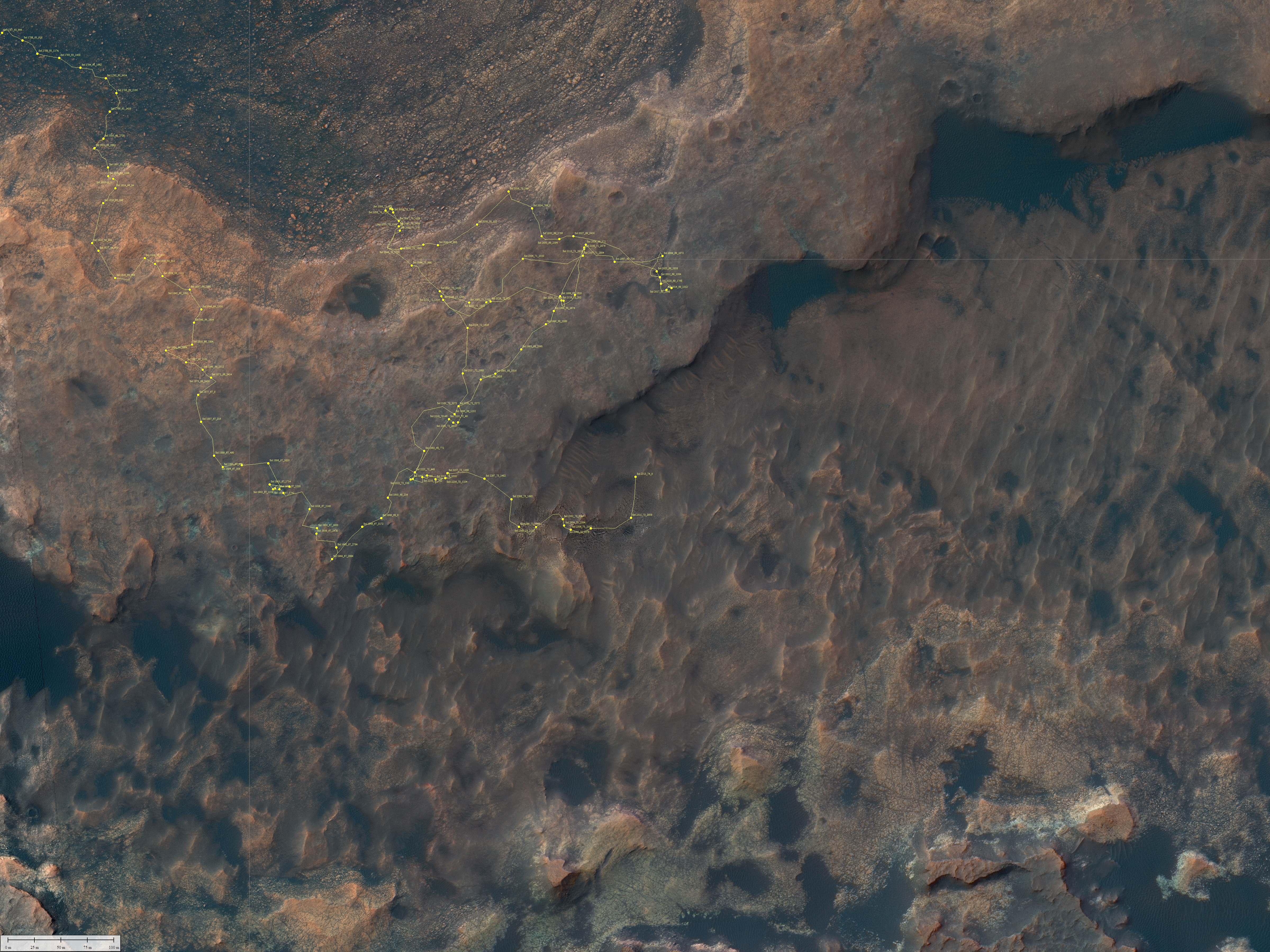
Cool image time! The panorama above, created from three photos taken on May 15, 2022 by the right navigation camera on Curiosity, shows the rocky and hilly terrain directly ahead of the rover’s present course. In the far distance in the center left can faintly be seen the lower flanks of Mount Sharp itself. The dust in the winter air acts to partly obscure those distant slopes.

The overview map to the right shows us what we are looking at. The yellow lines are my rough guess at the terrain covered by the panorama. The blue dot marks Curiosity’s present position. The red dotted line the rover’s original planned route. The white arrows indicate one of the more interesting upcoming geological features, dubbed by scientists the “marker horizon,” a distinct layer found in many places on the flanks of Mount Sharp.

The green dot marks the approximate location of a recurring slope lineae, a place where the cliff is seasonally darkened by a streak that appears each spring and then fades.

The navigation panorama taken on May 15th also included four more shots covering terrain to the southwest, so what we see above is not necessarily where the rover is heading. The eventual goal is to get back to that red dotted line, but how the rover does so is apparently still being discussed by the science team. It appears they are trying to decide whether to head west again to reach Gediz Vallis Ridge, or instead cut south heading directly for Gediz Vallis.

Either way, that teethlike row of boulders in the near foreground is certainly impressive.

2 comments

Elon Musk gives another tour of Starbase

Tim Dodd of Everyday Astronaut has posted another 44 minute long interview with Elon Musk that took place as Musk gave him a recent tour at Boca Chica, walking around the base of the Starship and Superheavy boosters being prepared for that first orbital launch.

I have embedded the interview below. It has the following interesting take-aways:

  • In describing their decision to eliminate completely a separate attitude thrust system for Starship and instead use the fuels in the main tanks using controllable vents, Musk once again demonstrated his engineering philosophy that “the best part is no part.”
  • The company is definitely planning to test the deployment of some Starlink satellites on that first orbital test flight.
  • Musk once again emphasized that there is a high expectation that this first orbital flight will fail, but they are unbothered by this because this first ship is considered a prototype anyway that must be redesigned. Whether it completes its flight or not, the flight will tell them what needs to be done for future iterations.
  • They are aiming with Starship to reduce to cost to bring a ton to the surface of Mars from $1 billion to $100K. Musk called this improvement “insane” but entirely possible.
  • Musk also noted how the design of Starship is not like a plane, which wants to develop lift. Starship instead is designed to fall, but do so as “draggy” as possible. The goal is to shed as much velocity as possible, as soon as possible.

Dodd also notes this video is the first of a new series.
» Read more

15 comments

Study: Russian astronauts on ISS have better techniques for protecting the brain

According to a study comparing the changes in the brain experienced during long term missions on ISS, it appears that the Russians have developed better protocols for preparing themselves for return to Earth that prevents the enlargement in one part of the brain seen in American astronauts.

From the link:

The study focused on 24 Americans, 13 Russians, and a small, unspecified number of astronauts from the ESA. The researchers collected MRI scans of the astronauts’ brains before and after they spent six months on the ISS (only 256 individuals have visited the space station).

After being in space, all the space travelers exhibited similar brain changes: cerebrospinal fluid buildup and reduced space between the brain and the surrounding membrane at the top of the head. The Americans, however, also had more enlargement in the regions of the brain that serve as a cleaning system during sleep, e.g. the perivascular space (PVS).

…The Russian astronauts did not exhibit enlarged PVS, suggesting there might be differences in protocol that are neuro-protective.

From the paper itself:

[Russian C]osmonauts undergo six lower body negative pressure (LBNP) sessions starting two weeks prior to landing, while NASA and ESA astronauts do not typically do it. LBNP induces caudal displacement of fluids from the upper body by placing the legs and pelvis in a semiairtight chamber with negative pressure.

An advanced resistive exercise device (ARED) is regularly used by space flyers to perform free weight exercises on the ISS, but the load and frequency of use are lower for [Russian] cosmonauts compared with NASA and ESA astronauts. Lifting heavy loads during resistive exercise is often accompanied by a brief Valsalva maneuver, inducing increased ICP and decreased cerebral blood flow and cerebrovascular transmural pressure, which can result in PVS fluid accumulation. Although the effects of LBNP and ARED on the brain during spaceflight are unknown, they could partly explain the different WM-PVS changes detected in astronauts and cosmonauts. We cannot exclude that other factors (e.g., diet) might play a role in this difference. Further studies are required to confirm these hypotheses.

Apparently two protocols are different that seem to help the Russians. First, the LBNP, developed by the Russians on their earlier space stations, is essentially a pair of pants that sucks fluids down to the legs, simulating the situation normally found on Earth, and thus reduces the fluids in the upper body sooner than landing. Second, doing exercises simulating lower weight loads apparently helps the Russians as well.

3 comments

ISRO successfully tests human-rated solid rocket booster

India’s space agency ISRO announced on May 13, 2022 that it had successfully tested the man-rated version of the solid rocket strap-on booster used on its GSLV Mark 3 rocket that will launch its first manned mission into space.

The 20 m long and 3.2 m diameter booster is the world’s second-largest operational booster with solid propellant. During this test, about 700 parameters were monitored and the performance of all the systems was normal.

Launch of the Gaganyaan manned mission is now targeting ’23.

2 comments

FAA approves Huntsville airport as landing site for Dream Chaser

Capitalism in space: The FAA announced on May 13, 2022 that it has approved use of Huntsville International airport for landing Sierra Space’s reusable Dream Chaser cargo mini-shuttle, once it begins flying.

The approval covers “up to eight reentry operations at the airport from 2023 to 2027.” Though Sierra Space will still need to get its launch license from the FAA before those flights can happen, it looks like the company is finally getting close to the first flight of Tenacity, its first Dream Chaser ship.

13 comments

SpaceX launches 53 Starlink satellites on a new Falcon 9 rocket

Capitalism in space: SpaceX today successfully launched another 53 Starlink satellites, the company’s second launch in less than 24 hours.

The most newsworthy component of this launch is that for first time since February 2, 2022, and only the fourth time since the beginning of 2020, the Falcon 9 rocket used a new first stage, which successfully landed on its drone ship in the Atlantic. It appears that SpaceX is adding about two new boosters per year to its first stage fleet, based on the evidence from these launches.

The leaders in the 2022 launch race:

20 SpaceX
15 China
6 Russia
3 Rocket Lab
2 ULA

The U.S. now leads China 28 to 15 in the national rankings, and the entire world combined 28 to 24.

17 comments
1 480 481 482 483 484 1,327