Russians launch weather satellite and 42 smallsats

Russians today successfully launched a Russian weather satellite plus 42 smallsats on a Soyuz-2 rocket, lifting off from Vostochny in Russia’s far east.

Almost all of the secondary payloads were Russian. The one exception known was a demo cubesat from the United Arab Emirates (UAE), apparently built by its own engineers and flown to test their growing capabilities. Previous UAE satellites and probes have previously been built by others and used to train UAE engineers.

The leaders in the 2023 launch race:

43 SpaceX
24 China
9 Russia
5 Rocket Lab

American private enterprise now leads China in successful launches 49 to 24 in the national rankings, and the entire world combined 49 to 41, with SpaceX by itself still leading the rest of the world, excluding other American companies, 43 to 41.

0 comments

A northern lowland ice sheet on Mars?

A northern lowland ice sheet on Mars?
Click for original image.

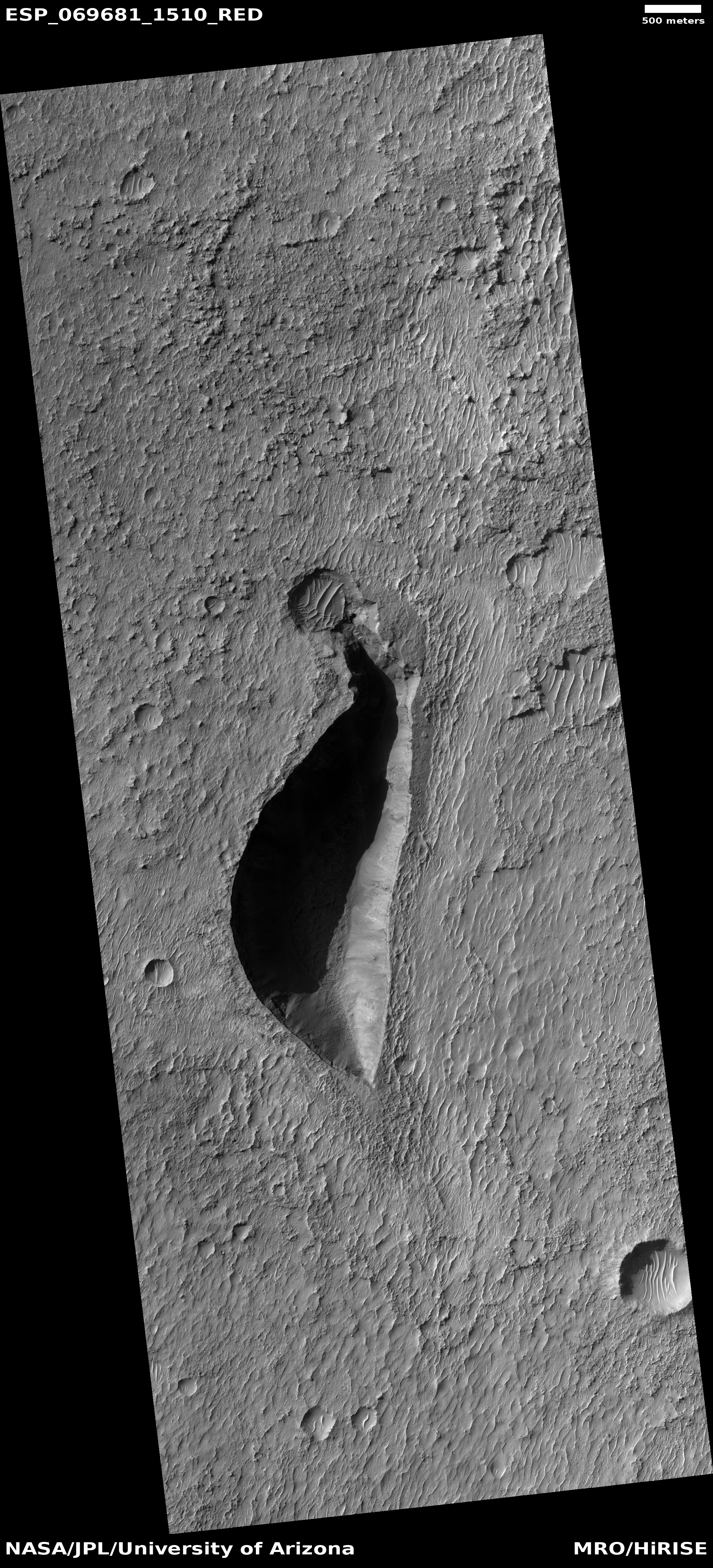
Cool image time. The picture to the right, cropped to post here, was taken on March 14, 2023 by the high resolution camera on Mars Reconnaissance Orbiter (MRO). Dubbed simply a “terrain sample,” this image was likely taken not as part of any specific research project, but to fill a gap in the camera’s schedule in order to maintain its temperature by taking regular images. When the camera team needs to do this, they try to find interesting locations not previously photographed. Sometimes the photos turn out somewhat boring. Most of the time however they capture something very intriguing.

In this case, the intriguing feature of this picture is its stippled surface that seems to overlay a relatively flat surface underneath, with some faint covered craters visible. On top are several more recent craters that suggest either the impact landed in very soft material, thus producing little ejecta and no crater rims or the craters are not craters but sinks, places where the ground is subsiding due to some underground process.
» Read more

0 comments

Japan’s military tests using Starlink for communications

Japan’s Self-Defense Forces (SDF) have been testing since March the use of SpaceX’s Starlink constellation to augment that nation’s own geosynchronous communications satellites.

Japan’s Defense Ministry signed a contract with an agent that provides SpaceX’s services to equip units of the Air, Ground and Maritime SDF with Starlink antennas and other communication devices. The SDF has been using the service at about 10 locations, including bases and camps, to verify whether there are any operational issues.

The ministry currently has two of its own X-band communication satellites in geostationary orbit about 36,000 kilometers above Earth for SDF units to use. The Starlink deal marks the first time the SDF is using a private-sector satellite constellation in low orbit.

An agreement with another company that provides a similar service will be concluded during the current fiscal year. [emphasis mine]

The goal is to provide Japan redundant communications capabilities in case China or Russia — both of which have become more aggressive militarily in the past few years — attempt to take out its own satellites. The highlighted sentence strongly suggests a deal with OneWeb is also being negotiated.

4 comments

Webb makes first detection of one particular carbon molecule

The uncertainty of science: Using the Webb Space Telescope, astronomers have made the first detection of methyl cation (pronounced cat-eye-on) (CH3+) in space, located in a baby solar system the star-forming region of the Orion nebula about 1,350 light years away.

While the star in d203-506 is a small red dwarf, the system is bombarded by strong ultraviolet (UV) light from nearby hot, young, massive stars. Scientists believe that most planet-forming disks go through a period of such intense UV radiation, since stars tend to form in groups that often include massive, UV-producing stars.

Typically, UV radiation is expected to destroy complex organic molecules, in which case the discovery of CH3+ might seem to be a surprise. However, the team predicts that UV radiation might actually provide the necessary source of energy for CH3+ to form in the first place. Once formed, it then promotes additional chemical reactions to build more complex carbon molecules.

Broadly, the team notes that the molecules they see in d203-506 are quite different from typical protoplanetary disks. In particular, they could not detect any signs of water. [emphasis mine]

In the next day or so we shall likely see a number of stories in the mainstream press shouting some variation of “Webb finds key element of life!” Webb has done no such thing. It has found a carbon molecule not seen previously, which simply provides scientists another small data point in trying to understand the development of complex solar systems.

The highlighted sentences make clear the uncertainty in this field and the general shallow amount of knowledge. For example, why carbon molecules but no water, which is made up of hydrogen and oxygen, both ubiquitous throughout the universe and found in large amounts in star-forming regions?

5 comments

Real pushback: Thirteen university-run child mutilation clinics to shut down this year

Owned for the purpose of mutilation and castration
Up to now, government-controlled apparently to allow their
mutilation and castration

Bring a gun to a knife fight: Because of pressure from state legislatures, up to thirteen university-run child mutilation clinics — falsely called “gender-affirming clinics” — are to shut down before the end of this year, with more shut downs likely next year as well.

Up to 13 pediatric gender clinics at university hospitals could close or scale back by the end of the year, as a result of Republican-led states restricting doctors from removing healthy organs or injecting hormones into minors who are confused about their gender.

In some cases, university youth gender clinics have already scaled back their operations as a result of state law. Litigation against the legislation could slow down or stop some clinics from closing. However, some are being closed while litigation proceeds.

The closures represent a quick change from just a year ago when The College Fix identified at least thirteen Republican-led states that funded pediatric gender clinics through universities, including Oklahoma, Florida and West Virginia.

» Read more

6 comments

Determining whether a Martian crater is impact or volcanic

Determining whether a Martian crater is impact or volcanic
Click for original image.

Overview map

Cool image time! The picture above, rotated, cropped, reduced, and sharpened to post here, was taken on March 22, 2023 by the high resolution camera on Mars Reconnaissance Orbiter (MRO). The camera team labeled this “Crater rim and ejecta,” which subtly reveals the picture’s scientific purpose.

The white dot on the overview map to the right indicates the location of this 15-mile-wide unnamed crater, about 150 miles northwest of where the rover Opportunity landed and traveled south to the rim of Endeavour Crater. It also shows in the inset that the crater appears to sit in the center of an upraised mound, suggesting it was formed not by impact but by volcanic processes.

This picture however says otherwise. The many small mounds and mesas to the south of the crater rim are not what one would expect on the apron of a volcano. Instead, they suggest this crater is an impact, with those mounds the eroded ejecta from that impact, now also partly buried by dust. This hypothesis is strengthened by the data from Opportunity, which found a great deal of impact ejecta during its travels, possibly from the very event that created this crater.

6 comments

Rocket Lab to attempt full recovery of first stage on next launch

In announcing the launch window, opening July 14th, for its next New Zealand launch, Rocket Lab also revealed that it will attempt the full recovery of the first stage after it splashes down softly in the ocean using parachutes.

Rocket Lab is also planning to conduct a marine recovery of Electron’s first stage as part of this mission. Rocket Lab’s recovery team will retrieve Electron using a customized vessel and transport the stage back to Rocket Lab’s production complex for analysis. Data from this recovered stage will inform Rocket Lab’s ongoing recovery and reuse program.

The company recently decided to forego any further attempts to snatch the first stage in the air before splashdown using a helicopter. Instead, it thinks it can recover the stage in good enough condition out of the water to use it or its engines again.

The launch itself will carry seven smallsats, four for NASA and three for two commercial companies.

0 comments

House Democrats propose and Republicans approve Space Force increasing spaceport fees

We’re here to help you! The House Armed Services Committee, controlled by a majority of Republicans, has approved a defense funding bill that includes an amendment, proposed by a Democrat, that would allow the Space Force to charge much larger fees for the use of its spaceports.

Committee members signed off on the legislation June 22, which proposes $874 billion in defense spending. The full House is slated to vote on the bill in July. Included in the bill is an amendment offered by Rep. Salud Carbajal, D-Calif., that would allow the Space Force to collect fees from companies for the indirect costs of using the military’s launch ranges, like overhead infrastructure or other charges that a traditional port authority might impose on its users.

Today, per the Commercial Space Launch Act of 1984, the service is limited to collecting fees for direct costs like electricity at a launch pad. The law also restricts the Space Force from accepting in-kind contributions from commercial companies to upgrade its ranges.

The committee’s bill, if approved, would require commercial launch companies to “reimburse the Department of Defense for such indirect costs as the Secretary concerned considers to be appropriate.”

The bill also includes a Republican amendment that encourages the Space Force to charge other additional fees, or require private companies to do work the Space Force is presently handles.

Though the latter amendment might make sense, both amendments will likely achieve just one thing: making it much more expensive to launch from Cape Canaveral and Vandenberg. Whether those increased costs will be kept as low as possible is entirely unknown. We certainly should not trust officials in the federal government to do so.

7 comments

Two ultraviolet images of Mars, taken six months apart

Mars in ultraviolet

The two images to the right, rearranged, cropped, and reduced to post here, were taken six months apart by the Mars orbiter MAVEN using its Imaging Ultraviolet Spectrograph (IUVS). From the press release:

The IUVS instrument measures wavelengths between 110 and 340 nanometers, outside the visible spectrum. To make these wavelengths visible to the human eye and easier to interpret, the images are rendered with the varying brightness levels of three ultraviolet wavelength ranges represented as red, green, and blue. In this color scheme, atmospheric ozone appears purple, while clouds and hazes appear white or blue. The surface can appear tan or green, depending on how the images have been optimized to increase contrast and show detail.

The first image [top] was taken in July 2022 during the southern hemisphere’s summer season, which occurs when Mars passes closet to the Sun. The summer season is caused by the tilt of the planet’s rotational axis, similar to seasons on Earth. Argyre Basin, one of Mars’ deepest craters, appears at bottom left filled with atmospheric haze (depicted here as pale pink). The deep canyons of Valles Marineris appear at top left filled with clouds (colored tan in this image). The southern polar ice cap is visible at bottom in white, shrinking from the relative warmth of summer. Southern summer warming and dust storms drive water vapor to very high altitudes, explaining MAVEN’s discovery of enhanced hydrogen loss from Mars at this time of year.

The second image [bottom] is of Mars’ northern hemisphere and was taken in January 2023 after Mars had passed the farthest point in its orbit from the Sun. The rapidly changing seasons in the north polar region cause an abundance of white clouds. The deep canyons of Valles Marineris can be seen in tan at lower left, along with many craters. Ozone, which appears magenta in this UV view, has built up during the northern winter’s chilly polar nights. It is then destroyed in northern spring by chemical reactions with water vapor, which is restricted to low altitudes of the atmosphere at this time of year.

Though of course not visible, the landing sites for Viking-1 (1976), Pathfinder (1997), and Franklin (2028) are captured in the bottom global image, as indicated by the white dots I have added. The two left dots are Viking-1 and Pathfinder respectively, located in the northern lowland plain dubbed Chryse Planitia. Franklin will land to the right, in the transition zone between those northern lowland plains and the southern cratered highlands.

1 comment

Ariane-6 engineering test rocket at launchpad for engine tests

Ariane-6 test version at launchpad
Click for original image.

An engineering test version of ArianeGroup’s Ariane-6 rocket has arrived at the launchpad in French Guiana, where it will undergo a series of static fire engine and fueling tests.

As seen in this image [to the right] taken on 22 June 2023, the doors of this mobile gantry have been opened and the structure rolled back on rails. The operation, which takes about half an hour, was a trial run in preparation for a series test firings of the Vulcain 2.1 engine. These test firings will be conducted on the launch pad as part of ongoing preparations for the first-ever flight of Ariane 6. Removing the gantry for the first time – and then returning it – also helped validate the Ariane 6 ground infrastructure.

The Ariane 6 rocket visible here is not intended for flight. It is being used to check assembly procedures, electrical and fuel connections, telemetry, etc. Flight models, including the rocket that will make Ariane 6’s inaugural flight, are being built in Europe and integrated by prime contractor Ariane Group. After shipping to French Guiana, Ariane 6 core and upper stages are assembled horizontally, before being transferred to the launch pad and lifted upright inside the gantry, where the solid-fuel boosters and payload are attached. The horizontal assembly method cuts the time and cost of a launch campaign, and is a first for an Ariane rocket.

With only one Ariane-5 rocket launch left on its manifest, the European Space Agency desperately needs to get Ariane-6 off the ground and operational. It was originally supposed to make its first launch in 2020, thus overlapping the final launches of Ariane-5 by several years. At this moment it appears there will be a gap between when one rocket retires and the other begins flying.

0 comments

SpaceX launches 56 more Starlink satellites

SpaceX this morning successfully launched another 56 Starlink satellites, with its Falcon 9 rocket lifting off from Cape Canaveral.

The first stage completed its eighth flight, landing on its drone ship in the Atlantic. The fairing halves completed their 7th and 10th flights, with the latter a new record.

The leaders in the 2023 launch race remain the same:

43 SpaceX
24 China
8 Russia
5 Rocket Lab

American private enterprise now leads China in successful launches 49 to 24 in the national rankings, and the entire world combined 49 to 40, with SpaceX by itself still leading the rest of the world, excluding other American companies, 43 to 40.

0 comments
1 444 445 446 447 448 2,413