Sunspot update: The Sun rages on

Time for my monthly sunspot cycle update, where I take NOAA’s monthly graph showing the long term trends in the Sun’s sunspot activity, and annotate it with additional data to provide some context.

The trend of sunspot activity exceeding the predictions continued in February. While the increase in activity from January still left it less than the activity in December, the total number of sunspots is still far above the number predicted by NOAA’s panel of solar scientists in 2020, with the rise towards a solar maximum also much steeper and far faster than predicted.
» Read more

2 comments

Sunspot Update: The Sun quiets down, but just a little

With the posting yesterday by NOAA of its monthly update to its graph showing the long term trends in the Sun’s sunspot activity, it is time for me to do my own update, showing this graph below with annotations in order to provide some context.

While sunspot activity dropped slightly in January, the activity still remained well above the prediction made by NOAA’s panel of solar scientists in 2020, with the upward trend towards a solar maximum much steeper than predicted as well.
» Read more

5 comments

Sunspot update: The Sun blasts off!

Over the weekend NOAA posted its monthly update to its graph showing the long term trends in the Sun’s sunspot activity. As I do every month, I have posted that graph below, annotated to show the previous solar cycle predictions and thus provide context.

In December the Sun’s sunspot activity not only continued the pattern of the past two years — whereby sunspot activity has consistently exceeded the prediction of NOAA’s solar scientist panel — the amount of activity shot up like a rocket. December 2021 saw the most sunspots in a single month since September 2015, when the Sun was about a third of the way into its ramp down from the solar maximum in 2014.

» Read more

15 comments

Sunspot update: Sun continues to be more active than predicted

Time for our monthly sunspot update, using NOAA’s most recent monthly graph of sunspot activity. That graph is below, annotated to show the previous solar cycle predictions and thus provide context. It covers all activity through the month of November.

The pattern for the past two years since the end of the solar minimum continues, with sunspot activity consistently exceeding the prediction of NOAA’s panel of solar scientists, as indicated by the red curve. The activity in November dropped very slightly from October, but remained more active than the prediction.

» Read more

14 comments

Sunspot update: tiny uptick in March activity

UPDATE: In doing some analysis and prep work for future updates, I have discovered that the graph below is in error in its placement of the prediction for the next solar maximum in 2025. I have revised the graph below to note the error. On April 6, 2020 I posted an updated graph.

My original post:
—————————
This week NOAA unveiled a major revamping of the graph it has used for the past decade-plus to show the monthly progression of the sunspot cycle, and that I have been using since the start of this website to do my monthly sunspot updates.

Overall they did a very nice job. The new graph not only shows the present state of the cycle, but it allows you to zoom in or out on this cycle as well as all sunspot cycles going back to 1750, about the time the sunspot cycle was first recognized and the sunspot count became reliable.

The new graph also includes a new more precise prediction for the upcoming solar cycle, forecasting the peak in 2025, higher than the weak solar maximum that has just passed. I have taken the old graph (see my last update on March 12, 2020) and revised it to place this new prediction in context with the previous cycle. I have also added the March sunspot numbers to it.
» Read more

12 comments

Sunspot update: The flatline resumes

NOAA this week released its February update of its monthly graph showing the long term sunspot activity of the Sun. Below is my monthly version, annotated as I have done every month since 2011.

After a tiny uptick in sunspot activity in January, the Sun resumed the unprecedented flatlining of sunspot activity that began last June. Since then, the Sun has produced practically no sunspots, a drought that as far as I can tell has never happened since the 11-year sunspot cycle resumed in the 1700s (after the grand minimum in the 1600s) and astronomers began counting sunspots.
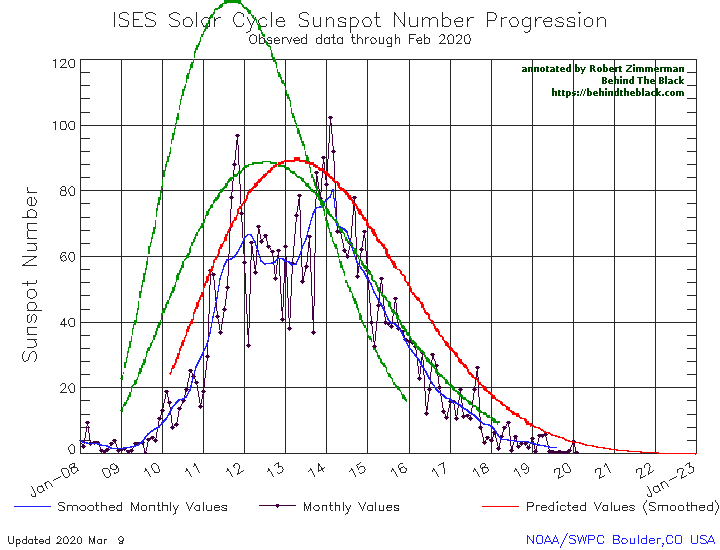
February 2020 sunspot activity
The graph above has been modified to show the predictions of the solar science community for the previous solar maximum. The green curves show the community’s two original predictions from April 2007, with half the scientists predicting a very strong maximum and half predicting a weak one. The red curve is their revised May 2009 prediction, extended in November 2018 four years into the future.

February saw only one sunspot, and it belonged to the old solar cycle. It also occurred at the beginning of the month, and was followed by 33-day streak of blankness, into the middle of March, when a sunspot from the new cycle appeared and quickly faded.

The continuing overall lack of sunspots, from either the old or new cycle, does not mean that we are entering a new grand minimum, with no sunspots for decades (though some scientists believe we are). It does suggest however that the next solar maximum will be weak, and very likely weaker than the very weak maximum that just ended.

Why the Sun does this remains a mystery. Scientists really have no fundamental understanding of the magnetic processes that produce the Sun’s sunspot cycles. And since that cycle appears to have some effect on the Earth’s climate, it also means scientists do not yet have a fundamental understanding of the climate either.

Not that this lack of knowledge matters anymore. We are in an age of panic and certainty, based on emotion and feelings. All that matters is that many people feel they understand the climate and how the Sun works, just as everyone is sure that COVID-19 will destroy the world if we don’t shut down all human activity.

They are certain, and any additional data that illustrates that certainty is unwarranted is irrelevant and must be ignored.

Certainty however is a very dangerous thing. The universe is always more complicated than we know, and to assume we now understand all without doubt leaves us very vulnerable to some bad surprises, as well as the chance we will take actions that are foolish, inappropriate, and even downright evil.

14 comments

The terrible consequences of NOAA’s data tampering

Link here.

In 2017 Tony Heller broke the story of how NOAA and NASA have been routinely adjusting their historic global temperature records to cool the past and warm the present in order to create the illusion that the climate is warming, far more than it is.

The post by Heller at the link above focuses in on how that tampering, which erased from the temperature data the record-hot year of 1934, is then used by both NOAA and NASA to claim each year for the past decade was the hottest ever.

The raw data however tells a far different story. The raw data from 1934, as reported amply at the time, recorded big heat waves and murderous droughts and extensive dust storms, all far more extreme than anything we have experienced in the past decade. Moreover, that raw data matches well with public news stories, and also matches well with all the published science prior to the 2000s.

Since then, however, intellectual honesty and the real scientific method has been replaced by an agenda-driven political manipulations. Having 1934 be the hottest year ever cannot stand, especially if present temperatures do not exceed that year’s records. Global warming demands a correction!

The nicest interpretation we can give to these adjustments is that the scientists are innocently engaged in confirmation bias. They believe the Earth is warming due to increased carbon dioxide in the atmosphere, and thus they must find evidence of that warming, even if it requires data adjustments to past record-hot years like 1934, adjustments that they then rationalize as necessary and scientifically justified.

More likely, they have decided that their political agenda to prove human-caused global warming requires them to be intellectually dishonest and the falsify the global temperature record. If so, this is a tragedy beyond words, as it signals that the revolution in human thought that began with the Renaissance and Galileo and was reinforced and cemented by the Enlightenment and Francis Bacon, has now ended.

That revolution made possible a burst of human creativity and civilization that lasted more than five hundred years. The consequences for future generations should that revolution be rejected now cannot be good.

18 comments

No trend in hurricanes since 1970

The uncertainty of science: A new study has found no trend, up or down, in hurricanes that made landfall since the 1970s, despite many global warming predictions that said the numbers of catastrophic hurricanes would increase.

Key quote:

There are a lot of ups and downs in the data, but no obvious trends.

The scientists note that though they see no obvious trends, it is difficult to pin anything down because the variability from year to year is so great.

That large variability in occurrence means – as a simple matter of mathematics – that our ability to detect changes in tropical cyclones one or two magnitudes smaller (or more) on similar time scales is obviously made difficult, if not impossible.

So, when next you hear a global warming expert, either a teenager not attending school or a Democratic politician who doesn’t remember anything from school, claiming we are all going to die from giant hurricanes caused by human-caused global warming, remember this study. It demonstrates that those “experts” have no idea what they are talking about.

38 comments

Arsonists the cause of most of Australia’s bushfires

It ain’t climate change: Police in Australia have arrested almost two hundred arsonists, suspected of the causing the bulk of the bushfires that have been sweeping the country.

Thus the cause is not global warming, an absurd claim that has been made repeatedly over the past few months by various climate scientists who in their spare time make their livings as either actors or activists. As noted in the article at the link:

Melbourne University Professor Janet Stanley, quoted in the Australian, said that the arsonists were typically young males aged 12 to 24 or older men in their 60s – generally from an unsettled background. She said, “They are often kids not succeeding in school, or they have left school early and are unemployed. The boundaries between accidentally and purposefully are unclear because many arsonists don’t plan on causing the catastrophe that occurs. Often there is not an intention to cause chaos and the penalties for accidentally lighting a fire are far less than purposefully lighting a fire.”

What is especially sad is that these actors and celebrities expect us to take them seriously, when it is very clear they haven’t faintest idea what they are talking about. Worse, news outlets seem to think their ignorant opinions are worth reporting, as if they carry real weight in the discussion.

Think about it. Why should any adult give any credence to the opinions of a teen-age girl about the science of climate when she is intentionally not attending school and therefore is intentionally not getting educated? No adult should. That so many do, including many politicians (who also known nothing about the subject), speaks volumes about the decay and childishness of our culture today.

21 comments

No warming in U.S. since 2005

NOAA data since 2005
Click for full image.

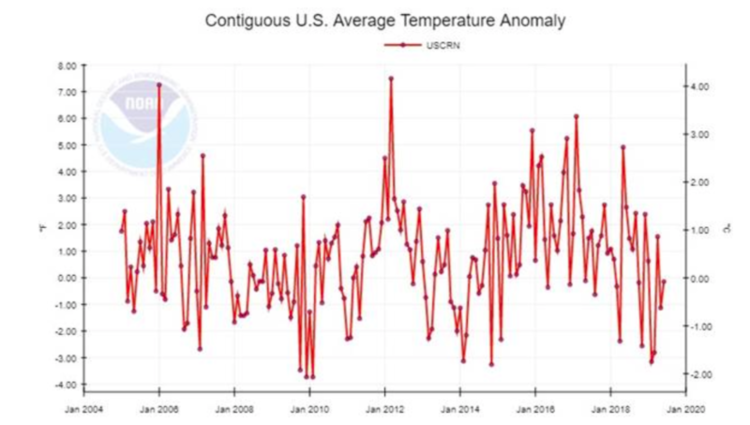
Using temperature stations specifically picked to eliminate as many biases and temperature errors as possible, NOAA has found that since 2005 the continental United States has experienced no warming at all.

The graph at the right, reduced to post here, illustrates this.

In January 2005, NOAA began recording temperatures at its newly built U.S. Climate Reference Network (USCRN). USCRN includes 114 pristinely maintained temperature stations spaced relatively uniformly across the lower 48 states. NOAA selected locations that were far away from urban and land-development impacts that might artificially taint temperature readings.

Prior to the USCRN going online, alarmists and skeptics sparred over the accuracy of reported temperature data. With most preexisting temperature stations located in or near urban settings that are subject to false temperature signals and create their own microclimates that change over time, government officials performed many often-controversial adjustments to the raw temperature data. Skeptics of an asserted climate crisis pointed out that most of the reported warming in the United States was non-existent in the raw temperature data, but was added to the record by government officials.

The USCRN has eliminated the need to rely on, and adjust the data from, outdated temperature stations. Strikingly, as shown in the graph below, USCRN temperature stations show no warming since 2005 when the network went online. If anything, U.S. temperatures are now slightly cooler than they were 14 years ago.

What is significant about this data is how it reveals the dishonesty of the adjustments that NOAA and NASA have been making to the temperature data. Those adjustments, supposedly done to make the data more accurate, have always cooled the past and warmed the present, a pattern that by itself is very suspicious.

These temperature stations were chosen to create a reliable baseline, picking stations that needed no adjustment and would thus give scientists a measure for justifying any alterations they impose on the raw data. Not only does this data suggest strongly that the claims of global warming year after year (“This year was the hottest on record!”) are suspect, it also shows that there is something seriously wrong with their adjustments. If their modifications to the raw data was correct, then this set of data should have matched it. It does not.

Will this mean they will readjust the overall data to eliminate the cooling in the past and the warming in the near present to make the data better fit what these results prove? Don’t be silly! That would show that there is little merit to the theories of the global warming alarmists, something that cannot be tolerated. It might cause those big government contracts to be cancelled. Worse, it will make it more difficult for these leftists to use the data to justify reshaping society into their vision of a socialist utopia.

No, what I expect to happen is that the scientists at NOAA (who also happen to be the ones who have been tampering with all the other data) to begin altering the temperature data from these baseline stations, to make them fit their theories. Or as Democratic presidential candidate Joe Biden recently put it, “We choose truth over facts.”

27 comments

Global warming must be happening! A politician declares it!

Stop the presses! Expert climate scientist and former New York City mayor Michael Bloomberg has used his extensive scientific research to determine, without a doubt, that the polar vortex that is presently freezing most of the country in record cold temperatures is unequivocally the result of global warming!

“The science is clear: Climate change makes extreme weather more frequent and more intense,” tweeted Mr. Bloomberg. “Americans are seeing this first hand from wildfires to hurricanes to the #PolarVortex in the Midwest. We need a climate champion in the WH who can lead us forward.”

I always go to politicians to get my science information. Don’t you? And in doing so, I immediately dismiss other details, such as the fact that the recent wildfires in California is mostly due to bad policy in clearing brush by California and the federal government, that there is no evidence of an increase hurricanes activity, and that back in the 1970s scientists linked the polar vortex to global cooling.

None of that actual data matters. A politician has spoken, and his word is always reliable. Moreover, this is a liberal politician, whose word is even more reliable, because he cares.

Finally, and maybe most important, he did this on twitter, that icon of thoughtful analysis and deep complex thought.

We should immediately shut down all fossil fuel operations, even if it means there will be no way to heat homes across most of the country and people will freeze to death. The world is being destroyed by those fuels, and we must save it!

17 comments

Sunspot activity continues to drop

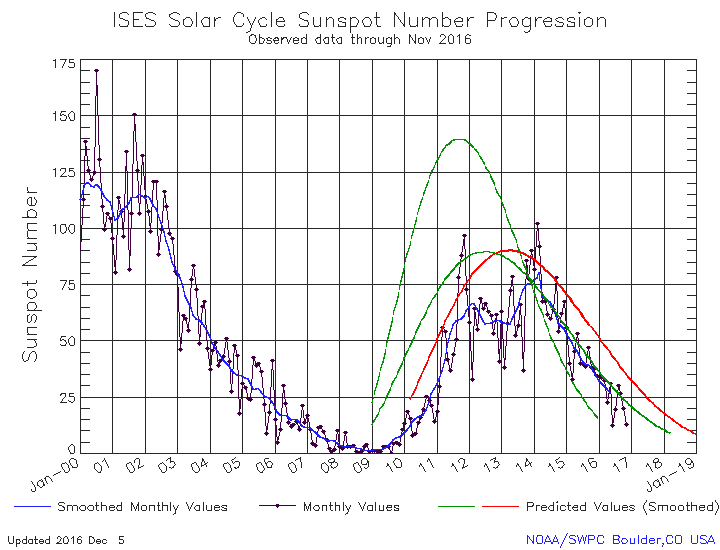
NOAA yesterday posted its monthly update of the solar cycle, covering sunspot activity for November. Below is my monthly annotated version of that update.

November 2016 Solar Cycle graph

The graph above has been modified to show the predictions of the solar science community. The green curves show the community’s two original predictions from April 2007, with half the scientists predicting a very strong maximum and half predicting a weak one. The red curve is their revised May 2009 prediction.

In November sunspot activity dropped again, to the second lowest point seen since 2010. Essentially, activity today is about where it was in 2010 when the solar minimum was finally ending. Now, the solar maximum is ending and we are beginning the next solar minimum.

Throughout the entire just completed solar maximum, the Sun continuously under-performed all predictions. Even now, despite following almost precisely the prediction of the 2007 low prediction during 2014 and 2015, in 2016 the ramp down has begun to slip below that prediction. The trend continues to suggest the arrival of solar minimum will be early, possibly as early as sometime late next year.

2 comments

New evidence of lakes and streams in Mars’ recent past

Using data from three different orbiters scientists have mapped out a region of lakes and streams on Mars that appear to have contained liquid water a billion years after the red planet is believed to have dried up.

To bracket the time period when the fresh shallow valleys in Arabia Terra formed, scientists started with age estimates for 22 impact craters in the area. They assessed whether or not the valleys carved into the blankets of surrounding debris ejected from the craters, as an indicator of whether the valleys are older or younger than the craters. They concluded that this fairly wet period on Mars likely occurred between two and three billion years ago, long after it is generally thought that most of Mars’ original atmosphere had been lost and most of the remaining water on the planet had frozen.

The characteristics of the valleys support the interpretation that the climate was cold: “The rate at which water flowed through these valleys is consistent with runoff from melting snow,” Wilson said, “These weren’t rushing rivers. They have simple drainage patterns and did not form deep or complex systems like the ancient valley networks from early Mars.”

This region, Arabia Terra, is the same area where scientists have found fossilized rivers.

0 comments

Top scientists to review data adjustments of temperature data

The uncertainty of science? A panel of five scientists has been formed to review the adjustments to the global temperature data at NOAA and the Goddard Institute of Space Studies (GISS) that have consistently cooled the past but warmed the present, thus creating the illusion of more warming than the raw data suggests.

Careful analysts have come up with hundreds of examples of how the original data recorded by 3,000-odd weather stations has been “adjusted”, to exaggerate the degree to which the Earth has actually been warming. Figures from earlier decades have repeatedly been adjusted downwards and more recent data adjusted upwards, to show the Earth having warmed much more dramatically than the original data justified.

So strong is the evidence that all this calls for proper investigation that my articles have now brought a heavyweight response. The Global Warming Policy Foundation (GWPF) has enlisted an international team of five distinguished scientists to carry out a full inquiry into just how far these manipulations of the data may have distorted our picture of what is really happening to global temperatures.

The global warming scientists at NOAA and GISS are finally going to challenged to explain their adjustments, something they have so far refused to do. For my part, I will be very surprised if they can come up with a scientifically justified explanation.

7 comments

Global Warming advocates debunk their own theory

Climate models vs climate reality

The statements and data provided by advocates of human-caused global warming themselves provide strong evidence that their theory of human-caused global warming is wrong.

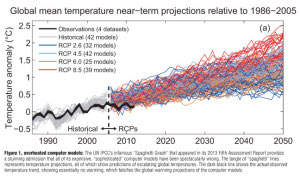
The article is detailed and includes a lot of hard but easy-to-digest data, such as the graph on the right, which shows how all the computer models predicting global warming have failed to predict the lack of warming for the past eighteen years. (The models predicted the rising colored lines. Actual global temperatures are shown by the black line.) This quote however is a nice summation:

Allow us to cite one more example out of many that could be brought to bear. On June 6, 2007, the New Zealand Climate Science Coalition published an analysis of seasonal climate predictions made by the New Zealand Institute of Water and Atmospheric Research (NIWA) showing that the Institute did not even achieve 50 percent accuracy. Director Dr. Jim Renwick’s response was telling. “Climate prediction is hard, half of the variability in the climate system is not predictable, so we don’t expect to do terrifically well,” he told the New Zealand Herald. Dr. Renwick, who is an IPCC lead author and a member of the UN’s World Meteorological Organization (WMO) Commission for Climatology Expert Team on Seasonal Forecasting, stated on New Zealand Radio, “The weather is not predictable beyond a week or two.”

This is huge! Phil Jones, a top AGW guru, admits “we don’t know what natural variability is doing,” and Judith Curry says that the climate models are “imperfect and incomplete” and natural causes “dominate” human effects on global temperatures. And IPCC/WMO bigwig Jim Renwick concedes his organization’s climate predictions are wrong more than half the time — and they can’t predict the weather more than two weeks out. Yet, we are supposed to empower national and international politicians and bureaucrats to completely regulate, re-engineer, tax, and regiment human civilization on a planetary scale, based upon the same faulty computer models that have universally, spectacularly failed — over and over again.

I hate to say this, but it appears that the only “deniers of reality” we have in this debate are the political advocates of human-caused global warming, people like Barack Obama, Joe Biden, and Al Gore, who continue to refuse to recognize the reality that there has been no warming during the past eighteen years.

8 comments

El Niño has finally arrived, far weaker than predicted

The uncertainty of science: The periodic warm weather pattern called El Niño has finally arrived in the mid-equatorial Pacific Ocean, more than a year late and far weaker than predicted by scientists.

The announcement comes a year after forecasters first predicted that a major El Niño could be in the works. At the time, NOAA predicted a 50% chance that an El Niño could develop in the latter half of 2014. The agency also said the wind patterns that were driving water east across the Pacific were similar to those that occurred in the months leading up to the epic El Niño of 1997, which caught scientists by surprise and contributed to flooding, droughts and fires across multiple continents.

In the end, last year’s forecasts came up short, in part because the winds that were driving the system petered out. Researchers, who have been working to improve their forecasting models since 1997, are trying to figure out precisely what happened last year and why their models failed to capture it.

But remember, these same climate scientists are absolutely sure that their climate models can predict the temperature rise of the climate to within a degree one century hence. Yet, they have no idea why this El Niño turned out weak and late, even though it exhibited the same early features as the epic 1997 El Niño.

3 comments

A cold Pacific causing the lack of warming?

The uncertainty of science: Global warming scientists have concocted another explanation among dozens for the refusal of the climate to warm since 1998: a cold Pacific!

Where’s the heat? Greenhouse gases, particularly carbon dioxide, continue to be pumped into the atmosphere, but sometime around 1998, the rise in Earth’s average temperatures slowed, deviating from the rates predicted by models. Scientists have proposed that what some call “the pause” could be the result of a number of factors, including heat storage in deep ocean waters to unexpectedly high amounts of aerosols in the stratosphere helping deflect solar rays back into space. Now, a new study suggests that natural cycles in the Pacific Ocean are the culprit.

Since the end of last El Niño warming event of 1997 to 1998, the tropical Pacific Ocean has been in a relatively cool phase—strong enough to offset the warming created by greenhouse gas emissions. But, this is just a temporary balm: When the switch flips and the waters turn warm again, the researchers say, Earth will likely continue warming.

“What this study addresses is what’s better described as a false pause, or slowdown,” rather than a hiatus in warming, says climate scientist Michael Mann of Pennsylvania State University, University Park. Some climate change deniers have taken encouragement from the pause, saying they show warming predictions are flawed, but Mann, a co-author on the study, notes that “there have been various explanations for why [the slowdown is happening], none of which involve climate models being fundamentally wrong.” [emphasis mine]

Does no one at the journal Science notice the outright stupidity of the first two paragraphs above? In the first it is posited that all the climate heat we haven’t been seeing could be stored in the oceans. In the second it is posited that a cold Pacific Ocean has offset the warming, thus causing the lack of climate warming.

If the oceans are storing the extra heat, how is it possible for the Pacific to be unusually cold?

We should not be surprised by this stupidity, however. The third paragraph shows that Science is depending on Michael Mann for its climate expertise, a global warming activist who was exposed as a fake scientist, a fraud, and a dishonest corrupter of data in the climategate emails. That this journal still goes to him for his opinions tells us quite a lot about the lack of objectivity at Science. Their use of the word “denier” for scientists who raise questions about global warming also tells us that the journal hasn’t the faintest idea how science works. The very heart of the scientific method demands skepticism. To instead equate skeptics with those who deny the genocide committed by the Nazis suggests that much of the so-called science published by Science is not science but propaganda.

14 comments

Watching politics eat away at climate science

Two stories today today illustrate how the field of climate science is being destroyed by politics.

In the first, a leading climate skeptic chortles over the resignation of Rajendra Pachauri, the man who has headed the IPCC since 2002, who has stepped down because of allegations of sexual harassment by an employee at the institute he heads in New Delhi. In the second, Willie Wei-Hock Soon, a scientist who has published numerous peer-reviewed papers raising questions about global warming science, is attacked for not fully disclosing the sources of his income.

In both cases, the two sides in the global warming debate are using these allegations as ammunition to attack the believability of each side’s stance on the scientific question of global warming. And in both cases, the stories raise literally no questions about the science itself that each man advocated.

I admit that I have attacked Pachauri numerous times in the past, but each time it was because he demonstrated outright ignorance of the field of climate science or had been caught making significant scientific errors. His resignation here however has nothing to do with the science published in IPCC reports, and should not be used as fodder to criticize the theory of human-caused global warming.

Similarly, none of the articles in the mainstream science press about the allegations against Soon have raised a single question about his actual results. All they have done is attack him for not revealing all of his funding sources. His research itself still appears valid. That the largest science journals, Science and Nature, have published articles attacking Soon, with the Smithsonian now piling on as well, without presenting any evidence that he had falsified any of his work, illustrates how corrupt this field has become. The science for these major science journals no longer matters. All that matters is destroying someone who was apparently successful in bursting the balloon on some global warming science.

Until everyone stops playing this game and focuses instead on the data itself and what that data is really telling us, we will get no closer to truly understanding the climate of the Earth. And tragically, I see far too little effort in the climate field to do this.

7 comments

How scientists lose the average layman

Link here.

A superb essay. I have written about this myself numerable times, but sadly our modern elite intellectual society finds it somehow impossible to get the point, which Shaw sums up very well in his last paragraph:

The point of all this is simply to say that scientific conclusions change over the ages. Complicated things take time. But when you come out and start lecturing us – or worse, start telling us how the government should orient policy – based on your own favorite theory of the day while not yet proving it to a satisfactory degree (even to we simpletons) then you can expect some of us to push back and demand you show your work. And it’s not because the pastor told us to think that way on Sunday.

Read it all. It also illustrates quite well why increasingly the public does not trust scientists or journalists when it comes to hot button issues like climate change.

1 comment

The endless and all-compassing terrors of global warming

Want to know what scientists have predicted climate change will do to the Earth? Go to ClimateChangePredictions.org, where they keep a full list of every prediction they can find.

I especially like the category “Having it both ways,” where they list different predictions that insisted on opposite consequences. For example did you know that global warning is going to bring both “less rain” and “more rain”, Other predictions are equally amusing.

7 comments
1 2 3 4 8