Majestic dunes on Mars

Beautiful dunes on Mars
Click for full image.

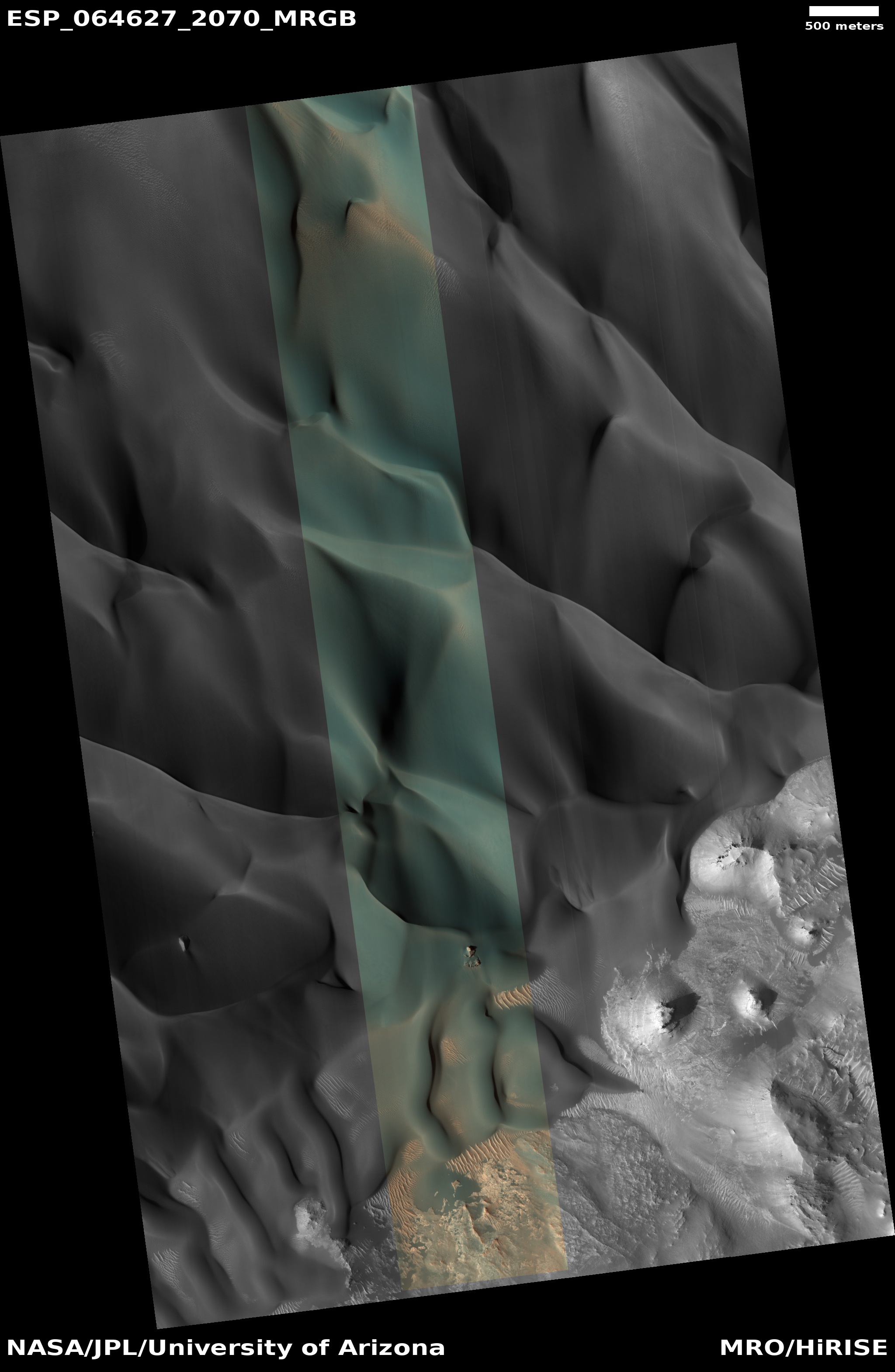
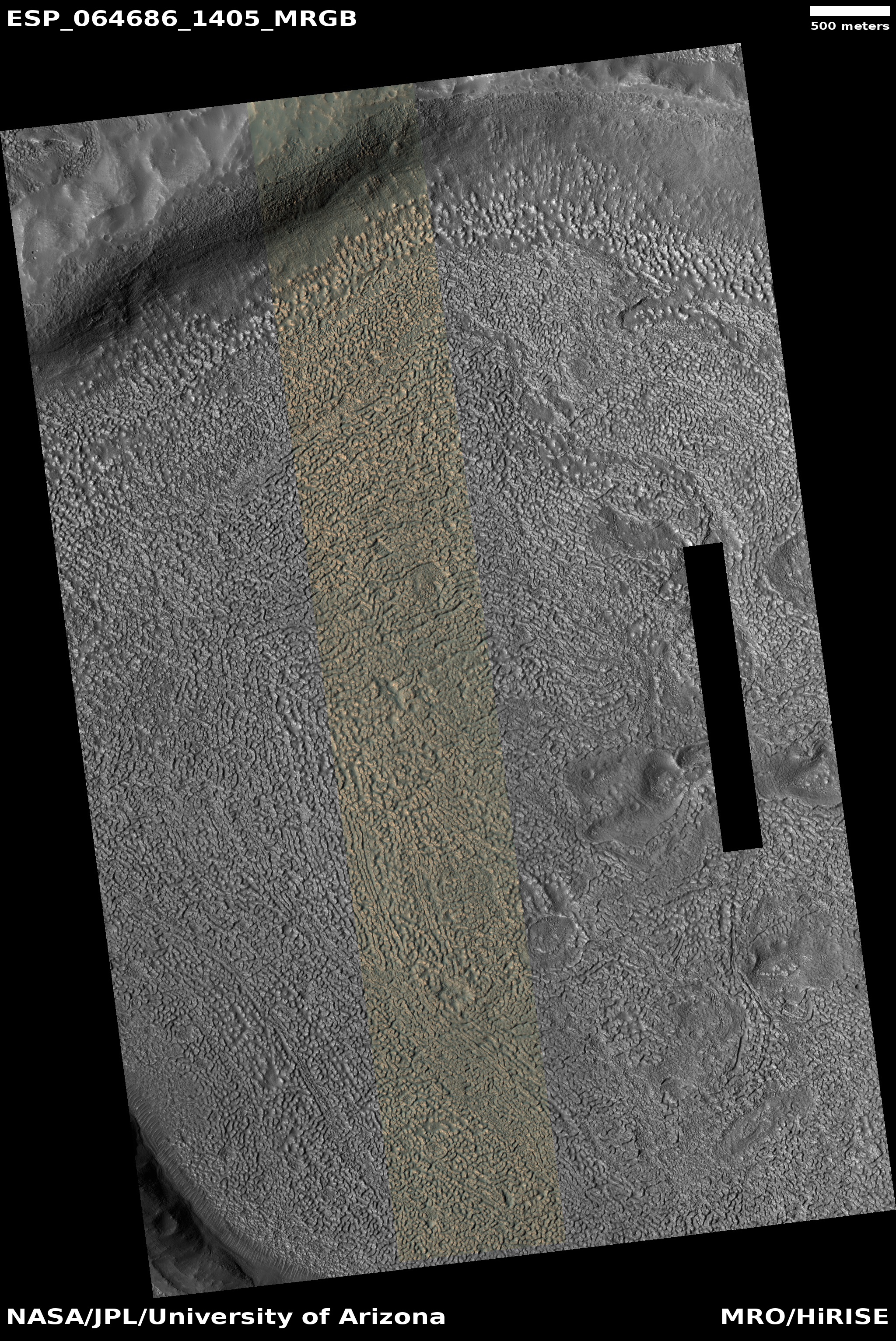
Cool image time! The photo to the right, rotated, cropped, and reduced to post here, was taken by the high resolution camera on Mars Reconnaissance Orbiter on May 10, 2020, and shows the dune field inside a large unnamed sixty-mile-wide crater in the highlands of Mars.

Scientists have been using MRO to monitor this site to track both dust devils and dune changes since at least 2009. In 2009 the focus was on the numerous dust devil tracks, and in fact I posted in March 2020 a comparison of an earlier image with a more recent picture, showing how the earlier tracks had vanished in recent pictures, probably wiped clean by the global dust storm in 2018.

This time however I am less interested in the science, which I covered in detail in that previous post, but in the beauty of these dunes. They are large and majestic, and the color strip tells us that they exhibit striking colors of green, gold, and tan. Is there a place on Earth with dunes of such colors? If so, it is rare.

Make sure you click on the image to see the full resolution photograph. It is even more breath-taking.
4 comments

Mars: A small volcano at the base of a big volcano

Volcanic vent near Pavonis Mons
Click for full image.

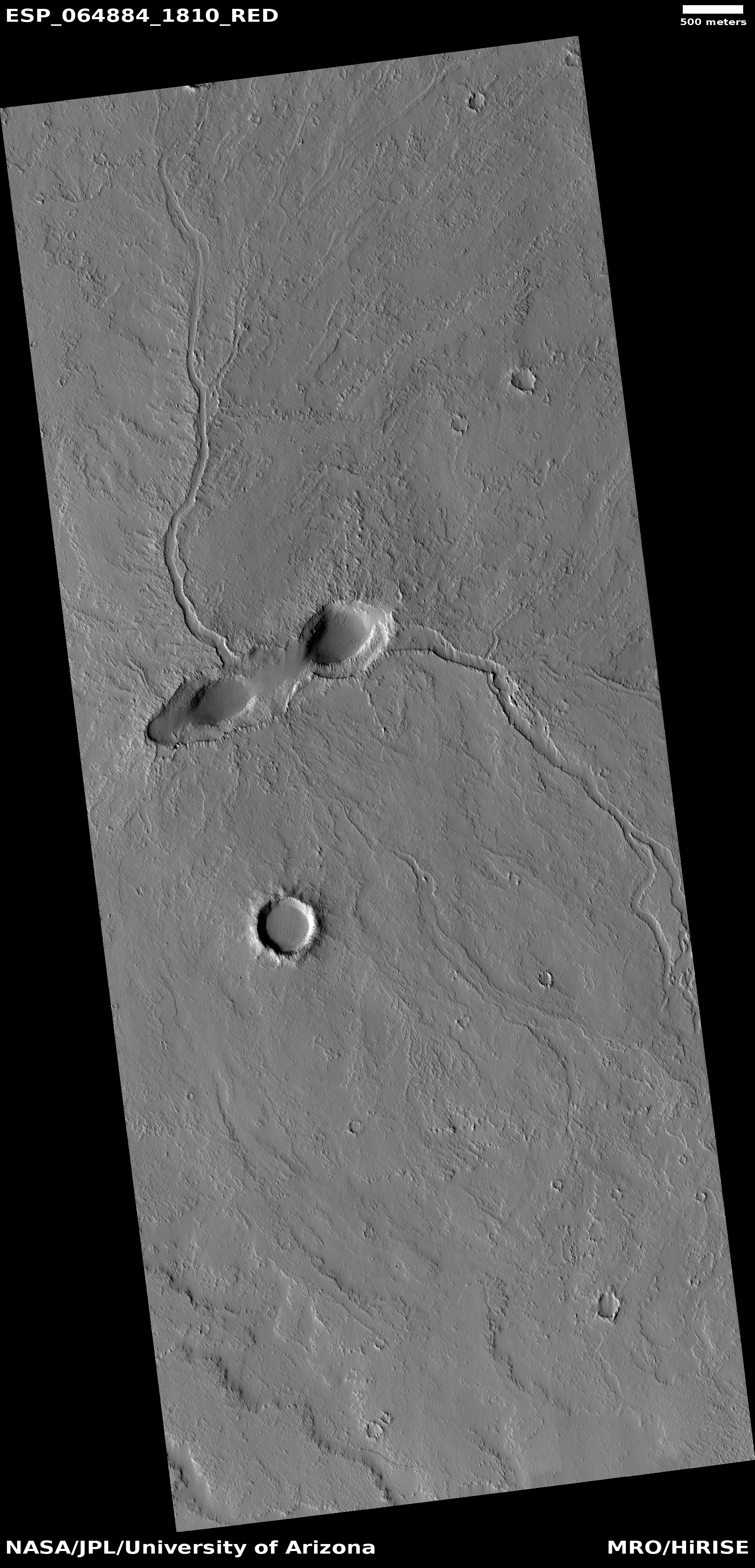
Today’s cool image is of a recent high resolution image taken on May 30, 2020 by Mars Reconnaissance Orbiter (MRO) of what they label as a volcanic vent near Pavonis Mons, the middle giant volcano in the string of three that sit between Olympus Mons, the biggest Martian volcano in the solar system, and Valles Marineris, the biggest canyon in the solar system.

MRO took a previous picture of this vent back in 2010, when they labeled it instead a “small volcano.” Both labels are essentially correct. The two depressions here clearly were a vent for lava at some point in the past. The depressions also fit the definition of a small volcano, as they sit at a high point with two rills flowing down from them. In some ways they could be considered small calderas at the top of a volcano.
» Read more

4 comments

Bottom edge of Martian glacier?

The foot of an inactive glacier on Mars
Click for full image.

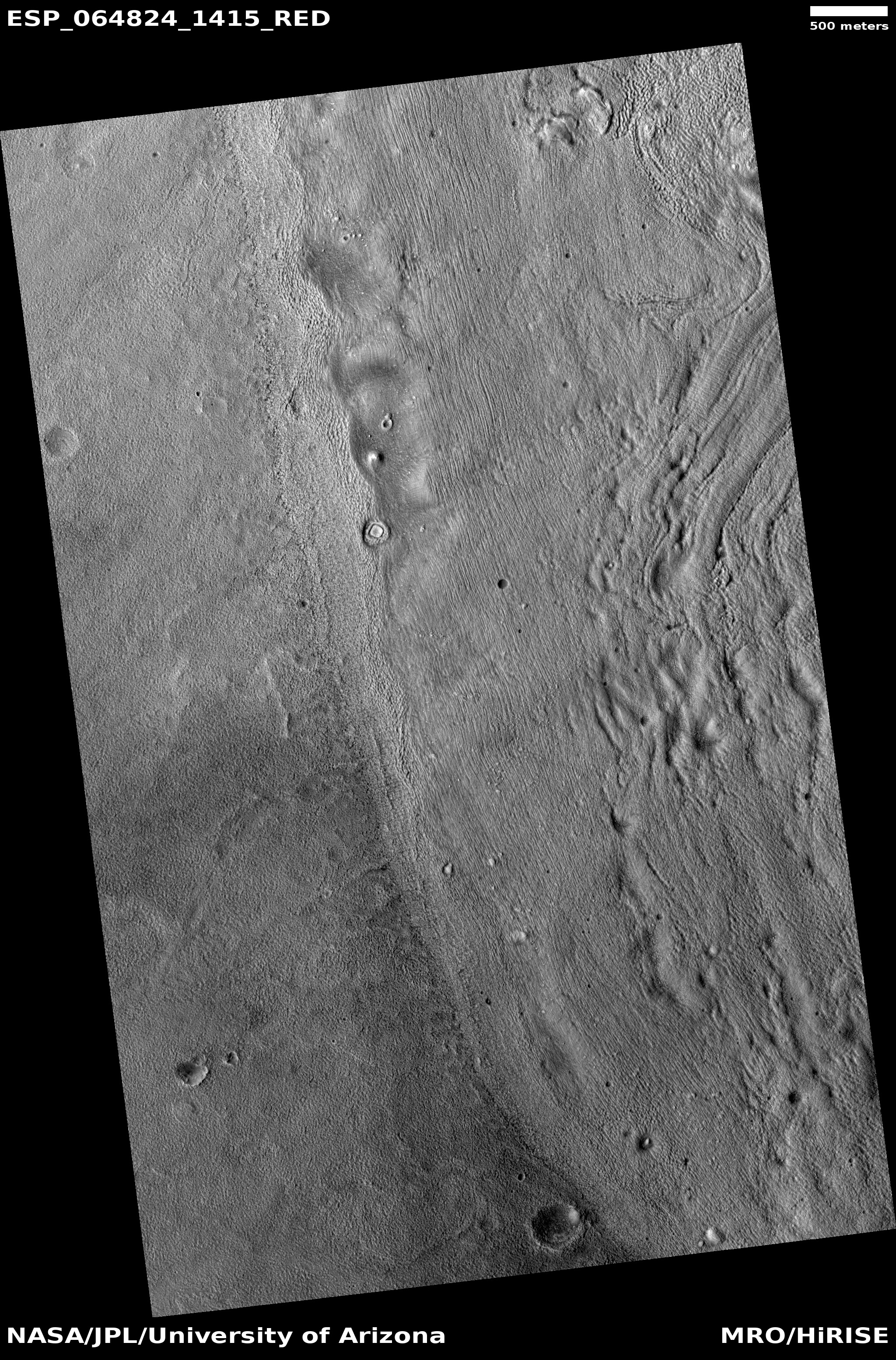
Today’s cool image, taken on May 25, 2020 by the high resolution camera on Mars Reconnaissance Orbiter (MRO), provides a nice example of the typical foot of an inactive buried glacial flow on Mars. The image to the right, rotated, cropped, and reduced to post here, focuses on the center of the full image. Uphill is to the right. The glacier’s edge runs down the middle left of the photo.

Scientists call this a lobate flow because its shape resembles a lobe, smooth and rounded as it comes down the slope. Located at 38 degrees south latitude to the east of Hellas Basin and just to the north of one of that basin’s major infeeding canyons, Harmakhis Valles, this flow comes down the west side of a large mountain. The overview map below provides the context, with the white rectangle indicating the photo’s location.
» Read more

0 comments

Catastrophes on Mars and Earth

Big rock break in Kasei Valles
Click for full image.

Cool image time! The photo to the right, rotated, cropped, and reduced to post here, was taken by the high resolution camera on Mars Reconnaissance Orbiter (MRO) on May 13, 2020, and shows what appears to be a giant block that at some point was attached to the cliff, and then broke off and fell away to the north. Subsequent erosion over the later eons widened the break until it now looks like a canyon.

Sounds great, but the event that separated this big piece of mountain, almost a mile across, from its cliffside was possibly even more catastrophic. And it might not have involved a sudden break and fall, but something more spectacular, and also still impossible based on everything we know about Mars.

Uncovering what really happened at this spot on Mars will not only help us understand the geological history of the Red Planet, it could also amazingly enough help illustrate the cultural shifts going on right now on Earth, and how to shift them in a more rational and sane direction.

This image is located near the outlet of Kasei Valles, one of the larger valleys draining downward from the Tharsis Bulge where Mars’ giant volcanoes are located. The overview map below shows us what Kasei Valles looks like in this area.
» Read more

15 comments

Martian sand traps and elongated dunes

Elongated dunes on Mars
Click for full image.

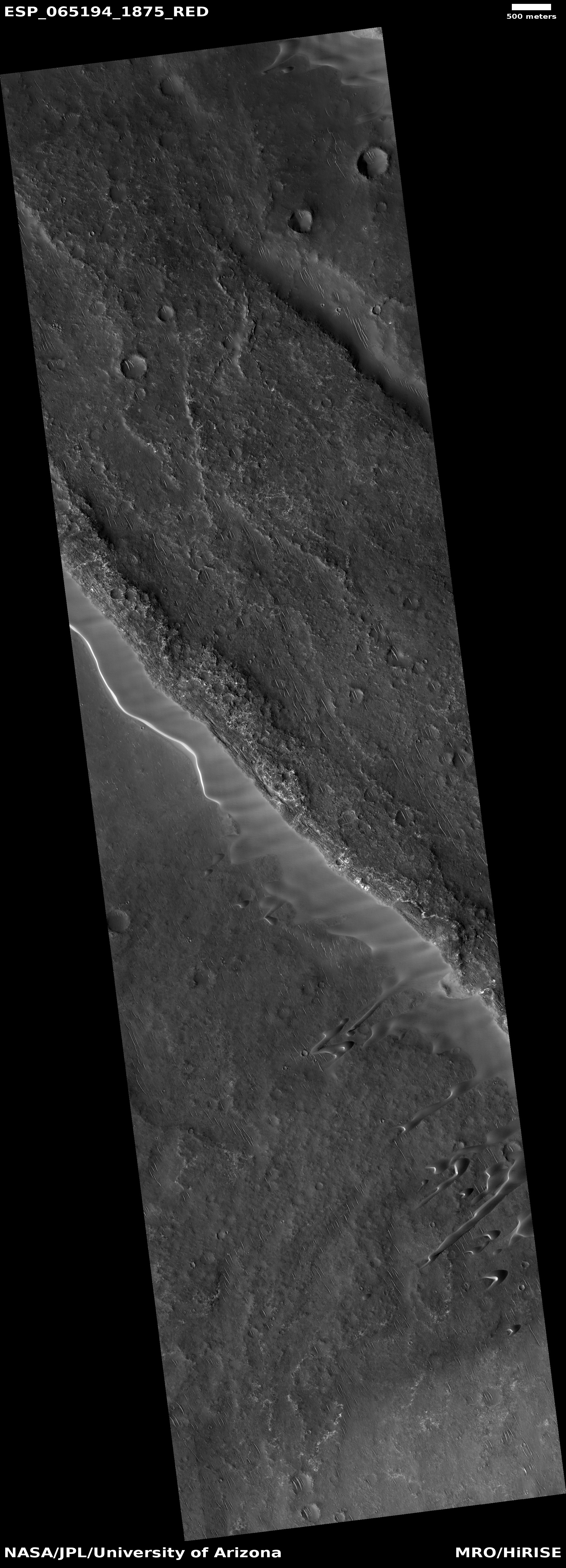
Cool image time! The photo to the left, rotated, cropped, and reduced to post here, was taken on June 23, 2020 by the high resolution camera on Mars Reconnaissance Orbiter (MRO). I was attracted by the uncaptioned image’s title, “Elongating Linear Dunes at Meroe Patera.” What are elongating linear dunes?

The photo shows two such dunes, stretching out to the southwest away from the pile of sand that abuts the cliff to the northwest. Unlike most dunes, which usually form and travel in groups, these for some reason form single straight lines extending for some distance.

I contacted the scientist who requested this image, Joel Davis of the Natural History Museum in London, hoping he could answer some questions about these strangely shaped dunes, and discovered that he was studying this exact subject for a paper since published. As noted in the paper’s introduction,
» Read more

3 comments

Ascraeus Mons, Mars’ second highest mountain

Ascraeus Mons

Today’s cool Mars’ image started out when I came across an interesting image of a depression on the northern flank of the giant Martian volcano Ascraeus Mons, the northernmost of the line of three giant volcanoes just to the east of the biggest of all, Olympus Mons.

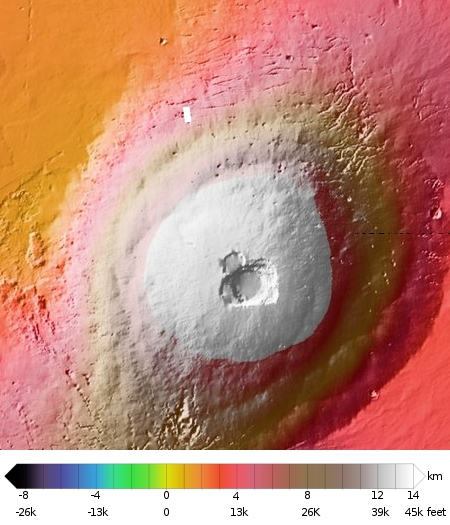
To provide context I created an overview showing the entire volcano (with the white rectangle showing the location of the depression image), and suddenly realized that this overview might actually be more interesting to my readers. To the right is that overview of Ascreaus, with a scale across the bottom to indicate the elevation of the mountain above what scientists have determined to be Mars’ pseudo sea level.

Notice that this volcano, the second highest on Mars, rises more than 43,000 feet above the surrounding plains. Its peak is estimated to be about 59,000 feet high, making it taller than Mt. Everest by about 30,000 feet (more than twice its height). Its diameter is approximately 300 miles across, giving it a much steeper profile than the higher but more spread out Olympus Mons. The map below shows this mountain in relation to Olympus as well as its nearby partner volcanoes.
» Read more

2 comments

OSIRIS-REx preps for final rehearsal of sample grab

The OSIRIS-REx science and engineering team is getting ready for its August 11th final rehearsal of the sample grab-and-go at the asteroid Bennu that it plans to do in October.

If the rehearsal goes right, the spacecraft will descend to within 131 feet of the surface of Bennu as it deploys its equipment as if it would continue down to the surface. It will also fly in formation above the Nightingale sample site when it does this, taking the highest resolution images yet of the surface of the asteroid.

It will then back off, returning to its home orbit farther from Bennu. Engineers will then review what happened, and use that data to prepare for the actual sample grab-and-go, set for October 20, 2020.

3 comments

Slushy floor of southern Martian crater?

Knobby floor of southern crater
Click for full image.

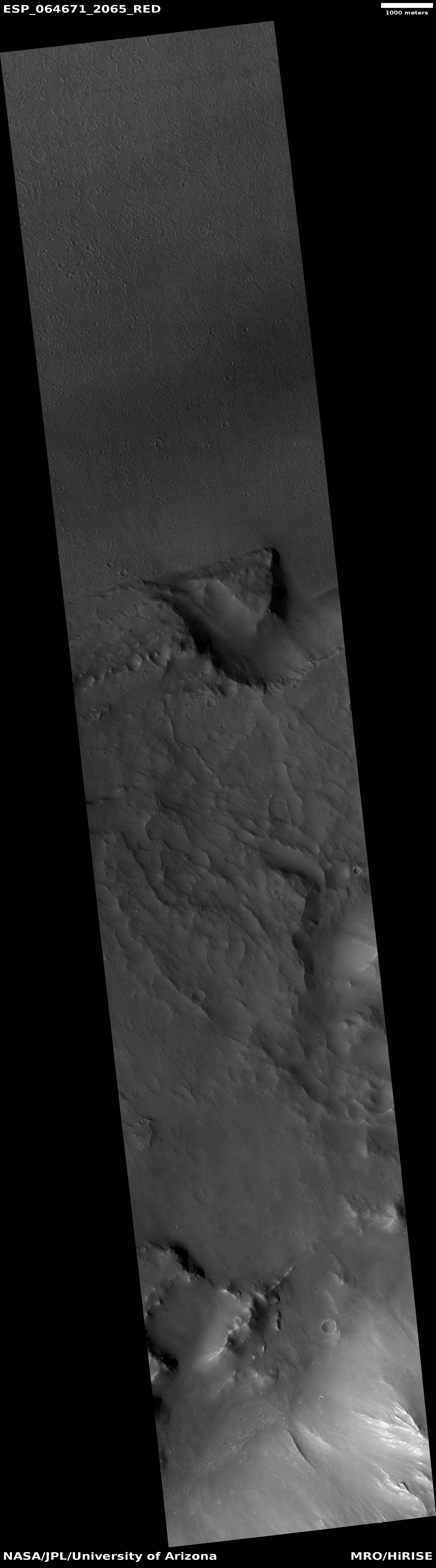
The cool image to the right, rotated, cropped, and reduced to post here, shows the northwest section of the floor of a crater in the southern cratered highlands of Mars, in a mountainous region dubbed Claritus Fossae, located south of Valles Marineris. The photo was taken by the high resolution camera on Mars Reconnaissance Orbiter (MRO) on May 14, 2020.

The entire crater floor appears to be covered by these strings of closely-packed knobs, reminiscent of the brain terrain found in the mid-latitude glacial regions of Mars and thought to be the result of underground ice sublimating upward.

Below is the area in the white box, in full resolution.
» Read more

0 comments

Filled and distorted craters on Mars

A very distorted and filled crater on Mars
Click for full image.

Cool image time! The photo to the right, rotated and cropped to post here, was taken by the high resolution camera on Mars Reconnaissance Orbiter (MRO) on May 25, 2020. The entire image was dubbed “Cluster of Filled Craters”, but I decided to highlight the crater of the cluster that was most strangely distorted of them all. The material that fills all the craters in the full image is almost certainly buried ice and is dubbed concentric crater fill by scientists.

This crater is located in the northern lowland plains the mid-latitudes between 30 and 60 degrees, where planetary scientists have found ample evidence of many such filled craters and glaciers.

Not only does the crater’s interior seemed filled with glacial material, its distorted rim suggests that it has been reshaped by glacial activity that might have covered it entirely over the eons as the mid-latitude glaciers of Mars waxed and waned with the extreme shifts that happen regularly to Mars’ rotational tilt. Moreover, there is strong evidence that in these lowland northern plains an underground ice table exists close to the surface, allowing for more distortion over time.

The overview map below provides some location context.
» Read more

5 comments

Scientists make first rough estimate of Mars’ internal structure

Artist's cutaway showing theorized Martian interior
Artist’s cutaway of theorized Martian interior

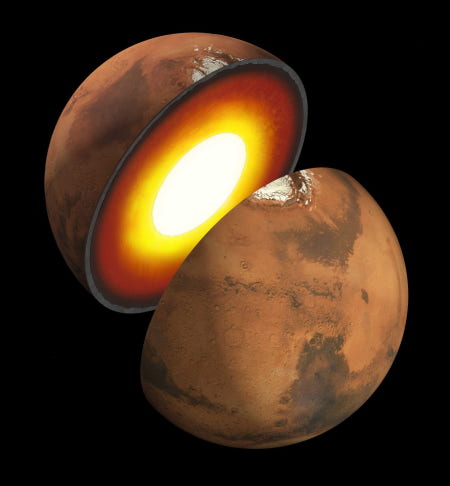
Using data from InSight’s seismometer, scientists have made their first approximation of the internal structure of Mars.

The first boundary Deng and Levander measured is the divide between Marsโ€™ crust and mantle almost 22 miles (35 kilometers) beneath the lander.

The second is a transition zone within the mantle where magnesium iron silicates undergo a geochemical change. Above the zone, the elements form a mineral called olivine, and beneath it, heat and pressure compress them into a new mineral called wadsleyite. Known as the olivine-wadsleyite transition, this zone was found 690-727 miles (1,110-1,170 kilometers) beneath InSight. โ€œThe temperature at the olivine-wadsleyite transition is an important key to building thermal models of Mars,โ€ Deng said. โ€œFrom the depth of the transition, we can easily calculate the pressure, and with that, we can derive the temperature.โ€

The third boundary he and Levander measured is the border between Marsโ€™ mantle and its iron-rich core, which they found about 945-994 miles (1,520-1,600 kilometers) beneath the lander. Better understanding this boundary โ€œcan provide information about the planetโ€™s development from both a chemical and thermal point of view,โ€ Deng said.

Because they only have one seismometer on the planet, this approximation has a great deal of uncertainty. Only when we have multiple such seismic instruments, scattered across the entire Martian globe, will scientists be able to hone their models more accurate of the planet’s interior.

2 comments

The dry barren plains of Tyrrhena Terra

Tyrrhena Terra badlands
Click for full image.

In a sense today’s cool image is a replay of one I posted in March, showing the dry barren terrain in the vast rough cratered highlands of Tyrrhena Terra, located along the equator of Mars between the giant basins of Isidis and Hellas.

Today’s image on the right, cropped to post here, was taken by the high resolution camera on Mars Reconnaissance Orbiter on March 26, 2020, and shows well the barrenness of this region. The surface appears quite solid, like bedrock, rather than the squishy soft surface of the northern lowland plains. Moreover, there is a lot of dust trapped in the low areas between the ridges, forming ripples that new data suggest move slowly across the surface. If you click on the full image, you will see that this terrain is far from local, and goes on in this manner for quite a distance in all directions.

This is a dry and forbidding place, about the size of the American southwest, from Texas to California.

The overview map below provides some context of Tyrrhena Terra’s location on Mars.
» Read more

0 comments

Study: Mars’ meandering canyons formed under ice

A new study comparing Mars’ meandering canyons with those found in the Arctic regions on Earth suggests that the Martian valleys were formed by water melting under large ice sheets, not flowing water on the surface.

A large number of the valley networks scarring the surface of Mars were carved by water melting beneath glacial ice, not by free-flowing rivers as previously thought, according to new research published in Nature Geoscience. The findings effectively throw cold water on the dominant โ€œwarm and wet ancient Marsโ€ hypothesis, which postulates that rivers, rainfall and oceans once existed on the red planet.

To reach this conclusion, lead author and postdoctoral research scholar Anna Grau Galofre of Arizona State Universityโ€™s School of Earth and Space Exploration developed and used new techniques to examine thousands of Martian valleys. She and her co-authors also compared the Martian valleys to the subglacial channels in the Canadian Arctic Archipelago and uncovered striking similarities. The western edge of the Devon ice cap on the Canadian Arctic Archipelago.

I have noted previously on Behind the Black my sense that the planetary science community was beginning to shift away from the hypothesis of flowing liquid surface water on Mars as an explanation for the planet’s riverlike and oceanlike features to some form or ice/glacial activity. For a half century the scientists have tried and failed to come up with some scenario that could allow water to flow on the surface in Mars’ cold climate and thin atmosphere.

Ice or glacial activity rather than flowing liquid water might solve this problem, and today’s paper is a push in this direction.

3 comments
1 108 109 110 111 112 157