Live stream of Perseverance launch tomorrow

I have embedded below the fold NASA’s live stream channel for tomorrow’s 7:50 am (Eastern) launch of the Perseverance rover to Mars on a ULA Atlas-5 rocket.

At present the channel is carrying NASA’s programming leading up to the launch. The actual live stream for the launch begins at 7 am (Eastern).

The weather looks good, and there appear to be no issues, as of 11 pm (Eastern).

» Read more

5 comments

Glacier country on Mars

Glacial flow in Protonilus Mensae
Click for full image.

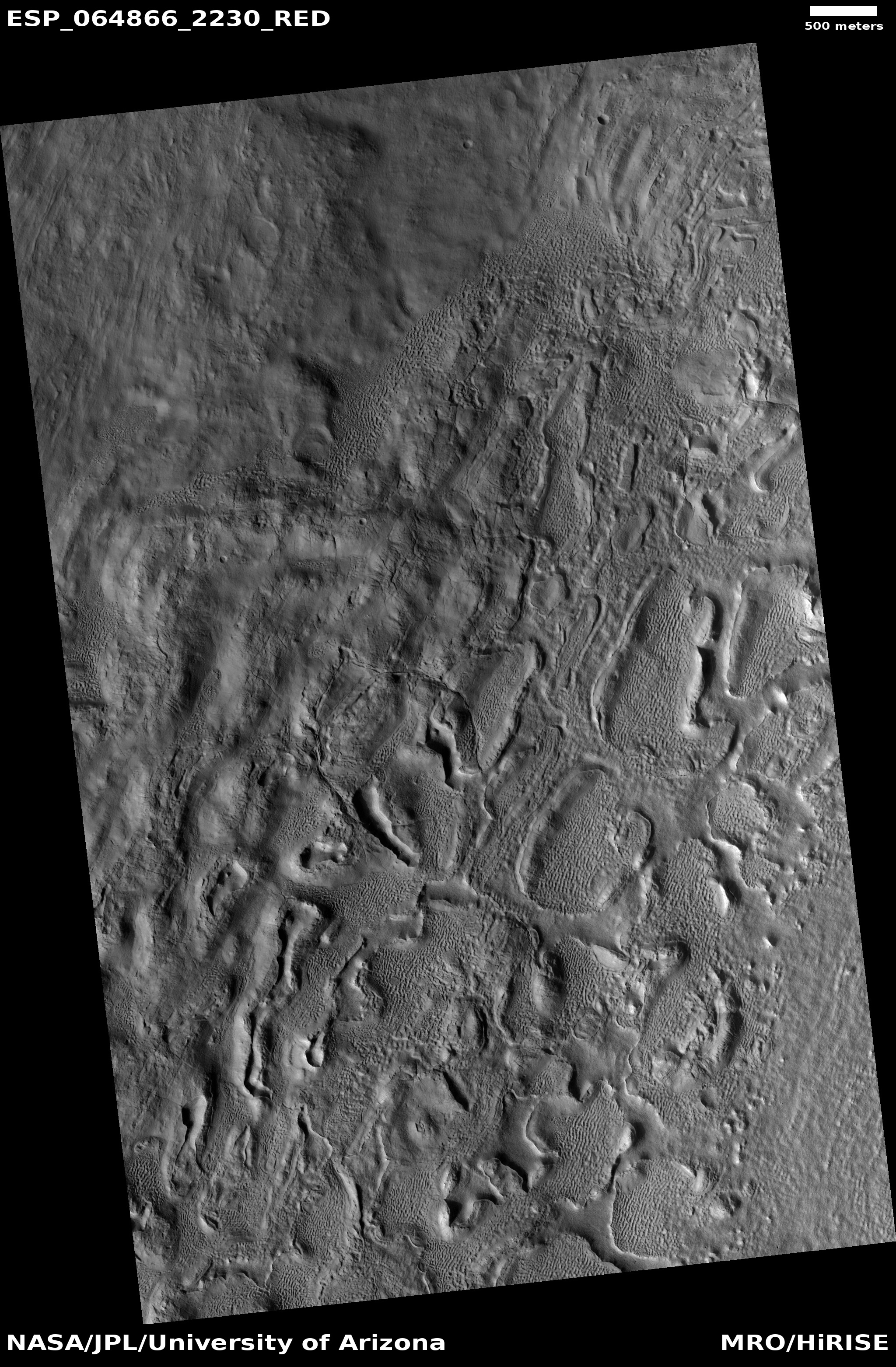
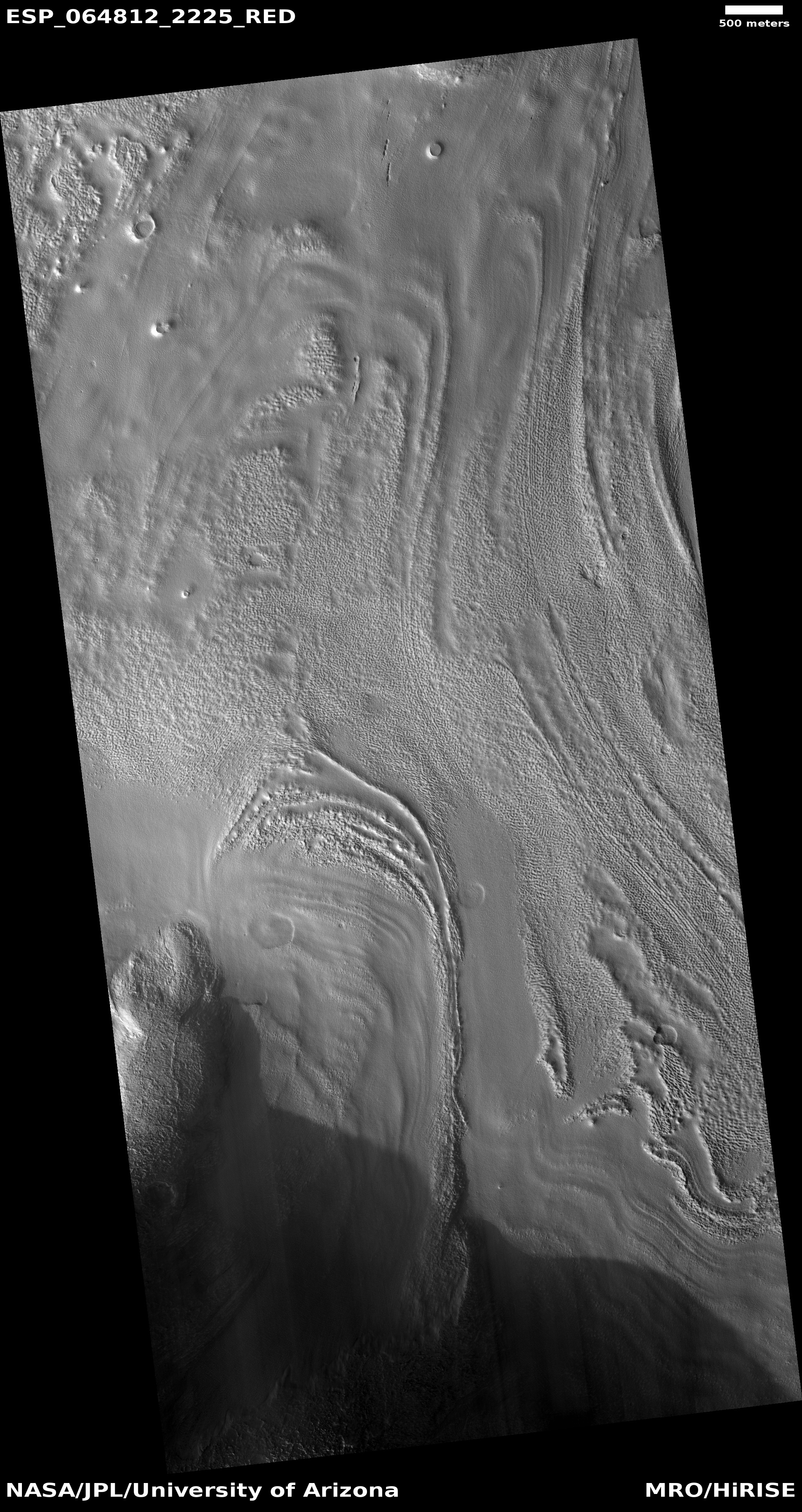
Cool image time! The photo to the right, rotated, cropped, and reduced to post here, was taken on May 24, 2020 by the high resolution camera on Mars Reconnaissance Orbiter (MRO), and provides a wonderful example of the kind of evidence of buried glaciers found extensively in the mid-latitudes of Mars.

This particular region, called Protonilus Mensae, is a region of chaos terrain at the transition zone between the southern cratered highlands and the northern lowland plains. I have featured a number of cool images in Protonilus, all of which show some form of buried glacial flow, now inactive.

The last cool image above was one that the MRO science team had picked to illustrate how to spot a glacier on Mars.

In this particular image are several obvious glacier features. First, we can see a series of moraines at the foot of each glacier in the photo, each moraine indicating the farthest extent of the glacier when it was active and growing. It also appears that there are two major layers of buried ice, the younger-smaller layer near the image’s bottom and sitting on top of a larger more extensive glacier flow sheet. This suggests that there was more ice in the past here, and with each succeeding ice age the glaciers grew less extensive.

Second, at the edges of the flows can be seen parallel ridges, suggestive also of repeated flows, each pushing to the side a new layer of debris.

Third, the interior of the glacier has parallel fractures in many places, similar to what is seen on Earth glaciers.

Protonilus Mensae, as well as the neighboring chaos regions Deuteronilus to the west and Nilosyrtis to the east, could very well be called Mars’ glacier country. Do a search on Behind the Black for all three regions and you will come up with numerous images showing glacial features.

Below is an overview of Protonilus, the red box showing the location of this image. Also highlighted by number are the locations of the three features previously posted and listed above.
» Read more

0 comments

Martian eroding ridges amid brain terrain

Brain terrain and bisected ridges on Mars
Click for full image.

Today’s very cool image is cool because of how inexplicable it is. To the right, cropped to post here, is a photo taken by the high resolution camera on Mars Reconnaissance Orbiter (MRO) of an area of what they call “Ribbed Terrain and Brain Terrain”.

I call it baffling.

Nor am I alone. At the moment the processes that create brain terrain (the undulations between the ridges) remain a complete mystery. There are theories, all relating to ice sublimating into gas, but none really explains the overall look of this terrain.

Making this geology even more baffling are the larger ridges surrounding the brain terrain, all of which appear to have depressions along their crests. Here too some form of sublimation process appears involved, but the details remain somewhat mysterious.
» Read more

1 comment

Rover update: Curiosity pauses to drill

Curiosity's entire journey so far in Gale Crater

Overview map of Curiosity's recent travels

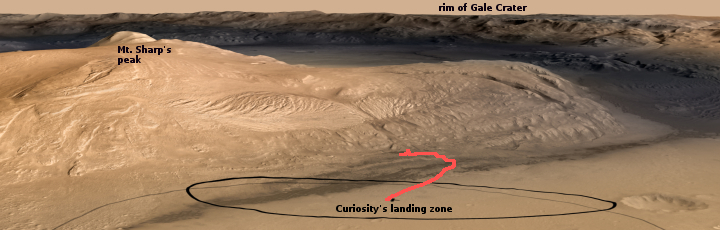
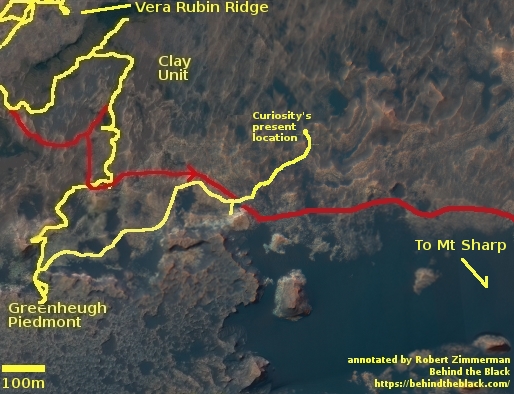
The artist’s oblique drawing above, as well as the map to the right, provide some context as to Curiosity’s present location and its entire journey in Gale Crater. For the overall context of Curiosity’s travels, see my March 2016 post, Pinpointing Curiosity’s location in Gale Crater. For all rover updates since then through May 2020, go here.

Since my last update on July 7, 2020, Curiosity has quickly moved a considerable distance to the east, as planned, skirting the large sand field to the south in its journey to the best path upward onto Mt. Sharp. The science team however has detoured away from their planned route, shown in red on the map, heading downhill a bit in order to find one last good location in the clay unit to drill. They are at that location now and are presently scouting for the best drilling spot.

About a week ago, before heading downhill, they had stopped to take a set of new images of Curiosity’s wheels. » Read more

3 comments

Tianwen-1 launch set for July 23rd

China has rolled out its Long March 5 rocket and is now preparing to launch its Tianwen-1 orbiter/lander/rover to Mars this coming Thursday, July 23rd, some time between 12 am and 3 am (Eastern).

A Long March 5 rocket is set for liftoff with China’s Tianwen 1 mission some time between 12 a.m. and 3 a.m. EDT (0400-0700 GMT) Thursday, according to public notices warning ships to steer clear of downrange drop zones along the launcher’s flight path.

Chinese officials have not officially publicized the launch date. Chinese state media outlets have only reported the launch is scheduled for late July or early August, and officials have not confirmed whether the launch will be broadcast live on state television.

This will be the first operational launch of the Long March 5, which has had three previous test launches, with the first two failing. The success of the December launch, as well as the May success of the related Long March 5B, made this Mars mission possible.

After achieving orbit in February 2021 and spending two months scouting the landing site, the lander will descend to the surface, bringing the rover with it. The prime landing site is Utopia Planitia, in the northern lowland plains.

6 comments

Active volcanoes on Venus?

Using computer models and past radar images from orbiters, scientists now believe that Venus could have as many as 37 active volcanoes.

The type of feature on Venus they think might still be active is called a coronae, circular features detected by radar and distinct to this planet that have been thought to be inactive ancient volcanic features.

In the new study, the researchers used numerical models of thermo-mechanic activity beneath the surface of Venus to create high-resolution, 3D simulations of coronae formation. Their simulations provide a more detailed view of the process than ever before.

The results helped Montési and his colleagues identify features that are present only in recently active coronae. The team was then able to match those features to those observed on the surface of Venus, revealing that some of the variation in coronae across the planet represents different stages of geological development. The study provides the first evidence that coronae on Venus are still evolving, indicating that the interior of the planet is still churning.

Lots of uncertainty here, but nonetheless this is good science. It also reinforces other evidence in recent years that has suggested active volcanism on Venus.

1 comment

More polygons on Mars!

Lava polygons on Mars?
Click for full image.

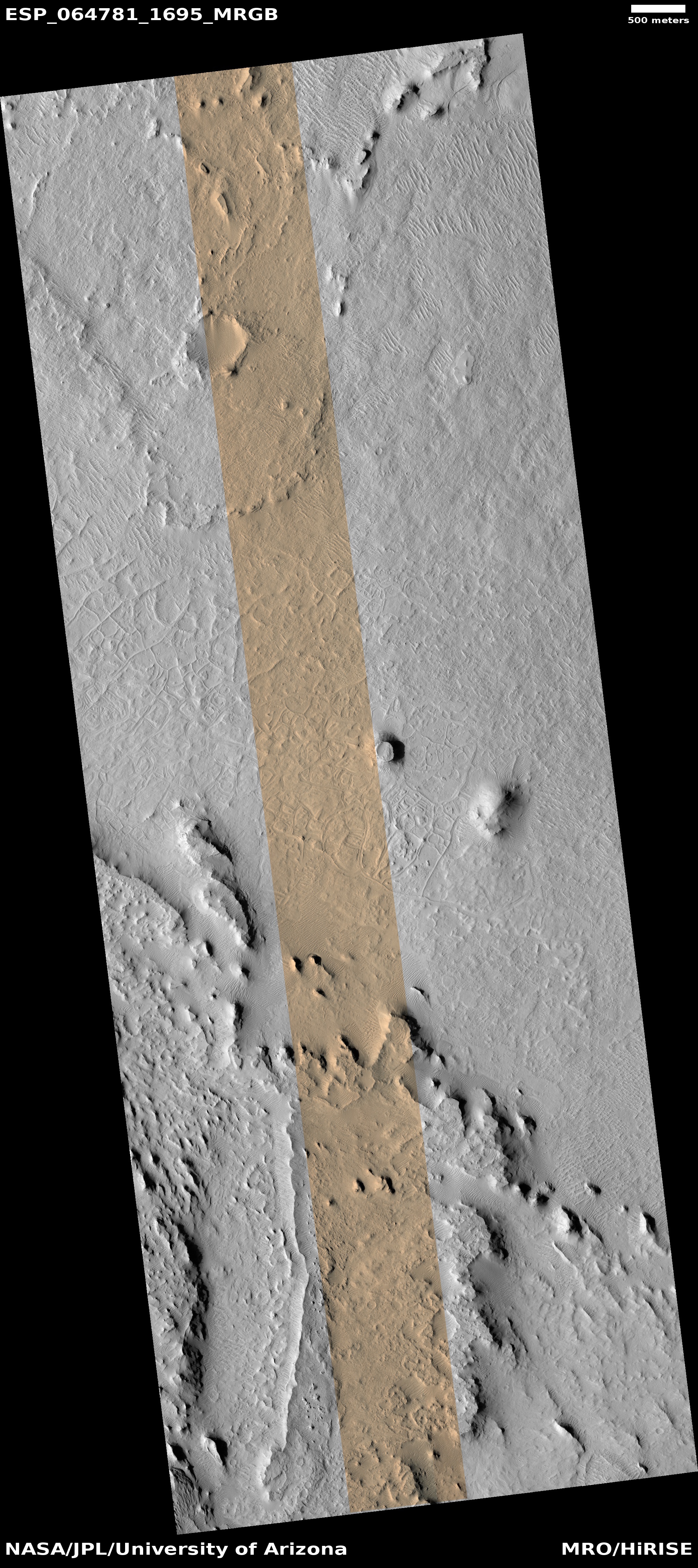
Today’s cool image, rotated, cropped, and contrast-enhanced to post here, focuses on polygons found near the equator of Mars. It was taken by the high resolution camera on Mars Reconnaissance Orbiter (MRO) on May 22, 2020, and shows what the science team labels as “well-preserved polygons.”

Previously I have posted cool images showing polygons (here and here), but those images were located in the northern mid-latitudes, and were thought to have been formed in connection with some form of freeze-melt-drying water process in permafrost.

Today’s image however is likely not related to water. It is located in the equatorial regions, where little water is expected. It also has a more permanent nature, which suggests that it is the result of some sort of volcanic or tectonic process. That the polygons are depressions suggests the latter, since a volcanic process is more likely to have filled cracks and left ridges more resistant to erosion, as explained by this article.

In this case the topography suggests instead some form of spreading and cracking process that left behind these polygon-shaped cracks. In mud, such polygons are found when the mud dries, but once again, these are in a very dry region. If formed in that manner they must have formed a very very long time ago, when the climate here was very different, and were somehow preserved for eons since.

The location, as shown in the overview map below provides some context, though it really doesn’t answer any questions..
» Read more

0 comments

Launch update on Mars missions

The launch status of the three missions to Mars:

First, the launch of UAE’s Hope orbiter by Mitsubishi’s H-2A rocket has been pushed back to July 20th due to bad weather. Their launch window extends to August 3rd, so they still have two weeks before it closes.

Second, China has rolled to the launchpad the Long March 5 rocket, with the Tienwen-1 orbiter/lander/rover. Though they have only said that the launch will occur between July 20th and July 25th, based on past operations, they usually launch six days after roll-out, putting the launch date as July 23.

China has also provided some clarity as to Tienwen-1’s landing site on Mars. According to this Nature Astronomy paper [pdf], published on July 13th, their primary landing site is in the northern lowland plains of Utopia Planitia. The Tienwen-1 science team has also considered [pdf] the northern lowland plains in Chryse Planitia, on the other side of Mars.

Since they will spend two to three months in Mars orbit before sending the lander and rover to the surface, it could very well be that they won’t make a final decision until they get into orbit.

Finally, on July 7th Perseverance was mounted on top of its Atlas-5 rocket for its July 30th launch. Its launch window closes on August 15.

6 comments

Seismic signal from recent Martian impact detected by InSight?

According to a science paper released today, a small impact that occurred about 25 miles south from the InSight lander between February 21st and April 6, 2019 might have been detected by the spacecraft’s seismometer.

From the paper’s abstract:

During this time period, three seismic events were identified in InSight data. We derive expected seismic signal characteristics and use them to evaluate each of the seismic events. However, none of them can definitively be associated with this source. Atmospheric perturbations are generally expected to be generated during impacts; however, in this case, no signal could be identified as related to the known impact. Using scaling relationships based on the terrestrial and lunar analogs and numerical modeling, we predict the amplitude, peak frequency, and duration of the seismic signal that would have emanated from this impact. The predicted amplitude falls near the lowest levels of the measured seismometer noise for the predicted frequency. Hence it is not surprising this impact event was not positively identified in the seismic data.

Based on this data, they now think they will only be able to detect about two impacts per year with InSight’s seismometer, a decrease from the previous estimate of as many as ten.

4 comments

Martian acne?

Acne on Mars?
Click for full image.

Cool image time! The photo to the right, rotated, cropped, and reduced to post here, shows what the scientists from the high resolution camera on Mars Reconnaissance Orbiter (MRO) label “fretted terrain.” In an earlier post describing evidence found by Europe’s Mars Express orbiter of glaciers in the northern mid-latitudes of Mars, fretted terrain was described as follows:

As is common with fretted terrain, it contains a mix of cliffs, canyons, scarps, steep-sided and flat-topped mounds (mesa), furrows, fractured ridges and more, a selection of which can be seen dotted across the frame.

These features were created as flowing material dissected the area, cutting through the existing landscape and carving out a web of winding channels. In the case of Deuteronilus Mensae, flowing ice is the most likely culprit. Scientists believe that this terrain has experienced extensive past glacial activity across numerous martian epochs.

In that case the fretted terrain was in the transition zone between the northern lowland plains and the southern cratered highlands, and actually resembled chaos terrain. What we see here looks far different, a surface that resembles the bubbly surface of a vat of thick molten stew.

This image is also deep in the cratered southern highlands, though still in the mid-latitudes at 41 degrees south latitude. While the presence of ice close to the surface is possible at this latitude and could definitely explain what this image shows, it would be a big mistake to accept this explanation without skepticism. A lot is going on here, and much of it suggests volcanic-type processes. The volcanoes might have been spewing mud or ice instead of molten lava, but then again, all is uncertain.

What is certain is that I can’t help thinking of the pock-marked skin of an adolescent teenager when I look at this photo. And for all we know, the processes that produce both surfaces could be in many ways similar.

0 comments

Monument Valley on Mars

Monument Valley on Mars
Click for full image.

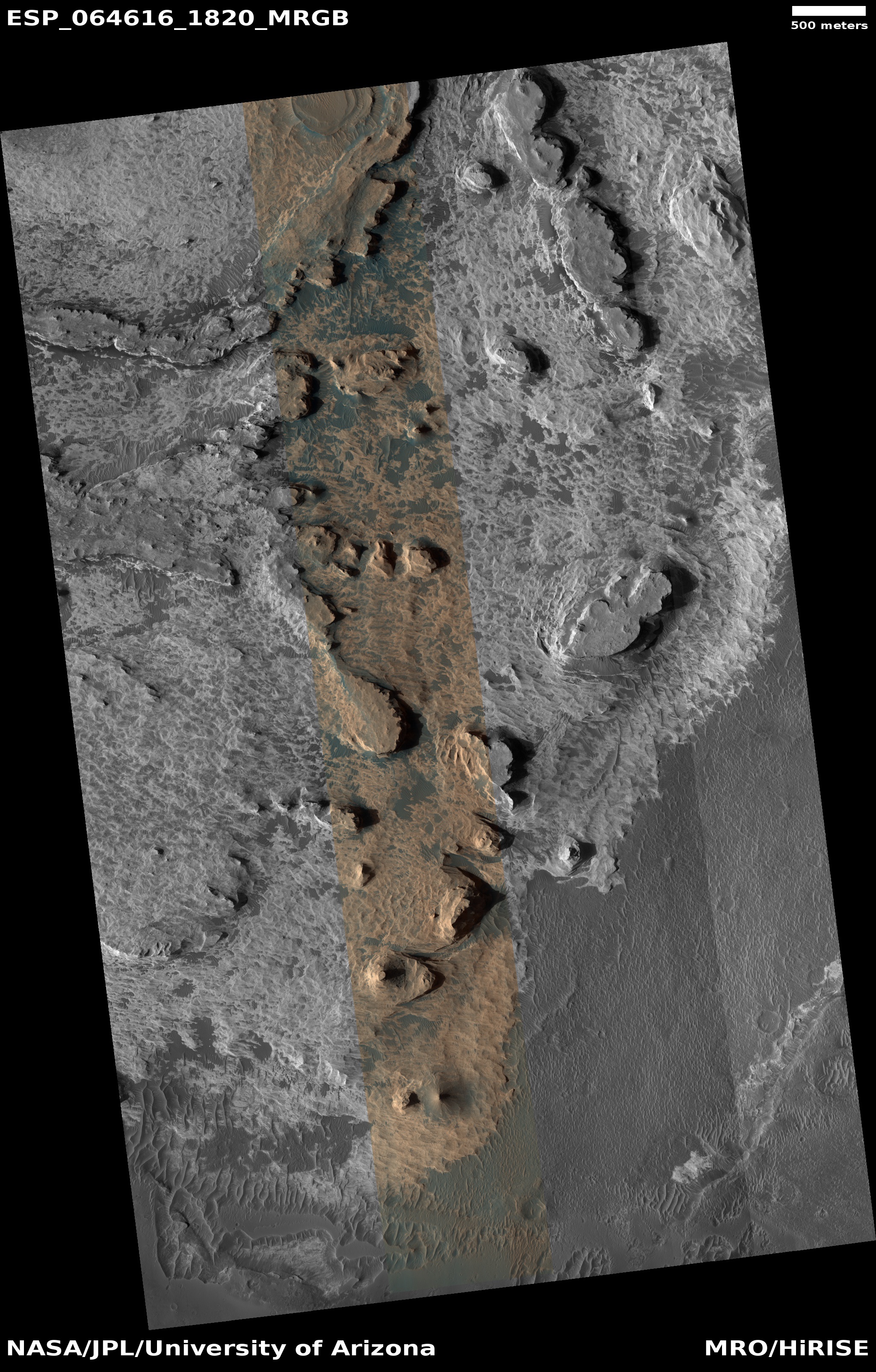
Today’s cool image is located near the Martian equator, in the middle of Arabia Terra, the most extensive region of the transition zone between the low northern plains and the southern cratered highlands. Taken on May 9, 2020 by the high resolution camera on Mars Reconnaissance Orbiter (MRO) and cropped to post here, the photo shows some layered mesas surrounded by a terraced and scalloped terrain with dust filling the low spots.

This is likely to be a very dry place on Mars. At only 2 degrees north of the equator, the evidence so far suggests that if there is a buried ice table (like the water table on Earth), it will be much deeper than at higher latitudes. The terrain reflects this, looking reminiscent of Monument Valley in the American southwest. In fact, the satellite image below, which I grabbed from MapQuest, shows a typical mesa in Monument Valley.
» Read more

6 comments

Martian swirls and curlicues

glacial features in depression on Mars
Click for full image.

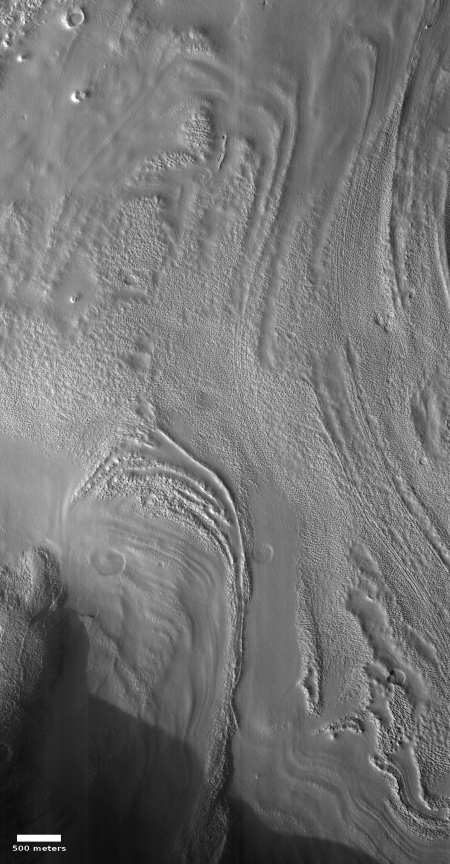
Cool image time! The photo to the right, cropped and reduced to post here, is a great example of how a well known geological process on Earth, glaciers, can form features on Mars that appear most inexplicable.

The image was taken on May 13, 2020 and highlights the geology found in a depression, likely an eroded crater, on the northwest flanks of one of Mars’ largest basins, Argyre Planitia, located in the planet’s southern cratered highlands. The basin is thought to have been formed by a giant impact during the Late Heavy Bombardment around 3.9 billion years ago, when the inner terrestrial planets were sweeping up the last remnants of the Sun’s accretion disk, with that process causing the many craters we see on the Moon, Mercury, and Mars

This particular depression is at 41 degrees south latitude, in the mid-latitudes where scientists have found much evidence of buried glaciers. This is likely what we are looking at here. The section I’ve cropped has a dip to the south, which somewhat fits these flow features. If you look at the full image, you will see comparably weird flow features south of this section, flowing downhill in the opposite direction, to the north.

The problem is that not all the features fit the direction of flow, or any flow at all. I suspect we are seeing evidence of the waxing and waning of glaciers over this terrain over many eons. Disentangling that history however is confounding, especially when we are limited to only studying such objects from orbit.

I must also add that this image was labeled by the MRO science team a “terrain sample,” which means it wasn’t specifically requested by any scientist studying this geology. Instead, they needed to take an image to maintain the spacecraft’s camera temperature, and picked this spot for that snapshot. Their choice wasn’t random, but it also wasn’t based on any focused research.

5 comments
1 109 110 111 112 113 157