Martian ridge sticking up out of a lava flood plain

Martian ridge sticking up out of a lava flood plain
Click for full image.

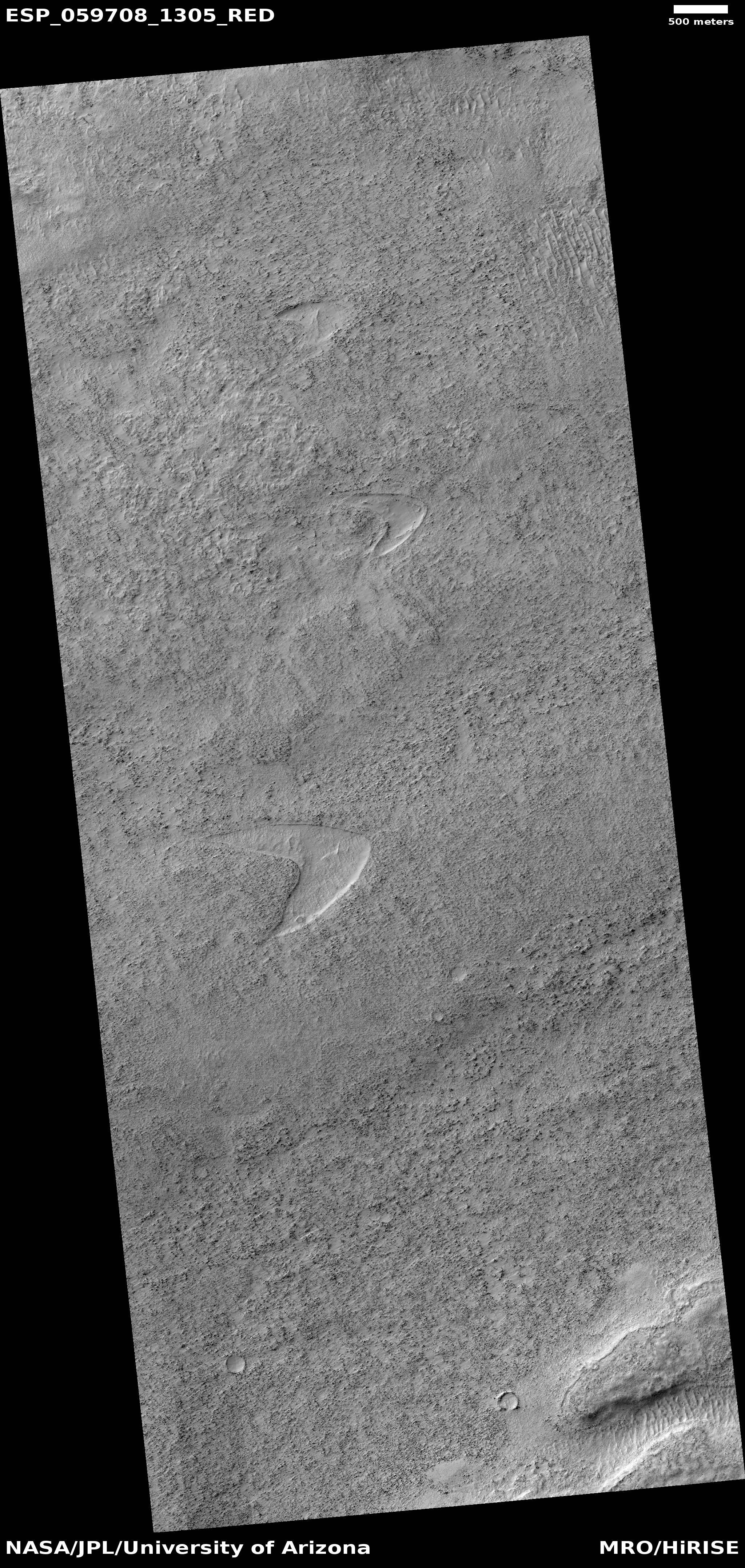
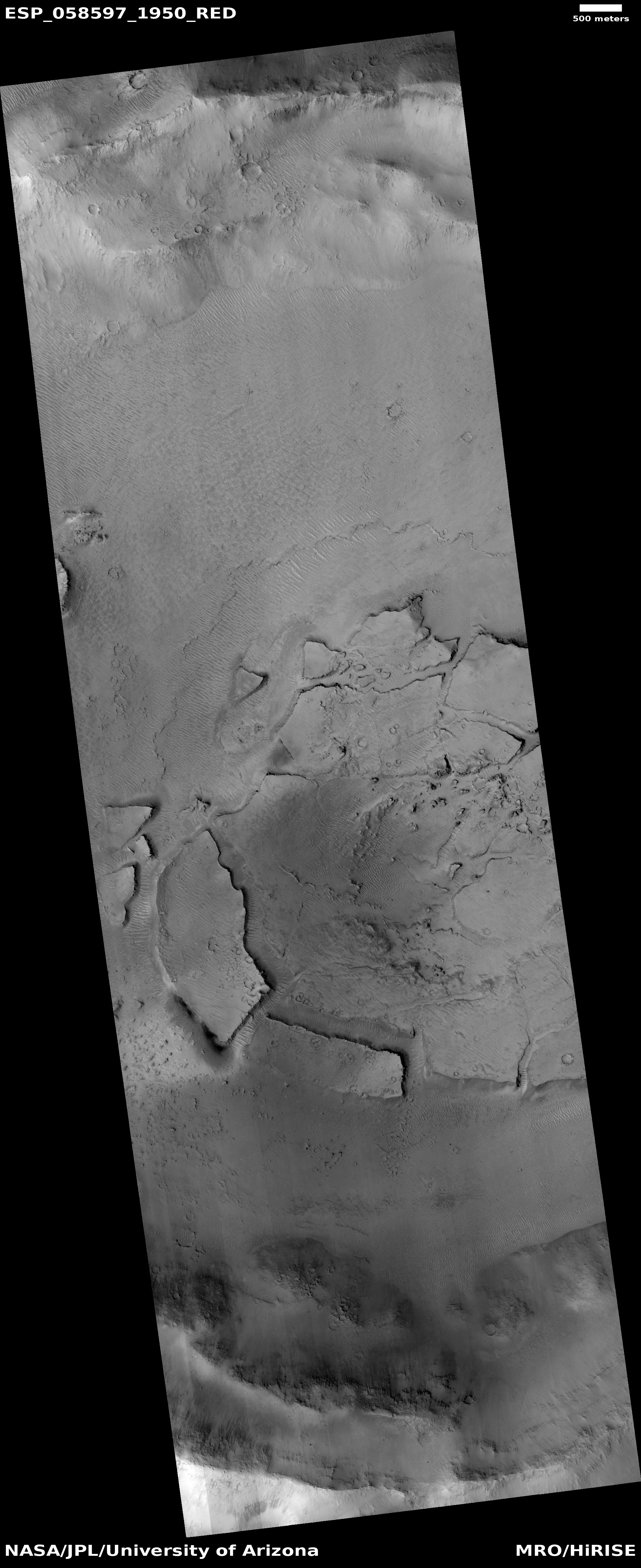
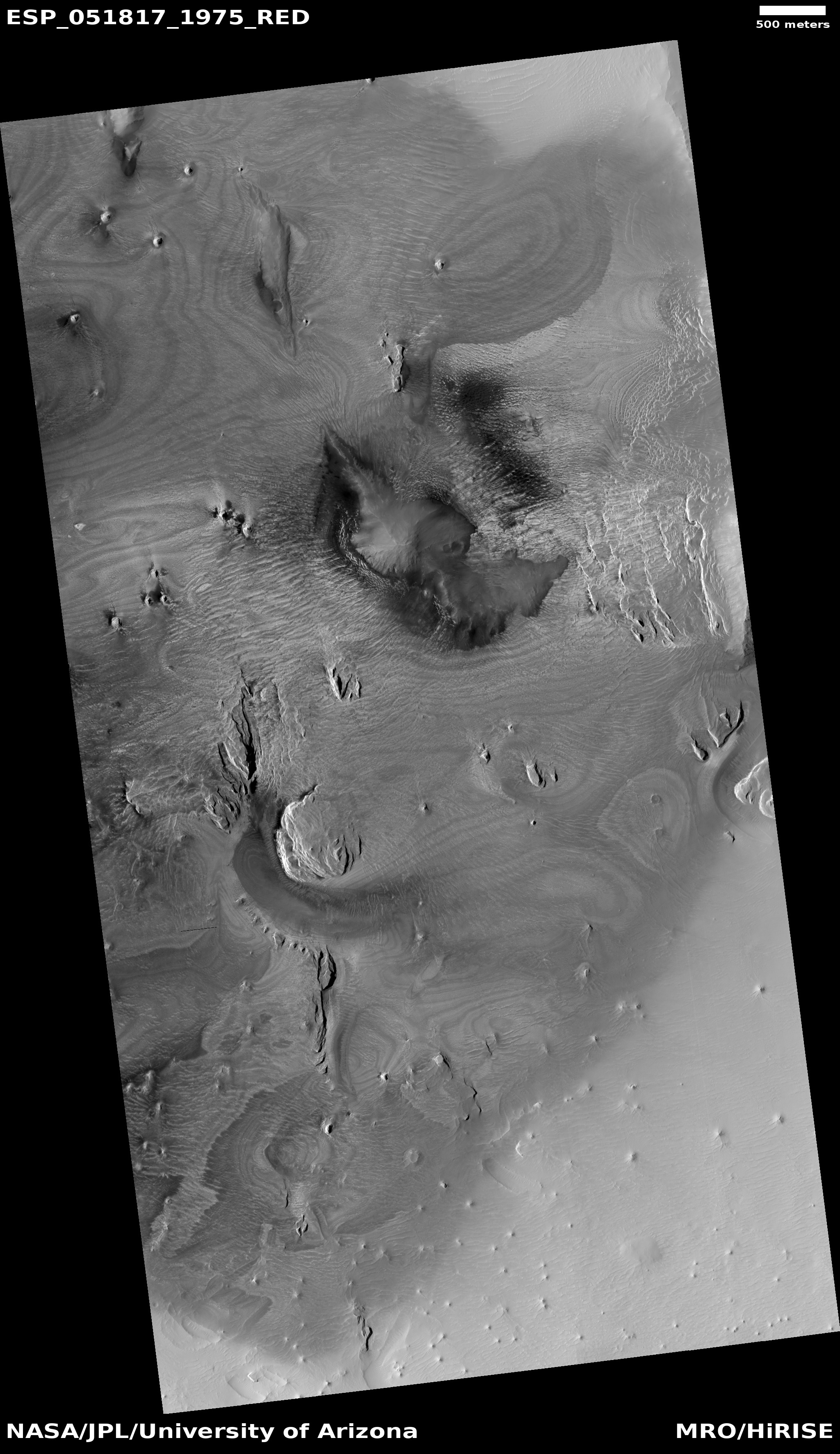
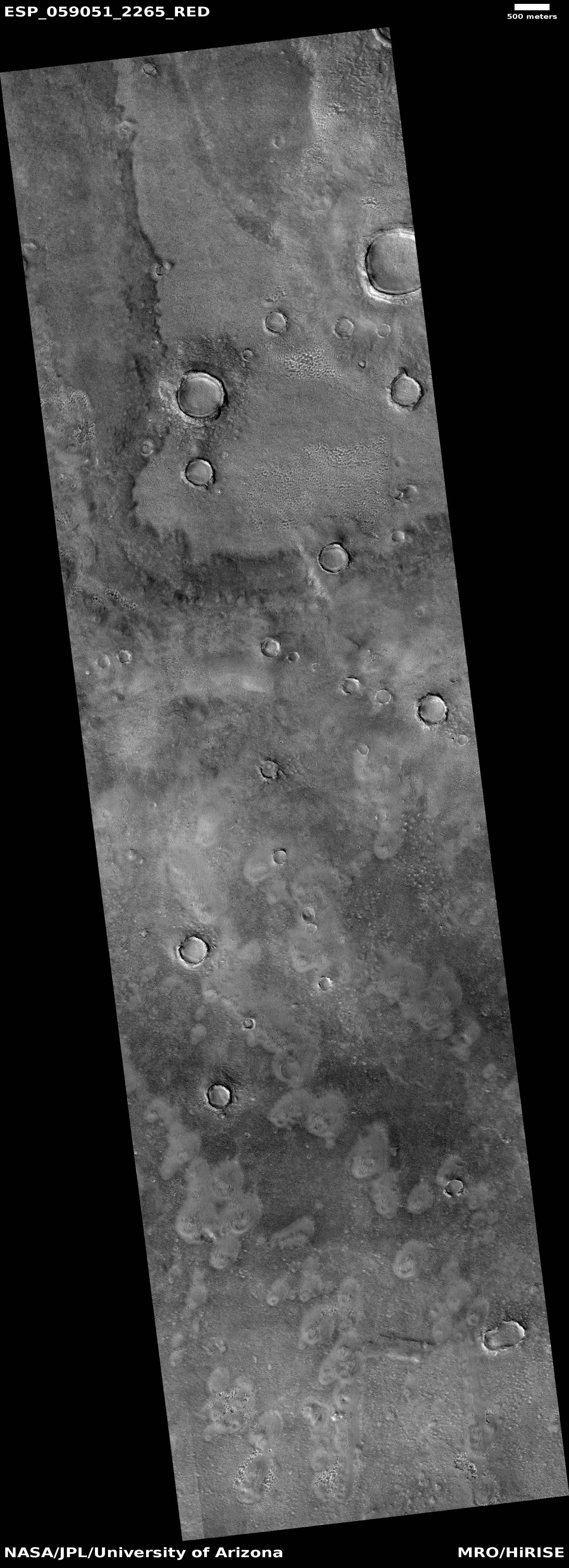
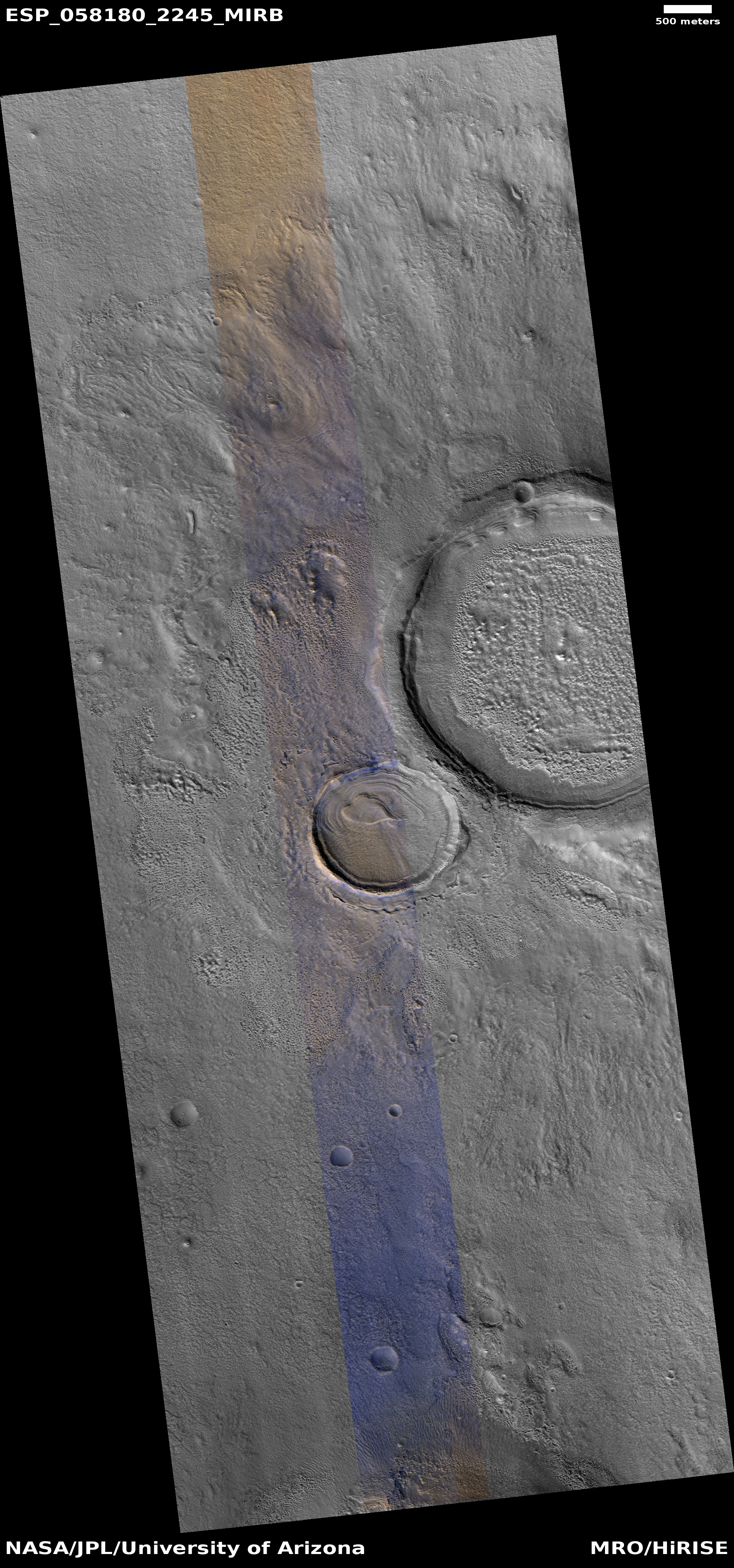
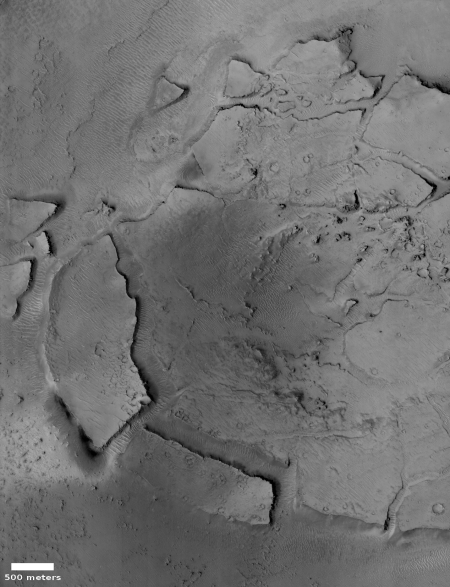
Cool image time! The photo to the right, rotated, cropped, and reduced to post here, was taken on August 9, 2020 by the high resolution camera on Mars Reconnaissance Orbiter (MRO) and was featured today as this camera’s picture of the day. As today’s caption notes:

This observation focuses a ridge that is standing above the old lava surface of the floor of Echus Chasma. What is this ridge doing here? Is it preexisting material surrounded by lava? Is it material pushed up at a restraining bend? If the ridge is not lava, it may have colorful flanks.

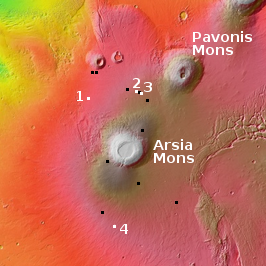
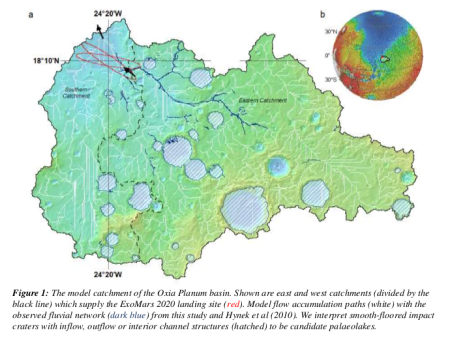
The overview map below shows that this location in Echus Chasma is even more interesting, as some scientists believe it once also held a large lake.
» Read more

2 comments

Mars: Are these eroding glaciers or impacts in lava?

Eroding lava or glaciers?
Click for original image.

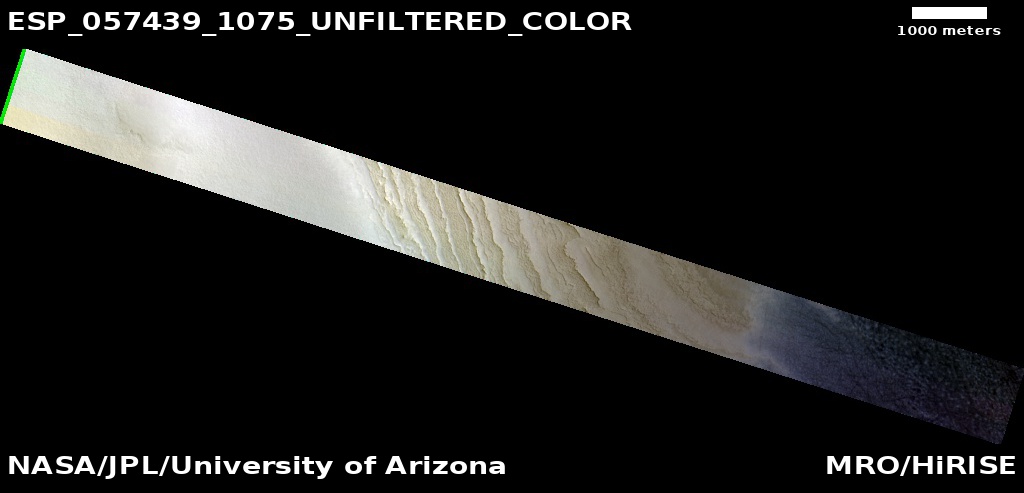
Cool image time and a mystery! The photo to the right, cropped to post here, was taken on March 29, 2022 by the high resolution camera on Mars Reconnaissance Orbiter (MRO) of an 18-mile-wide crater in the southern cratered highlands of Mars. The full picture, dubbed “Steep Cliff,” was taken apparently to get a good view of the crater’s northern rim. The rim’s steepness suggests that the floor of the crater is significantly filled.

More intriguing however are the scattering of strange depressions about six miles south of the rim. What caused them? The crater’s location is in a part of Mars where it is not unusual to find both glacial features as well as flood plain lava. In fact, the crater’s northeast and southwest rims appear to have been buried by what appears to be flood lava. The northern rim’s shallowness also suggests the crater is well filled with flood lava.

However, the crater is also at 38 degrees south latitude, a latitude where planetary scientists have found lots of glacial features. Much of this crater fill could be glacial.

The overview map below illustrates this mystery.
» Read more

1 comment

Dry flows on Mars?

Flows in Orson Welles Crater
Click for original image.

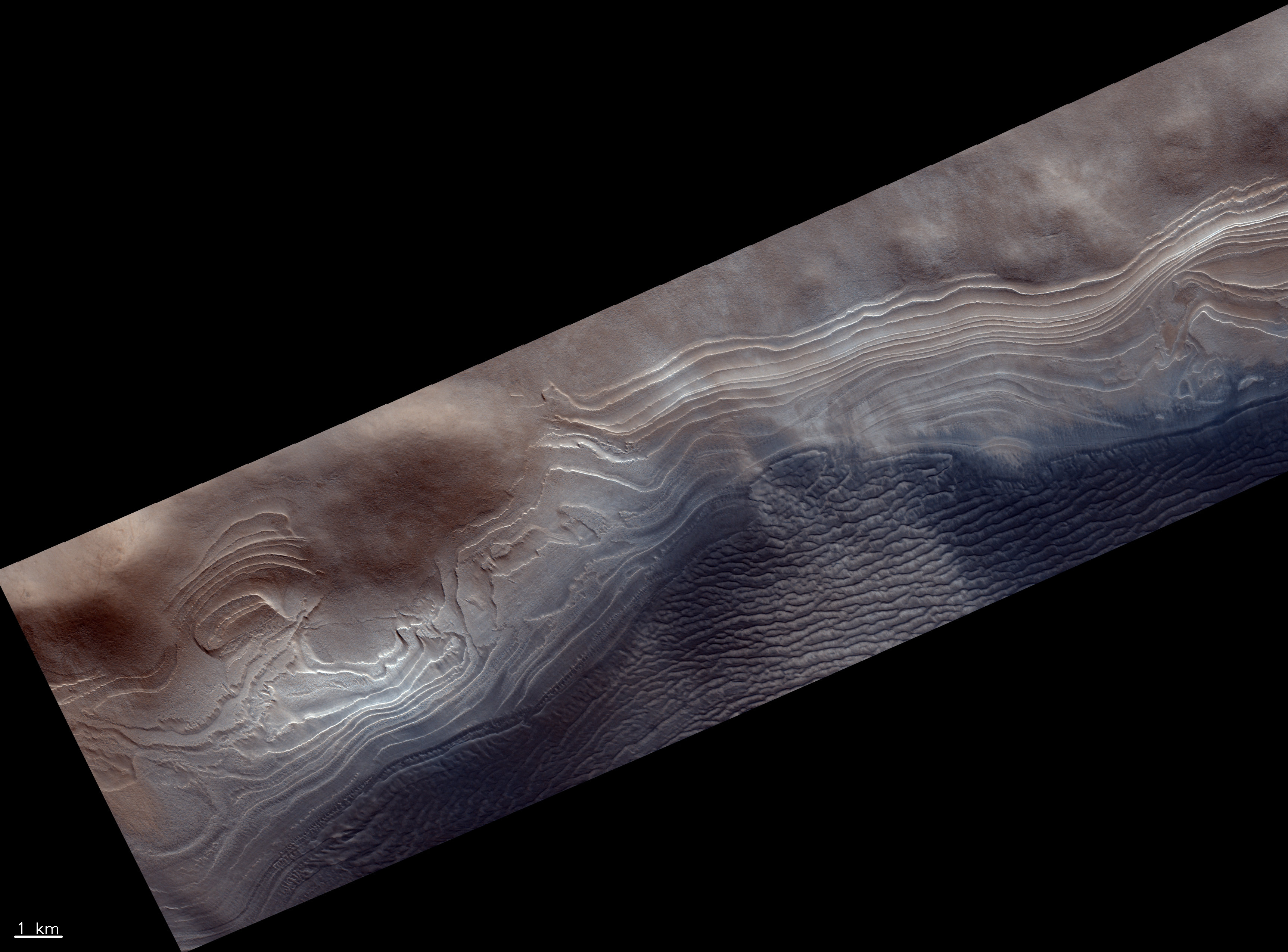
Cool image time! The picture to the right, rotated, cropped, reduced, and annotated to post here, was taken on September 21, 2021 by the high resolution camera on Mars Reconnaissance Orbiter (MRO) and shows what appear to be a variety of flows, from alluvial fill to slope streaks to dust coming down the southeastern interior rim of 77-mile-wide Orson Welles Crater on Mars.

The location is almost right on the equator, so none of these flows are ice- or water-related. Nor are such flows unusual in the meandering 800-mile-long canyon that cuts through Orson Wells crater, dubbed Shalbatana Vallis. I featured similar flows at a spot to the north and downstream from this one in May 2021, also on the canyon’s eastern rim.

The overview map below provides some context.
» Read more

0 comments

Perseverance’s upcoming travel plans

Overview map
Click for interactive map.

Today’s update from the Perseverance’s science team provided a rough outline of their travel and drill-sampling plans for the Mars rover in Jezero Crater as it begins its climb up onto the delta that once poured into the crater. The route they plan to travel initially is dubbed Hawksbill Gap.

At Hawksbill Gap, however, we may instead carry out the first portion of the sampling sol path (which includes abrasion and collecting observations using our proximity science instruments) at up to 5 locations along our ascent. After that, weโ€™ll turn around and begin a descent back down Hawksbill Gap and collect rock core samples at 3 of our abrasion locations.

This modified sampling strategy is intended to provide the team with valuable contextual information as we climb Hawksbill Gap and interpret the delta stratigraphy around us. With proximity science data in-hand, we can down-select our sampling sites to ensure weโ€™ll be collecting the most scientifically valuable cores along our descent. Of course, we still maintain the option of collecting sample cores at any point during our ascent, if the team decides a particular abrasion site warrants immediate sampling.

The map above shows my guess (the red dotted lines) as to their potential routes uphill. As the science team has so far not published a map indicating exactly where Hawksbill Gap is, I can only guess at this point. The blue dot indicates Perseverance’s present position, the green dot Ingenuity.

As for the helicopter, there is no word yet whether the engineers have successfully gotten its batteries back to full charge. Until then, it cannot fly, and is also at risk of freezing up in the cold Martian winter.

0 comments

Zhurong goes into hibernation

Overview map

According to a report today in China’s state-run press, the team running its Zhurong Mars rover have placed it into a hibernation mode in order to sit out the Martian winter.

To tackle the dust storms and low-temperature challenges, the Chinese rover went into dormancy on Wednesday. It is expected to wake up and resume work in December when the dust clears and Mars enters its spring season, the administration said in a statement.

The rover sits somewhere in the blue circle in the map to the right, created using elevation data and images from Mars Reconnaissance Orbiter (MRO). This region is about 25 degrees north latitude, so though it is in the dry equatorial regions of Mars, it still gets very cold in winter, down to -180 degrees Fahrenheit at night. Furthermore, the increased winter dust storms block the light from the Sun, which reduces the available power the rover’s solar panels can produce.

Chinese engineers have apparently adapted the hibernation techniques they use on the Moon with their Yutu-2 rover to place Zhurong in hibernation.

0 comments

The tuffy ground in the foothills of Mount Sharp

Shelfstone on Mars?
Click for original image.

Cool image time! The photo to the right, reduced and enhanced to post here, was taken on May 13, 2022 by the high resolution camera on the rover Curiosity, looking down at some of the unusual features on the ground near the rover.

The lighter circular feature in the center is not natural, but created by Curiosity’s Dust Removal Tool (DRT). As explained on May 16th on the science team’s blog:

When that dust settles on rocks, it can partially mask the chemistry and surface texture of these rocks from APXS and MAHLI in particular [two other Curiosity instruments]. Brushing rock surfaces with the DRT is not always possible, but it does improve scientific assessments of these surfaces.

What attracted me to this photo was the tuff-like look of that uplifted flat rock. It looks just like many surfaces one sees in a cave, where the surface gets covered with calcite flowstone or popcorn, due to either water flow or condensation and then evaporation of calcite-saturated water on the surface. In this case the cave formation this flat rock most resembles visually is shelfstone, though the formation process and chemistry was certainly different. It does suggest strongly however that some form of water process occurred here.

0 comments

InSight likely to shut down by the end of summer

Martian quake map as seen by InSight
Martian quake map as seen by InSight, adapted from this 2021
presentation [pdf]

According to the InSight science team, the Mars lander and its seismometer will likely shut down operations by the end of the summer due to lack of power.

“Towards the end of summer of ’22, we anticipate our seismometer will be turned off, not because we want to turn it off but unfortunately, we don’t have the energy to run it,” Garcia said. She said the team will use it intermittently after that as long as power is available, but by the end of the year the spacecraft is expected to fall silent.

The intermittent readings of the seismometer will be of extremely limited use, as it will then be pure luck whether it detects a quake, and any detection will not provide the true rate of quakes on Mars.

The loss of power is due to dust on the solar panels. The team had hoped a dust devil would come by periodically to blow the panels clean, as happened routinely with the Spirit and Opportunity rovers, but InSight has not been so lucky.

It appears the safe mode that occurred shortly after InSight detected its largest Mars quake yet on May 10th was very temporary, though right now the seismometer is essentially the only instrument they have power to run.

Overall, this mission has a very spotty history. Its launch was delayed two years when the French attempt to build the seismometer failed. The delay cost NASA’s planetary program $150 million, at a minimum.

Then lander’s second of two main instruments, a German experiment to dig down 16 feet to insert a heat sensor into the ground, failed when its digging tool, dubbed the mole, was unable to penetrate the alien Martian soil.

Fortunately, InSight’s prime instrument, the seismometer (finally completed by JPL) worked, giving us a first look into the structure of Mars’ interior as well as where earthquakes are found on its surface.

1 comment

Mahma Comparisons – Biggest volcano eruptions known

An evening pause: I run this at 2x speed, but if you aren’t impatient enjoy it as it is. The size difference between the smallest and largest is quite daunting. Note too that this video only lists the known giant eruptions, explosive events that happened suddenly. It does not include some of the Earth’s largest long term volcanic events, such as the Deccan Traps, that happened repeatedly lasting millions of years that is thought to have possibly contributed to the extinction of the dinosaurs.

Hat tip Alton Blevins.

13 comments

Pointy rocks on Mars

Pointy rocks as seen by Curiosity
Click for full image.

Pointy rocks as seen by Perseverance
Click for full image.

We have two cool images today from both of America’s rovers on Mars, each of which illustrates the alien nature of the red planet.

First on the right, cropped, reduced, and sharpened to post here, is a close-up taken by Curiosity’s high resolution camera on May 14, 2022 of the rightmost jagged boulder in yesterday’s navigation panorama. The number of layers is astonishing, though hardly a unique phenomenon as seen by Curiosity in its travels. Each likely marks one of many climate and geological cycles, each laying down another unique stratum for a relatively short period of geological time. Some might be volcanic ash or lava layers. Some might be layers caused by climatic changes.

The ability of these thin layers to extend outward so much, almost like they were floating, illustrates the weak Martian gravity, as well as the thinness of its atmosphere. On Earth, if the wind and weather didn’t cause these flakes to break, the gravity would.

Second on the right, cropped and sharpened to post here, is a high resolution photo taken by Perseverance on May 15, 2022 of one of the cliff faces seen by the rover looking up into the delta in Jezero Crater. Here again we see many layers and jagged, pointy rocks, illustrating again the many cycles in the past that formed the delta as it flowed into the crater.

The smoothness on the surface of the leftmost pointy rock suggests that it has stood in this position for a long very time, allowing the wind of Mars’ very thin atmosphere to erode its rough surface.

10 comments

Curiosity climbs on!

Curiosity's view to the southeast, May 15, 2022 (Sol 3474)
Click for full resolution. Original images can be found here, here, and here.

Overview map
Click for interactive map.

Cool image time! The panorama above, created from three photos taken on May 15, 2022 by the right navigation camera on Curiosity, shows the rocky and hilly terrain directly ahead of the rover’s present course. In the far distance in the center left can faintly be seen the lower flanks of Mount Sharp itself. The dust in the winter air acts to partly obscure those distant slopes.

The overview map to the right shows us what we are looking at. The yellow lines are my rough guess at the terrain covered by the panorama. The blue dot marks Curiosity’s present position. The red dotted line the rover’s original planned route. The white arrows indicate one of the more interesting upcoming geological features, dubbed by scientists the “marker horizon,” a distinct layer found in many places on the flanks of Mount Sharp.

The green dot marks the approximate location of a recurring slope lineae, a place where the cliff is seasonally darkened by a streak that appears each spring and then fades.

The navigation panorama taken on May 15th also included four more shots covering terrain to the southwest, so what we see above is not necessarily where the rover is heading. The eventual goal is to get back to that red dotted line, but how the rover does so is apparently still being discussed by the science team. It appears they are trying to decide whether to head west again to reach Gediz Vallis Ridge, or instead cut south heading directly for Gediz Vallis.

Either way, that teethlike row of boulders in the near foreground is certainly impressive.

2 comments

Scientists grow plants in lunar soil brought by from Apollo missions

In their first attempt, scientists have successfully grown plants in a small lunar soil sample brought by astronauts during the Apollo missions.

Researchers at the University of Florida had spent 11 years requesting permission from Nasa to borrow some of the lunar dust brought back by astronauts on the first manned Apollo 11 and Apollo 12 missions in 1969 and the Apollo 17 mission in 1972. Armstrong and Aldrin brought back 21.6kg of material including 50 rocks, samples of dust and two cores of rock after boring 13cm down into the Moonโ€™s surface. They contained no water and no signs of life.

…The lunar samples are deemed to be of โ€œincalculable historical and scientific significanceโ€, so the scientists were given only 12 grams, just a few teaspoonsโ€™ full, to work with and had to design a miniature experiment.

The researchers used thimble-sized wells in a dish usually used for growing cells as miniature plant pots and filled each with about one gram of lunar soil. They moistened the soil with water and a solution of nutrients and added a small number of seeds from the Arabidopsis thaliana plant, a common flowering weed also known as mouse-ear or thale cress. [emphasis mine]

The plants grew, but were smaller and took longer to grow then plants on even the most extreme environments on Earth. The scientists also found that plants did better in buried lunar soil then the material on the surface that had been exposed to the harsh radiation of space, suggesting that plowing the soil before planting will enhance growth.

The highlighted words in the quote above illustrate the madness of NASA’s bureaucracy. These lunar samples were brought back so that scientists could study it, not so that it could be locked away in a vault forever never to be touched. To make this very intelligence experiment wait 11 years before getting permission is absurd.

12 comments

Mountains, Mesas, and Box Canyons on the floor of Valles Marineris

Mountains, Mesas, and Box Canyons
Click for full image.

Overview map

Cool image time! The photo above, cropped, reduced, and rotated to post here, was taken on March 12, 2022 by the high resolution camera on Mars Reconnaissance Orbiter (MRO). It shows a small section of the floor of the giant 2,550-mile-long and 400-mile-wide Valles Marineris canyon on Mars. In fact, this section, as indicated by the black rectangle in the overview map below, is practically in the center of the canyon, at its widest point.

The geology here hints at several Martian processes. The mesas and closed canyons in the north are typical of chaos terrain, where it erosion appears to form along fault lines to create the random intersecting canyons. In other places on Mars, in the mid-latitudes, that erosion appears mostly formed by glacial activity. Here, in Valles Marineris at only 7 degrees north latitude, little ice had been expected.

However, this spot is also in the dead center of a region where orbital data from Europeโ€™s Trace Gas Orbiter (TGO) suggests there is a surprisingly large underground reservoir of hydrogen, which is assumed could only exist if it was locked in water molecules.

In fact, at this spot the data suggests up to 40% of the near-surface material might be composed of water (by weight). If so, that underground reservoir of ice could be causing the erosion that is creating this massive chaos terrain.

Meanwhile, the light-colored mountain in the south is the westernmost nose of a 50-mile-long ridgeline coming down from the canyon’s rim, about 30,000 feet higher. Its dendritic nature, like the hollows that form in the mountains of wet regions on Earth, suggest rainfall and water flowing downhill, wearing away these hollows over eons.

Rain however is almost certainly not the cause. Instead, we could be seeing erosion from wind, or maybe dry ice snow that fell long ago when this region was at a higher latitude when Mars’ rotational tilt was different.

Either way, the massive geology here illustrates the monumental nature of this largest canyon in the solar system, as well as the difficulties of exploring it.

1 comment
1 74 75 76 77 78 157