Thomas Jefferson — The meaning of the Declaration of Independence

An evening pause: Tomorrow is the Fourth of July, in which lovers of freedom and individual rights celebrate the signing of the Declaration of Independence, where by this nation committed itself forever to providing its citizens “the right to life, liberty, and the pursuit of happiness.”

Those words were written by Thomas Jefferson. In tonight’s evening pause, Steve Edenbo as Thomas Jefferson recites Jefferson’s thoughts on the meaning of his own words, taken from a letter he wrote just prior to the 50th anniversary of that signing in 1826, and mere weeks from his death.

May true Americans never stop honoring these words, and that man.

1 comment

Midnight repost: “What ever you do, don’t ‘shut up.'”

The tenth anniversary retrospective of Behind the Black continues: Tonight’s midnight repost is actually something not by me, but a video commentary by Andrew Klavan that he broadcast in 2011 and I embedded as a post in January of that year.

Sadly, his words have not become dated in the slightest. If anything, they has become more topical. And as then, I abide by his final words, “Whatever you do, don’t ‘shut up.””

3 comments

Midnight repost: Behind the Black

In celebration of the tenth anniversary the Behind the Black, I will each evening at midnight this month repost an earlier essay or article posted on the website sometime during the past ten years. Since I have posted more than 22,000 times since I started this website in July of 2010, I have plenty of good stuff to choose from. The thirty reposts over the next month will highlight some of the best.

We begin with what is really the only Easter Egg on Behind the Black, as it has sat as a unheralded link dubbed only Behind the Black on the main page since the website’s beginning. That link takes you to the following essay, excerpted and adapted from the final afterword in the paperback edition of my book about the Hubble Space Telescope, The Universe in a Mirror.

It explains much about my goals in all that I write.
————————————
Behind the Black

At the end of the last spacewalk during this last servicing mission to Hubble, astronaut John Grunsfeld took a few moments to reflect on Hubble’s importance. This was Grunsfeld’s third spaceflight and eighth spacewalk to Hubble, and no one had been more passionate or dedicated in his effort to get all of Hubble’s repairs and upgrades completed.

“As Arthur C. Clarke says,” Grunsfeld said, “the only way of finding the limits of the possible is by going beyond them into the impossible.”

For most of human history, the range of each person’s experience was of a distant and unreachable horizon. This untouchable horizon defined “the limits of the possible.” No matter how far an individual traveled, there was always a forever receding horizon line of unknown territory tantalizingly out of reach before him.
» Read more

1 comment

Truth, Justice, and the American Way

The words spoken during the opening credits of a 1950s children’s television show:

Faster than a speeding bullet.
More powerful than a locomotive.
Able to leap tall buildings in a single bound.
Look up in the sky!
It’s a bird.
It’s a plane.
It’s Superman!

Yes, it’s Superman, strange visitor from another planet who came to Earth with powers and abilities far beyond those of mortal men.

Superman, who can change the course of mighty rivers, bend steel in his bare hands, and who, disguised as Clark Kent, mild-mannered reporter for a great metropolitan newspaper, fights a never-ending battle for truth, justice, and the American Way.

That television show was obviously Superman, starring George Reeves, and these opening words expressed the mythology and basic ideals by which this most popular of all comic-book super-heroes lived.

I grew up with those words. They had been bequeathed to me by the American generation that had fought and won World War II against the genocidal Nazis, and expressed the fundamental ideals of that generation.

Much of the meaning of these fundamental ideals is outright and clear.

Truth means you always strive to be honest, and when you make a mistake you admit to it, without flinching. Or as Superman says quite clearly in the 1978 film, “I never lie,” saying this immediately after repeating that he is here “to fight for truth, justice, and the American way.”

Justice means you strive to administer the rules fairly so that the innocent are protected and the guilty are punished properly. It also means that you treat others justly, with respect and kindness, while defiantly standing up to those who would do the weak harm.

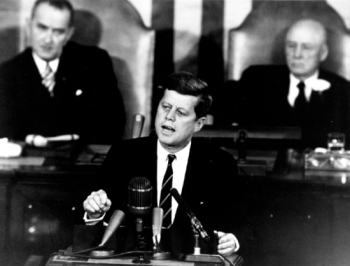
The phrase “the American Way” however is more puzzling. As a child I accepted it, but I have spent a lifetime as a historian and reader trying to understand it on a more fundamental level. The writers in the 1950s who gave that task to Superman knew what it meant, and assumed everyone else did. By the 1950s and 1960s they however no longer did a good job of teaching its meaning to my sixties generation, and many from my time grew up not understanding it.

I think I finally hit upon its basic meaning in writing Genesis: The Story of Apollo 8. As I said in trying to explain why the astronauts on that mission choose to read the first twelve verses of the Old Testament on Christmas Eve while orbiting the Moon,
» Read more

24 comments

Lego Antikythera Mechanism

An evening pause: From the youtube webpage:

The Antikythera Mechanism is the oldest known scientific computer, built in Greece at around 100 BCE. Lost for 2000 years, it was recovered from a shipwreck in 1901. But not until a century later was its purpose understood: an astronomical clock that determines the positions of celestial bodies with extraordinary precision. In 2010, we built a fully-functional replica out of Lego.

Hat tip Shaun Karry.

3 comments

Vera Lynn – The White Cliffs Of Dover & We’ll Meet Again

An evening pause: Performed live in 1984 to celebrate the fortieth anniversary of D-Day. Both songs were British hits during World War II, illustrating that generation’s cheerful determination to keep calm and carry on. It seems fitting to show them again today, the day before the D-Day anniversary.

Hat tip Tom Biggar, who notes that Vera Lynn is still alive, 103 years young.

0 comments

The history of the U.S.’s giant off-road land trains

Link here. These massive and very impressive working trains designed as trucks that could travel across roadless terrain, in the Arctic, is quite fascinating. This paragraph about their designer and builder however illustrates the kind of nation that made the fast building of such things possible:

Born in 1888, Robert Gilmore LeTourneau was an inventor of heavy machinery. In WWII, 70 percent of the Allies’ earthmoving equipment was created by LeTourneau Technologies, Inc. Having very little formal education, LeTourneau began his working career as an ironmonger. By the time he died in 1969 he was tremendously wealthy and personally held nearly 300 patents. He is buried on the campus of the University he founded in his name, where his gravestone reads “MOVER OF MEN AND MOUNTAINS.” Just a little character development for you.

Our country can still such a place, where we are not afraid and allow anyone to do anything, if they have the courage and the brains and the commitment. It requires however that we be both free and brave. Wearing masks for symbolic reasons and out of fear is certainly not a path to such a nation.

Hat tip Tom Biggar.

1 comment

NASA names WFIRST after its first head of astronomy, Nancy Roman

NASA today announced that it has renamed the proposed Wide Field Infrared Survey Telescope (WFIRST) the Nancy Grace Roman Telescope in honor of the agency’s first head of astronomy.

Considered the β€œmother” of NASA’s Hubble Space Telescope, which launched 30 years ago, Roman tirelessly advocated for new tools that would allow scientists to study the broader universe from space. She left behind a tremendous legacy in the scientific community when she died in 2018.

…When she arrived at NASA, astronomers could obtain data from balloons, sounding rockets and airplanes, but they could not measure all the wavelengths of light. Earth’s atmosphere blocks out much of the radiation that comes from the distant universe. What’s more, only a telescope in space has the luxury of perpetual nighttime and doesn’t have to shut down during the day. Roman knew that to see the universe through more powerful, unblinking eyes, NASA would have to send telescopes to space.

Through Roman’s leadership, NASA launched four Orbiting Astronomical Observatories between 1966 and 1972. While only two of the four were successful, they demonstrated the value of space-based astrophysics and represented the precursors to Hubble. She also championed the International Ultraviolet Explorer, which was built in the 1970s as a joint project between NASA, ESA (European Space Agency) and the United Kingdom, as well as the Cosmic Background Explorer, which measured the leftover radiation from the big bang and led to two of its leading scientists receiving the 2006 Nobel Prize in Physics.

Above all, Roman is credited with making the Hubble Space Telescope a reality. In the mid-1960s, she set up a committee of astronomers and engineers to envision a telescope that could accomplish important scientific goals. She convinced NASA and Congress that it was a priority to launch the most powerful space telescope the world had ever seen.

This is a nice and very fitting gesture to honor one of the many unsung heroes who were important in the history of space astronomy. I just hope that Roman’s telescope doesn’t end up like James Webb’s, so over budget and behind schedule that it destroys all other NASA space telescope projects. Sadly, its track record so far suggests this is what will happen, which is why the Trump administration has been trying to get it canceled.

0 comments

A Trip Through New York City in 1911

An evening pause: I’ve posted similar early 1900 film footage for Paris and San Francisco. My one reservation about this restoration is the adding of color. They don’t over do it, but adds an element of inaccuracy to the footage.

Hat tip Mike Nelson, noted some of the same things I did with the previous examples.

What strikes me is how well dressed everyone was, how there was no trash on the streets (despite no obvious public trash cans), no graffiti, no road rage despite the complete lack of traffic control, and the air quality looked significantly worse than today. Other than cleaner air I’m not so sure we can call today a big improvement.

I personally am not sure the air quality was worse either. Watch, and get a sense of what America was once like.

11 comments

Splashdown of Apollo 13

Today marks the fiftieth anniversary of the successful safe return to Earth of the Apollo 13 astronauts, Jim Lovell, Jack Swigert, and Fred Haise. Below is CBS’s coverage of that splashdown, in three videos.

If you are still under Wuhan flu house arrest, spend the time to watch them all. Each will automatically start after the previous ends.

Once again it is astonishing to see the differences from today. Note the shot of the quiet crowds watching the telecast in Grand Central Station, and their calm but joyous applause at their first view of the capsule, its parachutes deployed, gently descending safely to the ocean.

As with the moment when the failure occurred on April 13th, the news coverage continues to be detailed and focused on covering the event, not showing off news anchors and pundits. There are no shots of Walter Cronkite in his studio. He is not the story, and he knows it.

The coverage is also patient. For long periods while the divers are securing the capsule in the water, not much happens. There is no effort to return to the studio, or to break for commercials. The focus is on the story, and the story only.

Will someone please tell this to Anderson Cooper, Jim Acosta, and others of their modern ilk?

5 comments

Failure on Apollo 13

Today marks the fiftieth anniversary of the moment during the Apollo 13 mission to the Moon when there was an explosion that badly damaged the service module of the Apollo spacecraft, forcing the crew to use its Lunar Module (LM) as a lifeboat in order to get back to Earth.

Below is CBS’s coverage of that moment.

Because this video was recorded off of an analog television, the visuals are poor, to say the least, including several moments when the television loses vertical hold (a problem typical of early televisions).

However, it is very instructive to watch it, mostly to see the differences from today. Notice how calm everyone is, both at NASA and at CBS. Notice also how positive they are. Rather than hyping the possibility of death and failure, Cronkite is focused on explaining what the engineers are trying to do to save the astronauts.

And notice the detail and accuracy of his reporting. Cronkite has not only made it a point to educate himself on what is involved, he is making a concerted effort to provide this information to his audience. No speculations and opinions, only detailed reporting.

O if only we could see one tenth of such reporting on television today. The country’s mood would instantly improve a million percent.

11 comments

The 50th anniversary of Apollo 13

Today NASA announced its plans to mark the fiftieth anniversary of the launch of Apollo 13 on April 11, the only Apollo mission to fail in its goal of landing on the Moon while also proving that the engineering design of Apollo was brilliant, making possible under dire conditions the safe return to Earth of the astronauts.

While en route to the Moon on April 13, an oxygen tank in the Apollo service module ruptured. The lunar landing and moonwalks, which would have been executed by Lovell and Haise, were aborted as a dedicated team of flight controllers and engineering experts in the Apollo Mission Control Center devoted their efforts to developing a plan to shelter the crew in the lunar module as a β€œlifeboat” and retain sufficient resources to bring the spacecraft and its crew back home safely. Splashdown occurred in the Pacific Ocean at 1:07 p.m. April 17, after a flight that lasted five days, 22 hours and 54 minutes.

NASA is celebrating this anniversary in many virtual ways, though all public in-person events have been cancelled due to the Wuhan panic.

Below is a video showing the launch.as covered on CBS (Hat tip reader Mike Nelson).

The visuals are not great, partly because it was broadcast on an analog television, and partly because it appears to be a recording taken by a camera looking at that broadcast. At several points it appears the television loses vertical hold (a problem typical of early televisions). Still, it is worth watching simply to see how news organizations covered such events then, in comparison to today.

If you want to spend some time of your Wuhan house arrest watching more, the video automatically jumps to later videos of CBS’s coverage, including the moment the failure occurred as well as the splashdown. I will post these next week, on the fiftieth anniversary of each event.

3 comments

Apollo 15 command module pilot Al Worden passes at 88

Their numbers slowly shrink: Al Worden, who orbited the Moon as commander of the Apollo 15 command module, has passed away at the age of 88.

For three days in 1971, Worden circled the moon as Dave Scott and Jim Irwin worked on the lunar surface β€” including driving a rover for the first time. Being a command module pilot has been called the loneliest job in humanity. In the spacecraft alone, not able to talk to anyone when the capsule was on the back side of the moon. But Worden told NPR in a 2016 interview, “I was pretty comfortable with being by myself.”

After Scott and Irwin returned from the lunar surface and the crew was on its way back home, Worden conducted a spacewalk, the first ever in deep-space. He ventured outside the capsule to retrieve film from the scientific cameras.

The link is to an NPR obituary, so of course it makes a big deal about the effort by the astronauts to make some extra money by selling postage stamp covers that they bought with them post-flight.

Worden remembers it this way, “Jim and I were told that this was something that happened on every flight. No big deal. Well, it turned out to be a huge deal.” Even though previous crews had profited off lunar souvenirs, it became a public relations nightmare for NASA. The three astronauts never flew again. Worden said he regretted what happened: “I think the flight speaks for itself. I think the science that we did on the flight speaks for itself.”

I always thought it was quite offensive that the American government, the press, NASA, and the public took offense then about this. These guys were not paid that much, slightly above an ordinary middle class salary, for doing something totally unique and incredibly dangerous. If they had a chance to make some extra cash on the side, all power to them.

This was just after the 1960s, however, and private enterprise and commercial profit was steadily going out of fashion. We as a culture had bought into the Soviet model of top-down government programs that were centrally controlled. For any of the individuals involved to make some independent cash for themselves was considered crass and corrupt.

Regardless, God speed, Al Worden.

1 comment
1 15 16 17 18 19 55