Glacial evidence in the dry equatorial regions of Mars?

Is this evidence of glacial ice in the Martian dry equatorial regions?
Click for original image.

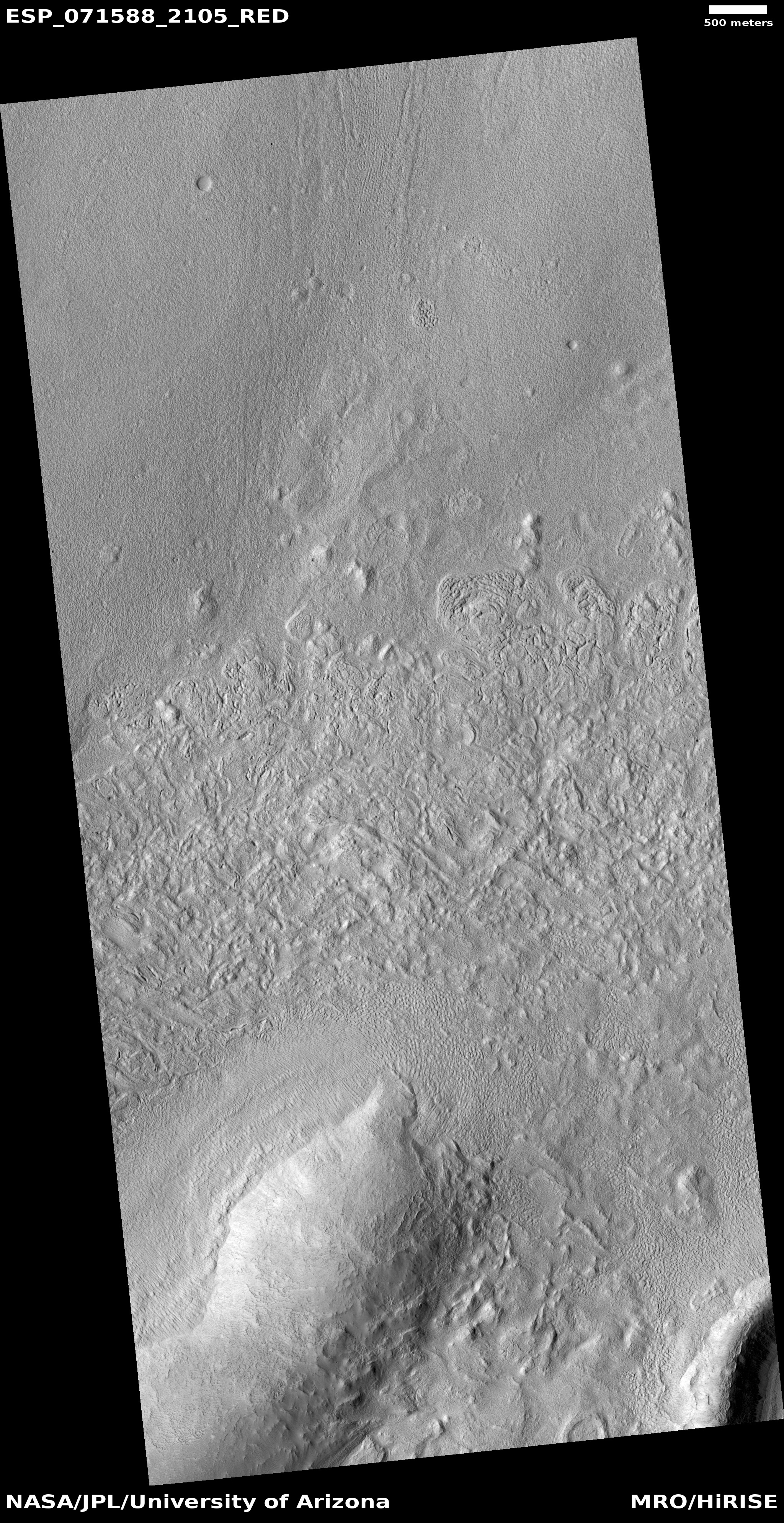
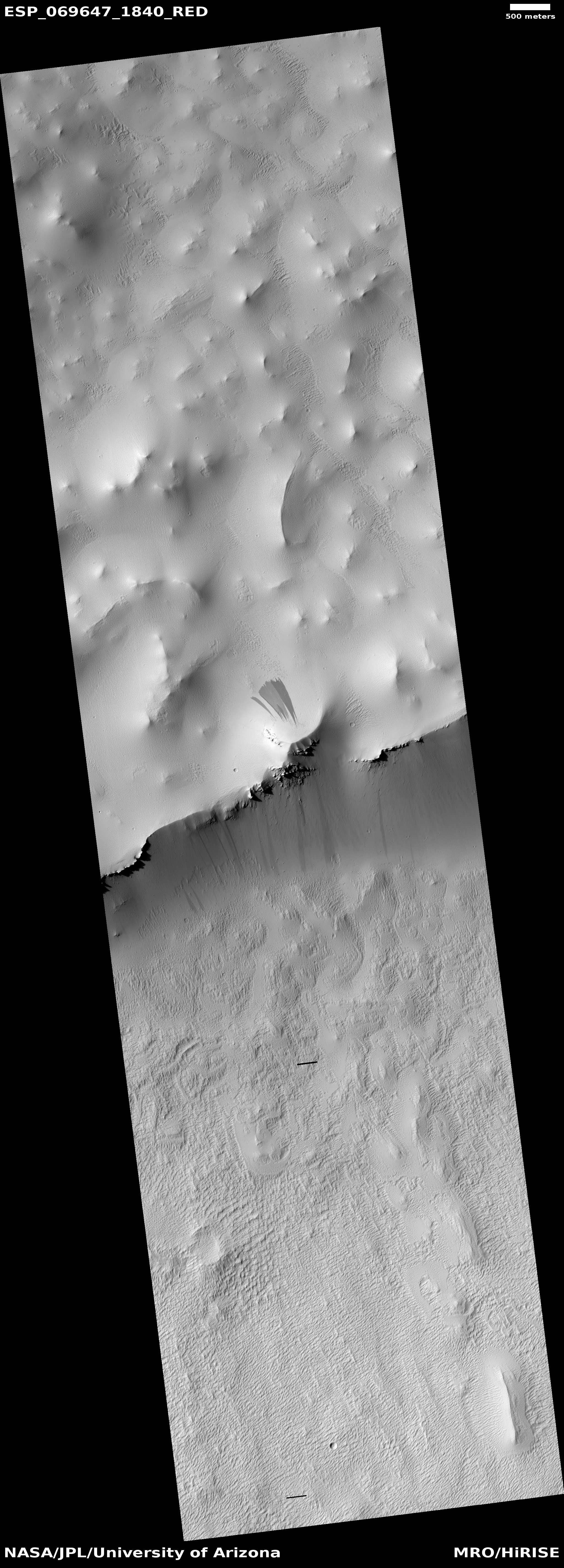
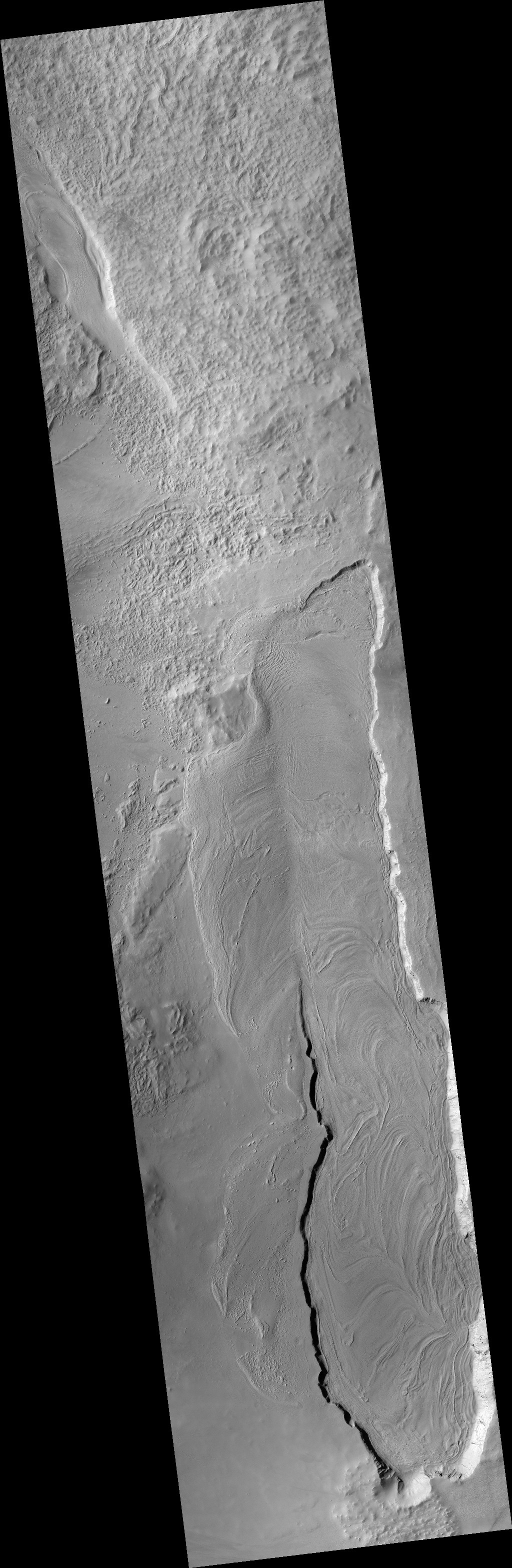
Cool image time! The picture to the right, rotated, cropped, rotated, and sharpened to post here, was taken on June 3, 2023 by the high resolution camera on Mars Reconnaissance Orbiter (MRO). It shows the eastern half of a six-mile-wide unnamed crater with a depth of about 1,500 to 2,000 feet from rim to floor.

What makes this picture significant is the patchy material in the center of that crater floor, some of which looks almost like very old peeling paint. It also resembles the kind of glacial features routinely seen in many craters poleward of 30 degrees latitude on Mars.

Is this another example of such glacial features? If so, its location is what makes it significant.
» Read more

0 comments

Flat-topped Martian mesa

Flat-topped mesa on Mars
Click for original image.

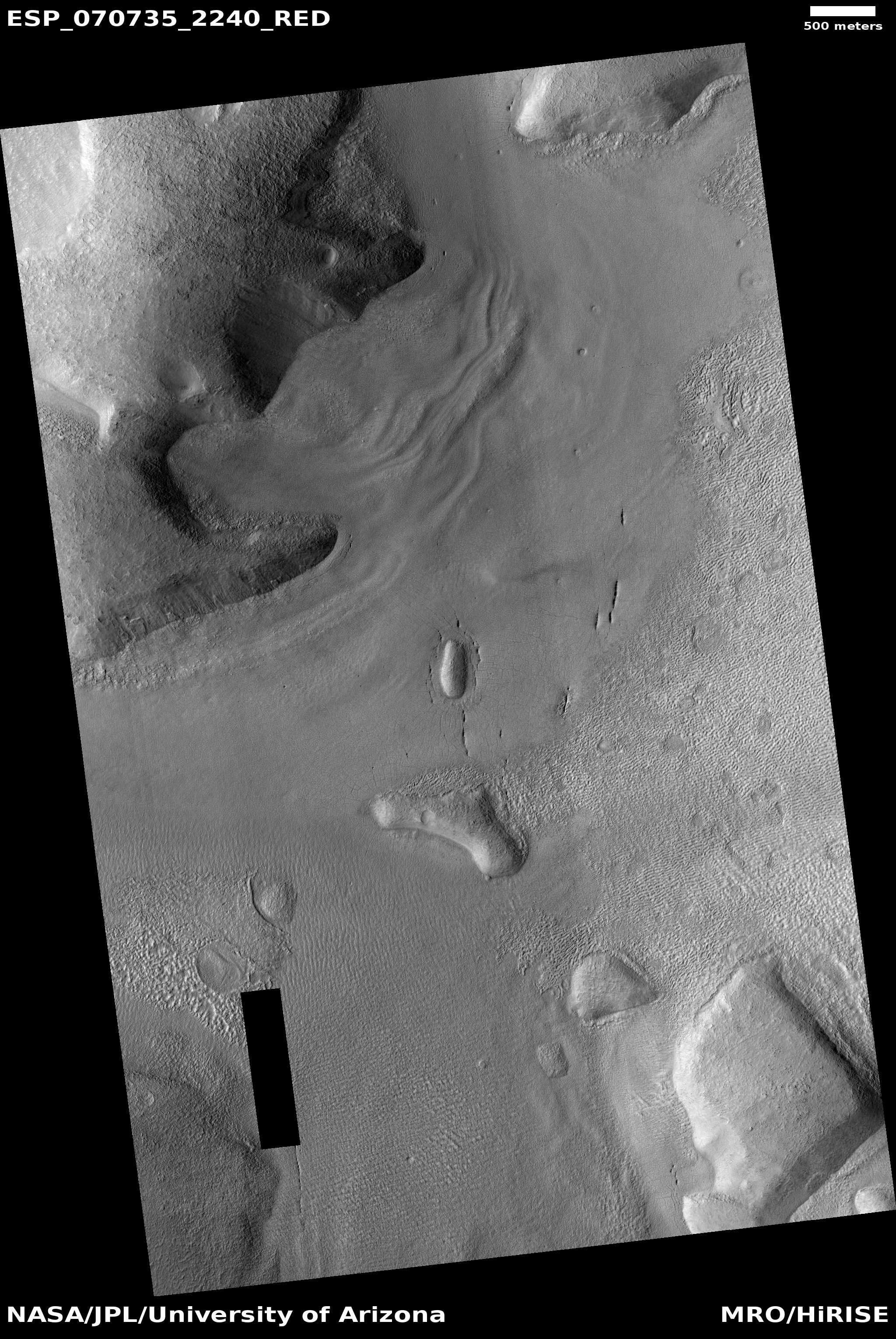
Cool image time! The picture to the right, rotated, cropped, and reduced to post here, was taken on April 18, 2023 by the high resolution camera on Mars Reconnaissance Orbiter (MRO). It shows only one of many flat-topped mesas in a chaos terrain region dubbed Oxia Chaos.

The mesa top is about 540 feet above the floor of the canyon to the north, which in turn is about 840 feet below the flat terrain north of it. That flat terrain to the north is not part of the chaos terrain, however, but the northern rim of the plateau that surrounds the chaos. Moreover, this particular piece of rim is separating from the plateau, as shown near the top of this January 16, 2008 context camera image from MRO. At some point in the future it will break off and fall into that canyon and on top of this mesa.
» Read more

0 comments

Another look at the vastness of Valles Marineris on Mars

The vast Valles Marineris
Click for interactive map.

This week I have returned several times to the giant Valles Marineris canyon on Mars in an attempt to capture its incomprehensible and glorious scale. Without question this canyon is going to become one of the prime tourist spots when humans begin living and working throughout the solar system. Fortunately, its vast size will mean that it will take many many centuries before it even becomes close to crowded there.

Today I try a different approach, using the global mosaic created by scientists at Caltech from the context camera images taken by Mar Reconnaissance Orbiter (MRO). That mosaic processes the images to allow one to see the surface from an oblique angle. The picture to the right covers one small part of the eastern end of Valles Marineris (the white rectangle in the inset), but though small the scale once again is gigantic.

The three white dots are our reference points, one on the north rim, one on the south, and one in the middle on the peak of that central mountain chain. Beginning from the south, the distance from the rim to the middle mountain peak is 43 miles, with the elevation dropping almost 13,000 feet to the floor of the south canyon, than rising almost 10,000 feet to the middle peak. The northern canyon is smaller. From the peak to the north rim is 27 miles, dropping about 9,300 feet and then rising about 8,500 feet to the north rim.

From rim to rim the distance is about 70 miles. Since the middle mountain chain about 18 miles wide, it fills only about 25% of the entire canyon.

In every case, the Grand Canyon would be merely be a small side canyon here. The depths are twice as deep, and the distances are many times larger. In width alone at this point Valles Marineris is seven times wider than the widest part of the Grand Canyon, and this is by far not Valles Marineris’s widest point.
» Read more

0 comments

A Martian gully formed by disappearing glacial ice?

Puzzling Martian gully
Click for original image.

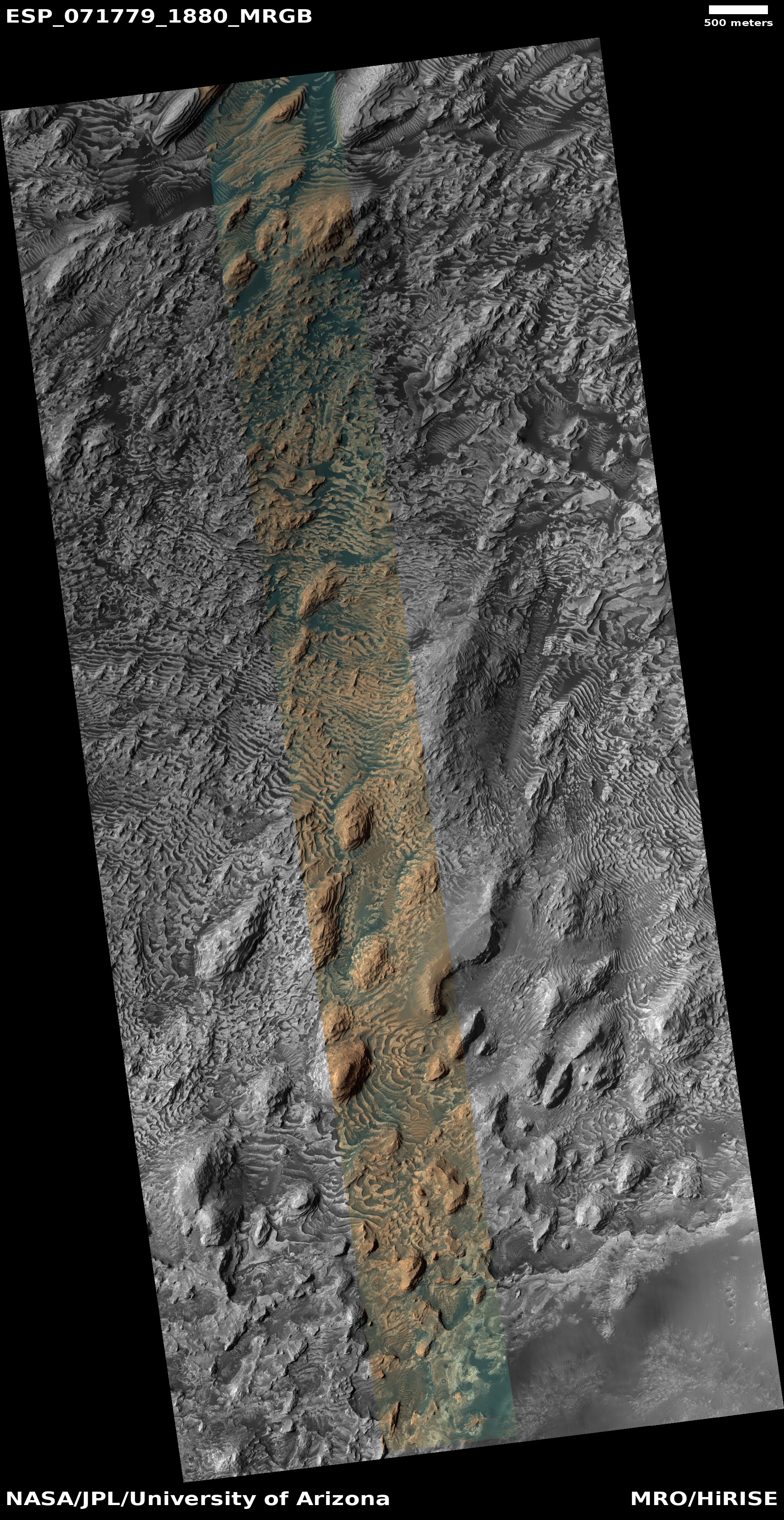
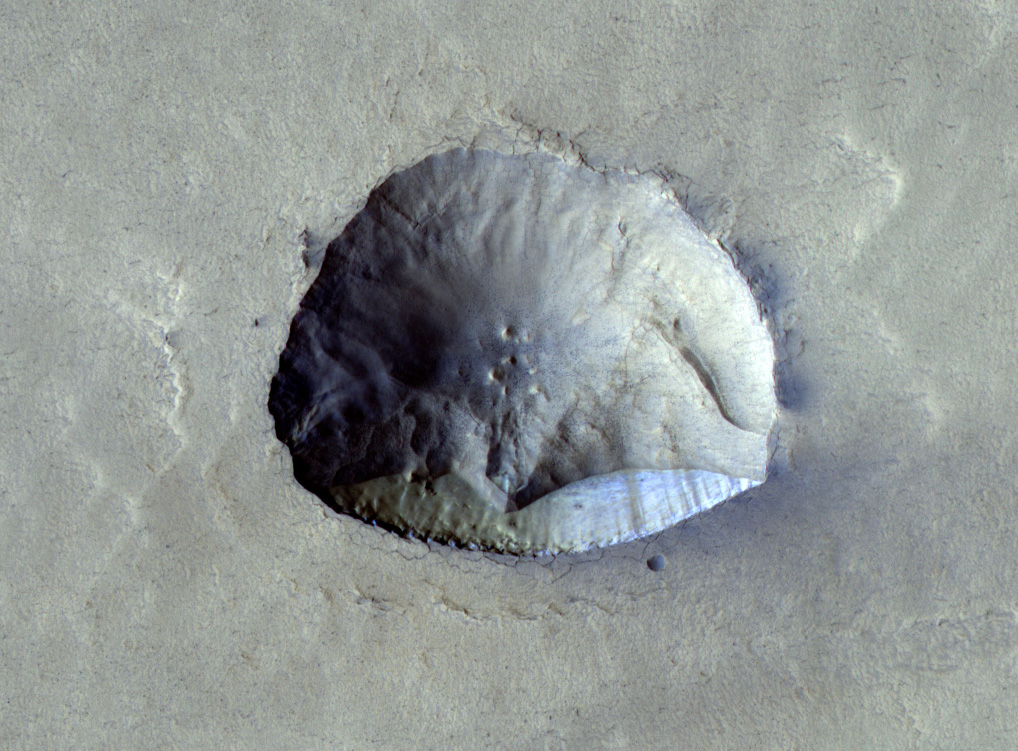
Cool image time! The picture to the right, cropped and reduced to post here, was taken on April 30, 2023 by the high resolution camera on Mars Reconnaissance Orbiter (MRO). It shows the rim of a seventeen-mile wide crater, and was the scientists label a “gully without apron,” meaning that though something has caused material to disappear within that gully, beginning high on the rim wall, there does not appear to be any piled up apron or debris at the gully’s base.

The blue colors imply the possibility of frost within the gully, while the orange suggests dust or coarse surface material.

The cracks emanating away at right angles from the gully’s base suggest glacial ice, which makes sense based on the location.
» Read more

0 comments

More sightseeing in Valles Marineris on Mars

More sightseeing on a mesa in Valles Marineris
Click for original image.

The opportunity to see more mind-blowing examples of spectacular views on Mars compels me to post another great view of a mesatop within Valles Marineris, the biggest known canyon in the solar system. The picture to the right, rotated, cropped, and reduced to post here, was taken on May 14, 2023 by the high resolution camera on Mars Reconnaissance Orbiter (MRO). It shows an 800-foot-high mesa with two points at its end, the cliff wall below highlighted by numerous layers, many alternating between light and dark material.

The erosion features on the top of the mesa suggests some flow down its middle and into the gap between its two end points. This is the dry equatorial region of Mars, so no near surface water is presently found. In the far past maybe ice, or theorized catastrophic floods of water, caused this erosion.
» Read more

0 comments

A Martian crater with a very weird rim

A Martian crater with a very weird rim
Click for original image.

In looking through new images from Mars Reconnaissance Orbiter (MRO), I sometimes stumble some very strange things, with today’s cool image an example. The picture to the right, rotated, cropped, and reduced to post here, was taken on May 7, 2023 by MRO’s high resolution camera, and shows the western half of a two-mile-wide crater with a very weird rim, almost as if a person had decided he wanted to reshape it with a filigree pattern.

Though only two-miles wide, this crater actually has been named Johnstown. I suspect this is because of its strange rim, prompting a research effort and the need to provide it a name. Why the rim has this repeating pattern of gaps, however, is beyond my pay grade to explain, and I have been unable to track down any research papers about it. The nearby surrounding surface suggests vaguely the possibility that this is a caldera, not an impact crater, but even so why would the rim of the caldera have these regular breaks?
» Read more

1 comment

The inconceivable scale of Mars’ canyons

Overview map

Today’s cool image takes us to one of Mars’ biggest canyon systems that while linked to Valles Marineris, the biggest Martian canyon of them all, is considered a separate canyon system because it is made up of a labyrinth of criss-crossing canyons instead of a single major canyon line.

In fact, its name is Noctis Labyrinthus, as shown on the overview map to the right. In many ways its complex pattern is reminiscent of the chaos terrain seen mostly in Mars’ mid-latitudes, but there are major differences. The rectangle marks the area we shall zoom into below to show these differences as well as to feebly illustrate the grand scale of these canyons.

First, the formation of these canyons is closely linked to the volcanic events that formed the three giant volcanoes to the west. They are also strongly linked (in ways not yet fully understood) with the suspected catastrophic floods that drained from Noctis, through Valles Marineris, and out into the northern lowland plains to the east, eons ago when this dry equatorial region could have been wet.
» Read more

4 comments

Puzzling crater on alien Mars

Puzzling crater on alien Mars
Click for original image.

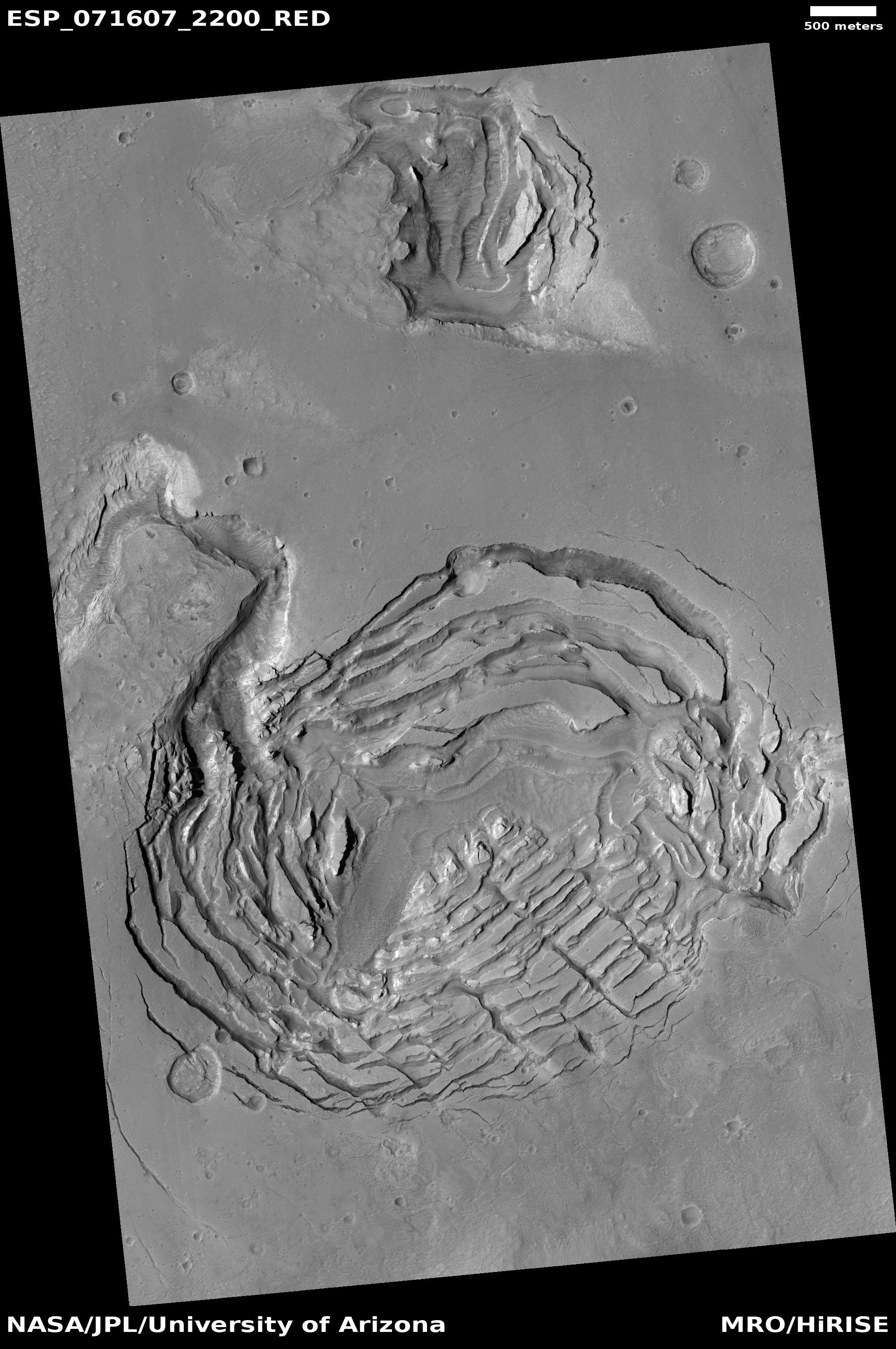
Today’s cool image once again illustrates that the things that orbiters photograph on the Martian surface are not always what they seem at first glance. The picture to the right, cropped, reduced, and sharpened to post here, was taken on March 23, 2023 by the high resolution camera on Mars Reconnaissance Orbiter (MRO). It shows what the scientists label as “layering” in this small mile-wide crater.

That layering, seen on both the interior and exterior slopes of its circular rim, is what makes this crater puzzling. It suggests this crater was not formed by an impact, but by volcanism. The layers suggest repeated eruptive events. That the crater sits above the surround plain by about 100 feet strengthens this conclusion.

And yet, a look at the overview map below suggests this conclusion is premature.
» Read more

1 comment

Swirls draining into a Martian crater

Swirls draining into a Martian crater
Click for original image.

Cool image time! The picture to the right, rotated, cropped, reduced, sharpened, and annotated to post here, was taken on April 8, 2023 by the high resolution camera on Mars Reconnaissance Orbiter (MRO).

The picture shows a terrain of swirls and terraced mesas. Because the shadows are deceptive, I have annotated the picture to show the actual drainage pattern of those swirls, suggesting that whatever material forms these swirls is not only draining about 200-250 feet down into the low point at the picture’s center, the swirls are also draining toward the small 1,000-foot-wide crater in the upper left. That crater however appears to lie on top of the swirls, which means it came after them.

What are the swirls made of?
» Read more

0 comments

Alien Mars

Alien Mars
Click for original image.

Today’s cool image illustrates again the alien geology of Mars, often disguised as geological features that at first glance seem familiar. The picture to the right, cropped and reduced to post here, was taken on April 9, 2023 by the high resolution camera on Mars Reconnaissance Orbiter (MRO). Its most distinct feature, the mile-wide double crater in the center bottom, at first appears typical of such craters found on the Moon and elsewhere, suggesting that the bolide that caused it broke in two as it cut through the Martian atmosphere.

This double crater however is not like lunar double craters, in that the shape of both craters is deformed, and the deformation is not quite the same in each. Moreover, the crater does not appear to have an upraised rim or to have thrown out any obvious ejecta. Instead, the two objects hit what looks like soft ground, such as when you drop a pebble into snow.

There’s more.
» Read more

0 comments

A Martian volcanic ash field covering an ancient lava flow

A Martian volcanic ash field covering an ancient lava flow
Click for original image.

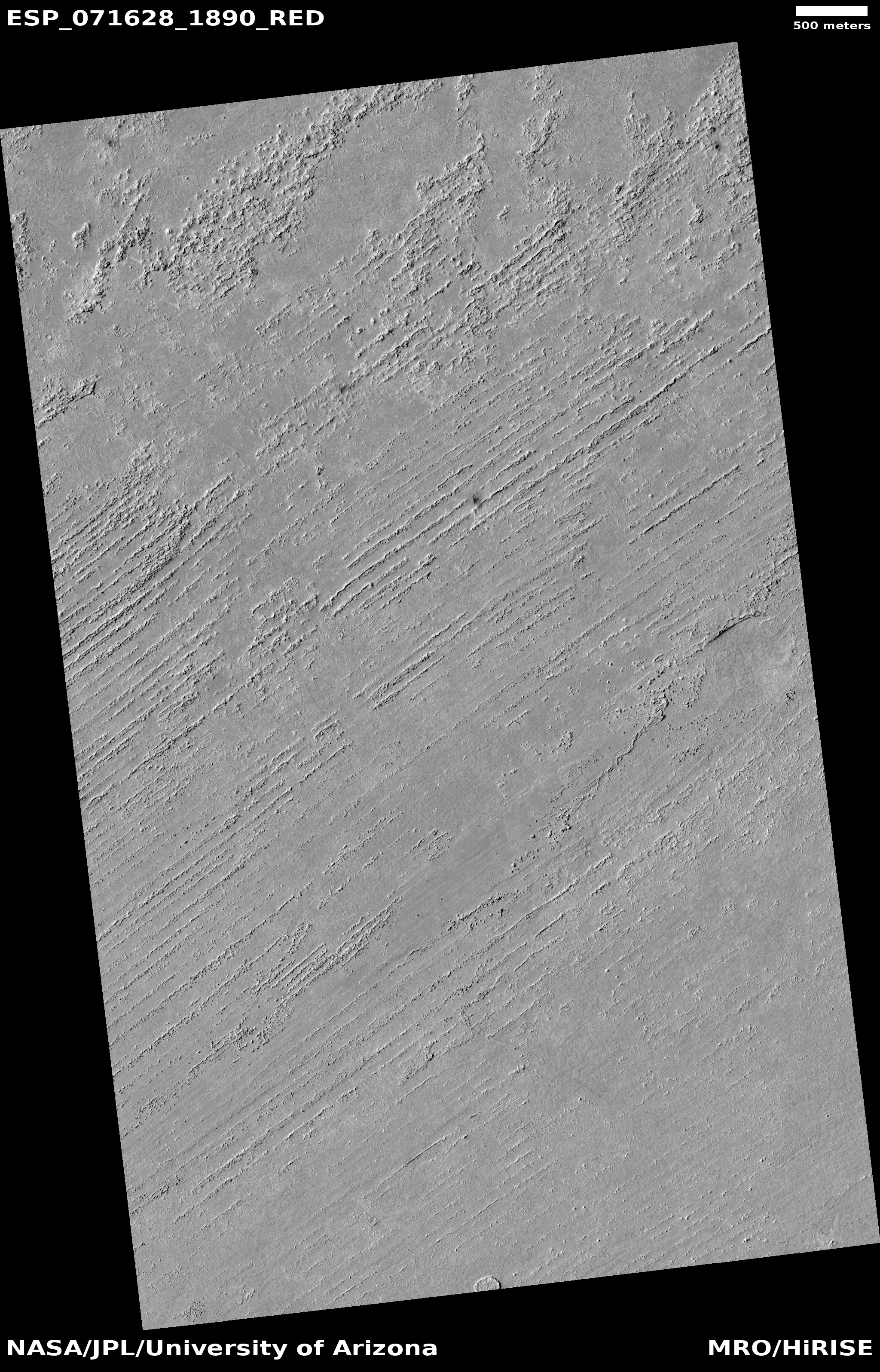
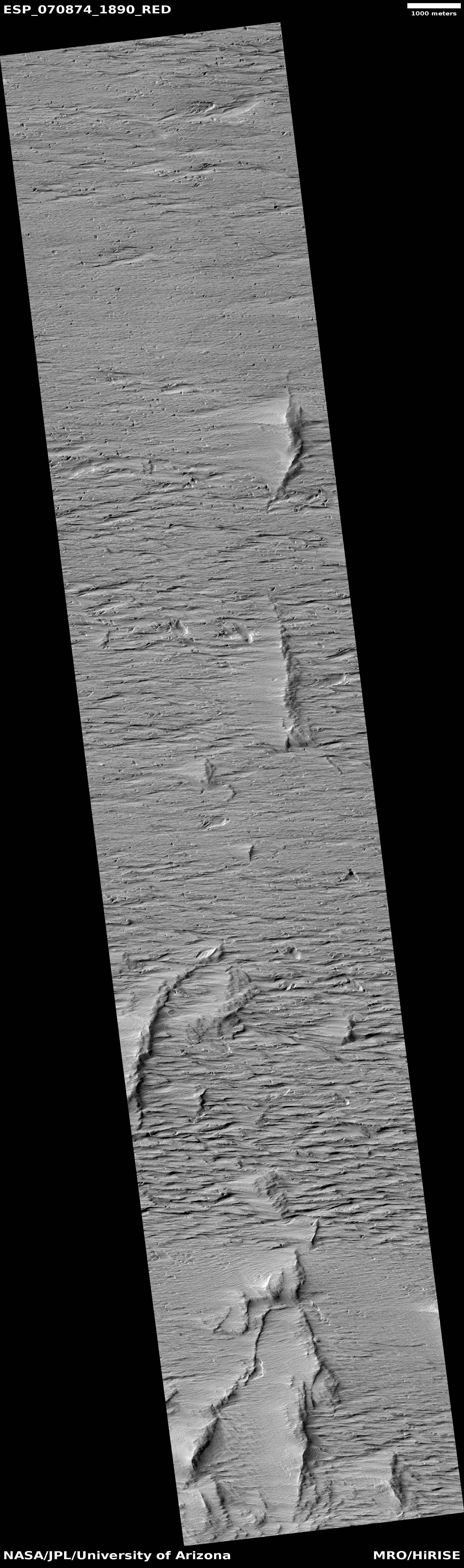
Cool image time! The picture to the right, rotated, cropped, reduced, and sharpened to post here, was taken on April 16, 2023 by the high resolution camera on Mars Reconnaissance Orbiter (MRO). It shows in the center an ancient tongue of lava flow that is surrounded by thick dust fields on the north and the south.

The arrow indicates the downhill grade. It also shows the direction of the prevailing winds, downhill to sculpt the volcanic ash into long streamers of parallel grooves, with obvious eddies forming around bits of older lava that still stick up through the ash. On the lava flow can also be seen one small volcano cone, on the picture’s right edge, suggesting that either during this flow or after it hardened magma bubbled up from below.

The location is fascinating, and in fact puts this picture into its much more spectacular context.
» Read more

0 comments

Another layered mesa in the Cydonia region of Mars

Another layered mesa in the Cydonia region of Mars
Click for original image.

Cool image time! The picture to the right, cropped, reduced, and sharpened to post here, was taken on March 22, 2023, and shows a 100-foot-high many-layered mesa in the Cydonia region of Mars.

The shadows in this picture are deceptive. The mesa’s high point is not the narrow ridge-line, but at the green dot just beyond that ridge’s northern terminus. In fact, if you were walking south from that dot and then along the crest of that ridge you would be walking downhill the entire length.

Cydonia is in the Martian northern lowland plains, in the mid-latitudes. Thus, there are many features in this picture suggesting near surface ice, such as the mounds with craters at their peak. All could be mud volcanoes as seen in many places in the northern lowland plains.
» Read more

1 comment
1 29 30 31 32 33 90