What is wrong at Blue Origin?

Link here. The article by Eric Berger depends on many anonymous sources at Blue Origin, and suggests that the central reason the first launch of the company’s orbital New Glenn rocket has been delayed until 2022 at the earliest is because Jeff Bezos decided to have them build its biggest iteration first, rather than take smaller steps upward to that version.

[I]nstead of offering a waypoint between New Shepard and a massive orbital rocket, Bezos ultimately opted to jump right to the massive, 313-foot-tall version. “It’s like if NASA had gone straight from Alan Shepard to the Saturn V rocket, but then also had to make the Saturn V reusable,” one former Blue Origin employee said.

Instead of crawl-walk-run, Bezos asked his engineering team to begin sprinting toward the launch pad. The engineering challenges of building such a large rocket are big enough. But because New Glenn is so expensive to build, the company needs to recover it from the outset. SpaceX enjoyed a learning curve with the Falcon 9, only successfully recovering the first stage on the rocket’s 20th launch. Blue Origin engineers will be expected to bring New Glenn back safely on its very first mission.

The decision to skip the “walk” part of the company’s development has cost Blue Origin dearly, sources say. The company’s engineering teams, composed of smart and talented people, are struggling with mighty technical challenges. And there are only so many lessons that can be learned from New Shepard—the smaller rocket has 110,000 pounds of thrust, and New Glenn will have very nearly 4 million.

While I am certain there is some truth to this, the article also appears to me to be a sales job for Bob Smith, the CEO that Bezos hired in 2017 to run Blue Origin. There have been many rumors that he takes a more traditional approach to rocket development, which means no failures can be allowed and must be designed out from the beginning. In fact, the article hints at this, but then spins it to Smith’s favor.

Since Smith arrived in the fall of 2017, some employees have struggled with his leadership style and complained that he has acted too slowly, pushing Blue Origin to become more like a traditional aerospace company than a nimble new-space startup. But from Smith’s perspective, he’s trying to implement a culture transformation, from a hobby-shop atmosphere to that of a major aerospace contractor that can go out and win major NASA and Defense Department contracts.

The history of the past five years confirms the employees’ perspective, not Smith’s. Before he arrived Blue Origin was getting things built and launched, at a fast pace. After he took over that pace slowed to crawl, in all its projects.

In fact, I would say that Blue Origin’s problems really come as much from Smith as Bezos. When Bezos might have pushed to go big with New Glenn, Smith should have pushed back, and insisted they build the smaller version first. Instead, he went ahead, while also apparently changing the company so that it functioned more like the older big space contractors (Boeing, Lockheed Martin) that can’t get anything built quickly for a reasonable cost.

None of this bodes well for Blue Origin or New Glenn. Unless a massive management change is instituted, the company’s future does not look as bright as it should, considering the amount of money (billions) that Bezos is committing to it. All the money in the world will do you nothing if what you want to do is poorly planned and badly executed.


12 comments

Rocket Lab to build new bigger rocket

Capitalism in space: As part of its announcement yesterday that Rocket Lab is going to become a publicly traded stock, the company also announced it is going to develop a new larger rocket, dubbed Neutron, to supplement its smaller Electron rocket.

The second link provides some additional details about Neutron.

Today, Monday, 1 March, the company revealed its “Neutron” rocket, a medium-class launch vehicle that can lift up to 8,000 kilograms (eight tonnes) into orbit, comparable to Russia’s Soyuz rocket. The two-stage vehicle will be 40 meters (131 feet) tall, more than double the company’s existing Electron rocket, which measures 18 meters (60 feet) tall and has so far flown 97 satellites across 18 launches.

They will design it to be human-rated from the start, and will also have the first stage land vertically using its engines so it can be reused. According to video from the company, they are aiming for a ’24 launch date.

5 comments

Update on ISS leaks: Several to be drilled & sealed over next 5 days

According to Russia’s state news service, astronauts on ISS have located several leaks in the 20-year-old Zvezda module of ISS, and will spend the next five days fixing them.

This report clarifies a previous report that left more questions than it answered. It appears that there are several leaks that were found using a microscope sent to the station and temporarily sealed. Now the goal in the next five days will be to permanently seal them.

[A] hole will be drilled at one of the fracture’s ends, which will be filled with cold welding and sealed with a fluoroplastic film on top. The same procedure will be done with other holes. After that, the surface will be sanded and wiped with alcohol wipes and covered with a sealant. Overall, the cosmonauts will put three layers of the sealant.

The repair method suggests that they are all cracks. To stop a crack from growing you drill out the end.

That they are all cracks further suggests that these are all stress fractures. Thus, no matter how permanent these particular repairs are, they cannot solve the greater problem of the aging module itself. We should expect more cracks to appear in the future unless something more drastic is done.

7 comments

Biden fires Boeing on SLS; gives job to Acme

In an interesting announcement today, the Biden administration fired Boeing as the prime contractor for SLS and gave the job to a well-known southwest company dubbed Acme.

Anticipating critical comment, White House spokesmen pointed out that Acme had a long history of use of solid-fuel rockets for crewed applications, “without loss of human life or serious injury” despite some less-than-fatal mishaps.

…The spokesperson also added, “It should be noted that Acme’s products have never killed anybody. Unfortunately the same can’t be said for Boeing.”

Before you comment, make sure you read the article at the link closely, and also click on the two links in the article to get some detailed background on Acme, from some original sources.

20 comments

A deep south Martian dune with bright patches

Dune with bright patches
Click for full image.

Cool image time! Last week the MRO science team posted a new captioned image entitled “Bright and Dark Dunes” featuring a particularly large single dune in the floor of a 25-mile-wide unnamed crater located at about 68 degrees south latitude. The photo to the right, rotated, cropped, reduced, and color enhanced to post here, shows that dune. According to the caption, written by Colin Dundas of the U.S. Geological Survey’s Astrogeology Science Center in Arizona,

This image shows a large sand dune with bright patches. Martian dunes near the poles often have bright patches in the spring, when seasonal frost is lingering. However, this image is from late summer, when frost is long gone. What is going on here?

A close-up look with [MRO’s high resolution camera] provides some clues. The bright patches are made up of large ridges that look like wind-blown bedforms. Additionally, the bright patches are yellowish in the infrared-red-blue image. In enhanced color, most sand on Mars is blue but dust is yellow. This suggests that the bright bedforms are either built from, or covered by, dust or material with a different composition.

Thus, the bright patches reveal either aspect of the dune’s underlying structure, either inherent in the bedrock itself, or the texture of its surface that allows it to hold more dust. As Dundas adds, “I think more study would be needed to determine the answer in this particular case.”

There are other aspects of this dune that can be seen by a look at the wider view afforded by MRO’s context camera below.
» Read more

0 comments

Looking into one of Jupiter’s smaller cyclones

A northern cyclone on Jupiter
Click for full image.

Cool image time! The photo to the right, cropped and reduced to post here, was taken by the Juno probe orbiting Jupiter and enhanced first by citizen scientist Kenneth Gill and then further enhanced by citizen scientist Navaneeth Krishnan.

Sadly all the link tells us about this storm is that it is in the northern hemisphere. Based upon the colors, my guess is that it located at the high latitude where Jupiter’s bands transition to the chaotic region of storms at the poles, as seen in this earlier wide image of the gas giant’s south pole.

No scale is provided, but an earlier image of other northern hemisphere storms suggests this storm would probably cover the state of Arizona.

2 comments

SpaceX: No 1st stage footage on tonight’s Starlink launch

During last night’s short broadcast leading to the abort at T-1:24 seconds of a launch of another 60 Starlink satellites, the company announced that it would not show the video feed from the reused first stage booster as it returned to Earth.

[A] SpaceX engineer revealed that the company would not be broadcasting live feeds from Falcon 9 B1049’s onboard cameras during the launch. The ambiguity of the comment made it impossible to determine if SpaceX was simply choosing to not show those views or if something was wrong with the camera downlink system, while the same engineer-turned-host did go on to state that “all systems are green” moments later.

No explanation for the sudden change – possibly the first webcast in years without live views from booster cameras – was given. Starlink-17 serves as a return-to-flight mission for SpaceX after Starlink-19’s failed landing, during which the rocket’s onboard cameras streamed what appeared to be clearly unusual and possibly off-nominal behavior early on in the landing process.

The article at the link then speculates that maybe SpaceX was worried about that booster’s ability to land (it will be flying its eighth time, same as the booster that failed on the earlier flight).

I am very skeptical of that theory, especially because SpaceX has never shown a reluctance to show the public its failures. Instead, I think SpaceX has decided to do an engineering test of that booster during its return, and for propriety reasons wants to keep this from public eyes. If so, the test itself might also mean they are willing to lose this booster during that test.

During the early days of their program to reuse boosters, they sometimes had the returning 1st stage do some very stressful maneuvers, producing very spectacular light shows when launched from Vandenberg on the California coast. It could be they want to test this older booster on its eighth flight in a similar manner, in order to reassess their engineering and thus make it possible to upgrade and extend the re-usability of later boosters.

1 comment

Rocket Lab about to go public

Capitalism in space: According to news reports today, the smallsat rocket company Rocket Lab is about to sign a deal that will make it a publicly traded stock in a merger with a venture capital company.

The Wall Street Journal reported today talks between the company and Vector Acquisitions Corp were nearing completion and could be finalised with 24 hours, and was expected to see Rocket Lab raise another $650 million in cash from other private investors.

Vector is a special-purpose acquisition company, a vehicle that recruits investors and lists before pursuing a business to buy. Vector, backed by tech private equity firm Vector Capital, raised $400m on launch in September.

Rocket Lab is one of a cluster of spaceflight operators jostling for global market share in the smaller-launch market, where the focus is on achieving reliable delivery of small cargoes to lower earth orbits. Any listing would catapult Rocket Lab – whose Mahia spaceport has delivered nearly 100 satellites into orbit – into the top rank of New Zealand companies, and represents a huge blow for the local NZX. With a valuation of $5.7b, it would have ranked as one the 10 largest companies on the national exchange.

According to Rocket Lab, it is not a New Zealand company but based in the U.S., despite the bulk of its operations being in New Zealand.

I will not be surprised it Rocket Lab’s stock price quickly rises once available for purchase. Unlike Virgin Galactic, this is a real company with a real product producing real profits. It is also very well placed to garner a healthy share in the emerging launch market of smallsats that is now arriving on the scene. The company is about to initiate launches from its second launchpad at Wallops Island in the U.S., which will also allow it to finally accelerate its launch pace to the promised twice a month pace it has been promising for the last two years.

4 comments

India & Russia successfully launch satellites

Both India and Russia today successfully launched satellites into orbit.

For India it was their first launch in 2021. Their PSLV rocket put into orbit a Brazillian satellite for studying Earth resources. The launch also included 18 other cubesats.

Russia in turn used its Soyuz-2 rocket to launch a new generation weather satellite for studying that country’s remote Arctic regions.

SpaceX had also planned another Starlink launch but aborted the countdown with just over a minute to go. They plan to try again tomorrow.

The 2021 launch race:

5 SpaceX
4 China
3 Russia
1 Rocket Lab
1 Virgin Orbit
1 Northrop Grumman
1 India

The U.S. still leads China 8 to 4 in the national rankings.

0 comments

Skiing dry ice boulders on Mars, captured in action!

Grooves in dune created by sliding dry ice blocks
Click for full image.

Today’s cool image is an update on a previous cool image published in April 2020 about how scientists believe the grooves seen on the slope of a giant dune in Russell Crater on Mars are believed to be formed by frozen blocks of carbon dioxide sliding down the slope when spring arrives. The photo to the right, taken on March 3, 2020 by the high resolution camera on Mars Reconnaissance Orbiter (MRO) and rotated and cropped to post here, shows these grooves. As I wrote then,

Because the block is sublimating away, the gas acts as a lubricant so that it can slide down the hill. If large enough, the dry ice block will stop at the base of the hill to disappear in a small pit. If small enough, it actually might completely vaporize as it slides, explaining the grooves that appear to gradually fade away.

The scientists actually did a test on Earth, buying a dry ice block at a grocery store and releasing it at the top of a desert dune. Go to my April 2020 link above to see the very cool video.

Several planetary scientists did further combing through many MRO photos of this dune and now think they have spotted examples where the camera actually captured a block as it was sliding downhill.
» Read more

1 comment

Relativity touts next generation rocket before its first generation rocket has even launched

Capitalism in space: In an interview with CNBC the CEO of Relativity Space, Tim Ellis, pushed his company’s plans to develop a completely reusable rocket, dubbed the Terran-R, even though they have as yet completed even one test launch of their first rocket, the Terran-1.

Called Terran R, the reusable rocket is “really an obvious evolution” from the company’s Terran 1 rocket, Relativity CEO Tim Ellis told CNBC – the latter of which Relativity expects to launch for the first time later in 2021. “It’s the same architecture, the same propellant, the same factory, the same 3D printers, the same avionics and the same team,” Ellis said. “I’ve always been a huge fan of reusability. No matter how you look at it – even with 3D printing, and dropping the cost, and [increasing the] automation of a launch vehicle – making it reusable has got to be part of that future,” Ellis added.

Terran R is the first of several new initiatives that Ellis expects Relativity to unveil in the year ahead, with the company having raised more than $680 million since its founding five years ago. Just like Terran 1, Relativity will build Terran R with more than 90% of the parts through additive manufacturing – utilizing the world’s largest 3D printers as what Ellis calls “the factory of the future.”

Relativity, valued at $2.3 billion, ranks as one of the most valuable private space companies in the world. Its investors include Tiger Global Management, Fidelity, Baillie Gifford, Mark Cuban and more.

All well and good, but maybe before Ellis brags about his next generation rocket he might be better served to focus on getting that first rocket successfully off the ground later this year. It is a good thing his company is thinking of making its rockets reusable, but right now he is overselling while under-performing, a very bad sales technique. Better to do what Scotty of Star Trek did routinely, undersell while over-performing.
» Read more

3 comments

Starship #10 completes another static fire test after quick engine swap

Starship #10 at 2nd static fire test
Screen capture from LabPadre live stream.

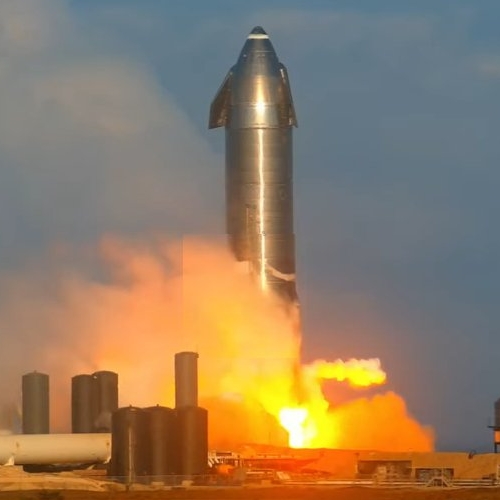
Capitalism in space: In what to me appears a remarkable tour de force, SpaceX today completed the second dress rehearsal countdown and static fire test of its tenth Starship prototype.

What made this a tour de force is that the previous test, only two days before, had found issues with one of the prototype’s three Raptor engines. In less than two days, SpaceX engineers were able to replace that engine and fire up the rocket again.

Compare that to the operations of Boeing and NASA in trying to do a single static fire test of SLS’s core stage. Preparations for the first test took months, and when this had an issue it is now going to take at least a month (if not more) before they can attempt a second test.

If today’s Starship static fire test came up clean with no problems, a test flight to about 30 to 40,000 feet could come as early as tomorrow.

2 comments

Searching for ice in the Martian low latitudes

Low latitude crater with intriguing debris on its floor
Click for full image.

Today’s cool image well illustrates the effort of planetary scientists to map out the range of buried ice on the Martian surface. Taken on December 13, 2020 by the high resolution camera on Mars Reconnaissance Orbiter (MRO) and rotated, cropped, and reduced to post here, it shows a 3.5-mile-wide crater located in the southern cratered highlands, but for those cratered highlands at the very high northern latitude of 24 degrees.

The black streaks on the crater’s interior slopes are probably slope streaks, but these are not the subject of this article. Instead, it is the material that covers the crater’s floor. These features resemble the glacial fill material that scientists have found widespread in the latitude bands between 30 to 60 degrees latitude. However, this crater is farther south, where such ice would not be stable and should have sublimated away.

Could there still be ice here? I emailed the scientist who requested the photo, Colin Dundas of the U.S. Geological Survey’s Astrogeology Science Center in Arizona, and asked him what I was looking at. His answer:
» Read more

4 comments

China commits to building its own SLS

The new colonial movement: China yesterday officially announced that it has approved construction of a heavy-lift rocket, dubbed Long March 9, that would by 2030 be able to put 140 tons into orbit.

The rocket is planned to have a lift capacity of 140 metric tons, with the capability of sending 50 or more tons into lunar orbit. It would be an immense vehicle, with a 10-meter diameter core and 5-meter side boosters. China would also like to eventually make the rocket, or at least part of it, reusable.

China is also developing another large rocket more comparable to the Falcon Heavy, though this other rocket has no name and information about it is more scarce.

Both projects indicate the long term commitment of the Chinese government to its space program. They also indicate that the present-day international competition to get into space is fueling far more development than the last forty years of international cooperation.

Whether these giant government rockets from China will be practical and efficient is an unanswered question. Just building something to compete is not the same thing as actually competing. The rockets have to be affordable, with the ability to launch frequently to make in-space exploration possible. If not, they will nothing more than big photo ops for incompetent politicians, kind of like SLS is for the U.S.

15 comments

Parker looks at Venus

Venus as seen by the Parker Solar Probe
Click for full image.

During its July 2020 fly-by of Venus, the Parker Solar Probe used its wide field camera to snap a picture of the planet, cropped and reduced to post here on the right.

The photo surprised the scientists in that it apparently was able to detect some major surface features through Venus’ thick cloud cover.

WISPR is designed to take images of the solar corona and inner heliosphere in visible light, as well as images of the solar wind and its structures as they approach and fly by the spacecraft. At Venus, the camera detected a bright rim around the edge of the planet that may be nightglow — light emitted by oxygen atoms high in the atmosphere that recombine into molecules in the nightside. The prominent dark feature in the center of the image is Aphrodite Terra, the largest highland region on the Venusian surface. The feature appears dark because of its lower temperature, about 85 degrees Fahrenheit (30 degrees Celsius) cooler than its surroundings.

That aspect of the image took the team by surprise, said Angelos Vourlidas, the WISPR project scientist from the Johns Hopkins Applied Physics Laboratory (APL) in Laurel, Maryland, who coordinated a WISPR imaging campaign with Japan’s Venus-orbiting Akatsuki mission. “WISPR is tailored and tested for visible light observations. We expected to see clouds, but the camera peered right through to the surface.”

“WISPR effectively captured the thermal emission of the Venusian surface,” said Brian Wood, an astrophysicist and WISPR team member from the U.S. Naval Research Laboratory in Washington, D.C. “It’s very similar to images acquired by the Akatsuki spacecraft at near-infrared wavelengths.”

This surprising observation sent the WISPR team back to the lab to measure the instrument’s sensitivity to infrared light. If WISPR can indeed pick up near-infrared wavelengths of light, the unforeseen capability would provide new opportunities to study dust around the Sun and in the inner solar system. If it can’t pick up extra infrared wavelengths, then these images — showing signatures of features on Venus’ surface — may have revealed a previously unknown “window” through the Venusian atmosphere.

The streaks in the picture come from cosmic rays.

3 comments

Land of rovers

Overview map

Today’s cool image is in honor the two newest Martian rovers, Perseverance (which now sits quite comfortably in Jezero Crater, ready to begin what will probably be more than a decade of exploration on the Martian surface) and China’s yet-to-be-named rover (set to hopefully soft land on Mars some time in late April).

The overview map to the right shows us the region where both rovers shall wander. The black box in Jezero Crater is where Perseverance now sits. The red cross about 1,400 miles away is the believed landing zone for China’s rover, located in Utopia Planitia at about 25 degrees north latitude. The Viking 2 landing site is just off the edge of the northeast corner of the map.

The latitude of 30 degrees, as indicated by the white line, is presently an important dividing line based on our present knowledge of Mars. South of that line the terrain is generally dry, though there is evidence that water in some form (liquid or ice) was once present. North of that line scientists have found evidence of considerable ice below the surface, with its presence becoming increasingly obvious the farther north you go.

Today’s cool image, shown below, is north of that line at 33 degrees latitude in Utopia Planitia, and is marked by the white cross, about 500 miles to the northwest of the Chinese rover’s landing site.
» Read more

3 comments

Tianwen-1 enters parking orbit around Mars

The new colonial movement: According to the Chinese state-run press, the Tianwen-1 orbiter has entered the parking orbit around Mars that it will use for the next three months to conduct reconnaissance of its lander/rover’s landing site.

At 6:29 a.m. (Beijing Time), Tianwen-1 entered the parking orbit, with its closest point to the planet at 280 km and the farthest point at 59,000 km. It will take Tianwen-1 about two Martian days to complete a circle (a Martian day is approximately 40 minutes longer than a day on Earth), the CNSA said.

Tianwen-1, including an orbiter, a lander and a rover, will run in the orbit for about three months.

The CNSA added that payloads on the orbiter will all be switched on for scientific exploration. The medium-resolution camera, high-resolution camera and spectrometer will carry out a detailed investigation on the topography and dusty weather of the pre-selected landing area in preparation for a landing.

China has also begun prepping the rocket that will launch Tianhe, the first module in its space station, sometime this spring. A total of eleven launches are planned over the next two years to assemble the station.

0 comments

First air leak crack on ISS has not grown

A inspection of the first air leak crack that had been found and patched in the Zvezda module on ISS last year has found that it apparently not increased in size since then.

The size of a crack in the intermediate chamber of the Russian Zvezda module aboard the International Space Station (ISS) remains unchanged, cosmonaut Sergei Ryzhikov reported to Russia’s Flight Control Center on Wednesday. “It [the length] has not changed. As in the previous measurements, I do not see any changes,” Ryzhikov said during his talks with Mission Control broadcast on NASA’s website.

On February 23, the cosmonaut carried out work with a microscope to trace another possible air leak. The photos of the work were transmitted to Earth and the video from GoPro cameras will be sent via the Russian broadband communications system. After completing the work, the cosmonaut reinstalled the patch in the area of the crack.

This Russian report is decidedly unclear about some details. Though it appears the astronaut was using the microscope to inspect another leak, he also apparently removed the patch on the first leak to check the crack for any changes, then replaced it. How one removes and replaces such a patch is a puzzle however. Such things are generally not removable.

No matter. The important detail is that the crack has not grown. If it was a stress fracture the recent dockings of spacecraft to the nearby port might cause it to grow. That it has not is good news.

The bad news is that the inspection did not find the second small leak that is thought to be in this same Zvezda module.

2 comments

Starship #10 completes launch dress rehearsal & static fire test

Starship #10 at static fire test
Screen capture from LabPadre live stream.

Capitalism in space: Starship #10 today successfully completed a launch dress rehearsal and static fire test in preparation for a planned 30 to 40 thousand foot test flight, possibly as soon as February 25th.

The Starship SN10 (“Serial No. 10”) vehicle performed its first “static fire” test on Tuesday (Feb. 23), lighting up its three Raptor engines for a few seconds at 6:03 p.m. EST (2303 GMT) at SpaceX’s South Texas site, near the Gulf Coast settlement of Boca Chica Village.

Static fires, in which engines briefly ignite while a rocket stays anchored to the ground, are a common preflight checkout for SpaceX. If all went well with today’s test, SN10 remains on track to launch soon — perhaps as early as Thursday (Feb. 25) — on a 6-mile-high (10 kilometers) demonstration flight into the South Texas skies.

I personally think it would be quite ironic if this Starship flies on the same day the second SLS static fire test had been originally scheduled but postponed. The contrast between the two development programs continues to be stark and astonishing. While one program has been flying test articles repeatedly as well as doing numerous engine and tank tests, the other has had trouble getting one static fire test completed without a hitch.

UPDATE: Apparently they have decided to swap out one Raptor engine based on the results of the static fire test, and thus will not do a flight tomorrow.

1 comment
1 59 60 61 62 63 76