
Dobie Gray – Drift Away
An evening pause: Performed live on television 1973.
Hat tip Dan Morris.
An evening pause: Performed live on television 1973.
Hat tip Dan Morris.
Capitalism in space: SpaceX today successfully used its Falcon 9 rocket to launch an Italian civilian/military radar satellite.
This was the fifth attempt to launch in five days, with the first three attempts canceled due to weather and fourth canceled because a cruise ship had violated the no-go zone in the Atlantic.
The first stage completed its third flight, landing at Cape Canaveral after sunset. I highlight this last fact because it shows how completely routine these 1st stage landing have become. No one even notices that the first stage has come back to Florida, and did in the dark. Also, this 1st stage had originally been configured for Falcon Heavy as one of its side boosters. This was its first flight after being reconfigured.
As I write this the satellite and upper stage are still linked together, coasting to the orbital point where the upper stage can boost the satellite into a transfer orbit and then deploy it. UPDATE: Satellite has successfully deployed.
The 2022 launch race:
4 SpaceX
2 China
1 Virgin Orbit
1 ULA

Click for full image.
In the past four years I have posted hundreds of cool images taken by the orbiters circling Mars. From those images I have been able to slowly gather and pass on to my readers some of the solid knowledge that scientists are gaining now about the Red Planet.
The image to the right illustrates best why one must never make any quick assumptions about the features you see in these photos. Taken on November 28, 2021 by the high resolution camera on Mars Reconnaissance Orbiter (MRO), it shows a small crater that appears partly filled with material. On its walls can be seen many slope streaks, a still unexplained feature unique to Mars that is not caused by rock or debris avalanches.
As for the material inside the crater, based on the majority of Martian images showing similar craters, the first assumption one might make is that this material is some form of eroding glacial material.
That first assumption however would simply be wrong. Glacial material found in Martian craters is routinely found in the mid-latitude bands between 30 and 60 degrees. This crater is sits almost exactly on the equator of Mars, where scientists have found no evidence of any glacial material or near-surface ice. In the equatorial regions the surface of Mars is essentially dry.
So what is that patch of material? As always, location is all.
» Read more

Freedom of speech cancelled at NC State.
They’re coming for you next: Blacklisted, attacked, ostracized, and subject to violent threats because he happened to be conservative and had publicly defended such ideas, Chadwick Seagraves, an IT employee at North Carolina State University, killed himself three weeks ago.
The attacks against him were part of an effort to get him fired by NC State, based entirely on anonymous accusations that slandered him as a bigot and racist and “white supremacist”, even though there was no evidence of such things. His anonymous accusers also claimed Seagraves had doxxed about 1,400 leftist activists, including members of Portland’s Antifa organizations, based on no evidence. The college, after an investigation, soon agreed that there was no evidence, and decided he would not be fired or punished in any way.
This wasn’t good enough however for our modern American Stasi storm-troopers. According to an email Seagraves sent to NC State professor Stephen Porter (who has himself been blacklisted by these storm-troopers and has sued the university because of it):
» Read more
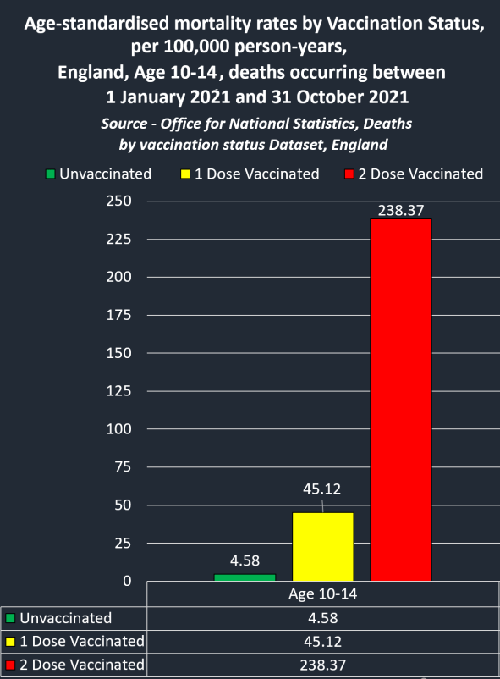
Data compiled by the Office of National Statistics in Great Britain shows that giving young children the COVID shots, especially those aged from 10 to 14, makes their mortality 10 to 52 times higher, depending on the number of shots received.
The graph to the right, from the link, illustrates this starkly. If a child gets one shot, the mortality goes up about ten times. If a child gets two shots, it increases the mortality another five-fold, or about fifty times greater than for children who get no shots at all.
The article at the link also notes that this data was gathered when 10 and 11 year olds were not eligible to get COVID shots. Thus all 10 and 11 year olds at that time fell into the unvaccinated category, where the death rate was low. However, since October 31, 2021, kids in Great Britain in these age brackets began getting shots, which means that we should expect deaths in these age brackets to rise. This also suggests the 52 times increase in childhood deaths caused by the COVID shots is likely understated.
Since the chances of death from the Wuhan virus itself among these children is practically nil, it is insane to give them these shots. Any government official who advocates it, such as Dr. Anthony Fauci, should be fired at once. At a minimum, such fools should certainly not be listened to or used as a guide for establishing any government health policy.
Par for the course: According to one member of NASA’s safety panel, the contractor building NASA’s second SLS launch tower, is having performance problems and is already behind schedule.
On Thursday, during a meeting of NASA’s Aerospace Safety Advisory Panel, one of its members provided an update on Mobile Launcher-2. George Nield, an engineer and scientist who previously led commercial space transportation for the Federal Aviation Administration, said the 90-percent design, review, and fabrication drawings for the large structure are behind schedule. These are the engineering drawings that should closely represent the final design and inform a construction schedule and logistics plan.
“Mobile Launcher-2 has encountered some challenges,” Nield said. “The selected contractor, Bechtel, has experienced some performance issues associated with underestimating the complexity of the project and some supplier related issues, as well as COVID.”
Note that NASA spent about $1 billion on the first tower, to be used only three times, at most. Its contract with Bechtel says the second tower will cost $383 million, but no one expects that number to be met.
Assuming Bechtel does not go over budget (hah!), NASA will have spent $1.4 billion on SLS’s launch towers, one of which will be used two or three times and then abandoned. That’s three times the cost of what SpaceX spent developing Falcon Heavy, and about a third the total development cost of Starship/Superheavy, including its planned launchpads in both Boca Chica and Florida.
Capitalism in space: The Japaneses company Ispace has revised its schedule for its first two private moon lander missions, delaying the second by one year while confirming that it is on target to launch the first before the end of ’22.
That second mission will also include a small rover, now being developed.
The only reason Ispace provided for delaying the second mission was “internal and external conditions.” My guess is that the internal conditions refers to that rover development, while the external conditions means they want more time to find customers to fly on the mission. Ispace won’t likely have trouble finding customers, but this gives them more time for others, mostly universities, to propose and create projects for that mini-rover.
Link here. The analysis is data driven, extensive, and thorough. It shows that with each COVID shot and booster the effectiveness against the Wuhan virus goes down, and in fact eventually reduces a person’s immunity against the virus. Key quote:
Israel is first, always.
Other highly vaccinated and boosted countries are a few weeks behind, and their boosted patients may still have some partial protection against severe disease and death. (People who received two doses last winter or spring probably have none at this point, if the data out of Scotland and the United Kingdom are to be believed.)
But that won’t last. The Israeli experience this month could not be clearer. A third dose does not provide long-term protection. When it fails, the boomerang effect is severe. Hospitals come under even more pressure than they would in a “natural” Covid wave, because the vaccine failure is highly synchronized – everyone becomes exposed at once.
And so – insanity upon insanity – the Israelis are offering a fourth dose.
Why would anyone believe at this point that a fourth dose will help for more than a couple of weeks? Not months, weeks. The trend line was obvious even BEFORE Omicron arrived; and Omicron drives vaccine efficacy down even more quickly. In countries with good data, vaccinated people actually are more likely to be infected than the unvaccinated.
Further, a fourth dose is likely to have MORE severe side effects – remember, the second and third doses produce notably increasing levels of heart inflammation in men, and mRNA therapeutics were repurposed as vaccines because of problems with toxicity after repeated dosing. [emphasis mine]
I am beginning to believe the reason so many lovers of the COVID shots want to force everyone else to get them is because they realize the facts above, either consciously or unconsciously. They are terrified of the consequences for themselves, and thus resent those who are not in the same boat. Rather than face their mistakes and admit error, they instead want no one to escape. Everyone has got to get the shots, so that everyone is equally in danger.
Embedded below the fold in two parts.
To listen to all of John Batchelor’s podcasts, well worth your time, go here.
» Read more
An evening pause: Performed live 2017.
Hat tip Diane Zimmerman.

Click for full image.
Cool image time! The image to the right, cropped and reduced to post here, was taken by cameras on the Hubble Space Telescope. From the caption:
The subject of this image is a group of three galaxies, collectively known as NGC 7764A. They were imaged by the NASA/ESA Hubble Space Telescope, using both its Advanced Camera for Surveys and Wide Field Camera 3. The two galaxies in the upper right of the image appear to be interacting with one another. The long trails of stars and gas extending from them give the impression that they have both just been struck at great speed, thrown into disarray by the bowling-ball-shaped galaxy to the lower left of the image. In reality, interactions between galaxies happen over very long time periods, and galaxies rarely collide head-on with one another. It is also unclear whether the galaxy to the lower left is interacting with the other two, although they are so relatively close in space that it seems possible that they are.
This galaxy group is estimated to be about 425 million light years away, though that number might be different for the galaxy in the lower left.

Click for full image.
Cool image time! The photo to the right, cropped to post here, is just one of the many hundreds taken by the high resolution camera on Mars Reconnaissance Orbiter (MRO) as well as Europe’s Mars Express orbiter showing the thick icy glacial flows that surround practically every mountain or hill in the Phlegra mountains of Mars.
This picture was taken on November 3, 2021, and shows the eroding foot of an eroding glacial flow coming down from a small hill in a southeastern part of these mountains dubbed Phlegra Dorsa. The downward grade is to the north.
At 30 degrees north latitude it is not surprising these glacial flows are eroding, as they are at the southernmost limit of the mid-latitudes bands where such glaciers are found. Closer to the equator scientists have yet to find much evidence of ice.
The repeating arcs at the foot of this glacier suggest that it pushed downward in cycles, with each later cycle traveling a shorter distance. This supposition makes sense, considering scientists think the ebb and flow of these Martian glaciers has been determined by the cyclical changes in the planet’s rotational tilt.
The overview map below not only gives the context, it shows this location relative to the candidate landing sites for SpaceX’s Starship spacecraft.
» Read more
United Airlines: Run by fascist clowns
They’re coming for you next: Because pilot Sherry Walker has refused to get a COVID jab, United Airlines has put her unpaid active leave, which prevents her by contract from getting another job, and also prohibits her from accessing her 401(k) account.
Walker told Fox Digital on Monday that she is considered an “active employee” after being put on unpaid leave for not complying with the airline’s vaccine mandate in November. “That means that they can call us back with two weeks’ notice at any given time, they can just grab us and pull us back. But because we’re active, we haven’t had a qualified lifestyle change. So Schwab, which owns our 401(k) accounts, refuses to let anyone access them,” Walker told Fox.
Walker added that employees in similar shoes have been prohibited from finding other jobs because United has cracked down on non-competes. “In this case, they have said that no, no outside employment. In fact, you must go through ethics and compliance, and it can’t be a company that we could have … a non-compete” with.
And why might United be doing this?
» Read more

The new colonial movement: The Chinese government today released a white paper summarizing in broad terms what it has accomplished in space over the past five years and what it intends to do in the next five years.
If this white paper is ignored by western governments, the ramifications to human freedom and civilization in space will be profound, and quite likely tragic.
You can read the English text of the white paper here.
The paper makes clear China’s considerable successes and advancements in the aerospace sector since 2016. It ramped up its manned program with the launch of two prototype space modules followed by the on-going assembly of its fullsize station. It has successfully landed probes on the Moon and Mars, and brought back samples from the former. It is presently upgrading or replacing its older rockets. It has launched a full constellation of Landsat-type Earth-resource satellites. It has expanded its satellite communications and broadcasting capabilities. It has completed its 30-satellite GPS-type constellation.
And that’s only a short summary.
The white paper then outlines China’s ambitious plans for the next five years. Three areas are of greatest importance.
» Read more
A recent job posting by SpaceX suggests it is still exploring its land or sea landing options for its Superheavy booster.
The job posting said that the company was “seeking a Marine Engineer to support … [its] current fleet of rocket and spacecraft recovery vessels, as well as the development of marine recovery systems for the Starship program.”
The article at the link outlines the many recovery options SpaceX has for Superheavy. The author notes that company’s recent focus has been to bring Superheavy back to its launchpad for quick relaunch. This new job posting suggests SpaceX has not finalized these plans.
First, it might be possible that SpaceX is merely preparing for the potential recovery of debris or intact, floating ships or boosters after intentionally expending them on early orbital Starship test flights. Second, SpaceX might have plans to strip an oil rig or two – without fully converting them into launch pads – and then use those rigs as landing platforms designed to remain at sea indefinitely. Those platforms might then transfer landed ships or boosters to smaller support ships tasked with returning them to dry land. Third and arguably most likely, SpaceX might be exploring the possible benefits of landing Super Heavy boosters at sea.
The author goes on to analyze the pros and cons for returning Superheavy to land, as well as the issues landing it at sea. Based on this analysis, SpaceX is probably planning to have Superheavy to return to land for the near future, even as it explores the sea option because it uses so much less fuel.
The new colonial movement: India’s new Vikram lunar lander, planned for launch later this year on Chandrayaan-3, is now undergoing final tests and assembly.
All payloads for tracking the lunar activity, the alpha-particle X-ray spectrometer and the ChaSTE — the lone instrument to touch the lunar surface to perform thermal measurements of lunar high-latitude regions — and others are being integrated with the rover. These are getting ready for tests and launch later this year,” said Kiran Kumar, who is currently the chairman of the Physical Research Laboratory (PRL) Council and a member of the Apex Science Board of the ISRO.
A launch date has not yet been set. Moreover, for this mission to fly India has got to get its rocket program flying again. It has been essentially shut down for two years because of its panic over the Wuhan virus.
According to NASA officials, SpaceX is hoping to complete as many as 52 launches in 2022, a pace of one launch per week.
The impressive figure was given during a virtual meeting of NASA’s Aerospace Safety Advisory Panel, or ASAP, which gives guidance to the space agency on how to maintain safety within its biggest programs. “NASA and SpaceX will have to be watchful during 2022 that they’re not victims of their success,” Sandy Magnus, a former NASA astronaut and member of the panel, said during the meeting. “There’s an ambitious 52-launch manifest for SpaceX over the course of the year. And that’s an incredible pace.”
Based on other sources, I had previously estimated a SpaceX manifest for ’22 to be 40 launches. That this new higher number comes from NASA’s corrupt safety panel, and was touted as a reason to raise questions about SpaceX, makes me suspicious of it.
Still, a launch pace by SpaceX of one launch per week is wholly possible. For one thing, the company needs to get a lot of Starlink satellites into orbit as quickly as possible. With its development of Starship blocked by government interference, it might have decided to up the pace of launches using Falcon 9.
Furthermore, because most of the rocket is reused, SpaceX has a far greater launch capacity. For every Falcon 9 it builds it gets ten or more launches from its first stage. This means SpaceX does not have to build as much to maintain a high launch pace.
As for the safety panel’s fears about such a pace, who cares? That safety panel has been consistently wrong about everything it has said about SpaceX and commercial space now for almost a decade. It is very likely wrong now. In a more rational world, NASA would have shut it down two years ago for doing such a bad job. Sadly, we no longer live in a rational world.
One of China’s pseudo-companies, named Space Transportation, has now announced that it plans to build and launch a fully reusable suborbital space plane to be used for both space tourism and point-to-point transportation, with the first flight targeted for ’24.
Space Transportation announced last August that it had raised $46.3 million for its hypersonic space plane plans, and the company has recently been conducting a number of tests of its Tianxing 1 and Tianxing 2 vehicles. A 10th flight test was conducted on Jan. 23, followed by another test in collaboration with a combustion laboratory belonging to Tsinghua University.
Details about these test flight activities have been limited, possibly due to the sensitive nature of hypersonic-related technologies.
The China Aerospace Science and Technology Corporation (CASC), China’s main space contractor, in 2020 and 2021 conducted highly secretive launch tests of suborbital and orbital vehicles from the Jiuquan Satellite Launch Center as part of a space plane development program. [emphasis mine]
It could very well be that the so-called Chinese super duper hypersonic military test flights that various anonymous and public officials in the U.S. military have claimed took place in the past few years were merely these ground tests by Space Transportation, ginned up to appear more dangerous and threatening.
If so, this fear-mongering by the American military community is somewhat shameful and dishonest, and in the long run is not the right way to go about its business. Their exaggeration of the threat leads to skepticism, which actually makes it more difficult to get their own hypersonic program funded.
Today’s story however is important. We must recognize that this attempt by China to apply hypersonic technology to commercial transportation applications is quite smart, and can eventually be dangerous to us. It will help stimulate development, which can then be applied to military applications.
It is also one of the rare times China has taken the lead in innovation. Except for one British rocket startup, as far as I know no western company is trying to develop hypersonic concepts for commercial purposes.
An evening pause: Hat tip Dan Morris.
Capitalism in space: An explosion last week during a static fire test of the upper stage engine of ABL Space’s RS1 rocket test explosion will delay that rocket’s first launch by three months, according to company officials.
The incident took place in the seventh in a series of hot-fire tests of the stage in Mojave. The overall test campaign started in December with a series of fill-and-drain, cold flow and ignition tests, followed by the hot-fire tests. Piemont said that, at the time of the anomaly, at least five more tests were planned before the company completed the test campaign.
That upper stage was being tested ahead of the first RS1 launch from Kodiak Island, Alaska. “After some final engine design changes were identified last summer, we set an aggressive schedule to try to launch by the end of 2021,” Piemont said. “Our schedule slipped a bit in past few months, but our programs were converging towards a launch from Kodiak in February.”
It now appears the RS1 will not launch any earlier than May.