Water and dry ice at the Martian north polar ice cap

water and dry ice at the Martian north pole
Click for original image. Click here for full image.

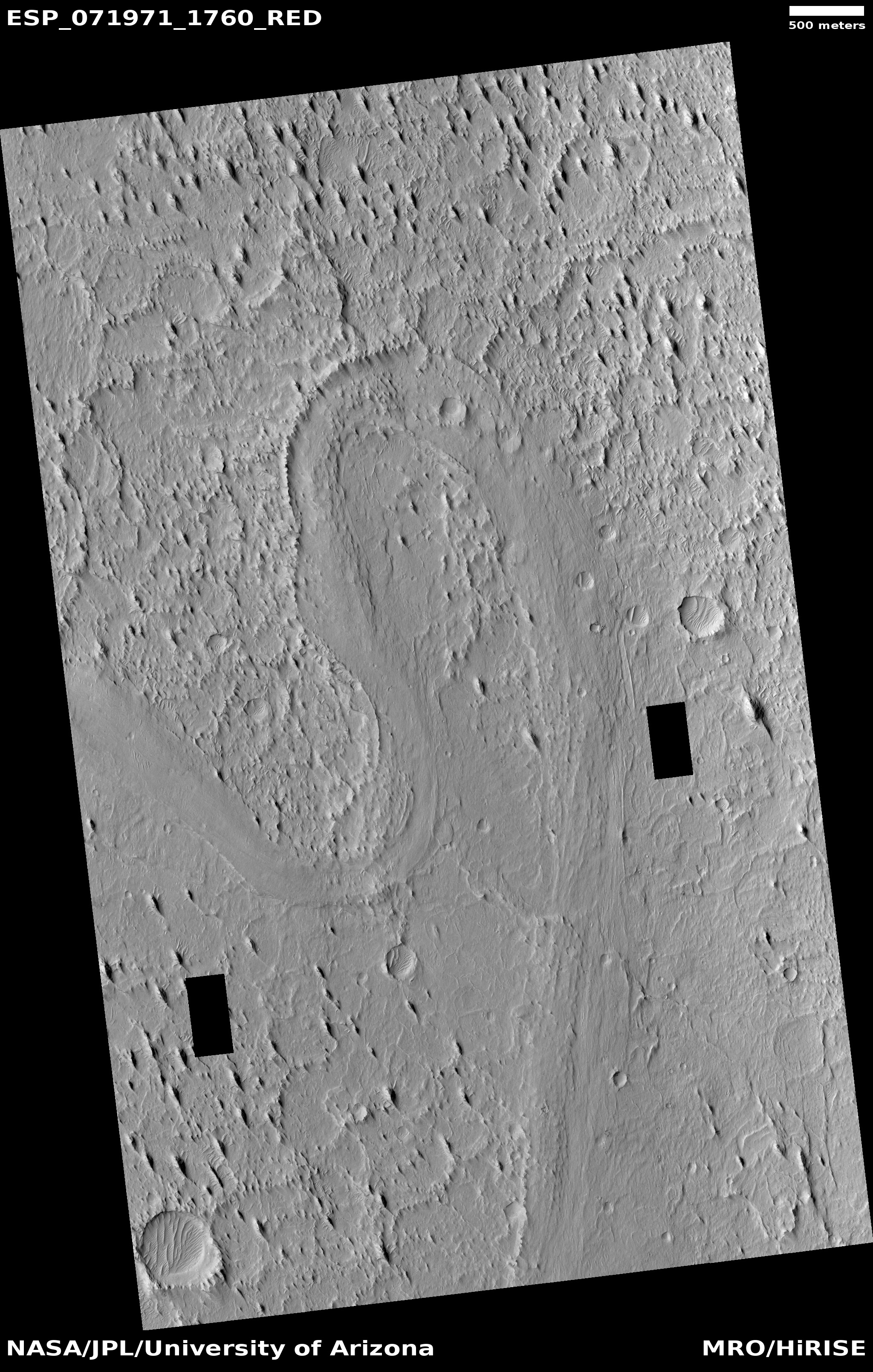
In our third Martian cool image of the day, we go to the north pole of Mars, as seen from orbit by the high resolution camera of Mars Reconnaissance Orbiter (MRO). Taken on March 30, 2022 and cropped and reduced to post here, this picture shows some of the distinct and unique geological features found only on the polar caps of Mars. From the caption by Candy Hansen of the Planetary Science Institute in Tucson, Arizona:

Both water and dry ice have a major role in sculpting Mars’ surface at high latitudes. Water ice frozen in the soil splits the ground into polygons. Erosion of the channels forming the boundaries of the polygons by dry ice sublimating in the spring adds plenty of twists and turns to them.

Spring activity is visible as the layer of translucent dry ice coating the surface develops vents that allow gas to escape. The gas carries along fine particles of material from the surface further eroding the channels. The particles drop to the surface in dark fan-shaped deposits. Sometimes the dark particles sink into the dry ice, leaving bright marks where the fans were originally deposited. Often the vent closes, then opens again, so we see two or more fans originating from the same spot but oriented in different directions as the wind changes.

The top layer of translucent dry ice falls as dry ice snow during the winter, than sublimates away with the arrival of spring. Since this photo was taken in autumn, we are looking at features left over from the activity from the spring and summer.

1 comment

Perseverance peers towards the rim of Jezero Crater

Perseverance peers through winter haze
Click for full image.

Overview map
Click for interactive map.

In our second cool image from Mars today, the Mars rover Perseverance gives us its own long distance view of the dusty winter air inside Jezero Crater. The photo above, cropped and reduced to post here, was taken on June 16, 2022 by the rover’s left high resolution camera, and looks to the southwest towards the crater’s western rim.

As with today’s previous cool image from Curiosity, we can see several ranges, each with distance faded more by the dust that hangs in the air during the winter on Mars. In the foreground right is the nearest cliff of the delta that flowed into Jezero over time in the past. Next is a knob and ridge line, also part of that delta flow but farther away. Third are some farther ridges that might have been part of that flow but maybe not.

Faintest of all are the highest mountains that form the western ridge of Jezero Crater, barely visible in the haze.

The blue dot in the overview map to the right marks Perseverance’s approximate position when the photo was taken. The yellow lines my guess as to the area covered by the photo. The green dot marks Ingenuity’s present position after its last flight, much closer to the delta that I had predicted.

3 comments

Martian mountains, near and far

Navigation image
Click for full image.

Martian mountains, near and far
Click for full image.

Cool image time! The photo to the right, taken on June 18, 2022 by high resolution camera on the Mars rover Curiosity, provides a close-up of the area indicated by the arrow in the navigation camera image above taken three days earlier.

Because the rover had moved uphill slightly during those three days, the close-up can peek over what was the most distant ridge to see farther up Mount Sharp. (For context take a look at the overview map here.) All told, this close-up to the right shows four mountain ridges/ranges. First we have the ridgeline to the right, partly in shadow, which forms the right wall of the saddle that Curiosity appears heading for. Next we can see to the left the top section of the large 1,500 foot high mesa on the other side of the canyon Gediz Vallis. Note its many layers, all of which are going to become a major item of study as Curiosity gets closer.

Third we have a very rough and tumbled ridgeline, formed in a layer the geologists have dubbed the sulfate bearing unit. This layer tends to be very light in color, and more easily eroded. Curiosity is presently beginning to move into this layer as it climbs.

Finally there is the most distant ridge, which is simply the higher reaches of Mount Sharp though not its peak by a long shot.

The dusty winter air is quite evident by the chariscuro effect, causing the more distant ridges to appear more faded.

Note: This will be the first of three cool Martian images today. Stay tuned.

0 comments

NIH to discriminate against whites in awarding research grants

Federal government: dedicated to segregation!
NIH: dedicated to racial discrimination

“Segregation today, segregation tomorrow, segregation forever!” The National Institutes of Health (NIH) has now created a program to award about $20 million in grant money exclusively to black researchers, thus favoring research not because of its merit but solely because of the skin color of the grantee.

The program will create a new class of NIH’s standard R01 research grant designed to “encourage a more diverse pool of PIs [principal investigators],” said Walter Koroshetz, director of the National Institute of Neurological Disorders and Stroke (NINDS), at a recent meeting. NINDS is launching the program, aimed at new PIs and those whose labs are at risk of folding, together with the National Institute of Mental Health (NIMH) and National Institute on Drug Abuse (NIDA). In 2021, the three institutes partnered on a policy with similar aims that NIH later pulled because of concerns it would violate federal antidiscrimination laws.

The NIH attempted to create a similar bigoted grant program last year, but had to back off when critics pointed out its obvious illegality. Agency officials now claim this new program passes muster, because

…it aims to enhance diversity “in a very broad sense,” [NIH extramural chief Michael] Lauer says. An NIH spokesperson notes that although the program “encourages” applications from researchers in underrepresented groups, “it is not exclusive—all new investigators and at-risk investigators are eligible to apply.” (NIH defines “at-risk” as a PI who will have no NIH grants if their high-quality proposal isn’t funded.)

What a lie. We all know that the grant application will require each applicant to state their race, and the NIH will then automatically disqualify anyone who isn’t black. It will also conveniently never make public the actual racial breakdown of those who win grants from this program, in order to hide its bigotry.

6 comments

SLS dress rehearsal countdown continues, though T-0 delayed two hours

The SLS dress rehearsal countdown is proceeding today as planned, though the countdown’s end at T-0 is now 4:38 pm (eastern), two hours later than previously announced.

Apparently they have delayed T-0 from the beginning of the two-hour simulated launch window to its end. This decision so early in the count suggests the launch team wants to give itself extra time either to deal with some issue that has come up that they haven’t told us about yet, or to give themselves more time in case some issue should come up.

2 comments

ISS forced to dodge space junk from Russia’s November ’21 anti-sat test

Last week the Russians were forced to use the engines of the Progress cargo capsule docked to ISS to shift the station’s orbit slightly to avoid a collision with some debris left over from Russia’s anti-satellite test in November 2021.

“I confirm that at 22.03 Moscow time, the engines of the Russian Progress MS-20 transport cargo ship carried out an unscheduled maneuver to avoid a dangerous approach of the International Space Station with a fragment of the Kosmos-1408 spacecraft,” Roscosmos chief Dmitry Rogozin wrote on Telegram (opens in new tab), according to a Google translation, using Roscosmos’ designation for Progress 81.

While the Russians have consistently denied the anti-sat test and the 1,500 satellite pieces it created would cause a collision threat, yesterday’s action was not a surprise, and was predicted by many right after the test.

The concern however is not the debris that has been identified and is being tracked, since collisions from that stuff can be predicted and avoided. The concern is from the smaller pieces that were not identified.

5 comments

SLS dress rehearsal countdown begins

NASA engineers began their fourth attempt to complete a full dress rehearsal countdown of the SLS rocket yesterday, with everything proceeding so far as planned.

Overnight, engineers powered up the Orion spacecraft and the Space Launch System’s core stage. Teams also configured several systems on the ground, rocket, and spacecraft and performed activities to prepare umbilicals that connect the rocket and spacecraft to the mobile launcher and are used to provide power, communications, coolant, and propellant.

Actual fueling begins tomorrow, when the countdown is supposed to conclude at T-0 at 2:40 pm (Eastern).

NASA live stream is available here.

7 comments

SpaceX completes its third launch in less than 48 hours

Capitalism in space: SpaceX tonight successfully completed its third launch in less than 48 hours, launching a commercial communications satellite.

The first stage completed its ninth flight, landing on a drone ship in the Atlantic Ocean. At this moment, though the satellite is in orbit it has not yet been deployed.

The leaders in the 2022 launch race:

26 SpaceX
18 China
8 Russia
3 Rocket Lab
3 ULA

American private enterprise now leads China 35 to 18 in the national rankings, and leads the entire world combined 35 to 29.

At this point the U.S. is halfway to matching its annual record for launches of 70, set in 1966. With the year not quite half over, the U.S. is also only seven launches behind its total of 48 last year, which had been the most launches for the U.S. in a year since 1968. SpaceX itself is only five launches behind its own record of 31 from last year, and is easily on a pace to meet its goal of 60 launches this year.

16 comments

UAE’s Rashid lunar rover getting ready for November launch

The new colonial movement: Engineers have now delivered the United Arab Emirates’ (UAE) first lunar rover, Rashid, to France for testing and preparation for its early November launch on a Falcon 9 rocket.

The 10-kilogram rover will now spend a few weeks in Toulouse for vibration and thermal vacuum testing, a series of final checks to ensure it can survive the extreme environment during a rocket launch and spaceflight. It will then be moved to Germany, so it can be integrated with a Japanese lander, called Hakuto-R Mission 1, built by private company ispace inc, which will deliver the rover to the lunar surface.

Once completed, it will be shipped to the launch site in Florida’s Kennedy Space Centre in September.

Unlike the UAE’s Al-Amal Mars orbiter — which was mostly built in the U.S. by American companies and universities as part of a training program for UAE citizens, Rashid appears to have largely built in the UAE by those engineers.

7 comments

South Korea reschedules launch to June 21 after fixing sensor issue

The new colonial movement: South Korea space officials from its KARI space agency have now rescheduled the second test launch of their home-built Nuri rocket for June 21st, after replacing a fuel sensor on the rocket that was not working.

ARI said engineers identified the problematic part within the sensor and replaced it, and Kwon said they also found no other problems after inspecting the rest of the rocket. Kwon noted that the rescheduled launch date could be subject to change depending on weather conditions.

This will the second time KARI has attempted an orbital launch of Nuri, with the first experiencing an upper stage failure in October 2021.

0 comments

Kitt Peak telescopes undamaged from wildfire

Firefighters have so far been able to protect the telescopes on Kitt Peak in Arizona from being damaged by a fast burning wildfire that began a week ago.

In a statement, NOIRLabs, which manages Kitt Peak Observatory for the National Science Foundation, said a crew of firefighters are working on the summit with multiple engines. Hydrants have been tested, and fire hoses deployed to defend the observatory’s buildings, they said, adding firefighters are dropping “large amounts” of fire retardant on the southern end of the observatory in an effort to slow the fire’s advance.

On Thursday, firefighters cleared a line of trees and brush below the peak’s southern ridge, an effort that was “mostly complete” by the evening, said NOIRLabs. Firefighters also cleared the area around individual domes, as well around “critical infrastructure,” and around flammable propane tanks. In some places, ground crews started backfires to create fuel breaks, officials said.

Firefighters are continuing to remove brush on the slopes, and have spotters watching for hot-spots.

That this point it appears the telescopes are safe, as the fire teams allow the fire to burn out.

5 comments

SpaceX successfully launches German military satellite

Capitalism in space: SpaceX this morning used its Falcon 9 rocket to successfully launch a German reconnaissance satellite, completing its second of three launches this weekend.

The first stage completed its third flight, landing at Vandenberg, in thick fog. The third launch is set for just after midnight tonight.

The leaders in the 2022 launch race:

25 SpaceX
18 China
8 Russia
3 Rocket Lab
3 ULA

American private enterprise now leads China 34 to 18 in the national rankings, and the entire world combined 34 to 29.

0 comments
1 107 108 109 110 111 192