The new ebook edition of Genesis

I am thrilled to announce that the new ebook edition of my first book, Genesis: the Story of Apollo 8, is now officially available for sale for only $5.99 from Mountain Lake Press. The direct link to Mountain Lake Press’s sales page is here and on the right. Within two weeks the book will also be available at all retailers, but if you buy it direct from Mountain Lake Press, I will make a little extra money, which would be very much appreciated.

In creating this ebook edition I made sure that all the graphics from the original but out-of-print hardback were included. Valerie Anders, the wife of astronaut Bill Anders, added her own thoughts in a new foreword. I also added a new introduction discussing how the history of space exploration has evolved since the book’s initial publication in 1998. As I noted,
» Read more

0 comments

Telescopes of the future

Two stories were published on Thursday about two very different future space telescopes. Both are worthwhile, but the differences between them illustrate how the industry of space astronomy — like manned space — is evolving from Big Science and government to small, efficient, and privately built.

First there is this story describing how the nonprofit B612 Foundation’s project to launch an infrared telescope by 2017 had passed its first technical review.
» Read more

0 comments

Polar bear fraud

The scientist famous for identifying drowning polar bears in the Arctic has been reprimanded for leaking emails and following “inappropriate” procurement procedures at his job at the Department of Interior.

The investigation also criticized the scientist, Charles Monnett, for fudging his data in reporting the death of the polar bears, a report that the global warming movement used extensively to falsely prove that global warming was causing the destruction of the polar bear population.

The Nature story above tries to make light of Monnett’s misconduct, especially in connection with his polar bear report as well as his work in awarding contracts. The report itself [pdf] is far more harsh.

In connection with Monnett’s contract work, it appears he actually helped one contractor write his proposal, then sat on the board that awarded the contract to that contractor.
» Read more

1 comment

Why I spent $50 at a political fundraiser today

Jonathan Paton

Two days ago Ralph Kayser, head of the Tucson Tea Party, sent out an email announcing that the Republican Congressional candidate for my district, Jonathan Paton (pictured on the right), was going to hold a luncheon fundraiser today. Ralph wanted to know if anyone was interested in attending.

Normally, I detest giving money to politicians, from either party. I consider them to be the worst form of bloodsuckers. They don’t produce any wealth, cannot create jobs no matter how hard they try, add restrictions to our lives that squelch freedom, and generally only serve to squeeze tax dollars from us all for wasteful government projects, money that we would better left in our own hands to use as we each saw fit. And then they go on the campaign trail, begging for more money so that they can beat the other guy.

Like I say, bloodsuckers.

Nonetheless, to me this election is different, in the same way the 2010 election was different.
» Read more

3 comments

The next great comet?

Amateur astronomer Jason Lewis sent me an email today describing how the amateur astronomy community is abuzz with the discovery of a new comet, presently dubbed C/2012 S1, that is due to make its dive around the Sun in late November 2013 and pass closest to the Earth in January 2014 at a distance of about 37 million miles. Based on the preliminary numbers, this comet might be one of the brightest in years, almost certainly a naked eye object and visible to everyone from both the northern and southern hemispheres.

To quote the comments from one astronomy forum:
» Read more

2 comments

Boeing and the fear of competition

Boeing has indicated that it might shelve its CST-100 manned capsule, despite their recent almost half a billion dollar contract award from NASA.

This possibility illustrates why Boeing is losing market share, not only in space, but in the aviation industry. The article suggests that the NASA contract might not be enough to pay for CST-100, and that Boeing is unsure there is enough private market to make up the difference.

“That’s just for the ISS. That’s kind of the basement,” adds Elbon. More flights than those to the ISS are required he says, and Boeing is cautious about over-committing itself while future revenue streams are unclear.

I say bull hockey.
» Read more

37 comments

The science cuts from sequestration

The journal Science today published this detailed look at the cuts that would occur in all the federal government’s various science programs should the automatic budget cuts outlined in the sequestration legislation occur on January 2, 2013.

Not surprising, the article includes a great deal of moaning and groaning about the terrible harm the cuts would have on science research should they occur. From the Obama administration:
» Read more

5 comments

“We choose to go to the Moon.”

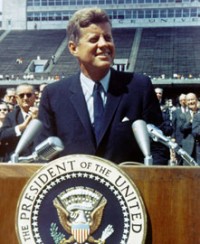
Kennedy at Rice University

Fifty years ago today, John Kennedy gave a speech at Rice University in Texas, outlining his reasoning behind his proposal that the United States send a man to the Moon before the end of the decade. The key phrase:

But why, some say, the Moon? Why choose this as our goal? And they may well ask why climb the highest mountain? Why, 35 years ago, fly the Atlantic? Why does Rice play Texas?

We choose to go to the Moon. We choose to go to the Moon in this decade and do the other things, not because they are easy, but because they are hard, because that goal will serve to organize and measure the best of our energies and skills, because that challenge is one that we are willing to accept, one we are unwilling to postpone, and one which we intend to win, and the others, too.

Video below the fold. The full text can be found here. (Interesting sidebar: When I posted Monday’s evening pause that quoted this speech I hadn’t realized the 50th anniversary of the speech was this week!)

This speech is worth watching, in full, if only to see the passion of both Kennedy and the audience for what he says. It also reveals a somewhat higher level of sophistication coming from a politician than one would see nowadays. Kennedy not only understood the deeper philosophical reasons for exploration, his thoughts were grounded in history as well as recent events, all of which he referenced repeatedly.
» Read more


1 comment

A delayed but higher prediction for the solar maximum?

The uncertainty of science: The solar scientists at the Marshall Spaceflight Center today revised upward their prediction for the upcoming peak of the solar maximum, from a sunspot number of 60 to 76, while simultaneously delaying the arrival of their predicted peak from the spring to the fall of 2013.

Since Marshall does not archive its predictions, I am required to keep track of the revisions they make and note them here. Previously I had outlined the changes in this prediction since January 2011. Here is an updated listing:
» Read more

1 comment

We have a choice

A website, ScienceDebate.org, submitted a wide range of questions to Barack Obama and Mitt Romney about their plans for science and technology, and the answers, shown in a side-by-side comparison, are interesting, though in general they demonstrate the ability of politicians to speak for a long time without saying much.

This ability to blather is especially apparent to their answers to the question 12: “What should America’s space exploration and utilization goals be in the 21st century and what steps should the government take to help achieve them?” Neither candidate adds much to what was said in the Republican and Democratic party platforms, making it obvious that neither really cares or knows that much about this subject.

Overall, however, the answers do reveal the basic and fundamental differences between the two candidates, which can be seen in their answers to the very first question about encouraging innovation:
» Read more

1 comment

Ryan’s speech

If you depend on the conservative commentary about Paul Ryan’s acceptance speech yesterday at the Republican convention to find out how he did, you would have no doubt that this was the greatest and most effective speech since Genesis. To quote just one report:

Paul Ryan’s speech, in two words? Nailed it. Everything that I like (and surmise that others will like as he becomes more and more familiar to them) about Paul Ryan was on perfect display during his half hour-ish on stage. He was intelligent without being intimidating; he was stern and serious but still optimistic and even funny; and he hinted at his wonkiness without getting into jargon and maintained his approachability. But the most beautiful thing about Paul Ryan as the potential vice president of the United States is his uncanny knack for breaking through populist myths and shrill leftist attacks and instead communicating the merits of free-market economics and small government, all without being shrill or polarizing.

Because I’m not spending a lot of time watching these conventions, mostly because they really are nothing more than public relations events staged by both parties, I didn’t see the speech live. After reading reports like the one above, however, I decided late last night to go to youtube and dig up Ryan’s speech and see this amazing performance for myself.
» Read more

1 comment

Romney, the Republicans, and Space

The Republican Party, as part of their national convention taking place in Florida this week, yesterday released their party platform for the upcoming election campaign.

Normally, I don’t waste my time with party platforms. No one really reads it, and no president ever follows it. Granted, it can give you a general sense of where a party and candidate is headed philosophically, but this is politics. If you think philosophy is their number one priority then I have a bridge in Brooklyn I want to sell you.

However, this document is helpful to us, at least when it comes to the nation’s space effort, as it actually devotes one entire (though short) section on the subject. Considering how vague Mitt Romney has been on what he will do with NASA and space, and how schizophrenic the Republicans in Congress have been, any hint on how they might approach this particular program should they win the election is helpful.

Here is the entire statement of the Republican party platform on the subject of space exploration:
» Read more

15 comments

More rumors about a year-long mission on ISS

The possibility that NASA might finally agree with Russia’s repeated request to fly a year-long mission to ISS grew stronger this morning with two stories:

The first, by James Oberg, digs into the underworld of NASA politics to find that plans might very well be more advanced than NASA is letting on:
» Read more

1 comment

Cave exploration the astronaut way

How not to go cave exploring:

An international crew of six astronauts will start training for a caving adventure designed to prepare them for spaceflight. CAVES, an abbreviation of Cooperative Adventure for Valuing and Exercising human behaviour and performance Skills, prepares astronauts to work safely and effectively and solve problems as a multicultural team while exploring uncharted areas using space procedures.

Or to put it more bluntly, overly complicated, bureaucratically organized, and not very efficient. For example:
» Read more

2 comments
1 60 61 62 63 64 84