Bringing life to the slumping lifeless slopes of Mars
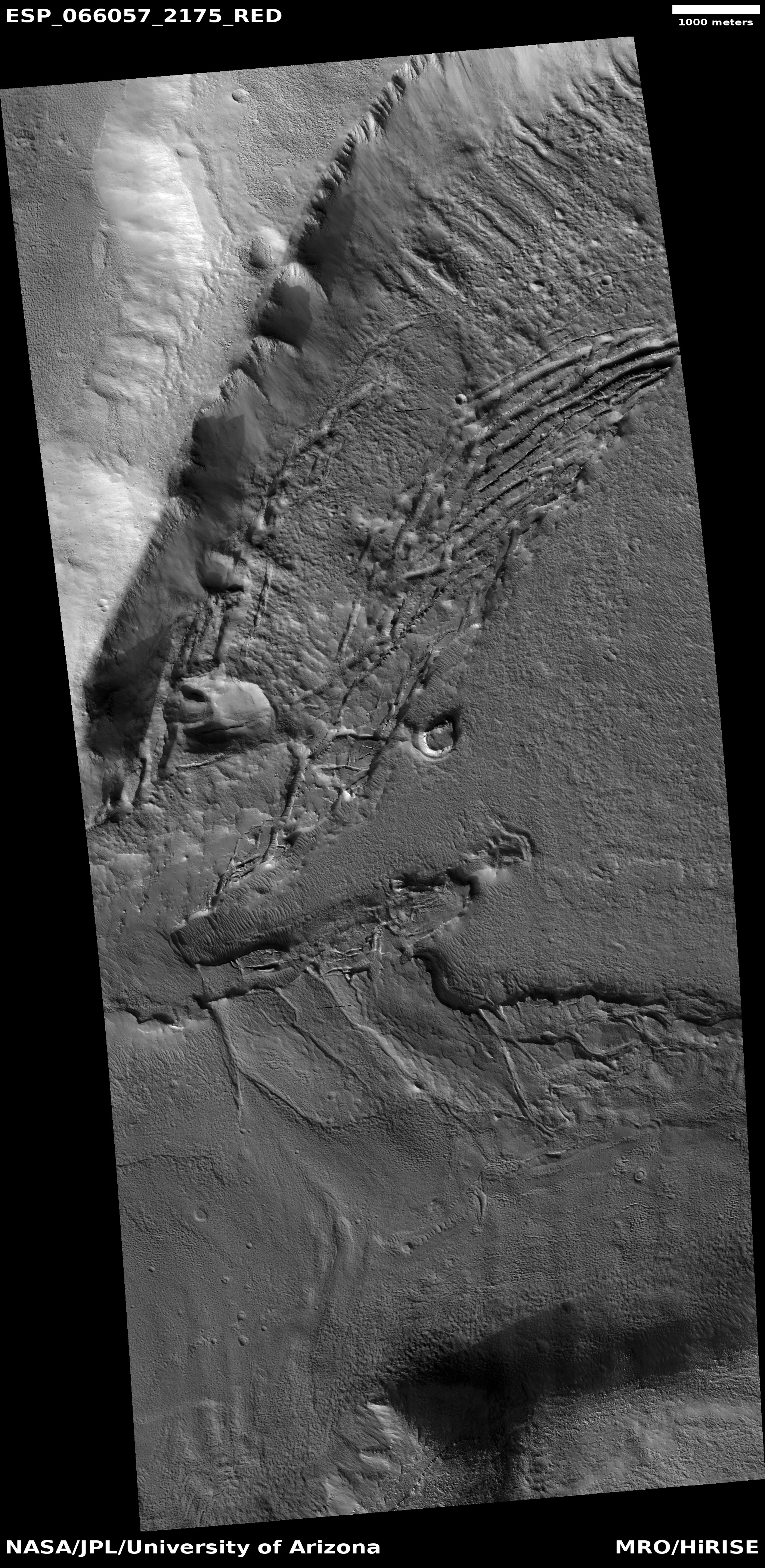
Slumping slopes on Mars
Click for full image.

To me, the cool image to the right, cropped and reduced to post here, helps illustrate the most significant difference between Mars and Earth, its obvious lack of life. This lack fundamentally changes the nature of erosion on the Red Planet.

On Earth life covers practically every square foot of the surface, and that life probably does more than anything to reshape the surface, and it does it far more quickly than any geological or meteorological process. For example, even if we are in the most lifeless area of the Sahara Desert, with no plant life, the dunes will still be reshaped and changed simply by the passage of any animal, whether it be a lizard, camel, or human driving a jeep.

On Mars, there is no visible life, and this lack means that any changes we see are solely geological or meteorological in nature. From a scientist’s perspective, the view is clean, all changes wrought solely by inanimate nature, without the added factor of life.

In a sense, Mars gives us a view of what geological and meteorological processes would do on Earth, if the Earth was lifeless.

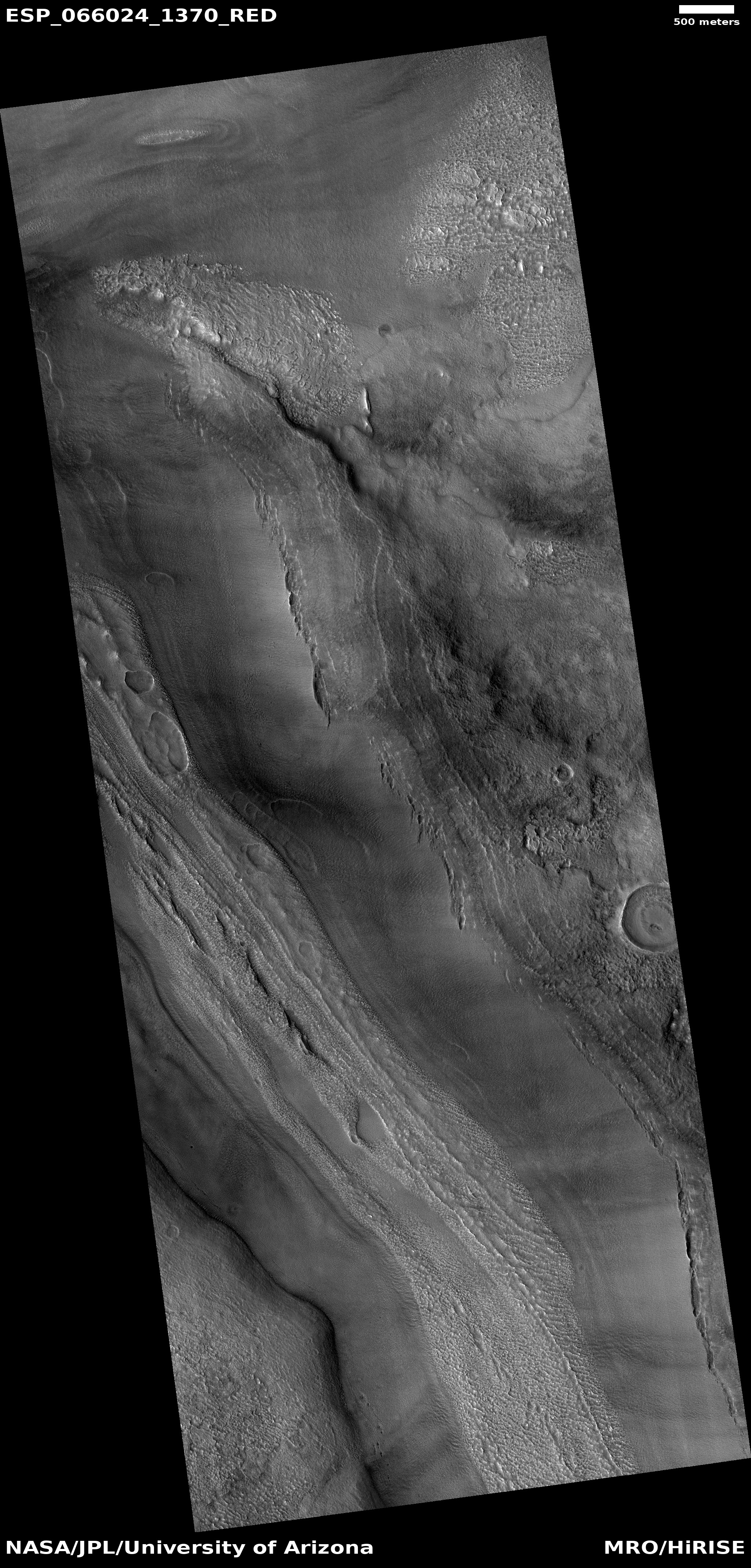
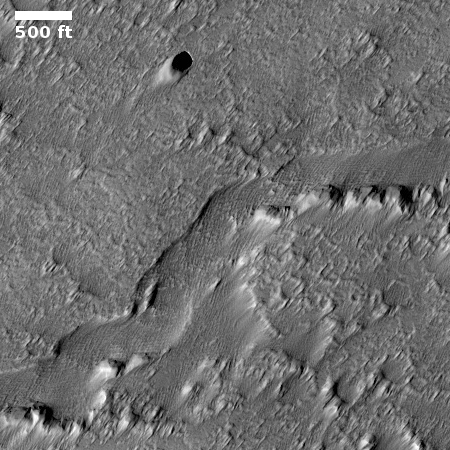
Today’s image, taken by the high resolution camera on Mars Reconnaissance Orbiter (MRO) on August 29, 2020, exemplifies this. Labeled “Slope Failures in Tempe Terra,” it shows the slow break-up and slumping of debris as it oh-so-slowly falls from higher terrain. The cracks developed as large chunks pulled apart as the material slide downward to the east.

This cracking took a lot of time. On Earth, during that time it would have either been obscured by plant life, or would have been distorted greatly by the traffic of animal life across its surface. Animals would have dug holes, and humans might have reshaped it to build homes and roads. On Mars, none of that happened, so the geology was free to evolve slowly, without interference, and now sits in plain view for scientists to interpret.

Such knowledge will over time strengthen our understanding of Earth geology, because it will give us a better understanding of the influences of life on that geology. Geologists will be better able to separate the influence of life and inanimate natural processes.

The overview map below helps give the wider context of those Martian inanimate natural processes, on a grand planetary scale.
» Read more
3 comments

Was there a catastrophic flood in Kasei Valles on Mars?

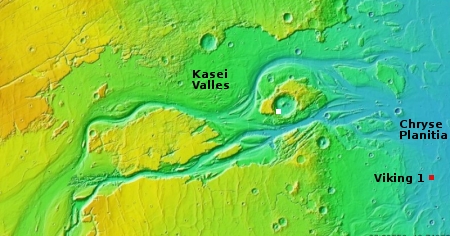
Overview map of lower section of Kasei Valles

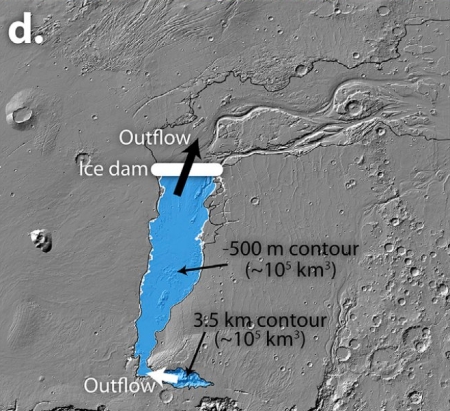
Figure from paper

In our on-going exploration of Mars using the amazing high resolutions being taken by Mars Reconnaissance Orbiter (MRO), we return today to Kasei Valles, the drainage valley coming down from Mars’ giant volcanoes that I featured only a few days ago. And like that post, we must begin from afar and zoom in to understand what we are seeing in the final cool image.

Kasei Valles is a canyon system is about 1,900 miles long, and would cover two-thirds of the continental United States if placed on Earth. Its north-trending upstream section to the west and south of the area shown on the overview map to the right is thought to have been formed by some combination of glacial and volcanic processes. The downstream west-east section shown in the map instead appears to have been formed by a sudden catastrophic flood, which some scientists have theorized [pdf] occurred when a three hundred long ice dam broke suddenly, releasing the flood quickly across this terrain to create its features. The second map to the right, from their paper, illustrates this hypothesized event.

The white box in 60-mile wide Sharonov Crater near the center of the first map above indicates the location of today’s cool image below. The 1976 landing site of VIking 1 about 420 miles to the east is also indicated.

If you look closely at the first overview map above you can see that the rim of Sharonov Crater appears breached in its southwest quadrant, just to the west of the white box. This breach is less a break and more an area of increased erosion. Regardless, it sure appears that a massive flow pushed through the rim here.
» Read more

0 comments

Weird crater on Moon

Strange Ryder Crater on the Moon
Click for full image.

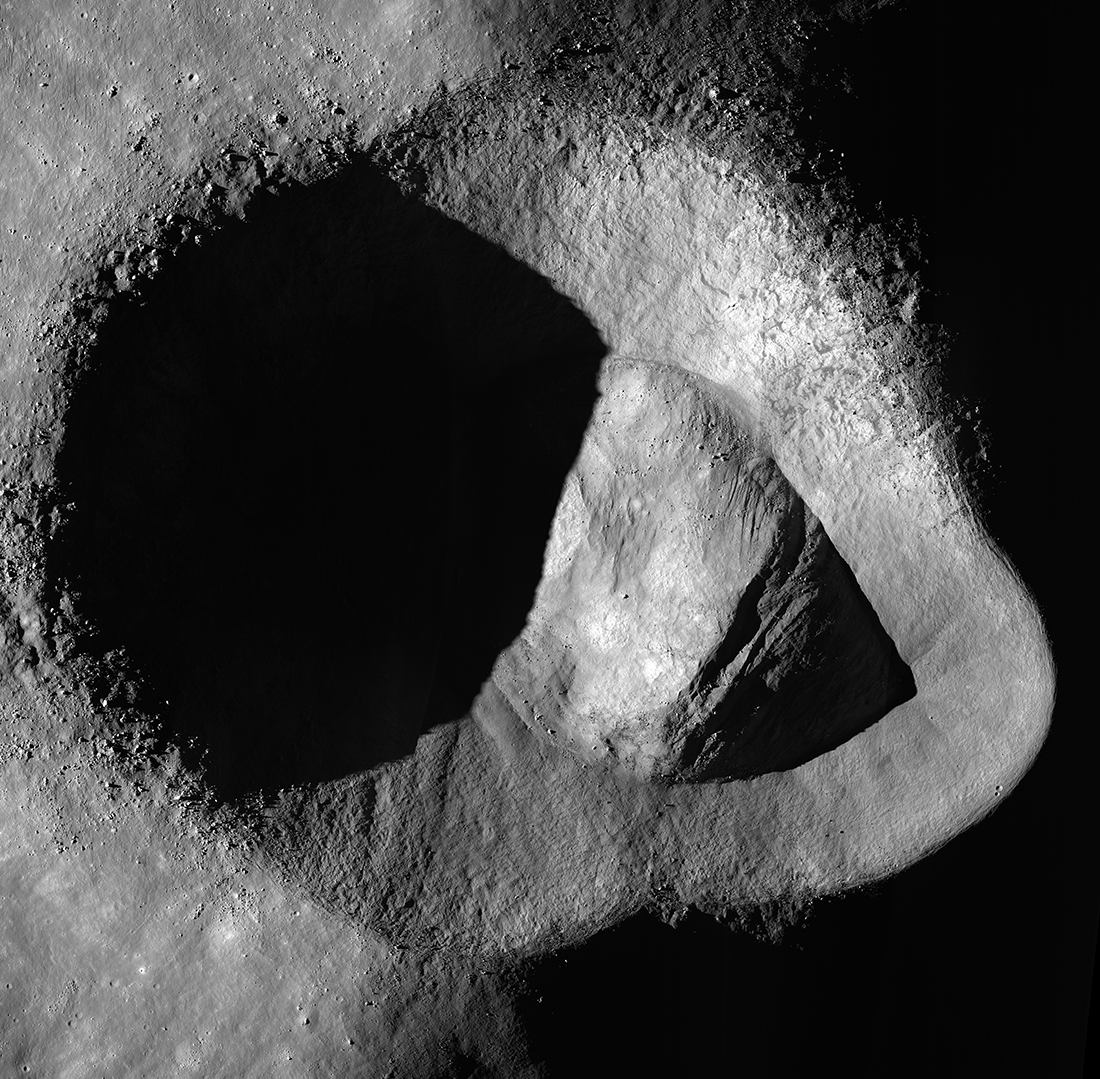
The photo to the right, released today by the science team of Lunar Reconnaissance Orbiter (LRO), takes a overhead view of the unusual crater dubbed Ryder (named after lunar scientist Graham Ryder).

The crater is located on the Moon’s far side, on the edge of the South Pole-Aitken Basin, the Moon’s largest and possibly oldest impact basin. What makes Ryder Crater intriguing is its strange shape, as well as its interior north-south interior ridge.

This crater was featured previously in 2012 in a spectacular oblique image looking east across the crater. Then, the scientists theorized its strange shape was caused by two factors, first that the impact was oblique, and second that it occurred on a steep slope.

Today’s release adds another factor that might explain the interior ridge. The context map below makes that explanation obvious.
» Read more

3 comments

The edge of Martian chaos

Overview map of end of Kasei Valles

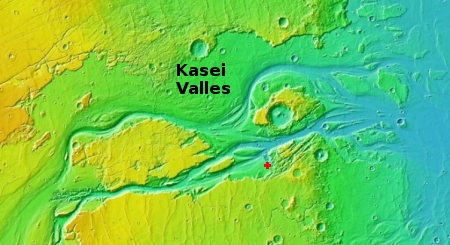
For today’s cool image, we are going to start from afar and zoom in, because I think that might be the best way to gain at least a rudimentary understanding of the strange geology visible at this one particular Martian location.

The first image, to the right, is the overview map. The red cross indicates our target, a chaotic canyon that flows into the larger Kasai Valles, one of Mars’ largest and longest canyons and possibly only exceeded in size by Valles Marineris. This part of Kasai is near its end, where it drains out into the vast northern lowland plains of Mars.

The second image, below, comes from the wide angle camera on Mars Reconnaissance Orbiter (MRO).
» Read more

1 comment

Update on InSight’s mole: It is now underground

InSight's mole now completely buried
Click for full image.

An update today on the mole digging tool on the Mars lander InSight has revealed that the mole appears to finally be completely buried, though it remains unclear whether its most recent digging effort had succeeded in digging downward.

We found that during the first two rounds of hammering and during the first half of the third round of hammering, the scoop went further into the sand. Since the Mole was hidden under the scoop, the penetration of the probe itself could not be observed directly.

During the hammering, the flat tether running to the probe moved considerably, but these could only be clearly identified as forward movements during the hammering on 22 August. Overall, we could estimate from the movements of the scoop that the Mole moved at most one centimetre further into the ground. It was interesting to observe that during the second half of the round of 250 hammer blows on 19 September, the scoop did not go any further, probably because it encountered duricrust. This was certainly a desired outcome, as it allowed a second Free Mole Test to be conducted. In fact, the probe continued to move according to the movements of the tether, but it could not be clearly determined that these movements brought the Mole deeper into the ground.

The image shows InSight’s arm above the filled hole, with the mole’s flat tether coming out of the ground.

They are now going to fill the hole more, and then press down with the scoop during later drilling efforts to see if this allows the mole to proceed downward. If it fails I’m not sure if there is anything else they will be able to do to get the mole to work.

9 comments

Fingerprints on Mars!

Fingerprint terrain on the Martian south pole icecap
Click for full image.

No, today’s cool image is not a variation of the absurd “face on Mars” that our alien-obssessed fantasy culture focused on for more than twenty years that turned out to be nothing more than a mesa whose shadows in one image made it look very vaguely like a face.

Instead, today’s cool image is of a very weird Martian geological feature that strongly resembles the whorls and curls seen in all fingerprints, and is thus apply named “Fingerprint Terrain.”

The photo to the right, rotated, cropped, reduced, and annotated to post here, was taken by the high resolution camera on Mars Reconnaissance Orbiter on August 26, 2020. It shows part of the surface of Mars’ south pole residual icecap, about 130 miles from the south pole, at a place where the temporary thin dry ice mantle that arrives every winter with the bulk of it sublimating away with the coming of spring.

The fingerprint in this image shows that sublimation process, with the gaps in dry ice mantle getting wider and larger as you move north, until the ridges between disappear altogether.

But why does it look as it does, like a fingerprint? In other places this sublimation process does not look like this at all. Sometimes we get spiderlike formations. Sometimes we get splatters that suggest geysers. Sometimes the surface sublimates to produce swiss cheese shapes. But why a fingerprint here?

I asked this question of Shane Byrne of the Lunar and Planetary Lab University of Arizona, who had requested this particular image, hoping he and other planetary scientists had investigated this geology and come up with an explanation. His answer illustrates how little we yet know about Mars.

Itโ€™s almost definitely some sort of sublimation process, but it hasnโ€™t been well investigated. There are some papers that talk about sublimation landforms on the cap in general and map out where different types are, but nothing that I know thatโ€™s specific to the fingerprint terrain.

In other words, why the dry ice cap sublimates away in this manner, at this and other locations, remains unexplained.

I’ll say it again: Mars is strange, Mars is alien, and Mars is therefore a place humans must go.

14 comments

Lava cones, fissures, and channels from Olympus Mons

A lava cone, fissure, and channel on Mars
Click for full image.

Cool image time! The photo to the right, cropped and reduced to post here, was taken on June 29, 2020 by the high resolution camera on Mars Reconnaissance Orbiter (MRO). In this one spot we see three obvious volcanic features, all however formed by different processes.

The location of this image is west of Olympus Mons. It sits on the vast lava plain that was laid down by that volcano, the largest in the solar system.

In order of likely occurrence, the cone probably came first. It likely indicates a past eruption coming up from below to create a small volcano.

The shallow meandering channel that sweeps around it to the north and east probably marks a later lava flow coming down from Olympus Mons.

The deeper straight fissure to the south probably came last. It is a graben, a crack caused by the uplift of the entire surface because of pressure from a magma chamber below, causing cracks to form as the surface is stretched.

Three different volcanic events, each probably taking thousands of years, with maybe thousands to millions of years between them. The context map below adds weight to the scale of time and size represented by this one Martian photo.
» Read more

0 comments

A massive Martian glacier that looks just like a glacier on Earth

Massive glacier on Mars
Click for full image.

If you ever had any doubt about the existence of glaciers on Mars, today’s cool image should ease those doubts. The photo to the right, taken on August 27, 2020 by the high resolution camera on Mars Reconnaissance Orbiter (MRO) and rotated, cropped, and reduced to post here, shows many features that are appear identical to features found on typical massive glaciers on Earth.

Downhill is to the northwest. The many parallel grooves or fractures running along the length of the glacier resemble what are seen in many similar Earth glaciers. Some of these fractures are caused by the glaciers slow drift downward, with different sections moving at slightly different rates, thus causing a separation along the flow. Hence the parallel fractures.

These fractures also show evidence of some erosion. Because these Martian glaciers are no longer getting more snowfall, they are no longer growing. However, if the thin layer of dust and debris that protects the ice gets blown off or removed by motion, the ice is exposed and can then sublimate into gas so that the glacier erodes.

On the flow’s edges the darker parallel lines also resemble features seen on Earth, showing the exposed layers of the glacier’s past levels. The same thing can be seen on either side of the canyon’s walls.

The wide smooth section near the center of the parallel lines could very well be an impact crater that landed on this glacier sometime in the far past, and has since been distorted in shape as the glacier flowed downward.

If you still have doubts, the context image below, taken by MRO’s wide angle context camera, should help further allay those doubts.
» Read more

1 comment

A lunar landslide

Landslide on the Moon
Click for full image.

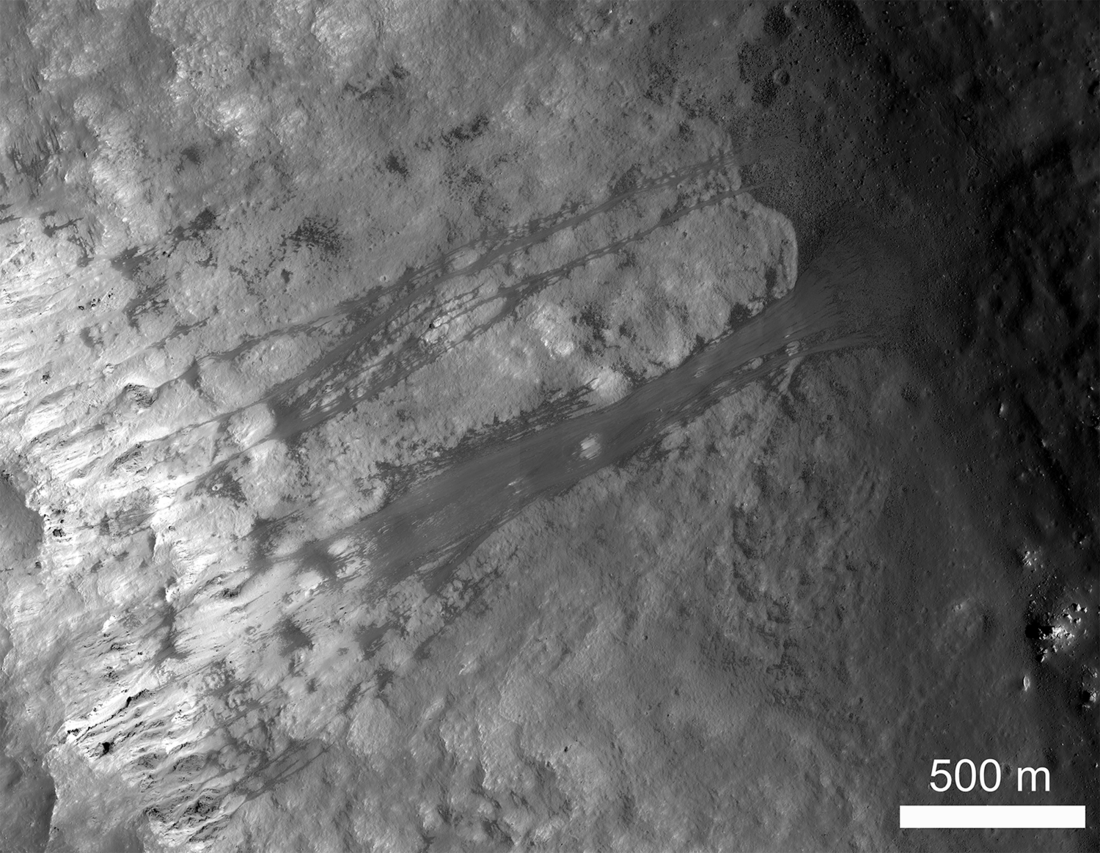
Cool image time! The image to the right was posted by the Lunar Reconnaissance Orbiter (LRO) science team on October 9, 2020, and shows a spectacular landslide almost a mile and a half long that had occurred on the interior rim of a crater on the Moon.

The top of the rim is on the left, with the landslide breaking out onto the floor of the crater on the right.

The walls of Kepler crater (30 kilometer diameter) exhibit numerous landslides. In this example, a landslide of dark material begins about 100 meters below the rim from a narrow box canyon. The box canyon is about 50 meters wide and 300 meters long. Overall, the slide is extends some 2300 meters (from the end of the canyon to its base). The base of the slide is on a fault block that lies some 1800 meters below the rim. The wall slope is about 33 degrees.

This slide is actually composed of a series of narrow landslides 20-30 meters wide. Along most of the slope, the individual slides overrun each other forming a band of debris up to about 180 meters wide. At the base of the slope, the individual slides can be recognized as they move apart forming a fan of material. A few individual isolated slides also occur adjacent to the main mass. The overlapping nature of these small slides indicate that the overall feature may have formed over a period of time, rather than all at once.

From above and at this resolution, the landslide looks almost like frozen flowing liquid. It allso looks like it began with a scattering of boulders breaking free at the top all at once that quickly consolidated into a single massive avalanche.

At the link you can zoom in or out to look at the entire image, at full resolution.

4 comments

More Martian pits!

Pit #1
Click for full image.

Pit #2
Click for full image.

Though the number of new pictures showing pits and possible caves from the high resolution camera on Mars Reconnaissance Orbiter (MRO) has significantly tailed off in the past year, as I noted in my previous post on Martian pits in September, the pictures are still rolling in. This post will highlight five new photos and the pits therein.

The first two, on the right, are both located on the southern flanks of the giant volcano Arsia Mons, where many such pits are found. They were taken respectively on August 16, 2020 and August 27, 2020. The first was a captioned image from MRO’s science team:

In this image, the ceiling of the lava tube collapsed in one spot and made this pit crater. The pit is about 50 meters (150 feet) across, so itโ€™s likely that the underground tube is also at least this big (much bigger than similar caves on the Earth). HiRISE canโ€™t see inside these steep pits because itโ€™s always late afternoon when we pass overhead and the inside is shadowed at that time of day.

What I find most interesting about both images is that the skylights do not occur where you’d expect. In image #1, the meandering rill that suggests an underground lava tube is about 1,000 feet south of the pit. The pit itself seems unrelated to that rill. In image #2, the surface shows no obvious evidence of an underground tube matching the three aligned pits. There is the hint of a narrow depression along the alignment of the three pits, but this could just as easily be evidence of wind-blown dust along that alignment.

In the full image all three pits appear to sit inside a very wide and very shallow northwest-to-southwest depression, but this is hardly certain, and regardless the three pits align in a different direction.

The overview map below provides some context.
» Read more

0 comments

More results about Bennu from OSIRIS-REx

Scientists using the OSIRIS-REx spacecraft have now published a special collection of papers outlining some of their discoveries made during that spacecraft’s observations of the asteroid Bennu from February to October 2019.

These papers just make official much of what was revealed during a conference I attended in November 2019. To sum up the papers:

  • Bennu has a lot of carbonates across its surface.
  • Some of that material came from another object that had to have had water.
  • The asteroid’s boulders come in two types, dark-porous and bright-solid, with the latter likely from that water-bearing other asteroid
  • Bennu’s surface is fresh, only recently exposed to space, including the sample site Nightingale.
  • Bennu’s interior has large voids, and its equatorial region is less dense.

The discovery of carbonates, produced from the interaction of water and carbon dioxide, is a big deal. As Dante Lauretta, OSIRIS-REx principal investigator, explained at that November conference, โ€œTo me this is one of the most exciting results from the conference.”

These findings have allowed scientists to theorize that Bennuโ€™s parent asteroid likely had an extensive hydrothermal system, where water interacted with and altered the rock on Bennuโ€™s parent body. Although the parent body was destroyed long ago, weโ€™re seeing evidence of what that watery asteroid once looked like here โ€“ in its remaining fragments that make up Bennu. Some of these carbonate veins in Bennuโ€™s boulders measure up to a few feet long and several inches thick, validating that an asteroid-scale hydrothermal system of water was present on Bennuโ€™s parent body.

The material could not have been created on Bennu itself, which means it formed on a different object that was large enough and existed long enough to create the veins in these boulders. That material was then flung back into space to settle onto Bennu’s surface.

The freshness of Bennu’s surface is also a big deal, as it means that etither the asteroid is not that old, or that its surface somehow gets plowed over periodically. It also means that when OSIRIS-REx grabs samples at the Nightingale site on October 20th, they will be grabbing material that has not been altered much by the harsh environment of space.

Finally, the data about Bennu’s interior and density is maybe the neatest discovery. As the press release notes,

The reconstructed gravity field shows that the interior of Bennu is not uniform. Instead, there are pockets of higher and lower density material inside the asteroid. Itโ€™s as if there is a void at its center, within which you could fit a couple of football fields. In addition, the bulge at Bennuโ€™s equator is under-dense, suggesting that Bennuโ€™s rotation is lofting this material.

Bennu’s very weak gravity makes it a very alien and hard-to-comprehend place. It appears that the gravel in this floating gravel pile is barely held together, some interlocking in a way that leaves many open gaps, with other pieces pulled outward by the spin of the asteroid.

In reading these results, my first impression was an overwhelming sense of time and its inconceivable vastness. Much of Bennu’s most primitive material comes from the early solar system, about six billion years ago. Other material is newer, but required many many millions of years to get created elsewhere, and then somehow end up in space to be captured by this asteroid.

A million years is a very long time. A billion years is a thousand times longer. To conceive such time frames and all that can happen during that time is practically impossible. Bennu has shown us just a hint of how much can happen, some of which we would never have imagined otherwise.

2 comments

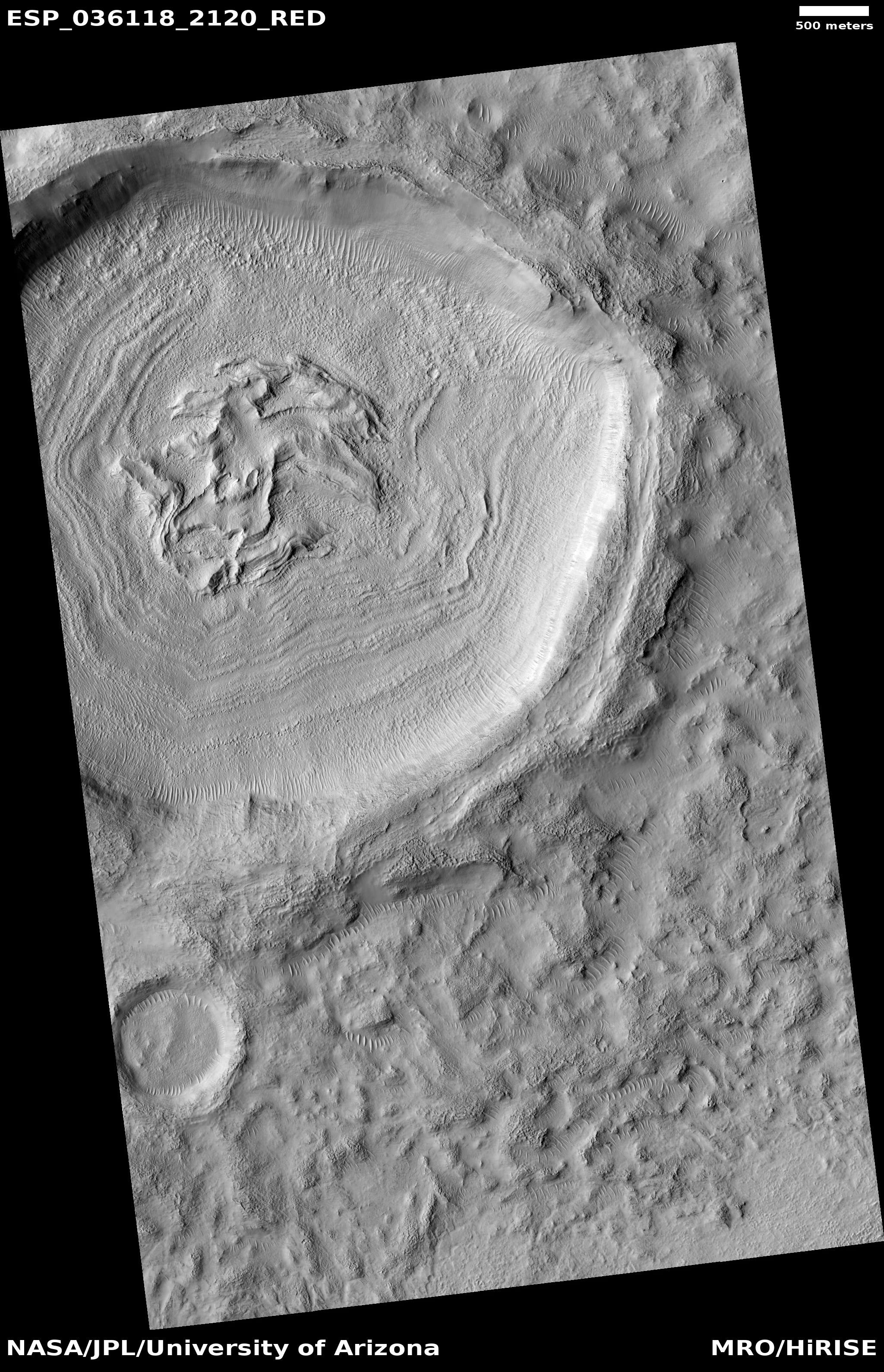
A typical mid-latitude Martian crater with glacial features

Typical mid-latitude Martian crater with glacial fill
Click for full image.

Cool image time! The crater on the right, the image cropped and reduced to post here, is a great example of many craters scientists have found in the mid-latitudes on Mars containing a variety of features that suggest buried glaciers. In this case we are looking at what they have dubbed a concentric crater fill, material that resembles glacial material that fills the crater’s interior and floor, and appears often to erode in a series of rings. You can see another example here.

The photo was taken on June 29, 2020 by the high resolution camera on Mars Reconnaissance Orbiter (MRO). The crater itself is located in a region of chaos terrain dubbed Nilosyrtis Mensae, located in the transition zone between the cratered southern highlands and the lowland northern plains.

Nilosyrtis Mensae is part of a region of Mars I call glacier country. When you include the mensae regions Protonilus and Deuteronilus to the west, this transition zone of random mesas, knobs, and criss-crossing canyons stretches about 2,000 miles. The context map below focuses in on Nilosyrtis Mensae, where this crater is located.
» Read more

0 comments
1 104 105 106 107 108 157