Sunspot update: Another month of greater activity than predicted

NOAA this past weekend released an update of its monthly sunspot cycle graph, showing the Sun’s sunspot activity for the past month. That graph is below, annotated to show the previous solar cycle predictions and thus provide context.

In July the Sun’s hot streak of sunspot activity continued. The number of sunspots on its visible hemisphere continued to exceed the prediction of NOAA’s solar science panel, with the numbers in July easily topping June’s numbers. Only at the very end of July was there a streak of five blank days, the first time the Sun has been blank of sunspots since May 6th, a stretch of activity not seen for years, since the last solar maximum was ramping down to solar minimum in ’16-’17.

The political consequences of this continuing high activity could be quite profound.
» Read more

3 comments

Sunspot update: Activity in May continued to exceed predictions

Time for our monthly sunspot update. On June 1st NOAA updated its monthly graph showing the Sun’s sunspot activity through the end of May 2021. Below is that updated graph, annotated as always to show the previous solar cycle predictions.

As has happened now for almost every month since the Sun’s sunspot cycle began to increase following the long and deep minimum in 2019, the activity in June exceeded the numbers predicted by the computer models of NOAA’s panel of solar scientists. While the activity dipped slightly from April, it still was more active than predicted.

» Read more

3 comments

Today’s blacklisted Americans: Biden administration working to blackball fossil fuel companies from obtaining financial services

Disagree with John Kerry? No more bank services for you!
Disagree with John Kerry?
No more bank services for you!

They’re coming for you next: The Biden administration, under the leadership of its “climate envoy” John Kerry, is apparently working behind the scenes to force banks to blackball fossil fuel companies from obtaining financial services.

Not surprisingly, the initial news stories from the mainstream press in mid-March describing this effort were written to hide the Biden administration’s goals. For example, Politico described a number of meetings arranged by Kerry and the Biden administration both with climate activist groups as well as financial institutes aimed at making those financial institutions “put your money behind your climate PR,” but the article only hinted at what the goals were.

Kerry has pitched banks on creating a U.S. net-zero banking alliance following the climate commitments from six major Wall Street banks, according to two people familiar with the discussions. Citi, Wells Fargo, Bank of America, Morgan Stanley and Goldman Sachs all set 2050 net-zero goals and JPMorgan Chase has said its lending would be aligned with the Paris agreement although Kerry and his team are pushing for more specific financial commitments as part of this effort.

Kerry also wants clear near-term actions from banks by 2030, which would align with the Biden administration’s timeline for the new emissions target it intends to submit as part of the Paris Climate Agreement process. [emphasis mine]

Doesn’t meeting “net-zero” goals for climate change sound wonderful? But what does it mean?
» Read more

10 comments

Today’s blacklisted American: All conservatives on Facebook

The Bill of Rights cancelled at Facebook and Instagram
No first amendment on Facebook.

The new dark age of silencing: It isn’t really news to post an article describing the effort at Facebook to silence and squelch conservative thought. I along with many others have already done so repeatedly, with the worst and most blatant banning beginning with the wave of censorship that these big social media sites initiated just after January 6th. Nor has Facebook eased up in subsequent months. For example, in April Facebook blackballed a mother for daring to criticize the radical Marxist and racist policies of her school board.

Since then, Facebook has shut down a pro-Israel Christian site with 77 million followers and blocked the viewing of reviews of a climate book by former Obama science advisor Steve Koonin that raised doubts about the theory of human-caused climate change.

In the former case, it appears that Facebook allowed itself to be influenced by a orchestrated attack by radical Islamic organizations, which posted more than a million comments of complaint to the site in an effort to get it canceled. Facebook of course complied.

In the latter case Facebook took on faith the complaints made by pro-global warming websites, which claimed that the book was false simply because it disagreed with those pro-global warming sites. None of them actually cited any incorrect facts put forth by the reviewed book. And even if they had found errors and falsehoods, the right answer to bad speech is never censorship, but an educated response.

Facebook claims that this censorship campaign is not really aimed at any particular political point of view, but is instead designed to reduce the overall political content on Facebook. And yet, their own description of their effort illustrates its partisan nature:
» Read more

12 comments

Sunspot update: Sunspot activity continues to exceed predictions

The uncertainty of science: On May 1st NOAA updated its monthly graph to show the Sun’s sunspot activity through the end of April 2021. As I do every month, I have annotated it to show the previous solar cycle predictions and posted it below.

In my sunspot update last month I reviewed in detail the range of predictions by solar scientist for the upcoming solar maximum, noting that based on the higher than expected sunspot activity that has been occurring since the ramp up to solar maximum began in 2020, it appeared that all of their predictions might be wrong. The continuing high activity that occurred in April continued that trend.

» Read more

7 comments

Starship #11 debris fuels environmentalist opposition

They’re coming for you next: The debris that fell as far as five and a half miles away when SpaceX’s Starship #11 prototype exploded just before landing on March 30th has increased the already vocal opposition from various environmentalist activists of the space project.

Environmental organizations such as the Sierra Club, the Friends of Wildlife Corridor, and concerned citizens in the environmental research field have expressed their dissent about the SpaceX activities at Boca Chica.

Chris Sandoval, a science teacher in Brownsville with degrees in Wildlife and Fisheries and Ecotoxicology, has put forth a research paper explaining the possible effects of SpaceX activity in the surrounding natural habitats and economic consequences as a result of their expansion in the region.

Sandoval says research would show that contamination from rocket fluids would harm wildlife in the surrounding area. “Contaminants such as those of hydrocarbons are able to kill aquatic life, both vertebrate and invertebrate, at very low concentrations, especially when it’s in a semi-enclosed area as the Lagunas are,” explained Sandoval.

And yet, none of these claims seem to apply to the government-run spaceports in Florida and California, both of which are also surrounded by wildlife refuges. Why is that? Why do these environmentalists have a particular opposition to the spaceport of this private company, but none or little opposition to the government’s? Could it be that what they really oppose is private enterprise, and are using the environment as a tool to destroy it?

I should add, according to the U.S. Fish and Wildlife Service that manages this refuge, SpaceX has been working closely with them on mitigating the damage, which in the end I suspect will be quite minimal. The ecology is far stronger than these environmentalist like to portray it. What SpaceX did hardly compares to the damage a hurricane would cause, and that is not an unusual event at this Gulf coast location.

Whether this environmental opposition to SpaceX will result in any major delays or obstacles remains to be seen. Under a Trump administration I would not be too concerned. Under today’s Democratic Party Biden administration, who knows? The tendency of Democrats is to regulate, and to use their power to squeeze others. So far that has not yet happened aggressively in connection to SpaceX, though there have been signs that the Biden administration is interested in increasing the regulatory roadblocks SpaceX must face. We will only have to wait and see.

Above all this increases the urgency for SpaceX to shift as soon as possible its Starship and Super Heavy test flights to the two oil-rigs it purchased and are refitting as floating launch and landing platforms. Once the bulk of those test flights are far away, out in the ocean, the political clout of these protesters will be minimized.

16 comments

Sunspot update: Higher than predicted activity continues

The uncertainty of science: Time for our monthly update of the Sun’s on-going sunspot cycle. Below is NOAA’s April 1, 2021 monthly graph, showing the Sun’s sunspot activity through the end of March 2021. I have annotated it as always to show the previous solar cycle predictions.

The higher than expected sunspot activity that has been occurring almost from the moment the ramp up to solar maximum began in 2020 continued in March. The numbers weren’t as high as they were in December and January, but they were still higher than the predicted sunspot number.

» Read more

5 comments

Giant Antarctic iceberg disintegrates, missing South Georgia Island

NASA photo of disintergrating iceberg

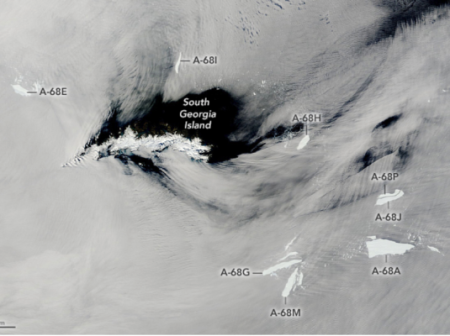
Chicken Little was wrong again! The giant Antarctic iceberg, that some scientists were terrified would crash into South Georgia Island and harm the wildlife that lives there, has done exactly what every other iceberg has done since scientists began tracking them by satellite, disintegrate and float around the island, doing it no harm at all.

The NASA satellite photo to the right shows the situation on February 11, 2021. In November the iceberg was almost exactly the same shape and size as South Georgia island, and was heading right for it. (See the graphics from my earlier post.) At that time there were cries of impended disaster from our typically panicky and fear-driven scientists of the environmental community, claiming that the berg might become grounded against the island to do harm to the wildlife there, even though thousands of bergs of all sizes have all routinely floated around the island harmlessly.

Since then the iceberg has broken up and (surprise!) floated around the island harmlessly, as shown by the satellite photo. The doomsayers were wrong again, as they are and have been routinely for decades.

Considering the terrible track record of predictions by the environmental movement, you’d think people would stop buying into its cries that the sky is falling, but sadly they still do, and apparently will continue to do so for the foreseeable future.

0 comments

Sunspot update: January activity returns to expected levels

Though I am a bit late this month, it is once again time provide my monthly update of the Sun’s on-going sunspot cycle. Below is NOAA’s February 1, 2021 monthly graph, showing the Sun’s monthly sunspot activity. I have, as I do each month, annotated it to show the previous solar cycle predictions.

After two months of relatively high activity, activity that was very high so early in the ramp up to solar maximum, the number of sunspots in January dropped down to closely match the predicted value. It was still higher, but not by much.

» Read more

3 comments

Giant iceberg heading to possible collision with South Georgia Island

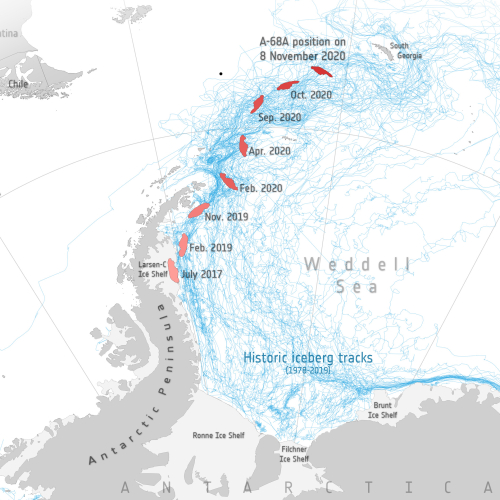
Track of iceberg in the past three years

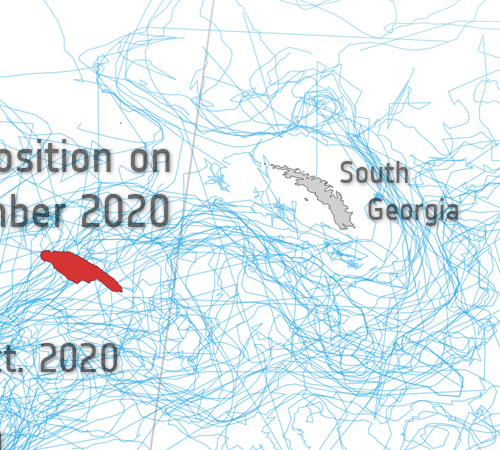
Close-up comparing iceberg with South Georgia Island.

The largest section of a huge iceberg that broke off from Antarctica’s Larson ice shelf in 2017 is now headed directly for a collision with remote South Georgia Island.

The first image to the right shows the iceberg’s movement since 2017. The second zooms in to show that the iceberg and island are almost the exact same size, 100 miles long.

South Georgia Island, 1,000 miles east of South America, has no permanent human inhabitants, though explorers, scientists, and mountain climbers do go there periodically. Instead, it is a wildlife preserve:

Around five million seals call the islands home, as well as 65 million birds of 30 different species. Migrating whales and various fish species populate the surrounding waters and there is a large penguin population.

The first link above, from the European Space Agency (ESA), typically shivers with the modern mindless fear that seems to permeate everything our culture considers:

About the same size as the South Atlantic island, it could ground in the shallow waters offshore and cause real problems for the island wildlife and seafloor-dwelling life. Penguins and seals need access to the sea to feed so the iceberg could easily block their foraging routes and life on the seafloor could be crushed if the berg grounds. The fear is that if the berg does anchor against the South Georgia coast, it could remain there for up to 10 years. When the A38 grounded here in 2004, many dead penguin chicks and seal pups were found along the shoreline.

All maybe true, but then, the arrival of icebergs this large to South Georgia Island while likely rare is also quite normal. The sea life there has had to adapt to these events, or else it would not have survived to today.

Also, note the blue lines. Those are the tracks of past icebergs as recorded from orbit. Not only is it common for icebergs to be aimed at South Georgia Island, the currents appear to guide them around the island once they get close. While this new berg is so huge it might plow into the island anyway, the data here suggests it will not.

Regardless, this somewhat rare event provides scientists a opportunity to learn something about the survival of species in hostile environments. We can’t prevent such things, but we can learn their consequences as well as how life adapts under such conditions.


6 comments

Bezos sells another $3 billion of Amazon shares

Jeff Bezos continues to accelerate his sale of his Amazon stock, selling another $3 billion this week.

In August, Bezos offloaded more than $3.1 billion of Amazon shares, after selling more than $4.1 billion worth of shares in February. The sales this week bring his total cash out in 2020 to more than $10.2 billion so far, which is a notable jump from 2019, when Bezos sold $2.8 billion worth of shares.

While Bezos had originally said these sales were for financing his space company, Blue Origin, it now appears that the bulk of this new money is aimed at funding environmental political organizations such as the Environmental Defense Fund, the Natural Resources Defense Council and the World Wildlife Fund.

4 comments

Sunspot update: An active October heralds the likely end of solar minimum

With the start of a new month it is once again time to publish another sunspot update. NOAA yesterday updated its monthly graph for tracking the Sun’s monthly sunspot activity. As I have done now every month since this website started in 2011, it is posted below, with additional annotations by me to show the past solar cycle predictions.

Unlike September, which saw almost no sunspots, October was a very active month, with the amount of sunspots far exceeding prediction. Furthermore, every sunspot during the month had a polarity assigning it to the new solar cycle, not the last.

» Read more

4 comments
1 5 6 7 8 9 57