Frozen waves of Martian lava?

Frozen waves of Martian lava?
Click for original image.

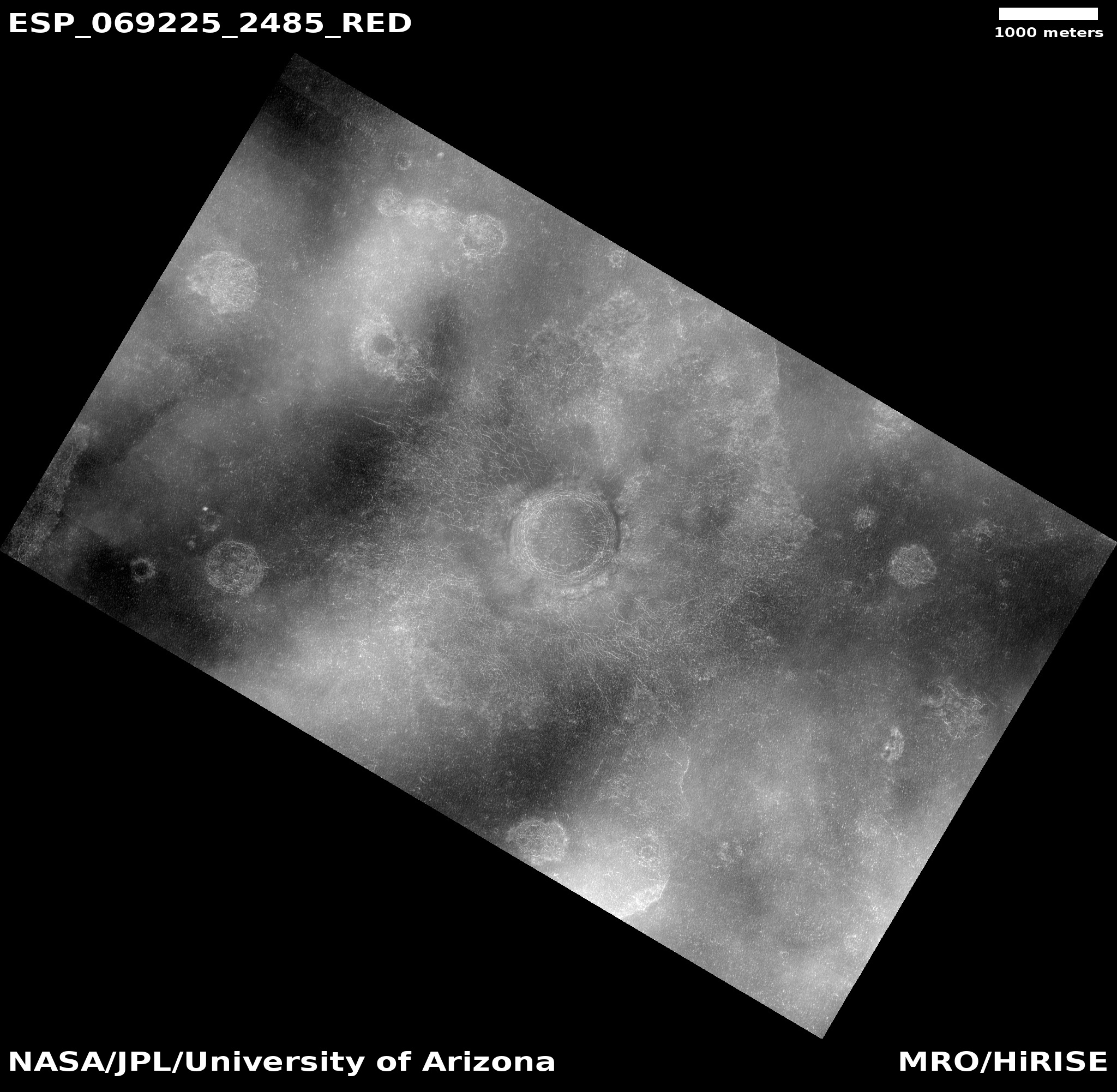
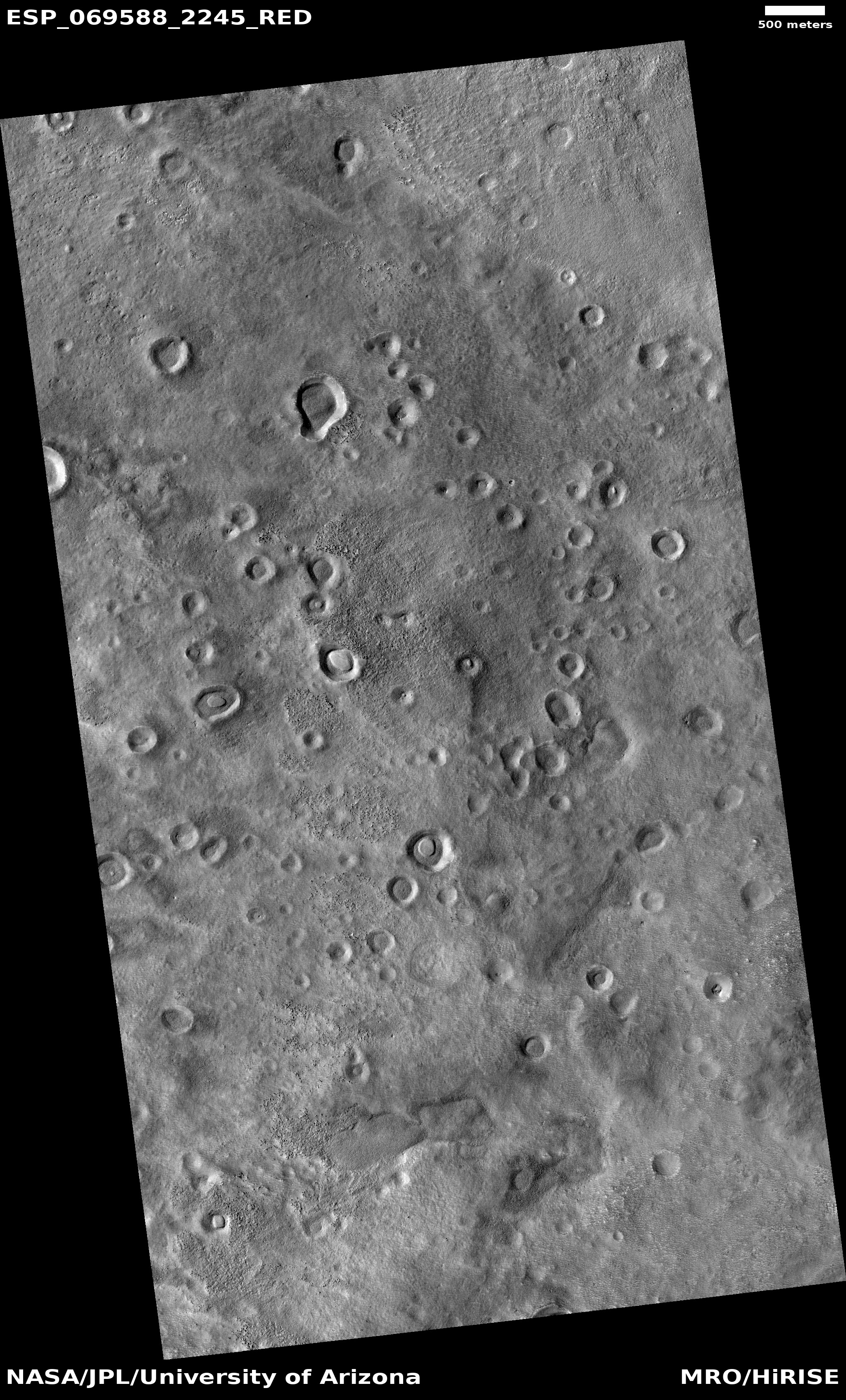
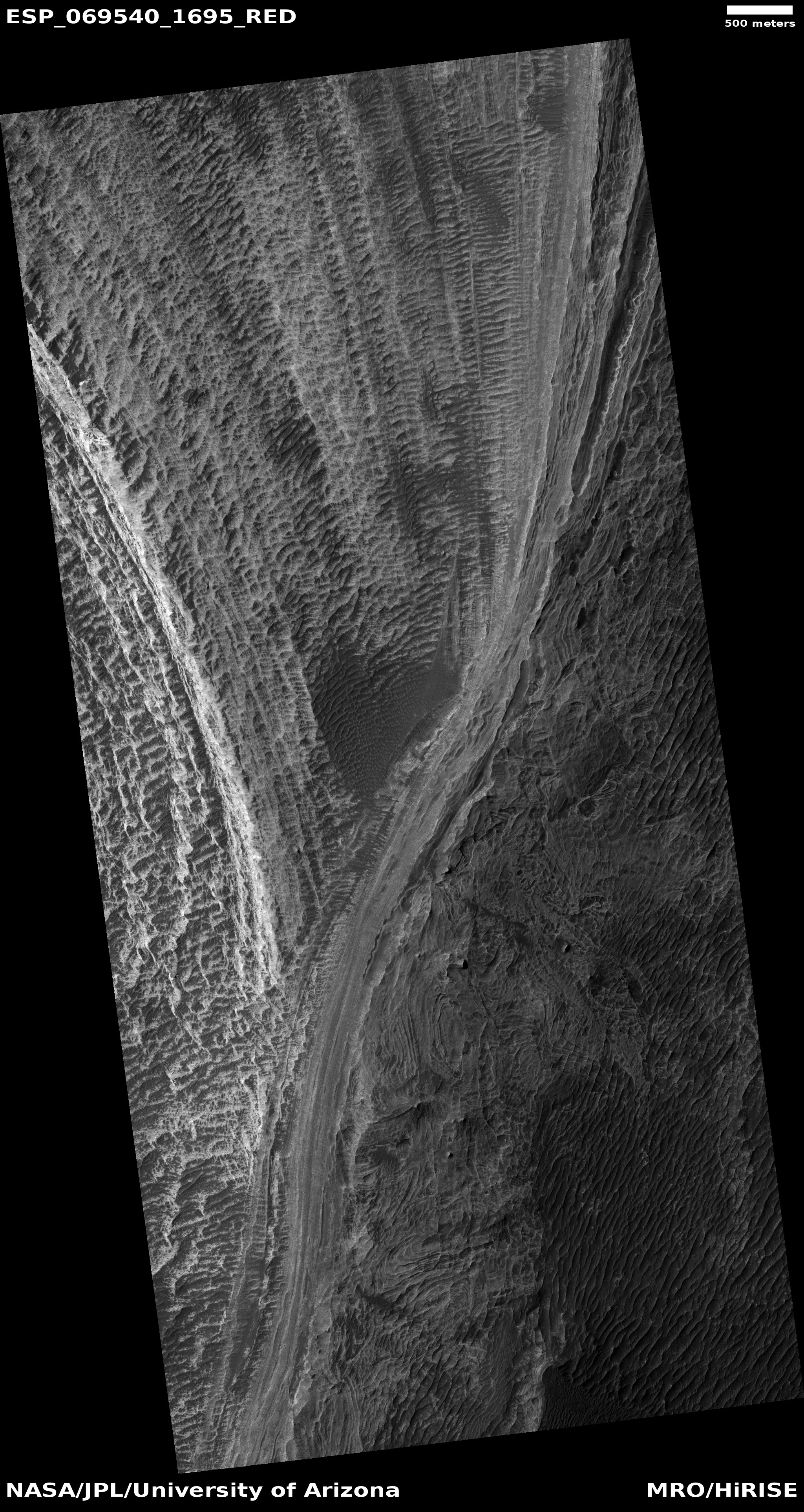
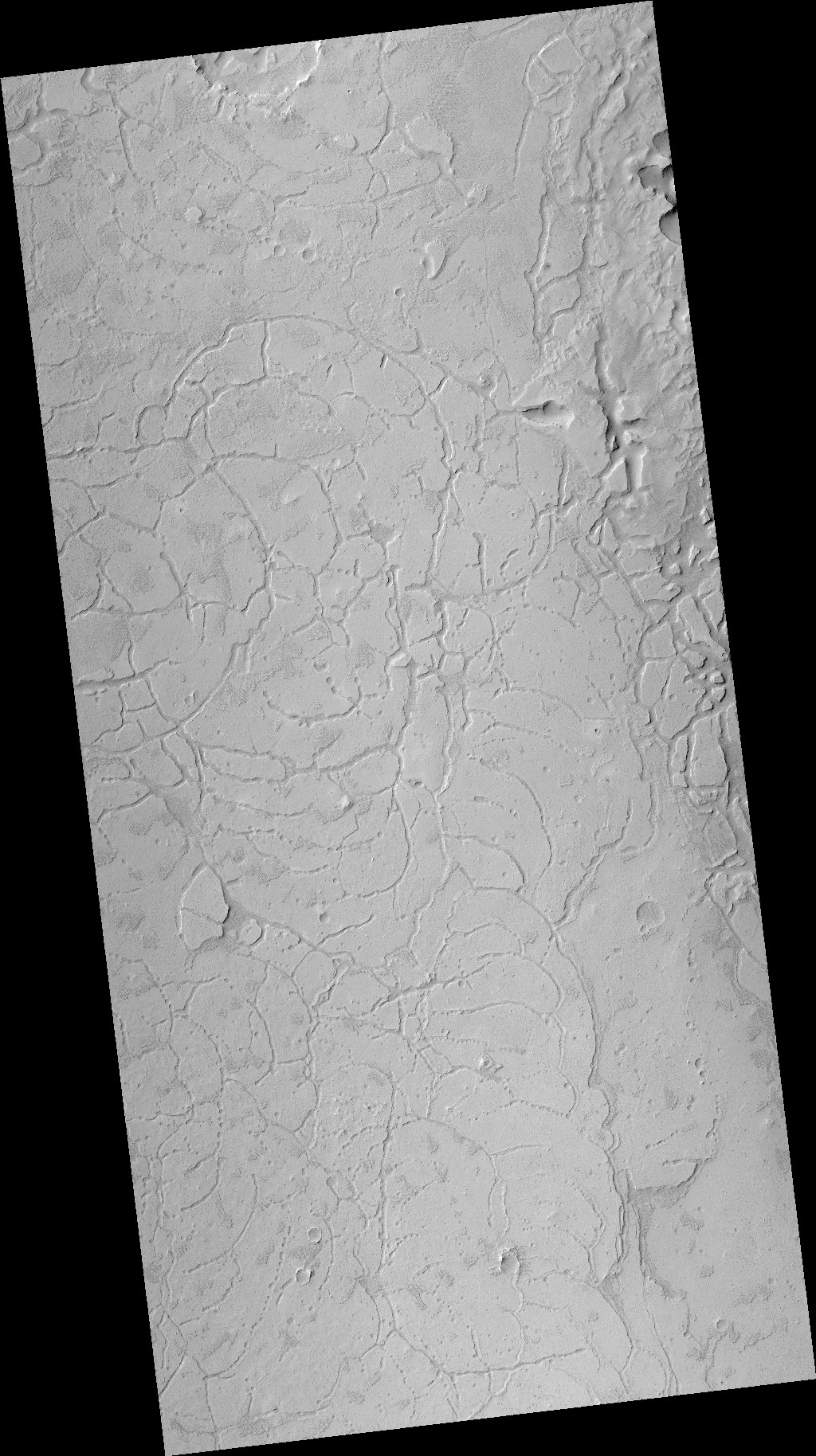
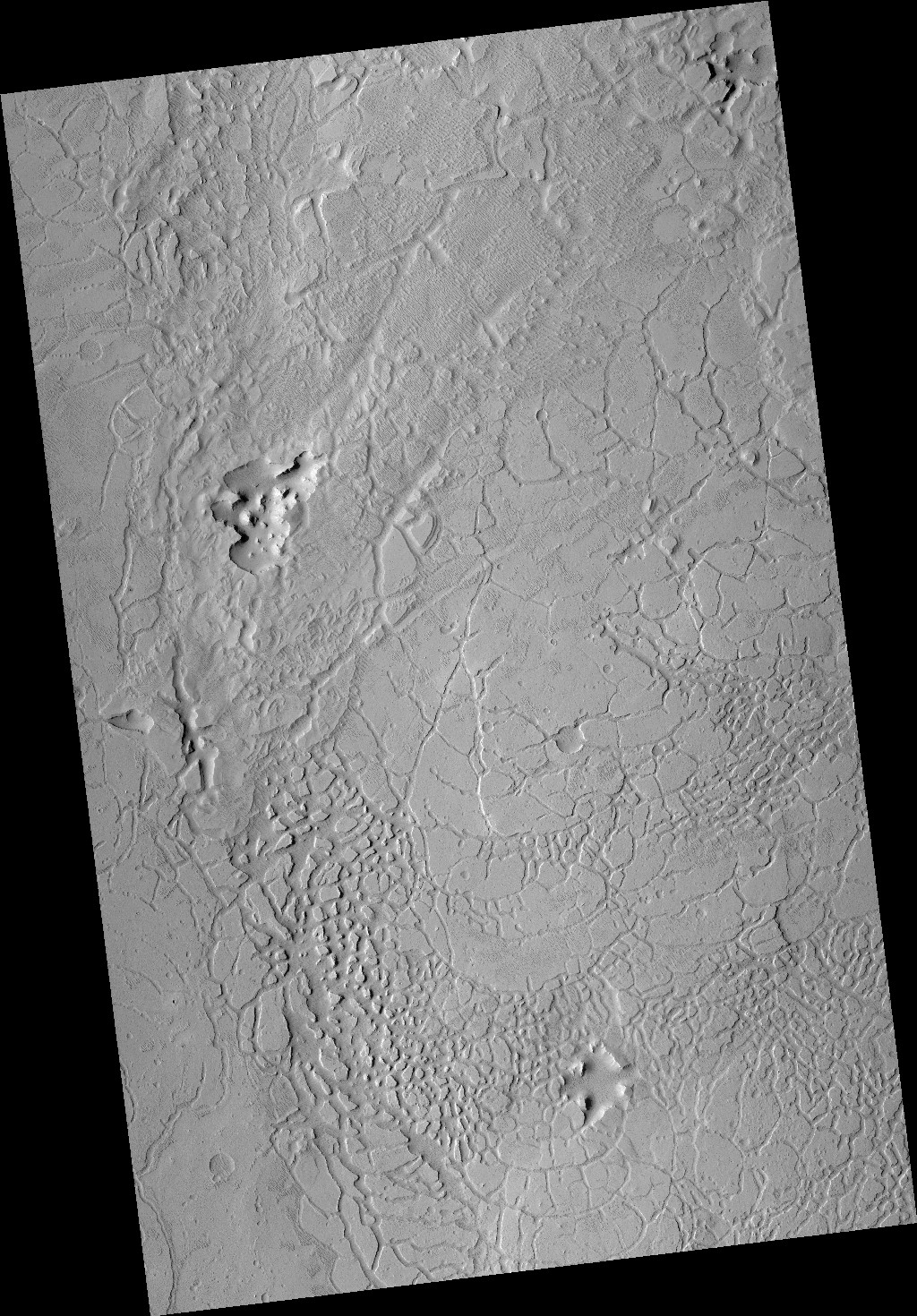
Cool image time! The picture to the right, rotated, cropped, reduced, and sharpened to post here, was taken on March 17, 2023 by the high resolution camera on Mars Reconnaissance Orbiter (MRO). The science team labeled this a terrain sample image, which implies it was taken not as part of any specific request, but to fill a gap in the camera’s schedule in order to maintain its proper temperature.

What are we looking at? This stippled terrain with curved ridges actually extends quite a distance beyond this image. A MRO context camera picture taken on July 22, 2020 shows its full extent, about 10 miles wide but extending to the north and south about 30 miles total, butting up against a north-south mountain chain to its east that is about seventy miles long with its highest peak about 8,000 feet above this plain.
» Read more

0 comments

Ancient volcano vent in the Martian southern cratered highlands?

Ancient volcano vent on Mars?
Click for original image.

The nature of today’s cool image suggests both ancient and more recent geological activity, each coming from entirely different sources but both helping to shape the alien Martian surface.

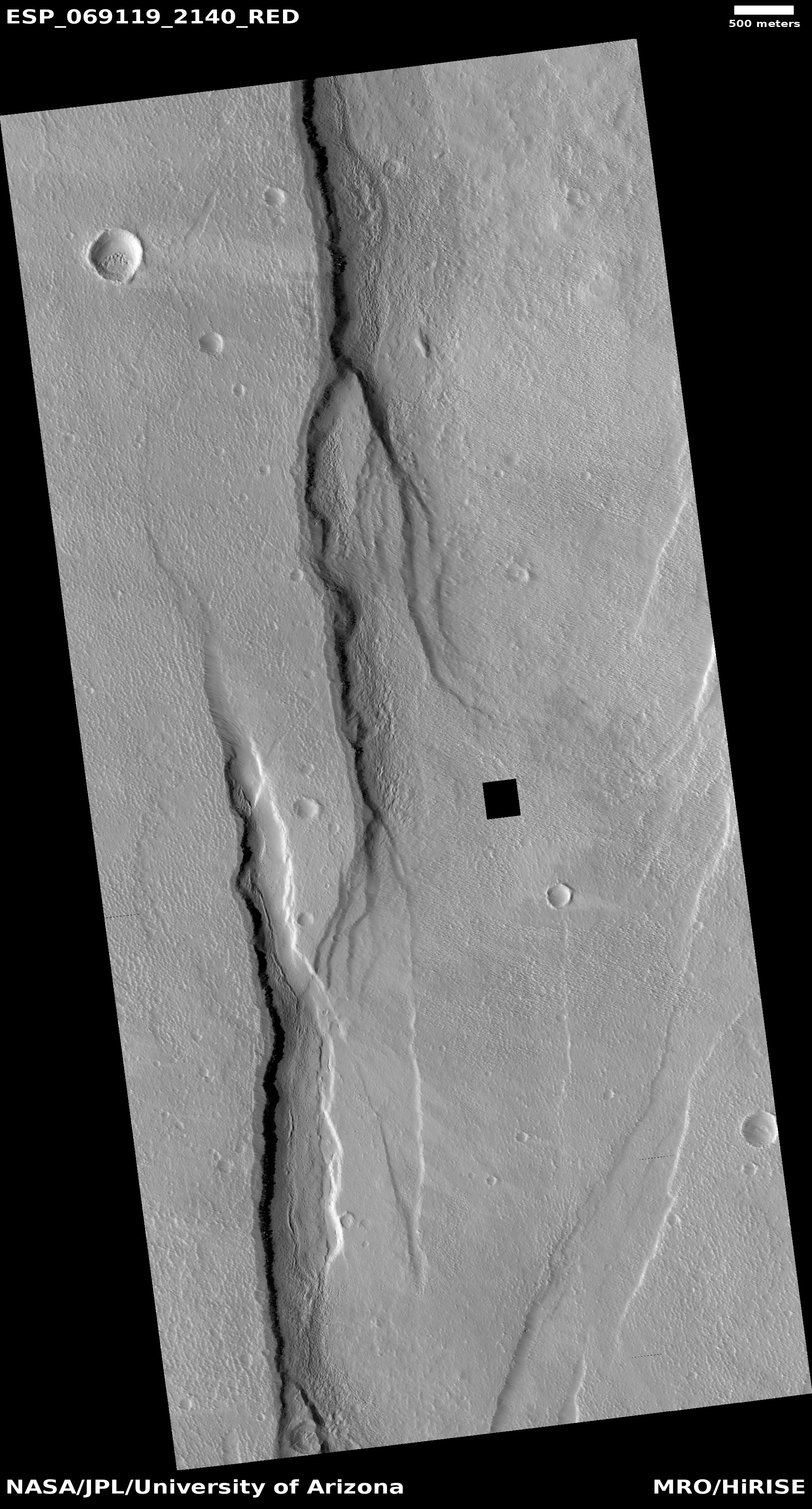
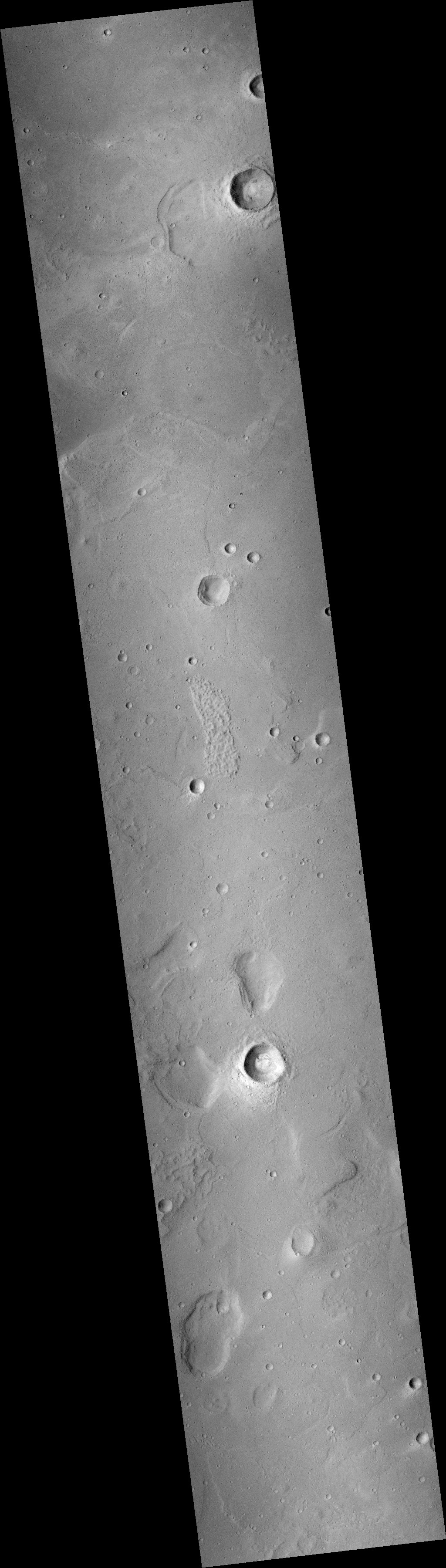
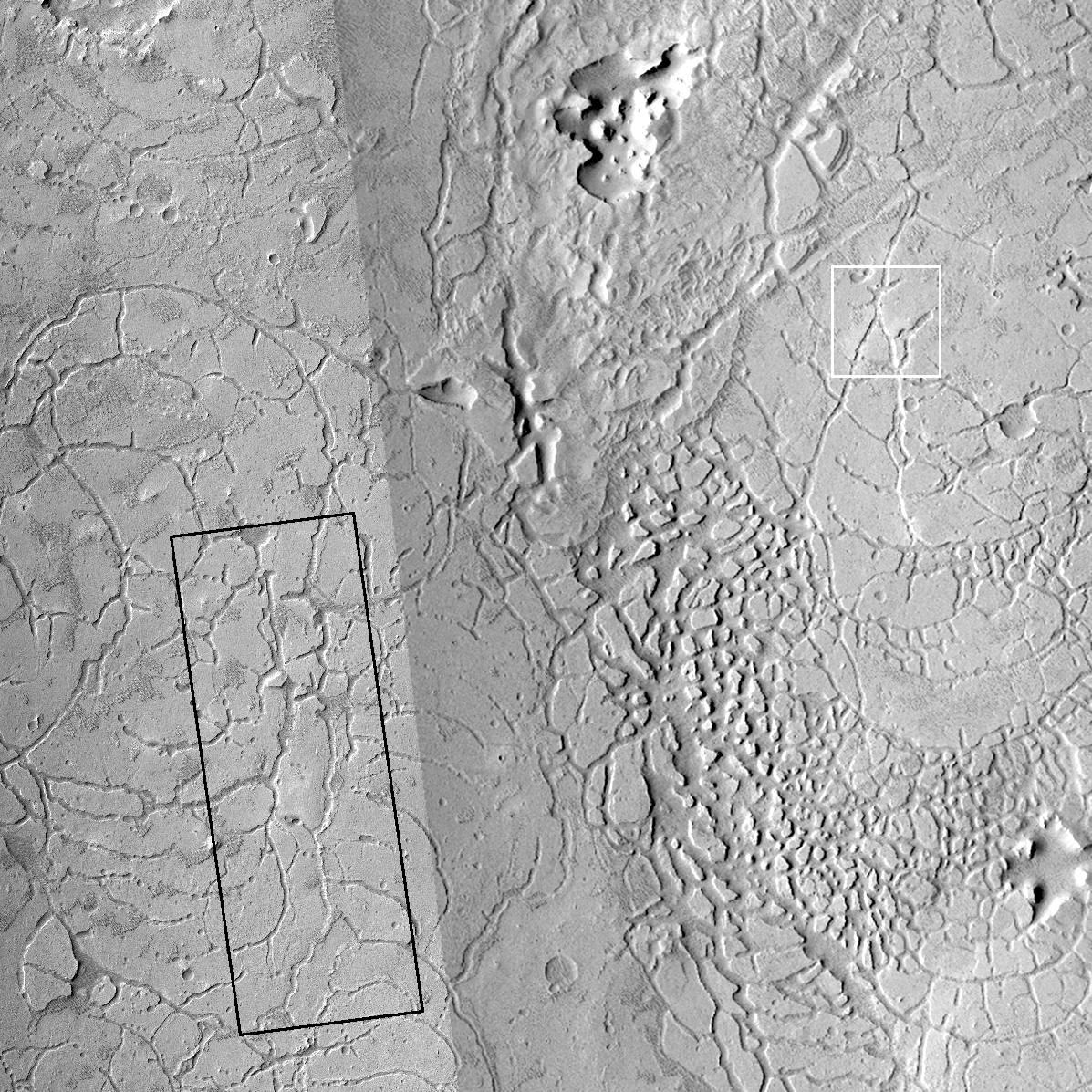
The picture to the right, rotated, cropped, reduced, and sharpened to post here, was taken on March 13, 2023 by the high resolution camera on Mars Reconnaissance Orbiter (MRO). It shows what the science team has labeled an “elongated depression,” sitting in the middle of a relatively flat but very rough stippled circular plain about 60 miles in diameter. An MRO context camera picture, taken on February 19, 2012, covered the central strip of this plain, and shows that its surface is equally rough and stippled everywhere, with only a few craters and one or two slight changes in elevation.

So, how does this feature tell us both about the ancient and recent geological history of this spot on Mars?
» Read more

1 comment

Buried dying glacier in the Martian dry equatorial regions?

Buried glacial ice in dry equatorial regions?
Click for original image.

Today’s cool image from Mars is not so much unique visually as it is unique in terms of its location. The picture to the right, rotated, cropped, reduced, and sharpened to post here, was taken on January 31, 2023 by the high resolution camera on Mars Reconnaissance Orbiter (MRO). It shows the northern rim of a small crater, with its floor filled with an intriguing mound of material.

The picture was labeled a “terrain sample”, which suggests it wasn’t taken as part of any specific research project by instead to fill a gap in the camera’s schedule. To maintain the camera’s proper temperature, it is necessary to take pictures regularly, and when the camera team finds a gap that is too long, they fill it by choosing some almost random target in that gap that might be interesting. Sometimes it is, sometimes not.

In this case I strongly suspect this target was hardly random. The picture title also mentions MRO’s now retired radar CRISM instrument, which was used to detect evidence of underground ice. My guess is that the camera team thus likely decided to image this crater in high resolution because that radar data suggested the presence of underground ice.

This guess is strongly confirmed by a context camera picture taken of this crater on September 1, 2008. The crater appears surrounded by the typical splash apron one routinely sees around impact craters in the mid- and high-latitude northern lowland plains, where there is a lot of near surface ice.

The bumpy mound seen in high resolution on the floor of this crater could very well be buried glacial ice, as it mimics similar features in the many craters in the mid-latitudes of Mars. But is it buried ice? The location says otherwise.
» Read more

1 comment

Chaos in the southern cratered highlands of Mars

Chaos in the southern cratered highlands of Mars
Click for full image.vi

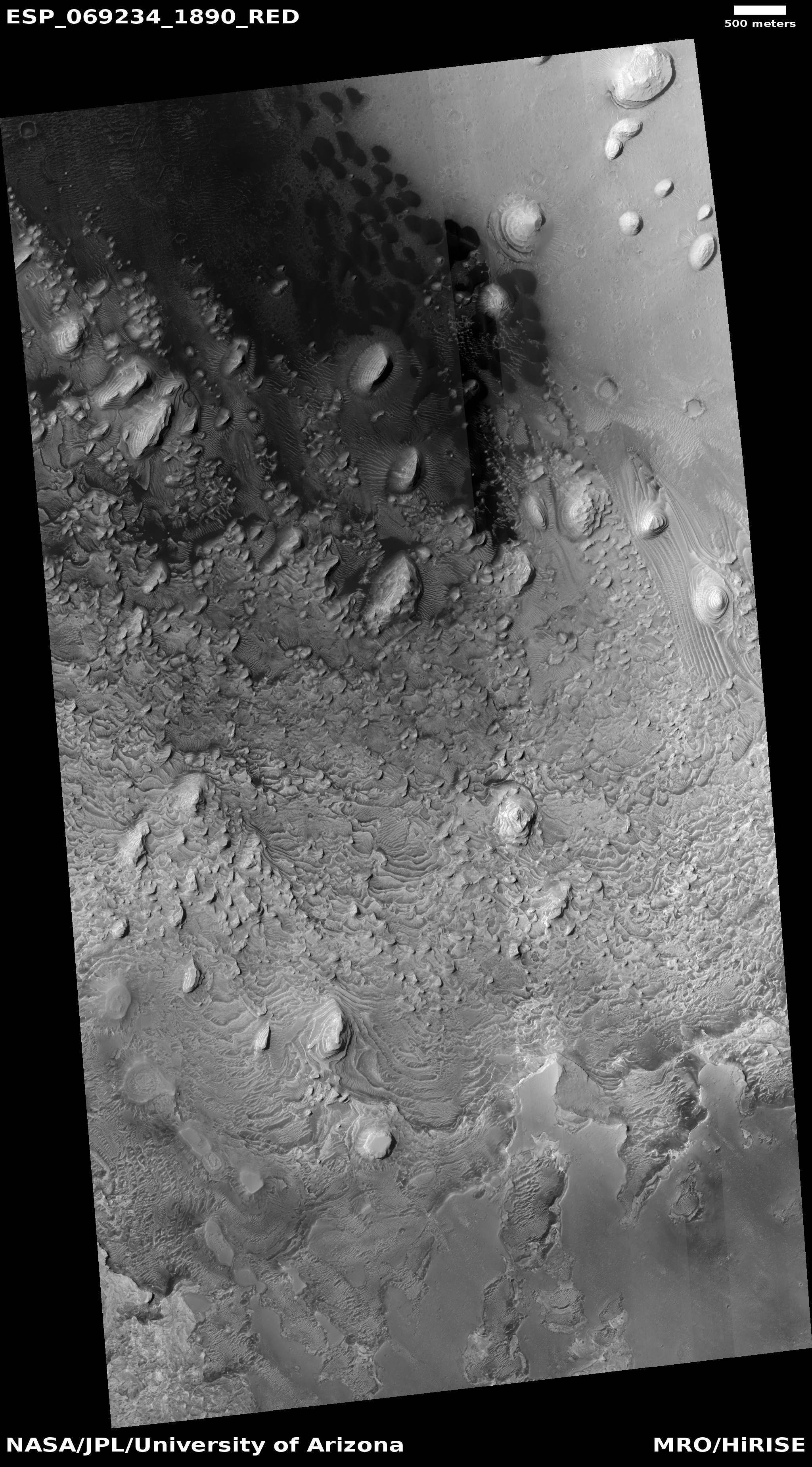
Today’s cool image takes us to a part of the cratered southern highlands of Mars that I have not featured much previously. The picture to the right, rotated, cropped, and reduced to post here, was taken on March 7, 2023 by the high resolution camera on Mars Reconnaissance Orbiter (MRO). It shows what appears to be a collection of rough hills and mesas surrounded by a sea of smooth ground that at the base of the cliffs seems to end abruptly.

The smooth ground is probably mantled by a layer of dust and debris. Since this location is at 36 degrees south latitude, there is also probably near surface ice under that layer. The abrupt edges likely indicate where the increasing slope next to the mesas and mounds caused that ice to be exposed and thus sublimate away.

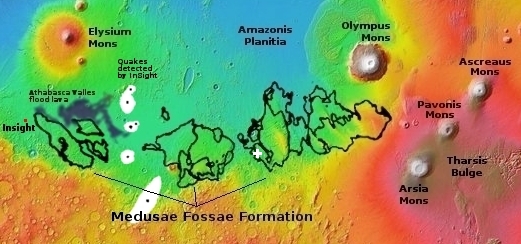
As for the location, we must go to the overview map.
» Read more

0 comments

Alien textured Martian lava

Alien textured Martian lava
Click for original image.

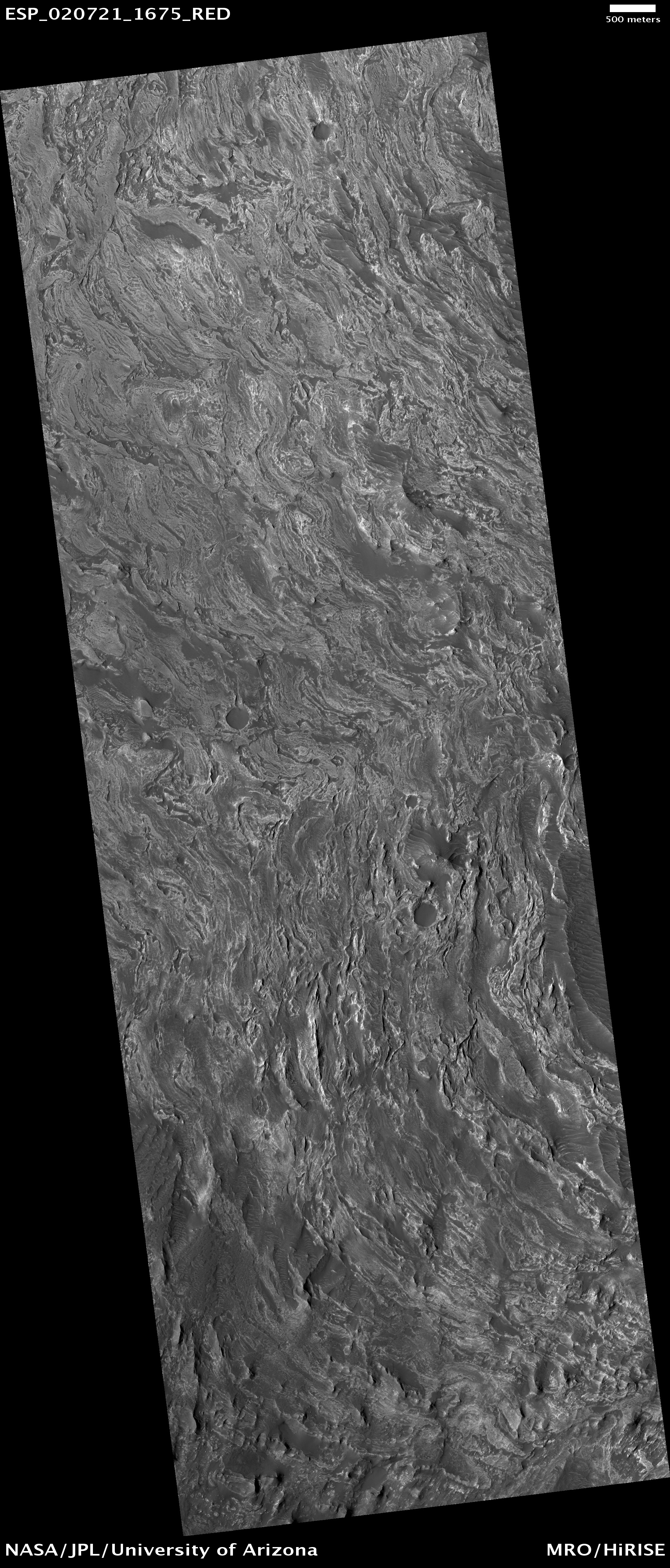
Cool image time! The picture to the right, cropped to post here, was taken on February 17, 2023 by the high resolution camera on Mars Reconnaissance Orbiter (MRO), and shows what the science team labels “regularly textured ground on Pavonis Mons.”

The arrow in the picture indicates the downhill trend. If you look at the full image, you will see that this texture pattern extends in all directions for a considerable distance, both uphill and down, and even covers the entire floor of a depression that appears to contour along the grade instead of going downhill.

The latitude here is very close to the equator. So, even though the elevation is high, being on the slopes of a giant volcano, there is probably no near surface ice here.
» Read more

1 comment

Brain terrain in and around pedestal crater on Mars

Brain terrain in and around a pedestal crater on Mars
Click for original image.

Cool image time! The picture to the right, cropped, reduced, and sharpened to post here, was taken on March 10, 2023 by the high resolution camera on Mars Reconnaissance Orbiter (MRO).

As I noted in a cool image only two weeks ago, brain terrain is a geological feature wholly unique to Mars that planetary geologists still do not understand or can explain. They know its knobby interweaving nodules (resembling the convolutions of the human brain) are related to near surface ice and its sublimation into gas, but no one has much confidence in any of the theories that posit the process that forms it.

In this case the brain terrain not only fills the crater, it appears to surround it as well, but only appearing at spots where a smooth top layer has begun to break apart. Moreover, the crater appears to be a pedestal crater, whereby much of the less dense surrounding terrain has vanished, leaving the compacted crater sitting higher.
» Read more

0 comments

Glacial sinkhole in the Martian southern cratered highlands?

Overview map

Glacial sinkhole in the Martian southern cratered highlands?
Click for original image.

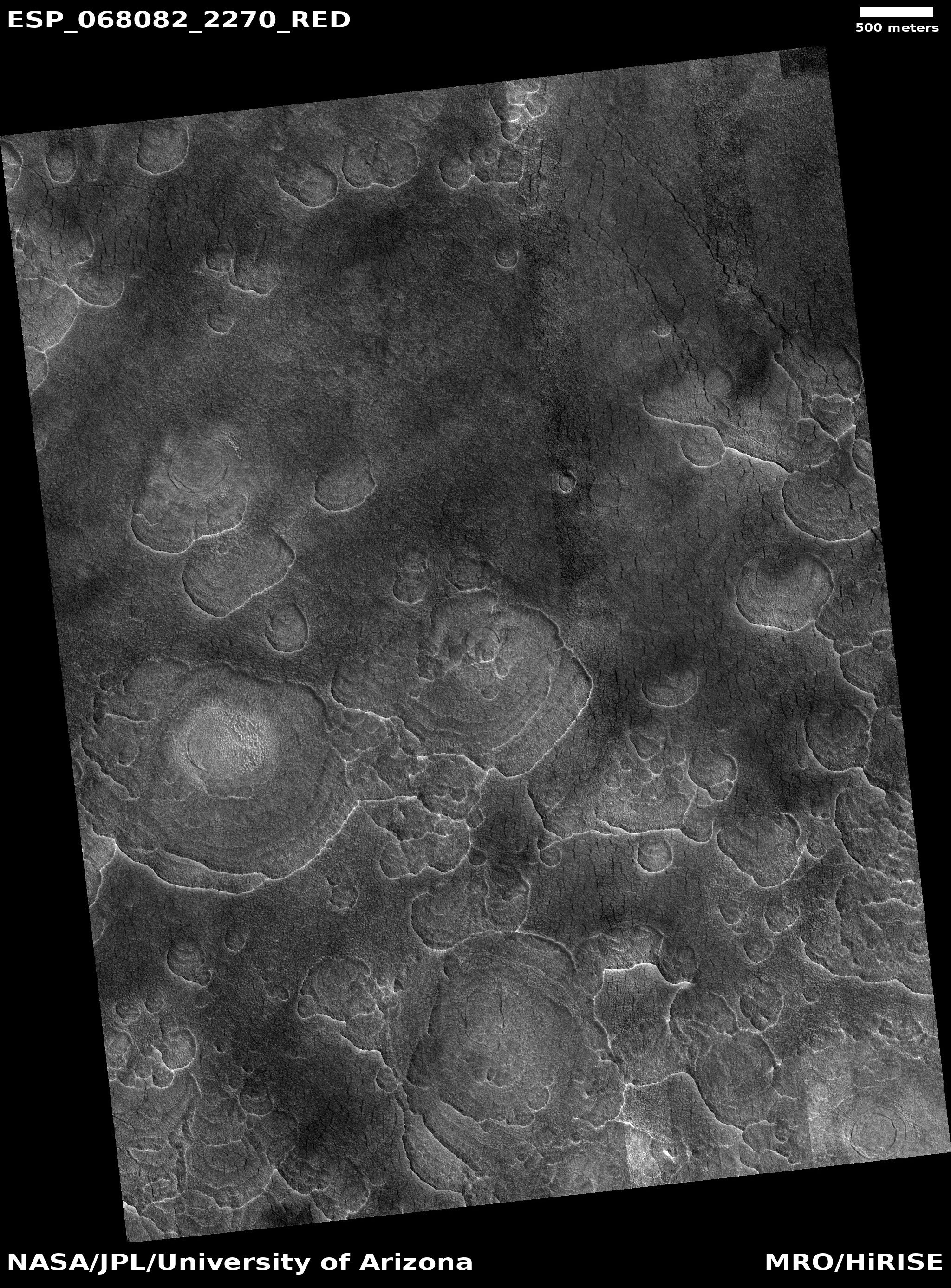
Cool image time! The picture to the right, cropped to post here, was taken on February 21, 2023 by the high resolution camera on Mars Reconnaissance Orbiter (MRO). This is a terrain sample image, which means it was snapped not as part of any specific research project but to fill a gap in the schedule in order to maintain the camera’s proper temperature. As usual, the camera team tried to pick something of interest, and I think they succeeded.

The two large depressions in the center of the picture do not resemble impact craters. They have no rim of ejected material and their shape is very distorted. Instead, both appear to be places where a top layer of ice/debris has sublimated away into gas, exposing a lower layer of glacial material that itself is sublimating away to form the bumpy mounds that fill the floor of the depressions.

The white dot inside the inset box on the overview map above marks this location, just south of the northern wall of a large 30-mile-wide canyon, with its northern floor even more depressed, as if the material in that raised middle a flat pile of glacial debris flowing to the southwest after leaving the gap in the crater to the northeast. An MRO context camera picture taken on January 6, 2016 gives a wider view, showing that there are a lot of these type depressions on the surface of this wide middle upraised floor, as well as some obvious impact craters.

This location is in the mid-latitude band where many glacial features are found. In this part of the southern cratered highlands there is also a lot of evidence of top layers sublimating away, as if the glacial material is a large buried ice sheet that is beginning to disappear at places where it has been exposed by impacts or shifting motion. The depression in the picture above appears to be an example.

0 comments

Endless dunes amidst Mars’ giant volcanoes

Endless dunes amidst Mars' giant volcanoes
Click for originial image.

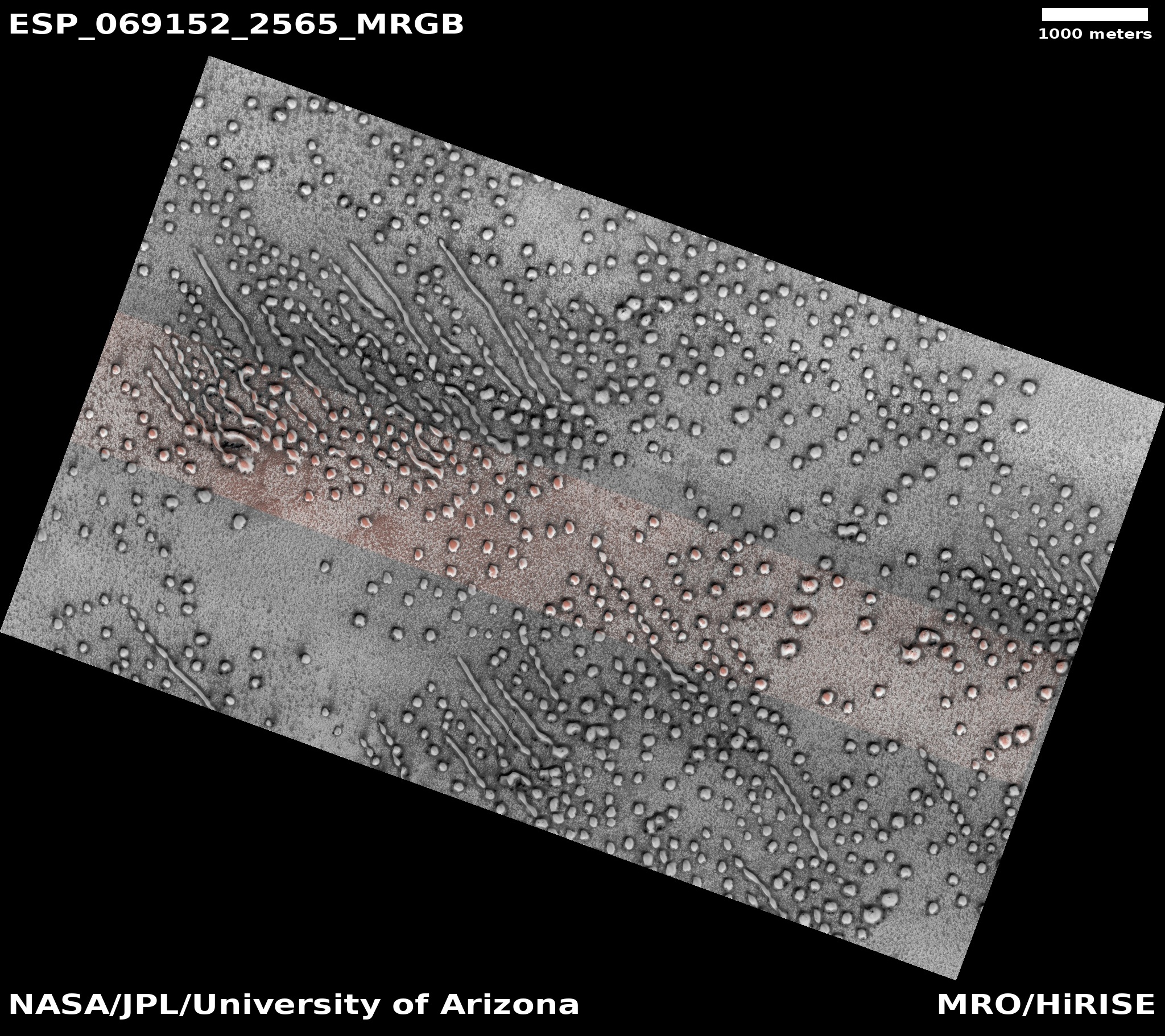
Past cool images on Behind the Black showing endless dune fields on Mars have generally focused on two places, the giant Medusae Fossae Formation volcanic ash deposits in the dry equatorial regions of Mars and the Olympia Undae dune sea that surrounds the Martian north pole.

Today’s image to the right, rotated, cropped, reduced, and sharpened to post here, takes us to a completely different dune sea. Taken on February 14, 2023 by the high resolution camera on Mars Reconnaissance Orbiter (MRO), the picture also shows an endless dune sea, though there is faint evidence on those dune fields of buried features, such as the meandering east-west feature in the picture’s center.

This dune sea is also in the dry equatorial regions, like Medusae, but it is much farther east, and sits surrounded by Mars’ biggest volcanoes.
» Read more

0 comments

Is this ice or lava in the death valley of Mars?

Ice or lava on Mars?
Click for original image.

Cool image time! The picture to the right, rotated, cropped, reduced, and sharpened to post here, was taken on February 28, 2023 by the high resolution camera on Mars Reconnaissance Orbiter (MRO).

To put it mildly this is strange terrain. The curving east-west feature resembles a glacial flow, but it also has features that say otherwise. For example, what could cause that gap in the middle of the picture? Such things are not usually seen in an ice flow. Then there is that filled crater on the center left edge of the picture, inside the flow. Though filled with material, the flow itself does not flow around the crater, suggesting the impact occurred after the flow. Moreover the crater is a pedestal crater, whereby the surrounding terrain has eroded away so that the crater ends up standing above it.

These facts suggest that this flow is very old, and has not flowed for a very very very long time. This in turn suggests it isn’t ice but solidified lava, though for a lava flow it also has features that are anomalous when compared to typical flood lava on Mars.
» Read more

1 comment

A rash on Mars

A Martian rash
Click for original image.

Cool image time! The picture to the right, rotated, cropped, reduced, and sharpened to post here, was taken on January 30, 2023 by the high resolution camera on Mars Reconnaissance Orbiter (MRO). The science team labeled this a “Circular Outcrop of Bright Rock.

What I see is a Martian skin rash. Based on the ripple pattern below the ridge one might think we are looking at sand dunes, except that the rash above the cliff has no such pattern. Instead, the ground in this one particular area looks very roughened in a random sort of way.

The location at 27 degrees south latitude suggests there is little near surface ice at this location to cause this feature. The overview map below provides another but not very helpful possibility.
» Read more

2 comments

Sinuous ridge inside Martian canyon

Sinuous ridge inside a Martian canyon
Click for original image.

Cool image time! The picture to the right, cropped, reduced, and sharpened to post here, was taken on February 7, 2023 by the high resolution camera on Mars Reconnaissance Orbiter (MRO). It shows what the camera team labels a “sinuous ridge within valley.”

The location is at 30 degrees south latitude, right on the edge of the southern of the two 30-60 degree mid-latitude bands where orbital images show many glacial features. Closer to the equator and there is little or no evidence of near surface ice on Mars. Farther from the equator from this latitude and the evidence of near surface ice increases, becoming very dominant the closer to the poles you get.

At this spot, it appears there is little near surface ice. The channel has ripple sand dunes inside it, and the sinuous ridge appears to be bedrock. Similarly, the plateau above the channel also appears like bedrock, the craters showing no evidence of splatter that is common where there is near surface ice.

What made the channel? And what made that a sinuous ridge inside it?
» Read more

0 comments

Brain terrain on top of Martian mountains

Brain terrain at high elevation on Mars
Click for original image.

Cool image time! The picture to the right, cropped and reduced to post here, was taken on March 26, 2023 by the high resolution camera on Mars Reconnaissance Orbiter (MRO). It is labeled by the scientists “Brain Terrain on Floor of Crater in Warrego Valles.”

Brain terrain is a geological feature entirely unique to Mars that remains unexplained in any way by geologists. The scientists know it is almost certainly related to near-surface ice and its sublimation into gas, but their theories as to its precise formation process remain incomplete and unconvincing, even to them.

In this case the brain terrain’s interweaving nodules seem to show flow patterns, but strangely those patterns go around depressions and hollows. Yet, the overall flow direction also seems to point downhill towards the slope on the image’s right edge.
» Read more

5 comments
1 32 33 34 35 36 90