Two pits at opposite ends of Mars’ big volcanoes

Overview map

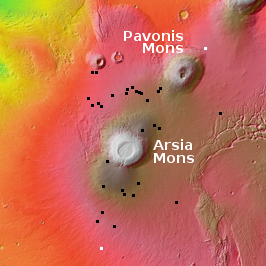
Regular readers of Behind the Black know that since 2018 I have regularly documented all the images of pits taken by the high resolution camera on Mars Reconnaissance Orbiter (MRO). (See my last pit post in January for a full list of these previous articles.) The black dots on the map to the right shows the location of all the pits near the volcanoes Arsia and Pavonis Mons that have so far been highlighted here.

The two white dots are the two most recent MRO pits, and are the subject of today’s cool image. They also happen to be the farthest north and south pits so far documented. The southernmost pit, which I am saving till last, is the most interesting.
» Read more

2 comments

Very peculiar flow features on Mars

Peculiar flows on Mars
Click for full image.

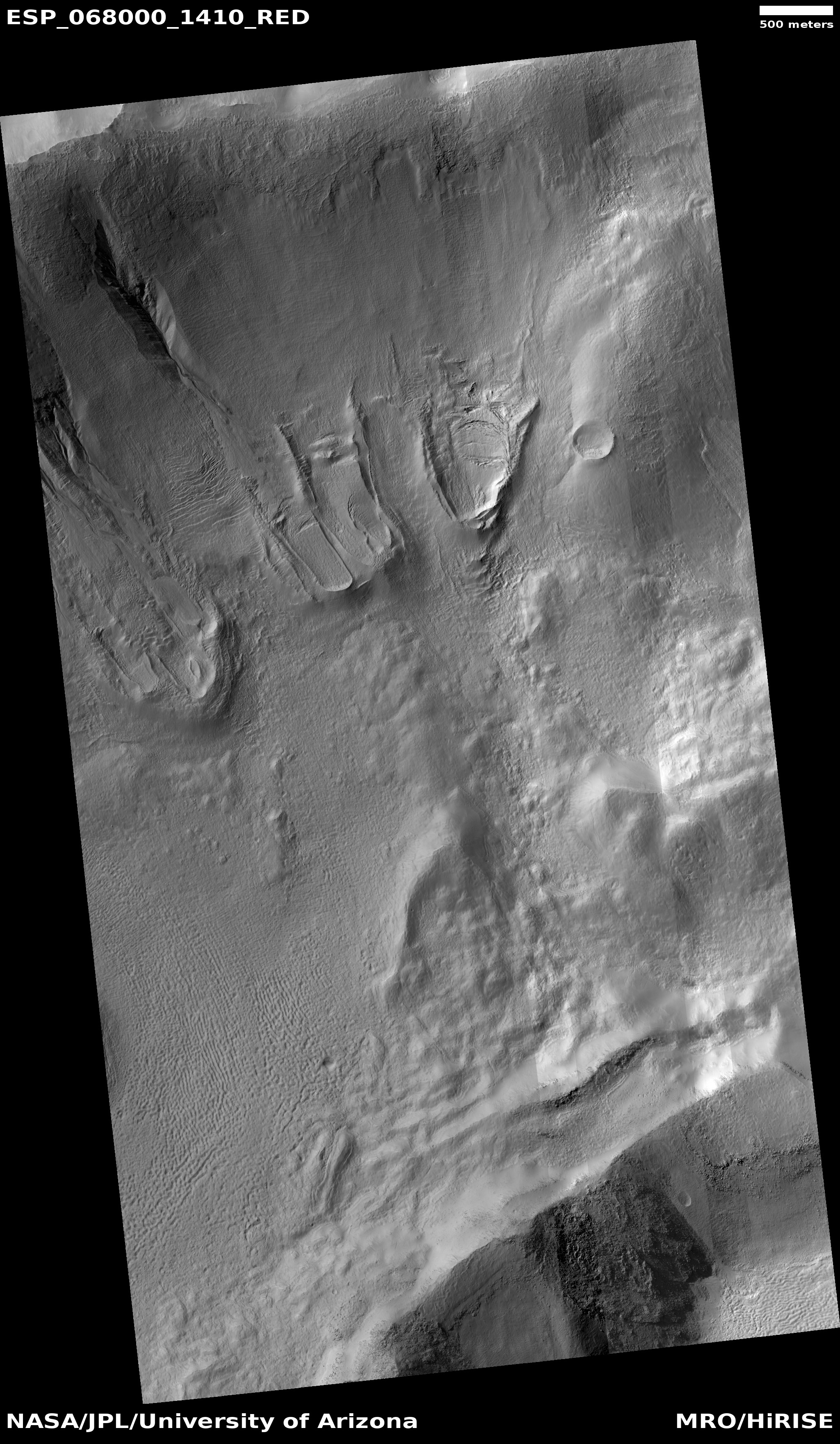
Today’s cool image focuses on one of the weirdest flow features I have yet seen on Mars. The first photo to the right, rotated and cropped to post here, comes from a January 27, 2021 picture by the high resolution camera on Mars Reconnaissance Orbiter (MRO). This cropped section focuses on the middle of three such weird features, two close flows heading downhill on the interior rim of very eroded 28-mile-wide crater. For some reason the flows also have depressions on their crowns. The depressions almost look like someone carved them out with a spackling spatula. In fact, the MRO science team agrees, labeling this image as “Spatulate Depressions with and without Upslope Gullies.”

The second image to the right shows a wider crop of the same picture, and explains the reason for the last half of that label.
» Read more

3 comments

Martian glaciers flowing off interior walls of Renaudot Crater

Overview map

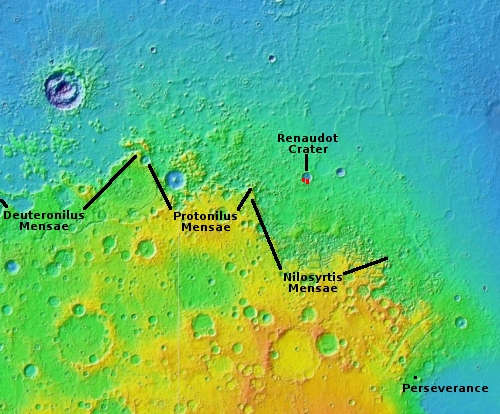
Cool image time! In the March 1st image release from the high resolution camera on Mars Reconnaissance Orbiter (MRO) were two pictures covering sections of the interior rim of 40-mile-wide Renaudot Crater, located in the northern lowland plains of Mars north of the region I dub Mars’ glacier country.

The map to the right provides the context. The two red boxes in Renaudot Crater show the location of the two images below, with the first being the one to the left. Located at about 42 degrees north latitude, we should expect to see evidence of ice and glacial features here, and that is exactly what both photos show.
» Read more

0 comments

Baffling ridges on Mars

Baffling ridges on Mars
Click for full image.

Today’s cool image is one of my “what the heck?” photos. The picture to the right, cropped and reduced to post here and taken on September 3, 2020 by the high resolution camera on Mars Reconnaissance Orbiter (MRO), shows a strange dune field of many parallel long dunes, cross-cut by larger ridges.

Are the larger ridges dunes? Or are they some form of volcanic or tectonic ridge, which is also very typical of this region, called Tempe Terra and located in the transition zone between the southern cratered highlands and the northern lowland plains?

Or are they eskers, ridges frequently found in places that were once covered by glaciers? At 35 degrees north latitude, it would not be surprising to see glacial features here, but as far as I can tell, the full image has no obvious such features.
» Read more

4 comments

Ice-filled crater in Mars’ glacier country

Crater filled with ice
Click for full image.

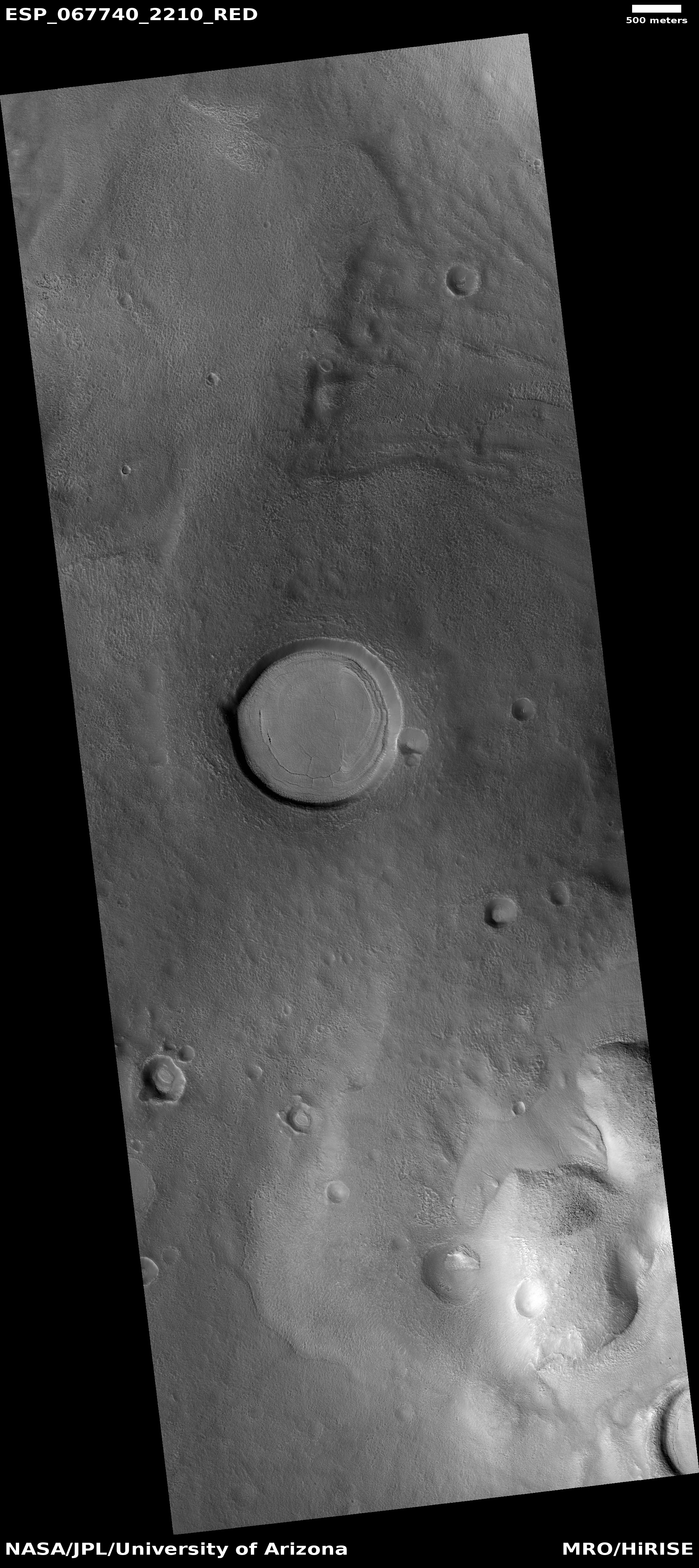
Cool image time! The photo to the right, cropped and reduced to post here and taken on January 7, 2021 by the high resolution camera on Mars Reconnaissance Orbiter (MRO), provides us a perfect example of the kind of glacial feature that scientists find routinely in the 30 to 60 degree mid-latitude bands on Mars. In this case the crater is in the northern reaches of a chaos region dubbed Nilosyrtis Mensae, the easternmost mensae region of what I dub glacier country on Mars.

When first identified scientists named this concentric crater fill, a purposely vague term that is only descriptive because they then did not know what it was made of, though they had their suspicions that it was buried glacial ice. Since then radar data has routinely confirmed that there is ice in such filled craters, making this particular glacial feature one of the most prevalent in those mid-latitude bands.

You can see a quite similar ice-filled crater, also in Nilosyrtis, in an earlier post from October 2020. While that earlier crater was on the southern edge of Nilosyrtis, today’s crater is about 300 miles almost due north, near the region’s northern fringe. In between are lots of similar glacial features, sometimes in craters, sometimes flowing off the slopes of mesas, and sometimes flow features in the open canyons between.

2 comments

Layers upon layers of Martian volcanic ash

Layers upon layers of Martian volcanic ash
Click for full image.

Today’s cool image provides I think a hint at the vast amount of time that has passed on Mars, allowing uncounted major events to occur which each lay down a bit of the geological history, a history that is now piled up on the surface so deeply that it will take decades of research to untangle it.

The photo to the right, cropped and reduced to post here, was taken on December 23, 2020 by the high resolution camera on Mars Reconnaissance Orbiter (MRO). It shows the layered nature of the Medusae Fossae Formation, the largest volcanic ash deposit on Mars (about the land area of India) and thought by some to be the source of most of the dust across the entire red planet.
» Read more

0 comments

Twisted and tilted bedrock in Martian crater

tilted strata in Martin Crater
Click for full image.

Cool image time! The photo to the right, rotated cropped, and reduced to post here, is only a small example of the strangely tilted and twisted strata in the central peak region of 38-mile-wide Martin Crater on Mars. The full image shows more.

The picture was taken on January 12, 2021 by the high resolution camera on Mars Reconnaissance Orbiter (MRO). The section I’ve cropped out shows a series of stratified strata that are are not only significantly tipped from the horizontal, but have also been bent and deformed.

The crater itself is located about 260 miles south of Valles Marineris, as shown on the overview map below.
» Read more

2 comments

A visit to Cydonia on Mars

Strange geology in Cydonia on Mars
Click for full image.

Cool image time! The Cydonia region on Mars, located at around 30-40 degrees north latitude in the northern lowland plains just beyond the transition zone up to the southern cratered highlands, is well known to many on Earth because it was here that the Viking-1 orbiter took a picture of a mesa that, because of the sun angle, made its shadows resemble a face. Thus was born the “Face on Mars” that consumed the shallow-minded among us — and thus the culture, media, and Hollywood — absurdly for decades, until Mars Global Surveyor took the first high resolution image and proved without doubt what was really obvious from the beginning, that it was nothing more than a mesa.

Cydonia however remains a very intriguing region of Mars, mostly because it is home to a lot of strange geology, as shown by the photo to the right, rotated, cropped, and reduced to post here. Taken on January 16, 2021 by the high resolution camera on Mars Reconnaissance Orbiter (MRO), it shows some of that strange and inexplicable geology.

While Cydonia is inside that 30-60 degree latitude band where MRO has imaged numerous glacial-type features, I do not know if many such features have been found there. Except for the pits and depressions in the photo’s lower right — which suggest decay in an ice sheet — little else at first glance in the picture clearly invokes any of the obvious glacial features one comes to expect. There appear to be what might be lobate flows in the image’s center going from the west to the east, but if they are glacial, they are so decayed to as leave much doubt.

The overview image below shows where Cydonia is on Mars, and helps explain partly what is found here.
» Read more

6 comments

Volcanic badlands on Mars

Volcanic badlands on Mars
Click for full image.

Cool image time! The photo to the right, cropped and reduced to post here, was taken on January 29, 2021 by the high resolution camera on Mars Reconnaissance Orbiter (MRO). It shows a particularly ugly region of rough terrain located about 900 miles to the southwest of the giant volcano Arsia Mons, the southernmost of the chain of three giant volcanoes between Olympus Mons and Valles Marineris. The picture sits inside the floor of a very old and degraded 185-mile-wide crater dubbed Koval’sky.

The section I cropped out was picked at random, because the entire full image looked like this. Though only a handful of images have been taken of the floor of Koval’sky Crater by MRO’s high resolution camera, all show similar rough terrain. In June 2017 the MRO science team posted one of those few such photos with the following caption:
» Read more

4 comments

SpaceX narrows Mars landing site for Starship to four prime locations

The prime and secondary Martian landing sites for Starship

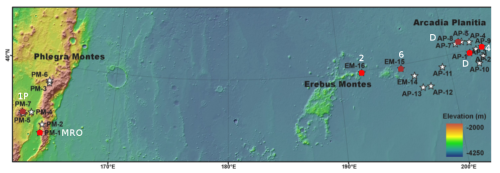
Capitalism in space: During this week’s 52nd Lunar and Planetary Science Conference, one poster [pdf] caught my eye as something significant. It was titled “SpaceX Starship Landing Sites on Mars.” The map to the right is figure 1 from that poster, annotated slightly by me based my earlier stories about SpaceX’s use of the high resolution camera on Mars Reconnaissance Orbiter (MRO) to research potential Martian landing sites for its Starship spacecraft. The stars indicate MRO images, most of which were described and linked to in my last major post about this SpaceX effort in November 2019.

The red spots covering some stars are the big story: SpaceX has narrowed its choice for its Starship landing site to four prime locations (indicated by the bright red spots) and three backup locations (indicated by the dark red spots). The images under the red spots numbered 2, 4, and 6 were linked to in my November 2019 post. The images under red spots marked by a “D” are earlier images taken by MRO when SpaceX was researching a potential Dragon landing site. The images under red spots labeled 1P and MRO are subsequent images taken by MRO since November 2019, with the 1P image previously linked to in a post in April 2020 entitled “The icy Phlegra Mountains: Mars’ future second city.”

The poster outlined why the prime candidate sites — PM1, EM16, AP1, and AP9 — were favored. For example, PM-1 in the Phlegra Mountains “…has the lowest latitude and elevation of the group, a clear association with LDAs [lobate debris aprons that resemble glacial features], well developed polygons, and has the highest SWIM [Subsurface Water Ice Mapping] score for geomorphic indicators of ice.”

EM 16 “…has a clear association with an LDA with nearby brain terrain and the strongest radar return for shallow ice and the highest combined SWIM score.”

AP1 “…appears to be the safest site and has a moderate combined SWIM score for ice.”

AP9 “…has the thickest ice from radar returns and geomorphology indicating shallow ice. It has the highest combined SWIM score for ice, but appears slightly rocky and rough.”

Below the fold are images, rotated, cropped, and reduced to post here, of the four primary landing sites, as well as links to the full images of all four plus the three back-up sites (AP8, EM15, and PM7).
» Read more

15 comments

A drainage channel on Mars

A drainage channel on Mars
Click for full image.

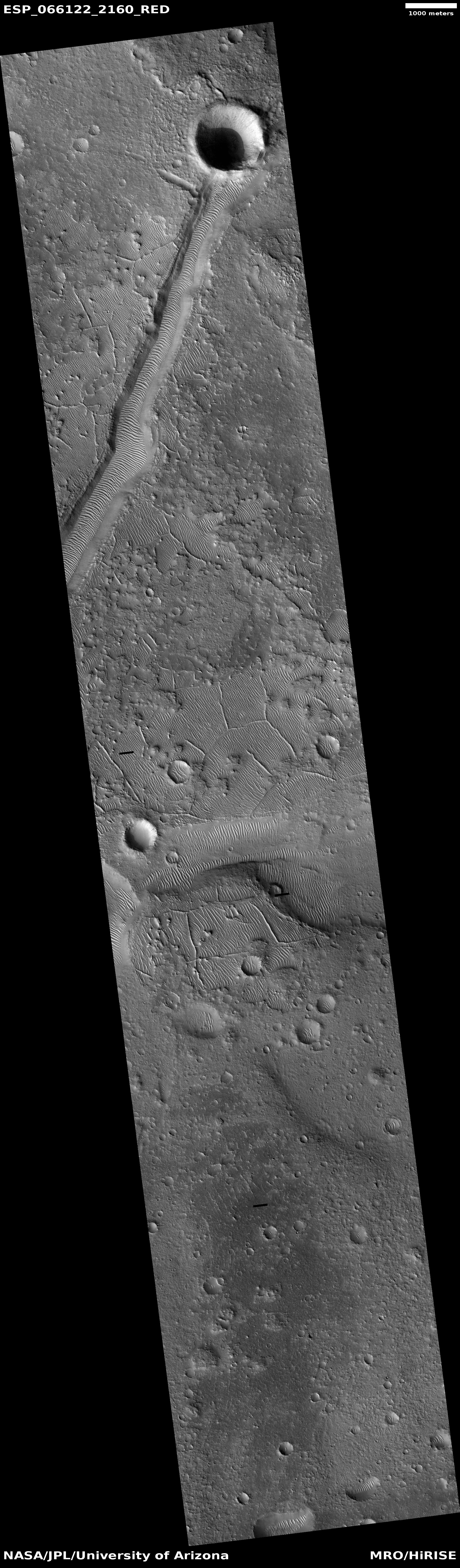
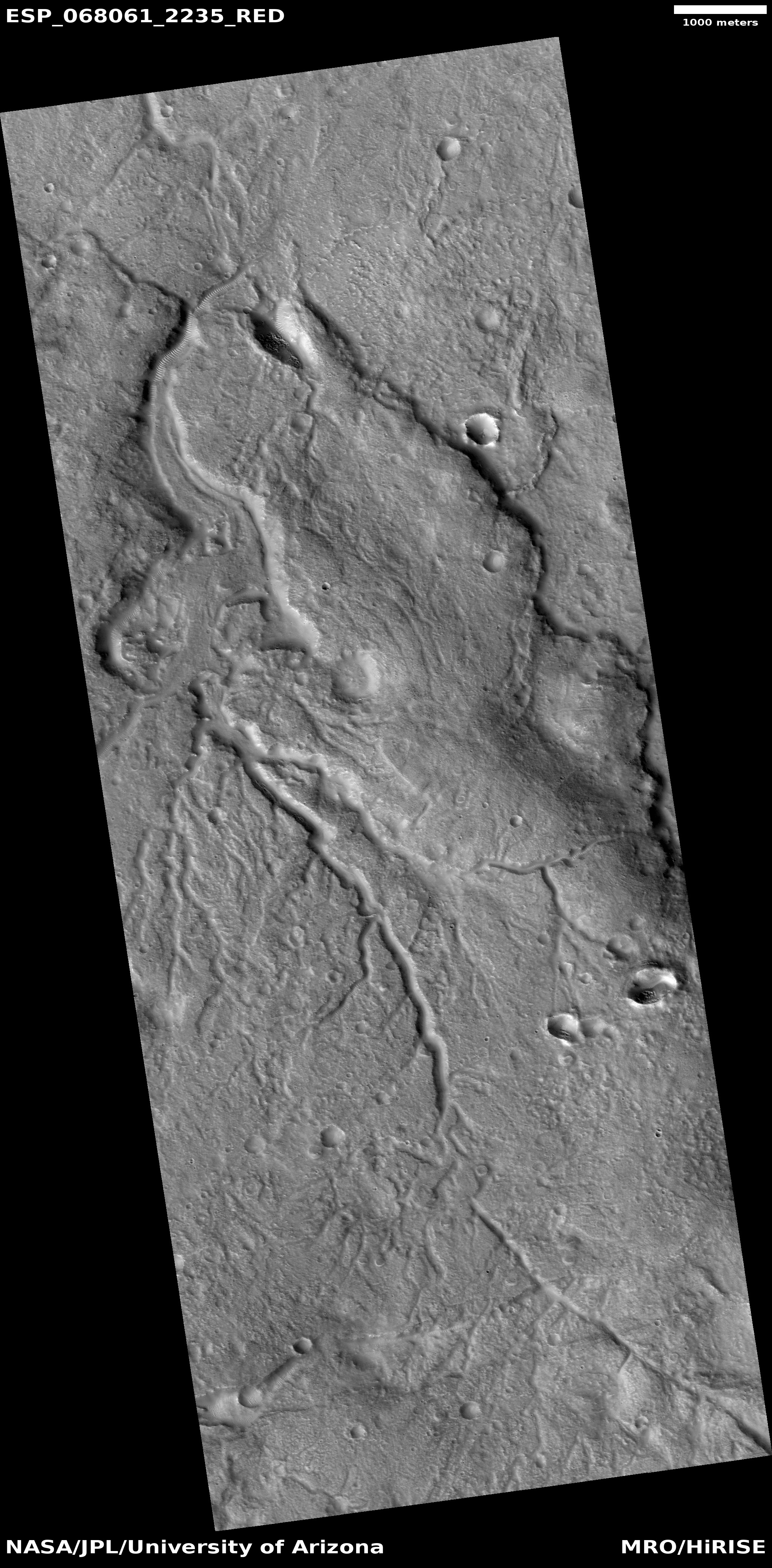
Today’s cool image from Mars highlights what is probably the biggest geological conundrum the red planet presents for planetary scientists. The photo to the right, rotated, cropped, and reduced to post here, was taken on February 1, 2021 by the high resolution camera on Mars Reconnaissance Orbiter (MRO). Though I have cropped it, I have cropped out very little, because the entire meandering drainage valley is its most interesting feature, and that takes up almost the entire image.

The photo was simply labeled by the camera team a “terrain sample northwest of Sytinskaya Crater”, so I suspect this was taken not in connection with any specific research but because they must use the camera at a regular intervals to maintain its temperature, and when they have gaps in their schedule they try to pick spots of interest in areas that have not had many high resolution photos taken. In this case however I suspect the location choice was very far from random, as they clearly wanted to capture this drainage system, in its entirety.

I called this merely a drainage channel without indicating what caused the channel, be it liquid water, ice, or wind, because in this case that is a main question. At first glance an Earthman will immediately suspect water, which is what scientists supposed for the last half century. The problem with that conclusion is that the Martian atmosphere is too cold and thin for liquid water to exist on its surface, and though there seems to be plenty of evidence that liquid water once existed there, no scientist has yet come up with a completely accepted climate model that allows for such conditions in anytime in Mars’ past.

The rover Opportunity found that some channels it explored might have been carved by wind, though to our human eyes it seems unlikely that a meandering tributary system such as this could have been carved by wind. The possibility however must not be dismissed out of hand, since Mars is an alien planet and alien things (to Earth) happen there.

The overview map below might provide some context.
» Read more

0 comments

Scallops of Martian ice

Scallops of Martian ice
Click for full image.

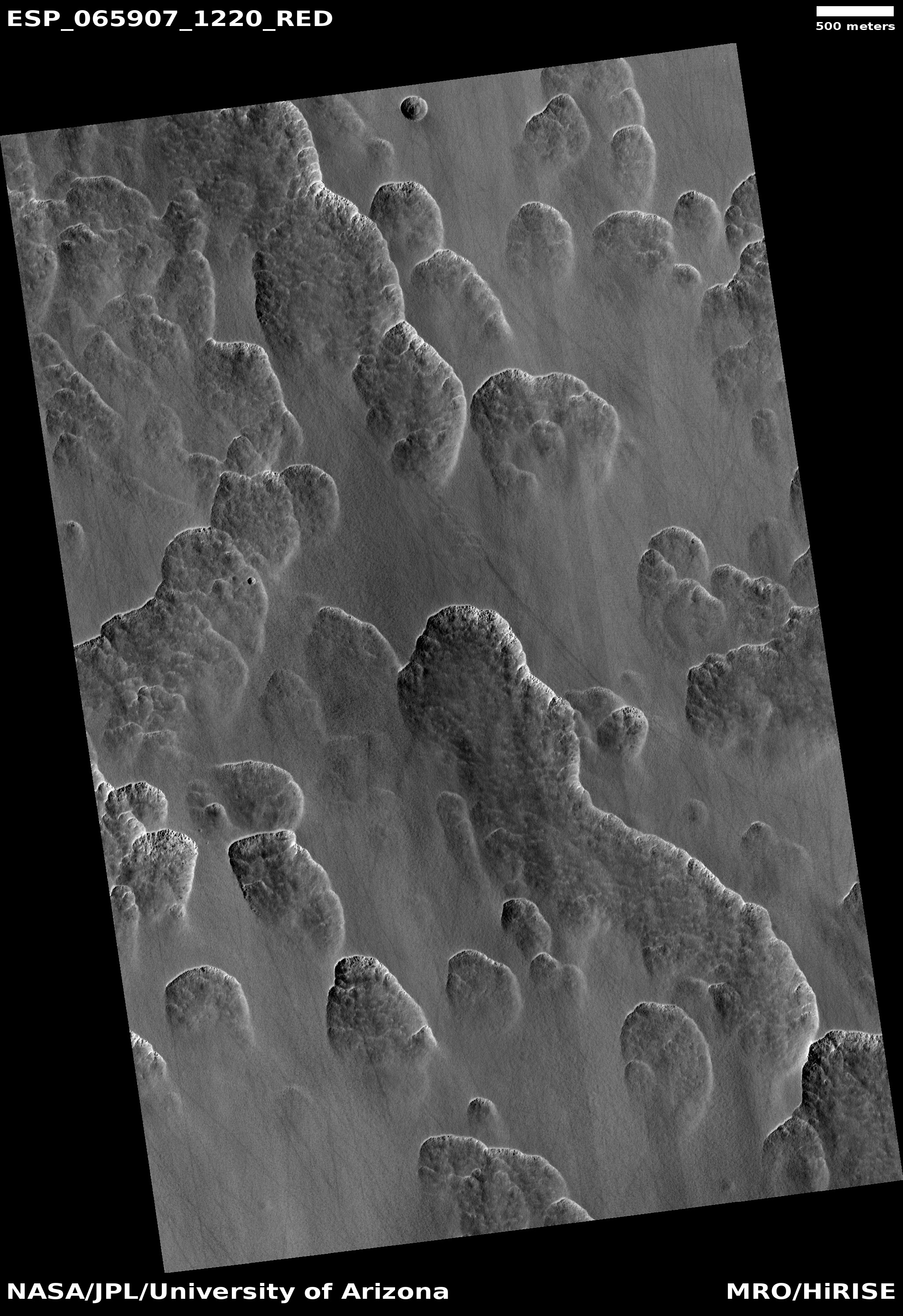
Cool image time! The photo to the right, cropped to post here, was yesterday’s captioned image from the MRO science team. From the caption, written by Shane Byrne of the Lunar and Planetary Lab University of Arizona,

About a third of Mars has water ice just below the dusty surface. Figuring out exactly where is vital for future human explorers. One of the ways scientists do this is to look for landforms that only occur when this buried ice is present. These scallops are one of those diagnostic landforms.

A layer of clean ice lies just below the surface in this image. As the ice ablates away in some spots the surface dust collapses into the hole that’s left. These holes grow into the scallops visible here as more and more ice is lost.

You can see those holes near the top of the scallop’s slopes.
» Read more

0 comments
1 58 59 60 61 62 90