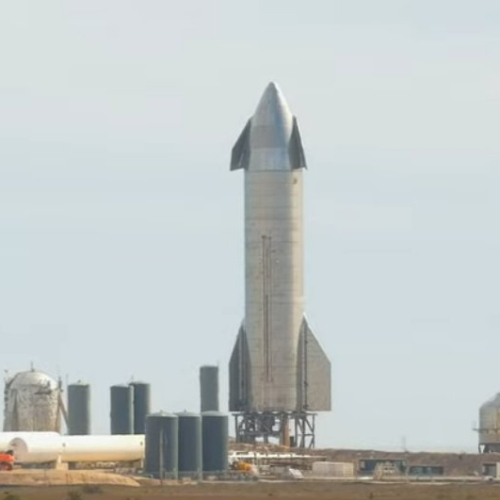
SpaceX ready to launch Starship prototype #24 into orbit

According to a statement yesterday by one SpaceX official, the company is now ready to launch its Superheavy #7 booster, stacked with its Starship prototype #24, on an orbital test flight, with the only remaining obstacle to launch the launch license, not yet approved by the FAA.

Speaking on a panel at the Space Mobility conference here about “rocket cargo” delivery, Gary Henry, senior advisor for national security space solutions at SpaceX, said both the Super Heavy booster and its launch pad were in good shape after the Feb. 9 test, clearing the way for an orbital launch that is still pending a Federal Aviation Administration launch license. “We had a successful hot fire, and that was really the last box to check,” he said. “The vehicle is in good shape. The pad is in good shape.”

…“Pretty much all of the prerequisites to supporting an orbital demonstration attempt here in the next month or so look good,” he said.

Henry also outlined SpaceX’s overall plans for Starship in the next year or two, beginning with a series of test/operational launches that will iron out the kinks of the rocket while simultaneously placing Starlink satellites into orbit. At the same time, development will shift to creating a Moon lander version of Starship for NASA’S Artemis program, including doing refueling tests of Starship in orbit. These test flights will also lead quickly to the three private manned flights that SpaceX already has contracts for, including two around the Moon and one in Earth orbit.

8 comments

SpaceX abandons plan to convert floating oil platforms into Starship/Superheavy landing spots

SpaceX has decided not to convert the two floating oil rigs it had purchased in 2020 into Starship/Superheavy landing platforms, and has sold both.

According to SpaceX CEO Gwynne Shotwell,

Shotwell said the company needed to first start launching Starship and better understand that vehicle before building offshore launch platforms. “We really need to fly this vehicle to understand it, to get to know this machine, and then we’ll figure out how we’re going to launch it.”

She said she expected offshore platforms to eventually play a role to support an extraordinarily high launch cadence. “We have designed Starship to be as much like aircraft operations as we possibly can get it,” she said in the conference presentation. “We want to talk about dozens of launches a day, if not hundreds of launches a day.”

This is a perfect example of this company’s intelligent ability to focus on the most important problems now, instead of getting distracted by future issues and challenges it knows exists but are not the priority at this time.

16 comments

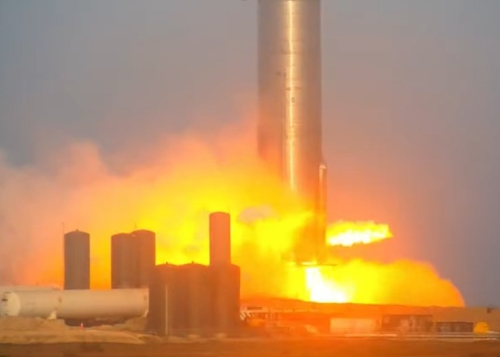
SpaceX completes 33-engine static fire test today of Superheavy prototype #7

Two seconds after ignition
Today’s Superheavy static fire test

SpaceX today successfully completed a 7-second-long static fire test of 31 of 33 Raptor-2 engines at the base Superheavy #7. The test ran for its full duration, and it appears no damage occurred to the launchpad. One engine shut down prior to test, and one shut down prematurely during the test. If this had happened during launch, the booster would still have had enough energy to get Starship to its required velocity to reach orbit.

The company will now have to analyze the test to determine whether it was sufficient to proceed to a March orbital launch. Certainly they will roll the booster back to the assembly building to exchange out the two engines that misfired.

All in all, it appears an orbital test flight of Starship could occur sometime in the next two months, assuming the FAA gets out of the way and issues the launch license.

EARLIER UPDATE:
—————-
Propellant loading is underway, and a rough time estimate for the actual static fire test is now 3 pm (Central).

Musk has now confirmed in a tweet that they are going to proceed to the test. It now appears that they have almost completed propellant loading. It appears they have filled the oxygen tanks, but not the methane tanks, and will probably not fill the methane tanks entirely for the test itself.

Original post:
—————-
No specific schedule has been announced of SpaceX’s attempt today to complete the first full 33-engine static fire test in Boca Chica of its seventh prototype of Superheavy, but a live stream is available from NASAspaceflight.com. I have embedded that live stream below.

The test will validate numerous systems, including the ground systems, the launchpad, the engines, and the systems for igniting all 33 in the proper sequence. Starship prototype #24 is not stacked on top of Superheavy in order to prevent any damage to it in case this test goes ugly. If so, SpaceX already has Superheavy prototype #9 ready to go in the nearby assembly building.

» Read more

21 comments

Stacked Starship and Superheavy complete first full wet dress rehearsal countdown

SpaceX yesterday successfully completed a full wet dress rehearsal countdown of its stacked Starship prototype #24 and Superheavy prototype #7, fueling both completely and taking the countdown down to T-0.

On this rehearsal however the Superheavy engines were not fired. From two SpaceX tweets:

Starship completed its first full flight-like wet dress rehearsal at Starbase today. This was the first time an integrated Ship and Booster were fully loaded with more than 10 million pounds of propellant

Today’s test will help verify a full launch countdown sequence, as well as the performance of Starship and the orbital pad for flight-like operations

Next step: Another full wet dress rehearsal countdown that includes a short static fire test of all 33 Superheavy Raptor-2 engines. Once that is done successfully, the company will be ready for that first orbital launch.

Meanwhile, SpaceX awaits its launch license from the FAA. I remain pessimistic that it will be issued on a timely manner, as there are clear signs the Biden administration wants to use its power against Musk, whom it now sees as an enemy.

16 comments

SpaceX to build five Starship/Superheavy prototypes in 2023

According to Elon Musk, SpaceX intends to build five Starship/Superheavy prototypes in 2023 for flight testing.

Assuming they can get launch permits, these five rockets should provide the company ample launch testing capability for at least the next two years, especially if it succeeds in landing these units and can consider reusing them in test flights.

At this moment, the launch permits from the federal government appears the main obstacle to getting this heavy lift reusable rocket tested and operational.

9 comments

Musk: SpaceX is now targeting late February/March for 1st orbital launch of Starship

According to a tweet put out by Elon Musk on January 8, 2023, SpaceX is now targeting late February/March for 1st orbital launch of the 24th prototype of Starship and the seventh prototype of Superheavy.

The testing in 2022 has not gone as smoothly as hoped, and is the reason no launch occurred last year:

Super Heavy B7 first left SpaceX’s Starbase factory in March 2022 and has been in a continuous flux of testing, repairs, upgrades, and more testing in the nine months since. The 69-meter-tall (~225 ft), 9-meter-wide (~30 ft) steel rocket was severely damaged at least twice in April and July, requiring weeks of substantial repairs. But neither instance permanently crippled the Starship booster, and Booster 7 testing has been cautious but largely successful since the rocket’s last close call.

Following its return to the OLS [orbital launch site] in early August, Super Heavy B7 has completed six static fire tests of anywhere from one to fourteen of its 33 Raptor engines. It has almost certainly dethroned Falcon Heavy to become the most powerful SpaceX rocket ever tested. And on January 8th, 2023, SpaceX rolled the rocket back to Starbase’s orbital launch site for the seventh time. According to statements made by CEO Elon Musk and a presentation from a NASA official, the last major standalone test between Booster 7 and flight readiness is a full 33-engine static fire. Together, B7’s 33 Raptor 2 engines could produce up to 7600 tons (16.7 million lbf) of thrust at sea level, likely making Starship the most powerful rocket stage in the history of spaceflight.

I had read speculation earlier that it was impossible for SpaceX to do a full 33-engine static fire test because the OLS could not hold the rocket down. That now appears to be incorrect.

Musk’s tweet and proposed schedule should also not be taken with great seriousness. He routinely sets ambitious targets merely to keep the pace fast, even if those targets are not met.

11 comments

SpaceX raises another $750 million in private investment capital

SpaceX has just completed another round of fund-raising, gaining another $750 million in private investment capital.

This additional money now means that SpaceX has raised about $10 billion in private money, most of which is being used for the development of Starship and Superheavy. When we add the $4 billion SpaceX will get from NASA for Starship, the company now has $14 billion to build this new rocket.

5 comments

NASA extends Boeing’s contract to produce more SLS rockets

NASA yesterday announced that it will pay Boeing $3.2 billion for two more SLS rockets.

NASA has finalized its contract with Boeing of Huntsville, Alabama, for approximately $3.2 billion to continue manufacturing core and upper stages for future Space Launch System (SLS) rockets for Artemis missions to the Moon and beyond.

Under the SLS Stages Production and Evolution Contract action, Boeing will produce SLS core stages for Artemis III and IV, procure critical and long-lead material for the core stages for Artemis V and VI, provide the exploration upper stages (EUS) for Artemis V and VI, as well as tooling and related support and engineering services.

All this really means is that NASA is going depend on SLS and Orion to fly its astronauts to and from the Moon, and because of that its pace of flight will be — at best — slow and long-drawn out. For example, this new order extends the contract out to 2028. It will thus leave plenty of time for SpaceX and other nations to get there first.

I predict that the private Starship missions paid for by Yusaku Maezawa and Jared Isaacman will both fly before these two new Artemis missions. You heard it here first.

20 comments

Billionaire Maezawa chooses his passengers for Starship lunar flight

Japanese billionaire Yusaku Maezawa yesterday announced the eight passengers he will take with him on his private Starship flight around the Moon, its launch date still not set.

The full list of ten (including the two back-up passengers) is a wide mixture of individuals with a wide range of disciplines coming from a wide range of countries. For those interested in space, the one name that stood out and was very familiar was Tim Dodd, created of Everyday Astronaut. He created a video describing his selection as well as Maezawa’s entire project, which I have embedded below:
» Read more

4 comments

Update on Starship/Superheavy testing at Boca Chica

Link here.

While work appears to be proceeding aggressively, it increasingly looks like no orbital launch will occur before the end of this year. SpaceX engineers appear to be preparing two different Superheavy prototypes, #7 and #9, but both are still undergoing modifications based on recent engine tests. In addition, modifications to Starship prototype #24 continue.

4 comments

Blue Origin-led team bids for NASA manned lunar lander contract

Capitalism in space: Though few details have been released, Blue Origin has teamed up with Boeing and Lockheed Martin to bid for a NASA contract to build a second manned lunar lander, after SpaceX’s Starship.

Blue Origin revealed its team’s submission to that second NASA program in a brief statement posted on its website on Tuesday, saying “in partnership with NASA, this team will achieve sustained presence on the Moon.”

The deadline for proposals was Tuesday. NASA is expected to make an award decision in June 2023.

Blue Origin’s team also includes spacecraft software firm Draper, Pittsburgh, Pennsylvania-based Astrobotic and Honeybee Robotics, a manufacturer of military and civil robotic systems that was acquired by Blue Origin in January.

It will be interesting to see if this proposed lander is significantly different than the previous proposal, which NASA considered overpriced and not as capable as Starship.

10 comments

NASA awards Starship a second manned lunar landing contract

Capitalism in space: NASA yesterday modified its manned lunar lander contract with SpaceX to award Starship a second manned lunar landing for $1.15 billion.

Known as Option B, the modification follows an award to SpaceX in July 2021 under the Next Space Technologies for Exploration Partnerships-2 (NextSTEP-2) Appendix H Option A contract. NASA previously announced plans to pursue this Option B with SpaceX. The contract modification has a value of about $1.15 billion.

…The aim of this new work under Option B is to develop and demonstrate a Starship lunar lander that meets NASA’s sustaining requirements for missions beyond Artemis III, including docking with Gateway, accommodating four crew members, and delivering more mass to the surface.

NASA is also accepting bids for a competitive second manned lunar lander, but has awarded nothing as yet.

Combined with earlier investments and contracts, SpaceX now had garnered about $13 billion for developing Starship and Starlink, about $9 billion from private investment capital and about $4 billion from NASA, with most of the cash used for Starship. In addition, the company plans another investment funding round that will raise its valuation to $150 billion.

SLS might have flown once, but it appears both NASA and the investment community is increasingly putting its eggs in the Starship basket.

1 comment
1 18 19 20 21 22 44