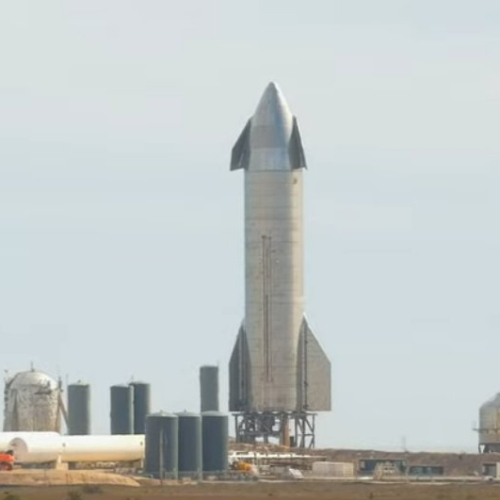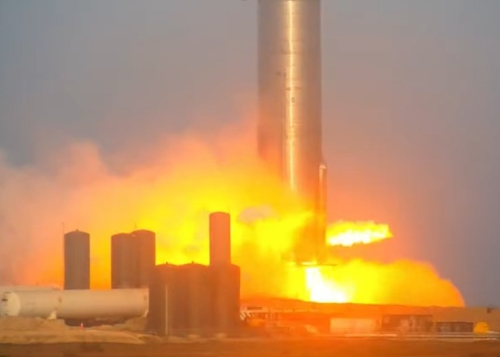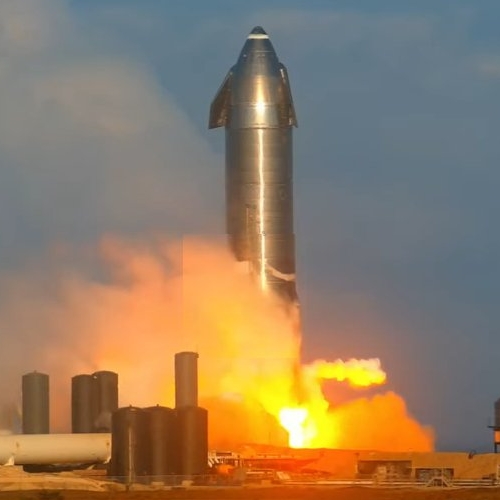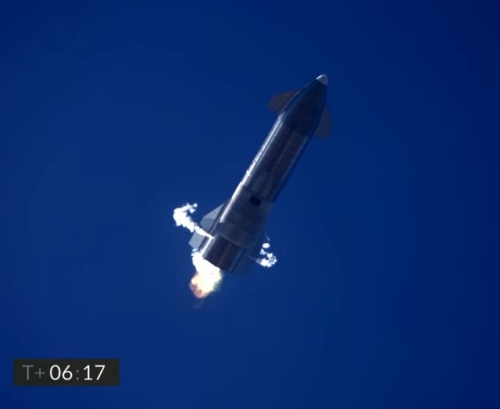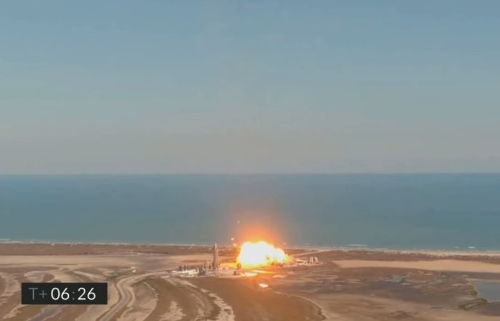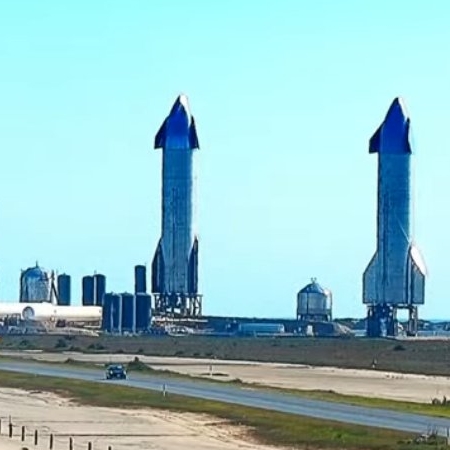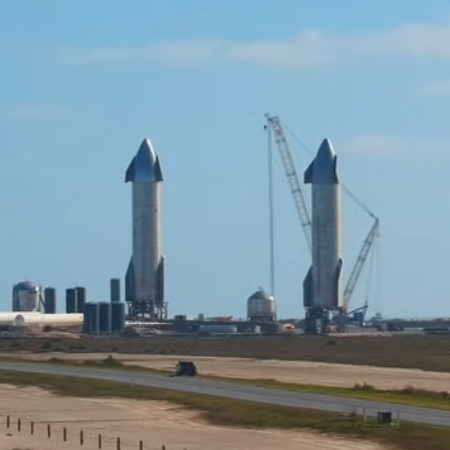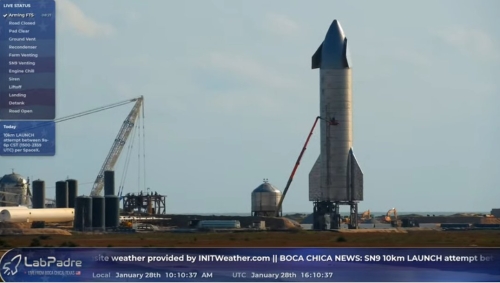
Superheavy prototype #7 undergoes 14 engine static fire test

SpaceX’s seventh prototype of its Superheavy first stage booster — intended to launch its Starship orbital craft on the first orbital flight — successfully completed a 10-second static fire test of 14 of its 33 engines yesterday.

I have embedded video of the test below the fold. It shows the burn repeatedly from different angles. It appears the engine test went exactly as planned, with no subsequent fires near the launch pad.

According to the article at the link, this test fire, even with only 14 engines, made this Superheavy booster the most powerful rocket on Earth, at least until tonight when NASA’s SLS launches. Once this booster fires all of its 33 Raptor-2 engines however it will then exceed SLS in power. That it hasn’t launched however makes this claim a little overstated.

Regardless, SpaceX continues to move quite smoothly towards that first orbital launch of Starship, which the company hopes to do before the end of the year.
» Read more

1 comment

InSight detects and dates large impact on Mars

InSight's Christmas Eve impact
Click for full image.

Using the data from InSight’s seismometer of a 4 magnitude earthquake on Mars on December 24, 2021, scientists were able to use the high resolution camera on Mars Reconnaissance Orbiter (MRO) to find the meteorite impact that produced that quake, the largest detected since spacecraft have been visiting Mars. The picture to the right, cropped and reduced to post here and unveiled at yesterday’s press conference, shows the new crater.

The meteoroid is estimated to have spanned 16 to 39 feet (5 to 12 meters) – small enough that it would have burned up in Earth’s atmosphere, but not in Mars’ thin atmosphere, which is just 1% as dense as our planet’s. The impact, in a region called Amazonis Planitia, blasted a crater roughly 492 feet (150 meters) across and 70 feet (21 meters) deep. Some of the ejecta thrown by the impact flew as far as 23 miles (37 kilometers) away.

With images and seismic data documenting the event, this is believed to be one of the largest craters ever witnessed forming any place in the solar system.

This is not the first such impact identified from InSight seismic data, but it is the largest. The white streaks surrounding the crater are thought to be near-surface ice ejected at impact.

The overview map below provides further context, as well as showing us the proximity of this impact to the proposed Starship landing sites on Mars.
» Read more

2 comments

NASA buys 3 Orion capsules from Lockheed Martin for $2 billion

Nice work if you can get it! Earlier this week NASA awarded Lockheed Martin a new contract worth $1.99 billion to build three more Orion capsules for its Artemis program.

This order marks the second three missions under the agency’s Orion Production and Operations Contract (OPOC), an indefinite-delivery, indefinite-quantity (IDIQ) contract for up to 12 vehicles. A breakout of these orders includes:

  • 2019: NASA initiates OPOC IDIQ and orders three Orion spacecraft for Artemis missions III-V.
  • 2022: NASA orders three additional Orion spacecraft missions for Artemis VI-VIII for $1.99 billion.
  • In the future: NASA can order an additional six Orion missions.

Under OPOC, Lockheed Martin and NASA have reduced the costs on Orion by 50% per vehicle on Artemis III through Artemis V, compared to vehicles built during the design and development phase. The vehicles built for Artemis VI, VII and VIII will see an additional 30% cost reduction.

Lawdy me! They’ve reduced the price! Lockheed Martin is only charging NASA three-quarters of a billion dollars per capsule on this new contract (after NASA spent about $18 billion for the development of the first six capsules– that’s $3 billion each). And Lockheed Martin will only charge about a half billion per capsule for future capsules! My heart be still.

Meanwhile, SpaceX is designing, testing, building, and will likely launch its reusable Starship manned spacecraft, which could launch about 10 Orion capsules on each launch, for about $10 billion total. Once flying the expected cost per launch will likely be much less than $100 million, with SpaceX claiming it could be as low as $2 million. Even if you add the development cost for these launches, Starship will cost less than Orion by many magnitudes, on its first launch.

I wonder, which is the better bargain? NASA clearly can’t figure it out, and NASA has the smartest, most brilliant people in the universe working for it.

22 comments

Dennis Tito signs deal to fly on 2nd manned Starship mission around Moon

Capitalism in space: Dennis Tito, the first tourist to fly in space and now 82-years-old, has signed a deal with SpaceX for both him and his wife Akiko to fly on 2nd manned Starship mission around Moon.

His weeklong moonshot — its date to be determined and years in the future — will bring him within 125 miles (200 kilometers) of the lunar far side. He’ll have company: his wife, Akiko, and 10 others willing to shell out big bucks for the ride.

Tito won’t say how much he’s paying; his Russian station flight cost $20 million.

The couple recognize there’s a lot of testing and development still ahead for Starship, a shiny, bullet-shaped behemoth that’s yet to even attempt to reach space. “We have to keep healthy for as many years as it’s going to take for SpaceX to complete this vehicle,” Tito said in an interview this week with The Associated Press. “I might be sitting in a rocking chair, not doing any good exercise, if it wasn’t for this mission.”

The bottom line is that this deal, combined with the two other passenger Starship deals SpaceX has already signed, demonstrates that there is a solid market for Starship, even before its first launch. Expect that market to boom once the rocket begins operations.

1 comment

SpaceX fully stacks Starship/Superheavy in preparation for launch

Starship about to be stacked on Superheavy
Starship about to be stacked on Superheavy, using
the launch tower’s chopstick arms. Click for full image.

For the first time in six months SpaceX engineers have stacked Starship prototype #24 on top of Superheavy prototype #7, with the intention of running a dress rehearsal countdown and a full static fire test of Superheavy’s 33 engines, all in preparation for the first orbital test flight before the end of this year.

According to CEO Elon Musk, Booster 7 and Ship 24 will attempt Starship’s first full-stack wet dress rehearsal (WDR) once all is in order. The prototypes will be simultaneously loaded with around 5000 tons (~11M lb) of liquid oxygen and methane propellant and then run through a launch countdown. Diverging just before ignition and liftoff, a WDR is meant to be more or less identical to a launch attempt.

…If the wet dress rehearsal goes to plan, SpaceX will then attempt to simultaneously ignite all 33 of the Raptor engines installed on Super Heavy B7, almost certainly making it the most powerful liquid rocket ever tested. Even if all 33 engines never reach more than 60% of their maximum thrust of 230 tons (~510,000 lbf), they will likely break the Soviet N-1 rocket’s record of 4500 tons of thrust (~10M lbf) at sea level. It would also be the most rocket engines ever simultaneously ignited on one vehicle. SpaceX will be pushing the envelope by several measures, and success is far from guaranteed.

Depending on the results of these tests, the stacked rocket will either require further modifications, or could even proceed directly to launch.

We are thus seeing a true race between SpaceX’s privately developed and funded rocket and NASA’s government developed and funded SLS rocket. Which will launch first? Right now the race is neck-and-neck, though that is deceiving since SpaceX began development twelve years after NASA started work on SLS. Even if SLS launches first, SpaceX will have clearly shown that private enterprise does things faster (7 years vs 18 years) and for far less money (about $9 billion vs $46 billion).

15 comments

SpaceX to upgrade 2nd Kennedy launchpad for manned launches

In order to create some increased redundancy, SpaceX and NASA have agreed to upgrade the company’s second launchpad at Cape Canaveral, LC-40, so that both it and pad LC-39A can launch manned Dragon capsules.

This plan grew out of concern by NASA that the new Starship orbital launchpad was too close to LC-39A, and could possibly damage it during a launch. Should that happen, and no back-up launchpad was available, the agency would have no way to get astronauts up to ISS, since Boeing’s Starliner is not yet operational. Because of that concern, NASA made it clear that no Starship launches could occur in Florida until this issue was resolved.

The solution? Make LC-40 a manned launchpad too.

Nothing is known about the nature of the modifications that LC-40 will require. But more likely than not, NASA will require SpaceX to develop something similar to Pad 39A’s facilities. That would involve building a new crew access tower, crew access arm, escape system (39A uses baskets and ziplines), and an on-site bunker for astronauts.

It is also likely that no Starship launches at Kennedy will occur until this work is done and a manned launch from LC-40 takes place. Though this could delay Starship somewhat, I expect not significantly. Before SpaceX is ready to launch operationally in Florida, it still has to do a lot of testing and development of Starship/Superheavy in Boca Chica, work that could take several years. I also suspect that it will get the launchpad work done relatively quickly, especially if NASA agrees to pay for it.

12 comments

Musk: Starship orbital attempt by November, at the latest

According to a tweet yesterday by Elon Musk, SpaceX engineers will likely have the first orbital prototypes of Starship and Superheavy ready for the orbital attempt either late in October, or by November. His full tweet:

Late next month maybe, but November seems highly likely. We will have two boosters & ships ready for orbital flight by then, with full stack production at roughly one every two months. [emphasis mine]

The highlighted words are the most significant. SpaceX is not building one rocket for test, like NASA has done with SLS. It is building an assembly line of test rockets, so that it can do a fast series of test launches plus upgrades, leading to quick and reliable operations. Should any one rocket launch fail, the company will speedily move on to the next, with little or no delay.

Should SLS fail in its first test launch sometime in the next month, NASA has no back-up. The entire program will be shattered, with no easy way to recover.

12 comments

SpaceX fires seven engines on Superheavy prototype #7

Capitalism in space: SpaceX today successfully did a static fire engine test of seven engines on its Superheavy prototype #7, intended to be the lower stage of the first Superheavy/Starship orbital test.

The link takes you to the full live stream. Below I have cued that live stream to just before the test occurred. Everything seems to go as planned, with no obvious anomalies.

SpaceX continues to be moving closer and closer to that first orbital flight.
» Read more

3 comments

Update on SpaceX’s Starship and Superheavy

Link here. The article not only outlines the test program leading to the first launch of prototypes Starship #24 and Superheavy #7, it describes the status of later prototypes, as well as the construction of SpaceX’s Starship launch site in Florida. Key quote:

Booster 7’s gradual approach to static fire testing will allow the teams to fix issues as they test and fully mature procedures and software ahead of the long-awaited orbital flight of Starship. Should this gradual testing go without a hitch, it could culminate in one or perhaps even two 33-engine static fire tests of Booster 7 on the OLM [orbital launch mount].

Once this testing is completed and any issues found fixed, it’ll be cleared to proceed into another phase of testing: Ship 24 will then be stacked on top of Booster 7 for combined tests. This could include launch countdown simulations, an eventual full-up countdown, and a 33-engine static fire test.

SpaceX hopes to complete this by mid-next month and clear both vehicles for launch shortly after. However, as we’ve seen in the past few weeks, any issues encountered during this intense test campaign could well mean a slip to later into the year and, perhaps, into next year.

4 comments

SpaceX successfully test fires all six engines on Starship prototype #24

Capitalism in space: SpaceX yesterday successfully completed for the first time an eight-second-long static fire test of all six engines on Starship prototype #24.

I have embedded video of the test below. The amount of power exhibited is quite impressive. In fact, it was so powerful it likely melted the concrete below the rocket, sending hot debris flying that caused a major brushfire.

Most likely, eight long seconds of blast-furnace conditions melted the top layer of surrounding concrete and shot a hailstorm of tiny superheated globules in almost every direction. Indeed, in almost every direction there was something readily able to burn, a fire started. In several locations to the south and west, brush caught fire and began to burn unusually aggressively, quickly growing into walls of flames that sped across the terrain. To the east, debris even made it into a SpaceX dumpster, the contents of which easily caught fire and burned for hours.

Eventually, around 9pm CDT, firefighters were able to approach the safed launch pad and rocket, but the main fire had already spread south, out of reach. Instead, they started controlled burns near SpaceX’s roadblock, hoping to clear brush and prevent the fire (however unlikely) from proceeding towards SpaceX’s Starbase factory and Boca Chica Village homes and residents.

The rocket itself came though the test unscathed, a major milestone on the path to its first orbital flight.

During a launch, the rocket would have quickly lifted off, and thus caused far less stress to the concrete on the ground. Nonetheless, this test suggests SpaceX needs to do more pad preparation for any tests of Superheavy prototype #7, which has 33 engines at its base.

» Read more

37 comments

More static fire tests of Starship/Superheavy expected this week

SpaceX appears to be gearing up for more engine tests of both Superheavy prototype #7 and Starship prototype #24 this week, having called for road closures at Boca Chica today with additional options thoughout the week.

The article at the link mostly provides an overview of the changes in both stages that occurred because of the shift from the first version of the Raptor engine to the much more streamlined Raptor-2. The side-by-side image of both versions is quite revealing, showing once again how much SpaceX adheres to Musk’s adage that “the best part is no part.” Raptor-2 is astonishingly simpler and more compact, even though it produces about 25% more power.

0 comments

SpaceX completes static fire test of three engines on Superheavy prototype #7

Capitalism in space: SpaceX yesterday successfully completed the first static fire test of more than one engine on its Superheavy prototype #7, firing three engines for five seconds.

NASASpaceflight livestreamed the test, and its footage suggests that only two engines may have fully lit up, with the third perhaps aborting. Whether or not the third Raptor joined the party, however, it was still the first multi-engine Super Heavy static fire that SpaceX has performed.

I have embedded that footage below. Expect more such tests in the coming days. If all works as planned (something we should not expect as this remains a development program), the tests will culminate in an orbital test flight sending Starship on a one orbit mission around the Earth. At present SpaceX wants that flight to occur before the end of this year.

» Read more

3 comments
1 19 20 21 22 23 44