Making smallsat rockets at Vector

Payload structure for Vector's Vector-R rocket

In the coming year we should see the spectacular first launches from two smallsat rocket companies, Vector and Virgin Orbit, joining Rocket Lab (which has already launched successfully three times) to form an entirely new industry of small rockets designed specifically for launching cubesat and nanosat satellites, what I call smallsats.

The image on the right shows the payload adapter fitting for Vector’s Vector-R rocket. The red and silver rectangular objects are dummy cubesat payloads. Overall, this structure, only about three feet high, will allow Vector to place as many as eight smallsats into orbit on one launch.

The picture was taken yesterday during a tour of Vector’s facilities given to me personally by Vector’s CEO, Jim Cantrell. During my previous tour of Vector back in March 2017, Cantrell had described the company’s planned test launch schedule as follows:

The company is presently in the testing phase leading up to their first orbital launches, which they hope to start in 2018. Right now they are building a series of full scale versions of their Vector-R rocket with a dummy second stage. The idea is to do a string of suborbital test flights, the first of which will fly in about a week from Mohave in California, with the second flying from the Georgia spaceport in Camden County.

The first two launches occurred as promised, first in Mojave on May 3, 2017 and then in Georgia on August 3, 2017. An announcement in October 2017 set the launch of the third test first for January 2018 but that launch did not happen. In March 2018 Vector announced it planned to launch two cubesats into orbit from Alaska by the end of 2018, but this did not happen either.

Because of the delays, with no explanation, I was beginning to harbor doubts about the company’s status. Last week Cantrell gave a talk at Tucson’s Space Business Roundtable, and I went to that talk to find out what the issues were as well as attempt to find out when they did plan to launch.

Cantrell not only filled me in on the details, but generously offered to give me another personal tour of Vector’s facilities, which had grown significantly since my 2017 tour. Then, Vector employed only thirty people and was based in a small warehouse. Now it employs more than 150, and has two much larger facilities in Tucson as well as one in California (where its mission control is based).

First let me outline the company’s launch status.
» Read more

3 comments

A visit to the Mexican border

Last night President Trump gave his first prime-time speech to the nation, focused specifically on the hot-button issue of illegal immigration. You can read the full text, with the Democratic response, here. A fair analysis can be read here, which also includes a thorough critique of the press’s mindless partisan reaction.

I usually don’t watch such speeches. I read the transcript afterward, to see if there is any substance there (usually not). It saves time.

What I did do yesterday however was visit the very location that is the subject and focus of these speeches, the border between the United States and Mexico. Diane and I and Earl, a visiting friend from back east, decided to give Earl a taste of international travel by driving down to Nogales to cross the border for lunch.

We do this periodically, not to go sightseeing but buy many of our prescription drugs, which tend to be about 75% cheaper in Mexico and do not require that prescription for purchase. For example, one of our cats has a fungal disease called valley fever which requires giving her a pill twice a day. In the states that drug costs more than $200 for a ninety day supply. In Mexico I can get that same amount for less than $50. (The cost difference illustrates well the mess our Congress has created of our drug industry, since the high cost is directly related to government regulations imposed in the last two decades and topped off by the passage of Obamacare in 2010.)

Anyway, below are some photos from this trip. They give you a sense of what it is like at one of the major populated border crossing points, which by the way and not surprisingly does not much resemble the impression given by our modern mainstream press.
» Read more

39 comments

Sunspot update December 2018: Decline to solar minimum continues

Time for the monthly solar cycle update! NOAA today posted its monthly update of the solar cycle, covering sunspot activity for December 2018. As I do every month, I am posting it below, annotated to give it some context.

December 2018 sunspot activity

The graph above has been modified to show the predictions of the solar science community. The green curves show the community’s two original predictions from April 2007, with half the scientists predicting a very strong maximum and half predicting a weak one. The red curve is their revised May 2009 prediction.

There really isn’t much to say about the sunspot activity in December. It continued to show a steady decline to solar minimum, exhibiting activity very comparable to what we saw in mid-2008 when the previous unusually long and extended solar minimum began.

One interested detail however: When NOAA issued this graph last month, it finally extended it out beyond the end of 2019 to the end of 2022. In doing so, it also extended out the 2009 prediction of the solar science community, as indicated by the red curve. I hadn’t commented on this last month, but if you look at that curve it drops to zero and then flatlines for the entire year of 2022.

If this is what the solar science community now expects for this upcoming minimum, it means that community is now expecting a record-breaking minimum, lasting far longer than any previous minimum, two to three years at least. It also means that they have not dismissed the possibility that the Sun is about to enter a Grand Minimum, where no significant sunspot activity is seen for literally decades.

Should such a grand minimum occur, it bodes ill for global warming advocates. The track record of the Earth’s climate consistently shows that when sunspot activity declines, the global climate gets colder. Why this happens is not clearly understood, though there is at least one theory backed up by good experimental data. Should this happen, we shall discover that global cooling is a far worse thing to fear than global warming.

9 comments

The 2018 global launch race plus predictions for 2019

In 2018 the global launch industry turned a significant corner. While there have been strong signs in 2016 and 2017 that we were about to see the arrival of a boom, it was not until this past year that we finally saw the beginnings of this boom.

Below is my updated launch graph showing what was accomplished in 2018. To put what was done in context, the graph shows all launches by every nation and private company for each year beginning in 1980, with 1968 added to provide a sense of what the launch industry was like during the height of the Cold War space race.

Before reading further, however, it is worthwhile to review what I wrote in my 2017 launch industry assessment, written in January 2018. My assessment then, as well as my predictions, provide some worthwhile context for understanding what actually happened this past year.
» Read more

11 comments

Dried mud cracks on Mars?

Mud cracks on Mars?

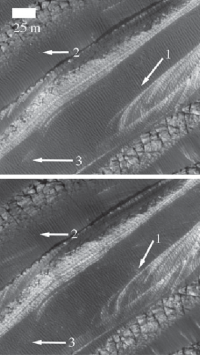
Cool image time! The image to the right, cropped and rotated to post here, was one of the uncaptioned photographs in the December Mars Reconnaissance Orbiter (MRO) image release. If you click on the image you can see the entire photograph. I have cropped the most interesting area, though cracks can be seen in other areas in the image.

What we appear to have here is a darker lower valley filled with dried mud, which over time has cracked as it dried. At its edges there appear to be ripples, almost like one sees on the beach as waves wash the shore. The perimeter slopes even show darker streaks as if the water in some places lapped up the slopes, and in others flowed downward into the valley.

Later, several meteorite impacts occurred, the largest of which produced concentric dried cracks on its outside perimeter. This impact also provides a rough idea of the depth of the mud in this valley.

Mud of course suggests that this lower valley once was filled with water. Was it? It is not possible now to come to a firm conclusion, but this image’s location shown by the red dot in the overview map below and to the right, provides a clue that strengthens this hypothesis.
» Read more

0 comments

The real meaning of the Apollo 8 Earthrise image

Earthrise, as seen by a space-farer

Today is the fiftieth anniversary of the moment when the three astronauts on Apollo 8 witnessed their first Earthrise while in orbit around the Moon, and Bill Anders snapped the picture of that Earthrise that has been been called “the most influential environmental picture ever taken.”

The last few days have seen numerous articles celebrating this iconic image. While all have captured in varying degrees the significance and influence of that picture on human society on Earth, all have failed to depict this image as Bill Anders, the photographer, took it. He did not frame the shot, in his mind, with the horizon on the bottom of the frame, as it has been depicted repeatedly in practically every article about this image, since the day it was published back in 1968.

Instead, Anders saw himself as an spaceman in a capsule orbiting the waist of the Moon. He also saw the Earth as merely another space object, now appearing from behind the waist of that Moon. As a result, he framed the shot with the horizon to the right, with the Earth moving from right to left as it moved out from behind the Moon, as shown on the right.

His perspective was that of a spacefarer, an explorer of the universe that sees the planets around him as objects within that universe in which he floats.

When we here are on Earth frame the image with the horizon on the bottom, we immediately reveal our limited planet-bound perspective. We automatically see ourselves on a planet’s surface, watching another planet rise above the distant horizon line.

This difference in perspective is to me the real meaning of this picture. On one hand we see the perspective of the past. On the other we see the perspective the future, for as long a humanity can remain alive.

I prefer the future perspective, which is why I framed this image on the cover of Genesis: the Story of Apollo 8 the way Bill Anders took it. I prefer to align myself with that space-faring future.

And it was that space-faring future that spoke when they read from Genesis that evening. They had made the first human leap to another world, and they wished to describe and capture the majesty of that leap to the world. They succeeded beyond their wildest dreams.

Yet, they were also still mostly Earth-bound in mind, which is why Frank Borman’s concluding words during that Christmas eve telecast were so heartfelt. He was a spaceman in a delicate vehicle talking to his home of Earth, 240,000 miles away. “And from the crew of Apollo 8, we close with good night, good luck, a Merry Christmas, and God bless all of you — all of you on the good Earth.” They longed deeply to return, a wish that at that moment, in that vehicle, was quite reasonable.

Someday that desire to return to Earth will be gone. People will live and work and grow up in space, and see the Earth as Bill Anders saw it in his photograph fifty years ago.

And it is for that time that I long. It will be a future of majesty we can only imagine.

Merry Christmas to all, all of us still pinned down here on “the good Earth.”

12 comments

Apollo 8: Fifty years ago

Fifty years ago the Apollo 8 mission successfully began with a 6:51 am launch at what was then called Cape Kennedy. It would be a space mission that would not only make history, being the first to take humans to another world, it would change America and western culture in ways no one at that time imagined.

I don’t have much to add. I’ve written hundreds of thousands of words on this mission already. If you want to know more, you can read or listen to Genesis: the Story of Apollo 8.

What I find gratifying is that it appears my goal in writing the book in 1998 has been an unparalleled success. Today alone there have been three major stories celebrating Apollo 8 and its legacy, from the Washington Post, Scientific American, and New Atlas. In the past week there have another half dozen. I expect dozens more in the coming week. All so far have gotten their facts right, and have been able to tell the story correctly of this nerve-racking mission given 50-50 odds of success. More important, all have understood thoroughly the political and historical context of the mission, and the long term impact that it had.

In 1998, when I wrote Genesis, the mission had been largely forgotten, even though I knew and remembered how important it had been. When the book came out that year, during its thirtieth anniversary, I was pretty much the only one writing about it, expressing my strong desire to change this lack of recognition, to make people remember.

Today, none of the many articles about Apollo 8 make mention of my work. This is right and fitting. I wasn’t an astronaut on board. Nor did I build the rocket or capsule. I was merely a historian telling the story. However, if my poor effort has served to make others remember, and report the story correctly in 2018, its fiftieth anniversary, I can sleep peacefully when my time comes.

There will never be another first mission by humans to another world. We should remember that first journey, and honor it. I am glad we finally are doing so.

16 comments

Curiosity’s future travels

MRO image of Curiosity's future travels

In the December release of images from the high resolution camera on Mars Reconnaissance Orbiter (MRO), there was one image entitled “Monitor Region Near Curiosity Rover.” To the right is a reduced, cropped, and rotated section of that image, annotated by me to show Curiosity’s future planned route (indicated by the yellow line). If you click on the image you can see the untouched full resolution version.

Curiosity’s journey has not yet brought it onto the terrain shown in this image. (For the overall context of Curiosity’s travels, see Pinpointing Curiosityโ€™s location in Gale Crater.) The rover is right now just off the left edge of the photograph, on the white ridge dubbed Vera Rubin Ridge visible in the uppermost left. This week it completed the last planned drill sampling on that ridge, and it will soon descend off the ridge and begin heading along the yellow route up the mountain. The white dots along its future route are the locations of recurring slope lines, believed to be seasonal seeps of brine coming from below and causing gentle landslides that darken the surface. As you can see, they hope to get very close to the first seep, and will observe the second from across the canyon from a distance of about 1,200 feet.

The peak of Mount Sharp is quite a distance to the south, far beyond the bottom of the photograph. Even in these proposed travels the rover will remain in the mountain’s lowest foothills, though the terrain will be getting considerably more dramatic.

Below is a full resolution section of the image showing the spectacular canyon to the south of that second seep. This is where Curiosity will be going, a deep canyon about 1,500 feet across and probably as deep, its floor a smooth series of curved layers, reminiscent of The Wave in northern Arizona. The canyon appears to show evidence of water flow down its slopes, but that is unproven.
» Read more

0 comments

Dark dunes, wedding cake mesas, and dust-filled gullies

Dark dunes, wedding cake mesas, and dust-filled gullies

Cool image time! The photo on the right, reduced, rotated, and cropped slightly to post here, was taken by the high resolution camera on Mars Reconnaissance Orbiter (MRO) and issued by the spacecraft science team in its December image release.

They didn’t give this image a caption. The release title, “Arabia Terra with Stair-Stepped Hills and Dark Dunes,” significantly understates the wild variety of strange features throughout this terrain. Normally I crop out one section of the photographs I highlight to focus on the most interesting feature, but I couldn’t do it this time. Click on the image to see the full resolution version. Take a look at the complex wedding cake mesas in the lower left. Look also at the streaks of dust that I think are filling the gullies between these hills. In the image’s upper left are those dark dunes, scattered between dust ripples and small indistinct rises and what appears to be a drainage pattern descending to the north. Interspersed with these dunes near the center of the image are several perched crater floors, indicating that the crater impacts happened so long ago that the surrounding terrain had time to erode away, leaving the crater floor hanging like a small plateau.

On the right the two largest mesas rise in even stair-stepped layers that would do the mesas in the Grand Canyon proud.

This could very well be the coolest image I have ever posted. Everywhere you look you see something different, intriguing, and entirely baffling.

Arabia Terra covers the largest section of the transition zone between Mars’s high cratered south and its low flat northern plains, where some scientists believe an intermittent ocean might have once existed. It lies to the east of Valles Marineris, and is crater-filled with numerous intriguing geology, as this image most decidedly illustrates. In this particular case it shows the floor of one of the region’s mid-sized craters.

2 comments

“What do we do now?

LM ascent engine

One of the advantages one gets from writing books and giving lectures about them is that you get to see some interesting places and meet some interesting people. This is what happened to me last week when I gave two lectures about the Apollo 8 mission to the Moon on consecutive nights to three different Buffalo aerospace organizations at two different venues. My entire visit was as a guest of the Niagara Frontier Section of American Institute of Aeronautics and Astronautics, as part of its Distinguished Lecturer program, something I have participated in now for almost a decade.

The first lecture was at the Niagara Aerospace Museum. Prior to my evening talk Don Erwin, a member of the museum’s board of trustees, gave me detailed tour of the museum and its holdings, which include a wealth of artifacts going back to the very beginnings of flight and running through the Apollo lunar missions. Many of aviation’s first innovators came from the western New York area, and the companies they created ended up building important components for the later U.S. effort to get to the Moon.

looking into ascent engine nozzle

Above on the right is one of their more significant artifacts, a lunar module ascent engine. Built mostly by Bell Aerospace, this particular engine was used to test the engine to make sure the design would work. It had to work, by the way, since it had no back-up and if it failed then the astronauts would have been stranded on the Moon.

Since it really only had to work reliably once, however, the nozzle was made of ablative material rather than a heavier metal. The second image on the right looks into that nozzle, where you can see the result of the various test firings done to prove out the engine. There is obvious wear to the interior of the nozzle.

What made this museum especially fun was how accessible everything was.
» Read more

6 comments

NASA’s warped measure of safety

In posting an invitation to social media users to attend the launch of the first unmanned test flight of SpaceX’s man-rated Dragon capsule on January 17, 2019, NASA’s public relations department added the following warning:

NASA has a series of reviews before the uncrewed test flight, and the outcome of these reviews, including the Flight Readiness Review, will ultimately determine the Demo-1 launch date.

For months I have reported numerous examples of NASA’s safety panel acting to create fake problems that will force a delay in this launch. First it was the fueling method. Then it was the insulation on the helium tanks. Then there was the need for SpaceX to fill out all the paperwork. Now it is the parachute system and worries about the safety culture at SpaceX.

I might take these concerns seriously, except that NASA’s safety panel seems to be so sanguine about far more serious safety issues with NASA’s SLS rocket and Orion capsule. This double standard is starkly illustrated once again in this NASASpaceflight.com article about NASA’s plans for the very first manned Orion/SLS mission.

On that manned mission, NASA will fly a host of new equipment for the first time. For example, the capsule’s “Environmental Control and Life Support System (ECLSS), crew displays, and other crew systems will be making their debut in Orion.” Anything else that has flown previously will essentially have done so only once, during the first unmanned test flight of SLS/Orion.

It gets worse. While NASA has demanded SpaceX fly the final manned version of its Falcon 9 rocket seven times before it will allow its astronauts on board, the agency plans to launch humans on SLS on only its second launch. More astonishing, that second launch will include a mission taking those astronauts on a loop around the Moon.

During the Apollo missions in the 1960s, NASA had a policy that no mission would head to the Moon without carrying a lunar module (LM). The logic was that the LM would act as a lifeboat should something go wrong with the Apollo capsule, a logic that was actually proven during Apollo 13.

NASA did send Apollo 8 to the Moon without the LM, but it did so in the context of a Cold War space race and an end-of-the-decade commitment by an assassinated president. The agency then knew the risks were high, but it decided the situation justified those risks.

NASA is not faced with a Cold War space race today. Instead, it has a grossly over-budget and long delayed boondoggle called SLS/Orion, increasingly embarrassed by the quick and efficient achievements of private space companies. In a desperate effort to keep that boondoggle alive, the agency is apparently pushing it to fly it too soon and with inadequate development. In fact, it appears to me that the safety culture at NASA that caused both shuttle accidents (a desire to favor frequent launches while ignoring safety analysis) has returned at NASA, and it has done so with a vengeance.

Meanwhile, the contrast with how the agency’s safety panel treats SpaceX versus SLS/Orion demonstrates how corrupt and unreliable that safety panel has become. They no longer really work to reduce risk. Their goal appears to promote government-built rocket systems over those manufactured by the private sector.

Hat tip to Kirk Hilliard for pointing out the language in the NASA pr invite to the SpaceX launch.

10 comments

Sunspot update November 2018: Minimum continues

NOAA’s monthly update of the solar cycle, covering sunspot activity for November 2018, was released yesterday. As I have done every month since this website began in July 2011, I am posting it below, annotated to give it some context.

November 2018 sunspot activity

The graph above has been modified to show the predictions of the solar science community. The green curves show the community’s two original predictions from April 2007, with half the scientists predicting a very strong maximum and half predicting a weak one. The red curve is their revised May 2009 prediction.

As I have been expecting now for the last three months, NOAA has finally revised this graph to extend it past the end of 2018. The graph below is the graph from October, which follows the layout and design used since 2007. You can see the differences by comparing the two graphs. In extending the new graph to the end of 2022, they fortunately did not change the design significantly. However, because the new graph has a slightly different scale, I have stretched the green and red curves to make them fit properly. While I suspect the poor quality of the 2007 and 2009 predictions is one reason they do not include them on their graph, I think it essential to add them to better understand the limitations of the science.
» Read more

15 comments
1 65 66 67 68 69 139