Rover update: May 30, 2019

Summary: Curiosity confirms clay in the clay unit. Yutu-2 begins its sixth day on the far side of the Moon. Three other rovers move towards completion and launch.

For the updates in 2018 go here. For a full list of updates before February 8, 2018, go here.
Clouds over Gale Crater

Curiosity

For the overall context of Curiosity’s travels, see my March 2016 post, Pinpointing Curiosity’s location in Gale Crater.

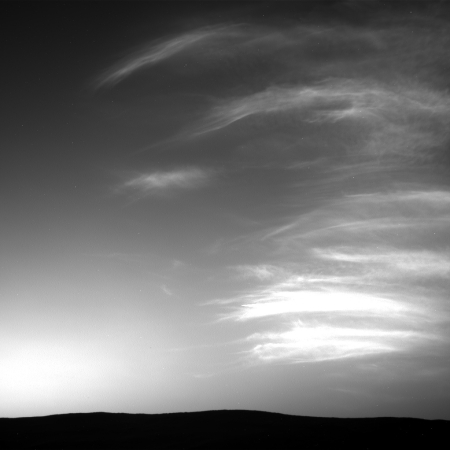
Curiosity’s journey up the slopes of Mount Sharp in Gale Crater goes on! On the right is one of a number taken by the rover in the past week, showing water clouds drifting over Gale Crater.

These are likely water-ice clouds about 19 miles (31 kilometers) above the surface. They are also “noctilucent” clouds, meaning they are so high that they are still illuminated by the Sun, even when it’s night at Mars’ surface. Scientists can watch when light leaves the clouds and use this information to infer their altitude.

While these clouds teach us something about Martian weather, the big rover news this week was that the data obtained from the two drill holes taken in April show that the clay formation that Curiosity is presently traversing is definitely made of clay, and in fact the clay there has the highest concentration yet found by the rover.

This clay-enriched region, located on the side of lower Mount Sharp, stood out to NASA orbiters before Curiosity landed in 2012. Clay often forms in water, which is essential for life; Curiosity is exploring Mount Sharp to see if it had the conditions to support life billions of years ago. The rover’s mineralogy instrument, called CheMin (Chemistry and Mineralogy), provided the first analyses of rock samples drilled in the clay-bearing unit. CheMin also found very little hematite, an iron oxide mineral that was abundant just to the north, on Vera Rubin Ridge. [emphasis mine]

That two geological units adjacent to each other are so different is significant for geologists, because the difference points to two very different geological histories. The formation process for both the clay unit and Vera Rubin Ridge must have occurred at different times under very different conditions. Figuring out how that happened will be difficult, but once done it will tell us much about both Gale Crater and Mars itself.

With the success of their clay unit drilling campaign, the Curiosity science team has had the rover begin its trek back from the base of the cliff below Vera Rubin Ridge to its planned travel route up the mountain.

An updated description of that route was released by the Curiosity science team last week, while I was in Wales. Below is their image showing that route, with additional annotations by me and reduced to post here.
» Read more
1 comment

The mysterious slope streaks of Mars

Massive flow on Mars
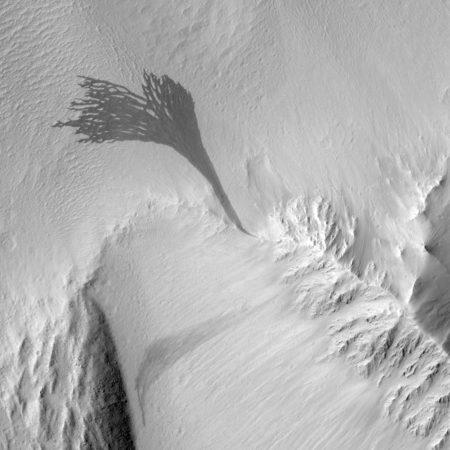
A typical Martian slope streak.

The uncertainty of science: In the past decade or so scientists have documented in detail a number of features on the Martian surface that evolve or change over time. From the constantly changing poles to the tracks of dust devils to landslides to the appearance of seasonal frost, we have learned that Mars is far from a dead world. Things are happening there, and while they are not happening as quickly or with as much energy as found on Earth, geological changes are still occurring with regular frequency, and in ways that we do not yet understand.

Of the known changing features on Mars, two are especially puzzling. These are the two types of changing streaks on the slopes of Martian cliffs, dubbed recurring slope lineae (referred as RSLs by scientists) and slope streaks.

Lineae are seasonal, first appearing during the Martian summer to grow hundreds of feet long, and then to fade away with the arrival of winter. Their seasonal nature and appearance with the coming of warm temperatures suggests that water plays a part in their initiation, either from a seep of briny water or an avalanche of dust. Or a combination of both. The data however does not entirely fit these theories, and in fact is downright contradictory. Some studies (such as this one and this one) say that the seasonal lineae are caused by water. Other studies (such as this one and this one) say little or no water is involved in their seasonal formation.

The answer remains elusive, and might only be answered, if at all, when Curiosity takes a close look at two lineae in the coming years.

Slope streaks however are the focus of this post, as they are even more puzzling, and appear to possibly represent a phenomenon entirely unique to Mars. I became especially motivated to write about these mysterious ever newly appearing features when, in reviewing the May image release from the high resolution camera on Mars Reconnaissance Orbiter (MRO), I found four different uncaptioned images of slope streaks, all titled “Slope Stream Monitoring.” From this title it was clear that the MRO team was re-imaging each location to see if any change had occurred since an earlier image was taken. A quick look in the MRO archive found identical photographs for all four slope streak locations, taken from 2008 to 2012, and in all four cases, new streaks had appeared while older streaks had faded. You can see a side-by-side comparison of all four images below the fold.
» Read more

3 comments

Fractured and collapsed Martian crater floor

Fractured and collapse Martian crater floor
Click for full image.

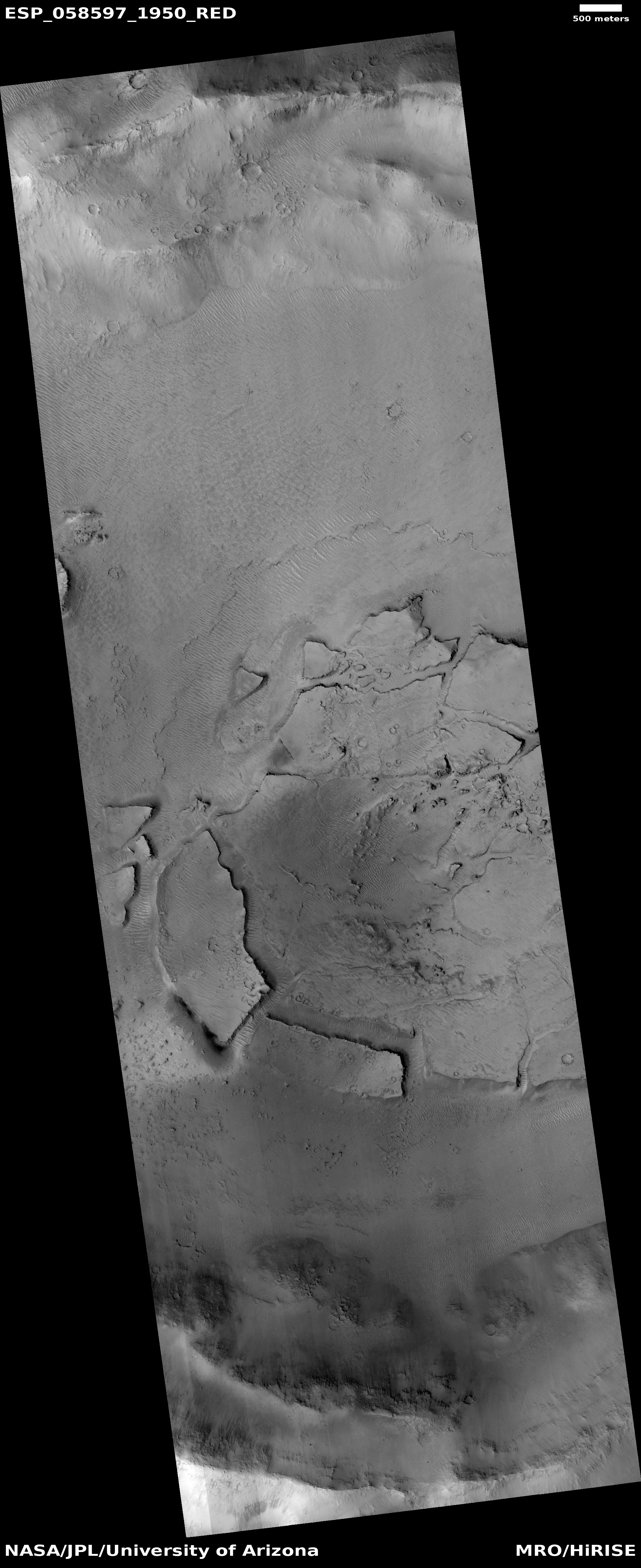
Time for some puzzling Martian geology. The image on the right, rotated, cropped, and reduced to post here, comes from the Mars Reconnaissance Orbiter (MRO) high resolution archive, and shows a strangely collapsed and fractured crater floor. In fact, like a number of other Martian craters, rather than having a central peak, the center of the crater floor, shown at the image’s center right, seems depressed.

The crater is located in a region dubbed the Cerberus Plains, in a hilly subregion called Tartarus Colles. Of the transition zone between the northern lowlands and the southern highlands these plains comprise the second largest region.

Being in the transition zone I would guess that the geology here is strongly influenced by the ebb and flow of the slowly retreating intermittent ocean that is thought to have once existed in the nearby lowlands. As water came and went, it created a variety of shoreline features scattered about, but not in a single sharp line as we would expect on Earth. Think more like tidal pools, where in some areas water gets trapped and left behind only to sublimate away at at later time.

We can see some hints of these processes in the images of the floors of two other craters that I have previously highlighted, here and here.

With this geological overview in mind, the broken plates here remind me of features I’ve seen in caves. Mud gets washed into a passage, partly filling it. Over time a gentle water flow over the surface of the mud deposits a crust of calcite flowstone on top of the mud. Should the water flow suddenly increase, it will wash out the mud below the crust. If the crust is not very strong or thick, it will crack into pieces as it falls, and thus resemble what we see here in this Martian crater.

There are cases where the crust becomes thick enough to remain standing, which produces some spectacular hanging calcite draperies that seem to defy explanation.

The collapse in the center of the crater is more puzzling, but suggests, based on comparable-looking Earth geology, that any perched water in this canyon might have actually drained out through underground drainage, accessed through the depression.

Be warned: All my explanations above are based on what exists on Earth, and Mars is very different from Earth. The lower gravity, colder temperatures, and different chemistry guarantee that the geological processes there will not be identical. We start by using what we know here, but recognize that we need to learn more about Mars to truly understand what goes on there.

1 comment

The many pits of Arsia Mons

The many pits of Arsia Mons

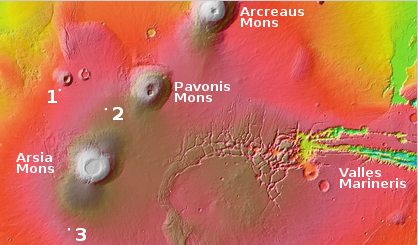
When it comes to Mars, it appears that if you want to find a pit that might be the entrance to an underground system, the place to look is on the slopes of Arsia Mons, the southernmost volcano in the chain of three giant volcanoes between Olympus Mons to the west and the vast canyon Marineris Valles to the east.

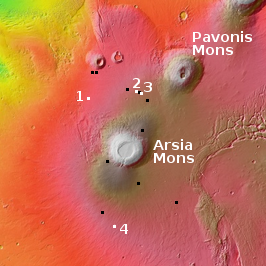
To the right is an overview map showing the pits that have been imaged since November by the high resolution camera of Mars Reconnaissance Orbiter (MRO). The black squares show the pits that I highlighted in previous posts on November 12, 2018, February 22, 2019, and April 2, 2019. The numbered white squares are the new pits found in March photograph release from MRO.

And this is only a tiny sampling. Scientists have identified more than a hundred such pits in this region. Dubbed atypical pit craters by scientists, they “generally have sharp and distinct rims, vertical or overhanging walls that extend down to their floors, surface diameters of ~50–350 m, and high depth to diameter (d/D) ratios” that are much greater than impact craters, facts that all suggest that these are skylights into more extensive lava tubes.

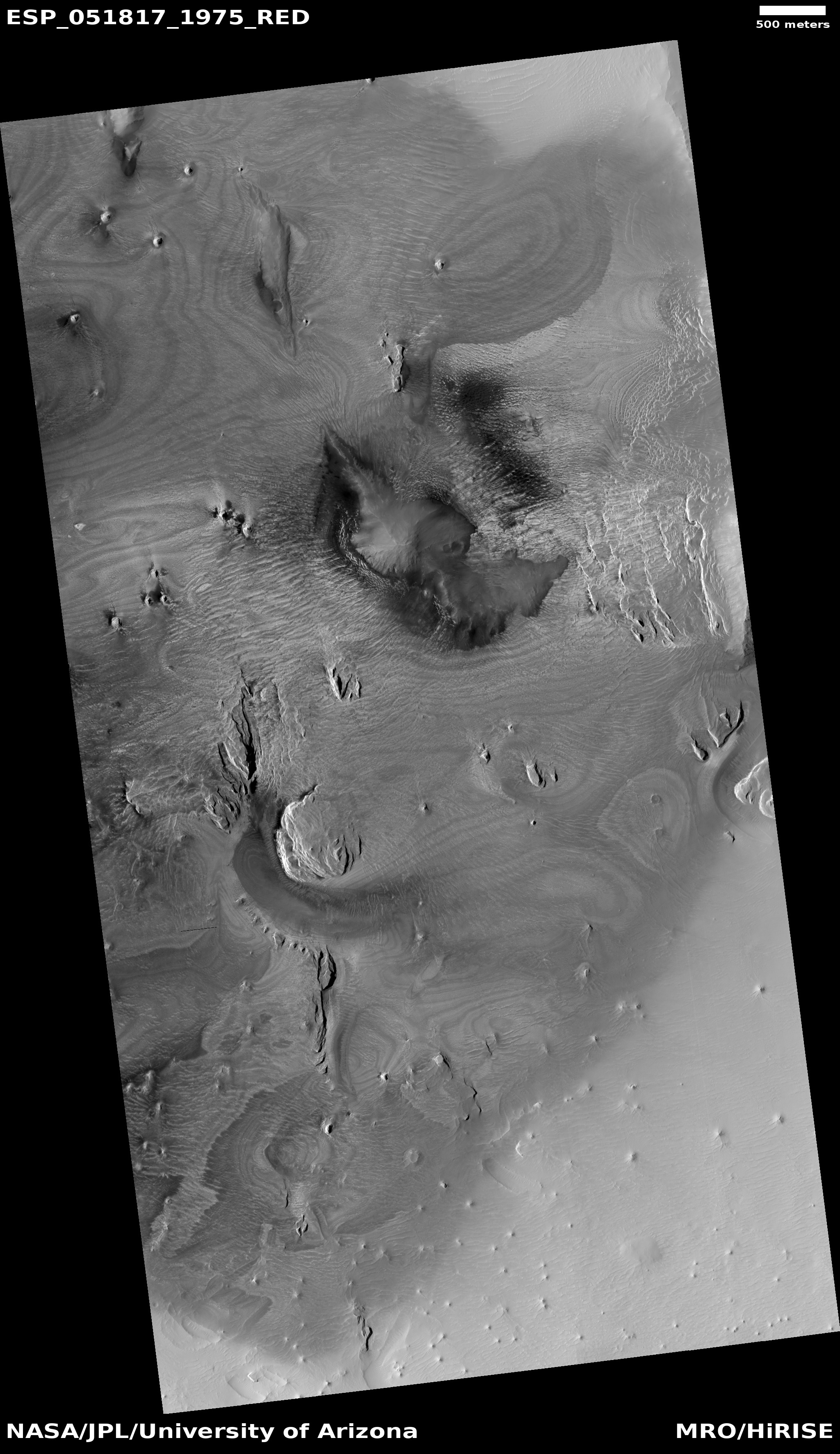
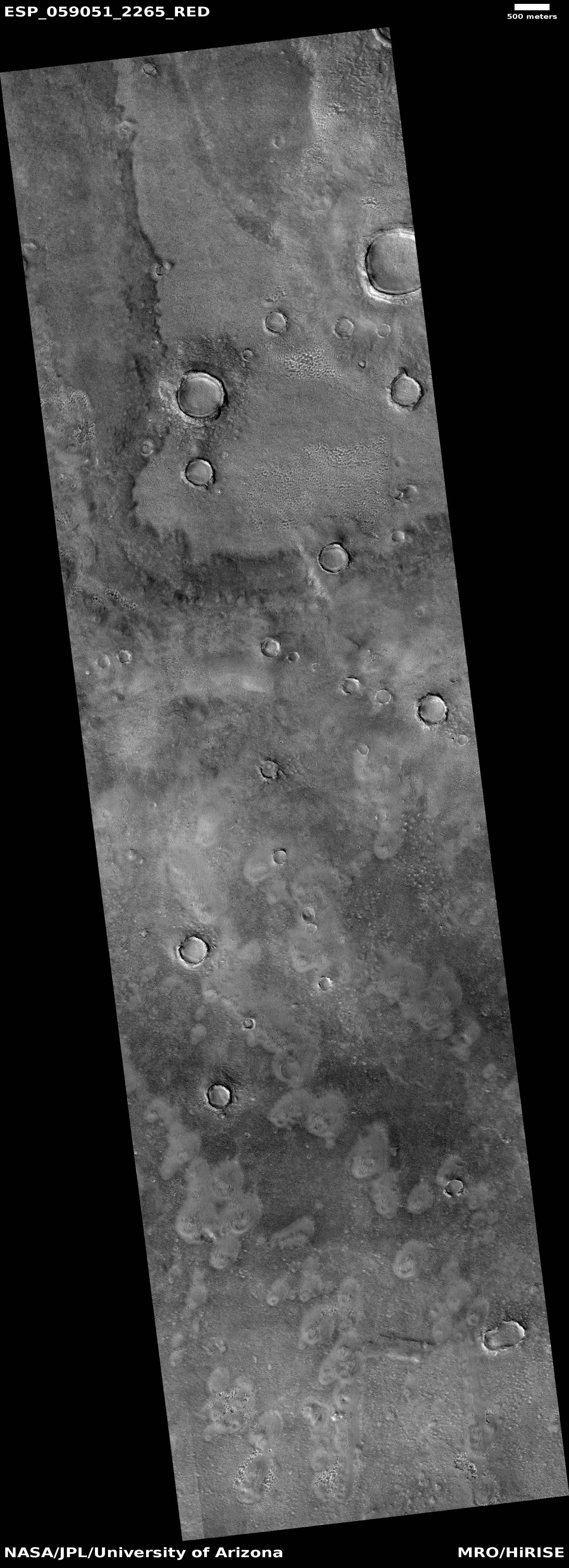
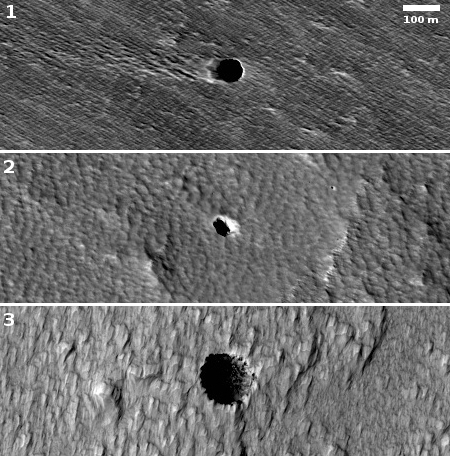
Below are the images of today’s four new pits.
» Read more

1 comment

Curiosity second drill hole in clay formation a success

two drill holes in clay formation
Click for full image.

The Curiosity science team has confirmed that their second drill hole in the clay formation that the rover is presently exploring was a success.

They have confirmed that enough material from the drill hole has been deposited in their chemical analysis hopper.

The image to the right, cropped and reduced to post here, shows both drill holes on the two different flat sections of bedrock near the top.

It seems that the science team wants to spend a lot of time in this location, as described in my last rover update. It is therefore unclear when they will move south to follow their long term travel plans.

2 comments

Another spectacular landslide found on Mars

Landslide in Hydraotes Chaos
Click for full image.

Cool image time! In perusing the April image release from the high resolution camera of Mars Reconnaissance Orbiter (MRO), I came across the image above, cropped and reduced to post here, of the discovery of another landslide within Hydraotes Chaos, one of the largest regions of chaos terrain on Mars. The image above was taken on February 9, 2019, and has since been followed up with a second image to create a stereo pair.

This is not the first landslide found in Hydraotes Chaos. I highlighted a similar slide on March 11. Both today’s landslide as well as the previous one likely represent examples of gravitational collapses as shown in this science paper about Martian ground water. Some scientists have proposed that Hydraotes Chaos was once an inland sea, and as the water drained away the loss of its buoyancy is thought to cause this kind of landslide at the base of cliffs and crater rims.

The past presence of water also helps explain the soft muddy look of this landslide. When this collapse occurred the material was likely saturated with water. Today it is most likely quite dry and hardened, but when it flowed it flowed like wet mud. Its size, almost a mile long and a quarter mile across, speaks to Mars’s low gravity, which would allow for large singular collapses like this.

Hydraotes Chaos itself is probably one of the more spectacular places on Mars. It sits at the outlet to Marineris Valles, shown in the image below. This gigantic canyon, which would easily cover the entire U.S. if placed on Earth, was the largest drainage from the large volcanic Tharsis Bulge to the west, where Mars’s largest volcanoes are located.
» Read more

0 comments

First Marsquake recorded by InSight?

The InSight science team has announced that they think they have detected their first Mars quake, though it was too small to provide much information about the Martian interior.

The Martian surface is extremely quiet, allowing SEIS, InSight’s specially designed seismometer, to pick up faint rumbles. In contrast, Earth’s surface is quivering constantly from seismic noise created by oceans and weather. An event of this size in Southern California would be lost among dozens of tiny crackles that occur every day.

“The Martian Sol 128 event is exciting because its size and longer duration fit the profile of moonquakes detected on the lunar surface during the Apollo missions,” said Lori Glaze, Planetary Science Division director at NASA Headquarters.

…Three other seismic signals occurred on March 14 (Sol 105), April 10 (Sol 132) and April 11 (Sol 133). Detected by SEIS’ more sensitive Very Broad Band sensors, these signals were even smaller than the Sol 128 event and more ambiguous in origin. The team will continue to study these events to try to determine their cause.

The data so far suggests is that Mars is far quieter than Earth geologically, but any conclusions at this point would be premature.

0 comments

How last year’s global dust storm changed one spot on Mars

One spot on the western flank of  Olympus Mons, August 2017
Click for full image.

To the right is an image taken by the high resolution camera on Mars Reconnaissance Orbiter (MRO) back in August 2017, cropped, rotated, and reduced to post here. It shows a particular spot on the western slope of the giant volcano Olympus Mons. The uncaptioned image release is entitled “Dark and Possibly Stationary Ripples in Anomalous Terrain.” The image was probably taken as a follow-up to this 2009 image to see if the the dark patches near the peaks and mounds as well as the strange wavy bands of light and dark had changed in eight years. As of 2017 however little had changed. The patches in the 2009 image seem darker, but that is almost certainly due to the lower sun angle causing longer shadows.

The slope goes downhill to the left. The wavy bands are thought to be geological layers exposed by erosion. The cause of the dark patches remain unknown.

I stumbled upon these two early images because of a third new image of this location, taken in February 2019 and spotted by me during my review of April 2019 images downloaded from MRO. That uncaptioned new image was titled “Change Detection in Olympus Maculae.” Had scientists spotted some new volcanic activity at this spot? To find out I dug into the MRO archive at this location and found both the 2009 and 2017 images.

The 2019 image is below. It is cropped, rotated, and reduced to match exactly with the image above in order to highlight any changes that might have occurred.
» Read more

1 comment

Thumbprints on Mars!

Thumbprints terrain on Mars!
Click for full image.

Honestly, don’t ask me. I didn’t come up with the name. I found the image on the right, cropped and reduced to post here, as part of the April image dump from the high resolution camera of Mars Reconnaissance Orbiter. The uncaptioned release dubbed this “Thumbprint Terrain in Northern Mid-Latitudes,” and it is obvious to see why. The cropped image on the right focuses in on the oval white mounds that really do look like some giant child was touching a soft damp muddy surface randomly with his fingers, leaving behind raised fingerprints as the mud stuck to his fingers as he pulled them away.

Each white area seems to have a crater. I suspect these are not impact craters, but possibly mud volcanoes, as each is at the top of a mound. My hypothesis is further strengthened by the location, which is deep within the low northern plains of Mars, a place where some scientists believe an intermittent ocean once existed. These mounds could have easily formed at that ocean’s floor, or thereafter when the land here was drying out.

On the other hand, these could be from impact. Maybe they are scattered ejecta from a larger impact, landing here in a group on a wet muddy surface. The impacts might have concentrated the material around the crater, making it more resistant to erosion, which is why the craters now stand above the floor of the plain.

On the third hand, all these theories could be wrong. Have any of your own?

4 comments

Bennu’s cobbled equatorial ridge

Bennu as seen by OSIRIS-REx
Click for full image.

The OSIRIS-REx science team has released a new close-up image of Bennu, this time showing the asteroid’s equatorial ridge. The image on the right is that photograph, reduced to post here.

When the image was taken, the spacecraft was positioned over Bennu’s northern hemisphere, looking southward over the asteroid’s equatorial bulge. The field of view shown is 168 ft (51.2 m) wide. For scale, the bright, rectangular rock above the dark region is 8 ft (2.4 m) wide, about the size of a long bed on a pickup truck

Like Ryugu, the scientists for OSIRIS-REx are going to be challenged in finding a location smooth enough for their touchdown sample grab. That surface reminds me of some avalanche scree slopes I’ve hike across, where you’ve got nothing but rough rocks to walk on.

4 comments

Monitoring the ice scarps on Mars for changes

Scarp #1 in 2011
Click for full image.

Scarp #1 in 2018
Click for full image.

Back in January 2018 planetary scientists released a paper announcing the discovery of a number of Martian cliff faces, or scarps as they called them, that all appeared to expose an underground layer of ice.

Those cliffs were mostly located to the southeast of Hellas Basin, the basement of Mars that is also advantageous for human colonization because its lower elevation means its atmosphere is thicker. (For example, that thicker atmosphere would make air transportation more practical.)

The two images to the right show what they listed as scarp #1 in their paper, rotated, cropped, and reduced to post here. The first image was taken in May 2011, with the second taken in December 2018, and was part of the March image release from the high resolution camera of Mars Reconnaissance Orbiter (MRO).

The December 2018 image was taken almost a year after the paper release, and was titled “Scarp Monitoring.” I therefore wondered whether the scientists had identified any changes. They theorize that these scarps form when the exposed ice slowly sublimates to gas into the atmosphere, causing the cliff face to collapse and retreat, which in the case of scarp #1 would be a retreat to the north. The terraces below the scarp suggest previous cliff locations. In their paper they noted evidence of some changes in the studied scarps, including some fallen boulders, as well as color changes that suggest some evolution.

The rate of that retreat is not known with precision, but based on the facts presently at hand, the scientists have estimated that it took about a million years to form this scarp. Whether any evidence of this retreat would be visible in only seven years is the purpose of these scarp monitoring images.

Do you see any difference? I don’t, but because I also don’t trust my expertise I decided to email the paper’s lead author, Colin Dundas of the U.S. Geological Survey’s Astrogeology Science Center. His emailed comments are most interesting.
» Read more

2 comments

More Martian Pits!

More pits on Mars!

As I said in my last post in February showing recent pit discoveries on Mars, I could almost make this a monthly series. In the March image download from the high resolution camera of Mars Reconnaissance Orbiter (MRO) were three (maybe four) more pits, all likely skylights above lava tubes and all located near the giant volcano Arsia Mons in the region dubbed the Tharsis Bulge. The image to the right shows all three, with a possible fourth just northwest of pit #2 and visible in its full image. For the full images of the other two pits go here (#1) and here (#3). In all three cases, click on the “black & white map projected” link to see the full image with scale.

Overview map

The overview map on right shows where these three pits are located. If you compare this map with my previous overview maps from November 12, 2018 and February 22, 2019 you can see that while these pits are all found on the volcanic slopes surrounding Arsia Mons, they are all different pits. Moreover, the ten pits listed in these three posts are only a small sampling of the more than hundred already found.

Whether these pits are deadend sinks or skylights into underground lava tubes that connect is at this point unknown. It would be a reasonable speculation to assume that some are deadends, and some link to extensive tubes of varying lengths. It would also be dangerous. Mars is alien. While the geology will be based on the same physical laws found on Earth, the lighter gravity is going to produce things differently.

The three images above however do show some intriguing details.
» Read more

0 comments
1 123 124 125 126 127 157