The very icy high northern latitudes of Mars

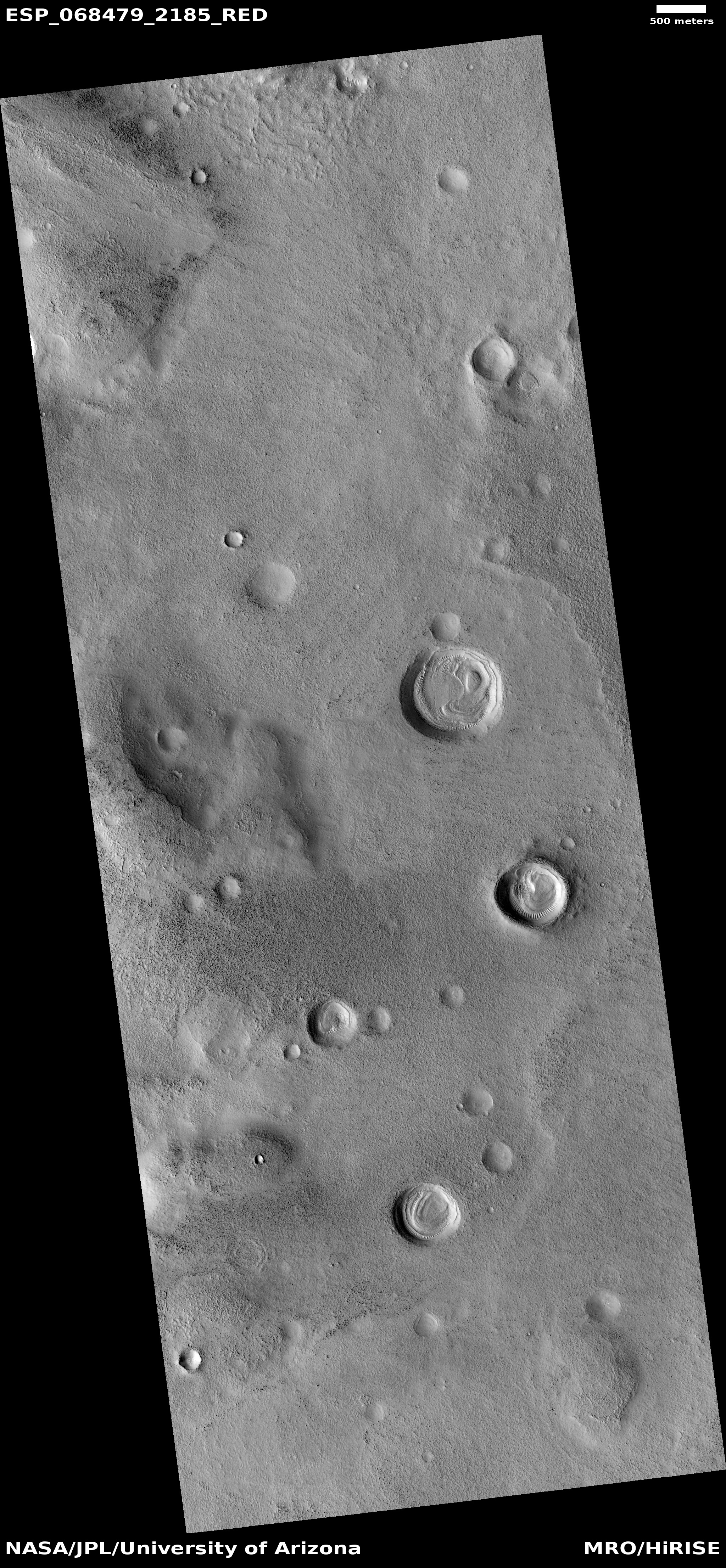
Pedestal crater on Mars
Click for full image.

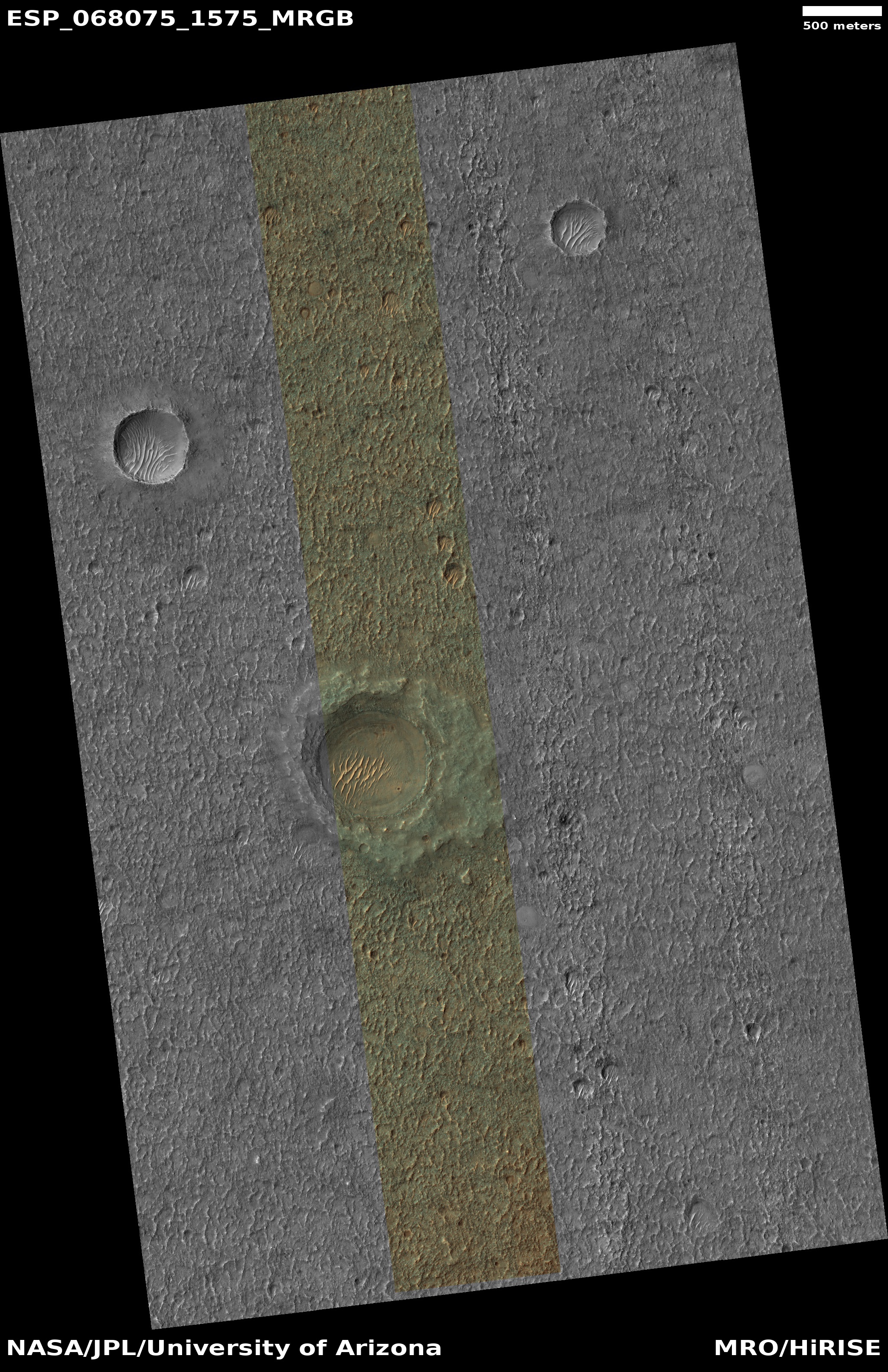
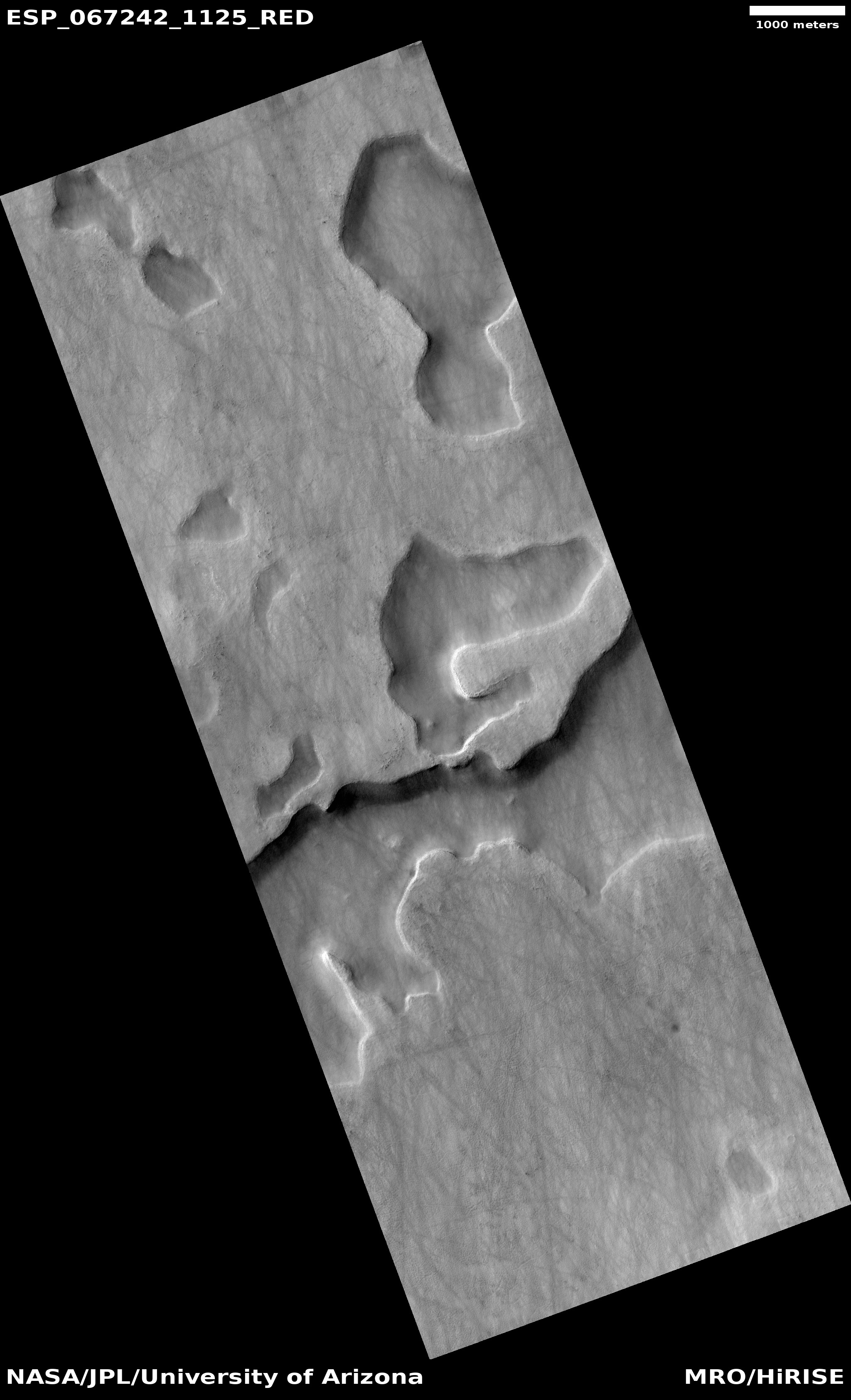
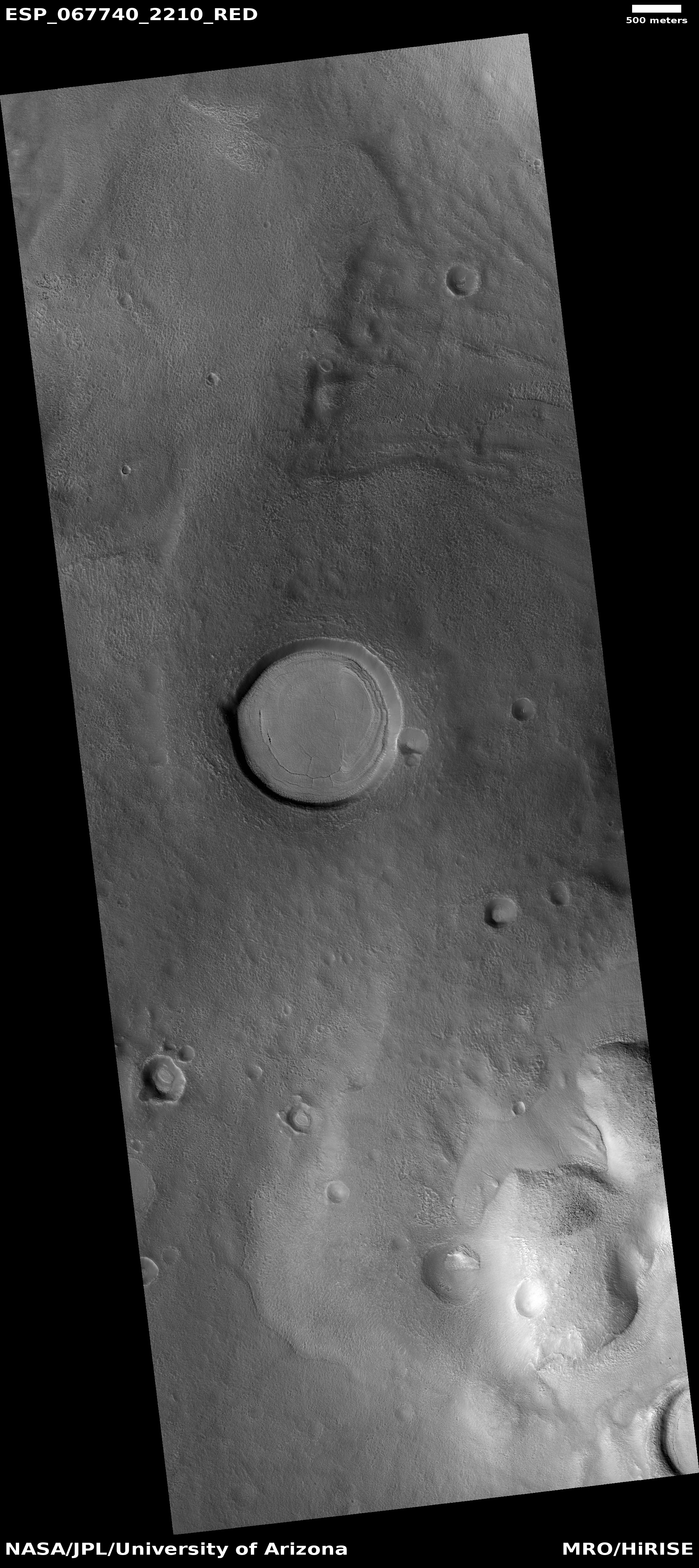
Today’s cool image to me illustrates how the presence of near surface ice in the high latitudes of the northern lowland plains of Mars helps to produce a very strange and alien terrain.

The picture to the right, rotated, cropped, reduced, and sharpened to post here, was taken on January 31, 2023 by the high resolution camera on Mars Reconnaissance Orbiter (MRO). It shows a typical example of what the scientists have dubbed a “pedestal crater,” where the crater ends up higher than the surrounding terrain because the impact had packed the ground and made it more resistant to erosion.

This theory however does not explain entirely what we see here. That apron mesa surrounding the crater also resembles the kind of splash field that is created when an impact occurs in less dense ice-rich ground. Note too the soft stippled nature of the ground. Wind erosion is not the sole cause of change here.
» Read more

0 comments

A pyramid on Mars

A pyramid on Mars
Click for original image.

Cool image time! The picture to the right, rotated, cropped, and reduced to post here, was taken on January 21, 2023 by the high resolution camera of Mars Reconnaissance Orbiter (MRO). It shows what the scientists label a “pyramidal mound”, which is I think understating the point somewhat.

This pyramid is almost perfectly square, with two perpendicular ridgelines rising from its corners to meet perfectly at the pyramid’s peak. A similar pyramid mound in the Cydonia region, where the so-called “Face on Mars” was found, caused endless absurd speculations in the 1990s of past Martian civilizations, all of which burst into nothingness when good high resolution images were finally obtained in the 2000s.

But what caused this very symmetrical natural feature?
» Read more

9 comments

Triple crater on Mars

Triple crater on Mars
Click for original image.

Cool image time! The picture to the right, cropped, reduced, and sharpened to post here, was taken on January 22, 2023 by the high resolution camera on Mars Reconnaissance Orbiter (MRO). It shows what the scientists have labeled simply as a “triple crater,” a very apt description.

What caused this? The most obvious explanation is the arrival almost simultaneously of three pieces. As this asteroid or comet entered the thin Martian atmosphere as a single object, that atmosphere was thick enough to break it into three parts but not enough to destroy it entirely. When it hit the ground, the top piece hit first, with the center and bottom pieces following in sequence, thus partly obscuring the previous hits.

The smaller surrounding craters could either be additional pieces from the bolide, or secondary impacts from ejecta thrown out at impact.
» Read more

0 comments

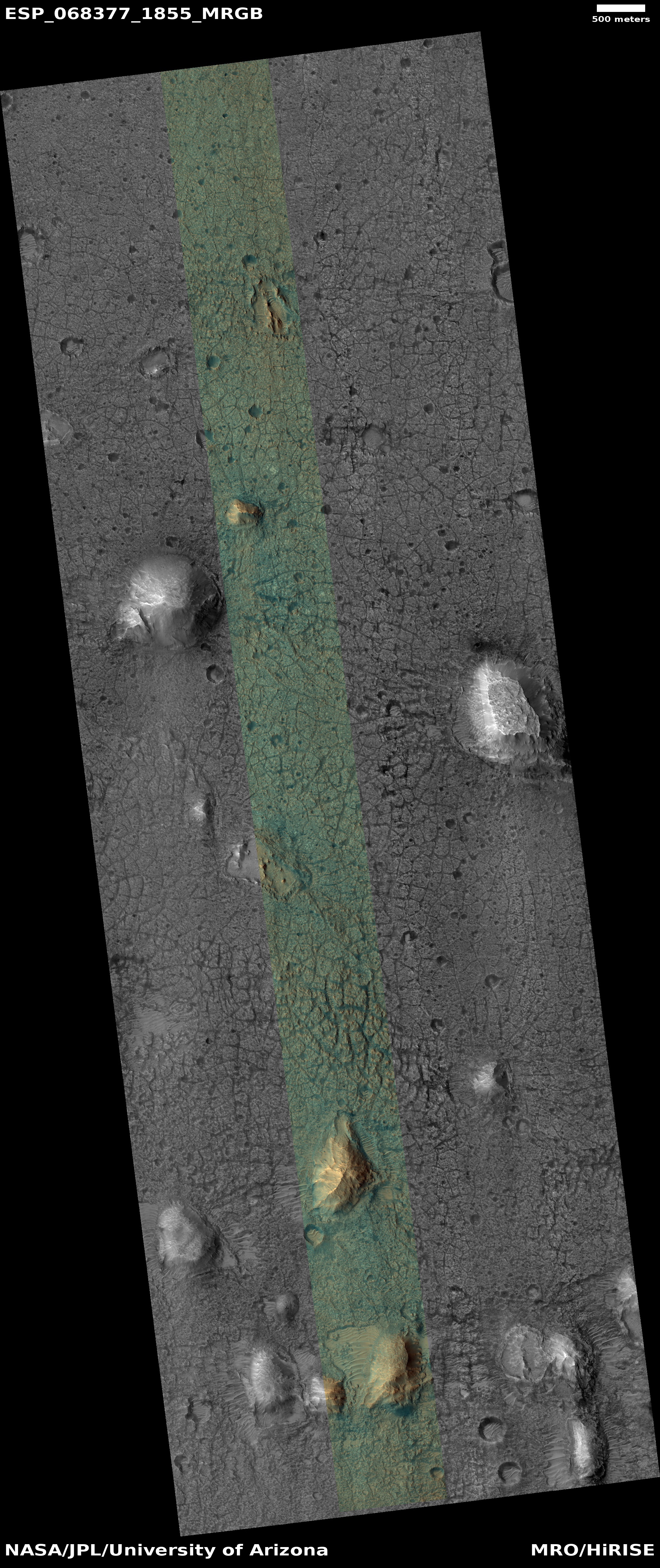
Weird surface cracking in the Martian northern lowland plains

Weird surface cracks on Mars

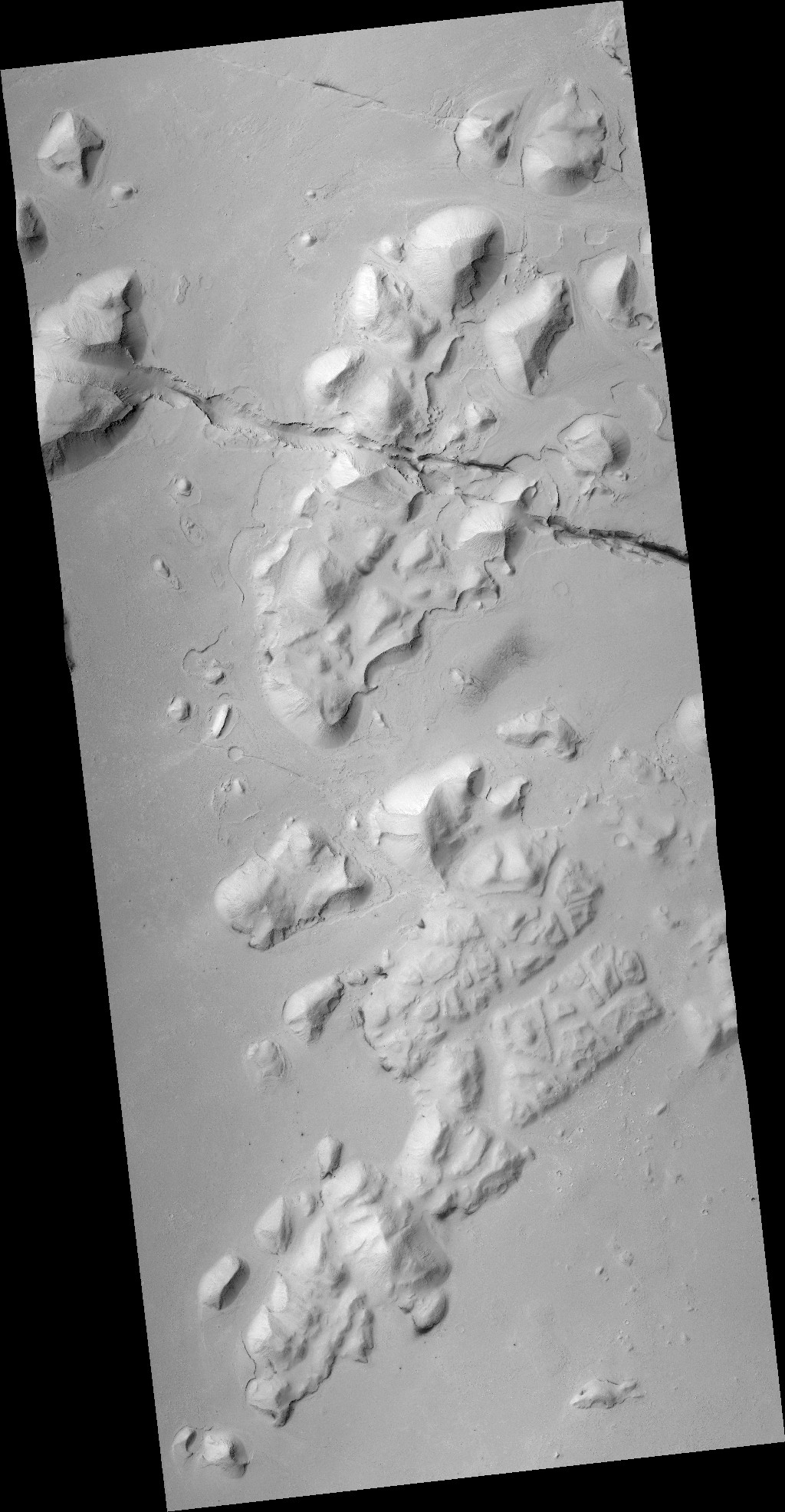
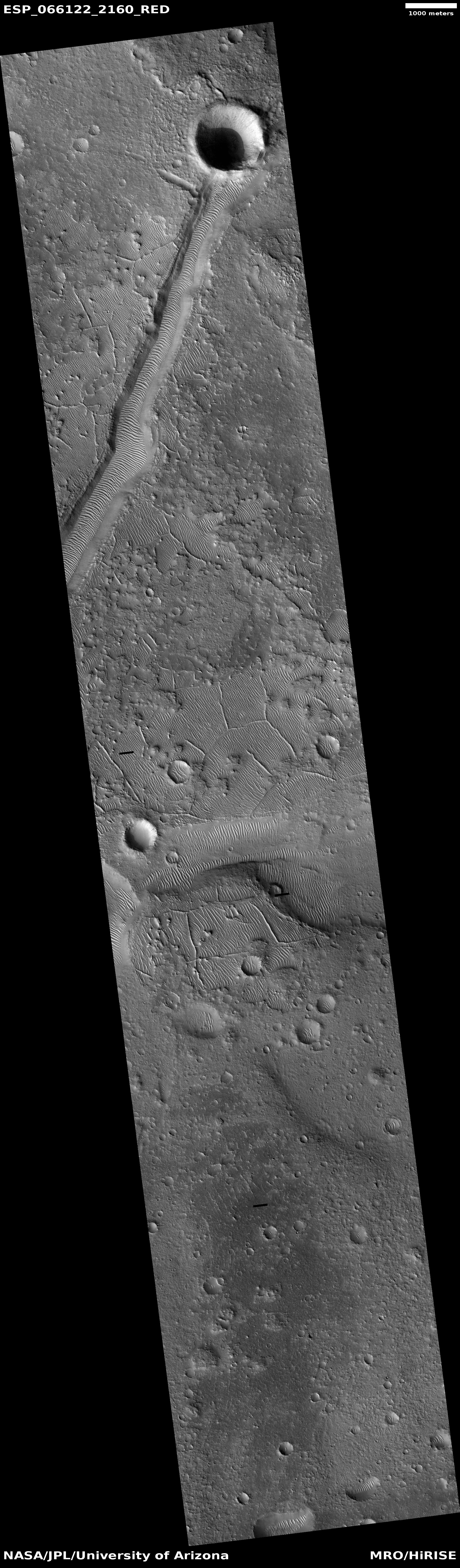
Cool image time! The picture to the right, cropped, reduced, and enhanced to post here, was taken on January 15, 2023 by the high resolution camera on Mars Reconnaissance Orbiter (MRO). The picture was simply labeled “Channel-like feature”, which hardly describes this strange terrain.

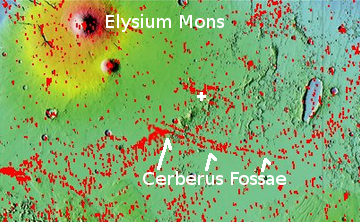
Apparently a mantle of surface material has covered and filled an ancient east-west channel. That surface material however has since cracked along the edges of that channel as well along its length. The cracks suggest that the material in the channel is moving downhill slowly, cracking along the cliff walls while also being pulled apart to form the north-south cracks.

My regular readers will I think be able to guess what is going on here, but if you can’t, the overview map below will help explain this.
» Read more

0 comments

Exploring the cratered southern highlands of Mars, part 4

Overview map

Gullies in Asimov Crater
Click for full image.

Today is the last part in our four part exploration of the cratered southern highlands of Mars, begun last week. (For the early parts, go here-Part #1, here-Part #2, and here-Part #3.) Though there is no need, new readers should read the first three parts first, in order to get the larger perspective of this final post.

The picture to the right, rotated, cropped, reduced, and sharpened to post here, was taken on December 20, 2022 by the high resolution camera on Mars Reconnaissance Orbiter (MRO). It shows the eastern main gully descending down into a pit that sits in the north center of 52-mile-wide Asimov Crater, as shown in the inset on the overview map above. (For an MRO high resolution of the western gullies into this pit, see this January 2019 cool image post.)
» Read more

0 comments

Exploring the cratered southern highlands of Mars, part 3

Overview map

Pit and surface in crater
Click for original image.

This is the third part of this week’s series taking a look at some of the strange features in the southern cratered highlands of Mars. In the first part I posted a beautiful image of what appears to be a crater filled to the brim with glacial ice, surrounded by an ice sheet plain. In part two we took a look at the interior of Rabe Crater, which though very nearby does not appear to have obvious glacial features within it at all. What it has instead are deep open air pits and a lot of sand dunes.

Today’s image to the right, cropped, reduced, and sharpened to post here, takes us to the interior of an unnamed 45-mile-wide crater only about 70 miles north of Rabe. The black dot in the inset on overview map above indicates the photo’s location. The picture was taken on January 1, 2023 by the high resolution camera on Mars Reconnaissance Orbiter (MRO). Like Rabe, this crater also has many large open-air pits. In the picture one pit, near the lower center of the picture, is surrounded by soft-looking mounds and a strangely swirling textured and uneven terrain that makes up the majority of the crater’s floor.

This picture might help explain what we saw in Rabe. The textured terrain in this unnamed crater could easily be ice-impregnated and now hardened sand dunes. The pit could be where that impregnated ice has sublimated away, leaving behind the dust from those ancient dunes which then forms new sand dunes. In Rabe, the crater floor above its pits looks very similar to this swirling textured surface, suggesting the same process is going on there.

What strengthens this explanation is the many other craters nearby, all indicated by red dots in the overview map above, that also have pits or distorted crater floors. Their proximity suggests that there is an underground ice layer in this region, always at about the same elevation, and each crater impact exposed it. With time that exposed ice, no longer pure but filled with material from the impacts, sublimated partly away, producing the pits as well as ample sand to form sand dunes.

0 comments

Exploring the cratered southern highlands of Mars, part 2

Overview map

Dune-bedrock contact in Rabe Crater
Click for original image.

Our travels in the cratered southern highlands of Mars continues. Today we visit 67-mile-wide Rabe Crater, as indicated on the overview map above. The picture to the right, cropped and reduced to post here, was taken on January 27, 2023 by the high resolution camera on Mars Reconnaissance Orbiter (MRO).

Rabe Crater is significant for several reasons. First, it was one of the first places on Mars where sand dunes were identified, by one of the Viking orbiters in the late 1970s [pdf]. Second, the pits and sand in its interior, are unusual and puzzling. The inset on the overview map provides a closeup look at the crater. The yellow mound in the central south of the crater floor is all dunes, which are surrounded by the pit with steep cliffs more than a 1,000 feet high.
» Read more

1 comment

Exploring the cratered southern highlands of Mars, part 1

Overview map of southern cratered highlands of Mars

Glacial filled crater
Click for original image.

Today and for the next three days the cool images that I will post from Mars will explore a region that I have not covered very much in depth, the cratered southern highlands between the giant basins Argyre and Hellas. The map above is an overview of this 7,000-mile-long region, all of which is inside the 30 to 60 degree south latitude band where scientists have found much evidence of buried glaciers. In this region the bulk of that evidence is most obvious inside craters.

The picture to the right, cropped, reduced, and sharpened to post here, was taken on December 21, 2022 by the high resolution camera on Mars Reconnaissance Orbiter (MRO), and shows a typical example of the kind of glacial feature found. The white cross on the map marks its location, west of the Hellespontus Mountains that form the western rim of Hellas Basin.

Scientists have dubbed this feature concentric crater fill, a purposely vague term because — though it looks like glacial fill — until there is data to confirm it the scientists would quite properly rather not commit themselves. The concentric rings suggest multiple layers, each of which likely marks a different climate cycle in Mars’ geological history.

In this case the glacier features also appear to cover the entire plain surrounding the crater as well as its rim. The small crater to the west is similar, and both give the appearance that the ice sheet that covers them came after the impact, draping itself over everything, with the craters only visible because the ice sheet sags within their interiors.

More crazy features from the cratered highlands to come.

0 comments

The outermost edge of Mars’ north polar icecap

The outermost edge of Mars' north polar icecap
Click for original image.

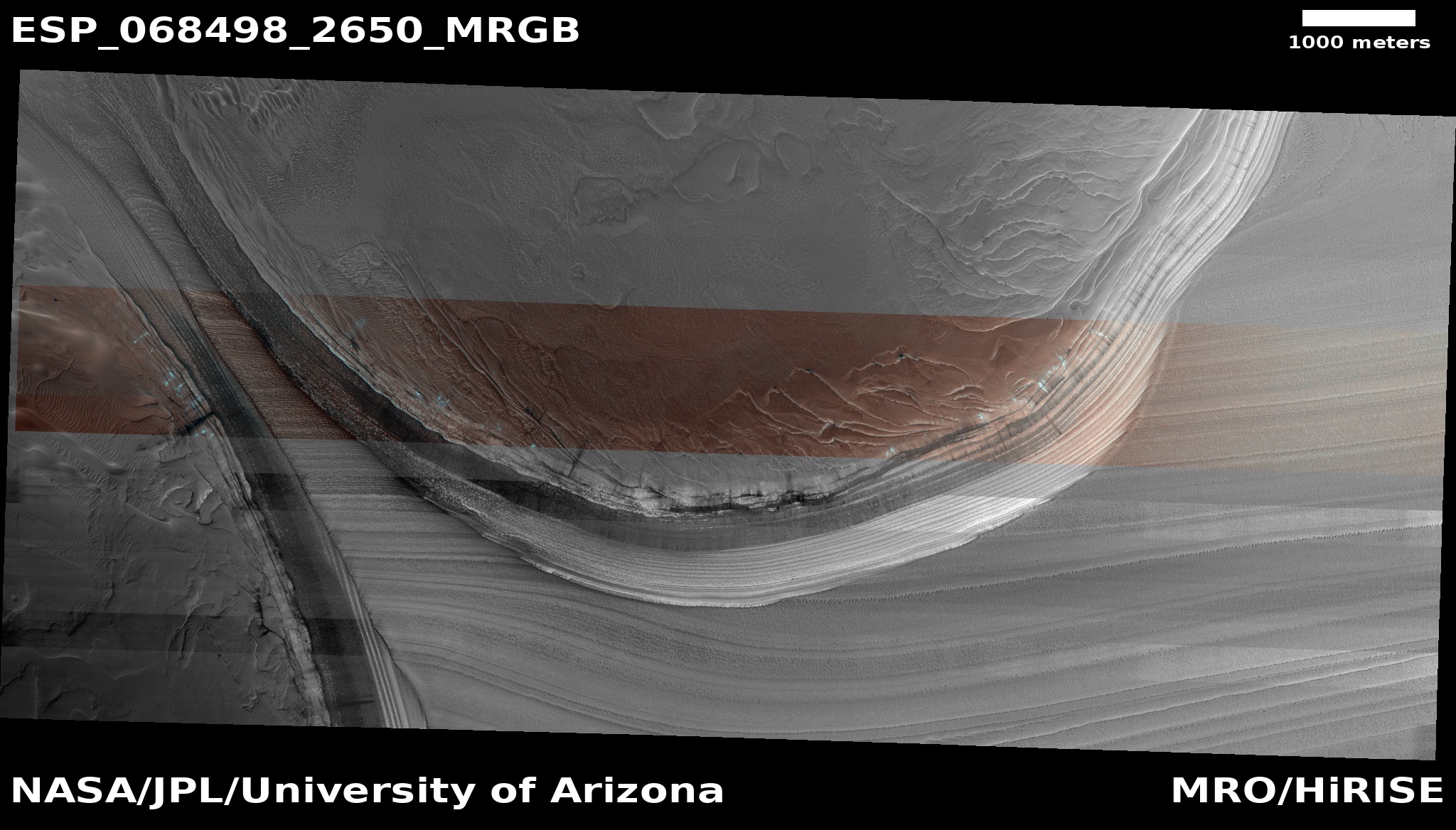
Cool image time! The picture to the right, rotated, cropped, reduced, and sharpened to post here, was taken on February 4, 2023 by the high resolution camera on Mars Reconnaissance Orbiter (MRO). It shows the terminating cliffs of the north pole ice cap of Mars, dubbed Rupes Tenius on this side of the icecap.

At this point the elevation difference of the icecap’s edge from top to bottom is not significant, only about 1,500 feet or so, though this is a very rough estimate. As with all other images of the ice cape’s edge, there are many many layers visible, all indicating a different cycle in the climate history of Mars as its rotational tilt swings from about 11 degrees to 60 degrees over eons.

Moreover, at this point there is likely not that much difference between the terrain on top and the terrain below. Both will be mixed ice and dust and coarse rocks, though the percentages will be shifting towards less ice as we go down.
» Read more

1 comment

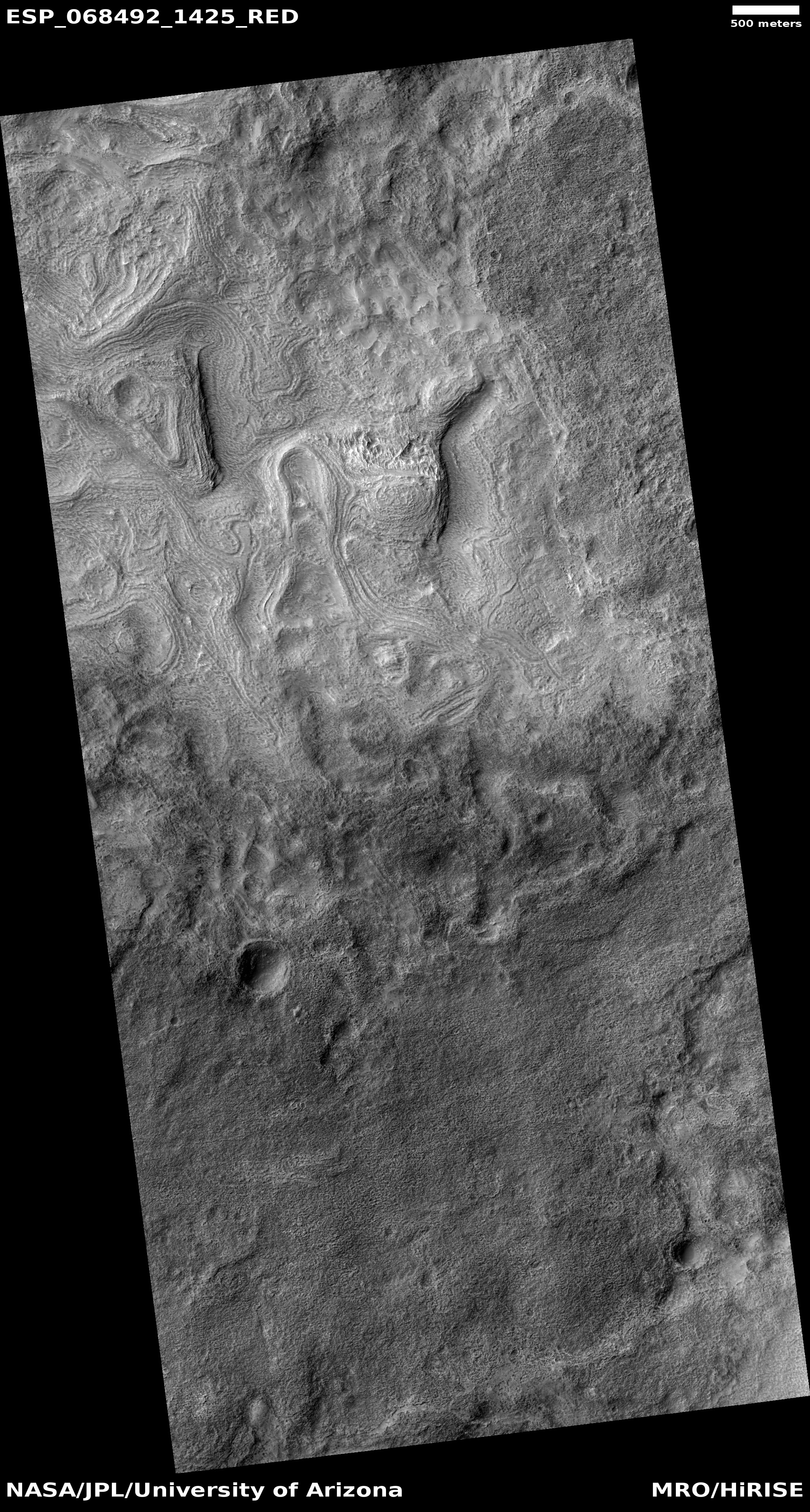
A journey into Martian chaos

Overview map of Aram Chaos

With today’s cool image, we shall begin with the overview map, and drill our way down until we get a close look at another example of truly alien Martian terrain, with only a hint of similarity to comparable geology on Earth.

The overview map to the right shows us Aram Chaos, an ancient 170-mile-wide impact crater that has gone through such complex geology that it is difficult, maybe impossible, to unravel it based on data obtained from orbit. As I wrote in a detailed December 2020 post describing the confusing geology of this crater,

The floor of Aram Chaos is a place of great puzzlement to planetary geologists. The geology there is incredibly complex, and includes chaos terrain overlain by several sedimentary layers of sulfate minerals. The chaos terrain is most obvious in the southern part of the crater’s floor. The flat areas near the eastern center are those overlaying sedimentary layers.

When we zoom into the white box we can see a good example of this complexity.
» Read more

0 comments

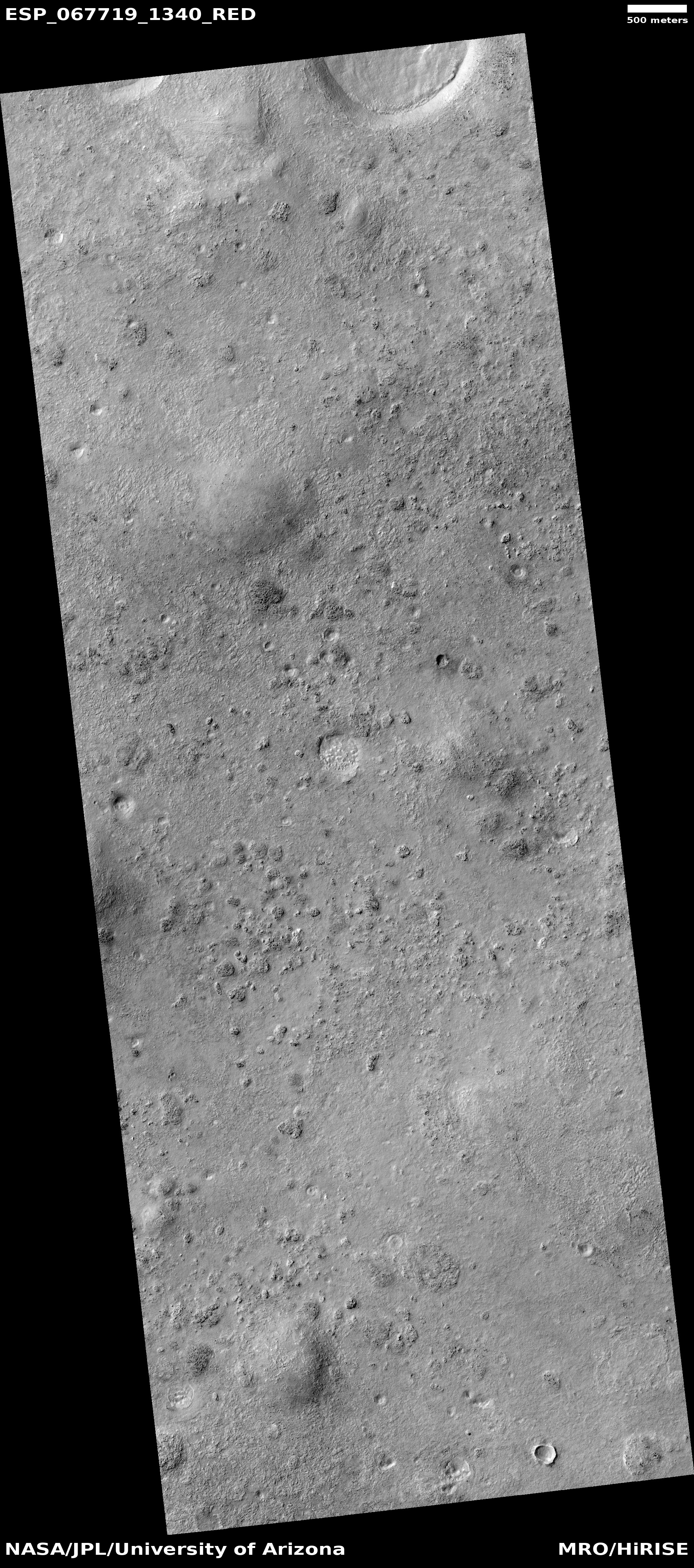
Sponge terrain on Mars

Sponge terrain on Mars
Click for original image.

Cool image time! The picture to the right, rotated, cropped, reduced, and sharpened to post here, was taken on January 11, 2023 by the high resolution camera on Mars Reconnaissnace Orbiter (MRO).

The scientists labeled this picture “Rocky Terrain.” Though this describes the overall sense of the full image, it fails to capture correctly the nature of this patch of ground at the center of the picture. As you can see, this patch of spongelike surface starts and ends abruptly. It appears that it is a layer on top of the surrounding terrain that has also been eroded aggressively since its placement.

The many craters on its surface seem to have come later, though as the crater size diminishes it becomes harder to separate the craters from the sponge holes. Moreover, some of the larger craters are distorted in shape, as if the impact hit material that was viscous and could flow somewhat.

The overview map below gives some context, but only some.
» Read more

3 comments

A bubbly cauldron on the surface of Mars

A bubbly cauldron on the surface of Mars
Click for original image.

Cool image time! The picture to the right, rotated, cropped, reduced, and sharpened to post here, was taken on December 20, 2022 by the high resolution camera on Mars Reconnaissance Orbiter (MRO). It shows a strange terrain of craters and mounds, with all the mounds having pits within them like volcanic calderas. In between the surface has a two-toned stippled look, as if two different materials are in the process of mixing.

My immediate impression was that of the bubbly surface of a vat of tomato sauce simmering. Or maybe the vile mixture created by the witches in Shakespeare’s Macbeth, which as they mix they chant:

First witch:
Round about the cauldron go;
In the poison’d entrails throw.
Toad, that under cold stone
Days and nights has thirty-one
Swelter’d venom sleeping got,
Boil thou first i’ the charmed pot.

ALL:
Double, double toil and trouble;
Fire burn, and cauldron bubble.

Of course, this is not a vat of witch’s brew or tomato sauce. It is the surface of the planet Mars, but an alien surface nonetheless.
» Read more

0 comments
1 34 35 36 37 38 90