Scientists: Ice layers in Burroughs Crater confirm Martian orbital climate cycles

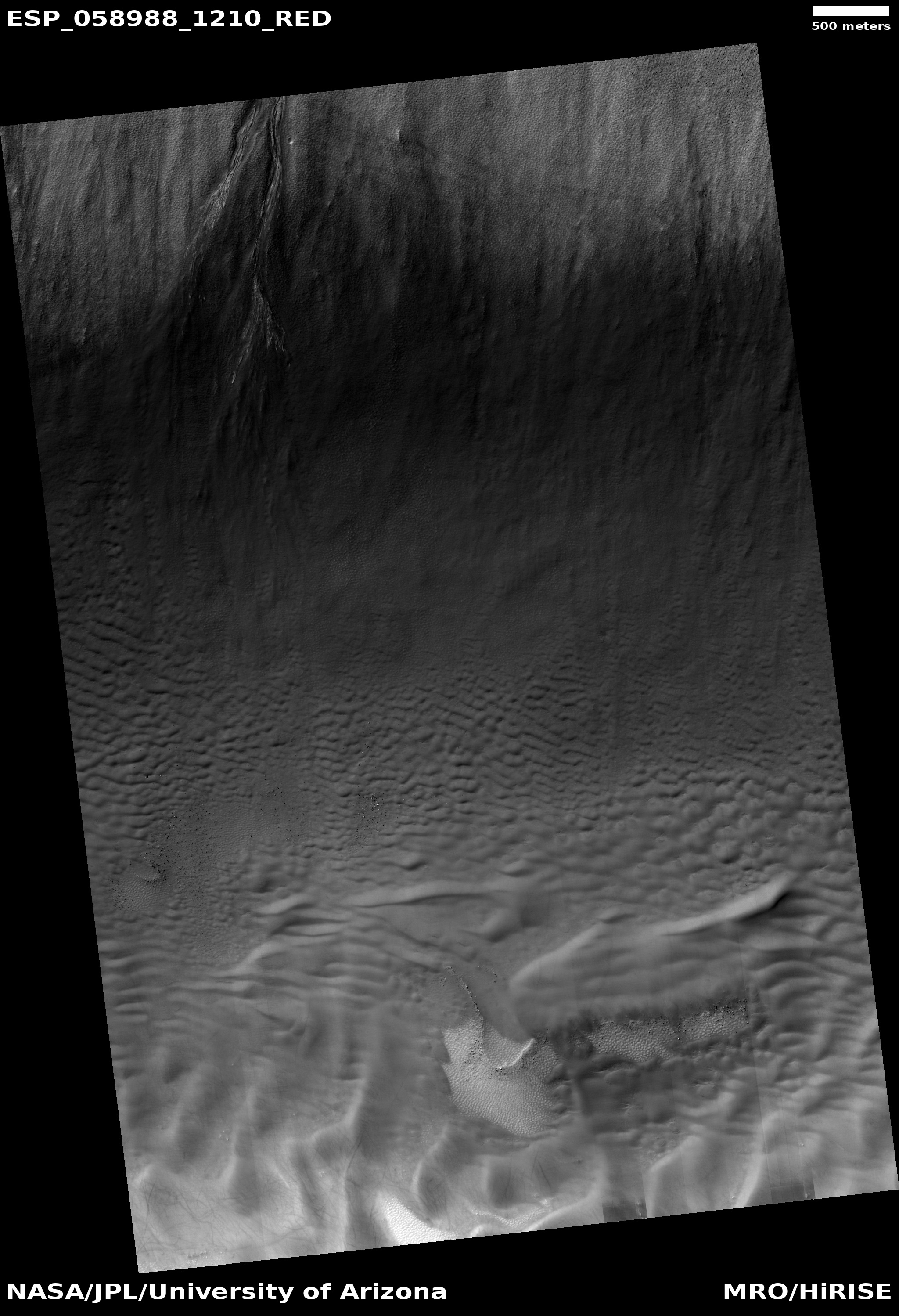
Layering in the west side of Burroughs Crater
Click for full image.

According to a new paper published today, scientists have used the ice layers inside Burroughs Crater on Mars to confirm the theory that the Red Planet has undergone numerous climate cycles during the past four million years, caused by the swings in the planet’s rotational tilt and eccentric orbit. From the press release:

Previously, Martian climate scientists have focused on polar ice caps, which span hundreds of kilometers. But these deposits are old and may have lost ice over time, losing fine details that are necessary to confidently establish connections between the planet’s orientation and motion and its climate.

Sori and his colleagues turned to ice mounds in craters, just tens of kilometers wide but much fresher and potentially less complicated. After scouring much of the southern hemisphere, they pinpointed Burroughs crater, 74 kilometers wide, that has “exceptionally well-preserved” layers visible from NASA HiRISE [Mars Reconnaissance Orbiter’s high resolution camera] imagery, Sori said.

The researchers analyzed the layers’ thicknesses and shapes and found they had strikingly similar patterns to two important Martian orbital dynamics, the tilt of Mars’ axis and orbital precession, over the last 4 to 5 million years.

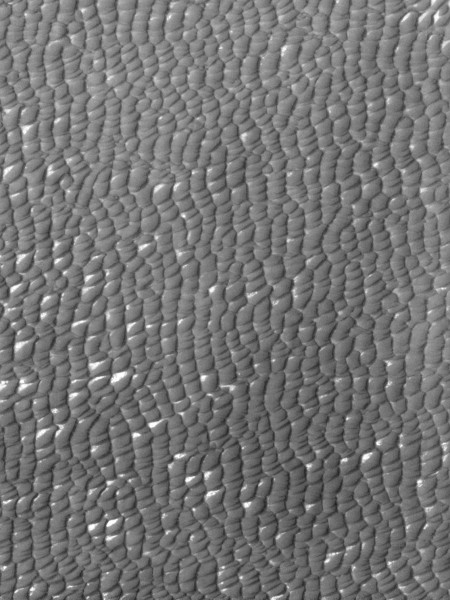
The photo above of those layers was taken by Europe’s Trace Gas Orbiter on March 13, 2019, cropped and reduced to post here.

This research greatly strengthens the theory that the ice on Mars gets distributed to different latitudes in cycles, depending on the cyclical fluctuations in the planet’s orbit and tilt. However, it does not yet confirm these cycles apply to the glaciers found in craters in lower latitudes. Burroughs Crater is at 72 degrees south latitude, near the southern polar ice cap, well south of the band of glaciers scientists have discovered in the mid-latitudes down to 30 degrees latitude. Nonetheless, this research strongly suggest the same cycles apply in those lower latitudes.

5 comments

Ice sheets on Mars below 30 degrees latitude?

Cracks in Ice on Mars?
Click for full image.

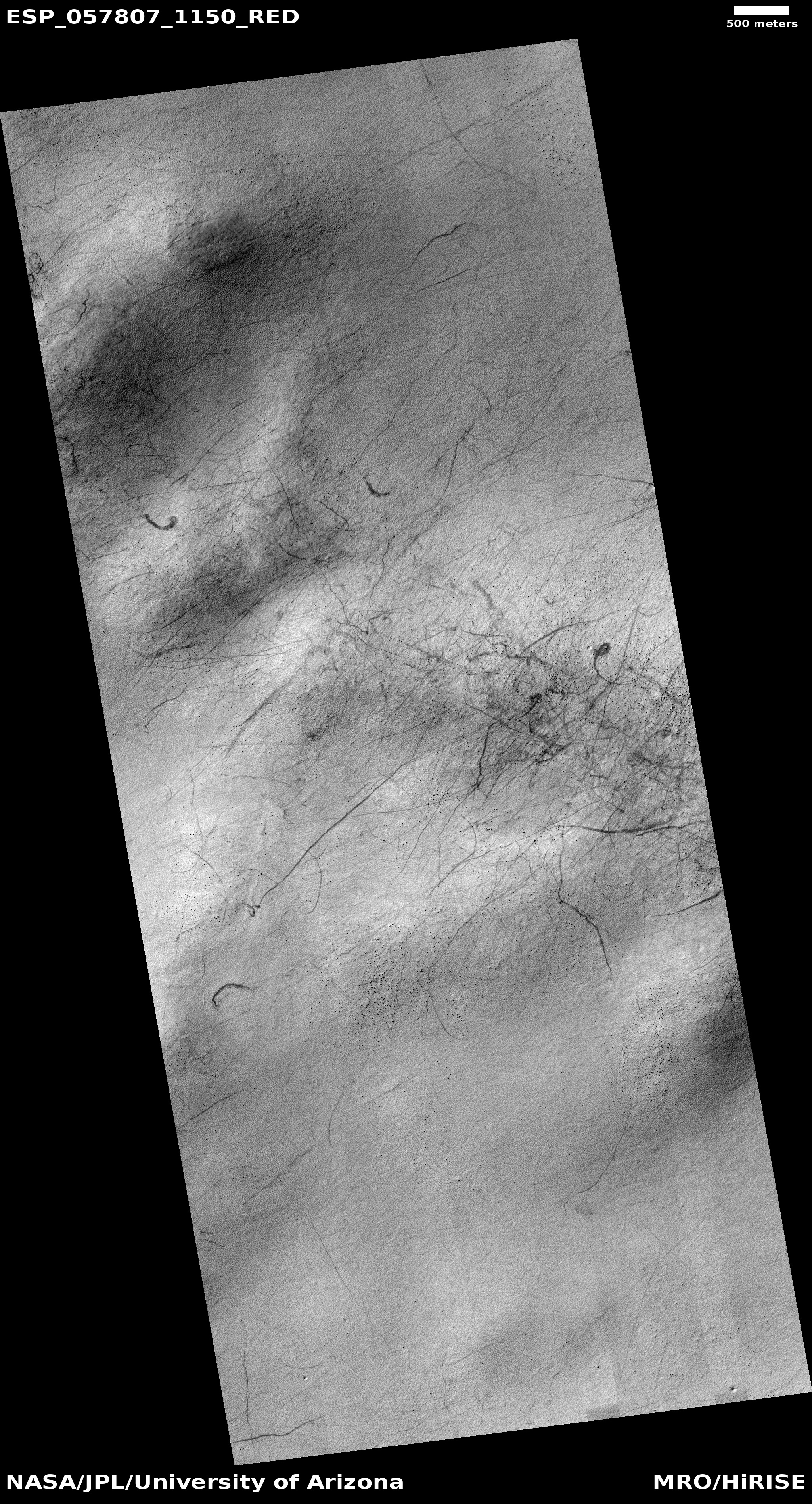
Cool image time! The photo to the right, cropped and reduced to post here, was taken on November 29, 2021 by the high resolution camera on Mars Reconnaissance Orbiter (MRO). It shows a collection of scattered thin surface fractures, grouped in clusters of parallel lines with the orientation of the clusters all somewhat random to other clusters.

The fractures, as well as the material inside the craters, appears to resemble glacial features, suggesting that these fractures are the result of either the past motion of the glacial sheet, or the sublimation of the buried ice, which causes it to crack and shrink as it slowly dissipates away.

The problem with that hypothesis is the location, as shown by the overview map below.
» Read more
0 comments

Recent avalanche on Mars

Close-up comparison of slump
Click for full image.

Wide view comparison of slump
For full images go here and here.

Cool image time! Today the science team for the high resolution camera on Mars Reconnaissance Orbiter (MRO) released images showing a very recent avalanche, or slumping, on the interior slopes of what looks like a small three-mile-wide crater inside the easternmost reaches of the giant canyon Valles Marineris.

The comparison above, reduced and rotated to post here, is their close-up showing the change, which occurred sometime between March 2021 and February 2022. The wider comparison on the right, cropped, reduced, and annotated by me, shows a wider view to help place this slumping in the context of the crater.

Calling this an avalanche is not really accurate, as it isn’t really the fall of boulders and rocks, but the quick slumping downward of an entire section of what looks like dust or sand. As Alfred McEwen of the Lunar & Planetary Laboratory in Arizona writes in the caption:
» Read more
1 comment

Mesa in the Martian northern lowlands

Mesa in the dry northern lowlands
Click for full image.

Cool image time! The photo to the right, cropped and reduced to post here, was taken on February 2, 2022 by the high resolution camera on Mars Reconnaissance Orbiter (MRO) and shows a mesa sticking up on the relatively flat and featureless northern lowland plains in Utopia Planitia, the second largest impact basin on Mars.

The full image shows three such mesas. Though pictures taken in the northern lowlands of Utopia tend to show evidence of buried ice or glaciers, the impression I get from this picture is one of dryness. If there is any ice here, it is below ground. And even that seems unlikely. The surface surrounding nearby craters does not have that squishy and slushy look that is seen in the north when an impact occurred on near surface ice. Instead, the ground looks solid.

The overview map below reinforces this impression.
» Read more

0 comments

More thumbprints on Mars!

Thumbprints on Mars
Click for full image.

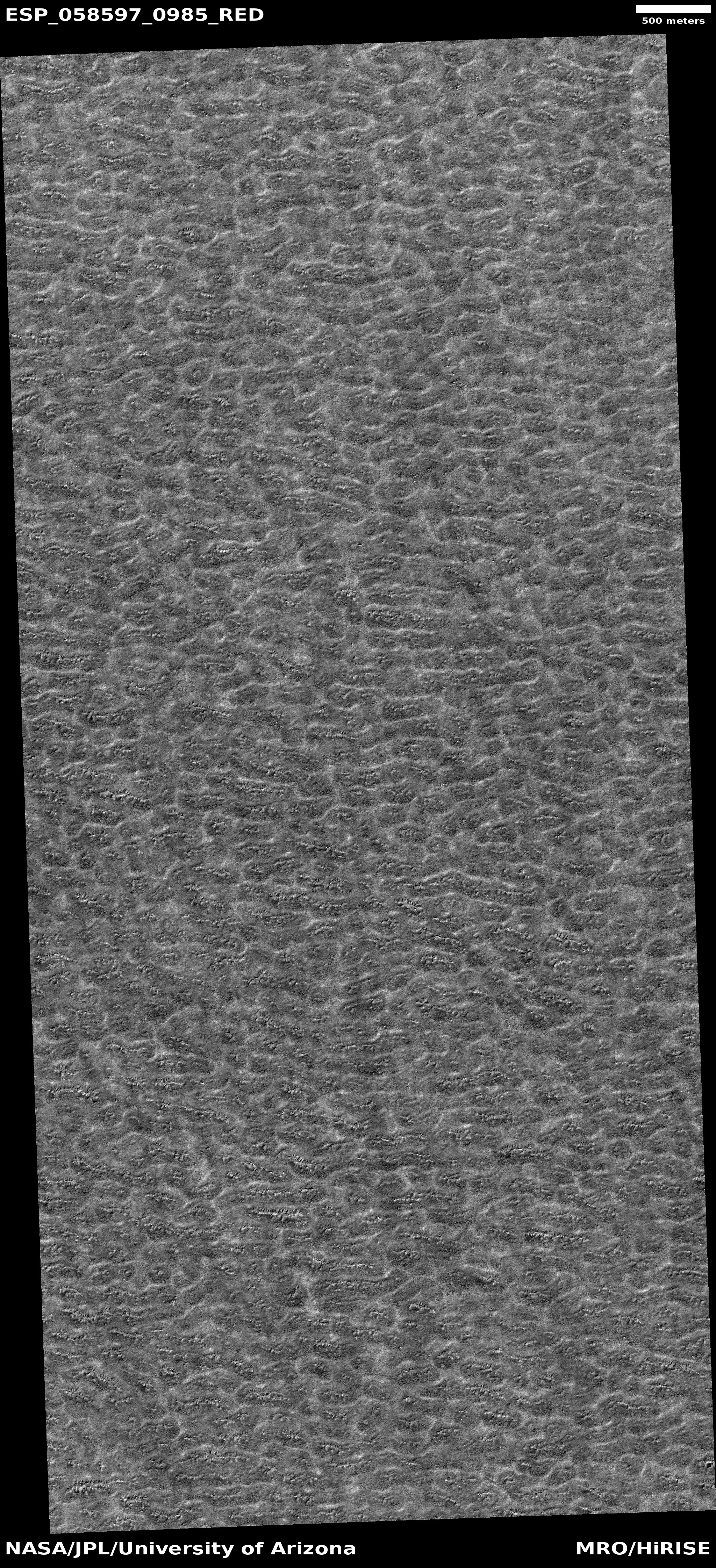
Cool image time! Among the many strange and unexplained geological features that scientists have identified on Mars, the thumbprint feature is one of the most intriguing. The photo to the right, cropped and reduced to post here, is a fine example, and was taken on September 10, 2021 by the high resolution camera on Mars Reconnaissance Orbiter (MRO).

The thumbprints are the lighter splotches, and are generally found near curved ridges located mostly in Martian lowlands. All appear to have crater-like features in them, though these craters are not impact craters, but likely (though not confirmed) caused by some form of underground eruption, be it mud, ice, lava or something else. Though scientists do not yet really understand the process that formed the thumbprints, the data strongly suggests that they formed in connection with glacial events. From this 2003 paper [pdf]:

TT [thumbprint terrain] as well as the associated trough systems were formed by a glacial mechanism. [Elevation] data show that the trough systems consistently lie topographically above the TT; this implies that if they were they formed by the same glacier, the troughs must have formed before the glacier retreated and formed the TT.

The splash apron around the crater near the bottom of the photo supports the glacial theory, implying the presence here of underground ice.

Scientists have also theorized wind processes and cinder cones as explanations for these features.

These particular thumbprints are located, as shown in the overview map below, in the same general area as a previous cool image of thumbprints, from April 2019.
» Read more

1 comment

Monitoring one glacier flowing off a mesa in Mars’ glacier country

Vicous glacial flow on Mars
Click for full image.

Today’s cool image takes us back to the mesa in Mars’ glacier country that first clued me in on the prevalence of ice in the Martian mid-latitudes. The photo to the right, rotated, cropped, and reduced to post here, was taken on November 13, 2021 by the high resolution camera on Mars Reconnaissance Orbiter (MRO), and shows a viscous flow coming down from a hollow on that mesa’s southern wall.

The new image has likely been taken to see if anything has changed since the previous image was taken in 2014. Based on the resolution published at the MRO website, nothing seems to have changed, though with more sophisticated software higher resolution versions of the images are available that might show some changes.

In my first post about Mars’ glacier country in December 2019, this flow was one of four that I featured coming off this same 30-mile wide mesa, as shown by the first overview map below.
» Read more

0 comments

Fractured terrain on Mars

Fractures on Mars
Click for full image.

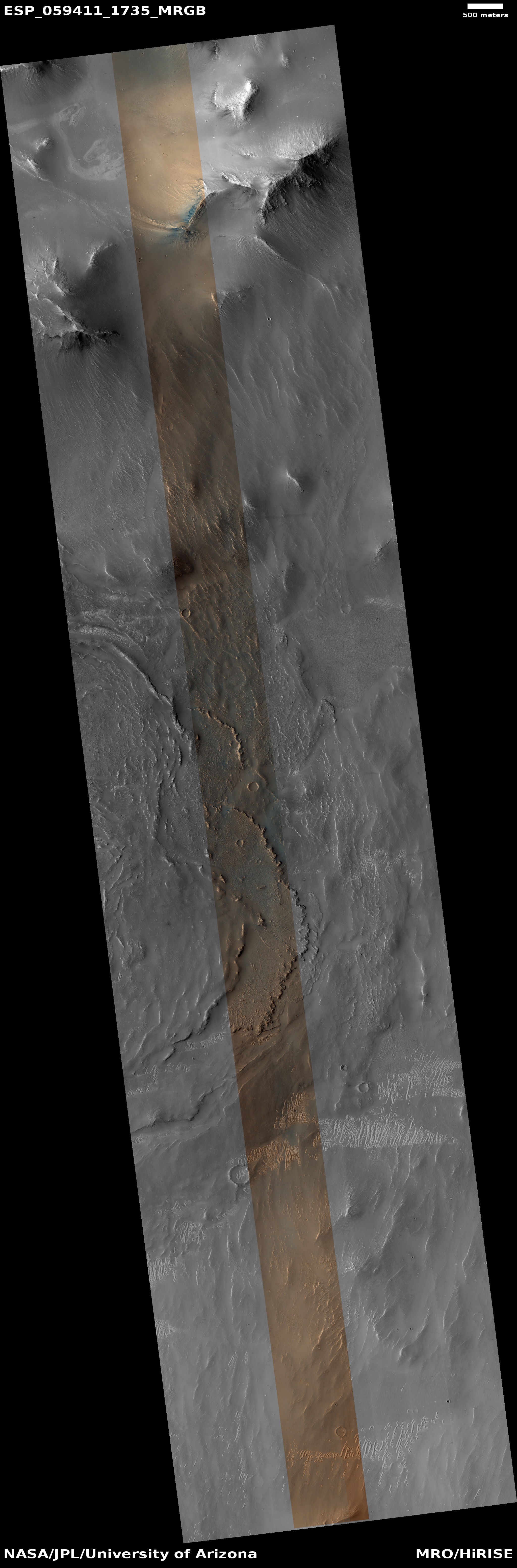
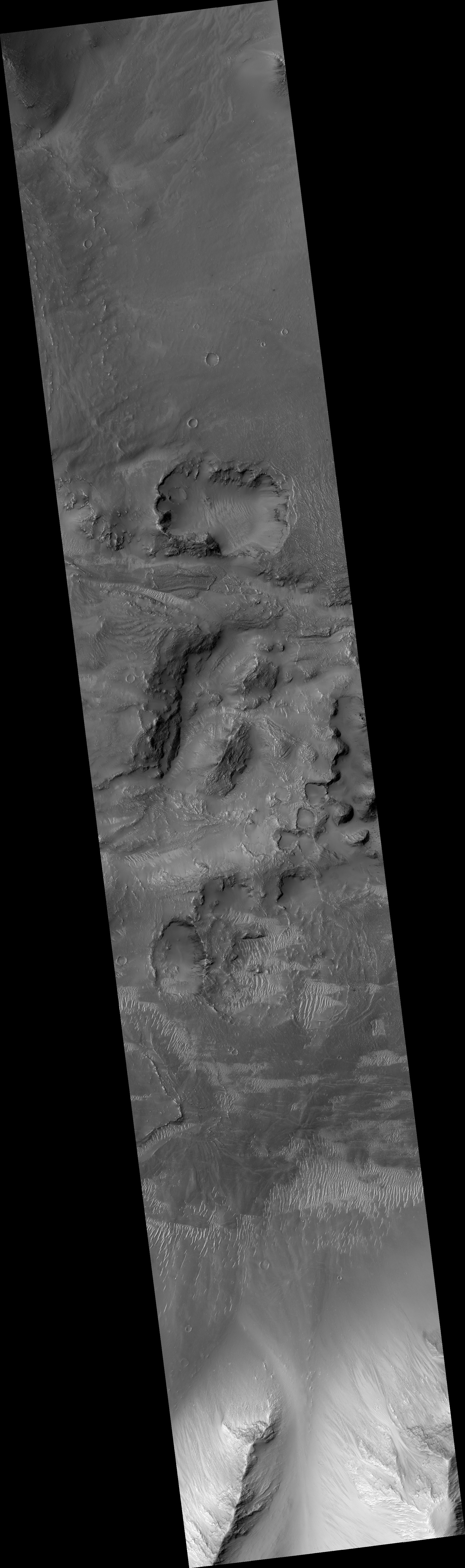
Today’s cool image, which at first glance does not seem so puzzling, actually falls into my “What the heck?” category of baffling Martian geology. The picture to the right, cropped and reduced to post here, was taken on January 15, 2022 by the high resolution camera on Mars Reconnaissance Orbiter (MRO). Labeled “Avernus Cavi fractures”, it shows what resembles the well-documented chaos terrain seen in many places on Mars, where erosion over eons along fault lines creates mesas with random criss-crossing canyons.

The problem is that this location is practically on the Martian equator, and chaos terrain tends to be found in the mid-latitude bands where there are many glaciers, suggesting the cyclical waxing and waning of those glaciers is what causes the erosion. Here at the Martian equator the terrain is very dry. No glaciers.

Moreover, note the higher mesa near the top center. Its flat top suggests that once this terrain was covered with an even higher layer of material, almost all of which was stripped away evenly everywhere, except where that mesa sits. As an amateur geologist I can’t think of any sequence of events that would do such a thing. I suspect professionals might have problems themselves.

Then there are the small parallel ridges. They suggest dunes, especially inside the depressions where sand and dust can get trapped. On the mesa tops however these ridges are more mysterious. Why for example are they aligned with the small ridge in some hollows, but not others? They in many ways remind me of the ridges in this earlier “What the heck?” cool image, also right on the equator.

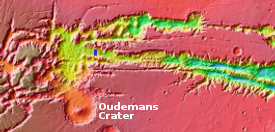
The overview map below provides some help, though not much.
» Read more

2 comments

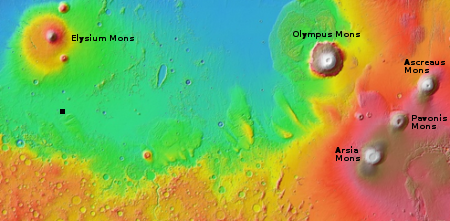
The layered Martian history exposed in Valles Marineris

Overview map

The layers in Valles Marineris
Click for full image.

Cool image time! Like the Grand Canyon in the United States, Mars’ largest canyon, Valles Marineris, appears to have been carved out of a layered terrain, thus exposing those many layers in the walls of the canyon.

Valles Marineris, however, is much much larger than the Grand Canyon. You could fit dozens of Grand Canyons inside it and hardly fill it. Yet, its walls have the same layered look, suggesting that in Mars’ long geological history, first came many events that laid down new layers time after time, followed by a long period when the laying ceased and other events carved out the canyon to its almost 30,000 foot depth (which by the way is also about six times deeper than the Grand Canyon).

Today’s cool image to the right, cropped and reduced to post here, was taken on September 5, 2021 and shows a terraced terrain on the floor of Candor Chasma, one small side canyon of Valles Marineris that is still much larger than the Grand Canyon. The black dot in the overview map above indicates its location. I roughly estimate the elevation difference between the high and low spots in the picture is about 3,000 feet, a difference that while two-thirds that of the depth of the Grand Canyon is almost unnoticeable within the depths of Valles Marineris.

This layering is probably the canyon’s most important geological feature. See these previous cool images here and here for other examples. When geologists finally arrive on Mars and can begin dating these layers in detail they will likely reveal the planet’s entire geological history, going back five to six billion years.

Most of the layers are probably volcanic flood lava laid down by repeated eruptions from the giant volcanoes to the west. In between and within however will be deposits from the Martian atmosphere, telling us its composition and thickness. All told, the layers of Valles Marineris will likely unlock almost all of the most basic secrets of Martian geology.

We merely have to go there to find out.

0 comments

Martian crater overwhelmed by glacier?

Martian crater overwhelmed by glacier?
Click for full image.

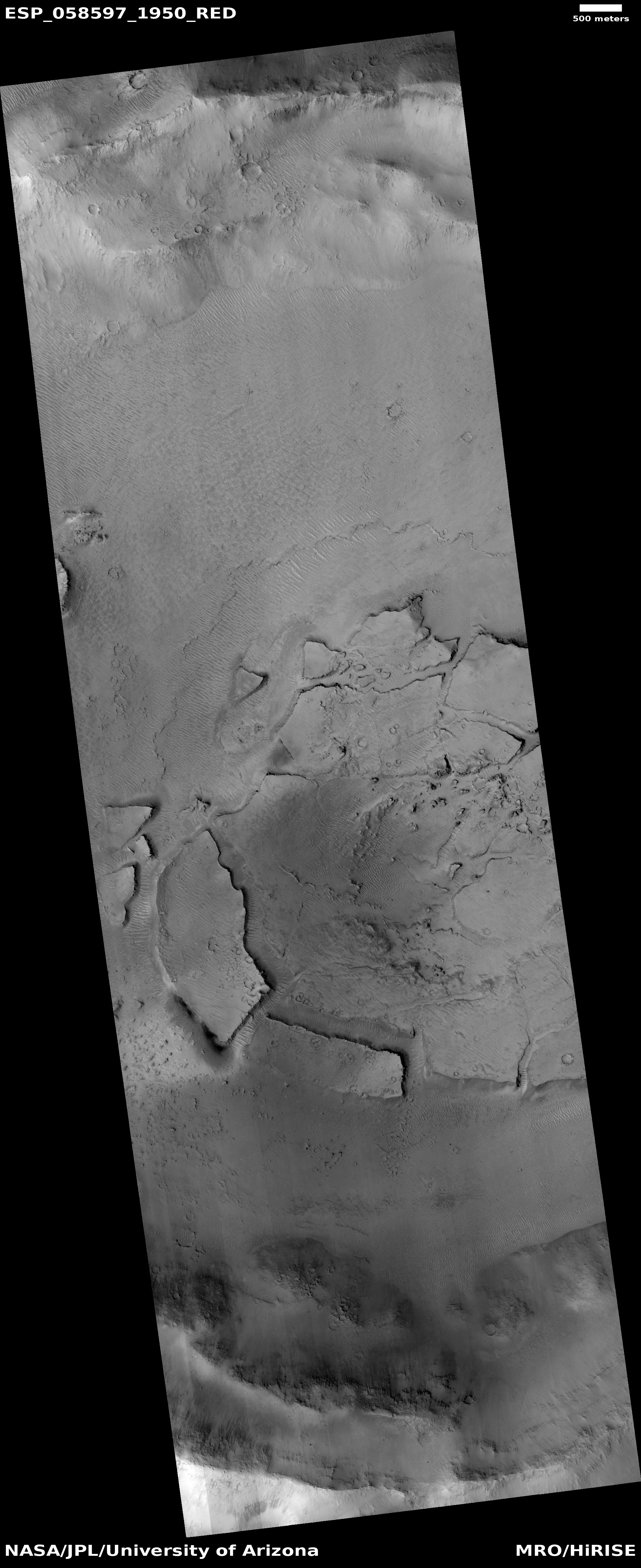
Cool image time! The photo to the right, rotated, cropped, and reduced to post here, was taken on January 28, 2022 by the high resolution camera on Mars Reconnaissance Orbiter. It shows what the science team labels a “modified crater.”

What I see is an old crater almost completely covered by glacial material. That material however is also very old, as there are numerous small craters on its surface, enough that it must have been here for a long time. Its cracked surface also suggests this glacier is very old.

Thus, while we might have ice here, buried by a thin layer of dust and debris to prevent it from sublimating away, it must be very old ice. The many climate cycles caused by the extreme swings in Mars’ rotational tilt, from 11 to 60 degrees, have apparently not caused this ice to ebb and flow very much.

Might it therefore not be ice, but hardened lava?

The location, as shown by the overview map below, provides some context, but only makes this mystery more puzzling.
» Read more

2 comments

Scientists: Martian topography in one region suggests the past existence of lakes and river networks, but not a large single ocean

Based on a just published paper, scientists using orbital topography data and imagery have concluded that more than three billion years ago on Mars ancient rivers in the transition zone between the southern cratered highlands and the northern lowland plains fed into numerous lakes in the lowlands, not a single large ocean as some scientists posit.

From their abstract:

The northern third of Mars contains an extensive topographic basin, but there is conflicting evidence to whether it was once occupied by an ocean-sized body of water billions of years ago. At the margins of this basin are the remnants of deltas, which formed into water, but the size and nature of this water body (or water bodies) is unclear, and detailed investigations of different regions of the basin margins are necessary.

In this study, we use high-resolution image and topographic datasets from satellites orbiting Mars to investigate a series of water-formed landforms in the Memnonia Sulci region, set along the boundary of Mars’s northern basin. These landforms likely formed billions of years ago, providing evidence for ancient rivers and lakes in this region. The geologic evolution of these rivers and lakes was complicated, likely influenced by water-level fluctuations, changes in sediment availability, and impact cratering. Our topographic analysis of these rivers and lakes suggests that they terminated in a series of ancient lake basins at the boundary of Mars’s northern basin, rather than supplying a larger, ocean-sized body of water. [emphasis mine]

Overview map

The Memnonia Sulci region is in the cratered highlands just south of the Medusae Fossae Formation, the largest volcanic ash deposit on Mars. The region of study in it is marked by the blue dot in the overview map to the right.

The study does not preclude the possible existence of a northern ocean on Mars, but it says that at least in this region at the equator, it did not exist. Instead, the various river valleys drained into separate smaller and relatively short-lived lakes.

7 comments

Dry barren ground in Martian northern lowlands?

Dry barren ground in the Martian northern lowlands?
Click for full image.

Today’s cool image is intriguing because of what appears to not be there, rather than what is there. The photo to the right, cropped and reduced to post here, was taken on November 3, 2021 by the high resolution camera on Mars Reconnaissance Orbiter (MRO).

At first glance it appears to show a very dry, barren surface. At its base are many parallel grooves running from the southwest to the northeast. On top of these grooves are several more recent crater impacts, as well as several patches of higher bedrock that appears to have been hard enough to resist whatever erosion process caused the groves.

Yet, based on the overview map below, the location of this photo should not be dry and barren, but instead home to a near-surface ice sheet covering everything.
» Read more

0 comments

Deformed Martian craters

Deformed Martian craters
Click for full image.

Cool image time! The picture to the right, rotated, cropped, and reduced to post here, was taken on September 3, 2021 by the high resolution camera on Mars Reconnaissance Orbiter (MRO). The focus of the image for the MRO science team were the wedding cake layers inside the largest crater. These layers suggest glacial ice, with the layers suggesting multiple cycles of glacial ebb and flow. Since the crater is at 43 degrees north latitude, and sits in the chaos region dubbed Protonilus Mensae, smack dab in the center of what I call Mars’ glacier country, this conclusion makes perfect sense.

To my eye, however, the most interesting feature of this photo are the many distorted craters. The overview map below shows the picture’s location, as well as several nearby very large impact craters which might have caused many secondary impacts, including the many craters at this location.
» Read more

1 comment
1 47 48 49 50 51 90