The beginning of chaos on Mars

The beginning of a chaos canyon
Click for full image.

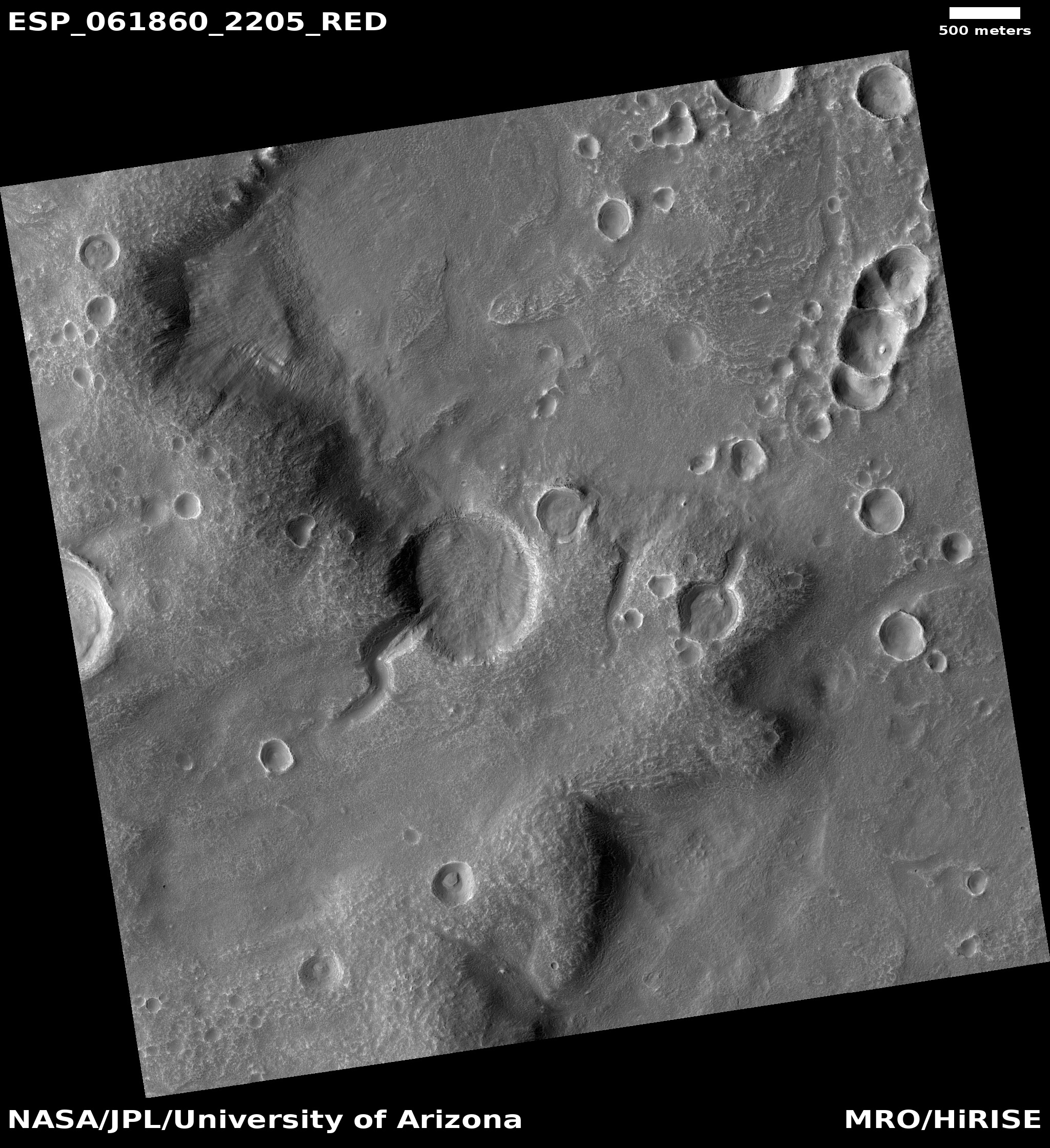
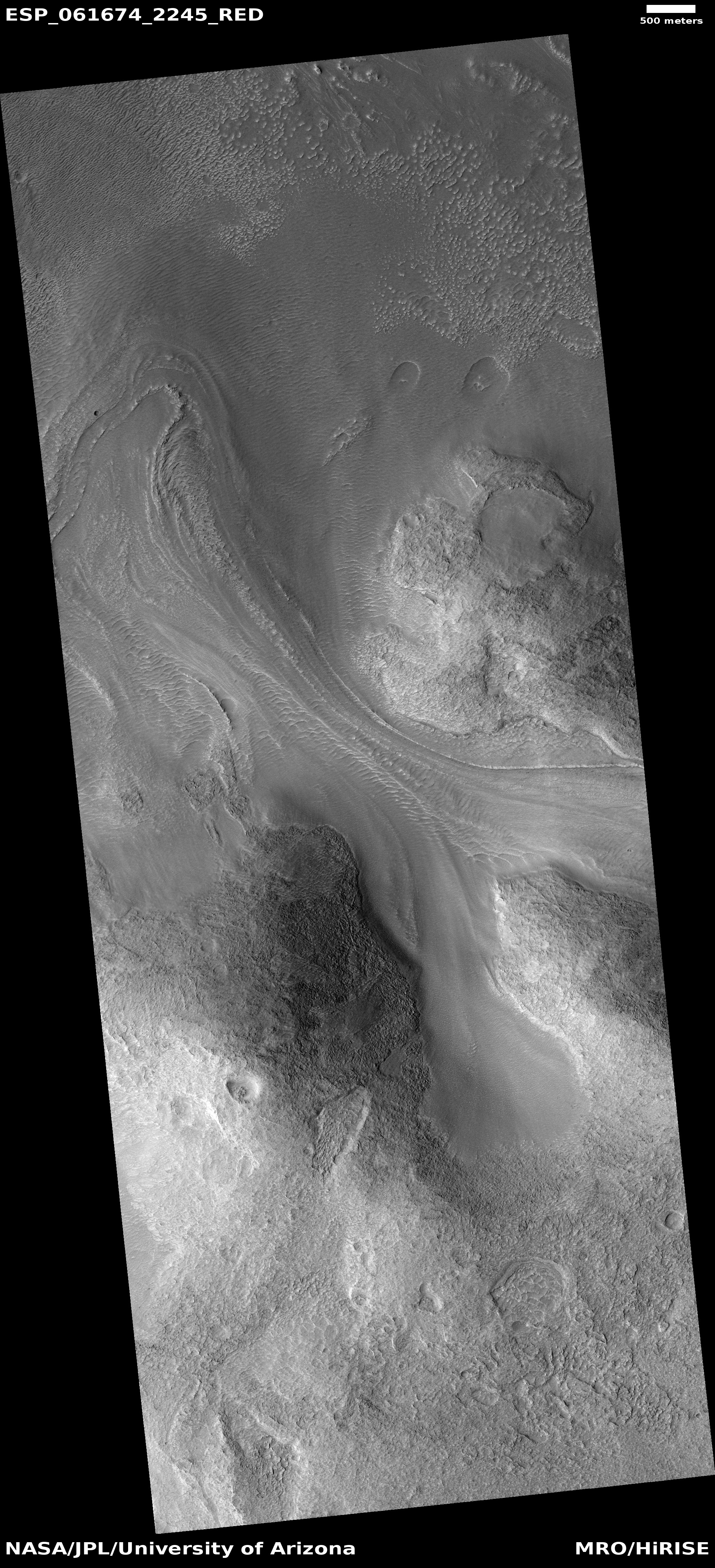
Cool image time! The photo on the right, rotated, cropped, and reduced to post here, was taken by the high resolution camera of Mars Reconnaissance Orbiter (MRO) on October 7, 2019. In one image it encapsulates the process that forms one of the more intriguing and major Martian geological features, dubbed chaos terrain.

Chaos terrain is typically a collection of mesas separated by straight-lined canyons. It is found in many places on Mars, most often in the transition zone between the southern highlands and the northern lowlands where an intermittent ocean might once have existed. It is believed to form by erosion, possibly caused by either flowing water or ice, moving along fault lines. As the erosion widened the faults, they turned into canyons separating closely packed mesas. With time, the canyons widened and the mesas turned into a collection of hills.

This image shows the beginning of this process. It is centered on a fault line running from south to north. In the south all we can see is the fault expressing itself as a very shallow small depression in the plains. As we move north the depression widens and deepens. The material inside the depression near the top of the photo could very well be a buried inactive ice glacier. Several million years ago, when the inclination of Mars was much higher and the mid-latitudes were much colder than the poles, the water ice at the poles was sublimating from the poles to those mid-latitudes where it fell as snow. At that time this glacier was likely active, helping to grind out this canyon.

The image was taken at the south border of a chaos region dubbed Nilosytis Mensae, as shown by the overview maps below.
» Read more

1 comment

Martian pimples

Pimples on Mars!
Click for full image.

Cool image time! The image to the right, cropped and reduced to post here, is one of those terrain sample images the science team of the high resolution camera of Mars Reconnaissance Orbiter (MRO) takes periodically when they have a gap in their observation schedule with no specific requests for images of the terrain below. Still, they need to use the camera regularly to keep its temperature maintained, so they then take a somewhat random picture over that terrain, based partly on information from lower resolution images but without a strong sense of what they will find.

In this case, they found what I dub pimples, raised mounds with small holes at their peaks. The image, taken on November 30, 2019, is located is in the northern lowlands, at a latitude (45 degrees) where subsurface ice is possible. Thus, we could be looking at water ice volcanoes.

Very few high resolution images have been taken of this area, with no others close by. Thus, the overall context of these mounds is hard to gauge. They could be widespread, or very localized.

The unknowns here and general lack of research suggests this location and these mounds are ripe research for some postdoc student interested in planetary geology.

3 comments

Six Martian summers at a polar impact crater

Crater on Martian north polar ice cap
Click for full image.

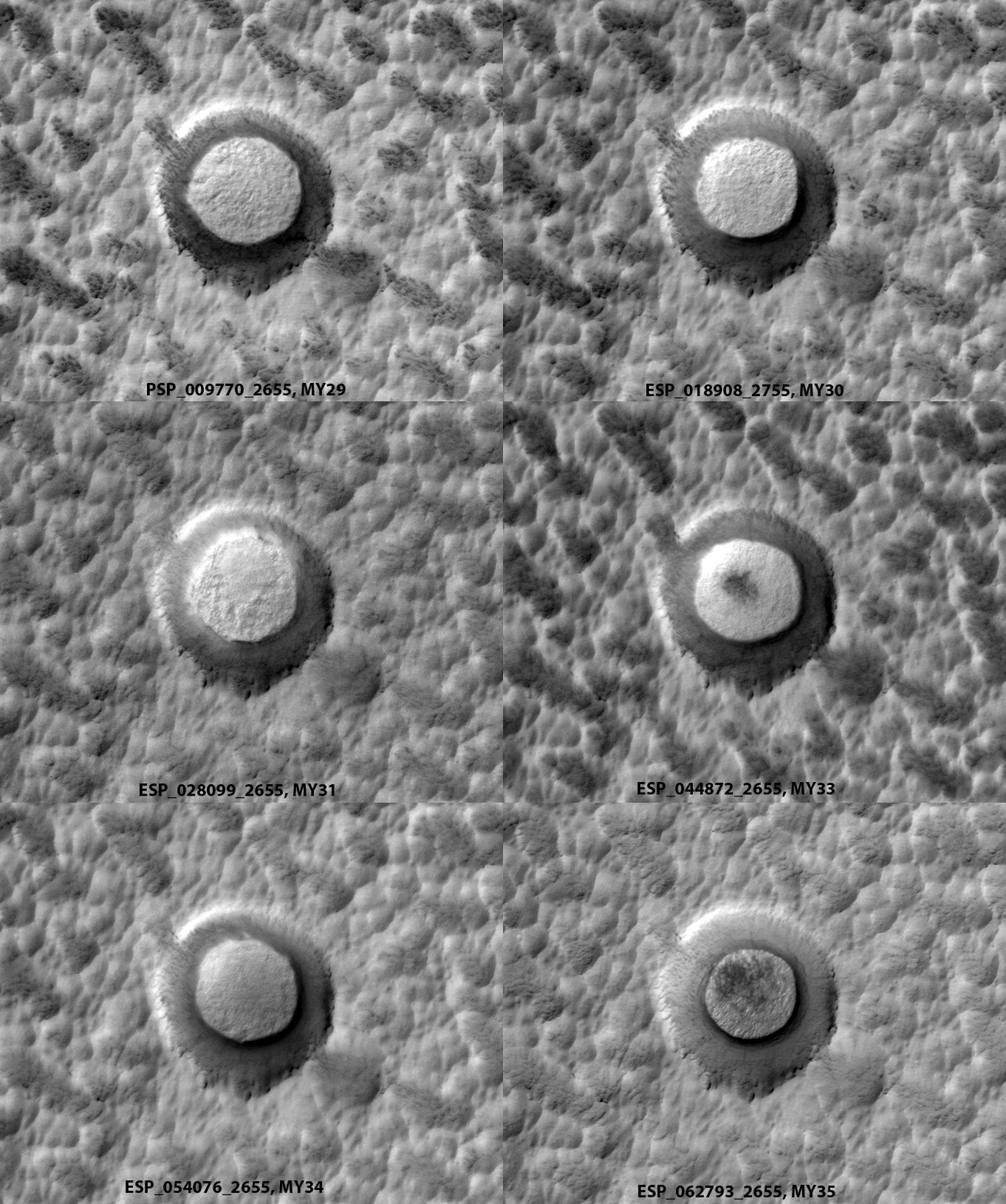
Cool image time! The science team for the high resolution camera on Mars Reconnaissance Orbiter (MRO) last week released a very neat short movie compiled from images taken of an impact crater located on top of the northern polar ice cap of Mars. As noted by planetary scientist Alfred McEwen of the Lunar & Planetary Laboratory in Arizona in the image caption,

Shown here is an impact crater on the north polar ice cap, which contains an icy deposit on the crater floor. These inter-crater ice deposits shrink and expand or change shape or surface texture from year to year,

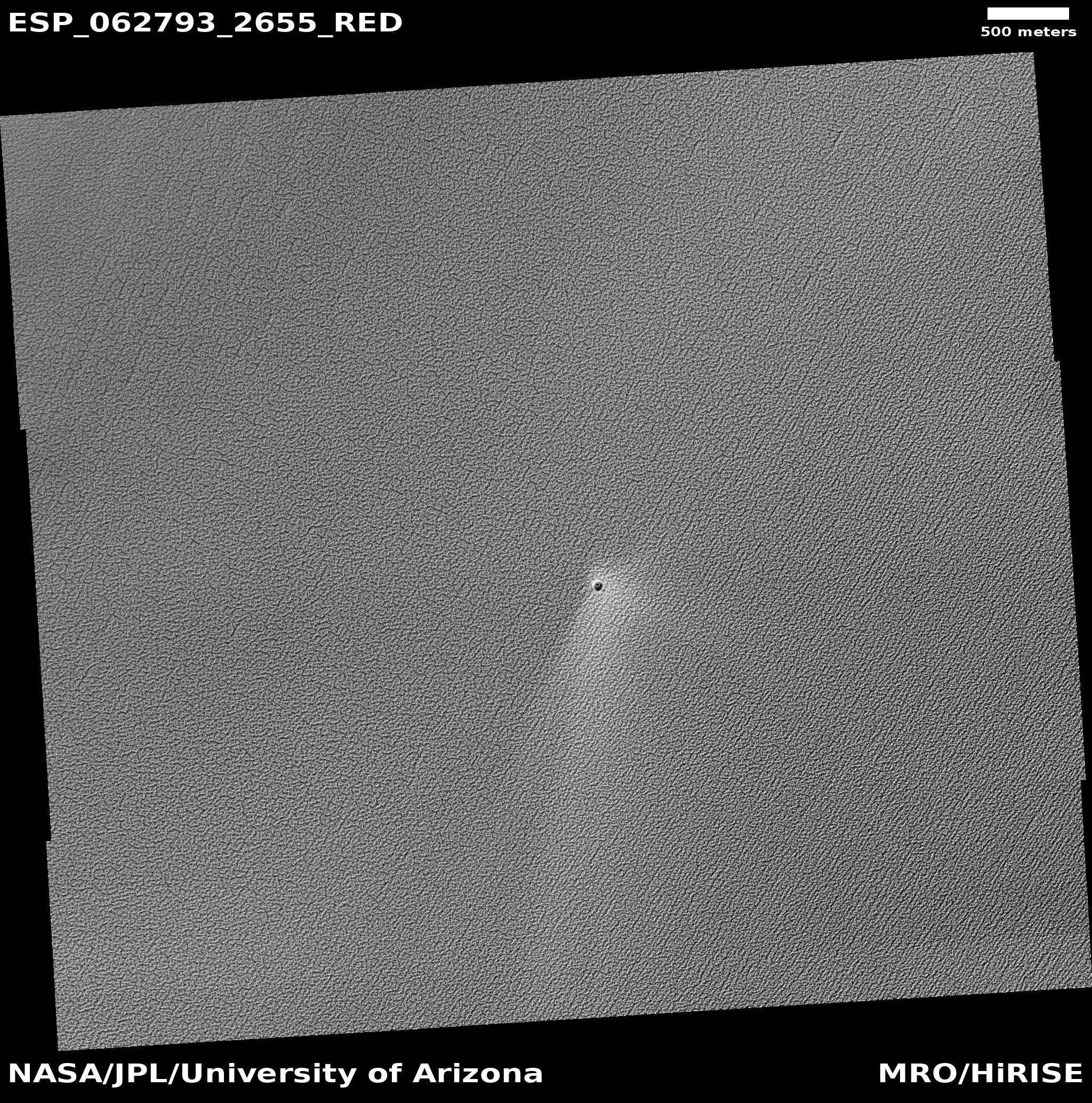
The image on the right, cropped and reduced to post here, is the most recent of these six images. The crater, which is about 200 feet in diameter, is the black speck in the center. The white streaks to the south of the crater, similar on all six photos, indicate that the prevailing winds come from the pole.

The animation zooms in on the crater so that you can see the details on its crater floor. And though the animation is fun, below the fold is a collage of all six photos, which I think makes it easier to see how the inter-crater ice deposits changed from summer to summer.
» Read more

0 comments

Tadpole on Mars

Tadpole on Mars
Click for full image.

Cool image time! The image on the right, cropped and reduced to post here, was taken by the high resolution camera on Mars Reconnaissance Orbiter (MRO) on October 7, 2019, and shows a crater on the northern fringe of Arabia Terra, one of the largest transitional regions between the Martian northern lowlands and the southern highlands. It shows a crater with an inlet canyon that makes the entire crater resemble a wiggling tadpole.

This is certainly not first tadpole-resembling crater found on Mars. See for example this press release from February 2018, showing a tadpole crater with the tail being an outlet channel. In today’s image however the channel feeds the crater.

In fact, take a look at the full image. This crater apparently occurred right at the edge of a large mesa cliff, with this impact cutting into the cliff near its bottom. The canyon might have actually existed before the impact, with the crater merely obliterating the canyon’s outlet.

If you look along that escarpment to the east you can see similar southwest-to-northeast flows. One is a canyon flowing downhill through the escarpment, probably resembling what the first canyon might have once looked like before the impact. To the east of this is another tadpole crater. This second tadpole impact however took place on top of the mesa, so the channel flows out from the crater and then down off the mesa, the reverse of the tadpole crater above.

These flow features are consistent with the nature of this transitional zone, a region with many features suggesting it was once the shoreline of an intermittent ocean. That ocean, if it had existed, is long gone, though scattered across the Martian surface are geological ghost features like these that speak of its past existence.

5 comments

Martian dry ice frost on glacial remains?

Frost on ridgelines and inside crater
Click for full image.

Close-up of frost

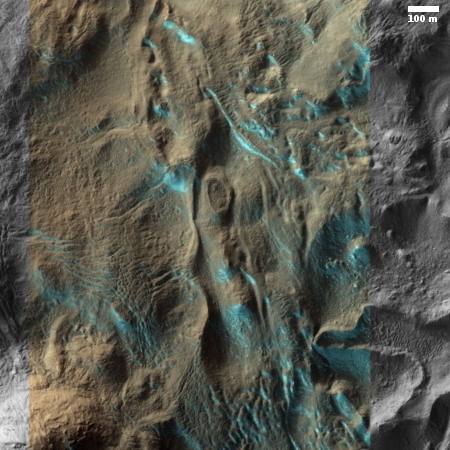
Cool image time! The photo on the right, rotated, cropped, and reduced to post here, was taken by the high resolution camera on Mars Reconnaissance Orbiter on November 30, 2019. Located just east of Hellas Basin in southern mid-latitudes, the color strip shows dry ice frost both in the crater as well as on the ridgelines to the north. As noted in the caption, written by Candy Hansen of the Planetary Science Institute in Tucson, Arizona,

When we acquired this image, it was [winter in the southern hemisphere] on Mars, but signs of spring are already starting to appear at latitudes not far from the equator. This image of Penticton Crater, taken at latitude 38 degrees south, shows streamers of seasonal carbon dioxide ice (dry ice) only remaining in places in the terrain that are still partially in the shade.

The turquoise-colored frost (enhanced color) is protected from the sun in shadowed dips in the ground while the sunlit surface nearby is already frost-free.

Note for example how the frost disappears in the southern half of the crater floor, the part exposed to sunlight.

What immediately struck me however were the underlying features. The entire northeast quadrant of the crater’s rim appears to have been breached by some sort of catastrophic flow, as if there had been a glacial lake inside the crater that at some point smashed through suddenly, wiping that part of the rim out as it ripped its way through.

To the right is a full resolution inset, indicated by the white box above, of the dry ice frost on the outside of the crater. I find myself however drawn more to the underlying features, which once again have a chaotic aspect suggesting a sudden violent event, coming from the south and moving north.

I have no idea if my visceral conclusions here have any validity. At this latitude, 38 degrees, scientists have found a lot of buried inactive glaciers of ice, so I could be right. Or not. Your guess is as good as mine.

0 comments

Gully on Mars

Gully in crater on Mars
Click for full image.

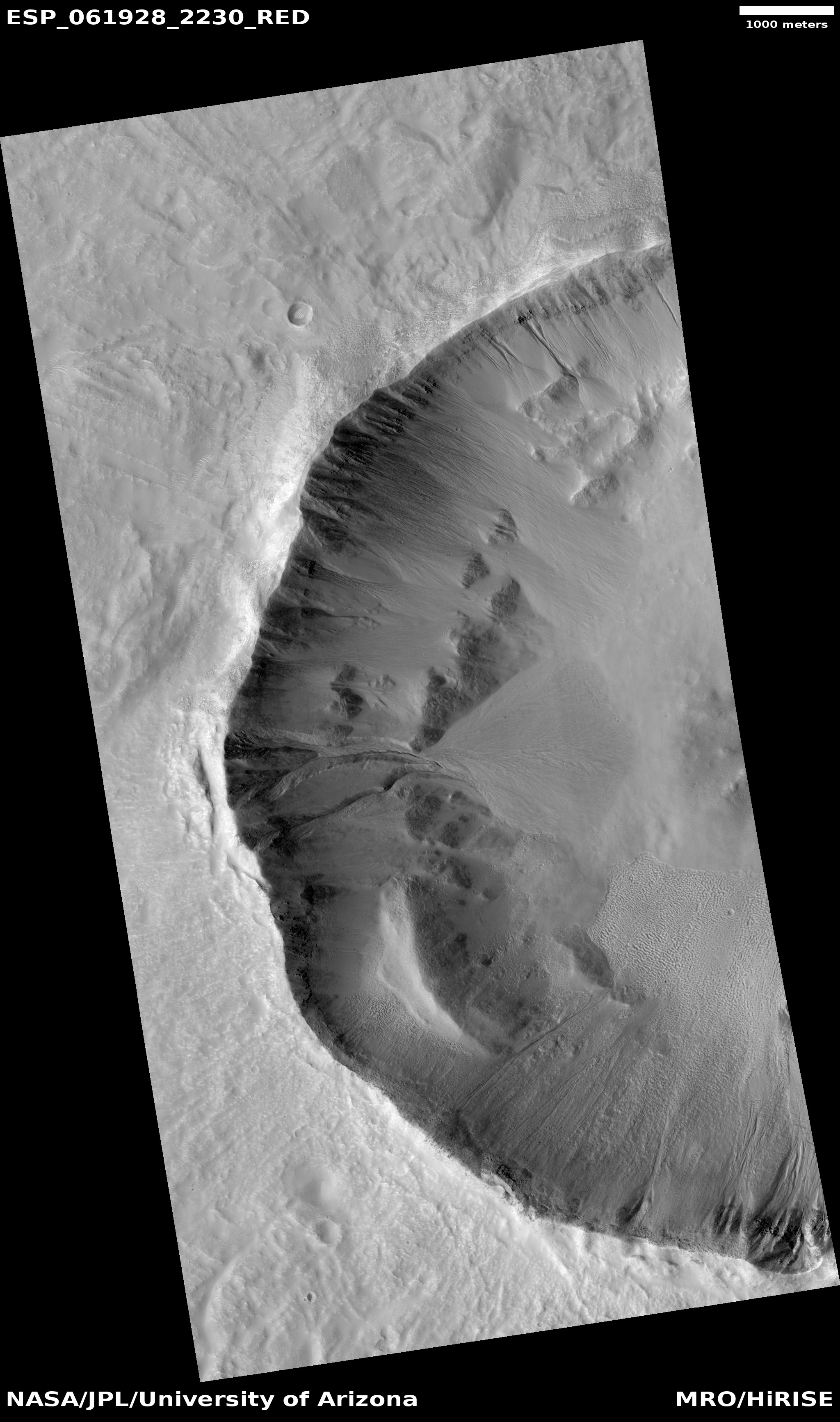
Cool image time! If we were told that the photo on the right was taken by an airplane over some southwest desert gully, no one should be surprised if we were to accept that description entirely. The gully sure looks like a lot of drainages one can routinely see when flying over the American southwest, dry, treeless, but showing the typical dendritic pattern seen for most desert water drainages.

Of course my readers all know that this is not in the American southwest, but on Mars, in a crater located in the transition zone between the southern highlands and the northern lowland plains. The image, cropped to post here, was taken by the high resolution camera on Mars Reconnaissance Orbiter on October 12, 2019.

It appears that this particular gully has been subject to repeated monitoring, since November 2015. A rough and very quick comparison of the earlier image with today’s image does not show any obvious change. This does not mean there hasn’t been any evolution, as my look was cursory, and I could easily be missing changes. Seasonal variations might also be occurring that I could be missing.

The reasons for the monitoring are of course obvious. This gully strongly suggests the flow of liquid downhill. Is that occurring today, or are we seeing the evidence of a past flow from long ago? Only some long term monitoring can tell.

There is also the possibility that we are looking at a buried glacier. The crater is located at 42 degrees north latitude, well within that mid-latitude band where scientists have located many buried Martian glaciers. If so, then the monitoring is to see if that glacier is active in any way.

1 comment

Pedestal craters in the Martian northern lowlands?

Pedestal craters on Mars?
Click for full image.

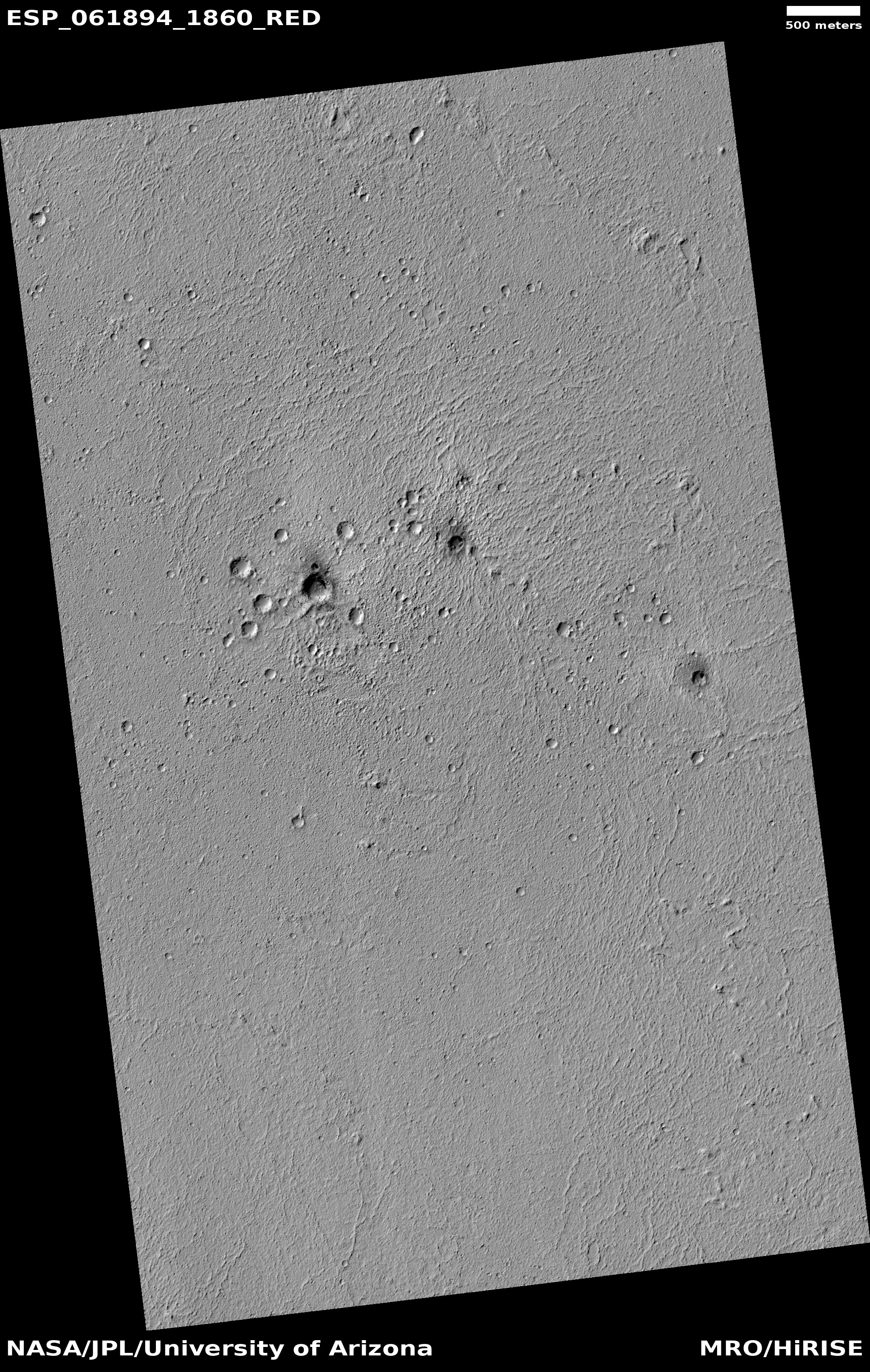
Cool image time! The photo on the right, cropped and reduced to post here, shows a cluster of really strange mesas, craters, and pits, located in Utopia Planitia, the largest and deepest plain of Mars’ northern lowlands where an intermittent ocean might have once existed.

The image was taken on October 26, 2019 by the high resolution camera on Mars Reconnaissance Orbiter (MRO) as part of its regular image-taking program. In this case it was dubbed a “terrain sample” image, meaning that it was not specifically requested by any researcher, but was taken because they need to use the camera regularly to maintain its temperature, and thus sometime produce images over previously untouched areas, not knowing what they will find, as part of that maintenance schedule.

In this case the terrain sampled is especially intriguing. Are the upraised depressions what are called pedestal craters, created when the impact landed on what was once an icy plain, which subsequently sublimated away to leave the crater sitting high above the surrounding flats? Maybe, but this location is at 23 degrees north latitude, and research has generally found these pedestal craters at latitudes higher than 30 degrees.

Moreover, that many of these upraised depressions are not circular suggests that their formation was not impact related.

Other mysteries: Why are all the ridgelines bright? What caused the parallel white streaks to the east and west of some mesas? And if these are impact craters, why are some distorted?

If this region was once the seabed of an intermittent ocean, this fact might explain the features. Then again, it is more likely that this lowland area was once covered in ice in the far past, when the planet’s tilt was greater and the lower latitudes were actually colder than the polar regions, and thus allowed ice to build up in those lower latitudes. We might therefore be seeing the end result of an erosion/sublimation process as that ice disappeared when Mars’ inclination shifted.

Lots of questions, and no answers.

2 comments

Darkened craters on Mars

Darkened craters on Elysium Planitia
Click for full image.

It’s time for the first cool image of 2020! The photo to the right, cropped and reduced to post here, was taken by the high resolution camera on Mars Reconnaissance Orbiter (MRO) on October 10, 2019. It shows a handful of darkened craters on the vast volcanic Elysium Planitia plain between the giant volcanoes Olympus Mons to the east and Elysium Mons to the north.

My first thought was that these dark craters were recent crater impacts, possibly a set of secondary impacts from a larger nearby impact. However, in looking at the archive of MRO’s high resolution camera at this location (Latitude 5.925ยฐ norther; Longitude 164.965ยฐ) I found that almost no high resolution images have been taken in this region, as shown by the overview map below to the right.
» Read more

2 comments

Giant scallops on Mars

Scallops on Mars
Click for full image.

It’s a slow news week, with the too much partying only real space news today the expected third launch of China’s Long March 5 rocket (supposedly scheduled for this morning but so far no word). (To my gentle reader: For some reason I have been losing a day during this whole week, always thinking that Christmas was on Thursday and that today was Friday. Thus my error in thinking the Long March 5 flight was today. It is tomorrow morning. Forgive me for my absent-mindedness.) So let’s look at a cool image!

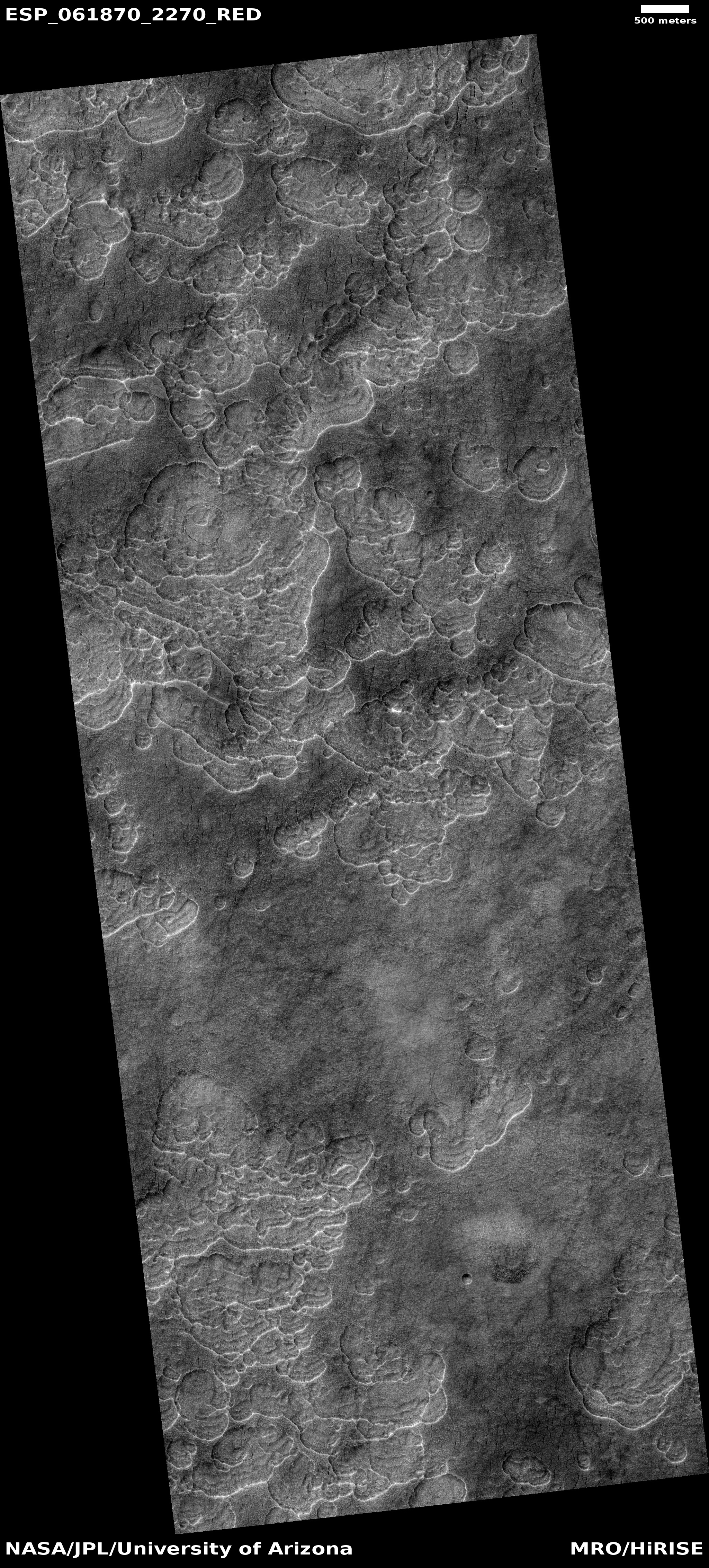
The photo on the right, cropped and reduced to post here, was taken my the high resolution camera on Mars Reconnaissance Orbiter (MRO) on October 8, 2019. Entitled “Scalloped Depressions in Utopia Planitia,” it shows a strangely eroded surface in the northern lowlands of Mars, where an intermittent ocean might have once existed.

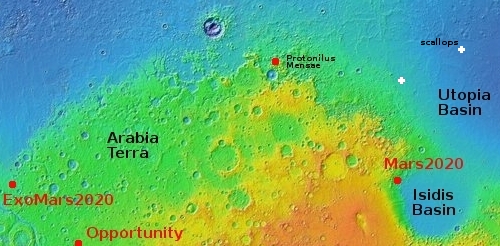
The location of these scallops is shown to the right.

Location of scallops in Utopia Planitia

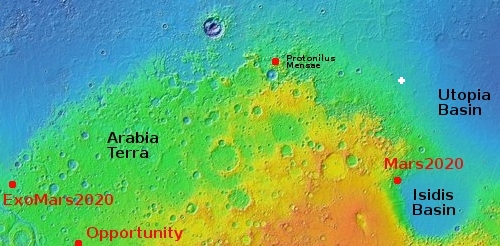
I have taken the same overview map used from two recent cool image posts, showing how these scallops relate in location to the strange crater in Utopia Planitia as well as the glacial-surrounded mesa in Protonilus Mensae.

In caves, scallops like this form from water or wind flow, but when they do, they are all oriented the same way. Here the scallops are at different orientations, terracing down from the center of the image. In this case it appears that scientists believe [pdf] the formation process is related to the sublimation of underground ice at this location.

According to [one hypothesis] scallop formation should be ongoing at the present time. Sublimation of interstitial ice could induce a collapse of material, initially as a small pit, then growing southward because of greater solar heating on the southern side. Nearby scallops would coalesce together as can be seen to have occurred.

What is most cool is that the geologists think the process that forms these scallops is related to the same processes that cause the formation of the swiss cheese landforms in the south polar regions.

1 comment

Crater in the Martian northern lowlands

Crater in Utopia Planitia
Click for original full image.

Cool image time! The photo to the right, rotated, cropped, and reduced to post here, was taken by the high resolution camera on Mars Reconnaissance Orbiter (MRO) on October 26, 2019. It shows a crater in the western edge of Utopia Planitia, the largest and deepest region of the Martian northern lowlands where it is theorized that an intermittent ocean might have once existed.

My first uneducated guess at looking at this image is that the impact occurred in some sort of wet slushy mud or ice, which then melted and filled the crater interior, ponding in the crater’s center as it froze.

A more educated guess, based on what I have learned in the past year, is not much different. The crater is located at 40 degrees north latitude and therefore sits in the middle of the mid-latitude band where scientists think there are a lot of buried inactive glaciers.

Overview map

The map to the right, revised from my December 20, 2019 post about glaciers flowing off the slopes of a mid-latitude mesa, illustrates this even more clearly.

This crater, indicated by the white cross, sits at approximately the same latitude as that mesa and its glaciers in Protonilus Mensae. It also sits at in an area where accumulated data from several spacecraft have mapped a lot of water ice, close to the surface.

Thus, it is reasonable to suppose that the impact that made this crater pushed into that ice-table, melting the water which subsequently froze and then subsided downward into the ground to form the crater’s central ponded features.

Or to put it as I did initially, the impact smashed into some wet slushy mud/ice, melting it so that it filled the crater interior to then freeze as we see it.

1 comment

A deep dive into Valles Marineris

Dunes on the floor of Valles Marineris
Click for full image.

The vastness of Mars is sometimes hard to fathom. While the planet is much smaller than Earth, its entire global surface is approximately the same as the Earth’s land area. This is a lot of territory. It took humanity many tens of thousands of centuries to expand outward to settle all of it. It took even longer before humanity was successfully able to map all of the Earth so that its entire surface was known to all humans, a task that was only completed a handful of centuries ago.

While we now have the technology to quickly map the entire globe of a planet like Mars, the devil is always in the details. At this time the resolution of our global maps give us only a glimpse of the Martian surface.

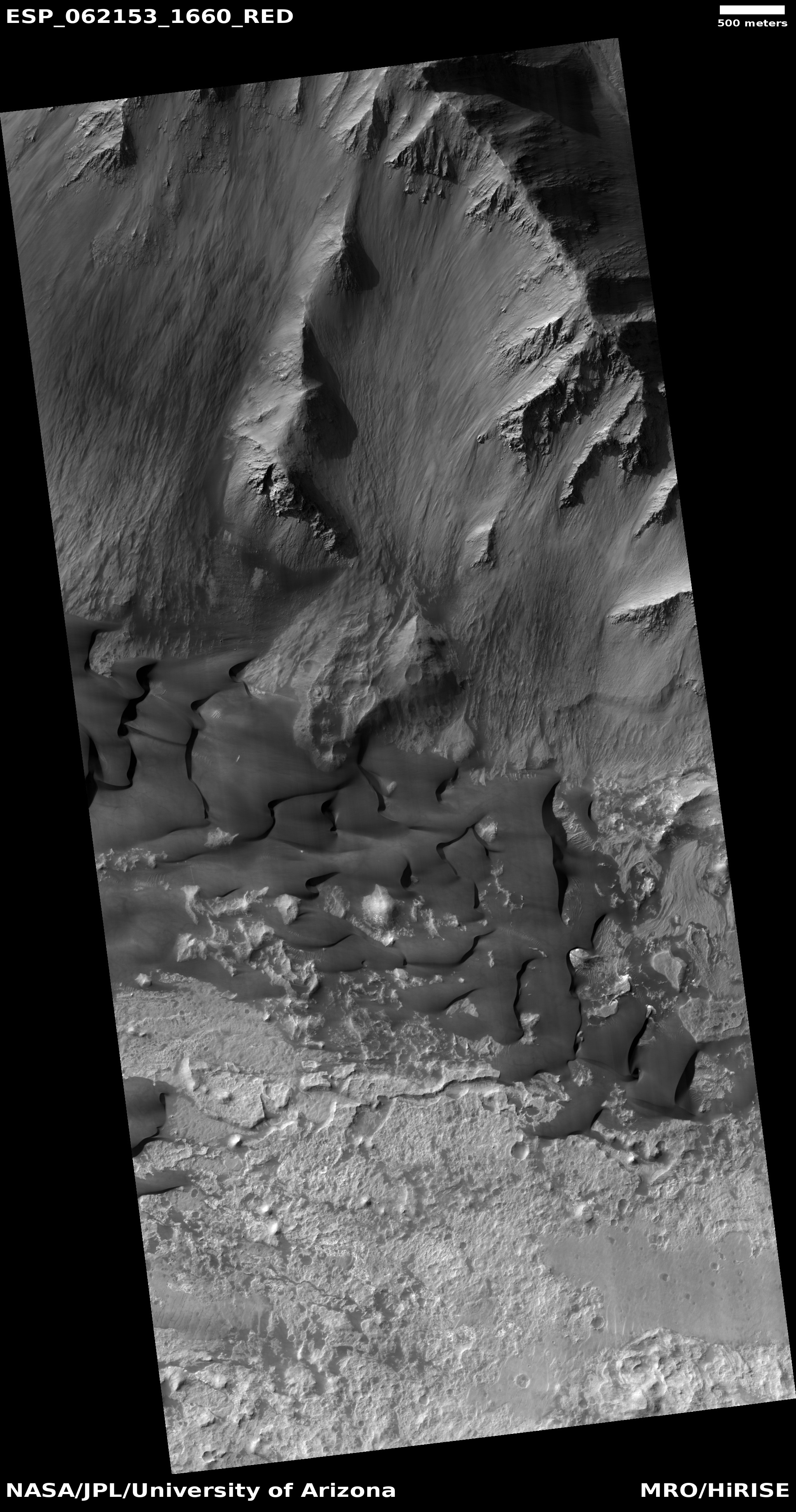
The image to the right, reduced and cropped to post here, is a good example. Taken by the high resolution camera on Mars Reconnaissance Orbiter (MRO) on October 30, 2019, it shows a set of large dunes on the northern floor of a side canyon on Mars that is part of Coprates Chasma, a canyon that forms only a small part of the vast Valles Marineris canyon system east of the giant volcanoes of the Tharsis Bulge.

The sand of these dunes is mostly volcanic material, dark basalt that was deposited as lava from those giant volcanoes, then later ground down in landslides and erosion to be recycled as sand that formed dunes trapped within the canyon bottom. The dunes themselves are slowly moving eastward, driven mostly by the predominate west-to-east winds that blow down this side canyon of Coprates Chasma. The motion is very slow, so slow that even though the image title is “Coprates Chasma Dune Changes”, I was unable to spot any changes when I compared this 2019 image with a photo taken in June 2019.

To find out what had changed, I contacted Matt Chojnacki of the Lunar and Planetary Laboratory at the University of Arizona, who has been studying the nature of the sand dunes in Valles Marineris. After making a quick preliminary blink test using more sophisticate tools than I have available, he found “minor advancements. The rocks move a bit too in places.” Without a full analysis he also added, “I can tell some dune crests have moved to the east.”

The research by Chojnacki and others has found that the dunes within Valles Marineris are in many ways different than dunes found elsewhere in the mid-latitudes on Mars, suggesting that being trapped within this giant canyon has produced some specific regional features. They tend to be darker, the canyon contains several sand dune seas, called ergs (only seen elsewhere on Mars in the polar regions), and the dunes tend to be more hardened, so that they change relatively little when compared to similar dunes elsewhere on Mars.

These particular dunes in Coprates Chasma however are not hardened, since if so they would have been covered by the landslides and material that comes down from the canyon’s nearby northern slopes. Instead, they move, but appear to move far slower than similar dunes elsewhere on Mars.

To me, this image provides a good vehicle for getting a sense of the size of Valles Marineris. Coprates Chasma itself only one of about a dozen named sections of the entire Valles Marineris canyon system, and this particular image shows only the floor of a side canyon of Coprates. The map below gives an overview of the entire system.
» Read more

1 comment

Buried glaciers flowing off of Martian mesa

Glacial flow off of mesa
Click for full image.

Cool image time! Planetary geologists now think that the mid-latitudes of Mars contain many buried and inactive glaciers, formed several million years ago when the planet’s inclination was more than 50 degrees [pdf], rather than the 25 degrees it is now. At that time the mid-latitudes were actually colder than the poles, and water would sublimate from the poles to the colder mid-latitudes to pile up as snow and glaciers.

With today’s 25 degree inclination those mid-latitude glaciers are inactive, and have been so for several million years. It might even be that Mars’ water is beginning a shift back to the poles, but this is uncertain. If anything the planet is presently in a balance, and won’t start transferring water back to the poles until its inclination drops closer to zero.

The image to the right, taken by the high resolution camera on Mars Reconnaissance Orbiter (MRO) on September 23, 2019, is of one of those glacial flows, coming off a mesa in a region called Protonilus Mensae, located in the transition zone between the southern highlands and the northern lowland plains where an intermittent ocean might have once existed.

Much of the geology of Protonilus Mensae is chaos terrain, places where the surface has eroded along angled fissures to form many mesas. The overview map below focuses in on the particular mesa where this flow is located. The red boxes indicate all the MRO images taken of this mesa, with the image above indicated by the black dot.
» Read more

1 comment
1 74 75 76 77 78 90