Large glacier-filled crater/depression on Mars?
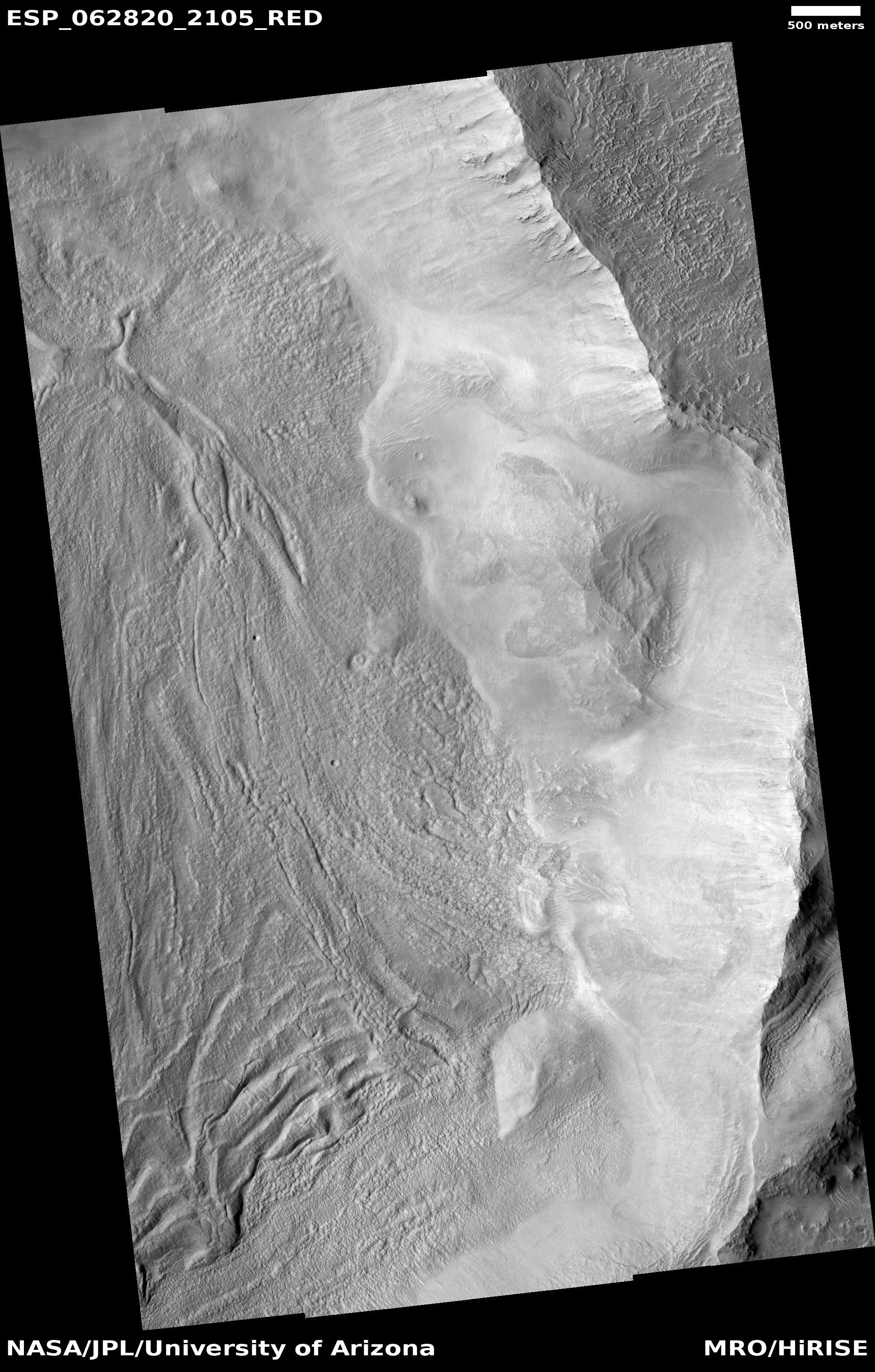
Glacier-filled depression?
Click for full image.

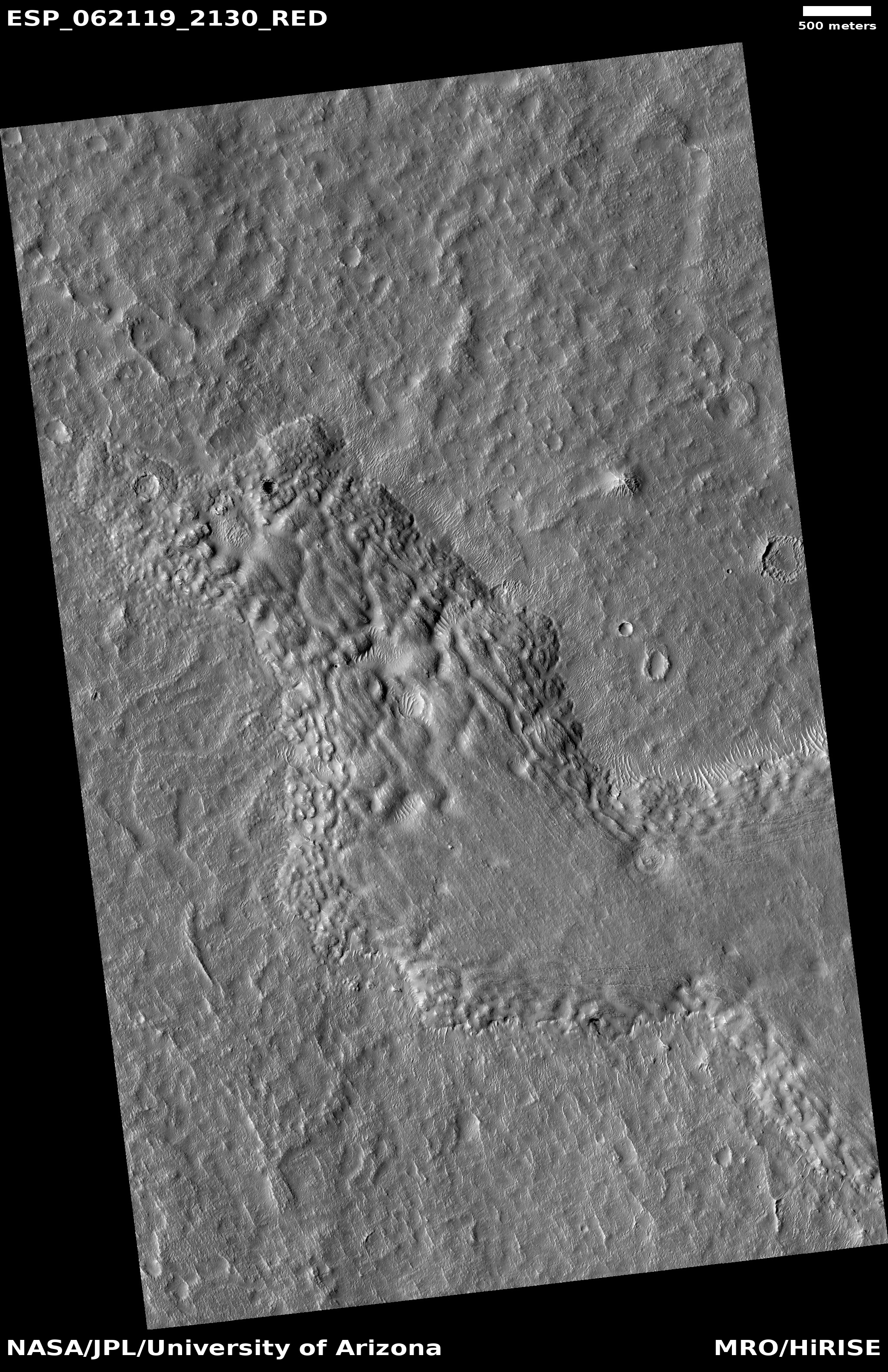
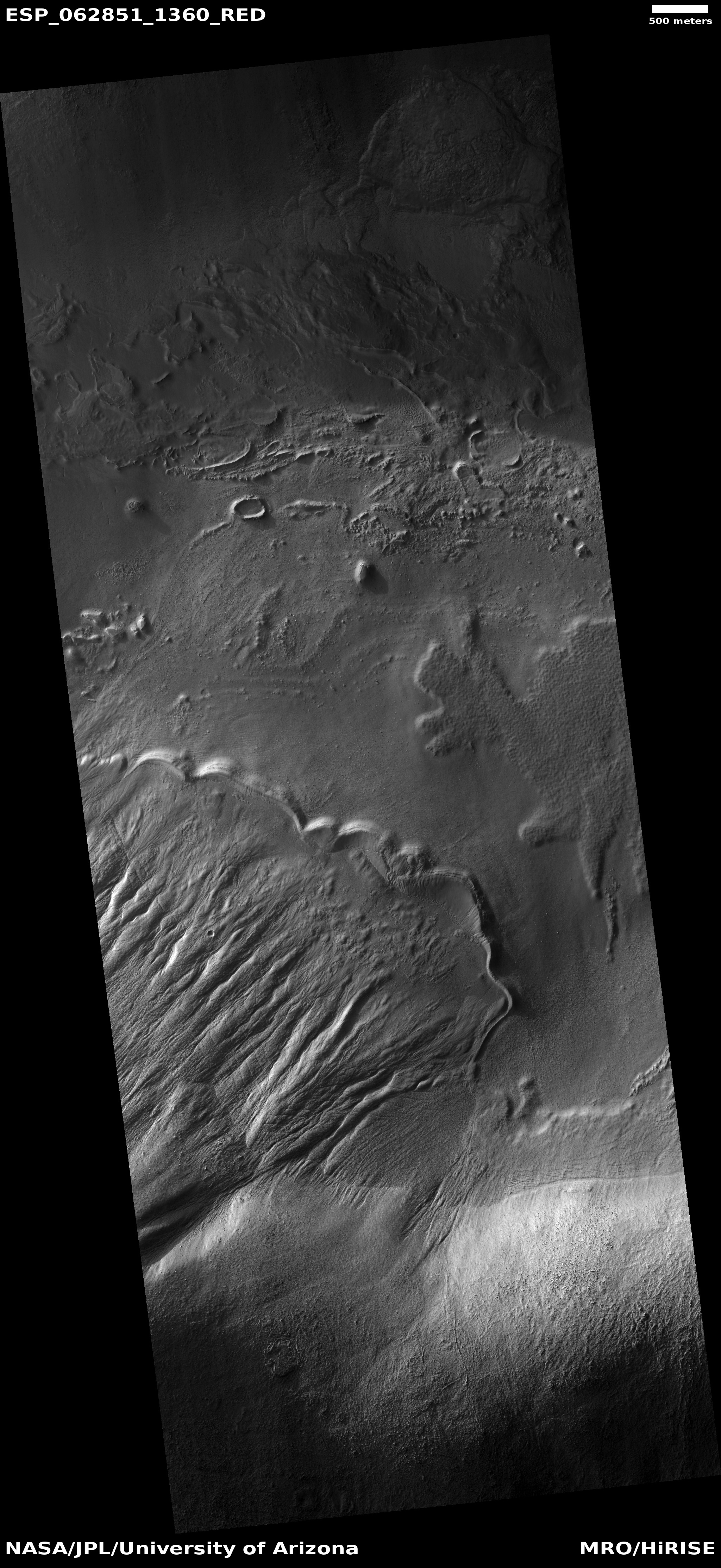
Cool image time! The photograph on the right, rotated, cropped, and reduced to post here, was taken by the high resolution camera on Mars Reconnaissance Orbiter (MRO) on December 21, 2019. It shows the eastern half of the floor and interior rim of a large squarish-shaped crater or depression in what seems to be an unnamed region of chaos terrain located in the transition zone between the Martian southern highlands and the northern lowland plains.

The floor of this depression has many of the features that indicate the presence of a buried ice glacier, including flow features on the depression floor, linear parallel grooves, and repeating moraine features at the slope base. In fact, all these features give the strong impression that this crater is ice-filled, to an unknown depth.

Chaos terrain, a jumble of mesas cut by straight canyons, are generally found in this transition zone, and could be an erosion feature produced by the intermittent ocean that some believe once existed in the northern lowlands. Whether or not an ocean lapped against these mesas and created them, this chaos terrain is believed to have been caused by some form of erosion, either wind, water, or ice.
Wide context view

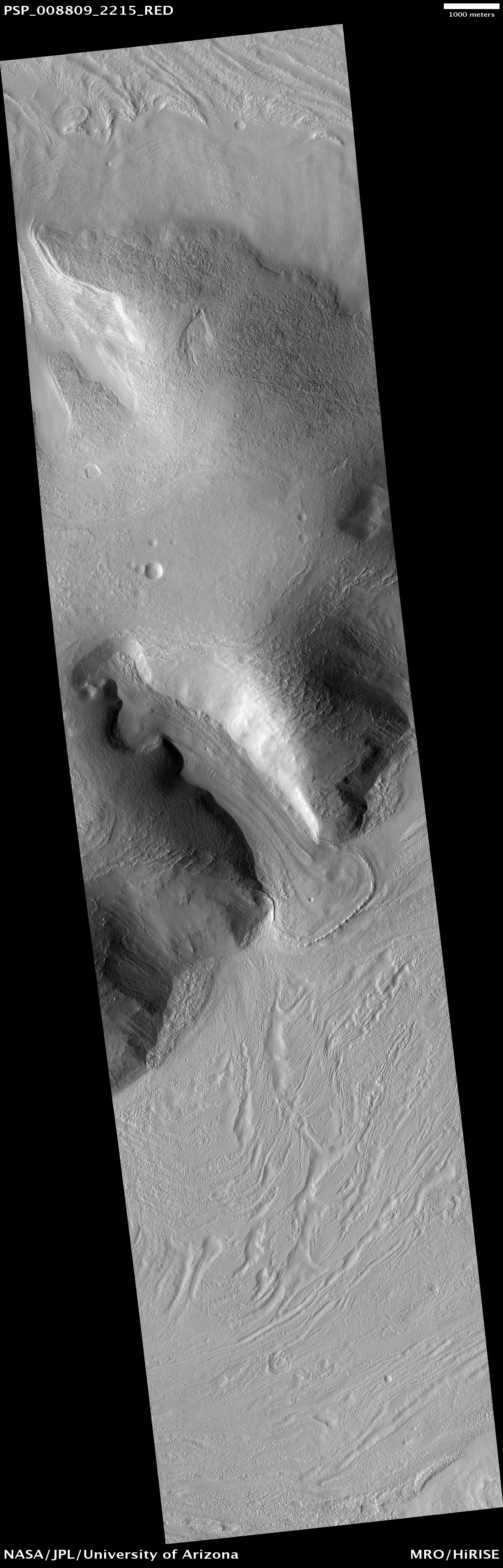
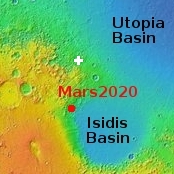
The location is of this chaos terrain in that transition zone is illustrated by the context map to the right. It sits on the edge of the vast Utopia Basin, one of the largest and deepest northern lowland plains. It also sits several hundred miles due north of the planned landing site of the Mars2020 rover in Jezero Crater. There is a lot of chaos terrain in this region, with lots of evidence of buried glaciers flowing off the sides of mesas.

Today’s image, with its numerous features suggesting the presence of a buried glacier filling the depression, reinforces this evidence.
Closer context view, showing the chaos terrain region

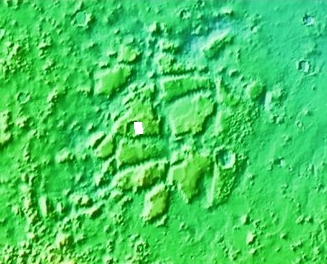
What impresses me most about this particular depression — should it be ice-filled — is its size. I estimate from the scale of the image that the depression is about six miles across, somewhat comparable though slightly smaller than the width of the Grand Canyon. And yet, unlike the Canyon it appears to have a wide flat floor across its entire width. The second context map to the right zooms in on this chaos region to show how relatively large the depression is. It would not be hard to spot it from orbit. We don’t know the depth, but even if relatively shallow this depression still holds a heck of a lot of water ice.

While the depression appears like a crater in lower resolution wider photographs, higher resolution images suggest it is not round but squarish. Why is not clear, and unfortunately MRO’s high resolution camera has taken no other images of it. This image was also one of their terrain sample photographs, taken not because of any specific research request, but because they need to use the camera regularly to maintain its temperature. This location, having few previous images, fit this schedule and made sense photographing.

Thus, no one appears to be specifically studying this location, making it a ripe subject for some postdoc student who wants to put their name on some Martian geology.
0 comments

The range for exposed ice scarps on Mars keeps growing

Overview of ice scarp locations on Mars

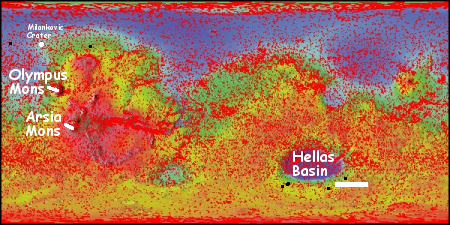
In January 2018 scientists announced the discovery of eight cliffs with visible exposed ice layers in the high mid-latitudes of Mars. At the time, those eight ice scarps were limited to a single crater in the northern hemisphere (Milankovic Crater) and a strip of land in the southern highlands at around latitude 55 degrees south.

In the past two years scientists have been using the high resolution camera on Mars Reconnaissance Orbiter (MRO) to monitor these scarps for changes. So far they have seen none, likely because the changes are below the resolution of the camera.

They have also been able to find more scarps in the southern hemisphere strip beyond that strip at 55 degrees south.

Now they have found more scarps in the northern hemisphere as well, and these are outside Milankovic Crater. As in the south, the new scarps are still all along a latitude strip at about 55 degrees.

The map above shows with the black dots the newer scarps located in the past two years. The scarp to the east of Milankovic Crater is typical of all the other scarps, a steep, pole-facing cliff that seems to be retreating away from the pole..

The scarp to the west of Milankovic Crater is striking in that it is actually a cluster of scarps, all inside a crater in the northern lowland plains. Moreover, these scarps are more indistinct, making them more difficult to identify. According to Colin Dundas of the U.S. Geological Surveyโ€™s Astrogeology Science Center in Arizona,
» Read more

1 comment

Remnant moraine on Mars

Remnant moraine on Mars
Click for full image.

Cool image time! Using both Martian orbiters and rovers scientists are increasingly convinced that Mars has lots of buried glaciers in its mid-latitudes. These glaciers are presently either inactive or shrinking, their water ice sublimating away as gas, either escaping into space or transporting to the colder poles.

The image to the right, cropped and reduced to post here, shows some apparent proof of this process. Taken by the high resolution camera of Mars Reconnaissance Orbiter (MRO) on December 23, 2019, it shows a weird meandering ridge crossing the floor of a crater. The north and south parts of the crater rim are just beyond the cropped image, so that the gullied slope in the image’s lower left is actually a slope coming down from that rim.

My first reaction upon seeing this image was how much that ridge reminded me of the strange rimstone dams you often find on cave floors, formed when calcite in the water condenses out at the edge of the pond and begins to build up a dam over time.

This Martian ridge was certainly not formed by this process. To get a more accurate explanation, I contacted Dan Berman, senior scientist at the Planetary Science Institute in Arizona, who had requested this image. He explained:
» Read more

1 comment

Martian dust devil!

Martian dust devil!
Click for full image.

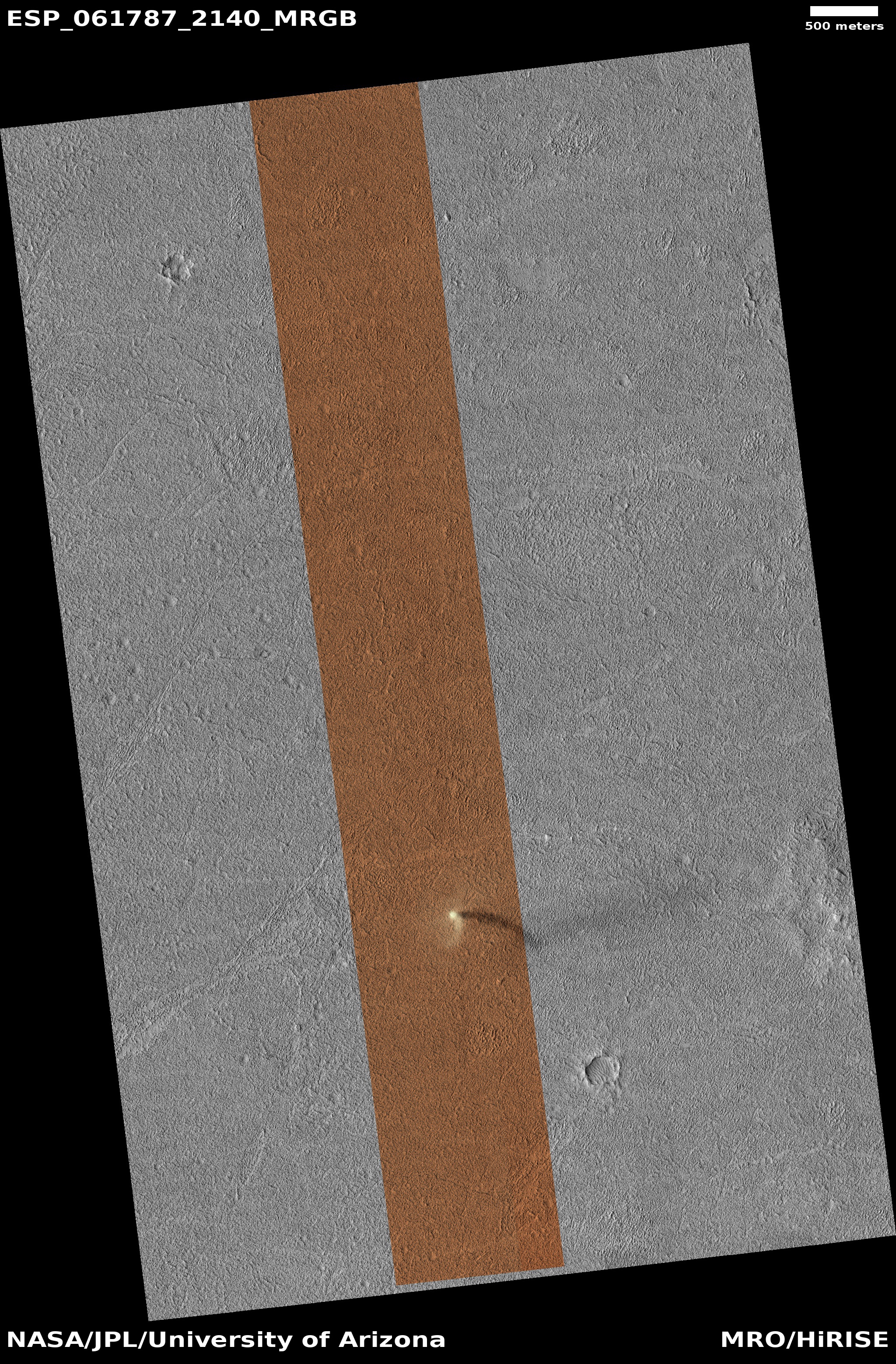
Cool image time! The science team for the high resolution camera today posted a new captioned image, cropped by me to the right to post here, showing an active Martian dust devil as it moves across the surface of Mars.

Dust devils are rotating columns of dust that form around low-pressure air pockets, and are common on both Earth and Mars. This Martian dust devil formed on the dust-covered, volcanic plains of Amazonis Planitia. The dust devil is bright, and its core is roughly 50 meters across. The dark streak on the ground behind the dust devil is its shadow. The length of the shadow suggests the plume of rotating dust rises about 650 meters into the atmosphere!

That’s about 2,100 feet tall, almost a half mile in height. The location, Amazonis Planitia, is part of the northern lowlands of Mars, flat and somewhat featureless. It is also somewhat near the region near Erebus Montes that is the candidate landing site for SpaceX’s Starship rocket, a region that appears to have a lot of ice just below the surface.

The science team also linked to a 2012 active dust devil image that was even more spectacular. I have also posted on Behind the Black a number of other dust devil images, highlighting this very active, dramatic, and somewhat mysterious aspect of the Martian surface:
» Read more

3 comments

A bullseye on Mars

Bullseye crater on Mars
Click for full image.

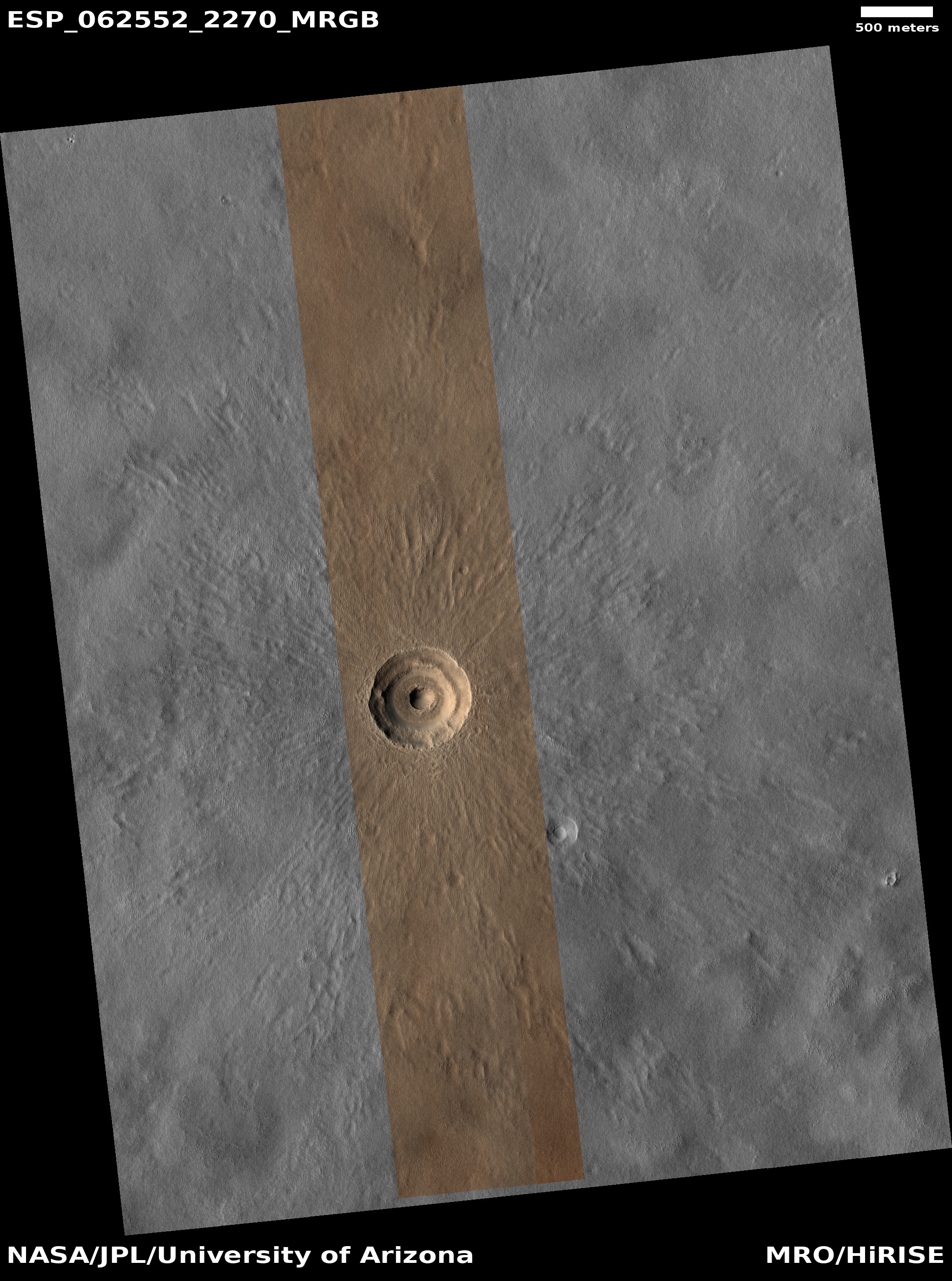
Cool image time! The photo on the right, cropped and reduced to post here, was taken by the high resolution camera of Mars Reconnaissance Orbiter (MRO) on November 30, 2019. It shows a lone crater on the flat northern lowlands of Mars in a region dubbed Arcadia Planitia.

The crater is intriguing because of its concentric ridges and central pit. As this region is known to have a great deal of subsurface water ice, close to the surface, these features were probably caused at impact. My guess is that the ice quickly melted, formed the kind circular ripples you see when you toss a pebble in a pond, but then quickly refroze again, in place.

This location is also of interest in that is it just north of the region that SpaceX considers the prime candidate landing site for its Starship manned spaceship.

1 comment

The cliff at the end of Chasma Boreale on Mars

The cliff at the end of Chasma Boreale
Click for full image.

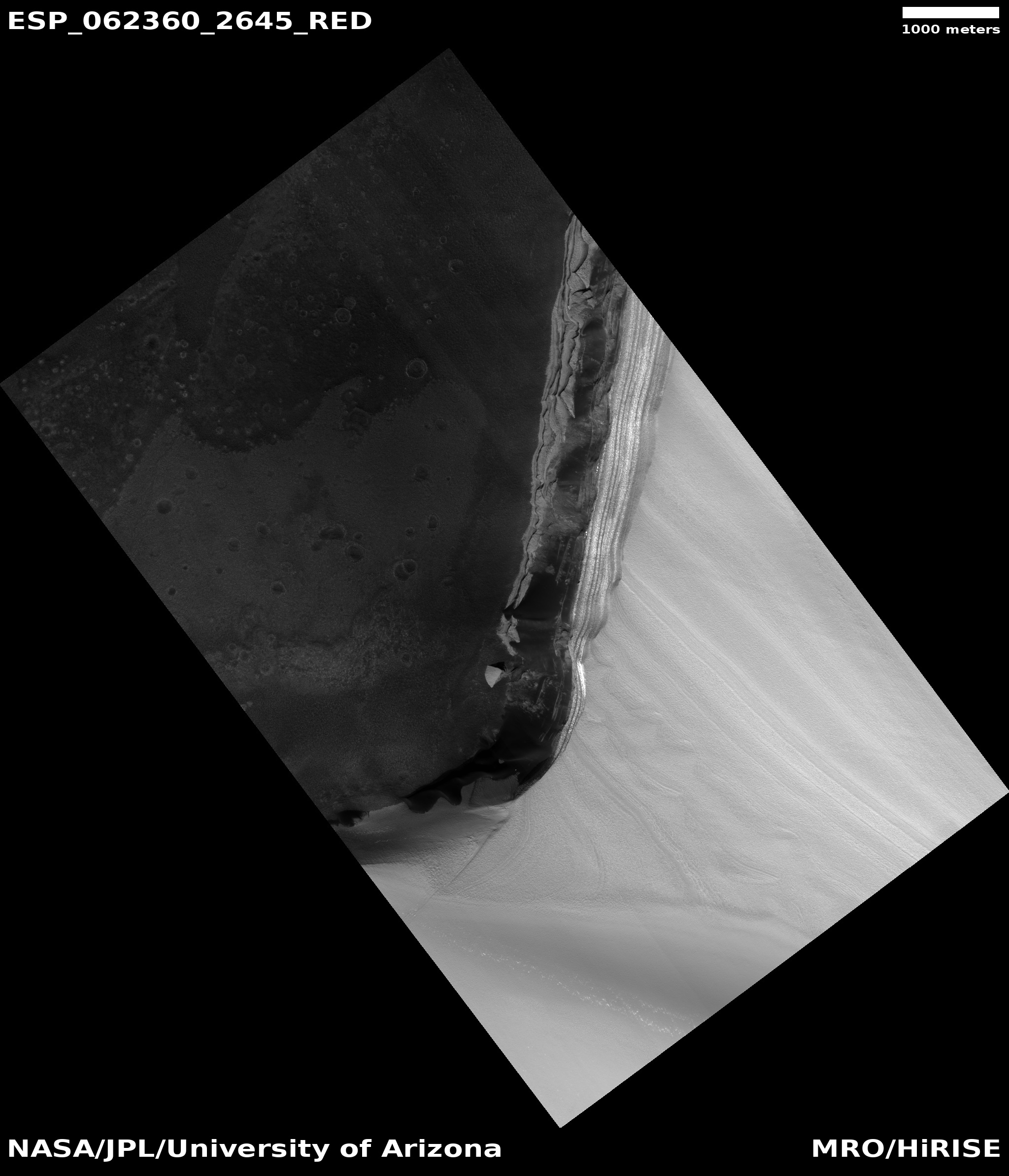
Cool image time! The image to the right, cropped to post here, was taken by the high resolution camera on Mars Reconnaissance Orbiter (MRO) on November 15, 2019 during the height of the Martian summer in the northern hemisphere. It shows the scarp of the polar ice cap, looking directly down that scarp at what the MRO image post dubs an “exposure of basal unit”, or the bottom of the cap itself. This suggests that the base of that cliff is no longer ice, but the bedrock below it. If this cliff is similar to other scarps off the polar ice cap it should be at least 1,600 feet tall. It might be more, however, as the elevation difference between the cap and the floor of this basin is estimated by scientists to be more than a mile total.

This scarp however is different than the outer icecap scarps where avalanches occur with great frequency during the spring and summer. Instead, it is located in the heart of the ice cap, at the very end of the gigantic canyon Chasma Boreale that slashes a deep cut into that ice cap, practically cutting it in half.

Overview

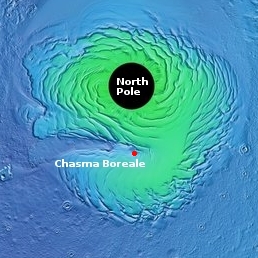
The overview map on the right, with the red dot showing where this image is located, illustrates the cutting nature of Chasma Boreale. The canyon itself is 350 miles long with a width of about 75 miles at its beginning and with walls that at some points rising a mile in height.

Scientists theorize this canyon was formed by melting ice from cap that built up at the cap’s base, causing erosion and collapse, with the flow following the grade down hill from this end point out to the lowland plains beyond. It is also possible winds played a part in this process, encouraging the canyon formation.

0 comments

Frozen lava that flowed from Elysium Mons

Lava flows off of Elysium Mons
Click for full image.

Cool image time! The photo on the right, rotated, cropped, and reduced to post here, was taken by the high resolution camera on Mars Reconnaissance Orbiter (MRO) on October 27, 2019. It shows a dramatic lava flow coming off the flanks of the giant volcano Elysium Mons, a flow that has probably been frozen in place for somewhere between 600 million to 3.4 billion years.

If you look close you can see several craters on top of the lava flow. To my eye these impacts look like they occurred when the lava was still soft, which suggests they were debris thrown up by the volcano. This however would be surprising, as the eruption of Elysium Mons is not thought to have been explosive, but slow and steady. Either way, these crater impacts are one of the ways scientists have been able to estimate the age of this volcano and its long frozen flows.

MRO has taken a scattering of high resolution images in this area, all of which are aimed at similar frozen flows coming off the volcano. All are about 250 miles from the caldera, which gives you a sense of the size and extent of Elysium Mons. While it is the fourth largest volcano on Mars at 7.5 miles high, its grade is so gentle that if you were standing on the surface the peak would be hard to see from any point.

0 comments

How to spot a glacier on Mars

A glacier on Mars
Click for full image.

Overview map

The science team for the high resolution camera on Mars Reconnaissance Orbiter (MRO) today posted a nice lesson on what features to look for when you are trying to find glaciers on Mars.

To do this they used one of the earliest images of a Martian glacier, taken by MRO on June 12, 2008. The image to the right, cropped and reduced to post here, shows that entire glacier, coming off a mesa in the chaos terrain region of Protonilus Mensae, a region of mesas and glaciers that I highlighted in an earlier post in December, showing images of a mesa that had numerous glaciers flowing down from all sides.

The overview map to the right shows the location of both that earlier glacier-surrounded mesa (the red dot in Protonilus Mensae) and today’s image (the blue dot).

What the MRO science team has done with the image today however is to use it to illustrate the most important geological features that one will see when looking at a Martian glacier.
» Read more

0 comments

A Martian avalanche: before and after

A Martian avalanche: before and after
Click for full resolution animation.

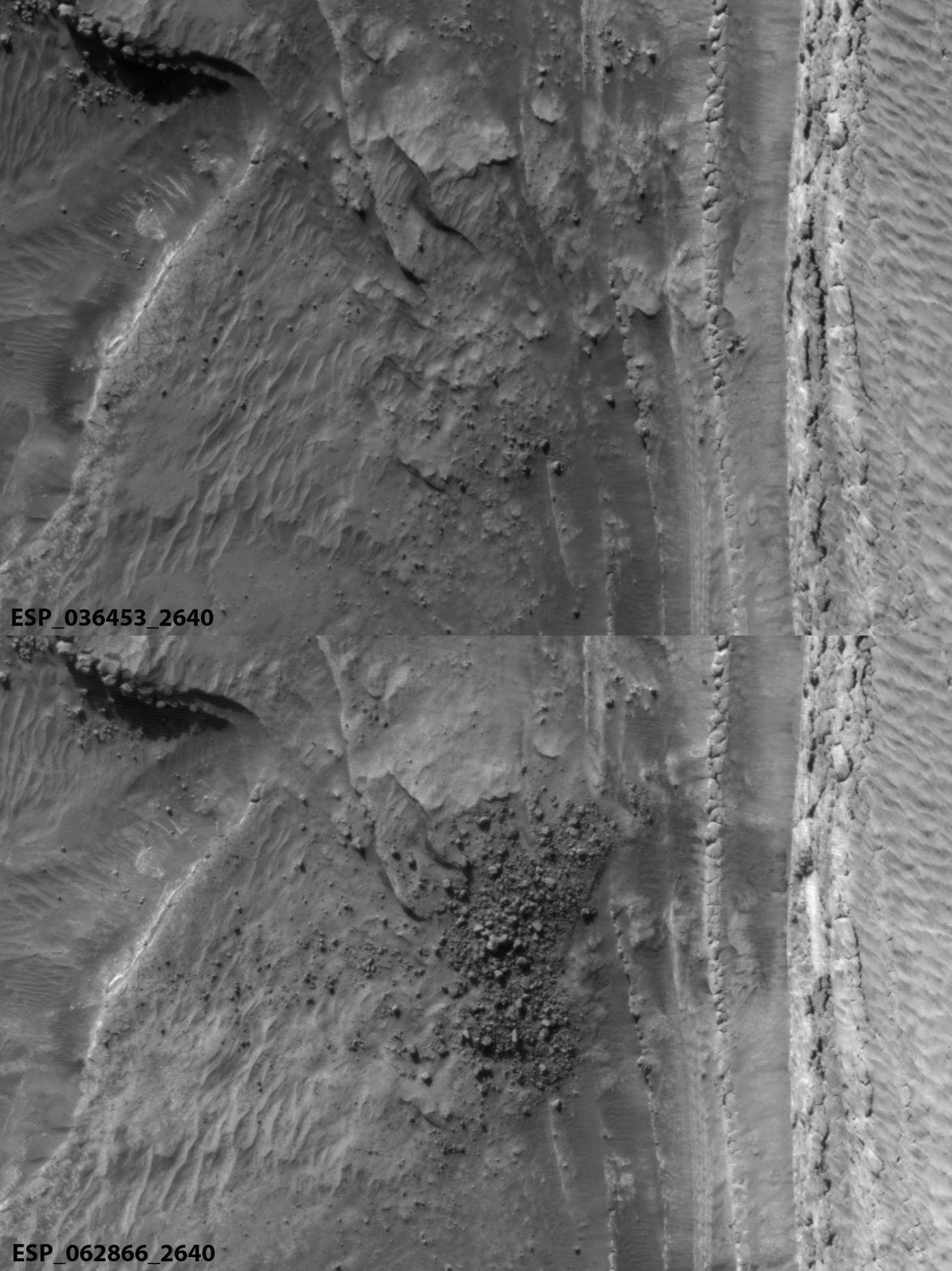
Cool image time! The science team for the high resolution camera of Mars Reconnaissance Orbiter (MRO) today released a beautiful blink animation showing the before and after terrain at an avalanche site along the scarp of Mars’s north pole ice cap.

The animation is very cool, but it is also helpful to align the two images next to each other to carefully study what actually changed. The image to the right, cropped and reduced here, shows both photos. (Thank you to planetary scientist Shane Byrne for splitting the animation for me.). I have added the white bars to indicate the cliff section that broke off during the avalanche. That section was made of water ice, with probably some dust and rocks mixed in, and broke into the blocks that are now scattered on the ground below.

This avalanche itself is actually not unusual and as I noted in an earlier post, is part of an annual season of numerous avalanches that occur on this northern scarp of the polar ice cap each spring. As written by Dr. Candice Hansen of the Planetary Science Institute in Tucson, Arizona,

Every spring the sun shines on the side of the stack of layers at the North Pole of Mars known as the north polar layered deposits. The warmth destabilizes the ice and blocks break loose. When they reach the bottom of the more than 500 meter tall cliff face [about 1,600 feet], the blocks kick up a cloud of dust.

And as Byrne noted to me in an interview when I asked him how it was possible for MRO to image so many avalanches, as they occur,

โ€œIt is incredible. I think this is the most incredible thing about the whole process.โ€ said Byrne. โ€œIf you fly over a mountain range on the Earth and take a picture, the chances catching an avalanche in progress are almost zero. But on Mars half of the images we take in the right season contain an avalanche. Thereโ€™s one image that has four avalanches going off simultaneously at different parts of the scarp. There must be hundreds to thousands of these events each day.โ€

In an email exchange with him today, he also added that this is not the first before and after comparison images obtained. “Weโ€™ve been seeing these blockfalls for several years now. Thatโ€™s partly why these scarps are being so intensively monitored by HiRISE.”

Do these avalanches mean that the Martian northern polar ice cap is shrinking? Maybe, maybe not. Right now scientists think the cap is in a steady state, neither growing or shrinking. These events are thus more likely comparable to the routine calving of ice sections from the foots of glaciers here on Earth, a common tourist destination in the waters of western Alaskan coast.

9 comments

Strange parallel grooves in Martian crater floor

Parallell ridges and ruts in Martian crater floor
Click for full image.

Full crater view
Click for full image.

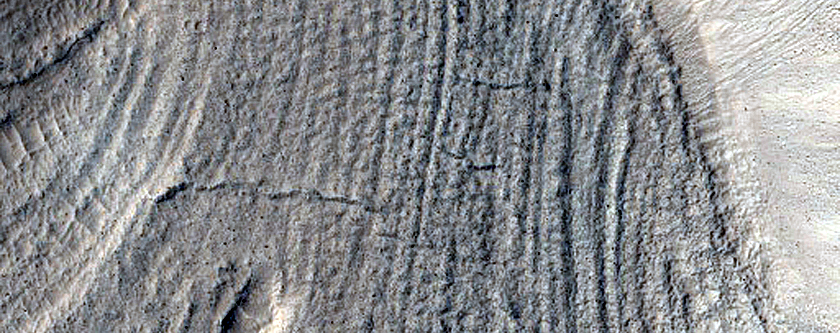
Cool image time! The image above, cropped to post here, was taken on December 2, 2019 by the high resolution camera of Mars Reconnaissance Orbiter (MRO) of a crater in the northern lowlands of Mars. It focuses in on the strange lineated ruts and ridges found on the crater’s central floor, as indicated by the black box on the wide shot to the right.

The north-south alignment of these groves suggests to me that they are wind caused, as if dust and sand had ponded in the crater’s lowest point and was then shaped by the prevalent winds. They also appear solid and old, as if this shaping occurred a long time ago and they are now decaying with time.

This location is at the same latitude as the plains around Erebus Montes, the prime candidate landing site for SpaceX’s Starship, and a region where a lot of shallow subsurface ice has been detected. It lies due west of that region, separated by the north-south Phlegra Montes mountain chain. At this latitude, 36 degrees north, scientists have found ample evidence of water ice, though some regions have more than others. This crater sits on the edge of this particular rich area, which might explain why the crater looks more solid and dry than others at similar latitudes. There simply might be less ice here, or the ice lies deeper below the surface.

I am off with Diane on a hike this morning, so this cool image fills in for my normal morning news posting. I should catch up this afternoon.

0 comments

More Martian pimples

More pimples on Mars
Click for full image.

In a captioned image release last week from the science team of the high resolution camera on Mars Reconnaissance Orbiter (MRO), planetary scientist Alfred McEwen describes a string of mounds aligned and deformed by a fissue.

The image, cropped and reduced to post here, is to the right. As McEwen notes,

A possible geologic interpretation is that as the rift began to open, subsurface material (perhaps mud) erupted to create the mounds, which were then deformed as the rift continued to spread.

Located in Chryse Planitia, the region of the northern lowland plains just north of the outlet from Valles Marineris, these mounds and their probable geological origin seem very similar to the pimple mounds I highlighted in a cool image only last week. The only difference is that the earlier posted pimples were not aligned with any obvious fissure or rift.

0 comments

Inexplicable ridges on Mars

Inexplicable ridges on Mars
Click for full image.

Don’t ask me to explain the geology on today’s cool image, rotated, cropped and reduced above. Taken by the high resolution camera on Mars Reconnaissance Orbiter (MRO) on August 16, 2019, the image’s uncaptioned website merely calls these “Convergent and Overlapping Narrow Curved Ridges.”

I don’t know why the sand in the hollows appears light blue, or even if it is sand. I don’t know what created the ridges, or why they seem to overlap each other randomly, or why they seem to peter out to the south.

I am sure there are planetary scientists out there who have theories that might explain these features. I also know that they would forgive me if I remained skeptical of those theories. This geology is a puzzle.

Hellas Basin, the basement of Mars

The location of these ridges is in the southeast corner of Hellas Basin, which I like to call the basement of Mars as it is the equivalent of the United States’ Death Valley, having the lowest relative elevation on the planet. As I have noted previously, the geology in this basin can be very strange. To my eye it often invokes a feeling that we are looking at Mars’s “uttermost foundation of stone” (to quote Tolkien), frozen lava that flowed in many ways and then froze in strange patterns.

Or not. Your guess is as good as mine.

3 comments
1 73 74 75 76 77 90