Black dunes and weird hills on Mars

Black dunes and weird hills on Mars
Click for full image.

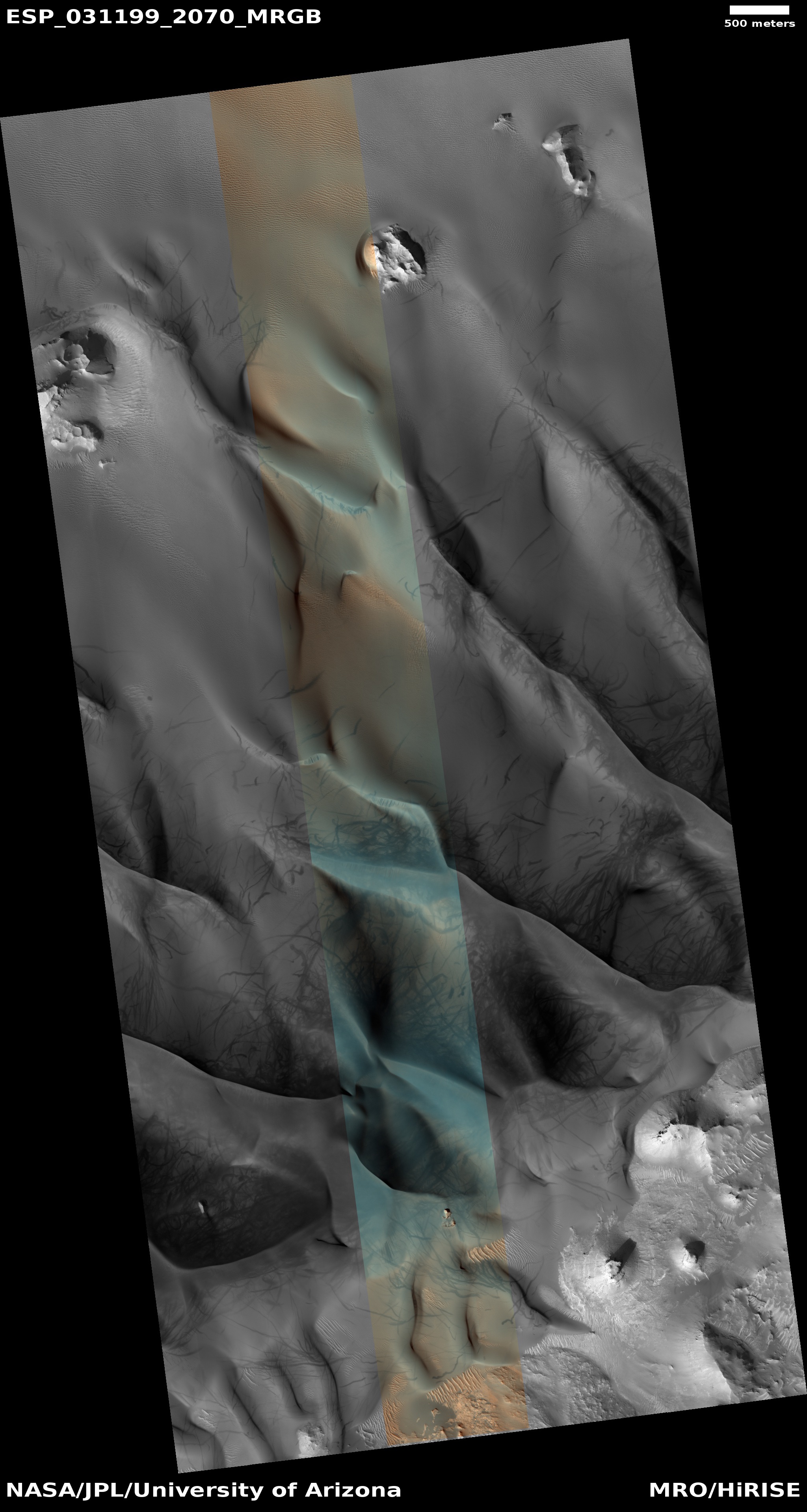
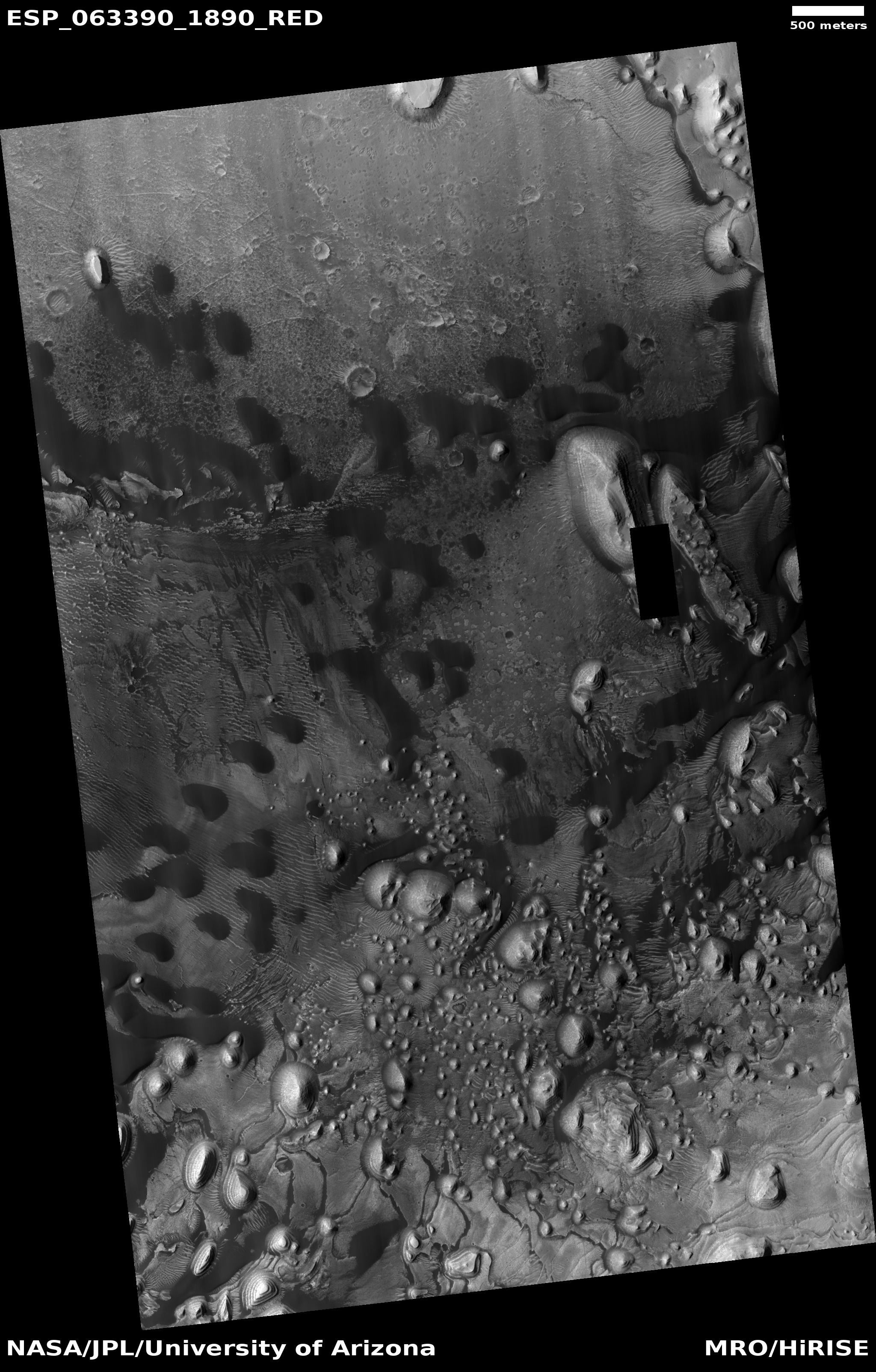
Cool image time! Or I should say a bunch of cool images! The photo on the right, rotated, cropped, reduced, and annotated by me, was taken by the high resolution camera on Mars Reconnaissance Orbiter (MRO) on February 3, 2020. An uncaptioned image, it was entitled “Arabia Terra with Stair-Stepped Hills and Dark Dunes.” Arabia Terra is one of the largest regions of the transition zone on Mars between the northern lowland plains and the southern cratered highlands. It is also where Opportunity landed, and where Europe’s Rosalind Franklin rover will land, in 2022.

This image has so many weird and strange features, I decided to show them all, Below are the three areas indicated by the white boxes, at full resolution. One shows the black dunes, almost certainly made up of sand ground from volcanic ash spewed from a long ago volcanic eruption on Mars.
» Read more

1 comment

Martian dust devil tracks come and go

The changing surface of dunes on Mars
Click for full image.

Earlier image of the same dunes
Click for full image.

Cool image time! To understand what created the vastly strange and alien Martian surface, it will be necessary for scientists to monitor that surface closely for decades, if not centuries. To the right is one small example. Taken by the high resolution camera of Mars Reconnaissance Orbiter (MRO) and rotated, cropped, and reduced to post here, it shows a dune field inside a crater in the southern cratered highlands of Mars. Craters have been found to be great traps for dust and sand on Mars. Once the material is blown inside, the winds are not strong enough to lift the material out above the surrounding rims. Thus you often get giant dunes inside craters, as we see here.

What makes this location of interest to planetary scientists is the changing surface of these dunes. They have been monitoring the location since 2009. In 2013, the MRO science team released a captioned photograph, the second image to the right, also rotated, cropped, and reduced by me to match the same area in the top image. In that caption planetary scientist Corwin Atwood-Stone of the Lunar and Planetary Laboratory in Arizona wrote,

This area was previously imaged in August 2009, about two Mars years ago, and in that image dust devil tracks were also visible. However the tracks visible now are completely different from the earlier ones. This tells us that there has been at least one dust storm since then to erase the old tracks, and lots of dust devil activity to create the new ones.

Since then the MRO science team has taken repeated images of this location to monitor how the dust devil tracks change, as well as monitor possible changes to the dunes themselves, including avalanches. The newest image above shows the result of the global dust storm last year. It wiped out the dust devil tracks entirely.

The newer image was entitled, “Monitor Dune Avalanche Slopes,” but I couldn’t find any examples. Based on published research, I am sure there is something there, even if I couldn’t find them. Maybe my readers have a better eye than I.

0 comments

Martian badlands

The Tyrrhena Terra badlands
Click for full image.

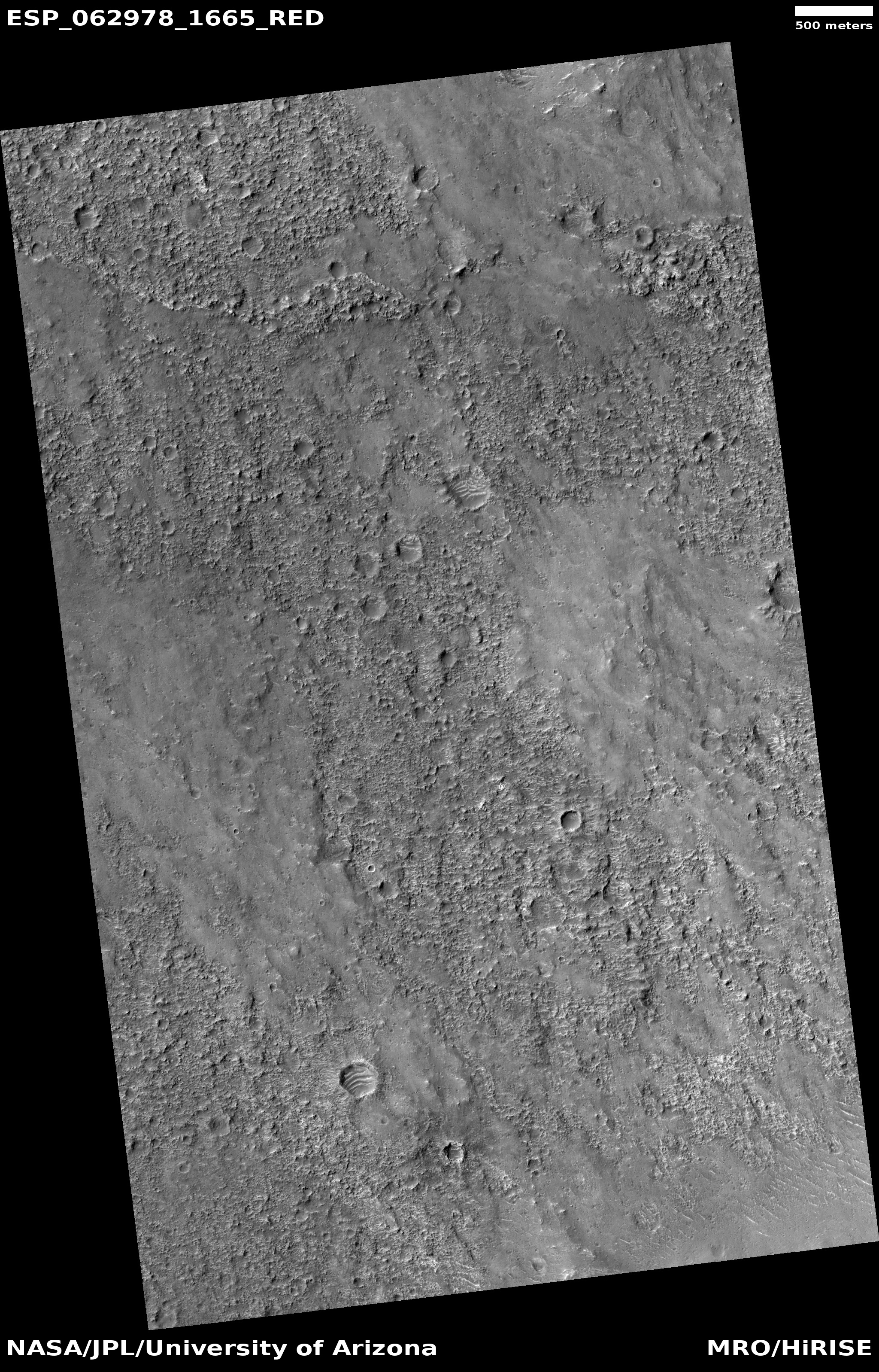
The photo to the right is a small section cropped from an image taken by the high resolution camera on Mars Reconnaissance Orbiter (MRO) on January 2, 2020. It shows the rough, cratered southern highlands dubbed Tyrrhena Terra that lie between the low Isidis Basin to the north and Mars’ deepest basin, Hellas, to the south.

The image was taken not because any specific scientific request, but because MRO was doing spectroscopy over this area and it made sense to also take a photograph. Comparing the photograph with the spectroscopic data allows scientists to better understand that spectroscopy.

The white cross in the map below shows the location of this image. The map itself covers latitudes from 40 degrees north to 55 degrees south.
» Read more

5 comments

Rolling boulders on Mars

Boulder tracks on Mars
Click for full image.

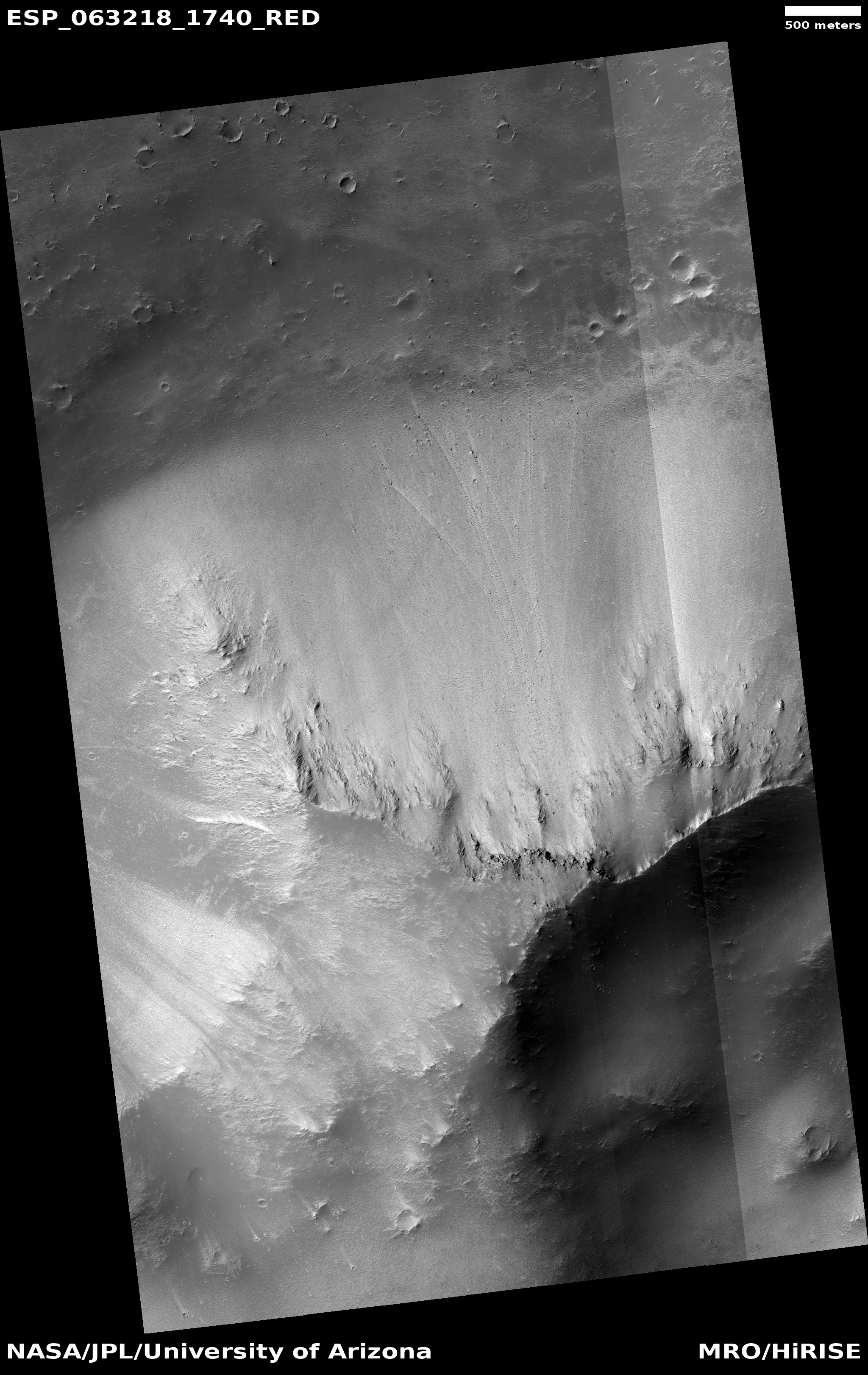
Cool image time! The photo to the left, cropped to post here, was taken by the high resolution camera on Mars Reconnaissance Orbiter (MRO) on January 21, 2020, and shows several boulders at the bottom of a slope, along with the tracks those boulders made as they rolled downhill sometime in the far past.

Uphill is to the south. We know the dark spots at the end of these tracks are large boulders partly because of the wind streaks emanating away from them to the north. As the wind goes around each rock it produces eddies that produce the tracks. Based on the scale and the image resolution (about 10 inches per pixel), these boulders range in size from about one to five feet in diameter.

This image has two points of interest. First, the tracks left by the boulders seem to have a repeating pattern. My guess is that the pattern most likely formed because the boulders are not spherical in shape, and as they rolled each roll repeated a certain pattern reflecting that shape. This theory is reinforced by a close look at each boulder. Though the resolution is insufficient to resolve the boulders themselves, the pixel distribution for each strongly suggests an asymmetric shape.

Second, this image, when compared with an earlier MRO image of the same spot, taken fourteen years ago in December 2006, shows no obvious change. These tracks, and their boulders, have therefore probably sat here, as we see them, for a long time. Since there appear to be two sets of tracks, with one overlying the other, this suggests that two separate events (an earthquake or nearby impact) each time caused a bunch of boulders to break free and roll downward together, with the second set of boulder tracks crossing over the earlier set.

Establishing when those two events occurred, however, will require some on-site data, something that will likely not occur until humans roam the surface of Mars in large numbers.

0 comments

Summer at the Martian North Pole

Buzzell pedestal crater in context with polar icecap scarp
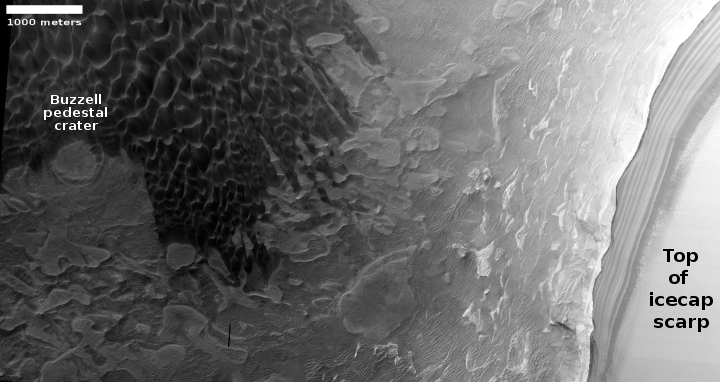
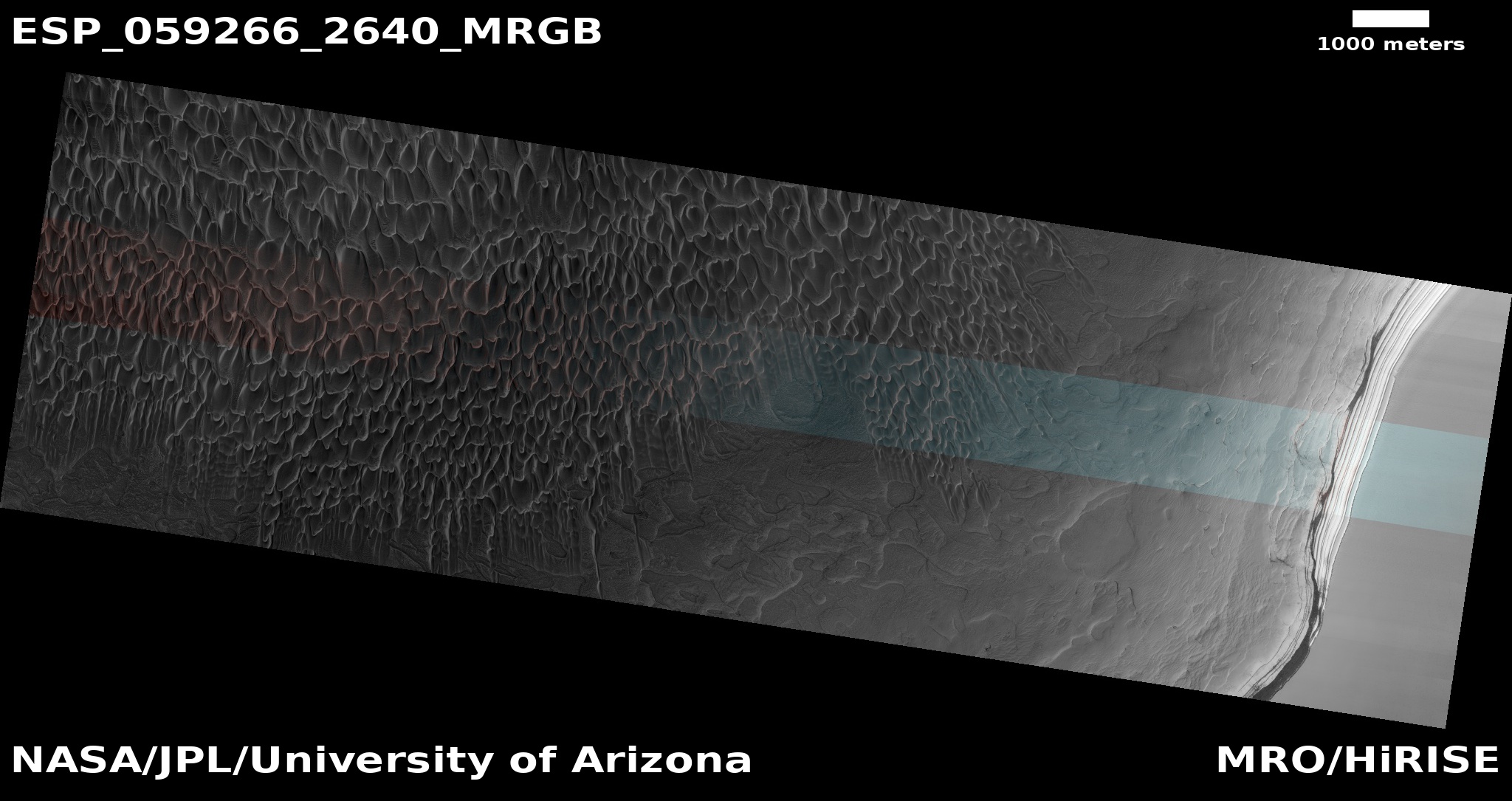
Cool image time! The image above, cropped, reduced, and brighten-enhanced to post here, was taken by the high resolution camera of Mars Reconnaissance Orbiter (MRO) on December 26, 2019 of the dunes just below the 1,500 to 3,000 foot high scarp that marks the edge of the Martian north polar icecap. I have brought up the brightness of the dune area to bring out the details.

This one image shows a range a very active features at the Martian north pole. At this scarp scientists have routinely photographed avalanches every Martian spring, as they have been occurring, caused by the warmth of sunlight hitting this cliff wall and causing large sections to break off. As Shane Byrne of the Lunar and Planetary Lab University of Arizona explained in my September 2019 article,

On Mars half of the images we take in the right season contain an avalanche. There’s one image that has four avalanches going off simultaneously at different parts of the scarp. There must be hundreds to thousands of these events each day.

Buzzell dunes, March 19, 2019
Click for full image.

On the left side of the image is an area of dunes that Candice Hansen of the Planetary Science Institute in Arizona has dubbed “Buzzell.” As spring arrives here, she has MRO regularly take images of this site (as well as about a dozen others) to monitor the changes that occur with the arrival of sunlight on the vast dune seas that surround that polar icecap.

The image to the right zooms in on one particular distinct feature, a pedestal crater, surrounded by dunes, that I have labeled on the image above. This image was taken just as spring began, with the Sun only five degrees above the horizon. At that time the dunes and pedestal crater were mantled by a frozen layer of translucent carbon dioxide that had fallen as dry ice snow during the sunless winter and then sublimates away each Martian summer.

Since March I have periodically posted updates to monitor the disappearance of that CO2 layer. (See for example the posts on August 2019 and November 2019.) Below are two more images, showing the ongoing changes to this area from early to late summer.
» Read more

2 comments

Glacial breakup on Mars

glacial breakup on Mars
Click for full image.

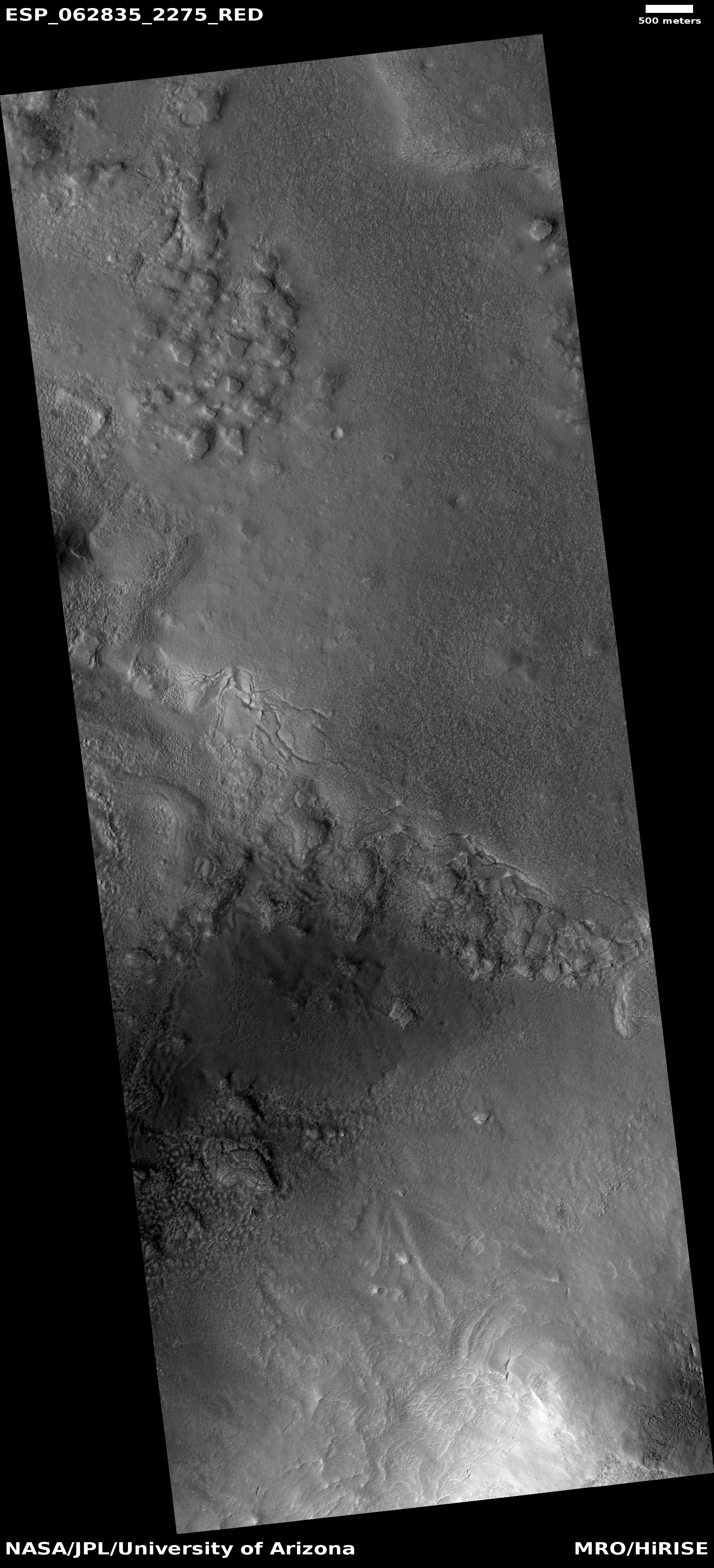
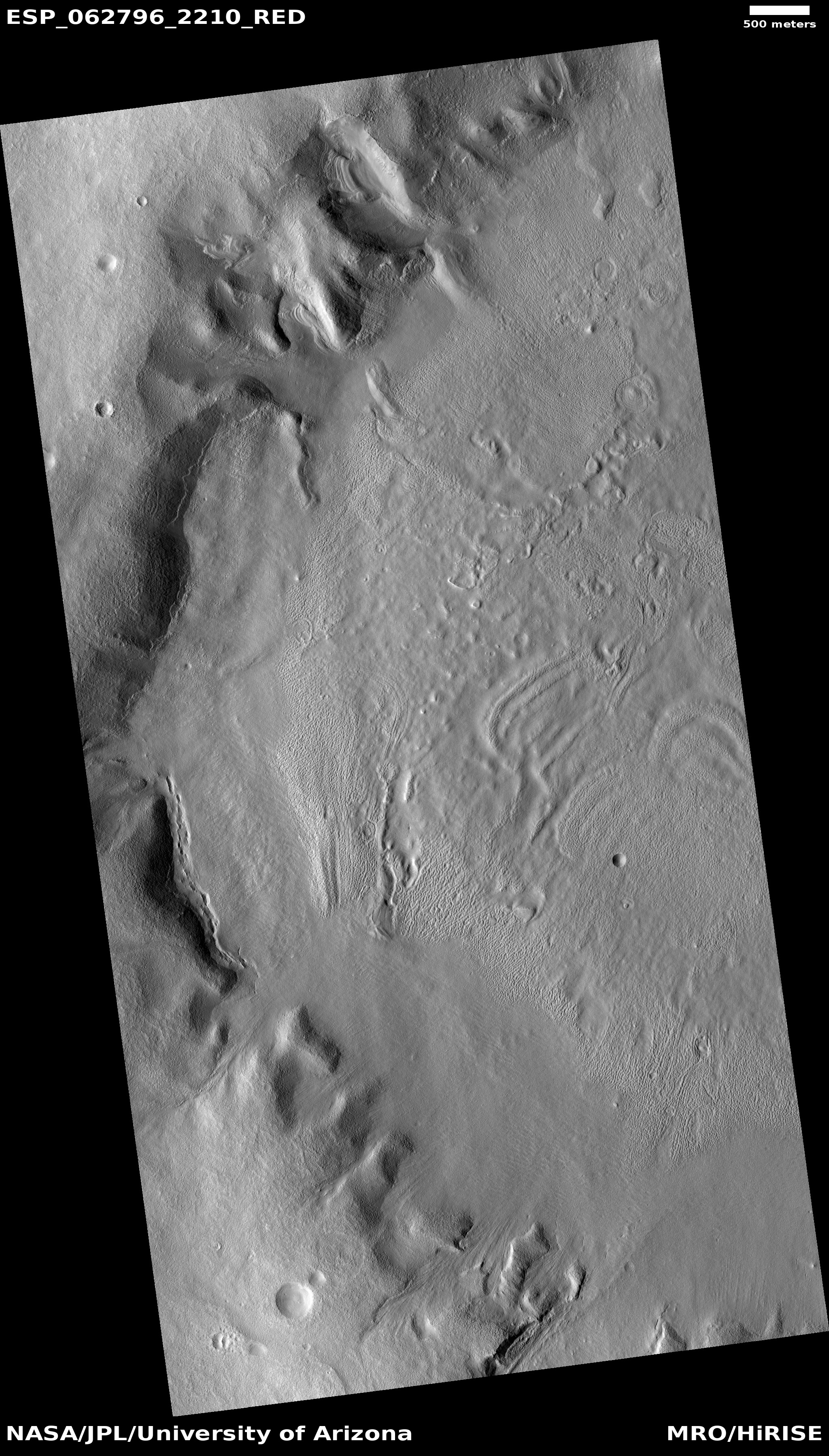
Cool image time! The photograph to the right, cropped and reduced to post here, was taken by the high resolution camera on Mars Reconnaissance Orbiter on December 22, 2019 and was titled “Contact Between Debris Apron and Upper Plains in Deuteronilus Mensae”.

The section of the full image that I have focused on shows what appears to be the downhill break-up of the surface debris covering an underlying water ice glacier. The grade is downhill to the south.

I am confident that this is buried glacial material based on recent research:

Both of these reports found lots of evidence of shallow ice in Deuteronilus Mensae, a region of chaos terrain in the transition zone between the Martian northern lowlands and the southern highlands.

With this image we see what appears to be the slippage of that ice downslope, causing breakage and cracks on the surface, with much of that surface made up of the dust and debris that covers the ice and protects it. Towards the bottom of the image it even appears that the disappearing ice is unveiling the existence of a bunch of buried bedrock mesas, typical of chaos terrain, previously hidden by the ice because it filled the surrounding canyons.

Below is a close-up of the photograph’s most interesting area of break-up.
» Read more

1 comment

Peering into a Martian pit

Peering into a pit
Click for full image.

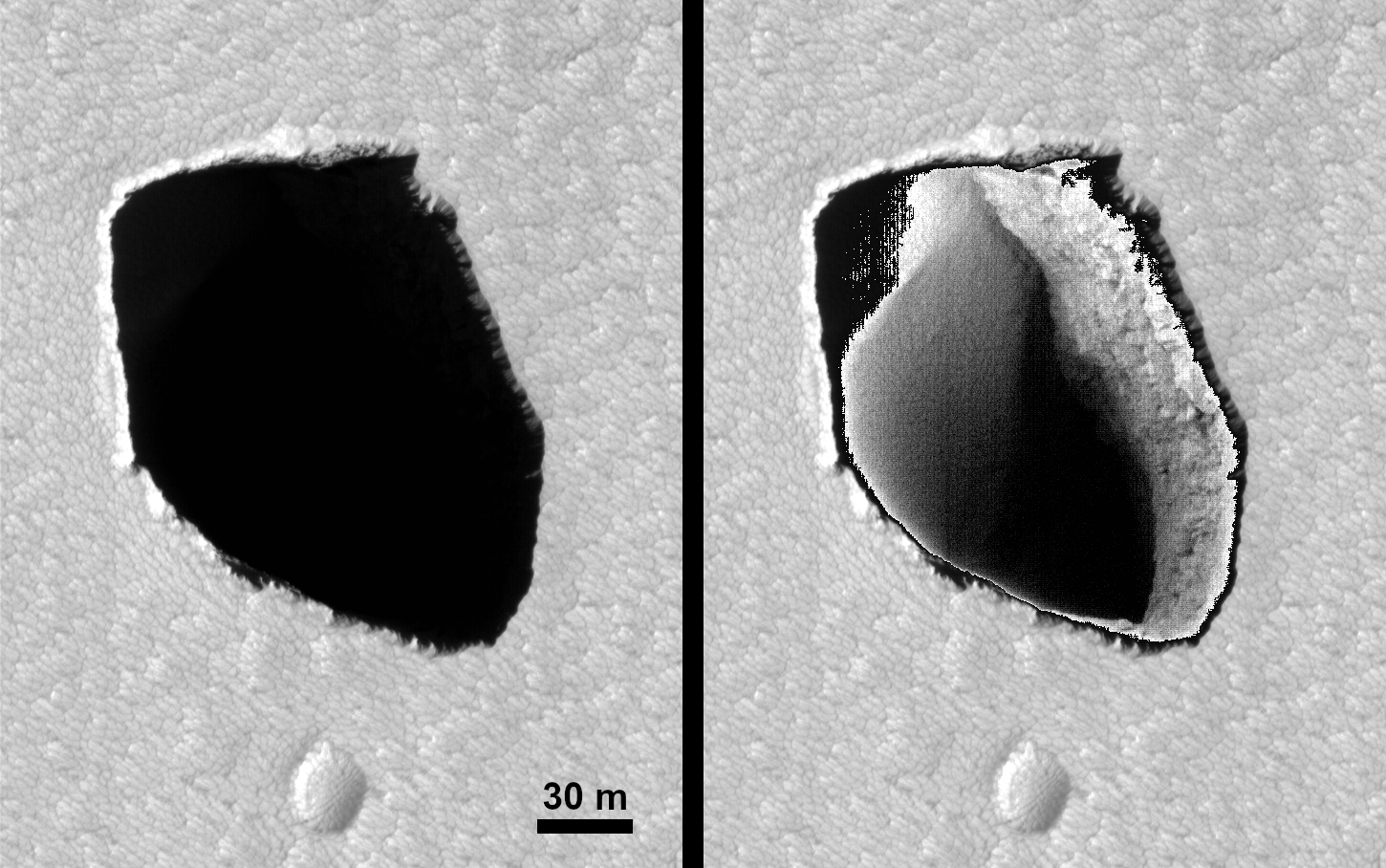
Cool image time! The science team for the high resolution camera on Mars Reconnaissance Orbiter last week released the above image of a pit to the west of the giant volcanoes Arsia and Pavonis Mons. The left image is without any adjustments in exposure. The right image has brightened the pit’s interior to bring out details in order to see what’s there. As planetary scientist Ross Beyer of Ames Research Center noted in his caption:

The floor of the pit appears to be smooth sand and slopes down to the southeast. The hope was to determine if this was an isolated pit, or if it was a skylight into a tunnel, much like skylights in the lava tubes of Hawai’i. We can’t obviously see any tunnels in the visible walls, but they could be in the other walls that aren’t visible.

Wider view of pit
Click for full image.

Because the image has been rotated 180 degrees, north is down. The northern wall of the pit appears to be either very vertical, or overhung. A tunnel might head north from here, but because of the angle of the photograph, this cannot be confirmed.

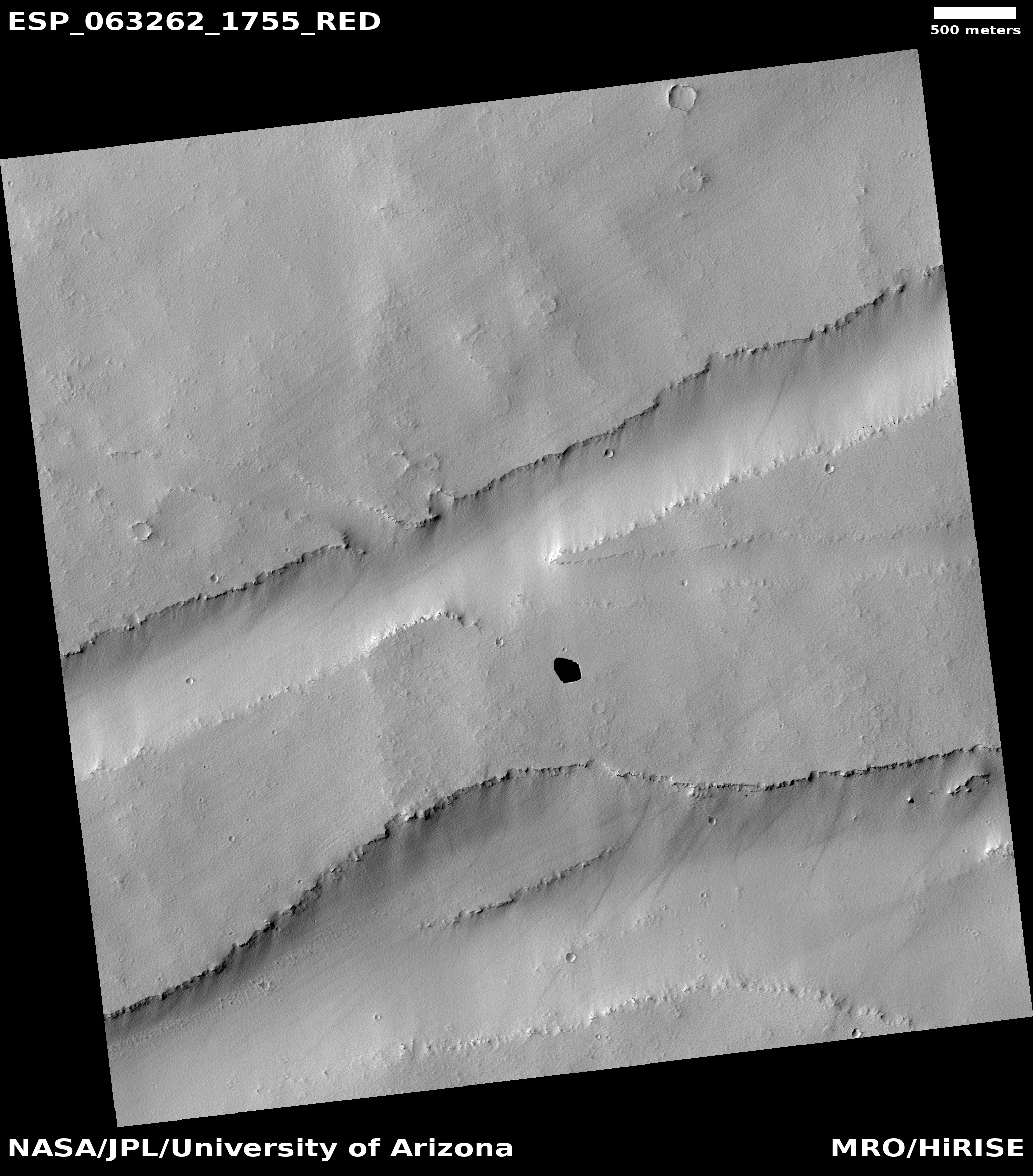
To the right is a wider look from the full photograph, showing the surrounding terrain, with north now to the top. In line with this pit is a depression that crosses the east-west canyon to the north. This alignment strongly suggests that a fault or fissure exists here, and that an underground void along this fissure line could exist. It also suggests that a deeper and larger void could exist below that larger canyon.

This pit, and the accompanying fissures, were likely caused by crack-widening along these faults, produced as this volcanic region bulged upward.

Map of knowns pits surrounding Arsia Mons

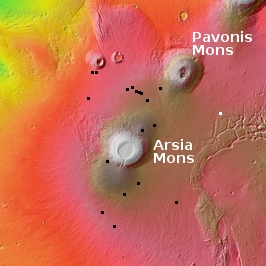
This pit is also one of the many many pits found near these volcanoes. The map to the right shows by the black boxes all the pits documented by the high resolution camera on MRO in the past few years, with this new pit indicated by the white box.

Beginning in November 2018 until November 2019 I was almost doing a monthly post reporting the new pits photographed by MRO. Since November however the number of new pit images dropped. This is not because every pit has been imaged, but because it appears they have completed their initial survey.

Below is a list of all those previous pit posts:
» Read more

2 comments

Enclosed Martian canyon, filled with ice

Ice-filled canyon on Mars
Click for full image.

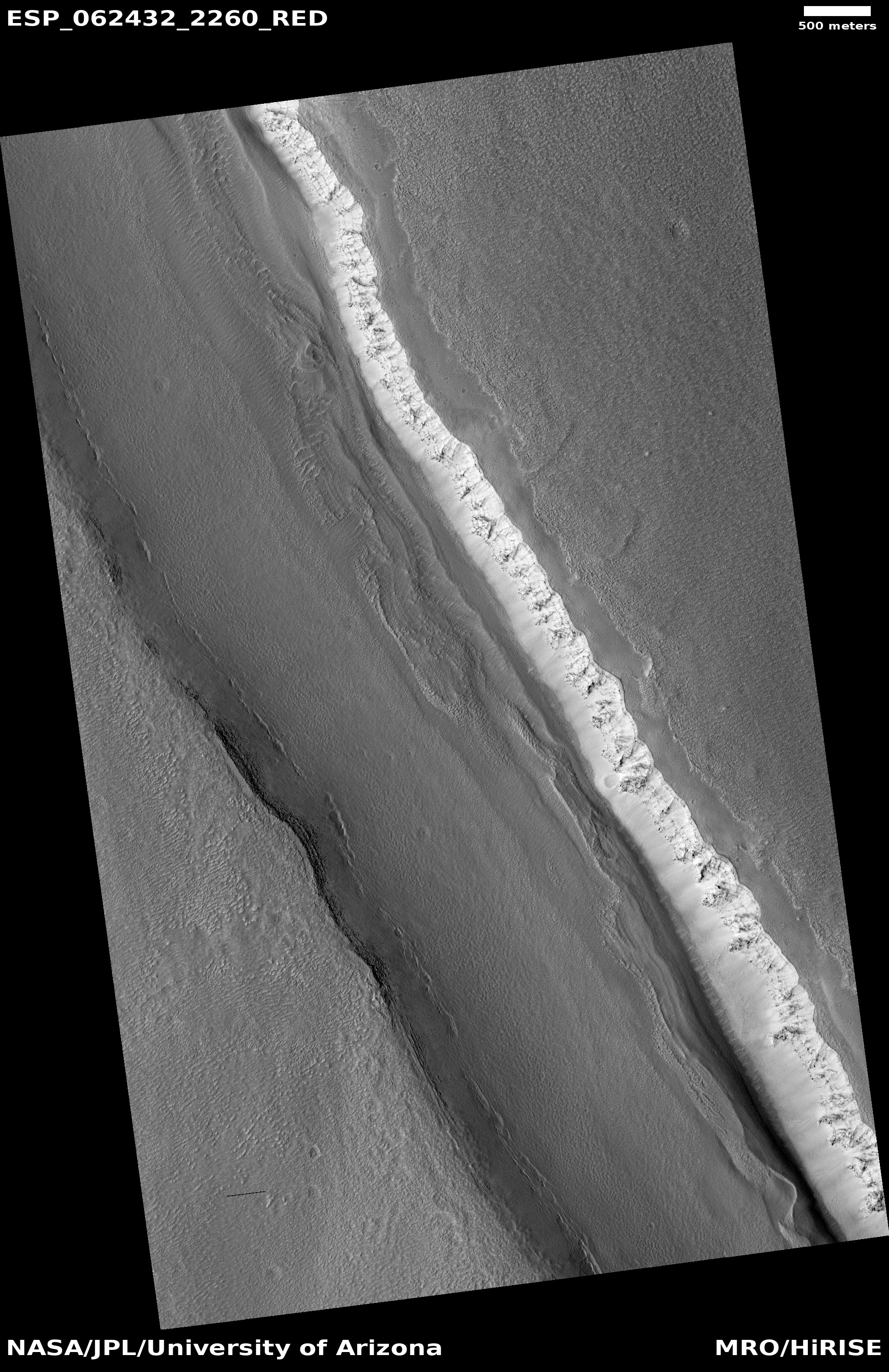
Cool image time! The photo on the right, rotated, cropped, and reduced to post here, was taken by the high resolution camera on Mars Reconnaissance Orbiter on November 21, 2019. The uncaptioned image was simply entitled “Ice-filled Graben.”

The location is on the lower flanks of the giant volcano Alba Mons, which in itself sits north of Olympus Mons and the volcanic Tharsis Bulge. The canyon is called a graben because it was formed when a section of the crust slips downward along parallel faults. It does not have the features of a rill, or lava flow, as it starts and stops suddenly. It probably formed due to the rise of the volcano, pulling apart its flanks along faults, causing some sections then to slip downward.

How do the scientists know this is ice-filled? I suspect they have other data that indicates the presence of water, but there are also clear features inside this canyon that resemble the glacial features found elsewhere on Mars. For example, note the parallel lines near the canyon walls. These indicate past surface levels as well as layers within the ice from cyclic climate processes. The line of pits along the southwest wall, where the surface gets more sunlight, also suggests that this sunlight is causing more ice to sublimate away.

Finally, the graben is located at 46 degrees north latitude, definitely far enough north for such ice to exist, based on ample other research.

8 comments

Ice-filled canyon on Mars?

The ice-filled head of Mamers Valles
Click for full image.

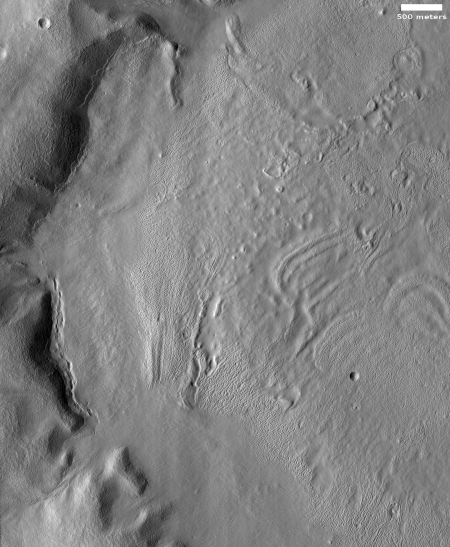
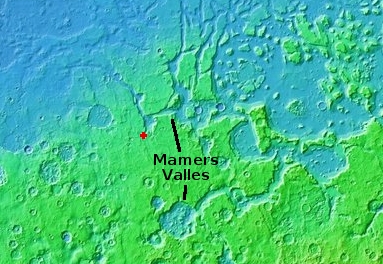
The image to the right, rotated, cropped and reduced to post here, was taken on December 19, 2019 by the high resolution camera on Mars Reconnaissance Orbiter (MRO). Labeled “Head of Mamers Valles”, it shows the very end of one side canyon to this very extensive canyon system made up of the fractured fissures and mesas of chaos terrain.

Mamers Valles itself sits in the transition zone between the northern lowland plains and the southern cratered highlands. This specific canyon is close to those lowlands, at a latitude of 40 degrees north, where scientists believe there are many buried inactive glaciers of ice.

The image reinforces this belief. The entire canyon appears practically filled with what looks like ice. In fact, it almost looks like we are looking down at a frozen lake with a layer of snow on top of it. In this case, the layer is not snow, but dust and dirt and debris that covers the ice to protect it and prevent it from sublimating away.

The overview map below shows the location of this canyon, by the red cross, within Mamers Valles.
Mamers Valles

Mamers Valles is actually a very large collection of miscellaneous canyons, flowing into the lowlands. In some areas it looks like very old chaos terrain, with the canyons so eroded that all we see are scattered mesas. In other places the canyons more resemble meandering river canyons sometimes interspersed with crater impacts.

Scientists have analyzed the canyons in Mamers Valles, and from this concluded that they were likely formed from “subsurface hydrologic activity”. which in plain English means that flowing water below ground washed out large underground passages, which eventually grew large enough for their ceilings to collapse and form the canyons we see today.

Yesterday I posted an image of a string of pits that could very well be evidence of this same process in its early stages of canyon formation. In Mamers Valles the process is far more advanced, and the canyons have existed for a long time, long enough for the planet’s inclination to go through several cycles of change, from a low of 25 degrees tilt (what it is now) to has high as 60 degrees. At that high inclination the mid-latitudes were colder than the poles, so that ice would sublimate from the poles to fall as snow in the mid-latitudes, forming active glaciers within canyons such as this.

Now that the planet’s inclination is similar to Earth’s, 25 degrees, the poles are slightly colder than the mid-latitudes, and the glaciers in this canyon are either inactive (if buried) or slowly sublimating away so that the water can return to the poles.

Here however the surface debris appears to be protecting the glaciers, leaving the canyon filled mostly with ice. For future settlers this ice would likely be relatively accessible, and at a latitude where the environment is also relatively mild, for Mars.

5 comments

Pits indicating a Martian underground river?

A string of pits suggesting a past underground river system on Mars
Click for full image.

Cool image time! As my regular readers well know, I am a caver, and am thus always interested when the high resolution camera on Mars Reconnaissance Orbiter (MRO) takes a close-up of a pit that might also be an entrance to a cave.

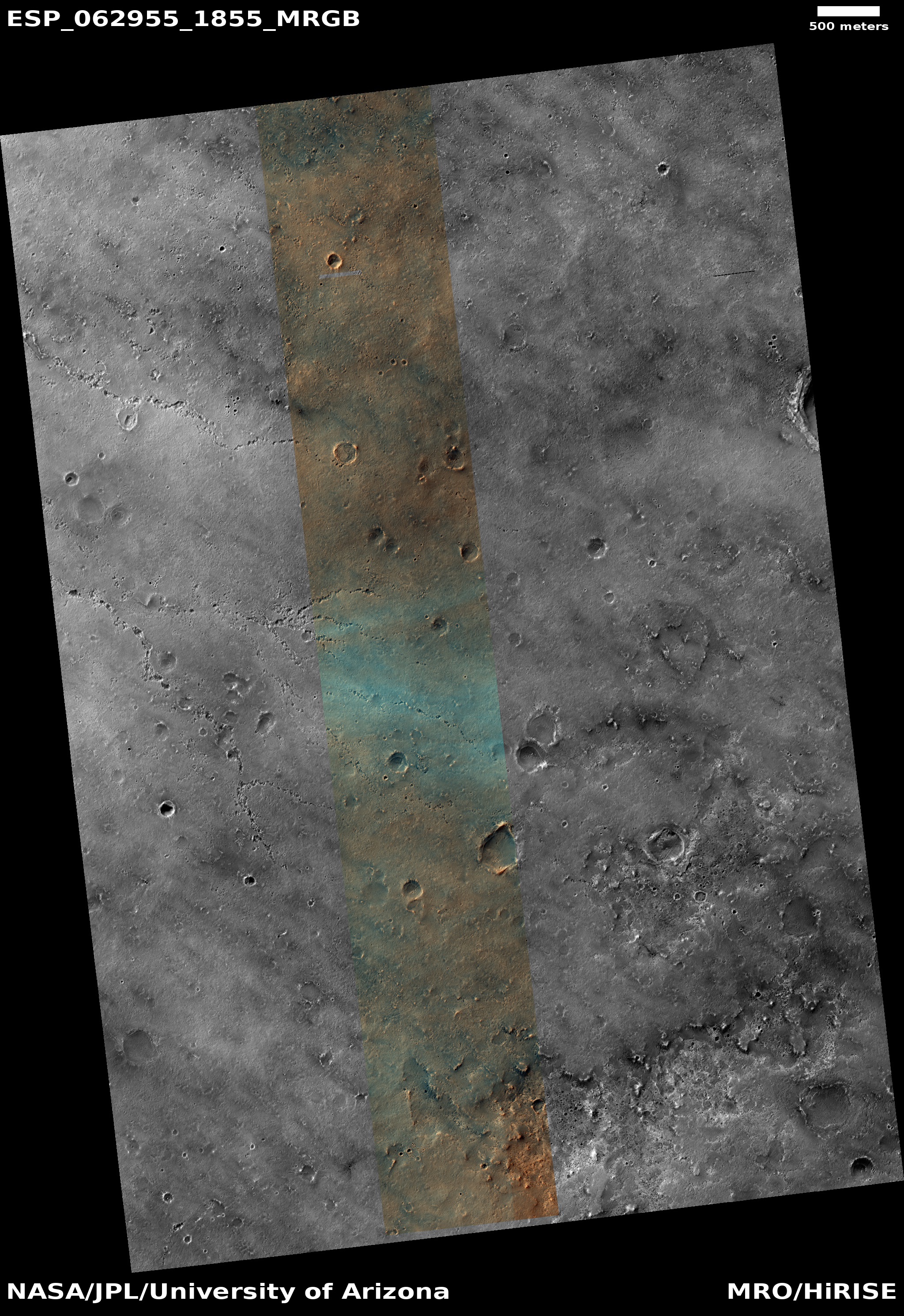
The photo to the right, cropped and reduced to post here, was part of the most recent image release from MRO, but was boringly labeled “Arabia Terra” after the region where it is located, one of the largest transition zones on Mars between the northern lowland plains and the southern cratered highlands. When I took a close look, what I found was an intriguing string of pits whose arrangement is strikingly reminiscent of a river tributary system.

The white box indicates one section that I have zoomed into, as shown below.
» Read more

10 comments

Martian wind-swept buried depressions

Wind-swept Martian depressions
Click for full image.

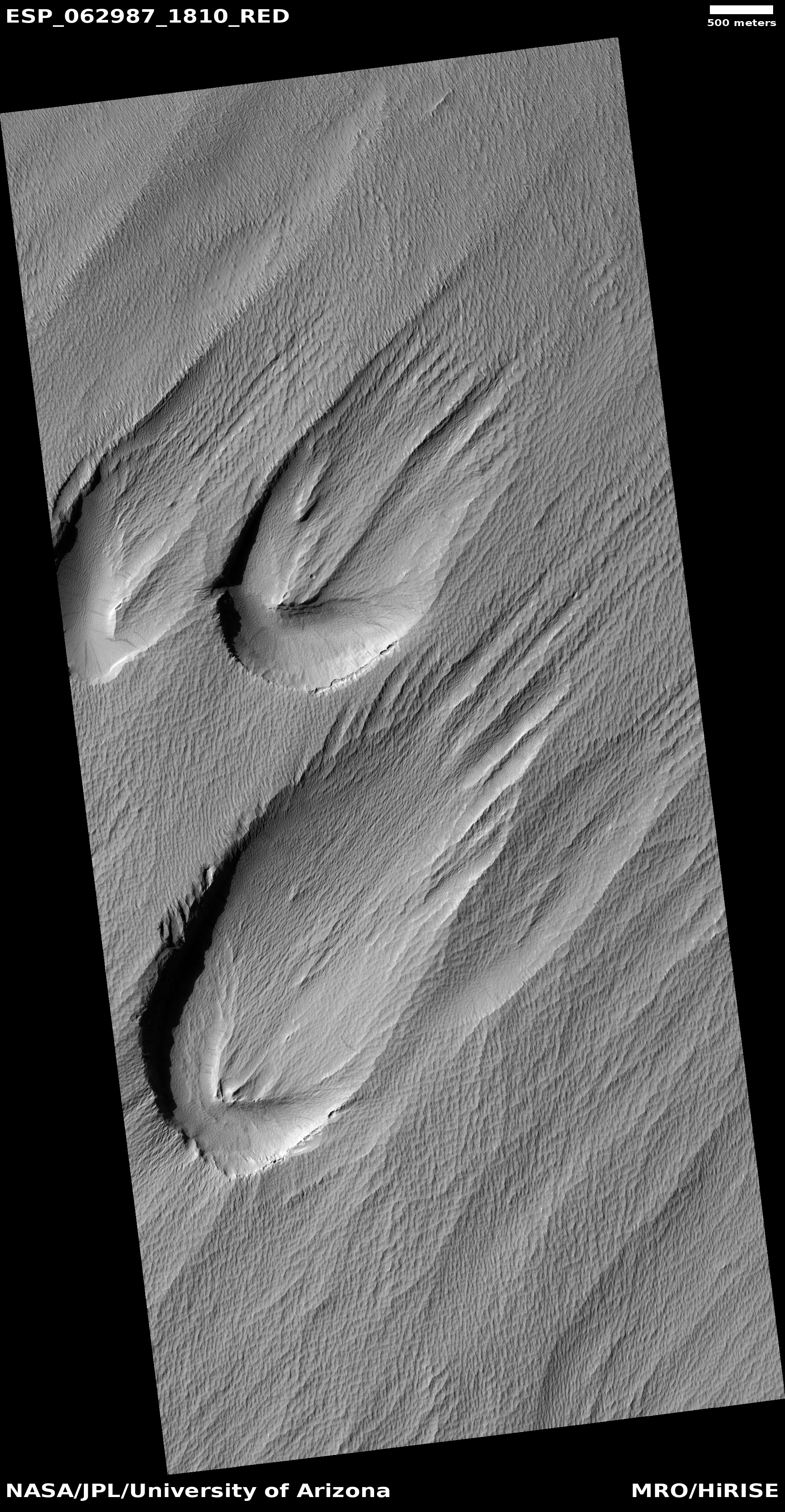
Cool image time! The photo to the right, rotated, cropped and reduced to post here, was taken on January 3, 2020 by the high resolution camera on Mars Reconnaissance Orbiter (MRO). It shows three strange teardrop-shaped depressions, clearly wind-swept and partly buried by dust and sand.

The location on Mars of these depressions is in the transition zone between the southern cratered highlands and the northern lowlands. This is also a region dubbed the Medusae Fossae Formation, a region where it appears a great deal of volcanic material was laid down during one or more eruptive events 3 to 3.8 billion years ago.

Whether these depressions were formed during those events is impossible to tell from the available data, especially because the underlying bedrock is buried in dust.

Their shape appears to have been caused as the wind slowly exposed three buried peaks of hard rock. The wind, blowing from the southwest to the northeast, would hit the peaks, producing an downward eddy that would churn out dust from the windward side. The wind and dust would then blow around the peaks, creating the teardrop tail on the leeward side to the northeast.

0 comments

MRO undergoing maintenance and software upgrade

NASA’s Mars Reconnaissance Orbiter, in space now for fifteen years, will undergo a two week computer software upgrade.

The maintenance work involves updating battery parameters in the spacecraft’s flash memory – a rare step that’s been done only twice before in the orbiter’s 15 years of flight. This special update is necessary because it was recently determined that the battery parameters in flash were out of date and if used, would not charge MRO’s batteries to the desired levels.

In addition to the battery parameters, engineers will use this opportunity to update planetary position tables that also reside in flash. The spacecraft will go into a precautionary standby mode, called safe mode, three times over the course of the update. It will also swap from its primary computer, called its Side-A computer, to its redundant one, called Side-B.

During these two weeks the spacecraft will suspend its science and communications operations.

0 comments
1 72 73 74 75 76 90