Results from Europe’s Trace Gas Orbiter at Mars

The European Space Agency today released the results of more than a year of observations from its Trace Gas Orbiter (TGO), among which were two significant findings.

First, the orbiter detected no methane in Mars’s atmosphere, contradicting recent results from both Curiosity and Mars Express.

The new results from TGO provide the most detailed global analysis yet, finding an upper limit of 0.05 ppbv, that is, 10–100 times less methane than all previous reported detections. The most precise detection limit of 0.012 ppbv was achieved at 3 km altitude. As an upper limit, 0.05 ppbv still corresponds to up to 500 tons of methane emitted over a 300 year predicted lifetime of the molecule when considering atmospheric destruction processes alone, but dispersed over the entire atmosphere, this is extremely low.

…“The TGO’s high-precision measurements seem to be at odds with previous detections; to reconcile the various datasets and match the fast transition from previously reported plumes to the apparently very low background levels, we need to find a method that efficiently destroys methane close to the surface of the planet.”

It appears they think the Curiosity and Mars Express detections were very localized and occurred close to the surface, where TGO could not detect it.

The second significant finding is indicated by the map below, showing a global map of subsurface water distribution on Mars. I have also posted below this map a global elevation map from Mars Reconnaissance Orbiter (MRO), as the similarities and differences are important.
» Read more
0 comments

A dance of dust devils

A dance of dust devils on Mars

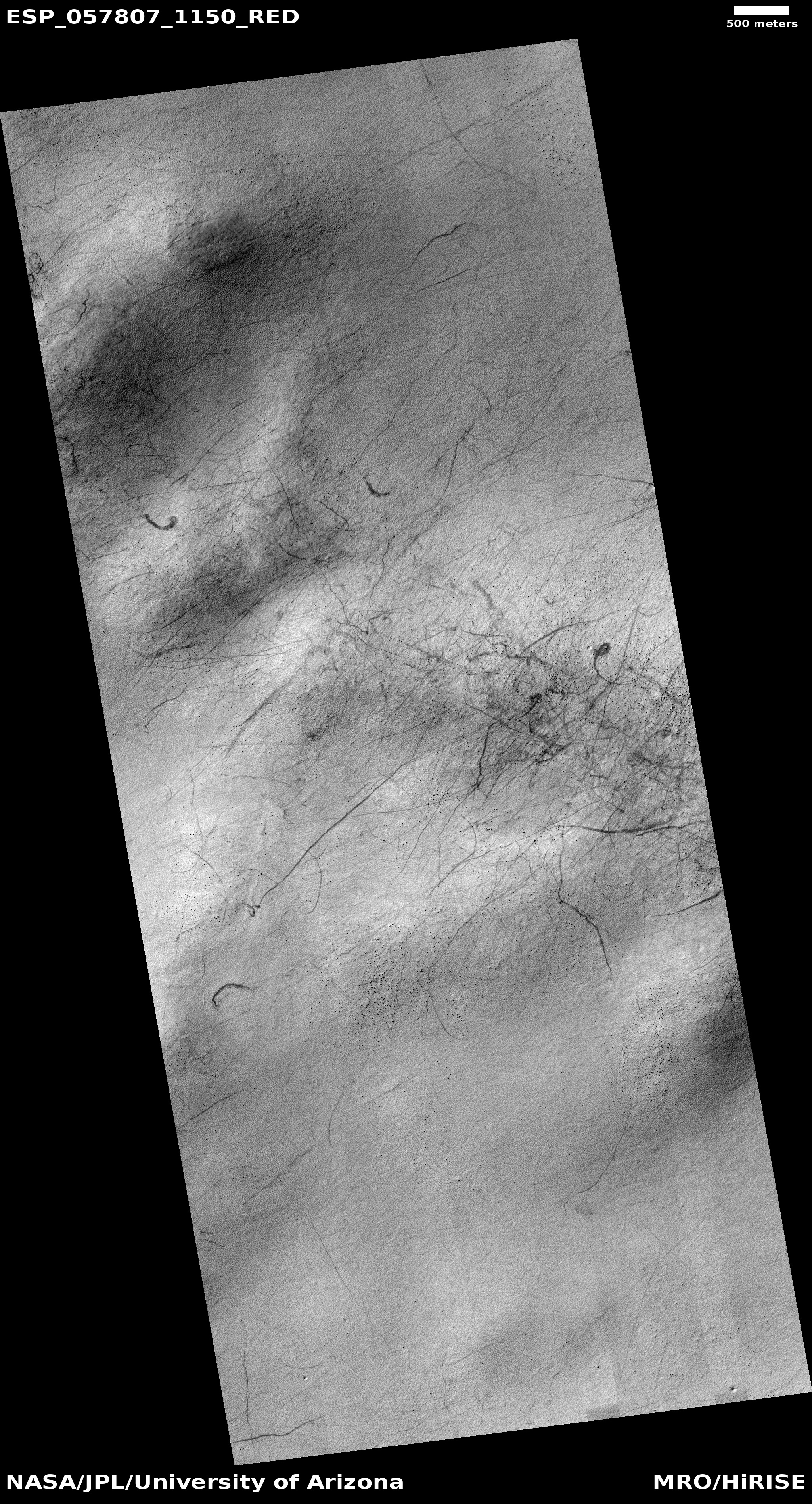
Many of my image posts about Mars have emphasized how slowly things change there. This post will highlight the exact opposite. When it comes to dust devils, it appears they can leave their trace frequently and often, and for some reason they seem to also favor specific locations.

June 2011
Click for full image.

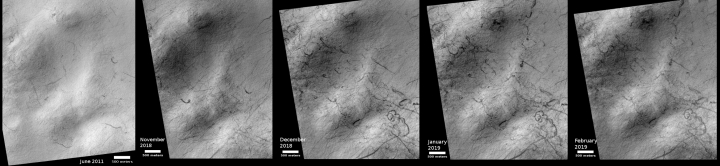
The string of images above are all of the same location in the southern highlands of Mars. All were taken by the high resolution camera of Mars Reconnaissance Orbiter (MRO) and can be found in the camera’s archive. I have cropped them to show the same approximate matching area. The first image in that strip above, shown at higher resolution to the right, was taken in June 2011 and titled “Possible Gully Features” by the MRO science team. This is not surprising, as the rounded hills in this image are actually the southwest rim of a large crater, and the slopes of craters have been found one of the best places to find the gullies where seasonal changes occur, all possibly caused by underground water.

From the title, it appears that the science team might have first hoped to spot either slope streaks or recurring slope lineae, the two most intriguing of these changing features. Instead, that 2011 image showed them a very eroded crater rim with a small scattering of dust devil tracks.

November 2018
Click for full image.

This lack of gullies probably reduced interest in this location. It wasn’t until seven years later, in November 2018, that the MRO team decided to take another image of this location (the second image in the strip above and shown to the right at higher resolution). This time they found a significant increase in the number of dust devil tracks.

At this point the decision must have been made to take another image of this location a month later in December 2018. I assume the scientists were curious to see if they would spot any additional changes in that one month period. This was dust devil season, so the likelihood of seeing more tracks was not unreasonable.

How many tracks appeared, and whether they were concentrated in any particular place, such as the ridge lines, would help researchers better understand what generates them, which in turn will give them a better understanding of the Martian atmosphere.

The result was astonishing.
» Read more

0 comments

Thumbprints on Mars!

Thumbprints terrain on Mars!
Click for full image.

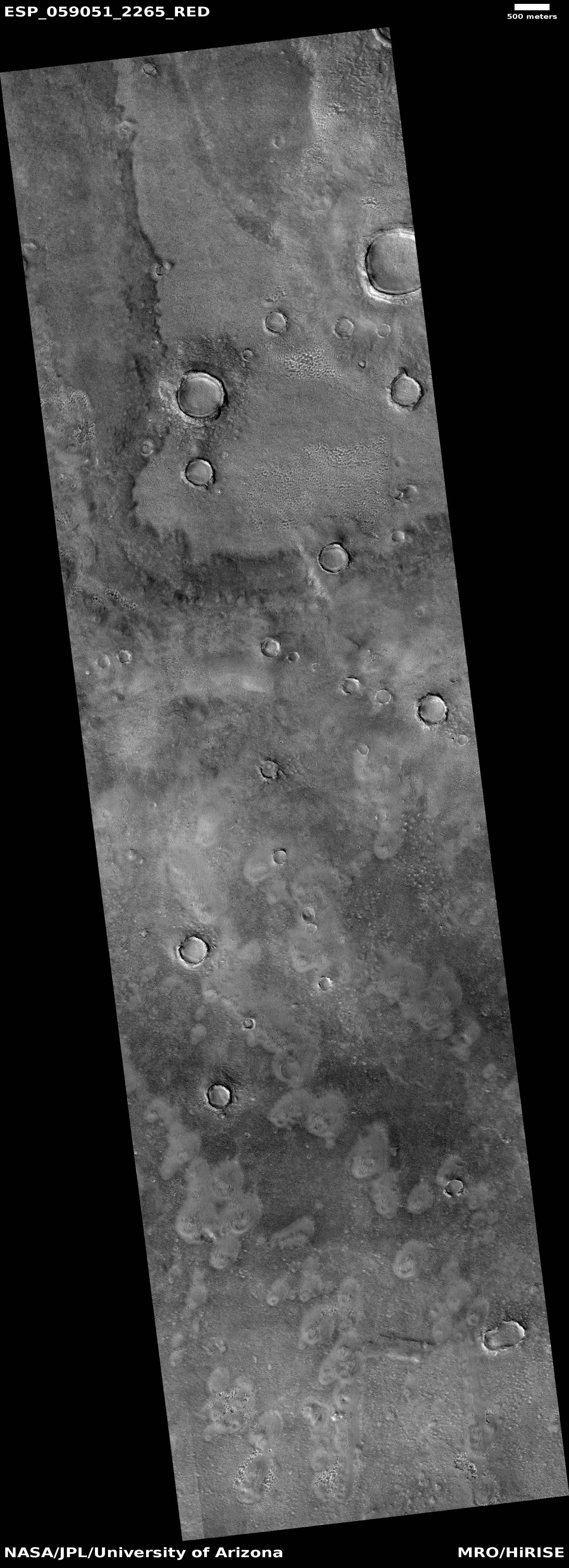
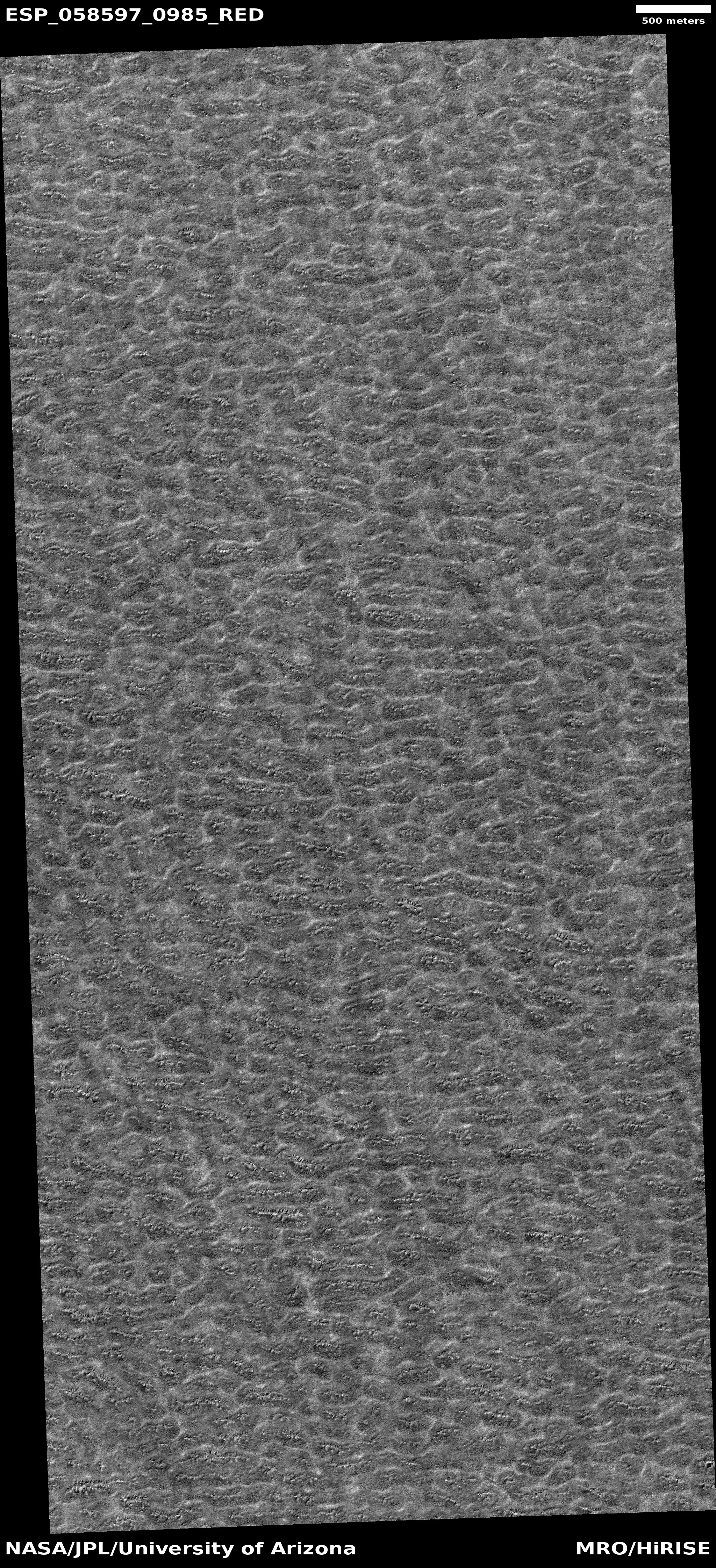
Honestly, don’t ask me. I didn’t come up with the name. I found the image on the right, cropped and reduced to post here, as part of the April image dump from the high resolution camera of Mars Reconnaissance Orbiter. The uncaptioned release dubbed this “Thumbprint Terrain in Northern Mid-Latitudes,” and it is obvious to see why. The cropped image on the right focuses in on the oval white mounds that really do look like some giant child was touching a soft damp muddy surface randomly with his fingers, leaving behind raised fingerprints as the mud stuck to his fingers as he pulled them away.

Each white area seems to have a crater. I suspect these are not impact craters, but possibly mud volcanoes, as each is at the top of a mound. My hypothesis is further strengthened by the location, which is deep within the low northern plains of Mars, a place where some scientists believe an intermittent ocean once existed. These mounds could have easily formed at that ocean’s floor, or thereafter when the land here was drying out.

On the other hand, these could be from impact. Maybe they are scattered ejecta from a larger impact, landing here in a group on a wet muddy surface. The impacts might have concentrated the material around the crater, making it more resistant to erosion, which is why the craters now stand above the floor of the plain.

On the third hand, all these theories could be wrong. Have any of your own?

4 comments

Monitoring the ice scarps on Mars for changes

Scarp #1 in 2011
Click for full image.

Scarp #1 in 2018
Click for full image.

Back in January 2018 planetary scientists released a paper announcing the discovery of a number of Martian cliff faces, or scarps as they called them, that all appeared to expose an underground layer of ice.

Those cliffs were mostly located to the southeast of Hellas Basin, the basement of Mars that is also advantageous for human colonization because its lower elevation means its atmosphere is thicker. (For example, that thicker atmosphere would make air transportation more practical.)

The two images to the right show what they listed as scarp #1 in their paper, rotated, cropped, and reduced to post here. The first image was taken in May 2011, with the second taken in December 2018, and was part of the March image release from the high resolution camera of Mars Reconnaissance Orbiter (MRO).

The December 2018 image was taken almost a year after the paper release, and was titled “Scarp Monitoring.” I therefore wondered whether the scientists had identified any changes. They theorize that these scarps form when the exposed ice slowly sublimates to gas into the atmosphere, causing the cliff face to collapse and retreat, which in the case of scarp #1 would be a retreat to the north. The terraces below the scarp suggest previous cliff locations. In their paper they noted evidence of some changes in the studied scarps, including some fallen boulders, as well as color changes that suggest some evolution.

The rate of that retreat is not known with precision, but based on the facts presently at hand, the scientists have estimated that it took about a million years to form this scarp. Whether any evidence of this retreat would be visible in only seven years is the purpose of these scarp monitoring images.

Do you see any difference? I don’t, but because I also don’t trust my expertise I decided to email the paper’s lead author, Colin Dundas of the U.S. Geological Survey’s Astrogeology Science Center. His emailed comments are most interesting.
» Read more

2 comments

Curiosity films partial solar eclipses by both Phobos and Deimos

Phobos partial eclipse of Sun

Last week Curiosity successfully captured partial solar eclipses by both Phobos and Deimos as the Martian moons crossed the face of the Sun.

The movie on the right shows Phobos eclipsing the Sun. The speed is ten times faster than real time.

The press release can be seen here. It notes how these observations, of which 8 in total have been made since Curiosity arrived on Mars, have helped pin down the orbits of both moons.

3 comments

Future of InSight’s heat probe dim

Blocked after drilling down only one foot instead of fifteen, engineers are increasingly worried that they will not be able to get InSight’s heat probe past whatever is blocking to so it can begin getting data of Mars’s inner thermal environment.

They are considering a bunch of options, including using InSight’s robot arm to either give the probe a nudge to help it get past the obstruction, or even use the arm to push the probe.

None of the options are encouraging it seems.

9 comments

A decade of changes at the Martian south pole

A decade of changes at the Martian south pole
Click for full image.

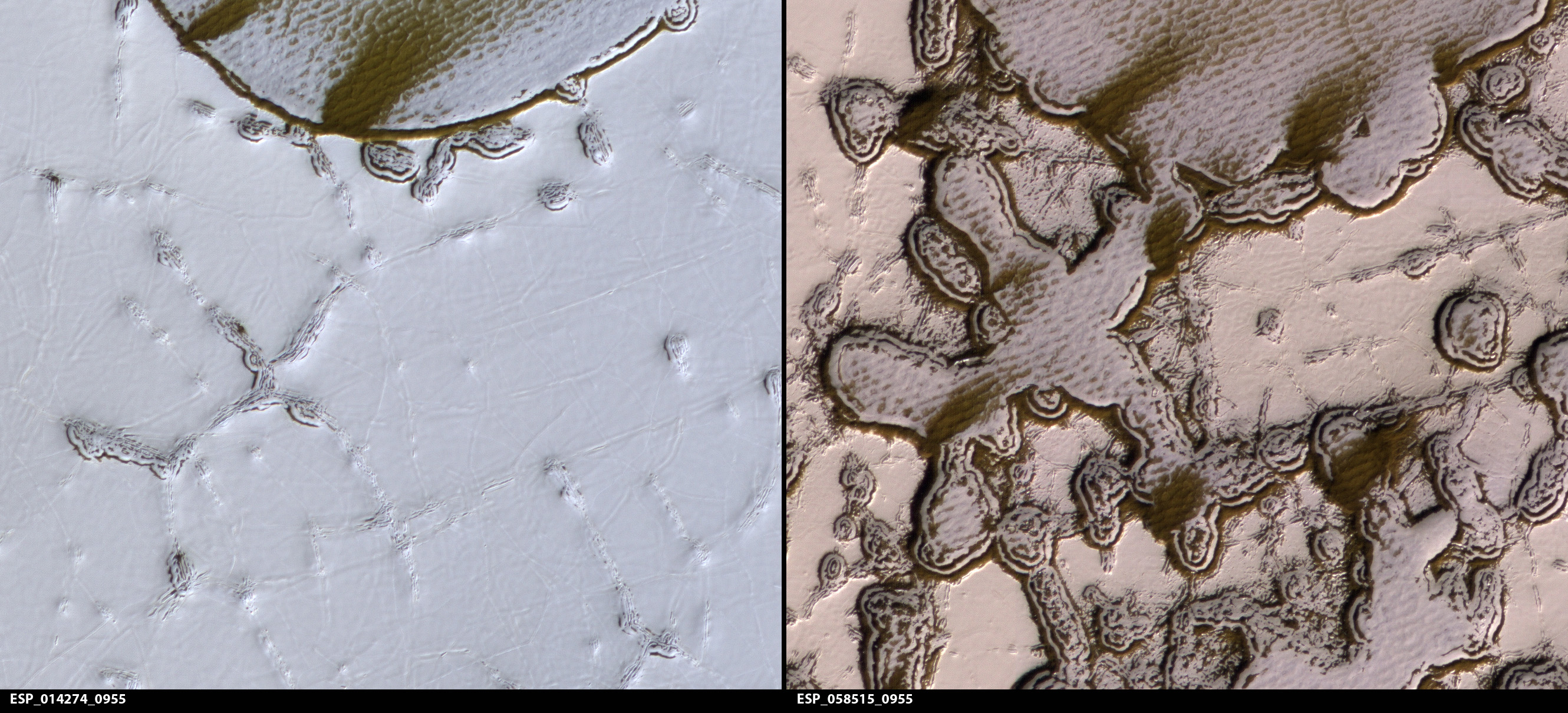
The image above, cropped, reduced, and annotated to post here, was released this week by the Mars Reconnaissance Orbiter (MRO) team. It shows the changes that have occurred at one location at the Martian south polar cap in the past decade. As planetary geologist Alfred McEwen wrote,

The south polar residual cap of carbon dioxide ice rapidly changes. This image was planned as an almost exact match to the illumination and viewing angles of a previous one we took in August 2009.

The pits have all expanded and merged, and we can just barely see the patterns in the 2009 image compared to this January 2019 picture. The 2009 image is also brighter and bluer, with more seasonal frost and/or less dust over the surface. These images were both taken in late southern summer, but our 2019 picture is slightly later in the Martian season by about two weeks.

You can get a better idea how much is changed by seeing the full image from which the above small area was cropped.
» Read more

1 comment

The Viking landers and its possible discovery of extraterrestrial life

Link here. One of the scientists involved in the Viking project has written a memoir of her experience, and the article interviews her.

Patricia Straat served as co-experimenter on one of the most controversial experiments ever sent to Mars: the Labeled Release instrument on the Viking Mars landers. The experiment’s principal investigator, Gilbert Levin, insists to this day that the project found extraterrestrial life. Most scientists doubt this interpretation, but the issue has never been fully settled.

Read it. It illustrates how uncertain science can be, even when an experiment produces a result that everyone involved dreamt of. As Straat notes,

The results met the pre-mission definition of a positive life response. But of course as soon as we got it everyone came up with alternative proposals to account for the results nonbiologically.

The problem was that though their experiment found evidence of life, none of the other Viking experiments did. Most significant was the apparently complete lack of organic material (based on carbon) in the soil.

To this day, no one has a good explanation for these results on Viking. The results remain a mystery, one that really will only be solved when we can return to Mars in force, and find out what it is really like.

5 comments

More Martian Pits!

More pits on Mars!

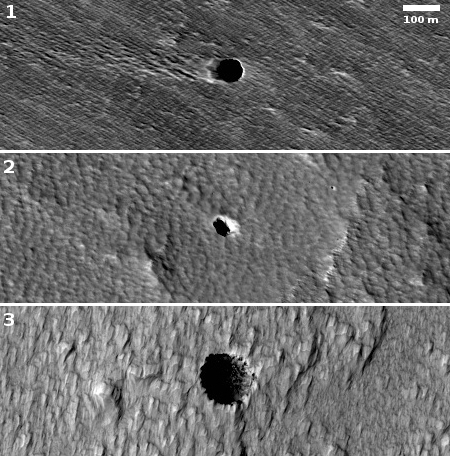
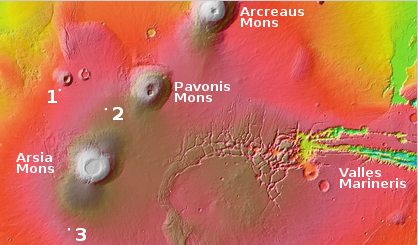
As I said in my last post in February showing recent pit discoveries on Mars, I could almost make this a monthly series. In the March image download from the high resolution camera of Mars Reconnaissance Orbiter (MRO) were three (maybe four) more pits, all likely skylights above lava tubes and all located near the giant volcano Arsia Mons in the region dubbed the Tharsis Bulge. The image to the right shows all three, with a possible fourth just northwest of pit #2 and visible in its full image. For the full images of the other two pits go here (#1) and here (#3). In all three cases, click on the “black & white map projected” link to see the full image with scale.

Overview map

The overview map on right shows where these three pits are located. If you compare this map with my previous overview maps from November 12, 2018 and February 22, 2019 you can see that while these pits are all found on the volcanic slopes surrounding Arsia Mons, they are all different pits. Moreover, the ten pits listed in these three posts are only a small sampling of the more than hundred already found.

Whether these pits are deadend sinks or skylights into underground lava tubes that connect is at this point unknown. It would be a reasonable speculation to assume that some are deadends, and some link to extensive tubes of varying lengths. It would also be dangerous. Mars is alien. While the geology will be based on the same physical laws found on Earth, the lighter gravity is going to produce things differently.

The three images above however do show some intriguing details.
» Read more

0 comments

Mars Express confirms Curiosity 2013 methane detection

The uncertainty of science: The Mars Express science team today announced that a reanalysis of the orbiter’s data showed the same spike spike of methane detection as seen by Curiosity on June 15, 2013.

The study exploited a new observation technique, allowing the collection of several hundred measurements in one area over a short period of time. The teams also developed a refined analysis technique to get the best out of their data.

“In general we did not detect any methane, aside from one definite detection of about 15 parts per billion by volume of methane in the atmosphere, which turned out to be a day after Curiosity reported a spike of about six parts per billion,” says Marco Giuranna from the Institute for Space Astrophysics and Planetology in Rome, Italy, the principal investigator for the PFS experiment, and lead author of the paper reporting the results in Nature Geoscience today.

“Although parts per billion in general means a relatively small amount, it is quite remarkable for Mars – our measurement corresponds to an average of about 46 tonnes of methane that was present in the area of 49 000 square kilometres observed from our orbit.”

Ten other observations in the Mars Express study period that reported no detections at the limit of the spectrometer’s sensitivity corresponded to a period of low measurements reported by Curiosity.

The data, along with their estimate about the source location for the methane, suggests that this was a geological event, not the result of biological life. They think the methane was trapped in ice-filled fissures, and released when that ice either broke or melted. Whether the methane itself was formed by past microbial life sometime in the past remains completely unknown.

To put it mildly, there are a lot of uncertainties in this result.

0 comments

Circular feature on Mars?

A circular feature on Mars?
Click for full resolution image.

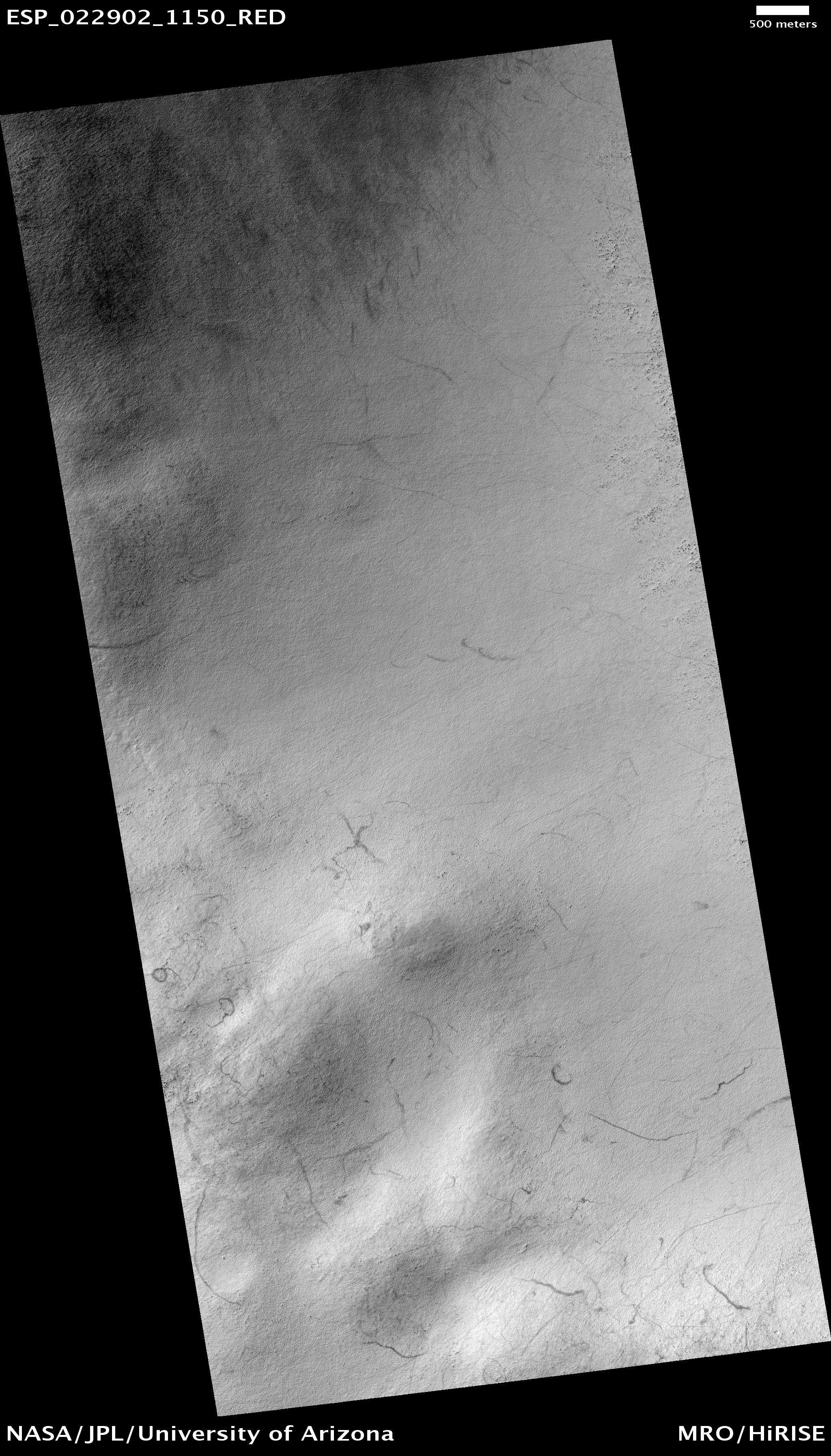
Today’s cool image is cool for two reasons. First and foremost, the image, found in the archive of the high resolution camera of Mars Reconnaissance Orbiter (MRO), is titled “Circular Feature.” On the right is the full image, reduced to post here. I have searched it high and low, at low resolution as well as full resolution, and can find nothing, nothing at all, that invokes a circular feature to me.

This strange terrain is located very close to the southern icecap. If anything, the knobs and features that fill this image remind me of brain terrain, partly obscured by a layer of partly melted snow or frost. Nothing however seems circular in the slightest.

The second reason this image is cool is that it is very representative of its very large surrounding region. For what appears to be several hundred miles in all directions this is all that one can see, in a variety of MRO images, here, here, here, here, here, and here, to show only a few. Ever so often a craterlike feature pops out, like in the last example, but generally the surface continues in this undulating bland manner, endlessly. The only changing aspect is the dark streaks that cut across, likely dust devil tracks made over a long period of time.

Below the fold is a section of the full resolution image, at full resolution. It doesn’t really matter where I took the crop, as anywhere in the full image everything looks pretty much the same. The only slow change that I can perceive is that the surface seems to be descending to the north, with the lighter areas implying the existence of terraces.

Take a look, and try to figure out for yourself what is going on here.
» Read more

4 comments

Scientists propose widespread deep groundwater on Mars

In a new study, scientists are now suggesting that widespread deep groundwater exists on Mars, and is the cause of the recurring slope lineae seen on many Martian slopes.

Previous theories for the cause of lineae proposed both dry and wet processes, all related to either near surface or atmospheric phenomenon. This new hypothesis is different, as it proposes deep groundwater as the source.

“We propose an alternative hypothesis that they originate from a deep pressurized groundwater source which comes to the surface moving upward along ground cracks,” Heggy says. “The experience we gained from our research in desert hydrology was the cornerstone in reaching this conclusion. We have seen the same mechanisms in the North African Sahara and in the Arabian Peninsula, and it helped us explore the same mechanism on Mars,” said Abotalib Z. Abotalib, the paper’s first author.

The two scientists concluded that fractures within some of Mars’ craters, enabled water springs to rise up to the surface as a result of pressure deep below. These springs leaked onto the surface, generating the sharp and distinct linear features found on the walls of these craters. The scientists also provide an explanation on how these water features fluctuate with seasonality on Mars.

This conclusion is most intriguing, but it is far from certain. Scientists have found a lot of lineae. For all of them to come from deep groundwater rising under pressure through fractures seems unlikely.

Nonetheless, this research indicates the growing belief among Mars researchers that water exists everywhere on Mars, and is accessible.

7 comments
1 139 140 141 142 143 212