Strange Martian gullies

Gullies on Mars
Click for full image.

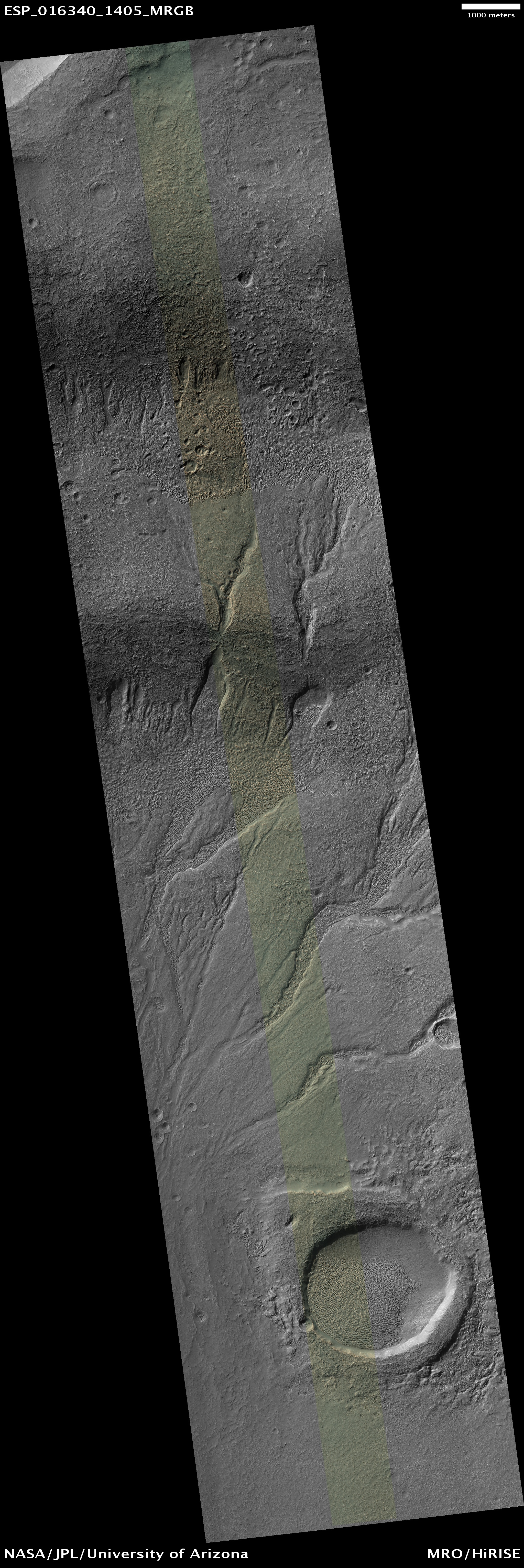
Cool image time! The image to the right, cropped and reduced to post here, was taken in 2010 by the high resolution camera on Mars Reconnaissance Orbiter (MRO). Uncaptioned, the image page is simply entitled “Older Gullies and Channels in Slopes of Softened Large Crater.”

I stumbled upon it today while researching another image taken this year of the “valley networks” in the floor of that same crater. Those networks were intriguing, but the gullies on the right were much more fascinating, because they appear to be some form of erosion drainage coming down both sides of a high ridge near the northern rim of this large apparently unnamed crater in the southern cratered highlands of Mars, to the west of Hellas Basin.

On Earth my immediate explanation for this erosion would be a major monsoon-like storm, such as we get here in the southwest and call “gully-washers.” When a lot of water is quickly dumped onto a hill where there is not of vegetation to help bind the soil together, the water will quickly carve out gullies that looks almost exactly like these.

On Mars, who knows? It certainly wasn’t a monsoon thunderstorm that did this. And being in the Martian southern highlands it is unlikely it was from an ocean of any kind. Were there lakes here? Past research has found places where lakes might have existed on Mars, but these places are far north in the transitional zone into the northern lowlands.

Nor are these gullies the only interesting features in this one image.
» Read more

0 comments

Mass wasting on Mars

Mass wasting in Martian crater
Click to see full image.

Cool image time! Mass wasting is a term that geologists use to describe a specific kind of avalanche, where the material moves down slope suddenly in a single mass.

The image on the right, taken from the image archive of the high resolution camera on Mars Reconnaissance Orbiter (MRO) and cropped and reduced in resolution to post here, shows a dramatic example of this kind of avalanche. You can see two separate avalanches, each of which moved a significant blob of material down slope into the center of the crater floor.

Studying such events is important. Scientists know that Mars has an underground ice table at high latitudes. What they don’t know is how far south that ice table extends. This crater is located at 5 degrees north latitude, almost at the equator, so if this avalanche exposed any ice in newly exposed cliff wall that would be a significant discovery.

Based on the color image, there does not appear to be any obvious ice layers, as seen in higher latitude scarps in the southern hemisphere. This doesn’t prove they aren’t there, merely that this image was unable to see them. Maybe the resolution is not good enough. Maybe the ice is too well mixed in with the dust and dirt and it therefore isn’t visible. Maybe the ice table is deeper underground than the deepest part of this crater.

Or it could be that at the Martian equator the underground ice is mostly gone. For future colonists, knowing this fact will influence where they put those first colonies. Near the equator has some advantages, but if there is little easily accessible water those advantages mostly vanish.

At the moment we simply do not know, though much of the imagery now being taken from orbit are attempts to answer this question.

One final detail about the image. Note the slope streaks coming down the crater’s slopes. These remain their own Martian mystery.

0 comments

Wind and/or water erosion on the Martian northern lowlands

A mesa in the northern Martian lowlands
Click for full image.

Cool image time! The picture on the right, cropped and reduced in resolution to show here, was taken by the high resolution camera on Mars Reconnaissance Orbiter on April 21, 2019, and shows the erosion process produced by either wind or water as it flowed from the east to the west past one small mesa.

It is almost certain that the erosion here was caused by wind, but as we don’t know when this happened, it could also be very old, and have occurred when this terrain was at the bottom of the theorized intermittent ocean that some believe once existed on these northern lowlands. The location itself, near the resurgences for Marineris Valles and the other drainages coming down from the giant volcanoes, might add weight to a water cause, except that the erosional flow went from east to west, and the resurgences were coming from the opposite direction, the west and the south.

The terrain has that same muddy wet look also seen in the more damp high latitudes near the poles. Here, at 43 degrees latitude, it is presently unknown however how much water remains below the surface.

When the craters to the right were created, however, it sure does appear that the ground was damp. Similarly, the material flow to the west of the mesa looks more like the kind of mud flow one would see underwater.

I must emphasize again that I am merely playing at being a geologist. No one should take my guesses here very seriously.

At the same time, I can’t help being endlessly fascinated by the mysterious nature of the Martian terrain.

0 comments

The damp southern latitudes of Mars

Impact craters on the southern permafrost of Mars
Click for the full image.

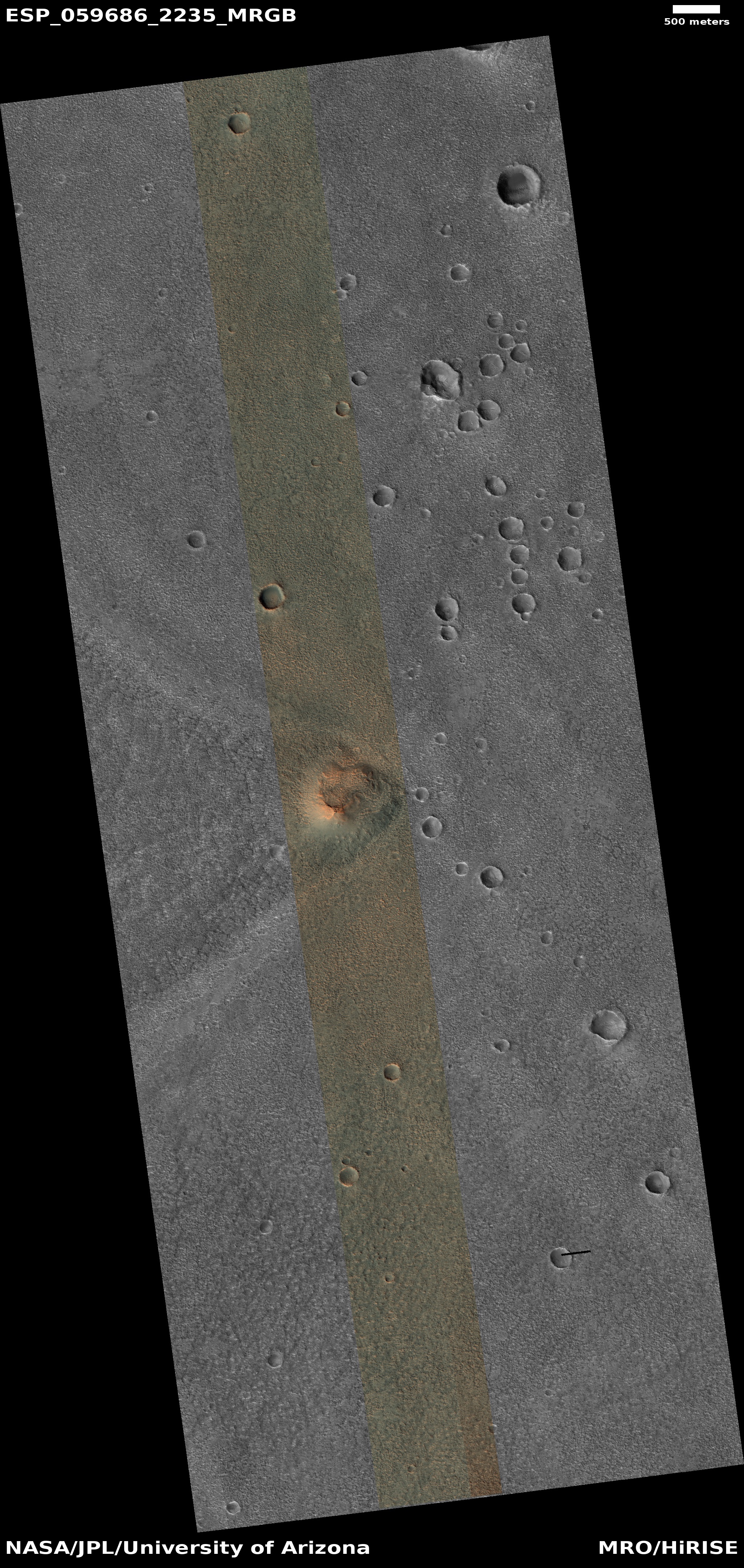
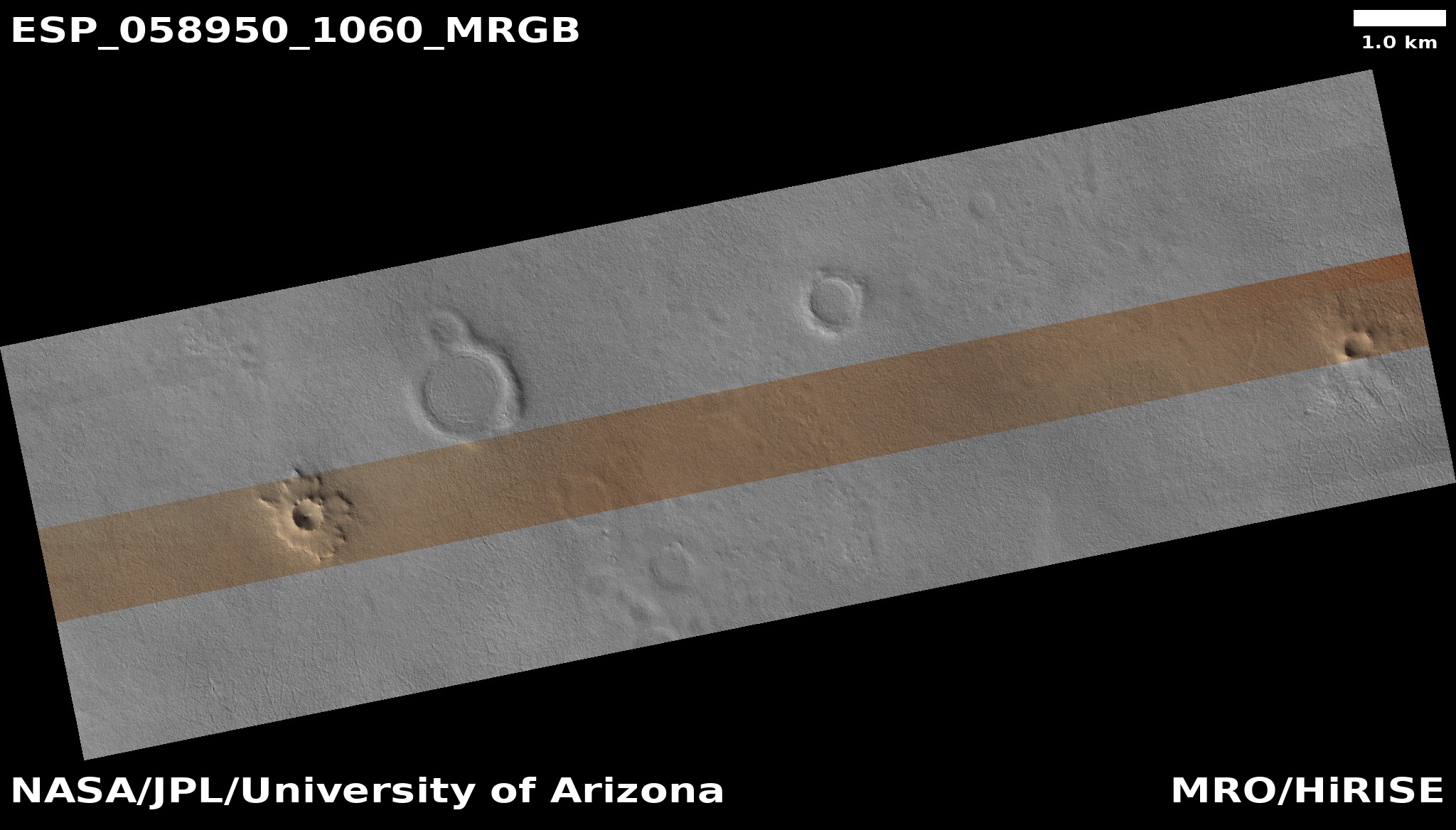
Cool image time! The image on the right, cropped to post here, was part of the monthly image release from the high resolution camera on Mars Reconnaissance Orbiter (MRO). The release came with no caption, and was merely titled Aonia Terra, indicating that it was part of the vast cratered region ranging from 30 to 81 degrees latitude south of Valles Marineris.

These craters are at the high latitude of 73 degrees, so they are relatively close to the south pole. Based on what I have recently learned about the Martian poles, the higher the latitude the more water you will find saturated in the ground. In many ways one could refer to this ground as a kind of permafrost.

The lander Phoenix landed at about 68 degrees north latitude, slighter farther from the north pole, and was able to find water by merely scraping off a few inches of ground.

Thus, we should not be surprised by the muddy look of these craters. Their bolides landed on ground that was likely saturated with water, and went splat when they hit.

The scientific puzzle is why one crater seems to sit above the general surface, as if the ground resisted the impact, while the other seems to be mostly sunken, as if the ground was so soft that when the bolide hit, it sunk as if it landed on quicksand, leaving only a vague trace of an impact crater.

Don’t ask me for an explanation. I only work here.

2 comments

Ghost dunes on Mars

A ghost dune
Click for full image.

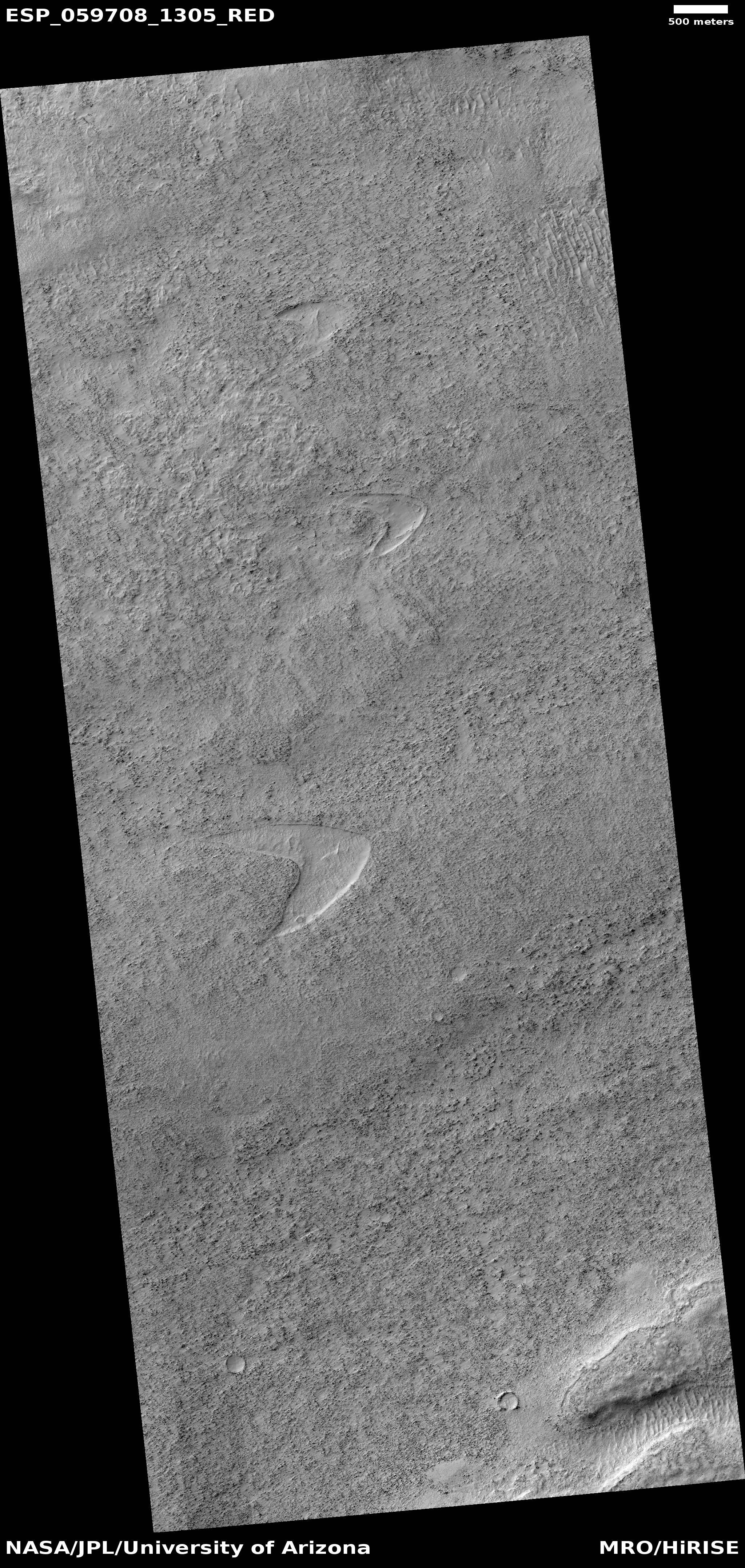
Cool image time! The Mars Reconnaissance (MRO) science team today released a captioned image of several ghost dunes on Mars. The image on the right is cropped and reduced to highlight one of those ghosts, which the scientists explain as follows.

Long ago, there were large crescent-shaped (barchan) dunes that moved across this area, and at some point, there was an eruption. The lava flowed out over the plain and around the dunes, but not over them. The lava solidified, but these dunes still stuck up like islands. However, they were still just dunes, and the wind continued to blow. Eventually, the sand piles that were the dunes migrated away, leaving these “footprints” in the lava plain.

The location of these ghost dunes is inside the southeast edge of Hellas Basin, what I call the bottom of Mars.

3 comments

Land of stucco and lava-filled cracks

Stucco and filled cracks on Mars
Click for full image.

Cool image time! The picture on the right, cropped and reduced to post here, was taken by the high resolution camera on Mars Reconnaissance Orbiter in December 2018 and released earlier this year. It shows a filled fault/fissure in a region dubbed Cereberus Palus, located south of the giant volcano Elysium Mons and to the west of Olympus Mons. This region is also biggest and most extensive sections of the transition zone between Mars’s southern highlands and the northern lowlands. This area however is so far from the lowlands its geology is more likely influenced more by the volcanism that created Elysium Mons to the north.

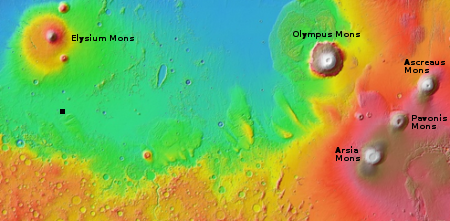
Overview map

The overview map to the right illustrates this geography, with the black square indicating the location of this image.

The image itself strengthens my uneducated conclusion. This region of Cereberus Palus is filled with many faults, cracks caused as the terrain was stretched by the rising volcano. In some cases, as shown here, the cracks became filled with lava from below, as indicated by the lighter color of the material in those filled cracks..

What struck me most about this image was the terrain on the picture’s right. Looks exactly like the stucco on the outside of my house. It is as if a plasterer came by before the lava solidified and ran his putty knife over the surface to create the multiple small ridges.

It is worthwhile checking out the full resolution image. The details are especially intriguing.

0 comments

The Martian North Pole

The Martian North Pole

Since the very beginning of telescopic astronomy, the Martian poles have fascinated. Their changing sizes as the seasons progressed suggested to the early astronomers that Mars might be similar to Earth. Since the advent of the space age we have learned that no, Mars is not similar to Earth, and that its poles only resemble Earth’s in a very superficial way.

Yet, understanding the geology and seasonal evolution of the Martian poles is critical to understanding the planet itself.

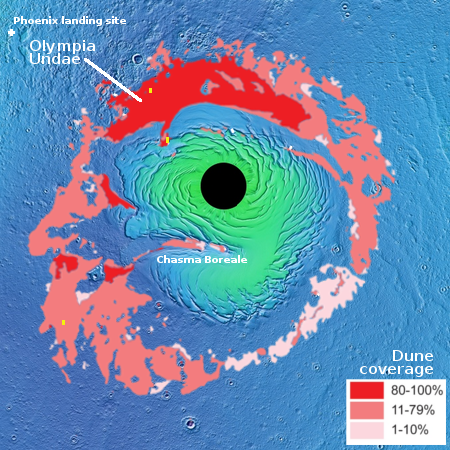
This post will focus on the Martian north pole. The map on the right of the north polar regions is based on many satellite images supplemented by a lot of research by planetary scientists. The black circle in the middle is an area with relatively poor image coverage. The green areas are regions of higher elevation where the bulk of the permanent ice cap is located, surrounded by the blue northern lowlands that cover much of Mars’s northern hemisphere and are thought to have once harbored an intermittent ocean.
Olympia Undae dune field
Click for full image.

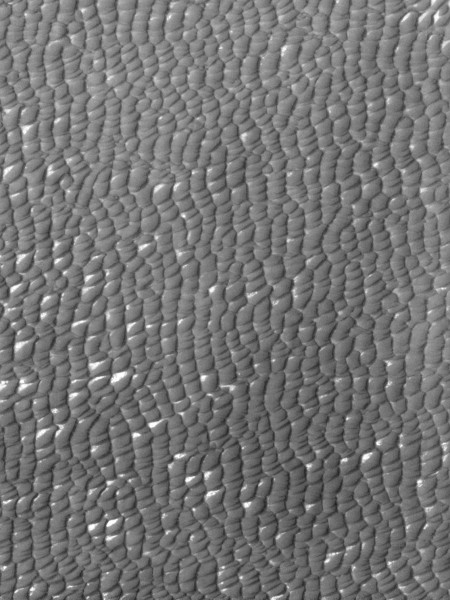
The reddish regions encircling the permanent ice cap are large seas of sand dunes, with Olympia Undae the largest and most sand-dune-packed. The image on the right, posted initially here on March 25, 2016, was taken by Mars Odyssey and shows the endlessness of this dune sea. Olympia Undae, spanning 120 degrees of longitude, is about 700 miles long, making it bigger than the Grand Canyon. As I noted in that post, “Just imagine trying to travel though this area. It is the epitome of a trackless waste. And without some form of GPS system getting lost forever would be incredibly easy.”

The polar cap itself, surrounded by those sand seas, is 600 miles across and a little less than 7,000 feet deep. It is made up of many seasonal layers, like the icecaps on Earth, with the bulk a mixture of water ice and cemented dust and sand. The very top layers, dubbed the residual icecap, is about three to six feet thick made up of frozen water having a volume about half of Greenland’s icecap. While this water could sublimate away, data suggests it is, like the icecaps on Earth, in a steady state, neither gaining or losing volume with each Martian year.

Above the residual icecap of water is the seasonal icecap made up of carbon dioxide. Unlike the other layers, this seasonal cap of dry ice, also less than six feet thick, comes and goes with the seasons. During the Martian summer it is gone, the carbon dioxide having sublimated away into the atmosphere. As the weather chills however that carbon dioxide begins to freeze again, falling as CO2 snow on the surface at the poles to create a thin cap of dry ice extending down to about 60 degrees latitude and covering practically everything seen in the first map above.

These facts suggest that future Martian colonists will have an interest in this region. While harsher than the rest of the planet, the conditions at the poles are not so much different that it will be impossible to work here. And here they will find a ready supply of carbon dioxide to help their plants grow, as well as a ready supply of water, all easily mined and near the surface.

In order to understand how this dry ice cap comes and goes, scientists have been using the high resolution camera of Mars Reconnaissance Orbiter (MRO) to repeatedly monitor some of the same locations in these sand seas to track the seasonal changes. In my routine review of the new images downloaded from MRO in May, I came across more than a dozen such images, all of which had been requested by Dr. Candice Hansen of the Planetary Science Institute in Tucson, Arizona, and taken just as the Martian winter was ending and spring was beginning. As she explained to me, “The images I’m requesting now follow-up on many of our earlier study sites so that we can study interannual variability. We’re also looking at more places to get a sense of what is similar/different depending on where you are.”

Below are two of these recent images, showing one example of the springtime changes that can be seen on these dunes.
» Read more

5 comments

Update on effort to resume drilling of heat probe on InSight

Link here. It appears InSight’s camera cannot see the hammer drill, called “the mole,” that pushes the heat probe down, and to get a look and assess the problem they are going to use InSight’s robot arm to remove the equipment in the way.

The lifting sequence will begin in late June, with the arm grasping the support structure (InSight conducted some test movements recently). Over the course of a week, the arm will lift the structure in three steps, taking images and returning them so that engineers can make sure the mole isn’t being pulled out of the ground while the structure is moved. If removed from the soil, the mole can’t go back in.

They also have a theory as to what has stopped the drilling.

Team members now believe the most likely cause is an unexpected lack of friction in the soil around InSight – something very different from soil seen on other parts of Mars. The mole is designed so that loose soil flows around it, adding friction that works against its recoil, allowing it to dig. Without enough friction, it will bounce in place.

They can’t see it, as designed? It depends on the soil for friction? I am very puzzled at these design decisions.

3 comments

Crater? Pit? Volcano?

Crater? Pit? Volcano?
Click for full image.

Cool image time! The photograph on the right, cropped to post here, was taken by the high resolution camera of Mars Reconnaissance Orbiter (MRO) on April 16, 2019 of the slope of a mountain inside a region dubbed Eridania that is part of the planet’s southern highlands.

The photograph, released as part of the June image release from MRO, came with no caption. Furthermore, the image title, “Eridania Mons,” provided no additional information, which is why I clicked on it. The vagueness of the title made me curious.

The full image shows a generally featureless plain. Near the image’s bottom however was the geological feature shown in the cropped section to the right. At first glance one thinks it is a crater. This first impression can’t be the entire story, because the feature is raised above the surrounding terrain, and in that sense is more like a small volcano with a caldera. The irregular pit inside the caldera kind of confirms this conclusion.

I would not bet much money on this conclusion. The overall terrain of the Eridania quadrangle is filled with craters, large and small. There does not seem to be any obvious evidence of past volcanic activity, and if there had been it has not expressed itself in large volcanoes.

However, other images of this mountain show many circular features that at first glance appear to be craters like the featured image. They appear slightly raised above the surrounding terrain, though not in as pronounced a manner.

They all could be small volcanoes. Or maybe they are impacts that hit a dense surface which prevented them from drilling too deep down, and instead caused the crater to be raised above the surrounding terrain.

‘Tis a puzzle. The irregular pit in this particular feature adds to the mystery. It does not look like the kind of pits one sees in calderas. Instead, its rough edge suggests wind erosion.

4 comments

Europe inaugurates ExoMars control center

The Europe Space Agency yesterday inaugurated the control center where it will control and download data from the ExoMars rover, Rosalind Franklin, scheduled to launch to Mars in the summer of 2020.

The control center also includes a dirt filled enclosure where they can simulate Martian conditions with a rover model.

The article outlined the project’s upcoming schedule:

Over the summer the rover will move to Toulouse, France, where it will be tested in Mars-like conditions. At the end of the year Rosalind Franklin will travel to Cannes to meet the landing and carrier modules for final assembly.

As I noted yesterday in my most recent rover update, this assembly, only six months before launch, gives them very little margin. If there are any problems during assembly, they will likely miss the 2020 launch window.

I also wonder if this will allow them any time to do acoustical and environmental testing, as was just completed on NASA’s 2020 rover, to make sure ExoMars can survive launch, landing, and the journey to Mars. If they forego those tests, they might discover after launch that they were launching a paperweight, not an expensive planetary probe.

1 comment

Rover update: May 30, 2019

Summary: Curiosity confirms clay in the clay unit. Yutu-2 begins its sixth day on the far side of the Moon. Three other rovers move towards completion and launch.

For the updates in 2018 go here. For a full list of updates before February 8, 2018, go here.

Clouds over Gale Crater

Curiosity

For the overall context of Curiosity’s travels, see my March 2016 post, Pinpointing Curiosity’s location in Gale Crater.

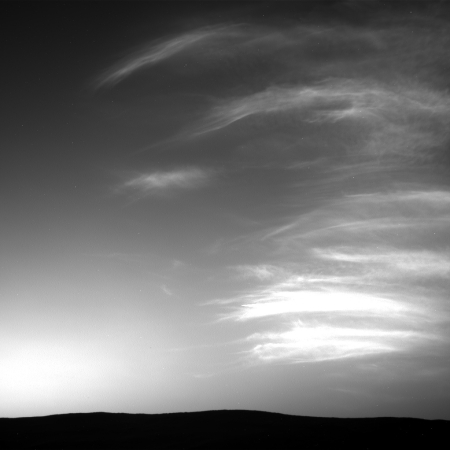
Curiosity’s journey up the slopes of Mount Sharp in Gale Crater goes on! On the right is one of a number taken by the rover in the past week, showing water clouds drifting over Gale Crater.

These are likely water-ice clouds about 19 miles (31 kilometers) above the surface. They are also “noctilucent” clouds, meaning they are so high that they are still illuminated by the Sun, even when it’s night at Mars’ surface. Scientists can watch when light leaves the clouds and use this information to infer their altitude.

While these clouds teach us something about Martian weather, the big rover news this week was that the data obtained from the two drill holes taken in April show that the clay formation that Curiosity is presently traversing is definitely made of clay, and in fact the clay there has the highest concentration yet found by the rover.

This clay-enriched region, located on the side of lower Mount Sharp, stood out to NASA orbiters before Curiosity landed in 2012. Clay often forms in water, which is essential for life; Curiosity is exploring Mount Sharp to see if it had the conditions to support life billions of years ago. The rover’s mineralogy instrument, called CheMin (Chemistry and Mineralogy), provided the first analyses of rock samples drilled in the clay-bearing unit. CheMin also found very little hematite, an iron oxide mineral that was abundant just to the north, on Vera Rubin Ridge. [emphasis mine]

That two geological units adjacent to each other are so different is significant for geologists, because the difference points to two very different geological histories. The formation process for both the clay unit and Vera Rubin Ridge must have occurred at different times under very different conditions. Figuring out how that happened will be difficult, but once done it will tell us much about both Gale Crater and Mars itself.

With the success of their clay unit drilling campaign, the Curiosity science team has had the rover begin its trek back from the base of the cliff below Vera Rubin Ridge to its planned travel route up the mountain.

An updated description of that route was released by the Curiosity science team last week, while I was in Wales. Below is their image showing that route, with additional annotations by me and reduced to post here.
» Read more

1 comment
1 137 138 139 140 141 212