Zhurong travels another 700 feet on Mars

Zhurong's location

According to a new update from China’s state-run press today, since the last update of its Zhurong Mars rover on July 31st, the rover has traveled just over 700 feet, for a total travel distance of about 2,624 feet, just under a half mile.

As of August 6, 2021, the rover has worked on the surface of Mars for 82 Martian days and the orbiter has been in orbit for 379 days. The two are in good condition and functioning properly.

The report provides no other real information.. I have indicated on the map to the right the range in which this travel distance could have taken Zhurong. Hopefully they will release more information soon.

The nominal mission was originally planned for 90 days. Right now it looks like the rover will easily exceed that.

0 comments

SpaceX stacks Starship on top of Superheavy

Superheavy with Starship on top
Click for original image.

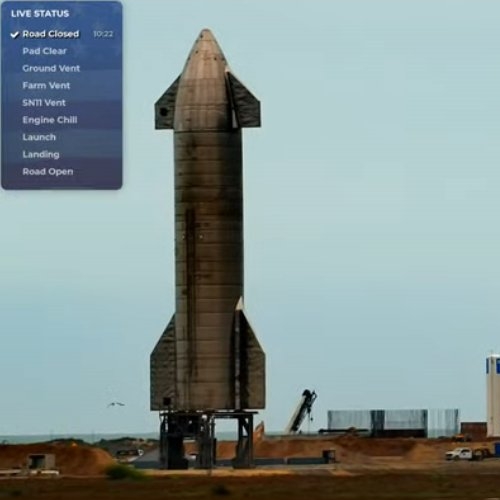
Capitalism in space: Only three days after the company had rolled Superheavy prototype #4 to the launchpad, SpaceX today stacked Starship prototype #20 on top, uniting for the first time the entire rocket.

All told, the rocket is 395 feet high, about 32 feet taller than the Saturn-5.

The photo to the right, reduced slightly to post here, was posted by Elon Musk earlier today. It also makes obvious several things that will be different for this Starship flight compared to the previous suborbital hops. Starship’s dark exterior is because it is covered with thermal tiles designed to protect it as it returns to Earth flying through the atmosphere at orbital speeds.

Note also the grid fins on Superheavy. Apparently they will be open during the entire flight, instead of unfurling shortly after stage separation as is done with Falcon 9.

I am not sure what the vertical attachments near the bottom of Superheavy are for. The plan is for the stage to land in the Gulf of Mexico, so it does not need landing legs. Could these be attachment points for holding the rocket to the launchpad?

I have been predicting a late September/early October date for this rocket’s first orbital launch test. SpaceX is sure working hard to beat that timeline. They still need to do tank tests and static fire tests of the whole assembly, but based on past schedules, they might get this done in only a few weeks. If so, it means they might be able to launch before the end of August.

My god, if only other American rocket companies worked in this manner. Imagine what wonders they all could accomplish.

19 comments

Astra to attempt orbital launch later in August

Capitalism in space: The smallsat rocket company Astra has announced that it will attempt to complete its first successful orbital launch before the end of this month, launching a Space Force satellite.

The U.S. Space Force has booked two missions with Astra, the Bay Area company announced today (Aug. 5). The first flight will launch a test payload for the Department of Defense’s Space Test Program from the Pacific Spaceport Complex in Kodiak, Alaska, during a window that runs from Aug. 27 through Sept. 11.

Astra has two previous test launches that attempted to reach orbit and failed. The second barely missed, because of a fuel mixture issue that had it run out of fuel prematurely.

If successful, this will make Astra the third operational American smallsat rocket company, following Rocket Lab and Virgin Orbit. Four others have promised launches in 2021. By next year the competition in this smallsat launch industry should be quite fierce.

0 comments

Virgin Galactic reopens suborbital ticket sale, raises price, delays next flight

Capitalism in space: Virgin Galactic announced yesterday that it is resuming ticket sales for flights on its reusable SpaceShipTwo spacecraft, raising the price from the old price of $250,000 to a new price of $450,000.

Virgin Galactic is offering customers three options: purchase a single seat, buy several together or book an entire flight on the eight-passenger Unity (or other space planes that come into operation, such as the recently built VSS Imagine). The company also sells seats for microgravity research and professional astronaut training. Those are in a different tier, going for $600,000 apiece, Colglazier said during a call with investors on Thursday afternoon.

The announcement also revealed that they are delaying their next flight until September. That flight has been scheduled for the summer for months. The company is also delaying the start of regular commercial flights until late in ’22, in order to make some upgrades to their spacecraft.

By that time, regular orbital tourist flights will have become almost routine. Moreover, one has the option to experience weightlessness for far less buying a ticket on one of the various companies that fly “vomit comet” airplanes.

One wonders if the demand for these flights will be sustainable. We shall see.

5 comments

China launches military communications satellite

China’s Long March 3B rocket yesterday successfully launched a military communications satellite.

This was China’s eighth government launch since the beginning of July, in a span of only five weeks.

The launch was from an interior spaceport, so the rocket’s strap-on boosters and first stage core landed within China. No word if any landed near or on habitable areas, or if the Chinese were using parachutes or grid fins to control their landing.

The leaders in the 2021 launch race:

26 China
20 SpaceX
12 Russia
3 Northrop Grumman
3 Rocket Lab

The U.S. still leads China 30 to 26 in the national rankings.

1 comment

Ingenuity successfully completes 11th flight

Ingenuity about to land
Click for full image.

Ingenuity has successfully completed its 11th flight, safely touching down at approximately its planned landing spot. From the science team’s tweet:

[Ingenuity] has safely flown to a new location! Ingenuity flew for 130.9 seconds and traveled about 380 meters before landing.

The image to the right, reduced to post here, was taken mere seconds before landing, and shows the helicopter’s shadow directly below it on the ground.

This particular flight was the first that did not push Ingenuity’s abilities, merely flying in a straight line to put it in a good position for later flights and to keep it ahead of Perseverance.

So far they have only released five images from the flight. Expect the rest to be downloaded from Perseverance in the next few days.

1 comment

Curiosity: Nine years since landing on Mars and the way forward

The way forward for Curiosity
Click for full image.

In today’s Curiosity update written by planetary geologist Abigail Fraeman, she noted this significant fact:

Project scientist Ashwin Vasavada pointed out a great fact at the beginning of planning today: At around 4 o’clock in the afternoon on Sol 3199 (the first sol in the plan we are creating today), Curiosity will begin its 10th Earth year on Mars. In the last nine years, the rover has traveled 26.3 km [16.3 miles], climbed over 460 m [1,509 feet] in elevation, and collected 32 drilled samples of rock.

Her update includes the first image taken by Curiosity upon landing, a view of Mount Sharp using the rover’s front hazard camera. In that picture, the mountain is far away, as the rover was sitting on the flat floor of Gale Crater.

The photo above, cropped and enhanced to post here, was taken yesterday by one of Curiosity’s navigation cameras, and looks out across the rocky mountainous terrain the rover is soon to travel. As Fraeman also notes,
» Read more

9 comments

China’s Long March 6 launches two military technology test satellites

Using its Long March 6 rocket, China yesterday successfully placed two military technology test satellites into orbit, designed to test “new interference suppression technology for Ka-band mobile communications satellites.”

The launch occurred at one of China’s interior spaceports. No word on whether the rocket’s first stage crashed near habitable area.

The leaders in the 2021 launch race:

25 China
20 SpaceX
12 Russia
3 Northrop Grumman
3 Rocket Lab

The U.S. still leads China 30 to 25 in the national rankings.

8 comments

Details on the Russian movie to be shot on ISS in October

Link here. The article provides a lot of details about who will fly, who will do what, and who is slated as back-ups if the primary crew of actress and director fail their training. However, I found the description of the movie to be the most interesting thing:

Shipenko revealed the script is still being fine-tuned, but the plot involves a cosmonaut who suffers a cardiac arrest during a spacewalk and, although he survives, he will require surgery to ensure he can handle the Soyuz return to Earth. A female cardiac surgeon, named Zhenya, has to be sent to the ISS to perform the procedure with only a few weeks to prepare for the trip.

Unlike the American space films like Gravity, this story is incredibly well grounded in reality. The Russians have actually experienced examples of station astronauts getting so sick in space that their missions had to be aborted early. In one case it was a prostate infection. In another it was the mental illness of the entire crew.

This story is also comparable to situations that have occurred in Antarctica, a very similar environment to the station. In the early 2000s the doctor in Antarctica had to perform surgery on herself because she had developed cancer. Then in 2016 Buzz Aldrin had to be evacuated due health issues.

If done right, this could not only make a damn good movie, it will also do so by revealing the true dangers of going to space.

6 comments

White blobs on Mars

White blobs on Mars
Click for full image.

Time for another “What the heck?” image. The photo to the right, cropped to post here, was taken on May 18, 2021 by the high resolution camera on Mars Reconnaissance Orbiter (MRO). It shows what appears to be a series of white circular features aligned with a ridge line.

Are these eroded craters? Maybe, but their alignment with those ridges suggests otherwise. If you look at the full image, you will see further parallel ridges to the north and south, also with similar circular blobs lined along them. Furthermore, the flat surrounding terrain, part of the northern lowland plains north of the resurgences from Valles Marineris, has a scattering of very normal looking craters, with distinct rims and even some glacial material within. As this is at 44 degrees north latitude, the presence of glacial material inside craters is not surprising.

Thus, the white blobs are likely not craters, but some form of eruptive material from below, coming up along those ridges which are probably faultlines. The whiteness suggests that material is water ice, but this of course is unconfirmed.

The question is of course, why? What would cause water ice to erupt along these faultlines? And why are such features not seen elsewhere? Faults and underground ice are common on Mars. Yet, I don’t remember seeing features such as this in any other Martian images.

2 comments

Ingenuity’s 11th flight scheduled for tonight

Ingenuity's 11th flight plan
Click for interactive map.

The next flight of Ingenuity on Mars is now scheduled for this evening, and will be a much simpler flight than the helicopter’s previous trip.

The map to the right shows the route in blue. The flight is mainly a transfer flight, intended to keep the copter ahead of the rover as they leapfrog from point to point in Jezero Crater. It will actually be the first flight by Ingenuity that does not push its engineering in any major way.

This map, the most up-to-date available, is at this moment about five sols out of date. Perseverance is likely slightly south and to the west of the location shown.

The present plan is for Perseverance to travel to the northwest along the dark ridgeline that Ingenuity will land next to. The rover will then retreat, returning more or less to its landing area and then north to circle around the largest crater on the map and then to head west to the base of the delta to the area labeled “Three Forks”, which is their entrance to the delta’s geology.

0 comments
1 55 56 57 58 59 126