ABL completes investigation into launchpad fire in July

The rocket startup ABL yesterday released the results of its investigation into launchpad fire in July that destroyed its RS1 rocket during a static fire test prior to an orbital test launch.

In a statement, ABL Space Systems said it ignited the E2 engines in the first stage of the RS1 rocket in the test, but aborted the test after just half a second because of a low pressure reading in one engine that the company said was caused by a faulty pressure sensor. The engines shut down, but a fire then broke out under the base of the vehicle, fed by fuel leaks from two engines. That fire was contained but could not be extinguished by either water or inert gas systems, and the company started offloading kerosene and liquid oxygen propellants from the vehicle.

The launch pad the company uses at Kodiak does not have its own water supply, with the company instead using mobile tanks that ran out of water 11 and a half minutes after ignition. That caused the fire to spread “and a progressive loss of pad systems,” the company stated, including the inability to continue detanking the rocket and eventually telemetry from the rocket.

ABL’s first launch attempt of this rocket in January 2023 failed when the first stages shut down immediately after lift-off and the rocket crashed on the launchpad. It completed its investigation of that failure in October 2023 and was ready for its second launch attempt this summer when the fire described above occurred.

The company has raised several hundred million dollars, with its chief investor being Lockheed Martin, which has also signed a contract for as many as 58 RS1 launches. It increasingly appears those launches might very well go to other providers.

0 comments

Firefly delivers its first Blue Ghost lunar lander for final environmental testing

Blue Ghost in clean room

Firefly this week completed the integration of the ten customer payloads onto its first Blue Ghost lunar lander and shipped the lander to JPL in California for final environmental testing before its planned launch before the end of this year.

Following final testing, Firefly’s Blue Ghost will ship to Cape Canaveral, Florida, ahead of its launch on a SpaceX Falcon 9 rocket scheduled for Q4 2024. Blue Ghost will then begin its transit to the Moon, including approximately a month in Earth orbit and two weeks in lunar orbit. This approach provides ample time to conduct robust health checks on each subsystem and begin payload operations during transit.

Blue Ghost will then land in Mare Crisium, a basin in the northeast quadrant on the Moon’s near side, before deploying and operating 10 instruments for a lunar day (14 Earth days) and more than 5 hours into the lunar night.

Once launched, Firefly will become the third American company, after Astrobotic and Intuitive Machines, to build a privately owned lunar lander and attempt a lunar landing. Since the other two companies were not entirely successful in their landing attempts, Firefly has the chance to be the first to succeed.

0 comments

SpaceX blasts its satellite competitors for lobbying the government to shut down Starlink/T-Mobile partnership

SpaceX on August 22, 2024 responded harshly to the effort by its satellite competitors to get the FCC to shut down the planned partneship of Starlink and T-Mobile, whereby Starlink will fill the gaps in T-Mobile’s coverage.

You can read SpaceX’s letter here. Its language however is quite blunt:

While the petitions from AT&T, Verizon, DISH/EchoStar, and Omnispace lack technical basis or legal merit, their game is clear. AT&T and Verizon seek to hamstring their competitor T-Mobile by talking out of both sides of their mouths, on one hand demanding without technical support that T-Mobile and SpaceX operate at unnecessarily low power levels that will force Americans to sacrifice service, while giving their own partner AST a free pass. AT&T goes so far as to claim to have conducted a secret study it refuses to show the Commission to support suppressing SpaceX’s out-of-band emissions to an interference-protection level ten times below the limit sufficient to protect terrestrial networks, while allowing its partner AST to exceed that limit.

DISH/EchoStar repeats its demand to siphon proprietary information from SpaceX to aid its own flailing ambitions, while stoutly refusing SpaceX’s repeated requests to engage in actual good faith coordination the way a company with actual technical concerns would.

And although it still has no commercial satellite service anywhere in the world, Omnispace continues to make unfounded claims of prospective harmful interference to prop up a decade-old spectrum play that it fears will lose financial value if American consumers can enjoy ubiquitous mobile connectivity using the PCS G Block downlink.

Fortunately, none of these unfounded arguments present any reasonable basis to delay swift grant of SpaceX’s request to bring ubiquitous mobile connectivity to American consumers.

The FCC has not yet responded to any of these demand letters. Nor has it yet issued the waiver SpaceX had requested in June 2024 allowing its Starlink system to operate beyond its licensed radio frequencies in order to facilitate cell surface with T-Mobile.

2 comments

NASA reveals technical problem during solar sail deployment of test mission

NASA today revealed that a technical problem occurred during the deployment of a demonstration solar sail mission launched in April on Rocket Lab’s Electron rocket.

Upon an initial attempt to unfurl, the solar sail paused when an onboard power monitor detected higher than expected motor currents. Communications, power, and attitude control for the spacecraft all remain normal while mission managers work to understand and resolve the cause of the interruption by analyzing data from the spacecraft.

The goal had been test the boom deployment of a 860 square foot sail from a cubesat only about 4 feet in size.

The concept of the solar sail is simple: Use the pressure produced by sunlight to maneuver and fly controlled throughout the solar system. The idea has been tested successfully several times, with the Japanese IKAROS test solar sail and the Planetary Society’s Lightsail-2 the most successful. Sadly almost all other attempts to test this idea have had technical problems of one kind or another.

Ironically, one test solar sail proved that such a deployment from a cubesat could be done very cheaply, unlike NASA’s effort above. Brown University students in 2023 used cheap off-the-shelf parts to launch a smallsat sail that successfully deployed and was then used to lower the satellite’s orbit in order to de-orbit it more quickly. Total cost, $10,000. And it worked.

4 comments

A real whirlpool in space

A real whirlpool in space
Click for original image.
Cool image time! The picture above, cropped to post here, was taken by the Hubble Space Telescope as part of a survey of nearby galaxies that have what astronomers call an Active Galactic Nuclei (AGN), because the supermassive black hole at the center is devouring nearby material at a great rate and thus producing high energy emissions as it does so.

Many active galaxies are known to astronomers at vast distances from Earth, thanks to the great brightness of their nuclei highlighting them next to other, dimmer galaxies. At 128 million light-years from Earth, UGC 3478 is positively neighbourly to us. The data used to make this image comes from a Hubble survey of nearby powerful AGNs found in relatively high-energy X-rays, like this one, which it is hoped can help astronomers to understand how the galaxies interact with the supermassive black holes at their hearts.

The bottom line is that this spiral galaxy literally is a whirlpool, the entire galaxy spiralling down into that massive black hole in its center. One cannot help wondering why such galaxies don’t end up eventually getting completely swallowed by that black hole.

Or maybe they do, and we don’t see such things because all that is left is a supermassive black hole that emits no light or energy at all, a dark silent ghost traveling between the galaxies unseen and undetectable.

8 comments

First high resolution images released from Juice’s fly-by of the Earth & Moon

Juice's high resolution view of the Moon
Click for original image.

The Italian science team that runs the high resolution camera on the asteroid probe Juice have now released that camera’s first images, taken to test its operation during the spacecraft’s close fly-by of both the Moon and then the Earth a week ago.

The picture to the right, cropped, reduced, and sharpened to post here, shows the Moon’s surface during that close fly-by, which got within 435 miles. The camera is dubbed Janus, and was developed by Italy and operated by the Italian National Institute for Astrophysics.

JANUS will study global, regional and local features and processes on the moons, as well as map the clouds of Jupiter. It will have a resolution up to 2.4 m per pixel on Ganymede and about 10 km per pixel at Jupiter.

The main aim of JANUS’s observations during the lunar-Earth flyby was to evaluate how well the instrument is performing, not to make scientific measurements. For this reason, JANUS took images with various camera settings and time intervals – a bit like if you’re going out to test a DSLR camera for the first time. In some cases, researchers intentionally ‘blurred’ the images so that they can test out resolution recovery algorithms. In other cases, they partially saturated the image to study the effects induced on the unsaturated areas.

As can be seen by the sample image above, the test images appear to have demonstrated that Janus will function as planned when Juice arrives in orbit around Jupiter in 2031 in order to study that gas giant’s upper atmosphere as well as its larger icy moons, Ganymede, Calisto, and Europa.

0 comments

JAXA finally shuts down SLIM operations after four months of no contact

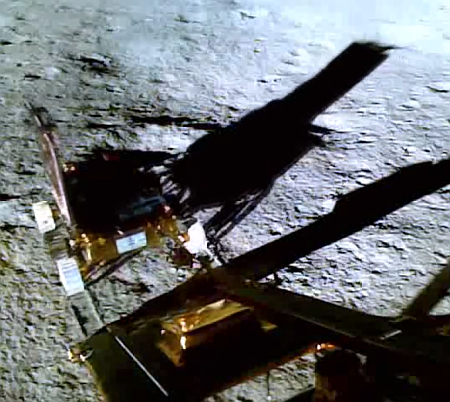
SLIM's last image
Click for original image.

Japan’s space agency JAXA today announced that it has now closed down all further attempts to contact its SLIM lunar lander on the surface of the Moon.

The Japan Aerospace Exploration Agency (JAXA) concluded operations of the Smart Lander for Investigating Moon (SLIM) on the lunar surface at 22:40 (JST), on August 23, after being unable to establish communication with the spacecraft during the operational periods from May to July*, following the last contact on April 28, 2024.

SLIM was launched onboard the H-IIA Launch Vehicle No.47 (H-IIA F47) on September 7, 2023 from the Tanegashima Space Center and achieved Japan’s first Moon soft landing on January 20, 2024. The landing precision was evaluated with a position error of approximately 10 meters from the target point, confirming the world’s first successful pinpoint landing. In addition, the Multi-Band Camera (MBC) successfully performed spectral observations in 10 wavelength bands on 10 rocks, exceeding initial expectations. Further, despite not being part of the original mission plan, the spacecraft was confirmed to survive three lunar nights and remained operational, demonstrating results that surpassed initial goals.

The lander’s main goal was to demonstrate the ability to do a precise robotic landing within a 100 meter landing zone. And even though one nozzle fell off during landing, resulting in SLIM landing on its side, it accomplished that goal and then survived three lunar nights, exceeding significantly its expected ability to function in harsh lunar environment.

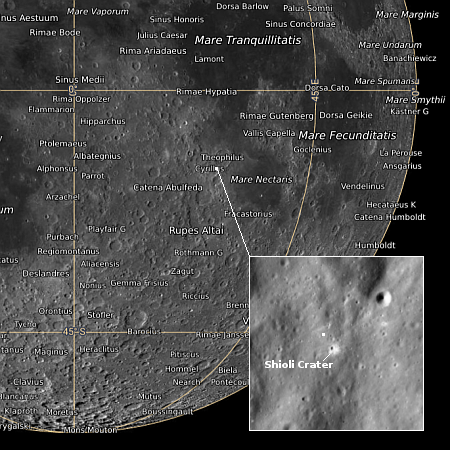
The image to the right, reduced to post here, was taken by SLIM just before it was shut down for its first lunar night. It looks to the southeast across the width of 885-foot-wide Shioli Crater, the opposite rim the bright ridge in the upper right about a thousand feet away.

0 comments

Rocket Factory Augsburg releases footage of 1st stage failure during static fire test

The German rocket startup Rocket Factory Augsburg today released the film footage it took during the failed 9-engine static fire test of its 1st stage last week.

I have embedded that footage below.

As the company’s CEO noted two days ago, the company has identified the cause as a fire in an oxygen pump which they think was unrelated to the engine design. This explanation remains puzzling, however. If the problem was not engine design, it suggests instead some other quality control error, which it is even more important to identify in order to prevent such errors in the future.

The video provides numerous angles of the failure, including one that captured the moment when the first stage fell over. As the CEO noted, it fortunately fell in the right direction, missing critical launchpad equipment and thus reducing significantly the damage to the pad.
» Read more

2 comments

Starliner will return unmanned; crew will return in February 2025 on Dragon

Starliner docked to ISS
Starliner docked to ISS.

In a briefing today, NASA’s administrator Bill Nelson announced that Boeing’s Starliner capsule, launched in June on its first manned mission, will return unmanned and that the two astronauts it brought to ISS — Butch Wilmore and Suni Williams — will return in February 2025 as part of the crew of the next Dragon manned mission, scheduled to launch in late September.

Nelson made it a point to note that NASA’s past inactions to protect astronauts on two different shuttle missions, thus leading to their deaths, was a factor in this decision. The agency now decided safety must come first, and since Starliner’s return abilities still carry uncertainties that relate directly to safety, it decided to use a more reliable and tested Dragon capsule to return those astronauts back to Earth. During the entire briefing and Q&A session it became very clear that NASA is now paying very close attention to its engineers and their conclusions, rather than dismissing those conclusions because of other management concerns, as it did during those previous two shuttle failures.

Nelson also stated that NASA still wants to use Starliner as a second crew vehicle to ISS. He noted that he has spoken to Boeing’s new CEO, who apparently committed to getting Starliner fixed and operating. It remains undecided whether another test manned flight will be required of Boeing (at Boeing’s cost) before NASA certifies it as an operational vehicle. Whether any other customers will be willing to use the capsule remains unlikely until Boeing has flown a lot of Starliner NASA flights with no problems.

At this moment they are looking to bring Starliner back in early September, using a simplified undocking system to get the vehicle away from ISS quickly. The next Dragon mission will launch no earlier than September 24th carrying two astronauts and two empty flight suits that Wilmore and Williams use during their return.

34 comments

Finding beauty on Mars in all the strange places

Overview map

Beauty on Mars
Click for original image.

Cool image time! The picture to the right, cropped to post here, was taken on May 23, 2024 by the high resolution camera on Mars Reconnaissance Orbiter (MRO).

The white dot in the inset of the overview map above indicates the location on Mars, smack dab in the middle of the 2,000-mile-long mid-latitude strip that I call glacier country, because practically every close-up image of this region shows glacial features.

This picture is no exception. The arrows in the inset show the downhill grade, falling about 1,700 feet across the entire inset. That grade is a reflection of the transition that takes place in this glacier country from the cratered southern highlands to the northern lowland plains.

I decided to crop the image at full resolution — showing only a tiny portion — because to my eye these curving linear grooves, produced naturally as Mars’ climate cycles cause glaciers to shrink and then grow repeatedly so that each cycle lays down a new line while squeezing the previous lines, are almost like a work of art. This might be nothing more than a glacier on an alien planet, but nature has caused it to form a very beautiful picture.

2 comments

NASA adds three orbital tug startups to its contract bid list

NASA yesterday added three orbital tug startups to its contract bid list, allowing these companies to bid on projects that require the deployment of NASA smallsats to different orbits after launch.

NASA announced Aug. 22 that it selected Arrow Science and Technology, Impulse Space and Momentus Space for its Venture-Class Acquisition of Dedicated and Rideshare (VADR) contract. That selection allows them to compete for task orders for launching specific missions, typically small satellites willing to accept higher levels of risk in exchange for lower launch costs.

Arrow provides small satellite companies the deployment equipment used to release the satellite after launch. Impulse and Momentus have orbital tugs that not only deploy smallsats, but move them to their preferred orbit after the tug’s release from its launch rocket.

This NASA announcement allows its smallsats to be launched on either a dedicated small rocket that puts the satellite in its desired orbit or as part of a larger rideshare launch with many satellites that then uses the tug to get the satellite where it needs to be.

0 comments

Amazon commits almost $20 million more to expanding its satellite production facility

Amazon yesterday revealed it is going to spend an addition $19.5 million to expand its satellite production facility at the Kennedy Space Center in Florida in order to overcome the long multi-year delay in getting production started.

The company said Aug. 22 the investment will support a secondary, 3,900-square-meter support facility at the site, which would help accelerate launch cadence amid a looming regulatory deadline to deploy half the constellation by July 2026. The building would join a 9,300-square-meter satellite processing facility Amazon announced last year at Kennedy’s runway-equipped Launch and Landing Facility, bringing total investment in the site to nearly $140 million.

The company hopes to open this additional facility by next year. It will need it, because its FCC license for its Kuiper internet constellation — conceived to be similar to SpaceX’s Starlink — requires it to launch half of the constellation of 3,200+ satellites by 2026 and have the entire constellation in orbit by 2029. Meeting that first deadline will be challenging at this point, though the company hopes to be launching frequently in the next few years. It has contracts to launch satellites 46 times on ULA rockets (8 on Atlas-5 and 36 on Vulcan), 27 times on Blue Origin’s New Glenn, 18 times on ArianeGroup’s Ariane-6, and 3 times on SpaceX’s Falcon-9. To provide payloads for those launches however it will need to be able to quickly build a lot of satellites, and that’s what this additional investment is for.

It must be noted again that the Kuiper constellation was first proposed by Amazon at almost the exact same time as Elon Musk proposed his Starlink constellation. SpaceX now has several thousand satellites in orbit and is earning several billion dollars per year from several million signed up customers. Amazon in comparison has only launched two test satellites and zero operational satellites in that same time frame.

2 comments
1 202 203 204 205 206 1,327