Update on the ten cubesats launched by SLS

Link here.

At this moment six of the ten cubesats either accomplished their mission successfully or are still operating, while four cubesats failed entirely.

Of those still working, two will go into lunar orbit and try to find evidence of both hydrogen and ice on the Moon. A third is testing “solid iodine” thrusters, while a fourth will observe how yeast samples react to a long exposure in deep space. A fifth cubesat is a joint NASA-JAXA mission, and is testing how to fly a smallsat in the low gravity of a Lagrangian point.

Finally, an Italian cubesat was used to successfully take images of the Moon and Orion, and has completed its mission.

1 comment

China’s Long March 4C rocket launches two satellites

Long March 4C launch

China today launched two experimental technology satellites, using its Long March 4C rocket from an interior spaceport.

The launch pictures, as captured on the right, show what appear to be panels falling off the rocket as it lifts off. Note how some of these falling panels are red, while the Chinese flag at the top of the rocket appears to be partly broken off in the later picture. The fairing and shell of the upper stage in the second picture also appear changed.

The Chinese state-run press claims the satellites reached orbit as planned, but these pictures suggest otherwise. If part of the fairing and outside of the upper stage fell off, there is a good chance the payload was damaged during max-q, the period soon after launch when rockets undergo the greatest stress in the Earth’s thicker atmosphere.

UPDATE from stringer Jay: Video of the launch. The panels continue to drop off for a considerable time.

Assuming this launch was a success, however, the 2022 launch race continues to heat up, with China vying to beat SpaceX after trailing the American company for most of the year.

58 China
56 SpaceX
21 Russia
9 Rocket Lab
8 ULA

The U.S. still leads China 80 to 58 in the national rankings, but trails the entire world combined 88 to 80.

7 comments

Orion successfully splashes down in the Pacific

NASA’s Orion capsule today successfully returned from a three week trip around the Moon, splashing down in the Pacific where it was successfully recovered.

The next Artemis flight will be a manned one, using SLS and Orion to fly around the Moon. It will also be the first time Orion will use its full environmental system, with humans on board. Though presently scheduled for May 2024, it is almost certainly not going to fly before 2025.

The actual Artemis manned lunar landing will follow, no sooner than two years after that. As presently designed, that mission requires the establishment of the Lunar Gateway station — astronauts can be transferred from Orion to Starship and back again, and that station is likely not going to be ready in this time frame.

As I said yesterday, I predict the two already purchased private Starship missions around the Moon, paid for by Yusaku Maezawa and Jared Isaacman, will happen first. Both will certainly beat NASA’s planned landing on the Moon. I also expect both to beat that Orion manned fly-around in ’24-’25. And each will cost pennies compared to the entire SLS/Orion program, while actually making a profit that will be used to further development and more manned private flights.

2 comments

SpaceX successfully launches Ispace’s Hakuto-R private mission to Moon

Lunar map showing Hakuto-R's landing spot
Hakuto-R’s planned landing site is in Atlas Crater.

Using its Falcon 9 rocket, SpaceX tonight successfully launched Ispace’s Hakuto-R lunar lander, the first private mission attempting to softly land on the Moon.

The Falcon 9 first stage completed its fifth flight, landing successfully at Cape Canaveral.

Hakuto-R, which is actually the first of two missions, carries seven payloads, including two small rovers, Rashid, which is the United Arab Emirates first lunar mission, and a smaller rover built by Ispace. Both will operate for about a week, one lunar day. Hakuto-R will land on the Moon in April, 2023.

A second payload is a cubesat from JPL, called Lunar Flashlight. It will go into lunar orbit, testing new fuel technologies while also attempting to identify water in the permanently shadowed craters at the lunar south pole.

The leaders in the 2022 launch race:

57 China
56 SpaceX
21 Russia
9 Rocket Lab
8 ULA

The U.S. now leads China 80 to 57 in the national rankings, but trails the entire world combined 87 to 80.

9 comments

NASA extends Boeing’s contract to produce more SLS rockets

NASA yesterday announced that it will pay Boeing $3.2 billion for two more SLS rockets.

NASA has finalized its contract with Boeing of Huntsville, Alabama, for approximately $3.2 billion to continue manufacturing core and upper stages for future Space Launch System (SLS) rockets for Artemis missions to the Moon and beyond.

Under the SLS Stages Production and Evolution Contract action, Boeing will produce SLS core stages for Artemis III and IV, procure critical and long-lead material for the core stages for Artemis V and VI, provide the exploration upper stages (EUS) for Artemis V and VI, as well as tooling and related support and engineering services.

All this really means is that NASA is going depend on SLS and Orion to fly its astronauts to and from the Moon, and because of that its pace of flight will be — at best — slow and long-drawn out. For example, this new order extends the contract out to 2028. It will thus leave plenty of time for SpaceX and other nations to get there first.

I predict that the private Starship missions paid for by Yusaku Maezawa and Jared Isaacman will both fly before these two new Artemis missions. You heard it here first.

20 comments

Chinese upper stage disintegrates in orbit

A Chinese Long March 6 upper stage, launched in on November 11, 2022, has disintegrated into more than 350 in orbit and now pose a threat to other orbiting spacecraft.

The Long March 6A rocket launched from Taiyuan, north China, on Nov. 11, successfully inserting the Yunhai 3 environmental monitoring satellite into its intended orbit.

The upper stage of the rocket, however, apparently suffered a breakup event shortly thereafter. On Nov. 12, the U.S. Space Force’s 18th Space Defense Squadron (18SDS) reported that it was tracking at least 50 discrete pieces of orbital debris from the rocket body. Ongoing tracking from 18SDS, which focuses on space domain awareness, now states that the debris cloud has grown to 350 objects associated with the rocket stage.

Based on the data, it appears the break-up occurred because the stage had an explosive event. It could have been programed to fire its engine to quickly de-orbit it and something went wrong. Or not. The Chinese have not demonstrated much concern about such issues.

4 comments

December 9, 2022 Quick space links

Courtesy of BtB’s stringer Jay.


2 comments

Ancient lava flows down the flanks of the solar system’s largest volcano

Lava flows on Olympus Mons
Click for full image.

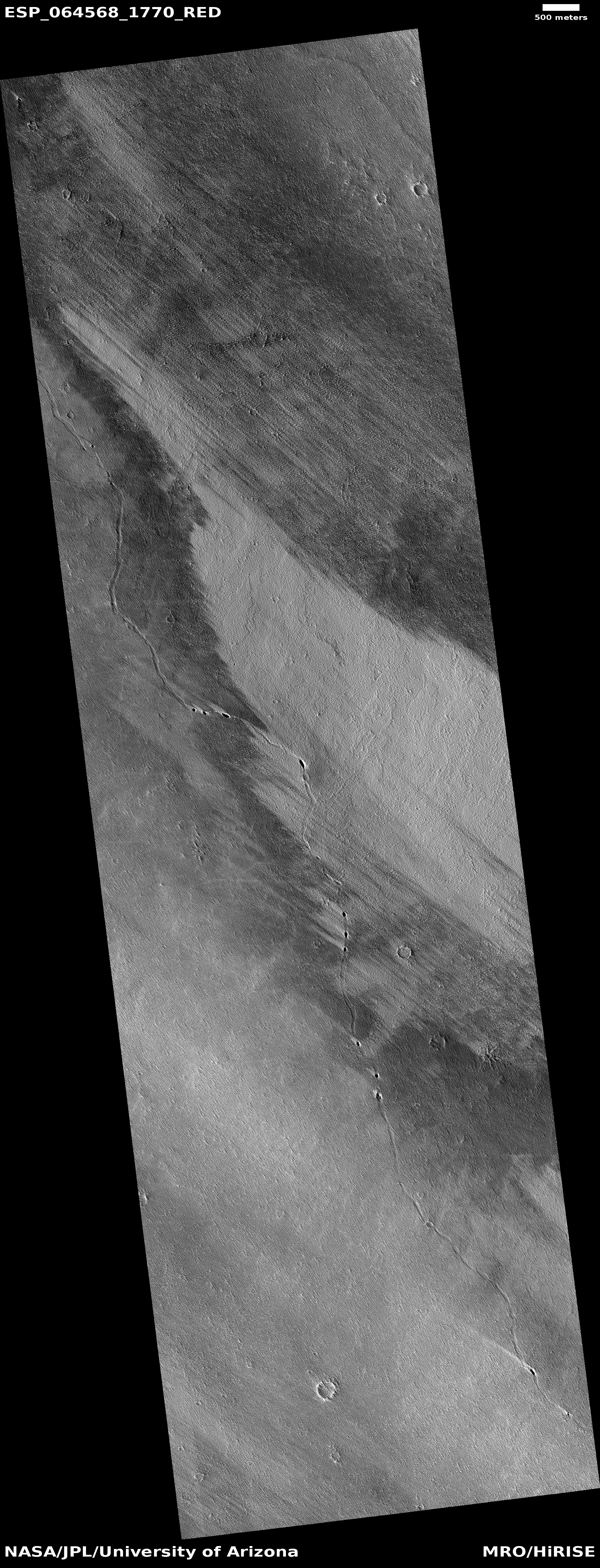
Cool image time! The photo to the right, cropped, reduced, and sharpened to post here, was taken on October 2, 2022 by the high resolution camera on Mars Reconnaissance Orbiter (MRO). It shows what appears to be very old and eroded lava on the northeast flanks of Olympus Mons, the largest volcano on Mars as well as the entire solar system. About 600 miles across, from the edge to its peak, Olympus rises about 54,000 feet, with an actual height relative to Marsโ€™ โ€œsea levelโ€ of just under 70,000 feet, more than twice as high as Mount Everest on Earth.

The white arrow show the downward grade. Several different flows can be seen throughout the picture, some confined to a central channel with smooth aprons of overflows on either side. Others are more broken and less coherent, and suggest that either the flows were inherently different, or are much older and have deteriorated with time.
» Read more

0 comments

Pushback: Students win $90K from University of Idaho for restricting their free speech

Idaho University bans religious speech
This college is still hostile to free speech.

Bring a gun to a knife fight: Three students who were punished last spring by the University of Idaho (UI) for daring to disagree publicly with an activist for the queer agenda have now won a $90K settlement as well as getting their records fully cleared.

As part of the settlement, university officials permanently rescinded the no-contact orders they had issued against Peter Perlot, Mark Miller, and Ryan Alexander, members of the Christian Legal Society chapter at the university, and Professor Richard Seamon, CLSโ€™s faculty advisor, and paid $90,000.

I reported this case when it happened, noting that the university had essentially “decided that the only opinions that could be allowed were those that agreed with the queer political agenda, and acted unilaterally to punish these Christians for refusing to bow to that rule.” The university has now lost, and lost badly.
» Read more

5 comments

Astronomers confirm Webb galaxies from the early universe

Astronomers using Webb have now confirmed with spectroscopy the age of at least four galaxies from the very very early universe, existing only a short time after the theorized Big Bang.

Four of the galaxies studied are particularly special, as they were revealed to be at an unprecedentedly early epoch. The results provided spectroscopic confirmation that these four galaxies lie at redshifts above 10, including two at redshift 13. This corresponds to a time when the universe was approximately 330 million years old, setting a new frontier in the search for far-flung galaxies. These galaxies are extremely faint because of their great distance from us.

The scientists had aimed Webb at Hubble’s Ultra Deep Field, doing a long infrared exposure lasting 28 hours over three days in order to gather the faintest infrared radiation (that Hubble could not see) and thus the most distant galaxies. The spectrum of individuals stars was then measured, which indicating their redshift and their estimated age.

The astronomers will next aim Webb at the more famous Hubble Deep Field, the first such long exposure that optical telescope took back in the late 1990s.

1 comment
1 651 652 653 654 655 2,914