Boeing announces major reorganization

Boeing yesterday announced that it is doing a major reorganization of its defense, space, and security divisions.

The action will replace numerous executives while reducing eight different divisions into four.

Such action was long overdue, considering Boeing’s many recent engineering failures, from space (Starliner) to aviation (737-Max), all of which demanded such a reorganization and consolidation, simply to pay the bills if not to fix serious management shortcomings. The bad economy has only made this more urgent.

2 comments

Japan to stay on ISS to 2030 in exchange for an astronaut flight to Gateway

NASA yesterday announced that Japan has agreed to remain on ISS through 2030, the first international partner to do so, and in exchange will get a Japanese astronaut flight to the Lunar Gateway station.

Under the Gateway Implementing Arrangement, NASA will provide an opportunity for a Japan Aerospace Exploration Agency (JAXA) astronaut to serve as a Gateway crew member on a future Artemis mission. This formally represents the first commitment by the U.S. to fly a Japanese astronaut beyond low-Earth orbit aboard NASAโ€™s Space Launch System (SLS) rocket and Orion spacecraft.

I remain very doubtful in the long run these flights will occur on SLS, which simply cannot launch frequently enough to make the entire program viable. More likely with time the rocket will be replaced by other commercial carriers.

4 comments

1st suborbital launch by Indian private company

Skyroot, a commercial rocket startup in Indian, yesterday became the first Indian company to complete a rocket launch, sending its Vikram-S suborbital rocket on a short flight.

I have embedded the launch below, cued to just before lift-off. The launch itself, which lasted only about six minutes, reached a elevation of just under 56 miles, tested of the rocket’s first stage, as well as a number of other systems.
» Read more

3 comments

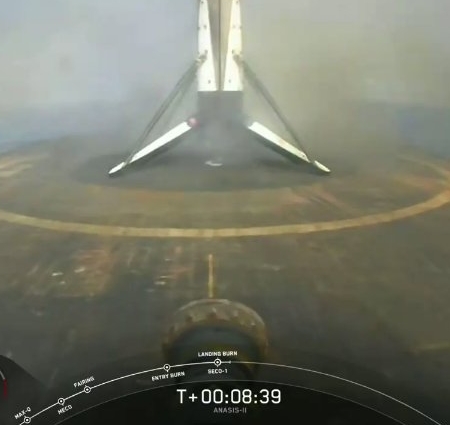
SpaceX cancels launch after reviewing static fire test data

After a review of the test data produced during its standard dress rehearsal countdown and static fire prior to launch, SpaceX decided to cancel a Falcon 9 launch yesterday, carrying 52 Starlink satellites.

The first stage booster had previously launched 10 times, though it is not clear if this is the cause of the delay.

Itโ€™s not the first time SpaceX has delayed a launch indefinitely after a static fire test, but it is the first time in years. SpaceX semi-regularly stands down from launch attempts to conduct inspections or complete minor repairs or component replacements when data is amiss or contradictory, but those plans tend to mention the next launch target. This time, even SpaceXโ€™s website has been scrubbed to say that โ€œa new target launch date [will be announced] once confirmed.โ€

The last time a prelaunch static fire was explicitly blamed for a launch delay was in August 2019, when SpaceX fired up a Falcon 9 rocket ahead of its Amos-17 launch, didnโ€™t like what it saw, decided to replace a valve on the booster, and then conducted a second static fire test to clear the rocket to launch. Itโ€™s possible that Starlink 2-4โ€™s sequence of events will end up being similar.

2 comments

ABL’s RS1 rocket aborts at ignition

The first test launch of ABL’s RS1 rocket aborted at T-0 yesterday, just as the rocket ignited its engines.

From a company tweet:

RS1 aborted terminal count during ignition. The vehicle is healthy, and the team is setting up to offload propellant for today. More information to come on our next opportunity.

Though it appears all is well with the rocket, the company has not yet announced a new launch date. The present launch window closes November 21, 2022.

0 comments

November 17, 2022 Quick space links

Courtesy of BtB’s stringer Jay, who trolls Twitter so we don’t have to.


4 comments

Today’s blacklisted American: Anti-Semitic attacks skyrocket on college campuses

The coming genocide
What American universities are aggressively working towards

They’re coming for you next: According to a recent study, anti-Semitic attacks against Jews have increased drastically on American college campuses in 2021 and 2022, rising in lock-step with the introduction of critical race theory and its anti-white, anti-American, and pro-Marxist agenda.

There were 254 attacks on 63 different college campuses with large Jewish populations, with Harvard University, the University of Chicago, Tufts University, UCLA, and Rutgers University having the highest number of incidents, according to a report by the AMCHA Initiative, a Jewish advocacy group that says its findings expose an “insidious,” never-before-revealed campus trend.
» Read more

5 comments

Slowly the Ukrainians continue to regain their country

The Ukraine War as of September 11, 2022
The Ukraine War as of September 11, 2022. Click for full map.

The Ukraine War as of November 16, 2022
The Ukraine War as of November 16, 2022. Click for full map.

In the two months since my last update on the Ukraine Way in September, the steady and continuing retreat of the Russians has continued, with the Ukrainians last week finally retaking all the territory north of the Dnipro River, including the city of Kherson.

The two maps to the right, created by the Institute for the Study of War (ISW) and simplified, reduced, and annotated to post here, show these gains, with the top map from their September 11, 2022 analysis and the bottom from their November 16, 2022 update. Pink areas are regions controlled by the Russians. Blue areas are regions retaken by the Ukraine. Red-striped areas are regions captured by Russian in its 2014 invasion. Blue-striped areas are regions inside Russian-occupied territories that have seen strong partisan resistance. The green lines in the top map mark the locations of important rivers.

Overall, the military actions of the Russians have continued to be haphazard, poorly thought out, and inexplicable, as they have been from the start of this war. For example, even as the Ukrainians were continuing their steady gains in the north, the Russians seemed relatively uninterested. Instead, it continued its attempts to gain ground in the middle, near Donetsk, as indicated by the two green circles. The Russians have been attempting for months to make gains in this area. Though they have captured some territory, those captures have been tiny and very costly. Nor have these captures done anything to impact the Ukrainian gains elsewhere.
» Read more

18 comments

Webb finding more galaxies in early universe than expected

The uncertainty of science: Astronomers using the Webb Space Telescope are finding in very early universe many more galaxies that are also far more developed then had been predicted.

The Webb observations nudge astronomers toward a consensus that an unusual number of galaxies in the early universe were so much brighter than expected. This will make it easier for Webb to find even more early galaxies in subsequent deep sky surveys, say researchers.

“We’ve nailed something that is incredibly fascinating. These galaxies would have had to have started coming together maybe just 100 million years after the big bang. Nobody expected that the dark ages would have ended so early,” said Garth Illingworth of the University of California at Santa Cruz, a member of the Naidu/Oesch team. “The primal universe would have been just one hundredth its current age. It’s a sliver of time in the 13.8 billion-year-old evolving cosmos.”

Erica Nelson of the University of Colorado in Boulder, a member of the Naidu/Oesch team, noted that “our team was struck by being able to measure the shapes of these first galaxies; their calm, orderly disks question our understanding of how the first galaxies formed in the crowded, chaotic early universe.”

The galaxies are smaller, more compact than present day galaxies, and appear to be forming stars at a tremendous rate. Because their distances, presently estimated, still need to be confirmed by spectroscopy, these conclusions remain somewhat tentative though quite alluring.

We should not be surprised if in the next two years data from Webb will overturn almost all the theories that presently exist about the Big Bang and its immediate aftermath.

2 comments

Ispace announces new launch date and landing site on Moon for Hakuto-R lander

Lunar map showing Hakuto-R's landing spot

Ispace today announced that its commercial lunar lander, Hakuto-R, will now launch on a Falcon 9 rocket on November 28, 2022 and will arrive on the Moon in 54-mile-wide Atlas Crater in April 2023.

The white dot on the map to the right shows this landing spot, in the crater’s northern quadrant. Atlas is distinct in that its crater floor has many large fissures with the crater’s interior rim terraced, but this area is relatively smooth.

The spacecraft will carry seven commercial payloads, including the UAE rover Rashid, which is about the size of a small Radio Flyer wagon and will operate on the surface for about two weeks (one lunar day). It has cameras, whose primary research function will be to photograph the variety of different materials attached to the rover’s wheels to see how each interacts with the Moon’s very harsh and abrasive dust.

2 comments

Rocket Factory Augsburg signs deal to use German engine test facility

Rocket Factory Augsburg (RFA), one of three German rocket startups pushing to begin test launches next year, has signed a contract with Germany’s aerospace agency DLR to use of its engine test facility for static fire tests of its Helix engine.

RFA announced the deal at the Space Tech Expo Europe in Bremen, Germany, Nov. 16, which will allow RFA to use the P2.4 test site in Lampoldshausen. DLR provides the basic infrastructure while RFA brings its own test stand and supporting infrastructure.

Test stands in Lampoldshausen have so far only been used by DLR, the European Space Agency and ArianeGroup.

The new test stand will add to RFA engine testing capacity already established in Esrange in northern Sweden, where the company has been conducting testing on the Helix engine for the RFA One launcher. Testing will continue in Sweden but the new development simplifies logistics and bureaucracy related to import and export rules. [emphasis mine]

The highlighted sentence is the news. The German government has decided to break the monopoly held by government related operations of these facilities, and open up their use to private independent commercial companies.

RFA says it already has a dozen customers, and hopes to begin commercial launches by ’24.

1 comment
1 663 664 665 666 667 2,914