Weird flat plateau on Mars

Weird flat plateau on Mars
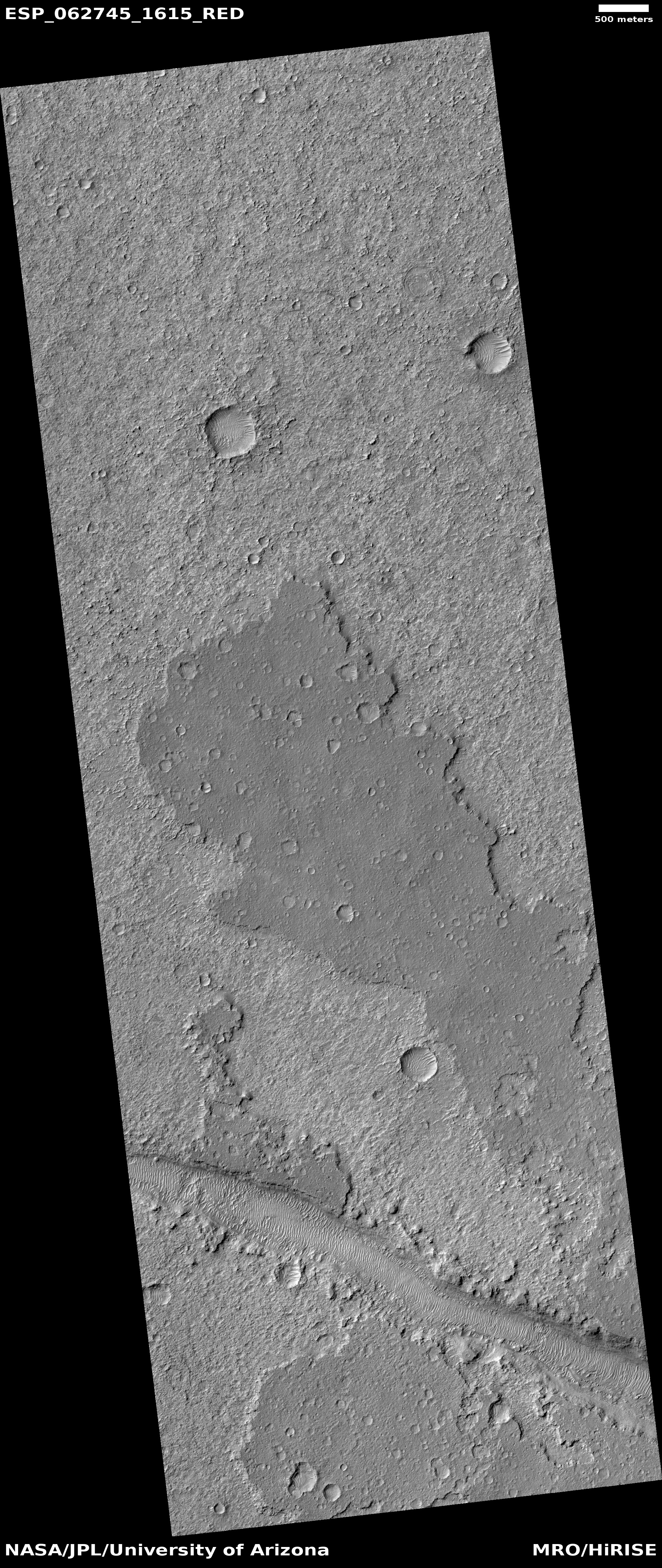
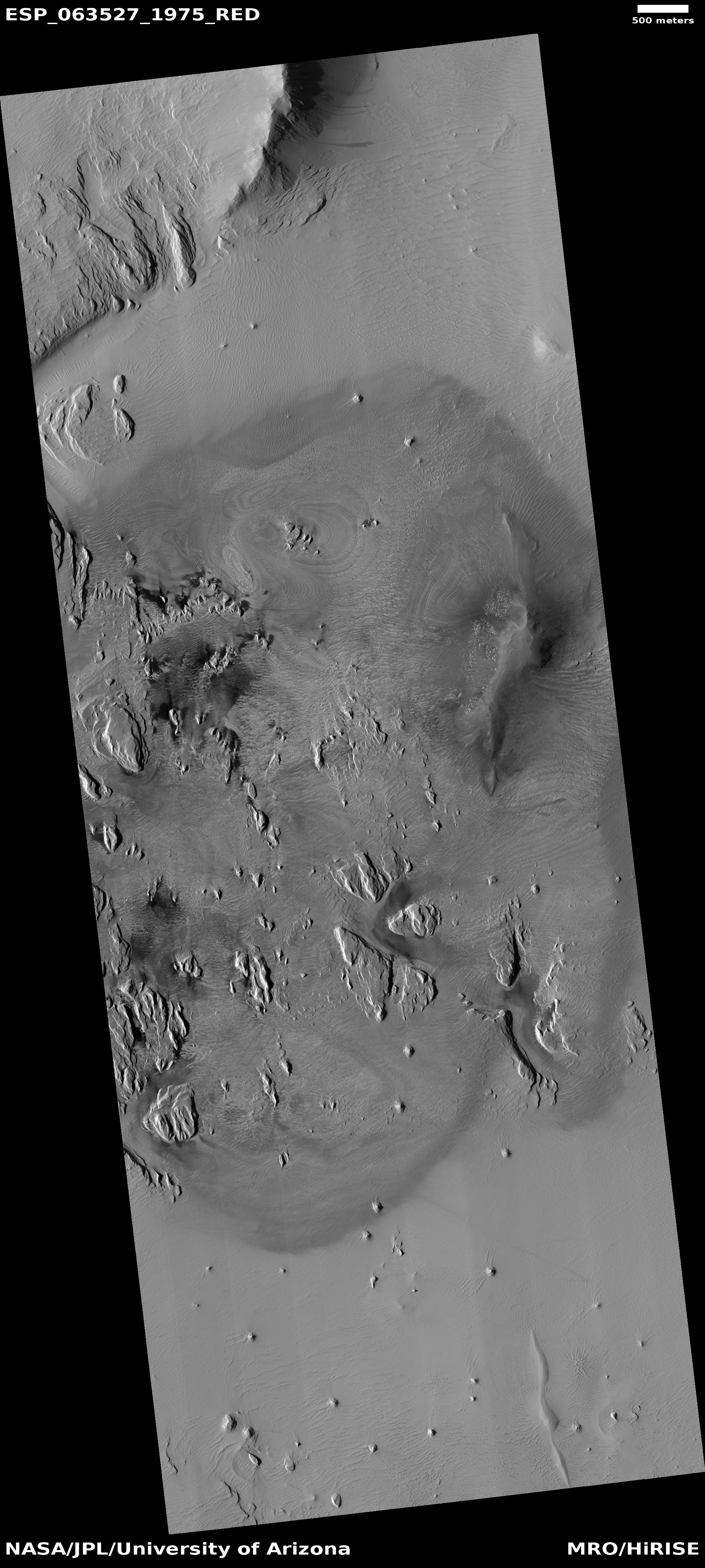
Click for full image.

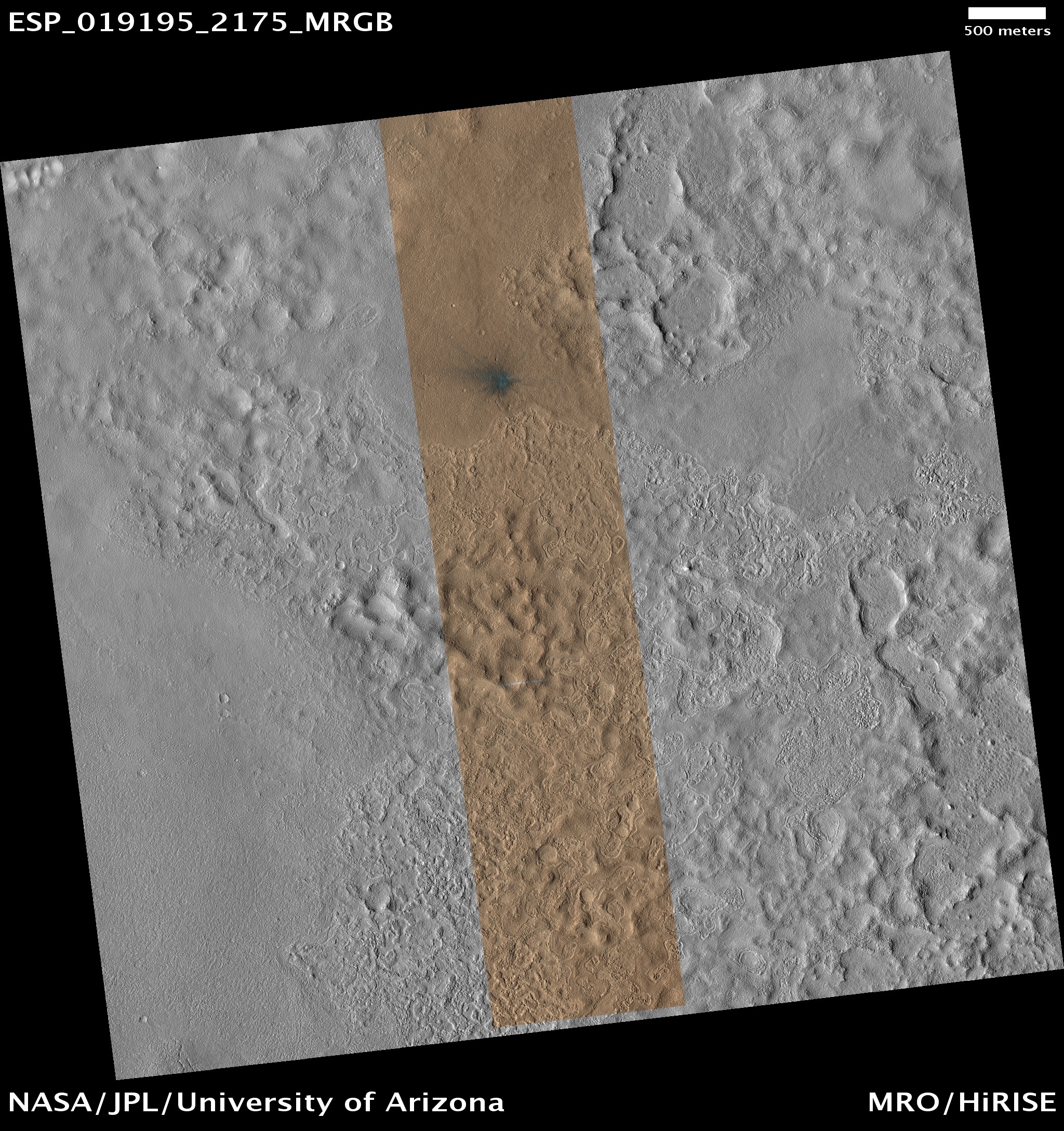
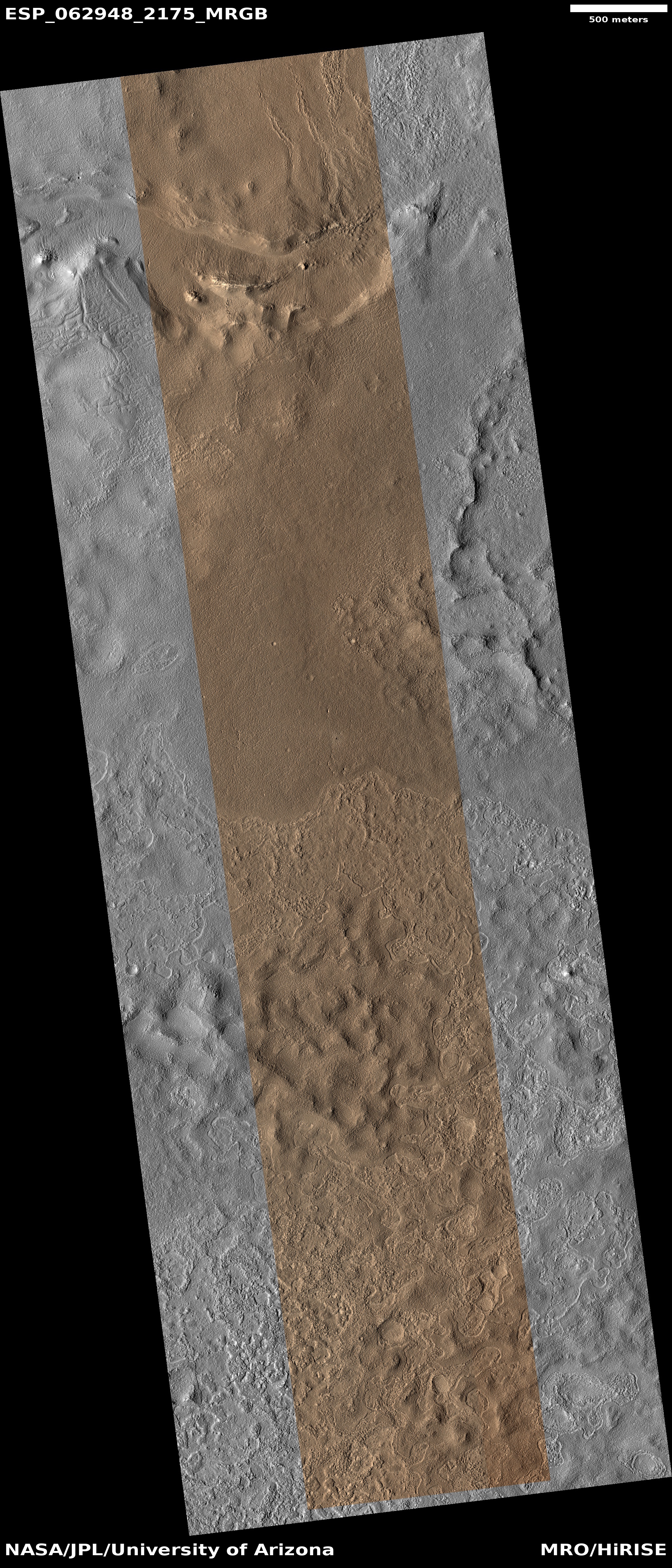
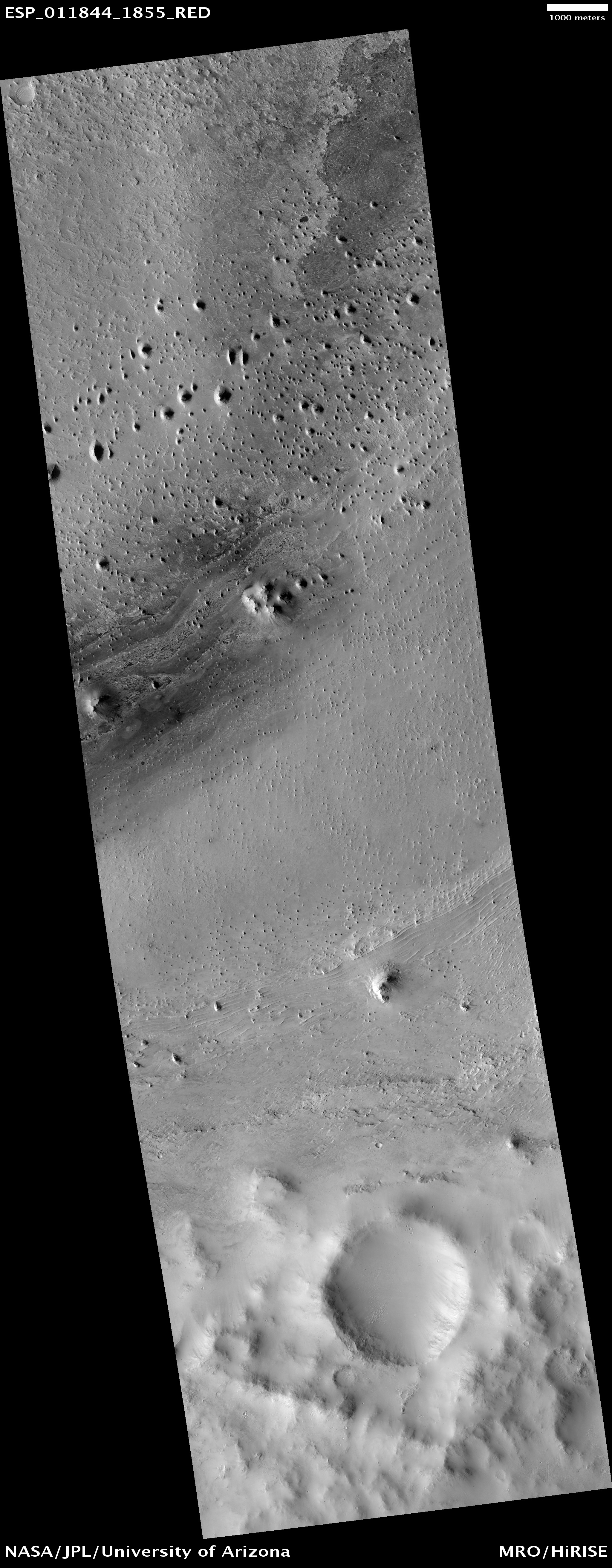
Cool image time! The image to the right, rotated, cropped, and reduced to post here, was taken by the high resolution camera on Mars Reconnaissance Orbiter (MRO) on December 15, 2020, and was actually a follow-up observation from an earlier image taken by the camera on Europe’s Trace Gas Orbiter (TGO), according to Dr. Livio Tornabene of the University of Western Ontario. As he explained in an email:

The team is rather polarized with their verdict on what exactly the feature is… while at first glance it appears to be a lava flow, it very well could be that these deposits eroded to yield this flow/lobate like appearance and isn’t lava at all. So as someone that is both involved with [TGO] and [MRO], I noticed that the lobate feature causing quite the debate had no coverage from [MRO].

It appears that some scientists think that instead of lava, this is a mud flow. Research presented [pdf] during the 2019 Lunar & Planetary Conference in Texas found evidence that mud could flow like lava under the right conditions.

At this point neither Tornabene nor anyone working on the TGO team have yet analyzed this new MRO image to see if they can answer this question. That this feature is located in a region just to the southeast of Marineris Valles where there is evidence both of volcanic activity and sedimentary deposition, makes answering the question even more challenging.

The data from TGO indicated [pdf] that the plateau was about 30 to 65 feet thick. Based on crater counts the age is thought to be between 1.6 to 1.9 billion years old.

What struck me about the plateau is that though it really does look like a flow, it also appears remarkably flat and smooth. Even more puzzling is that, according to the TGO paper, the plateau slopes downhill very gently (a 1% grade) to the south, not to the north as suggested by the shape of the flow. Maybe later geological events tilted the entire feature after it solidified, thus changing the grade?

Meanwhile that channel near the bottom of the image crosses through the grade and the flow, as if it was cut after the flow was placed. In other words, the flow and channel were formed separately, at different times.

Ah, the mysteries of planetary geology. If only we could just go there with a geologist’s hammer. These questions would then be so much more simple to answer.
2 comments

Changing Mars

The maculae splotch dubbed Maui
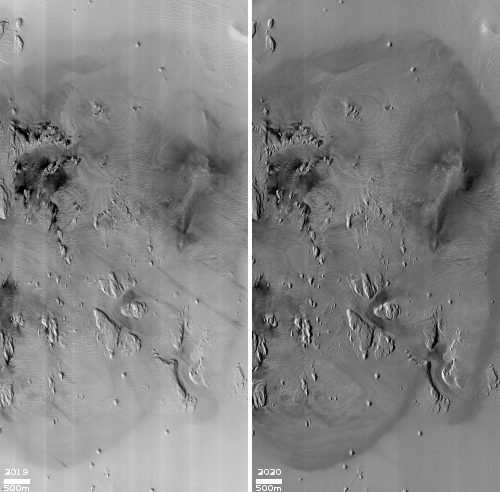
For the full images click here (2019) and here (2020).

While Mars appears to be a dead planet, with no clear evidence of life so far discovered, the planet is hardly inactive. Things are changing there continuously, even if it happens at a slower pace than here on Earth.

To the right are two images, rotated, cropped, and reduced to post here, taken by the high resolution camera of Mars Reconnaissance Orbiter. The first was on January 19, 2019, shortly after the end of the global dust storm that engulfed Mars during that Martian year. The second was taken on February 14, 2020, half a Martian year later. Both show one of a string of dark splotches located on the western flanks of the giant volcano Olympus Mons. Scientists call these splotches maculae, and because of their superficial resemblance to the islands of Hawaii, have given them names matching those islands. This particular patch is dubbed Maui. Below is a map showing all the splotches and their position relative to Olympus Mons, taken from a 2019 presentation [pdf].
» Read more

1 comment

Skiing dry ice boulders on Mars

Dune slope, with grooves, in Russell Crater
Click for full image.

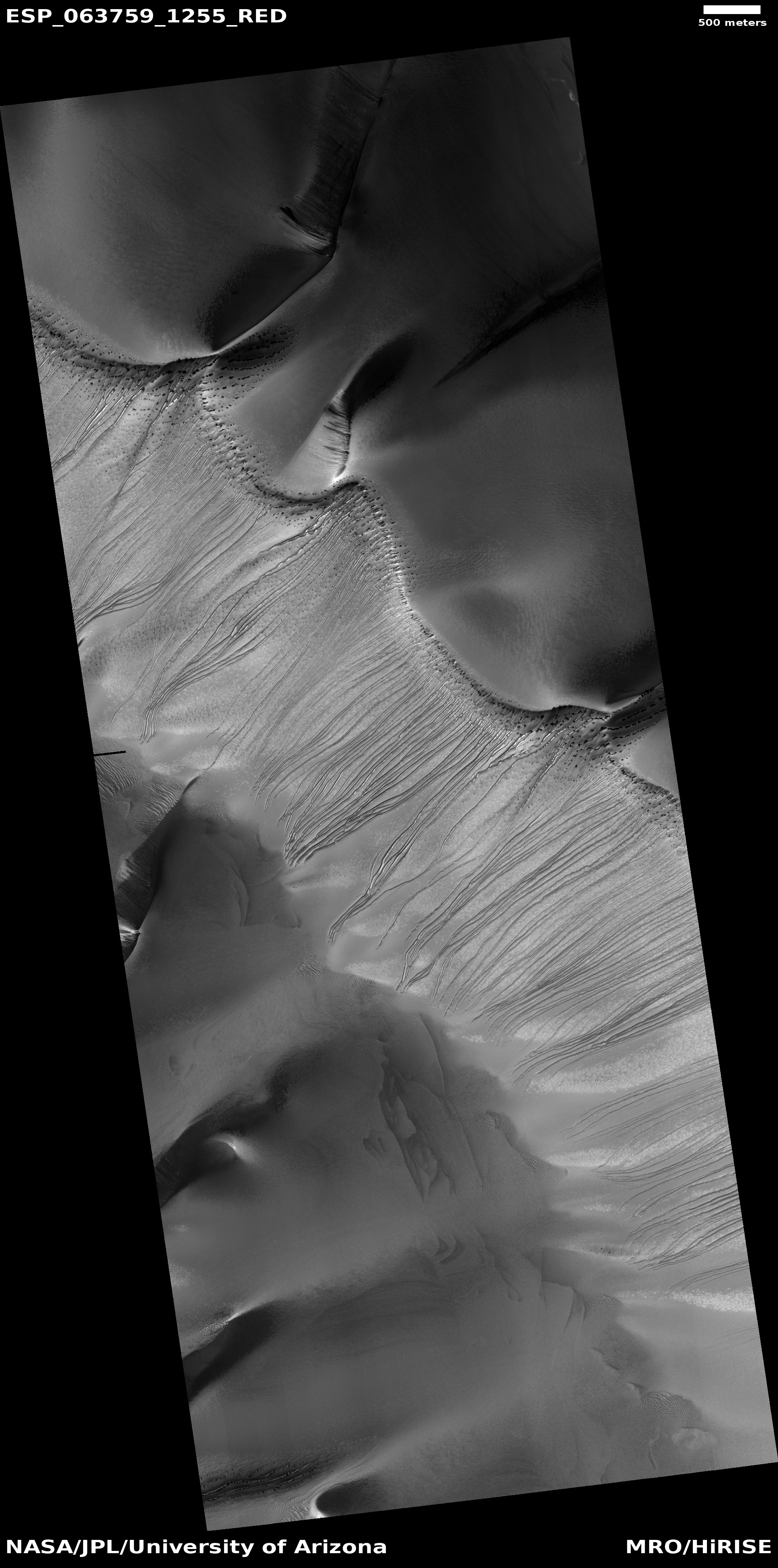
Cool image and video time! The image to the right, cropped and reduced to post here, shows something that when I spotted it in reviewing the newest image download from the high resolution camera on Mars Reconnaissance Orbiter (MRO), I found it very baffling. The photo was taken on March 3, 2020, and shows an incredible number of linear groves on the slope of a large dune inside Russell Crater, located in the Martian southern highlands at about 54 degrees south latitude.

If these were created by boulders we should see them at the bottom of each groove. Instead, the grooves generally seem to peter out as if the boulder rolling down the slope had vanished. Making this even more unlikely is that the top of the slope simply does not have sufficient boulders to make all these groves.

The image was requested by Dr. Candice Hansen of the Planetary Science Institute in Tucson, Arizona, who when I emailed her in bafflement she responded like so:
» Read more

3 comments

Enigmas on Mars

Enigmas on Mars
Click for full image.

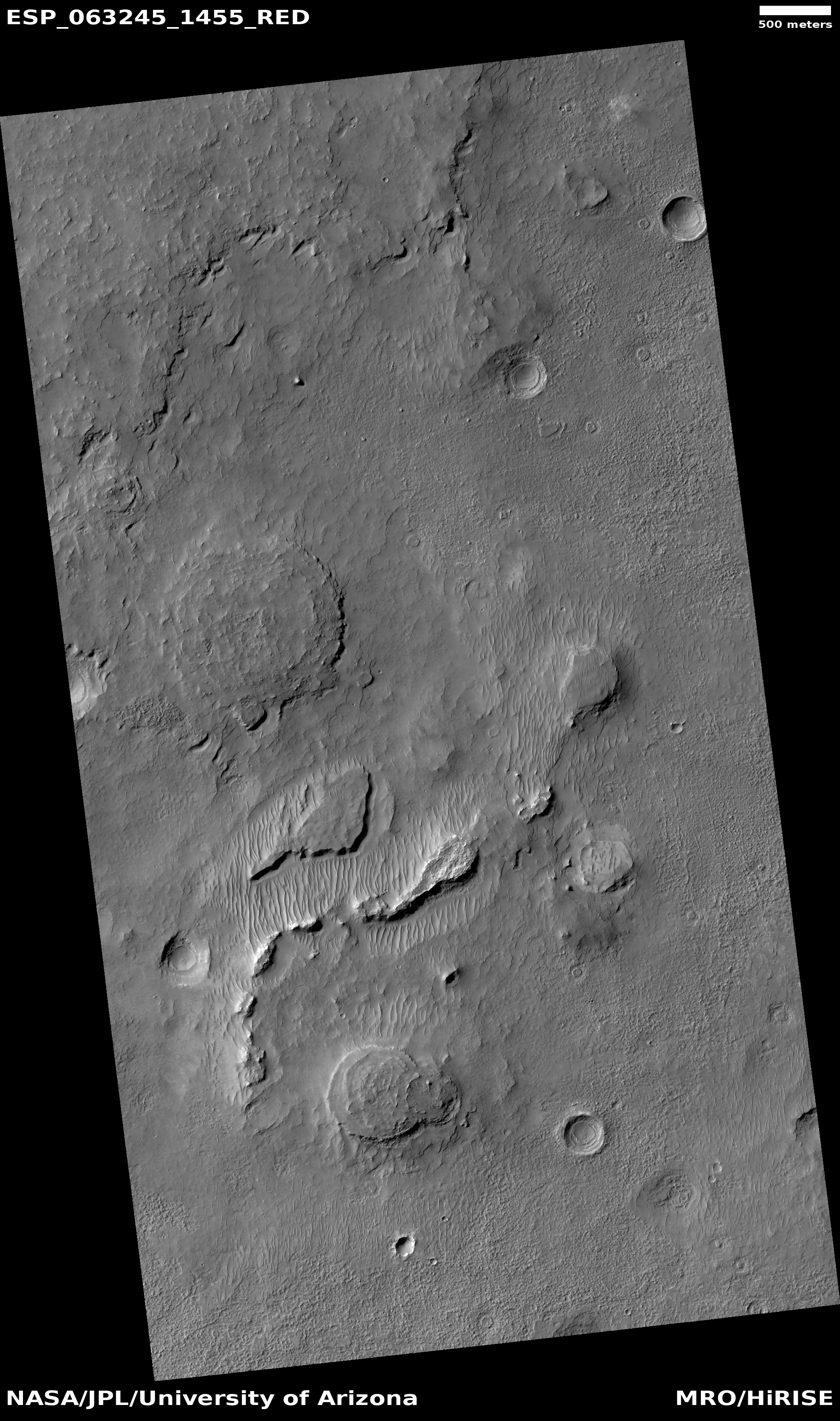
Cool image time! The photo on the right, cropped and reduced to post here, is a perfect example of the difficulty of explaining the alien landscapes on Mars, based on orbital imagery. It was taken by the high resolution camera of Mars Reconnaissance Orbiter (MRO) on January 23, 2020.

In this one image alone we have the following strange features, all within an area about 8 by 11 miles in size:

  • Several small very obvious pedestal craters (near the top right), some located inside depressions. Pedestal craters are created because the surrounding terrain eroded away around them. Since these are pedestals, however, why are they also inside depressions?
  • Two large circular mesas that appear to vaguely have terraced erosion. These might also be pedestal craters, but maybe not. They also sit much higher than the pedestal craters above. Either way, the mesas remained while the terrain around them eroded away.
  • Several normal craters with a series of circular features within each. At this latitude, 34 degrees south, it is possible these craters are filled with buried ice, what scientists call concentric crater filled glaciers.
  • A light-colored string of ridges aligned to almost look like a kite with tail. The light color says this ridge is not made up of the same material as the circular mesas and pedestal craters, but it too was not eroded away.
  • A number of small bean-shaped depressions (just south of the biggest circular mesa and near the top left). Don’t ask me what caused them. I have no idea.

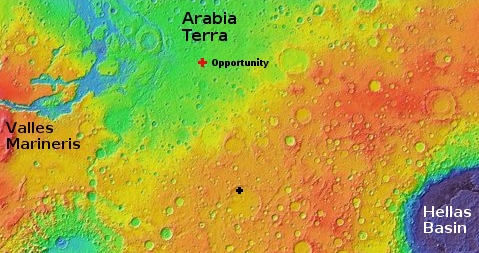
Overview map

The spot is located in the Martian southern cratered highlands, as shown by the blue cross in the overview map to the right. Complicating its geological history is that it sits inside a very gigantic very old and degraded crater, with numerous newer smaller impacts overlaid on top. Any explanation needs to include these impacts, and the ejecta from them.

If you click on the image and study the full resolution photograph, you can find even more enigmatic features. For most there is a reasonable geological theory. Putting them all in one place and somehow getting all those different explanations to fit together however is far more difficult.

2 comments

It ain’t simple keeping a camera functioning properly in orbit around Mars

ADC settings test on MRO
Click for full image.

In doing my normal exploration through the monthly download of new images from the high resolution camera on Mars Reconnaissance Orbiter (MRO), the last to occur near the end of February, I came across a slew of 49 images, each labeled as an “ADC Settings Test,” each covering a completely different location with no obvious single object of study, almost as if they were taken in a wildly random manner.

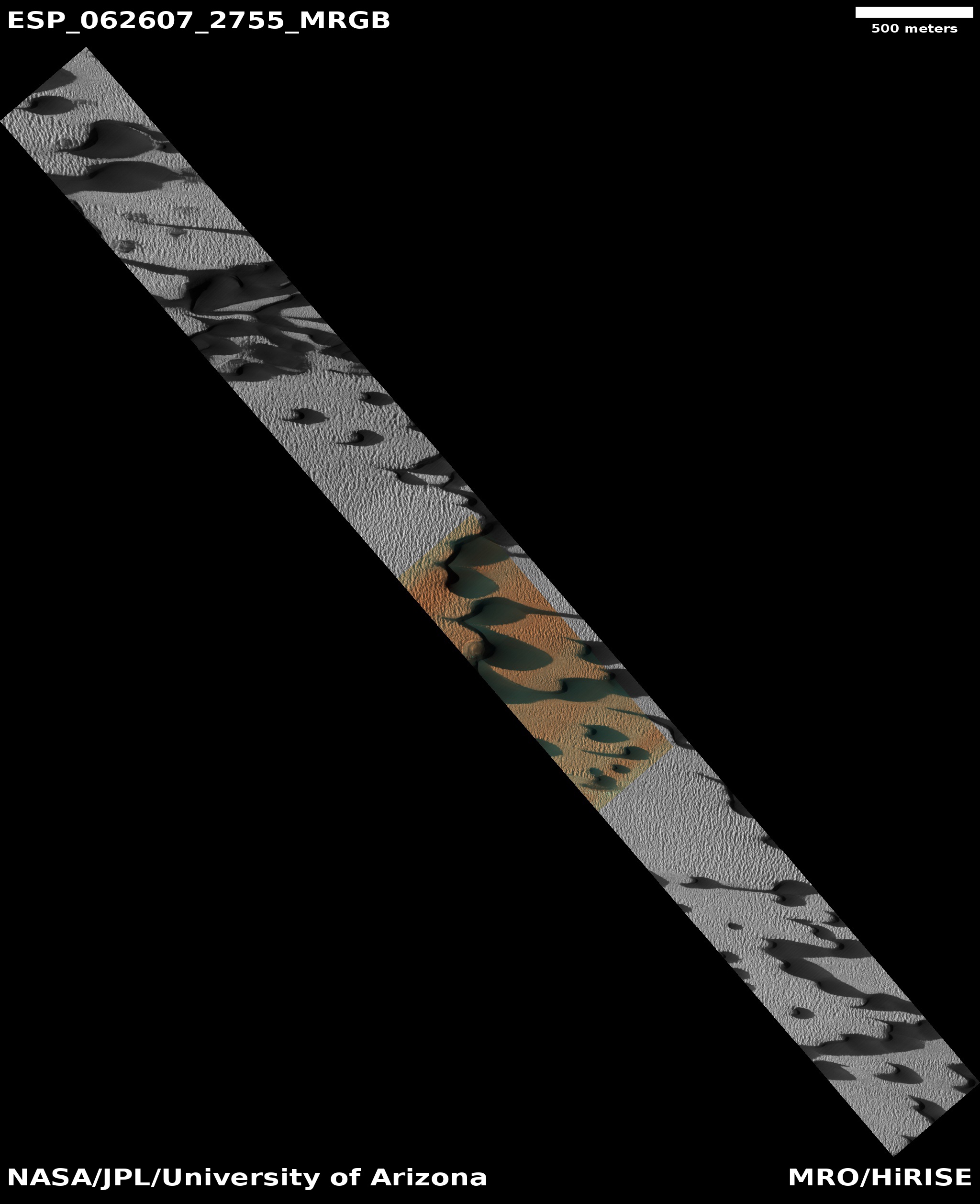
The image to the right, cropped and reduced to post here, is a typical example. It shows the mega dunes located near the end of the canyon Chasma Boreale that cuts a giant slash into the Martian north polar ice cap, almost cutting off one third of the icecap.

The black areas are shadows, long because being at the high latitude of 84 degrees the Sun never gets very high in the sky, even though this image was taken just before mid-summer, when the Sun was at its highest.

I was puzzled why these images were being taken, and contacted Ari Espinoza, the media rep for the high resolution camera, to ask if he could put me in touch with a scientist who could provide an explanation. He in turn suggested I contact Shane Byrne of the Lunar and Planetary Lab University of Arizona, who coincidentally I had already spoken with several times before in connection with the annual summer avalanche season at the Martian north pole.

Dr. Byrne first suggested I read this abstract [pdf], written for the 2018 Lunar and Planetary Science conference by the camera’s science team. In it they outline two issues with the camera, one blurred images and the second an increasing number of bad pixels occurring in images over time.

The first problem has since been solved. To preserve battery life — another long term problem that they have to deal with — they had adjusted the orbiter’s orbit slightly to get more sunlight and stopped warming the camera during the night periods. “That had the unfortunate effect of changing the camera’s focus,” explained Byrne. “Since we understand that now, we do warm-ups before taking the images and that fixed the blurring problem.”

The other problem however remains, and these ADC test images are an effort to fix it.
» Read more

6 comments

In the midst of Mars’ volcano country

lava channel
Click for full image.

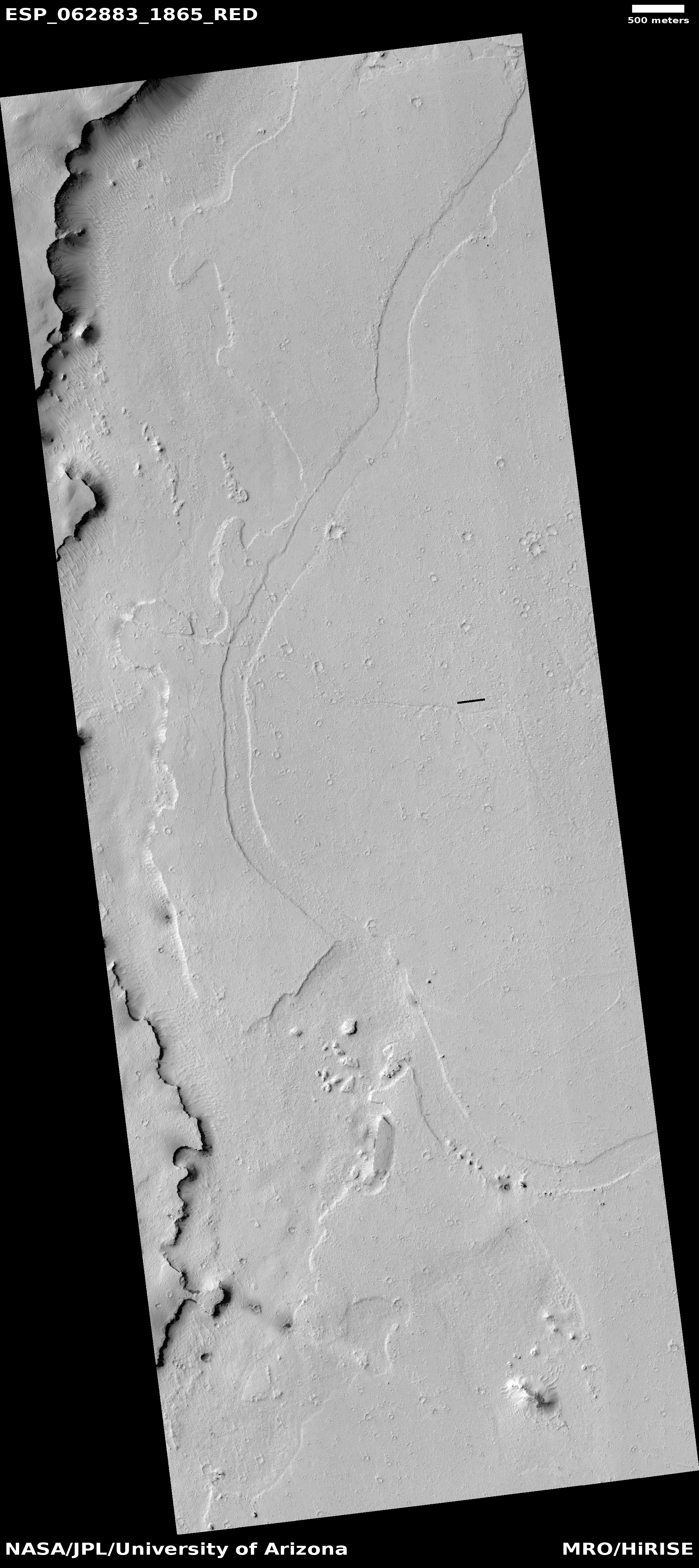
Cool image time! While the rest of the world is entirely focused on panic and disease, I am going to go on with my life. The photo to the right, rotated, cropped, and reduced to post here, was taken by the high resolution camera on Mars Reconnaissance Orbiter (MRO) on December 26, 2019. I suspected this channel was lava, and when I asked Colin Dundas of the U.S. Geological Survey’s Astrogeology Science Center in Arizona, he confirmed my suspicion.

Yes, that surface appears to be lava–it is part of the Elysium plains, which have many geologically-young lava flows. It’s likely that the channel is a lava channel, and the surrounding plains may be from an earlier stage of the same eruption.

The entire surface of the channel and the surrounding plains appear very fresh, mostly because of their smoothness and lack of many craters. You can also see what looks like a recent impact (the small dark splotch near the left edge about two-thirds from the top).

The fresh and smooth look of Elysium Planitia generally has led scientists to conclude that much of this region is formed from lava flows, some relatively recently. Thus, this particular lava channel is smack dab in the middle of Mars’ volcano country, quite vast and extensive. The context map below illustrates this.
» Read more

2 comments

Quick fading of a Martian impact crater

Fresh impact crater on Mars, in 2010
Click for full image.

The same impact, four Martian years later.
Click for full image.

Cool image time! Though it seems that no one is really interested in anything but the Wuhan virus and the attempt by our corrupt politicians to use it to gain power, I think that life requires more from us than politics and panic. Thus, I am going to keep posting pure science and cool images.

The two photos to the right were taken by the high resolution camera on Mars Reconnaissance Orbiter (MRO) almost ten years apart. They were both posted as captioned images, the first in 2010, the second on March 19, 2020 to illustrate the remarkable fading of a fresh impact’s dark ejecta, in only about four Martian years.

The March 19, 2020 captioned image included an animation to illustrate the change. I prefer putting the two images side-by-side. Either way, the change is striking. As planetary scientist Alfred McEwen noted in his caption, “the dark material has faded into the background, while the new 6.3-meter diameter crater persists.”

Wind and dust storms probably acted to wipe out the dark material, but the process did not take that long, and last year’s global dust storm was not a major factor, since much of the dark material was already gone in this July 2012 image.

The crater itself is located in Arcadia Planitia, just west of the Erebus Mountains, the very region in the northern lowlands that SpaceX has made its primary candidate landing site for its Starship rocket, partly because the terrain is flat which makes landing easy, and partly because there is amply evidence that these lowlands have lots of ice just below the surface. And the full image for the 2019 photo reinforces this conclusion. Much of the rougher ground south of the impact appears to be the partially sublimated surface of an ice block.

So, while this region will provide an easy smooth landing site and plenty of water for the first human arrivals, those humans will also have to contend with a planet without a thick atmosphere to protect them from most meteorites. Rare as these events are, they happen more often because of Mars’ location closer to the asteroid belt, and they hit the surface far more frequently.

1 comment

Mars: Volcanic, Glacial, or Fluvial?

Sinuous ridge on Mars
Click for full image.

Cool image time! The photograph on the right, rotated, cropped, and reduced to post here, was taken by the high resolution camera on Mars Reconnaissance Orbiter (MRO) on September 30, 2019. It shows what the image title dubs a “sinuous ridge” in a region called Tempe Terra.

What caused it? At first glance the meandering nature of the ridge suggests it was originally a riverbed, formed by flowing water. Eventually the water dried up, and because that riverbed was made of harder material than the surrounding terrain, long term erosion caused that surrounding terrain to wear away, leaving a raised ridge where the river used to be. Scientists have found many such inverted channels on Mars.

Not so fast!
» Read more

0 comments

Martian plateaus and buttes

Martian plateaus and buttes
Click for full image.

Cool image time! Rather than sit in cowering fear, as it appears too many worldwide are doing, I am going to stay calm and carry on. The photo to the right, rotated, cropped, and reduced in resolution to post here, was taken by the high resolution camera on Mars Reconnaissance Orbiter (MRO) on January 20, 2020. It shows a small section of a region dubbed Iani Chaos, a terrain dubbed such by scientists because of its cracked and chaotic nature, flat-topped mesas cut by canyons and fissures.

Chaos terrain is generally found in the transition zones on Mars between its southern highlands and northern lowlands. It was formed over time by erosion processes, either liquid water or ice, that slowly washed out the material along fault-lines, leaving mesas behind. This particular spot in Iani Chaos appears to be late in this process, with the gaps between the buttes wide and many of the mesas worn down into pointy knobs.

The location of Iani Chaos, as shown in the map below, tells us much about its history.
» Read more

1 comment

Layers upon layers upon layers on Mars

Layered mesa on Mars
Click for full image.

Cool image time! Or rather, a bunch of cool images! On February 17, 2020 the science team for the high resolution camera on Mars Reconnaissance Orbiter (MRO) released a very cool captioned photograph of a terraced mesa in a crater just north of Hellas Basin, shown in the image to the right, rotated, cropped, and reduced to post here.

The color strip down the center of this image illustrates how the colors of the different layers indicate the different make-up of each. These distinctions are not obvious in black & white. That array of colors also leads to some very beautiful scenery, as noted by planetary scientist Alfred McEwen in his caption:

Sedimentary layers record a history of Mars’ erosion and deposition by water and wind, and they make great landscapes for future interplanetary parks.

That this terraced mesa is located on the northern edge of Hellas Basin, the basement of Mars, is possibly not surprising. Other similarly terraced mesas like this have been found on the basin’s eastern edge, highlighted in my September 2019 post. The geology here appears to encourage this kind of erosion, where the different sedimentary bedrock layers erode away at different rates, leaving behind terraced mesas.

Terraced layers on Mars however come in other varieties, some of which build up over time instead of getting eroded away.
» Read more

0 comments

Inactive hot springs on Mars?

Inactive hot springs on Mars?
Click for full image.

Overview of Vernal Crater

Cool image time! In prepping my report of the interesting abstracts from Friday of the cancelled 51st annual Lunar & Planetary Science conference (to be posted later today), I found myself reading an abstract [pdf] from the astrobiology session about the possibility of now inactive hot springs on Mars! This was such a cool image and possibility I decided to post it separately, first.

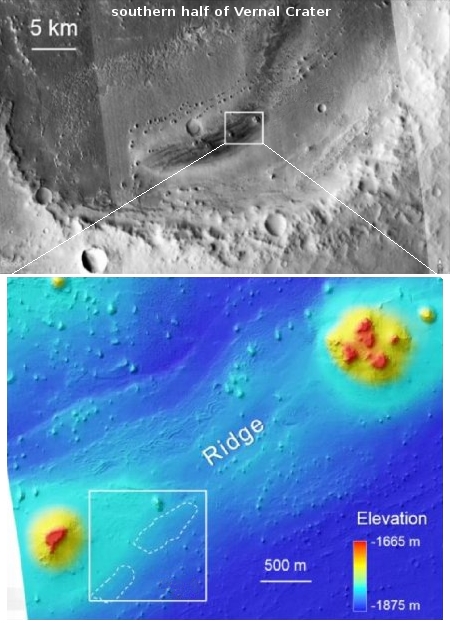
The top image to the right, cropped and expanded to post here, was taken by the high resolution camera on Mars Reconnaissance Orbiter in 2009. It shows some dark elliptical splotches inside the floor of a crater dubbed Vernal. The second image to the right, taken from the abstract, shows the context, with the top image a wide shot showing the southern half of Vernal Crater where these features are located, and the bottom image zooming into the area of interest. The white box focuses on the elliptical features seen in the first image above. From the abstract:

The elliptical features consist of concentric halos of high but varying albedo, where the highest albedo in each occurs in a small central zone that mimics the shape of the larger anomaly. Each feature is also traversed by circumferential fractures. Several similar tonal features extend for 5-6 km, on stratigraphic trend with the elliptical features. Hypotheses considered for the origin of the elliptical features included springs, mud/lava volcanoes, pingos, and effects of aeolian erosion, ice sublimation, or dust, but the springs alternative was most compatible with all the data.

The abstract theorizes that the small ligher central zone is where hot water might have erupted as “focused fluid injection” (like a geyser), spraying the surround area to form the dark ellipses.

I must emphasize that this hypothesis seems to me very tenuous. We do not really have enough data to really conclude these features come from a formerly active hot spring or geyser, though that certainly could be an explanation. In any case, the geology is quite intriguing, and mysterious enough to justify further research and even a future low cost mission, such as small helicopter drone, when many such missions can be launched frequently and cheaply.

0 comments

Secondary impacts in water ice on Mars

Secondary impact in water ice on Mars
Click for full resolution image.

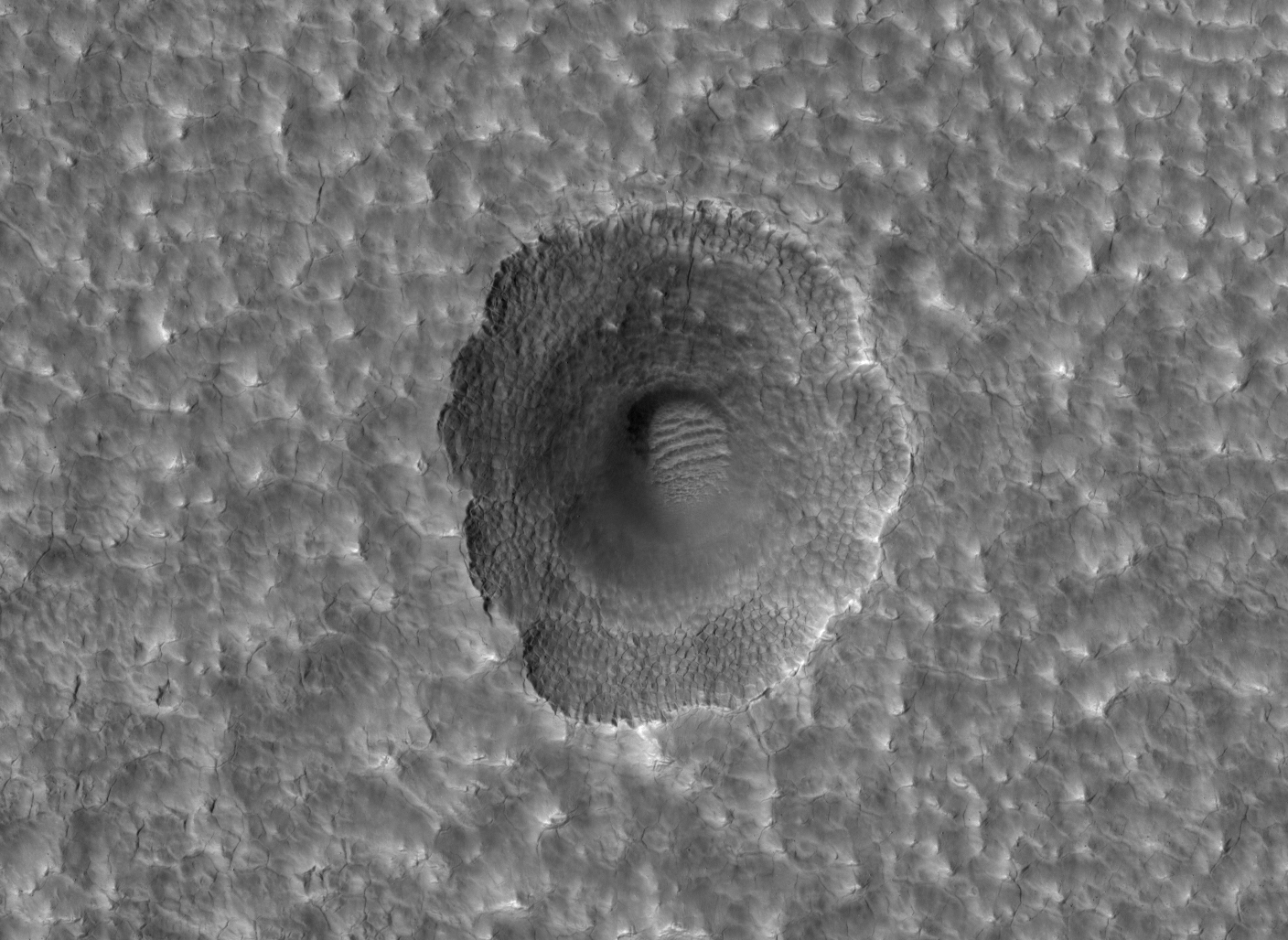
Cool image time! Today the science team for the high resolution camera on Mars Reconnaissance Orbiter (MRO) released a beautiful captioned image of a secondary impact of an object into the icy plains of Utopia Planitia, the northern lowlands northeast of where the rover Perseverance will land in 2021. The image to the right, cropped and reduced to post here, shows one of several secondary craters in the full image. As planetary scientist Alfred McEwen explains in the caption,

One interpretation [for the crater’s unusual appearance] is that the impact crater exposed nearly pure water ice, which then sublimated away where exposed by the slopes of the crater, expanding the crater’s diameter and producing a scalloped appearance. The small polygons are another indicator of shallow ice.

Note the dunes at the bottom of the crater. This has become a trap of wind-blown sand and dust. Note also how this secondary impact gives us a rough idea of the thickness of this ice, based on the area sublimated away.

There is a lot of relatively accessible ice in those northern lowlands, which is why SpaceX likes them for its possible landing site for Starship. That candidate site is in Arcadia Planitia, on the other side of Mars, but it is still in these same northern lowlands, where scientists have found lots of evidence of buried ice.

0 comments
1 71 72 73 74 75 90